- Product Description Description
- Table of Contents TOC
- List of Table & Figure LOT
- Get Free Sample PDF Sample PDF
Market Size, 2025
$17.52 BnMarket Estimate, 2026
$18.75 BnMarket Forecast, 2034
$32.22 BnCAGR, 2026–2034
7%Global Fruit Powders Market Size
The global fruit powders market size was calculated to be USD 17.52 billion in 2025 and is anticipated to be worth USD 32.22 billion by 2034 from USD 18.75 billion in 2026, growing at a CAGR of 7% during the forecast period.

Fruit powders represent a highly refined category of dehydrated agricultural commodities produced through advanced drying methodologies that preserve essential phytonutrients while eliminating moisture content. These powdered derivatives are generated by converting whole fruits or fruit extracts into fine granular forms using spray drying, freeze drying, or drum drying techniques. The transformation process significantly extends product longevity while maintaining bioactive compounds such as polyphenols, dietary fibers, and vitamin complexes. According to the Food and Agriculture Organization, approximately 14% of global fruit production experiences after harvest losses due to inadequate preservation infrastructure and perishability constraints. This substantial volume of agricultural waste directly incentivizes the adoption of dehydration technologies that convert surplus harvests into stable powder formats. According to the World Health Organization, the global burden of non-communicable diseases has continued to rise, prompting consumers to seek nutrient-rich food alternatives with extended storage longevity. Modern food manufacturing facilities utilize controlled atmospheric drying chambers that reduce water activity below 0.3, effectively inhibiting microbial proliferation and enzymatic degradation. The resulting powders serve as versatile ingredients in beverage formulation, dietary supplementation, confectionery production, and functional food development. Regulatory frameworks across multiple jurisdictions mandate strict moisture threshold compliance to ensure microbiological safety during international trade. Industrial-scale operations now integrate real-time moisture monitoring systems that guarantee consistent particle distribution and colour retention across diverse fruit varieties.
MARKET DRIVERS
Accelerated Consumer Preference for Transparent Ingredient Sourcing and Natural Formulations
Modern shoppers exhibit an unwavering commitment to purchasing food products that contain recognizable and minimally processed components, which is a key factor propelling the growth of the global fruit powders market. Fruit powders align precisely with this consumer paradigm because they serve as natural flavoring agents and natural colorants without requiring synthetic additives. As per the International Food Information Council, 68% of consumers actively examine ingredient lists before purchasing packaged goods, demonstrating a decisive shift toward transparent food manufacturing practices. Food developers increasingly replace artificial dyes and chemical preservatives with extracts obtained directly from fruit sources that deliver authentic taste profiles while maintaining regulatory compliance. For instance, natural fruit extracts offer significantly higher digestive compatibility compared to synthetic alternatives, further reinforcing formulation adjustments across major beverage and snack manufacturers. According to the retail audits, 54% of new product launches in the nutrition category now feature fruit powder ingredients as primary functional components. This behavior shapes the transition compels ingredient suppliers to scale production capacities and optimize extraction yields. Manufacturers who successfully integrate these transparent ingredients capture premium pricing tiers and secure extended supply contracts with multinational food corporations. The convergence of health consciousness and ingredient transparency establishes fruit powders as indispensable assets within contemporary product development pipelines.
Rapid Proliferation of Plant-Centered Beverage Innovation and Functional Hydration Solutions
The beverage industry undergoes continuous transformation as manufacturers prioritize botanical extracts and formulations rich in nutrients that cater to active lifestyles, which further contributes to the expansion of the global market. Fruit powders function as highly soluble flavor carriers and natural sweetening agents within smoothie blends, electrolyte waters, and botanical infusions. According to the Beverage Marketing Corporation, plant-centered beverage consumption increased by 28% over the previous three years, reflecting sustained consumer migration away from traditional carbonated soft drinks. Production facilities leverage fruit powders to achieve consistent taste uniformity across large batch volumes while eliminating the logistical constraints associated with fresh fruit transportation. Refrigerated storage limitations frequently result in 15% spoilage during transit, a challenge entirely circumvented through dehydrated powder utilization. According to the United States Department of Agriculture, powdered fruit concentrates retain a high level of original antioxidant capacity after controlled thermal processing, making them ideal for functional beverage fortification. Beverage formulators integrate these powdered matrices to enhance mouthfeel and stabilize emulsion structures without introducing artificial stabilizers. This technological alignment between dehydration science and beverage engineering drives sustained procurement volumes. Companies investing in powder blending technologies secure competitive advantages by delivering stable products that meet rigorous nutritional benchmarks while maintaining sensory appeal.
MARKET RESTRAINTS
Substantial Energy Requirements During Advanced Thermal and Freeze Drying Operations
The conversion of fresh fruit into powdered formats demands intensive energy allocation across multiple processing stages, which creates significant operational cost burdens and hampers the growth of the global market. Industrial dehydration relies heavily on continuous heat application or vacuum-based moisture extraction, both of which require substantial electrical and thermal inputs. According to the International Energy Agency, industrial drying processes account for a notable share of manufacturing energy consumption globally, placing severe financial pressure on medium-scale processing facilities. Freeze-drying methodologies further amplify expenditure by operating compressors at extremely low temperatures for extended durations to preserve delicate phytonutrients. Fluctuating utility prices across major manufacturing regions have increased production overhead during the current fiscal cycle, directly compressing profit margins for powder suppliers. Independent enterprises frequently lack the capital infrastructure required to install energy recovery systems that recycle waste heat from exhaust streams. The European Commission's energy efficiency directives challenge food processing facilities to continually reduce carbon emissions, compelling operators to invest in solar thermal arrays or biomass heating alternatives. These stringent operational expenses constrain market entry for emerging processors and limit pricing competitiveness in highly commoditized ingredient segments. Manufacturers must continuously optimize thermal transfer mechanisms to maintain economic viability while meeting sustainability targets.
Rigorous Food Safety Protocols and Complex International Compliance Frameworks
Fruit powder manufacturers operate within highly scrutinized regulatory environments that impose stringent quality benchmarks and mandatory contamination testing, which further impedes the expansion of the global market. International trade agreements require comprehensive documentation of pesticide residues, heavy metal concentrations, and microbial load thresholds before ingredients cross national boundaries. According to international trade food safety monitoring data, a notable percentage of imported dried fruit shipments fail initial safety screenings due to residual chemical contamination, triggering costly product recalls and shipment rejections. Compliance officers must conduct individual batch laboratory analyses that verify moisture levels below 5% and ensure the complete absence of pathogenic organisms. These mandatory verification procedures increase administrative overhead and delay distribution timelines, particularly for suppliers navigating multiple jurisdictional requirements simultaneously. The World Trade Organization sanitary committee continually reviews and implements updated maximum residue limits for agricultural chemicals, compelling processors to upgrade testing equipment and hire specialized quality control personnel. Independent production facilities frequently encounter disproportionate compliance costs that represent a visible share of total operational expenditure. This regulatory complexity restricts market fluidity and forces ingredient suppliers to consolidate production volumes to achieve economies of scale while maintaining continuous audit readiness across international export corridors.
MARKET OPPORTUNITIES
Strategic Utilization of Imperfect Produce and Processing Residuals for Value Addition
The agricultural sector generates substantial volumes of cosmetically imperfect fruit that remain nutritionally intact but face commercial rejection from traditional fresh produce channels, which is a promising opportunity for the global market. Powder production facilities actively procure these surplus harvests at significantly reduced acquisition costs, transforming economic waste into premium functional ingredients. According to the Upcycled Food Association, commercial repurposing of agricultural byproducts has expanded by 32% as manufacturers adopt circular supply chain models that prioritize resource efficiency. Juice extraction operations frequently discard pulp and peels containing concentrated dietary fiber and flavonoid compounds, which dehydration specialists now integrate into composite powder blends. This valorization approach reduces raw material acquisition expenses by approximately 25% while simultaneously lowering landfill disposal fees. Municipal waste management authorities report that food processing industries continue to divert significant volumes of organic waste from incineration streams through targeted upcycling partnerships. Regulatory incentives across multiple jurisdictions now offer tax credits for facilities that demonstrate verified waste reduction metrics. Ingredient formulators capitalize on these upcycled matrices to develop affordable nutritional supplements that appeal to environmentally conscious consumer demographics. The integration of circular economy principles into powder manufacturing establishes a scalable revenue model that harmonizes ecological responsibility with commercial profitability.
Implementation of Automated Monitoring Systems and Predictive Quality Optimization
Modern dehydration facilities increasingly deploy intelligent sensor networks and machine learning algorithms to regulate temperature gradients, airflow velocity, and moisture extraction rates in real time, which is another significant opportunity for the global market. These computational frameworks continuously analyze production parameters and automatically adjust operational settings to prevent thermal degradation of thermally delicate nutrients. According to the World Economic Forum, predictive maintenance technologies reduce unplanned downtime by 35% in automated food production environments, significantly enhancing equipment utilization rates. Machine learning-powered quality assurance modules scan particle size distribution and color uniformity at production speeds exceeding 500 kilograms per hour, ensuring consistent batch integrity without manual intervention. This technological integration minimizes raw material wastage by 19% while accelerating throughput capacities across continuous processing lines. Research institutions demonstrate that adaptive drying protocols powered by computational modeling preserve a high percentage of native vitamin C content compared to traditional fixed temperature methods. Equipment manufacturers now embed edge computing capabilities directly into drying chamber control panels, enabling remote performance diagnostics and rapid calibration adjustments. Powder producers who adopt these intelligent automation architectures achieve superior yield consistency and reduce energy consumption per unit output. The digital transformation of dehydration infrastructure establishes a competitive foundation for scalable ingredient manufacturing.
MARKET CHALLENGES
Unpredictable Agricultural Yield Fluctuations and Climate-Related Crop Instability
Fruit powder manufacturers depend heavily on consistent agricultural harvests that maintain precise sugar and acid ratios alongside uniform moisture profiles, which is a major challenge to the expansion of the global market. Prolonged drought periods, unseasonal frost events, and erratic precipitation patterns frequently disrupt crop maturation cycles, creating unpredictable raw material availability. According to the Intergovernmental Panel on Climate Change, extreme weather events have increasingly impacted global fruit harvest stability over the past decade, forcing procurement teams to source from alternative geographical regions at inflated pricing. Supply chain planners encounter severe difficulties in forecasting input costs when primary growing zones experience consecutive yield contractions. Orchards experiencing drought frequently produce smaller fruit volumes with concentrated phenolic compounds that alter final powder solubility characteristics and require formulation adjustments. Commodity trading indexes indicate that agricultural input prices experience substantial volatility annually, directly impacting production budgeting and extended contract negotiations. Storage infrastructure limitations in tropical growing regions exacerbate spoilage rates when delayed transportation prevents timely processing. Manufacturers must maintain strategic inventory reserves to buffer against seasonal shortages, which ties up working capital and increases warehousing expenditures. This environmental unpredictability compels processors to diversify supplier networks while continuously monitoring meteorological forecasts to mitigate procurement disruptions.
Oxidative Deterioration of Flavor Compounds and Moisture Reabsorption During Storage
Powdered fruit derivatives exhibit a high ratio of exposed surface to internal volume that increases exposure to atmospheric oxygen and ambient humidity during distribution and retail display, which further challenges the global market expansion. These physical characteristics accelerate lipid oxidation and pigment degradation, resulting in noticeable flavor deviations and color fading that diminish consumer acceptance. According to food technology studies, improper atmospheric control during storage accelerates lipid oxidation significantly, severely compromising aromatic integrity within packaged ingredient matrices. Food scientists must implement advanced barrier packaging technologies that incorporate oxygen scavengers and desiccant inserts to preserve organoleptic properties throughout extended distribution cycles. Premium-grade multilayer laminated pouches increase packaging expenditures by approximately 22% compared to conventional polyethylene alternatives, directly impacting product profitability. Retail environment temperature fluctuations frequently cause condensation within sealed containers, prompting powder agglomeration and reducing solubility performance during final consumer application. Manufacturers continuously reformulate blends with natural flow-enhancing agents to maintain unobstructed flow characteristics without altering nutritional profiles. Shelf life validation requires rigorous accelerated aging protocols that consume substantial laboratory resources and delay commercial launch timelines. Preserving sensory consistency across diverse climatic transport corridors remains a persistent technical hurdle that demands continuous packaging innovation and environmental control investments.
REPORT COVERAGE
| REPORT METRIC | DETAILS |
| Market Size Available | 2025 to 2034 |
| Base Year | 2025 |
| Forecast Period | 2026 to 2034 |
| CAGR | 7% |
| Segments Covered | By Fruit Type, Application, & Region |
| Various Analyses Covered | Global, Regional, and Country-Level Analysis; Segment-Level Analysis; DROC; PESTLE Analysis; Porter’s Five Forces Analysis; Competitive Landscape; Analyst Overview of Investment Opportunities |
| Regions Covered | North America, Europe, APAC, Latin America, Middle East & Africa |
| Market Leaders Profiled | Nutradry, DMH Ingredients, Kanegrade, Paradise Fruits, Aarkay Food Products, FutureCeuticals, NutriBotanica, La Herbal, Saipro Biotech Pvt. Ltd, Batory Foods, and International Flavors & Fragrances Inc |
SEGMENTAL ANALYSIS
By Fruit Type Insights
The pear fruit powder segment dominated the market by holding 36.3% of the global market share in 2025. The growth of the pear segment in the global market can be credited to the fruit's exceptional functional properties, including high soluble fiber content and mild natural sweetness that integrates seamlessly across beverage and bakery formulations. According to the Food and Agriculture Organization, global pear production exceeded 25.2 million metric tons in recent harvest cycles, with China contributing over 68% of total output. This abundant supply chain ensures consistent raw material availability for powder manufacturers at competitive acquisition costs. Pear powder delivers notable bioactive compounds such as potassium and magnesium, which support cardiovascular health claims that resonate with wellness-oriented consumers. According to clinical studies published in nutrition repositories, regular consumption of pear-derived products may assist in maintaining healthy blood glucose levels, which enhances its appeal for functional food developers. The powder's neutral flavor profile allows formulators to use it as a clean-label sweetener without overpowering delicate flavor systems in infant nutrition or medical nutrition products. Industrial adoption accelerates because pear pomace from juice processing can be valorized into powder formats, reducing waste disposal costs while generating additional revenue streams for agricultural cooperatives.
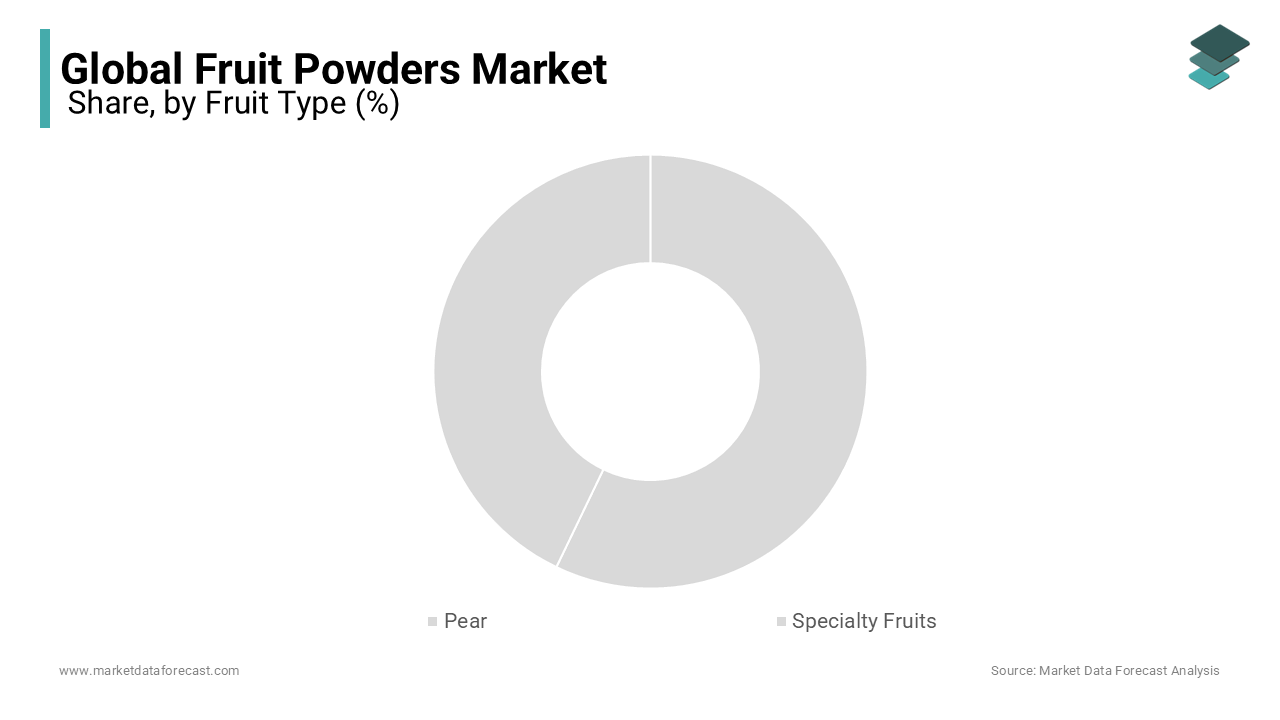
On the other hand, the specialty fruits segment is gaining traction and is estimated to register a CAGR of 13.3% during the forecast period in the global market, owing to the intensifying consumer demand for nutrient-dense superfood ingredients that deliver concentrated antioxidant and anti-inflammatory benefits. According to the International Food Information Council, over 71% of health-conscious shoppers actively seek products featuring exotic fruit derivatives such as acai, maqui berry, or camu camu. These specialty varieties contain significantly higher levels of anthocyanins and polyphenols compared to conventional fruits, which supports premium positioning in functional beverage and supplement applications. According to the Global Wellness Institute, the functional food sector continues to witness substantial expansion driven by consumer willingness to pay premium prices for ingredients with scientifically backed health narratives. Specialty fruit powders enable manufacturers to differentiate products through unique color profiles and flavor complexities that cannot be replicated with synthetic alternatives. Supply chain innovations, including freeze drying technology, preservation, and direct trade partnerships with indigenous growers, ensure consistent quality while supporting ethical sourcing commitments. The segment benefits from regulatory advancements such as the European Union's Novel Foods framework, which has streamlined approval pathways for non-traditional fruit ingredients, enabling faster commercialization cycles for innovative product launches.
By Application Insights
The beverages segment led the market by accounting for 28.4% of the global market share in 2025. This dominance reflects the critical role fruit powders play in modern beverage innovation, where they deliver natural flavor, color, and functional benefits without artificial additives. According to the Beverage Marketing Corporation, functional beverage sales increased by 24% year over year, with fruit powder fortified drinks representing the fastest-growing subcategory. Manufacturers leverage powders from acerola cherry for natural vitamin C fortification or beetroot for vibrant coloration in plant-based protein shakes and electrolyte waters. According to global beverage industry research, a substantial share of new beverage launches featured fruit powder ingredients as primary differentiators. The solubility and stability of modern fruit powders enable seamless integration into ready-to-drink formats without sedimentation or flavor degradation during shelf life. Beverage formulators value the ability to achieve consistent taste profiles across large production batches while reducing dependency on seasonal fresh fruit availability. The rise of direct-to-consumer subscription models for personalized hydration solutions has further amplified demand for single-origin fruit powders that support targeted wellness narratives. Retail audits indicate that beverages featuring recognizable fruit powder ingredients command price premiums of 15% to 22% compared to conventional alternatives, reinforcing the commercial viability of this application segment.
On the other hand, the pharmaceuticals application segment is estimated to register a CAGR of 14.4% during the forecast period in the global market, owing to the integration of fruit-derived bioactives into dietary supplements, nutraceuticals, and over-the-counter therapeutic formulations. According to European health product manufacturer associations, supplement consumption increased by 31% across industrialized markets, with fruit powder-based products representing a significant portion of new launches. Ingredients such as elderberry powder for immune support or pomegranate extract for cardiovascular wellness are increasingly incorporated into capsule, tablet, and effervescent formats. According to the World Health Organization, chronic disease prevention strategies now emphasize plant-derived compounds, which have elevated fruit powders from mere flavoring agents to active pharmaceutical ingredients. Regulatory developments, including streamlined pathways for traditional herbal medicinal products under European Medicines Agency guidelines, have accelerated commercialization timelines. Pharmaceutical manufacturers value the standardized phytochemical profiles achievable through advanced extraction and drying technologies, which ensure batch-to-batch consistency required for clinical efficacy claims. The convergence of food-grade safety standards with pharmaceutical-grade quality requirements positions fruit powders as versatile ingredients capable of bridging nutritional and therapeutic applications. This dual functionality enables manufacturers to develop products that address both preventive wellness and targeted health support, creating substantial market expansion opportunities.
REGIONAL ANALYSIS
Asia Pacific Fruit Powders Market Analysis
The Asia Pacific region is expected to showcase rapid modernizations in fruit dehydration infrastructure and witness significant increases in value-added nutritional exports over the next few years. According to the Asian Development Bank, food and beverage manufacturing investments in the region increased by 19% annually, driven by rising disposable incomes and urbanization trends. Countries such as India and China are implementing government-backed initiatives to modernize fruit dehydration facilities and reduce post-harvest losses, which currently exceed 30% for perishable produce. According to the Food and Agriculture Organization, the Asia Pacific accounts for over 55% of global tropical fruit production, providing abundant raw materials for powder conversion. The region's strong export orientation enables manufacturers to supply international markets while benefiting from competitive labor and energy costs. Consumer preferences are shifting toward convenient nutrition solutions, which has accelerated the adoption of fruit powders in instant beverages, snack foods, and functional supplements. Retail modernization across Southeast Asia has expanded distribution channels for premium powdered ingredients, while e-commerce platforms enable direct access to health-conscious urban consumers. Regulatory harmonization efforts through ASEAN food safety frameworks are facilitating cross-border trade and encouraging investment in quality certification systems that meet global export standards.

Europe Fruit Powders Market Analysis
The European region is projected to register an increased implementation of circular economy models and experience steady expansion in high-margin nutraceutical applications over the next few years. According to Eurostat, European Union fruit production exceeded 62 million metric tons in recent harvest cycles, with significant volumes diverted to value-added powder formats. The European Commission's Farm to Fork Strategy actively promotes circular economy principles, which incentivize the conversion of fruit processing byproducts into high-value ingredients. According to the European Food Safety Authority, over 78% of European consumers prefer products with recognizable natural ingredients, creating sustained demand for fruit-derived alternatives to synthetic additives. Germany, France, and the United Kingdom serve as innovation hubs where research institutions collaborate with industry to develop advanced drying technologies that preserve bioactive compounds. The region's strong pharmaceutical and nutraceutical sectors provide high-margin applications for standardized fruit powder extracts with documented health benefits. Retailers across Europe increasingly require sustainability certifications for ingredient sourcing, which has encouraged the adoption of traceable supply chains and ethical procurement practices. The mature regulatory environment ensures product safety while providing clear pathways for health claim substantiation that builds consumer trust in fruit powder fortified products.
North America Fruit Powders Market Analysis
The North American region is anticipated to experience high adoption rates of single-origin superfood powders and robust growth in direct-to-consumer wellness channels over the next few years. According to the United States Department of Agriculture, domestic fruit production exceeds 28 million metric tons annually, with substantial volumes processed into powder formats for extended shelf life applications. The United States Food and Drug Administration's Generally Recognized As Safe framework facilitates the rapid commercialization of novel fruit powder ingredients while maintaining rigorous safety standards. According to the International Food Information Council, over 69% of North American consumers actively seek products with added functional benefits, which has accelerated the adoption of fruit powders in supplements, beverages, and snack foods. The region's robust direct-to-consumer e-commerce ecosystem enables agile brands to launch innovative fruit powder formulations with minimal distribution barriers. Investment in food technology research at institutions such as Cornell University and the University of California drives continuous improvement in drying methodologies that enhance nutrient retention and sensory properties. Retail partnerships with major chains ensure wide distribution of fruit powder fortified products, while private label programs create volume opportunities for ingredient suppliers. The convergence of wellness trends and convenience preferences positions North America as a critical market for premium fruit powder innovation and commercialization.
Latin America Fruit Powders Market Analysis
The Latin American region is likely to see continuous increases in export-oriented food processing investments and a rising adoption of automated dehydration tools over the next few years. According to the Inter American Institute for Cooperation on Agriculture, Latin America produces over 40% of the world's tropical fruits, including mangoes, pineapples, and acai berries, which serve as premium raw materials for powder conversion. Countries such as Brazil and Mexico are investing in modern dehydration infrastructure to reduce post-harvest losses and capture additional value from agricultural output. According to the Economic Commission for Latin America and the Caribbean, food and beverage manufacturing investments in the region increased by 14% annually, driven by export opportunities and domestic demand growth. The region's proximity to North American markets enables efficient logistics for fresh fruit powder export,s while trade agreements facilitate market access. Consumer awareness of nutritional benefits is rising, particularly among urban populations, which has accelerated the adoption of fruit powders in functional beverages and snack products. Government initiatives supporting smallholder farmer integration into value chains ensure sustainable sourcing while improving rural livelihoods. The region's competitive labor costs and favorable climate conditions for year-round fruit production create structural advantages for cost-effective powder manufacturing that serves both domestic and international markets.
Middle East and Africa's Fruit Powders Market Analysis
The Middle East and Africa region is expected to accelerate its domestic import substitution initiatives and establish targeted upcycling partnerships to reduce raw crop spoilage over the next few years. According to the African Development Bank, food processing investments in Sub-Saharan Africa increased by 22% annually, driven by government programs to reduce import dependency and add value to agricultural output. Countries such as South Africa and Egypt are developing specialized fruit powder facilities that leverage local production of citrus, dates, and baobab for both domestic consumption and export markets. According to the Food and Agriculture Organization, post-harvest losses for perishable fruits in the region exceed 40%, creating a significant opportunity for dehydration technologies that extend shelf life and reduce waste. The region's strategic location enables efficient distribution to European and Asian markets while trade agreements facilitate market access for value-added agricultural products. Rising disposable incomes in urban centers are driving demand for premium functional ingredients, including fruit powders fortified with vitamins and antioxidants. Investment in cold chain infrastructure and quality certification systems is improving product consistency and meeting international export requirements. The convergence of agricultural development goals and commercial opportunities positions the region for accelerated growth in fruit powder production and consumption.
COMPETITION OVERVIEW
Competition in the fruit powders market features a dynamic interplay between multinational ingredient suppliers and specialized regional processors. The landscape rewards technical expertise in dehydration science coupled with agronomic knowledge and supply chain transparency. Large players leverage scale, integrated solutions, and global distribution networks while smaller firms differentiate through heritage fruits, organic certification, and artisanal production methods. Success requires balancing scientific rigor with commercial agility to respond to evolving consumer preferences for clean label, plant-based, and functional ingredients. Regulatory complexity, particularly regarding health claims and novel food approvals, creates both barriers and opportunities for differentiation. Companies investing in sustainable sourcing, waste valorization, and circular economy principles gain a competitive advantage as environmental considerations increasingly influence purchasing decisions. The convergence of food, beverage,4 and pharmaceutical applications expands the addressable market but demands rigorous quality systems and documentation. Innovation in powder functionality, such as improved solubility, stability, and bioavailability, drives premium positioning. Ultimately, market leadership depends on the ability to translate agricultural raw materials into consistent high-performance ingredients that meet the exacting requirements of modern food formulation while delivering authentic nutritional value.
KEY MARKET PLAYERS
A few major players in the global fruit powders market include
- Nutradry
- DMH Ingredients
- Kanegrade
- Paradise Fruits
- Aarkay Food Products
- FutureCeuticals
- NutriBotanica
- La Herbal
- Saipro Biotech Pvt. Ltd
- Batory Foods
- International Flavors & Fragrances Inc
Top Strategies Used By Key Market Participants
Key market participants employ several strategic approaches to strengthen their competitive position in the fruit powders market. Vertical integration of supply chains ensures control over raw material quality and cost while supporting sustainable sourcing commitments. Investment in advanced drying technologies, including freeze drying and spray drying optimization, enhances nutrient retention and sensory properties of finished powders. Application development laboratories provide technical support to customers, accelerating product innovation and time to market for new formulations. Strategic partnerships with agricultural cooperatives and growers secure reliable access to premium fruit varieties while supporting rural livelihoods. Expansion of production capacity in key geographic regions reduces logistics costs and improves responsiveness to regional market demands. Development of customized fruit powder blends addresses specific functional requirements for different application categories. Commitment to clean label and organic certification aligns with consumer preferences and regulatory trends. Research and development initiatives focus on novel extraction methods and bioactive standardization to differentiate product offerings. Digital traceability systems enhance supply chain transparency and build consumer trust in ingredient provenance. Collaborative innovation with food manufacturers drives the adoption of fruit powders in new product categories and applications.
Leading Players in the Market
- Dohler Group SE maintains a prominent position in the global fruit powders market through its integrated approach to ingredient development and application support. The company leverages advanced extraction and drying technologies to produce standardized fruit powder extracts with consistent bioactive profiles for beverage and supplement applications. According to industry reports, Dohler recently expanded its freeze-drying capacity in European facilities to meet growing demand for premium powder ingredients with enhanced nutrient retention. The company collaborates closely with food manufacturers to develop customized fruit powder blends that address specific functional requirements while maintaining clean label credentials. Dohler's investment in sustainable sourcing programs ensures traceable supply chains for specialty fruits while supporting agricultural communities in key growing regions. Recent innovations include microencapsulated fruit powders that improve stability in challenging formulation environments and enable controlled release of bioactive compounds. The company's application laboratories provide technical support for product development, accelerating time to market for new fruit powder fortified offerings. Dohler's commitment to research and development drives continuous improvement in powder functionality, sensory properties, and nutritional value, strengthening its position as a preferred partner for global food and beverage brands.
- Kanegrade Limited establishes a significant market presence through its specialized focus on natural fruit ingredients and application expertise across multiple food categories. The company utilizes proprietary drying methodologies to produce fruit powders with superior solubility, color retention, and flavor authenticity for beverage, bakery, and confectionery applications. According to industry intelligence, Kanegrade recently commissioned new production lines dedicated to organic fruit powders, responding to accelerating demand for certified clean-label ingredients. The company maintains direct partnerships with fruit growers to ensure consistent quality and ethical sourcing practices that align with consumer expectations for transparency. Kanegrade's technical team provides formulation support to help manufacturers optimize fruit powder usage levels while achieving desired sensory and functional outcomes. Recent product innovations include heat-stable fruit powder variants that withstand high-temperature processing without degradation of bioactive compounds. The company's investment in analytical capabilities enables rigorous quality control and batch-to-batch consistency that meets stringent regulatory requirements. Kanegrade's focus on customer collaboration and application development strengthens its position as a trusted supplier for brands seeking reliable, high-performance fruit powder ingredients.
- FutureCeuticals contributes significantly to the global fruit powders market through its science-based approach to ingredient development and clinical validation of health benefits. The company specializes in producing standardized fruit powder extracts with documented levels of key bioactives for use in dietary supplements and functional foods. According to industry reports, FutureCeuticals recently expanded its research capabilities to include clinical studies supporting health claims for fruit powder ingredients, enhancing its value proposition for wellness-oriented brands. The company maintains vertically integrated supply chains for specialty fruits, ensuring control over cultivation, harvesting, and processing to maximize phytochemical content. FutureCeuticals collaborates with academic institutions to advance understanding of fruit powder bioavailability and physiological effects, driving innovation in product development. Recent initiatives include the development of synergistic fruit powder blends that combine complementary bioactives for enhanced functional benefits. The company's commitment to sustainability encompasses water conservation, energy efficiency, and waste reduction throughout the production process. FutureCeuticals' focus on scientific rigor and clinical evidence strengthens its position as a preferred partner for brands seeking substantiated health benefits from fruit powder ingredients.
DETAILED SEGMENTATION OF THE GLOBAL FRUIT POWDERS MARKET IS INCLUDED IN THIS REPORT
This research report on the global fruit powders market has been segmented and sub-segmented based on fruit type, application, & region.
By Fruit Type
- Pear
- Specialty Fruits
By Application
- Beverages
- Pharmaceuticals
- Food Products
- Confectionery
- Bakery
- Candy And Dairy Products
By Region
- North America
- Europe
- Asia Pacific
- Latin America
- Middle East and Africa