- Product Description Description
- Table of Contents TOC
- List of Table & Figure LOT
- Get Free Sample PDF Sample PDF
Market Size, 2025
$3.23 BnMarket Estimate, 2026
$3.47 BnMarket Forecast, 2034
$6.14 BnCAGR, 2026–2034
7.40%Executive Summary: Global Fruit Tea Market
- Market Scope: Comprehensive market analysis of the global fruit tea industry covering forms (powder, ready-to-drink, instant pre-mixes), types (traditional, unsweetened, sweetened, flavored), distribution channels (supermarkets, specialty stores, online sales, retail stores), and regional landscapes across North America, Europe, Asia Pacific, Latin America, and Middle East & Africa.
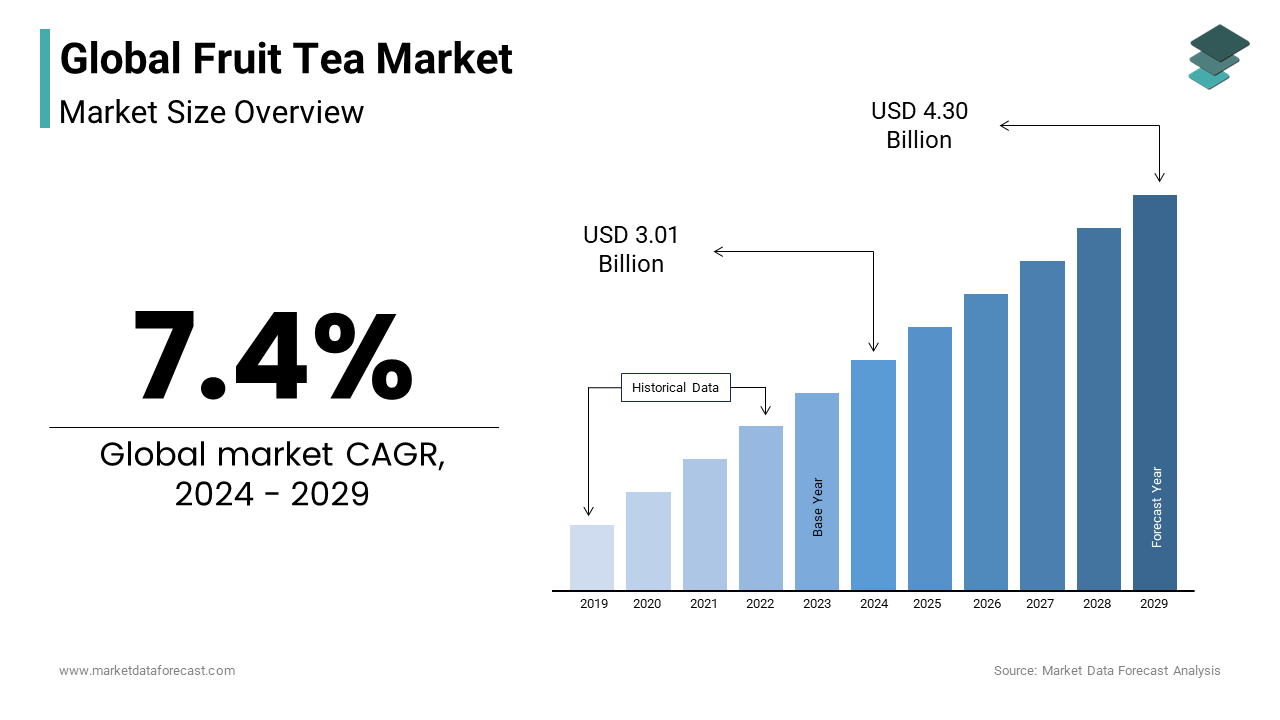
- Market Valuation: Valued at USD 3.23 billion in 2025, estimated at USD 3.47 billion in 2026, and projected to reach USD 6.14 billion by 2034, registering a healthy CAGR of 7.40% (2026–2034).
- Primary Growth Drivers: Growing consumer shift toward healthy, caffeine-free, and natural beverages driven by wellness awareness; rising disposable incomes and demand for ready-to-drink formats; and continuous innovation in unique fruit flavors targeting younger demographics.
Key Market Segment Metrics (2026–2034)
| Category | Leading Segment / Position | Growth Dynamics |
|---|---|---|
| By Form | Powder Segment (held a prominent market share backed by organic product demand and home-brewing popularity) | The ready-to-drink (RTD) segment is gaining strong traction and expanding rapidly to cater to busy consumer lifestyles. |
| By Type | Flavored Segment (dominated global revenue driven by millennial preferences and innovative flavor rollouts) | The traditional segment continues to grow steadily, largely supported by older demographic adoption. |
| By Distribution Channel | Supermarkets (dominated with a major share of 68.3% owing to extensive brand availability and accessibility) | Online sales are projected to grow the fastest, accelerated by digital adoption, e-commerce convenience, and direct-to-consumer platforms. |
| By Region | Asia Pacific (historically accounts for over 35% of total sales, with China as the world's largest producer and consumer) | North America is anticipated to expand at the fastest CAGR of 10.5%, driven by a strong shift toward natural, low-calorie beverages. |
Major Market Players & Market Structure
Market Structure: Highly competitive global marketplace featuring established multinational beverage giants and specialized tea brands competing on product innovation, clean-label transparency, and diverse flavor portfolios.
Key Companies: Twinings, Martin Bauer Group, Tetley, The London Tea Company, Unilever, Dilmah, Duncans Industries Ltd., Hain Celestial Group Inc., Van Rees, and Typhoo Tea Ltd.
Global Fruit Tea Market Size
The global fruit-tea market size was calculated to be USD 3.23 billion in 2025 and is anticipated to be worth USD 6.14 billion by 2034 from USD 3.47 billion in 2026, growing at a CAGR of 7.40% during the forecast period.
Fruit tea is a drink made by fermenting or decocting herbs, spices, fruits, or other plant substances in hot water. Fruit tea is rich in high levels of antioxidants and is like a fruit-rich food. It has several health benefits that make it popular with consumers worldwide. Antioxidants are good for health and well-being, reduce the effects of aging, and contribute to a better complexion. Fruit tea contains a large amount of vitamin C and has unique and powerful benefits, such as lowering cholesterol and blood sugar, which can help lose weight. Vitamin C improves the immune system and reduces the risk of infection. It also contributes to blood pressure control and has been used to treat high blood pressure. In short, vitamin C leads to a healthy body and heart.
Current Scenario of the Global Fruit Tea Market
The global fruit tea market has grown significantly in recent years due to several health benefits. Fruit tea has become a popular beverage outside the home for health-conscious consumers and attracts more attention than traditional black tea. Consumers' preferences for healthy, caffeine-free beverages drive the demand for fruit tea worldwide. The growing awareness regarding the importance and benefits of healthy beverages and the consumer demand for natural, healthier beverages are all boosting the adoption of fruit tea among consumers and expanding the global market revenue. The escalating disposable incomes of consumers and the rise in demand for ready-to-drink beverages due to people's busy lifestyles fuel the expansion of the global fruit tea market in the coming years.
MARKET DRIVERS
Low-caffeine and fruit-flavored tea products are popular among health-conscious consumers, contributing majorly to the expansion of the global market.
Furthermore, as the importance of a healthy lifestyle grows, the shift in consumer preferences to personalized tea sets will likely increase the demand for fruit tea worldwide. The millennial population and health lovers who prefer dietary options are gradually identifying new varieties and flavors that impact the market positively. Additionally, occasional and daily tea drinkers are increasingly moving to fruit-infused products due to numerous health benefits. Fruit tea is more popular with the younger population, as they may prefer specialty drinks like green tea and fruit tea over older people. In recent years, buyers have been concerned with the origin of the product's ingredients, with greater awareness and awareness among consumers worldwide. As a result, producers have become more informative and detailed in packaging to meet consumer demand, enhancing the adoption rate among consumers.
Population growth, coupled with an increase in disposable income, is majorly driving the growth of the fruit tea market in the coming years. Consumers' preferences for healthy, caffeine-free beverages are driving demand worldwide. Fruit tea is gaining popularity as it provides various vitamins and minerals that benefit users. Increased consumption of traditional and natural healthy tea drives the fruit tea industry. Fruit tea consumption is increasing in the corporate world as it strengthens immunity, improves brain function, and fights exhaustion, fueling global market revenue. The trend of adding a variety of flavors to tea is driving the teen market worldwide. Easy access to fruit tea products in retail stores, supermarkets, and online stores is one of the main drivers of the global fruit tea market. The growing demand for innovative flavors among consumers allows the market players to focus on developing innovative and unique flavors to accelerate the market growth opportunities.
MARKET RESTRAINTS
The volatility in raw material prices and increased product recalls are expected to hinder market growth.
The presence of alternative beverages such as herbal teas, kombucha, and other healthy beverages, as well as growing coffee consumption, are estimated to limit the expansion of the fruit tea market worldwide. The need for awareness among people regarding the health benefits and high costs associated with fruit tea is impeding market growth opportunities.
REPORT COVERAGE
| REPORT METRIC | DETAILS |
| Market Size Available | 2025 to 2034 |
| Base Year | 2025 |
| Forecast Period | 2026 to 2034 |
| CAGR | 7.4% |
| Segments Covered | By Form, Type, Distribution Channel, And Region |
| Various Analyses Covered | Global, Regional and Country Level Analysis; Segment-Level Analysis; DROC; PESTLE Analysis; Porter’s Five Forces Analysis; Competitive Landscape; Analyst Overview of Investment Opportunities |
| Regions Covered | North America, Europe, APAC, Latin America, Middle East & Africa |
| Market Leaders Profiled | Twinings, Martin Bauer Group, Tetley, The London Tea Company, Unilever, Dilmah, Duncans Industries Ltd., Hain Celestial Group Inc., Van Rees, and Typhoo Tea Ltd. |
SEGMENTAL ANALYSIS
Global Fruit Tea Market Analysis By Form
The powder segment has a prominent market share in global market revenue. The increasing demand for organic products and the growth in brewing tea at home across various regions are enhancing the segment's growth.
The ready-to-drink segment has gained traction recently and is estimated to increase with a prominent CAGR during the forecast period. Consumers' busy lifestyles are allowing them to choose ready-to-go drinks, which is expected to accelerate in the coming years, leading to segment growth.
Global Fruit Tea Market Analysis By Type
The flavored segment dominated the global market revenue and is estimated to grow significantly during the forecast period. The increasing demand for unique flavors among millennials and the escalating innovative product launches in different flavors are boosting segment growth.
The traditional segment is estimated to grow steadily during the forecast period due to the adoption of traditional drinks among the elderly.
Global Fruit Tea Market Analysis By Distribution Channel
The supermarket's segment dominated the global fruit tea market revenue with the largest market share of 68.3% due to wide availability and accessibility. Supermarkets and hypermarkets offer a wide range of products and brands, which makes it feasible for consumers to choose the desired product, driving segment growth. Various offline stores offer sample tastes of fruit tea to consumers, which helps them select the desired product. The primary distribution is done through supermarkets and retail stores. The specialty stores have gained traction recently, particularly among millennials seeking unique flavors.
Online sales are expected to grow the fastest during the forecast period due to rising digital shopping platforms. The pandemic has influenced people to adopt online platforms, and the availability of a wide range of brands is enhancing the adoption of online sales among consumers, which leads to segment growth.
REGIONAL ANALYSIS
By region, the global fruit tea market is divided into North America, Latin America, Europe, APAC, and MEA. Europe and North America have significant market potential. In contrast, Asia Pacific, Latin American, and MEA markets have growth opportunities to meet the rising demand for the fruit tea market over the forecast period. The Asia Pacific region accounted for over 35% of the total fruit tea market sales 2019. China is the world's largest producer and consumer of fruit tea. In recent years, consumers in the region have been exploring beverages with fruits and flowers, showing that the demand for products has grown significantly. North America is anticipated to expand at the fastest CAGR of 10.5% as consumer preference shifts from calories and sweet drinks to natural and healthy fruit-flavored beverages. According to TeaUSA, premium specialty tea has grown by 4-6% in the United States in 2018. Similarly, a report released by the Canadian government in 2019 confirmed that fruit or herbal teas had a higher annual rate of about 40%, and it is estimated that market growth in the area would accelerate as the number of frozen fruit drinks and frosts augmented from 2020 to 2026.
KEY PLAYERS IN THE GLOBAL FRUIT TEA MARKET
Major Key Players in the global fruit tea market are Twinings, Martin Bauer Group, Tetley, The London Tea Company, Unilever, Dilmah, Duncans Industries Ltd., Hain Celestial Group Inc., Van Rees, and Typhoo Tea Ltd.
RECENT HAPPENINGS IN THE MARKET
- In March 2022, Starbucks launched a limited-edition series of six iced tea drinks in Singapore. These drinks are made from various tea varieties.
- In March 2022, Irish Distillers released a limited edition of single-pot still whiskeys aged in unusual Japanese casks. The cedar logs are sourced from southern Japan, where the warm, damp climate produces a fragrant and porous wood that contributes to whiskey's deep flavor of herbal tea, clove spice, and a fruit finish.
- In October 2019, Hain Celestial introduced TeaWell, a natural wellness product with a healthy flavor. These products are available in fruit flavors like elderberries, grapes, and lemons to enhance consumers' immunity and health.
- In 2018, Harney & Sons introduced four new flavors: Loid Leaf Tea Plum Cider, Berry Young, Gabory Barrett Pear, and Venetian Tiramisu.
- In June 2018, Unilever's Lipton brand introduced two new flavors, watermelon and mango, in fruit iced tea bags for American consumers.
- R. Twining and Company launched the Superblends product line with natural flavors and premium ingredients mixed with green tea.
- Coca-Cola UK introduced organic tea under the Honest brand, with products in different fruit flavors, such as orange, lemon, pomegranate, blueberry, and mango.
DETAILED SEGMENTATION OF GLOBAL FRUIT TEA MARKET INCLUDED IN THIS REPORT
This research report on the global fruit tea market has been segmented and sub-segmented based on form, type, distribution channel, & region.
By Form
- Powder
- Ready to drink
- Instant pre mixes
By Type
- Traditional
- Unsweetened
- Sweetened
- Flavored
By Distribution Channel
- Supermarkets
- Specialty stores
- Online sales
- Retail stores
By Region
- North America
- Europe
- Asia Pacific
- Latin America
- Middle East and Africa