- Product Description Description
- Table of Contents TOC
- List of Table & Figure LOT
- Get Free Sample PDF Sample PDF
Market Size, 2025
$0.77 BnMarket Estimate, 2026
$0.83 BnMarket Forecast, 2034
$1.56 BnCAGR, 2026–2034
8.17%Executive Summary: Asia Pacific Fruit Tea Market
- Market Scope: Regional analysis of the Asia Pacific fruit tea sector, detailing forms, types, distribution channels, and country-level profiles across China, India, Japan, Australia, South Korea, and Southeast Asia.
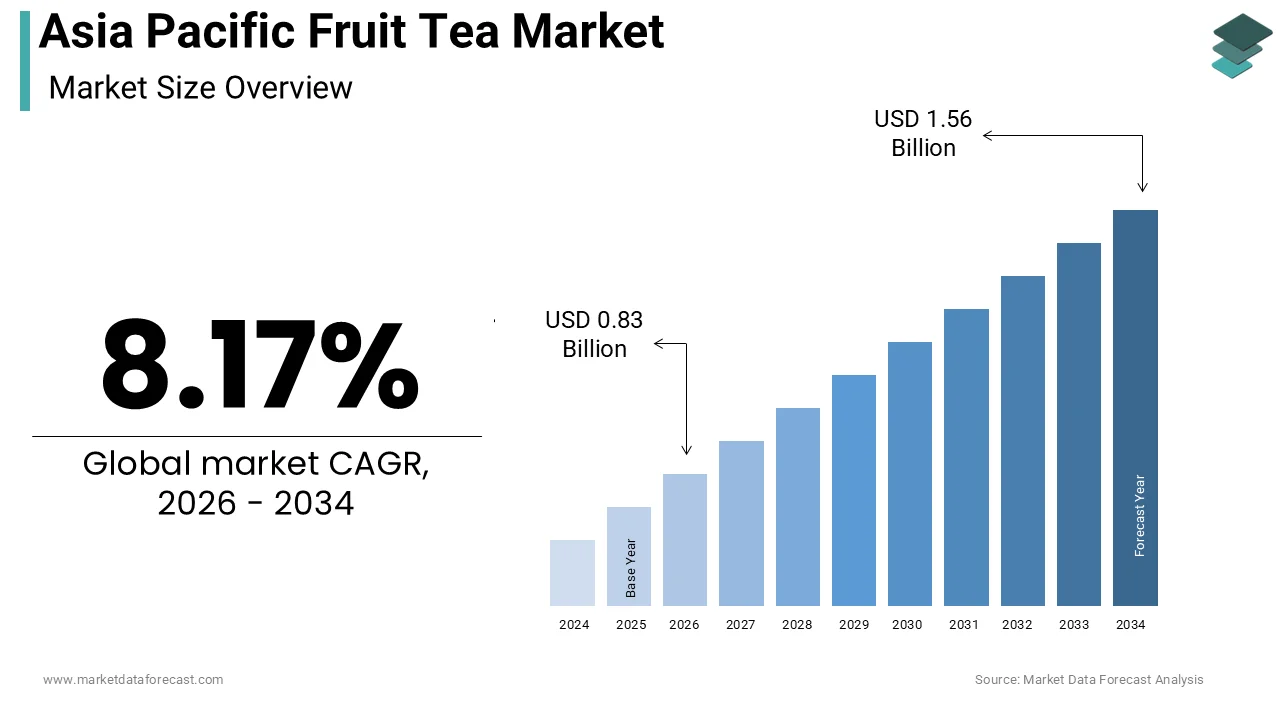
- Market Valuation: Valued at USD 0.77 billion in 2025, reaching USD 0.83 billion in 2026, and projected to expand to USD 1.56 billion by 2034, growing at a robust CAGR of 8.17% from 2026 to 2034.
- Primary Growth Drivers: Rising health consciousness, growing consumer preference for antioxidant-rich beverages, expanding disposable incomes, and increasing popularity of novel flavored tea variants among younger demographics.
Key Market Segment Metrics
| Category | Leading Segment (Base Position) | Fastest-Growing / High-Growth Segment |
|---|---|---|
| By Form | Ready to Drink & Instant Premix (dominated base market share due to high consumer demand for convenience and on-the-go consumption) | Powder (high-growth segment propelled by versatility in beverage preparation and extended shelf life) |
| By Type | Traditional Fruit Tea (held primary base share anchored by classic herbal and fruit infusion blends) | Flavored Fruit Tea (fastest-growing segment driven by innovative taste profiles appealing to younger demographics) |
| By Distribution Channel | Supermarkets & Retail Stores (accounted for leading sales share through widespread brick-and-mortar retail accessibility) | Online Sales (expected to register highest growth rate driven by e-commerce expansion and direct-to-consumer delivery) |
| By Region | China & Japan (market leaders backed by massive consumer populations and deep-rooted tea consumption cultures) | India & South Korea (key high-growth regional hubs driven by urbanization, café culture expansion, and health trends) |
Major Market Players & Industry Landscape
Market Structure: Highly competitive landscape featuring global beverage giants and regional tea brands expanding their wellness-focused product portfolios across urban markets.
Key Companies: Martin Bauer Group, Tetley, Twinings, The London Tea Company, Unilever, Hain Celestial Group Inc., Van Rees, James Finlay, Dilmah, Duncans Industries Ltd., Mcleod Russel, and Typhoo Tea Ltd.
 Download Free Sample Report
Asia Pacific Fruit Tea Market Size
The size of the Asia Pacific Frozen Food Packaging Market was calculated to be USD 0.77 billion in 2025 and is anticipated to be worth USD 1.56 billion by 2034, from USD 0.83 billion in 2026, growing at a CAGR of 8.17% during the forecast period.
Fruit teas are decoctions of herbs, spices, or fruits in hot water. It contains a high amount of antioxidants, making it very popular among consumers. It has multiple health benefits, which have helped in the increased demand for fruit tea. Antioxidants prevent the aging of the skin, making it look younger and more radiant. These teas contain high levels of Vitamin C which help in lowering the blood sugar and cholesterol levels. It also strengthens the immune system and regulates blood pressure hence lowering the chances of hypertension.
Various factors driving the market growth include the increasing population and a rise in people's disposable income. People nowadays are becoming health conscious and aware of their health, which in turn drives the market. Since it is a source of vitamins and minerals, fruit tea has gained immense popularity in the market. The use of fruit teas has increased in the corporate world due to its various properties like brain boosting and combating exhaustion. Also, with new flavors coming up, it is becoming popular among the younger generation. The easy availability of fruit tea is also another factor that drives the market.
This research report on the Asia Pacific Fruit Tea Market is segmented and sub-segmented into the following categories
Asia Pacific Fruit Tea Market By Form
- Powder
- Ready to drink
- Instant premix
Asia Pacific Fruit Tea Market By Type
- Traditional
- Unsweetened
- Sweetened
- Flavored
Traditional and flavored fruit teas are gaining popularity.
Asia Pacific Fruit Tea Market By Distribution Channel
- Supermarket
- Specialty stores
- Online sales
- Retail stores
Supermarkets lead the distribution channel segment in the market.
Asia Pacific Fruit Tea Market By Region
- China
- India
- Japan
- Australia
- South Korea
Asia Pacific continues to grow at a high CAGR.
KEY MARKET PLAYERS
Some of the key players of the Asia Pacific Fruit Tea Market are identified across the value chain of the fruit tea market include Martin Bauer Group, Tetley, Twinings, The London Tea Company, Unilever, Hain Celestial Group Inc., Van Rees, James Finlay, Dilmah, Duncans Industries Ltd., Mcleod Russel, and Typhoo Tea Ltd. Etc.