- Product Description Description
- Table of Contents TOC
- List of Table & Figure LOT
- Get Free Sample PDF Sample PDF
Market Size, 2025
$0.51 BnMarket Estimate, 2026
$0.55 BnMarket Forecast, 2034
$0.99CAGR, 2026–2034
7.65%Executive Summary: Asia Pacific Golf Cart Market
- Market Scope: Comprehensive regional analysis of the Asia Pacific golf cart sector, detailing propulsion types, seating capacities, vehicle formats, applications, sales channels, and country-level market dynamics.
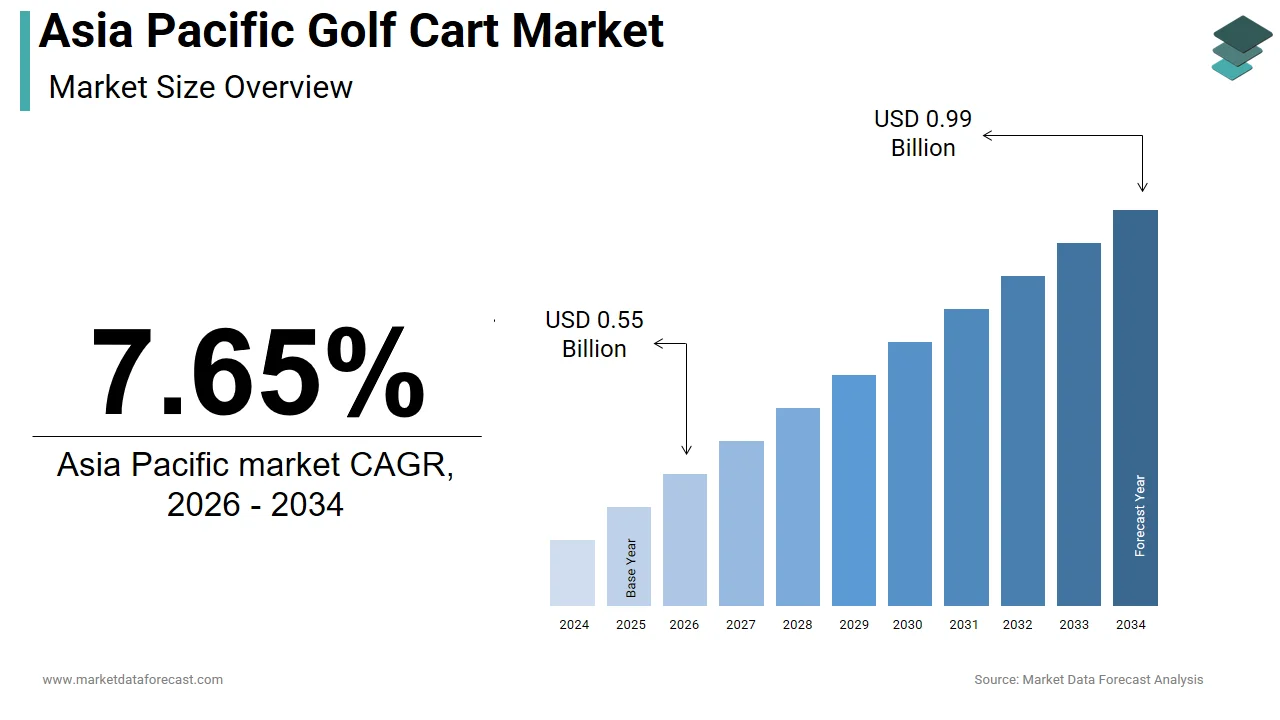
- Market Valuation: Valued at USD 0.51 billion in 2025, reaching USD 0.55 billion in 2026, and projected to expand to USD 0.99 billion by 2034, growing at a steady CAGR of 7.65% from 2026 to 2034.
- Primary Growth Drivers: Proliferation of leisure and tourism infrastructure across Southeast Asia, rising adoption of eco-friendly mobility solutions, and expanding utility use cases in smart cities, campuses, and resorts.
Key Market Segment Metrics
| Category | Leading Segment (Base Position) | Fastest-Growing / High-Growth Segment |
|---|---|---|
| By Propulsion Type | Electric Golf Carts (captured 62.2% share, driven by zero-emission policies, lithium-ion advancements, and urban EV adoption) | Gasoline Golf Carts (projected at a CAGR of 7.8%, favored for remote, off-grid locations, rugged terrain, and hilly courses) |
| By Seating Capacity | 4-Seater Carts (led with 56.4% share, fulfilling group transport requirements in resorts, golf courses, and corporate campuses) | 2-Seater Carts (fastest-growing at a CAGR of 9.2%, fueled by rising personal ownership, gated communities, and coaching academies) |
| By Vehicle Format | Open-Top (dominated with 67.4% share, preferred for aesthetic appeal, ventilation, and tourism/heritage site tours) | Enclosed / Weather-Proof (fastest-growing at a CAGR of 10.3%, driven by all-weather corporate/urban transport needs and ski resorts) |
| By Sales Channel | Offline (commanding distribution mode via dealerships, ensuring physical demonstrations, test drives, and custom fleet negotiation) | Online / D2C (fastest-growing at a CAGR of 11.5%, propelled by digital adoption, virtual showrooms, and doorstep delivery) |
| By Country | China & Japan (major manufacturing, resort, and golf infrastructure hubs with thousands of operational golf courses and EV pilots) | India & South Korea (high-growth markets driven by smart city initiatives, corporate campus mobility, and FAME EV policies) |
Major Market Players & Industry Landscape
Market Structure: Highly dynamic competitive ecosystem featuring established global leaders and agile regional manufacturers competing through smart navigation integration, lithium-ion efficiency, and extended utility applications.
Key Companies: Yamaha Motor Company, Textron Specialized Vehicles Inc. (E-Z-GO), Club Car LLC, Polaris Inc., and HDK Electric Vehicles.
 Download Free Sample Report
Asia Pacific Golf Cart Market Size
The size of the Asia Pacific golf cart market was worth USD 0.51 billion in 2025. The regional market is anticipated to grow at a CAGR of 7.65% from 2026 to 2034 and be worth USD 0.99 billion by 2034 from USD 0.55 billion in 2026.
Golf cart is a motorized vehicle designed for transporting golfers and their equipment across golf courses, as well as for utility purposes in resorts, industrial sites, and tourist hubs. These carts typically operate on electric or internal combustion engines and are increasingly being adopted beyond traditional golfing applications due to their efficiency, eco-friendliness, and cost-effectiveness. The market has witnessed steady growth driven by rising disposable incomes, growing tourism infrastructure, and increasing preference for sustainable mobility solutions. Also, countries such as Thailand, Japan, and Australia have expanded their recreational and hospitality sectors, contributing significantly to non-golf applications of golf carts.
In addition, urbanization and infrastructure development across emerging economies like India and Indonesia are fostering new use cases in logistics and campus transportation. As per the Asian Development Bank, over 60% of Asia’s population resides in urban areas, which is expected to rise to 65% by 2030, further reinforcing demand for compact, low-speed transport solutions. The integration of lithium-ion batteries and smart navigation systems into modern golf carts is also enhancing their appeal among environmentally conscious consumers and commercial operators alike.
MARKET DRIVERS
Expansion of Leisure and Tourism Infrastructure
The rapid expansion of leisure and tourism infrastructure across the region is one of the primary drivers of the Asia Pacific golf cart market. Countries such as Thailand, Malaysia, and the Philippines have been investing heavily in developing world-class resorts, theme parks, and integrated entertainment complexes to attract international tourists. According to the Pacific Asia Travel Association (PATA), international tourist arrivals in the Asia Pacific region grew by approximately 18% in 2023 compared to the previous year, signaling a robust recovery post-pandemic.
This surge in tourism has led to increased construction of golf courses and resort facilities, where golf carts serve dual purposes: transportation and guest convenience. For instance, in Thailand alone, over 250 golf courses are currently operational, many of which integrate electric golf carts to enhance visitor experience while aligning with sustainability goals. Moreover, luxury hotels and private clubs in Japan and South Korea are adopting premium electric carts equipped with GPS and climate control features, further boosting market growth.
Rise in Eco-Friendly Mobility Initiatives
The growing emphasis on eco-friendly mobility initiatives across both public and private sectors is another significant driver of the Asia Pacific golf cart market. Governments in countries such as China, South Korea, and Singapore have implemented stringent environmental regulations aimed at reducing carbon emissions and promoting clean energy transportation. According to the International Energy Agency (IEA), renewable energy capacity in the Asia Pacific region is projected to expand by 45% between 2023 and 2030, creating a conducive environment for electric vehicle adoption including golf carts.
Electric golf carts, especially those powered by lithium-ion batteries, are gaining popularity due to their zero-emission profile and lower maintenance costs. In Japan, for example, the Ministry of Economy, Trade and Industry (METI) has introduced subsidies for businesses that adopt electric transport solutions within campuses and industrial zones. This has led to an uptick in the usage of golf carts for intra-campus logistics in major corporations and universities.
Furthermore, cities like Shenzhen and Shanghai in China have launched pilot programs integrating electric golf carts into short-distance public transport networks.
MARKET RESTRAINTS
Limited Awareness and Acceptance in Rural Areas
One of the key restraints is the limited awareness and acceptance of golf carts in rural and semi-urban regions. Golf remains a relatively niche sport in many parts of the region, particularly in countries like India, Bangladesh, and Vietnam, where it is perceived as a luxury activity accessible only to affluent individuals.
Moreover, even in urban centers, the adoption of golf carts outside of dedicated golf courses remains limited due to a lack of consumer understanding regarding their utility and benefits. Many potential users are unaware that golf carts can be used for transportation within gated communities, university campuses, and industrial parks.
Educational campaigns and demonstration programs could help bridge this gap, but the absence of targeted marketing efforts by manufacturers and distributors continues to hinder widespread acceptance.
High Initial Investment and Maintenance Costs
The high initial investment and ongoing maintenance costs associated with advanced models are another critical restraint affecting the growth of the Asia Pacific golf cart market. For small and medium-sized enterprises (SMEs) operating golf facilities or resorts, this cost differential poses a considerable financial barrier. In countries like Indonesia and the Philippines, where capital availability is limited for local entrepreneurs, the adoption of premium carts remains sluggish. Additionally, maintenance expenses, particularly for battery replacements and software updates, add to the total cost of ownership. As per the ASEAN Business Advisory Council, nearly 40% of SMEs in Southeast Asia cited high equipment costs as a major deterrent to upgrading their fleet.
MARKET OPPORTUNITIES
Adoption in Smart City Projects
Their integration into smart city projects is one of the most promising opportunities in the Asia Pacific golf cart market. With rapid urbanization and increasing pressure to develop sustainable transportation ecosystems, several governments across the region are prioritizing the deployment of low-speed electric vehicles (LSVs) in planned urban developments.
Golf carts, especially electric variants, fit seamlessly into these frameworks due to their compact size, low emissions, and suitability for last-mile connectivity. In South Korea, for instance, the government has piloted the use of golf carts in designated pedestrian zones within Songdo International Business District, a flagship smart city project.
These initiatives are supported by policy incentives such as tax exemptions and subsidies for electric vehicle purchases.
Growing Use in Educational and Corporate Campuses
The increasing deployment of these vehicles in educational institutions and corporate campuses is another emerging opportunity for the Asia Pacific golf cart market. With sprawling campuses becoming the norm in universities and multinational companies, efficient internal transportation has become essential to ensure smooth movement of students, faculty, and employees. In China, leading tech firms such as Tencent and Alibaba have begun using customized electric golf carts for employee transportation within their massive office complexes. These carts are often equipped with Wi-Fi, USB charging ports, and real-time tracking systems, enhancing user experience while reinforcing the company’s commitment to sustainability.
Similarly, Australian universities like the University of Melbourne and Monash University have introduced electric cart fleets to assist elderly staff and visitors. These initiatives are backed by institutional policies favoring carbon-neutral operations, thereby creating a favorable environment for sustained market growth in the education and corporate sectors.
MARKET CHALLENGES
Regulatory Hurdles and Lack of Standardization
The inconsistent regulatory framework and lack of standardization across different countries a major challenges confronting the Asia Pacific golf cart market. Unlike conventional automobiles, golf carts fall into a gray area in terms of road legality, safety norms, and permissible usage. In some jurisdictions, such as New South Wales, Australia, golf carts are allowed on public roads provided they meet certain speed and safety requirements. However, in other regions like parts of India and Indonesia, their operation on public roads is either restricted or entirely prohibited.
Moreover, the absence of uniform charging infrastructure and battery compatibility standards complicates after-sales service and customer adoption. In China, although electric carts are permitted in special zones, interoperability issues persist due to differing plug types and voltage specifications.
Competition from Alternative Micro-Mobility Solutions
The growing competition from alternative micro-mobility solutions such as e-bikes, e-scooters, and autonomous shuttles is another pressing challenge for the Asia Pacific golf cart market. These alternatives offer similar benefits low emissions, ease of maneuverability, and cost-effectiveness but come with greater flexibility and often lower acquisition costs.
E-bikes, in particular, have gained traction in countries like Vietnam and India, where they are used for both personal and delivery services. Their portability and ability to navigate narrow streets give them an edge over bulkier golf carts. In urban settings, shared e-scooter platforms operated by companies like Beam and Neuron have become popular for short-distance travel, reducing reliance on larger vehicles.
Autonomous shuttles, though still in early adoption phases, pose a long-term threat as pilot projects gain momentum in Japan and Singapore. These self-driving pods can carry more passengers and operate continuously without human intervention.
REPORT COVERAGE
| REPORT METRIC | DETAILS |
| Market Size Available | 2025 to 2034 |
| Base Year | 2025 |
| Forecast Period | 2026 to 2034 |
| Segments Covered | By Propulsion Type, Seating Capacity, Vehicle Format, Application, Sales Channel, and Region. |
| Various Analyses Covered | Global, Regional and Country-Level Analysis, Segment-Level Analysis, Drivers, Restraints, Opportunities, Challenges; PESTLE Analysis; Porter’s Five Forces Analysis, Competitive Landscape, Analyst Overview of Investment Opportunities |
| Countries Covered | India, China, Japan, South Korea, Australia, New Zealand, Thailand, Malaysia, Vietnam, Philippines, Indonesia, Singapore, Rest of APAC |
| Market Leaders Profiled | Yamaha Golf-Car Company, Textron Specialized Vehicles Inc., Club Car LLC, Polaris Inc., HDK Electric Vehicles, and others. |
SEGMENTAL ANALYSIS
By Propulsion Type Insights
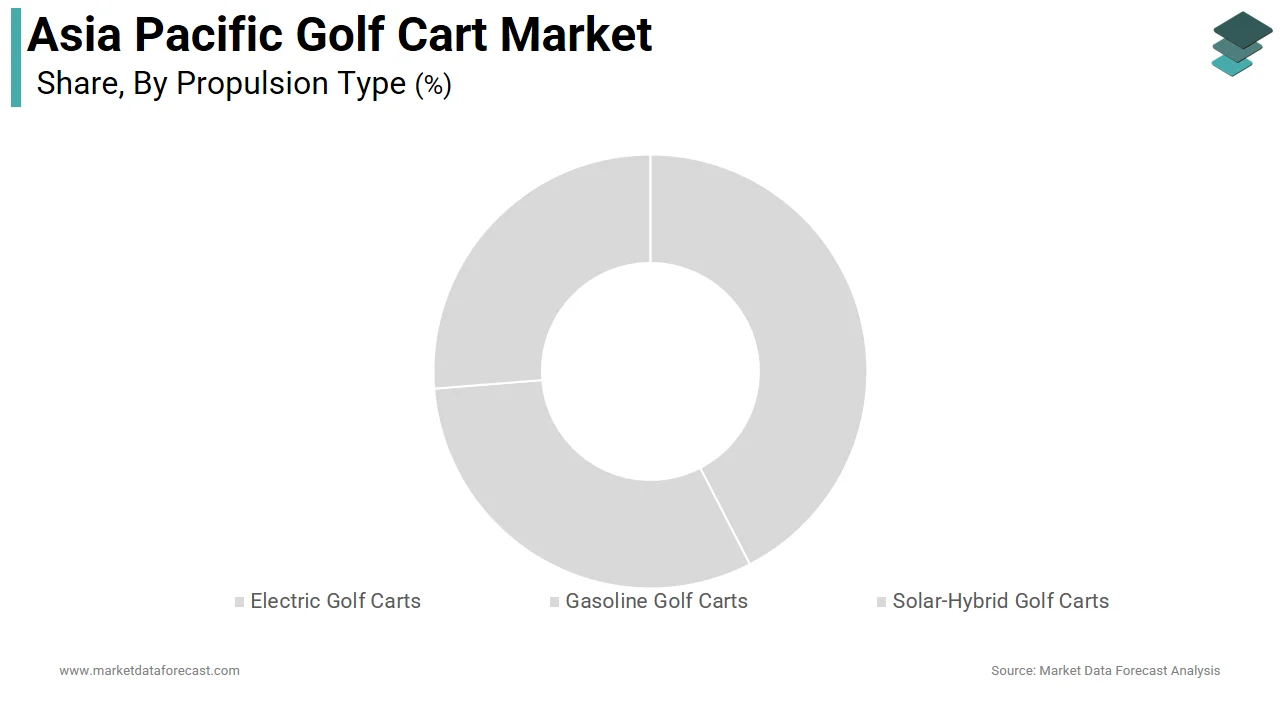
The electric golf cart segment accounted for the largest share of the Asia Pacific golf cart market with 62.2% in 2023. This dominance is primarily attributed to the Increasing emphasis on sustainable mobility, and the growing adoption of electric vehicles across various industries is largely attributed to the dominance ofthe electric golf cart segment. According to the International Energy Agency (IEA), Asia Pacific accounted for nearly 60% of global electric vehicle sales in 2023, reinforcing the region's shift toward cleaner transport solutions.
Governments in countries like China, Japan, and South Korea have introduced subsidies and tax incentives to encourage the use of electric carts in recreational, corporate, and educational settings.
Moreover, advancements in lithium-ion battery technology have significantly improved the performance and longevity of electric carts, making them more appealing to commercial users. BloombergNEF estimates that the cost of lithium-ion batteries fell by nearly 85% between 2010 and 2023, contributing to wider adoption across the region.
The gasoline golf cart segment is growing at the fastest pace, with a CAGR of 7.8% projected between 2026 and 2034. Its cost-effectiveness and suitability for remote and off-grid locations where access to reliable electricity is limited are fuelling the growth of the gasoline golf cart segment.
In countries like Indonesia, Vietnam, and the Philippines, many golf courses are located in regions with underdeveloped power infrastructure. Additionally, gasoline carts are preferred in rugged terrains where electric models may struggle with battery efficiency.
Furthermore, gasoline carts offer higher torque and better hill-climbing capabilities, which is a critical factor for hilly golf courses in mountainous regions like northern Thailand and South Korea. Manufacturers are also introducing fuel-efficient and low-emission gasoline engines, aligning with evolving environmental norms without compromising performance.
By Seating Capacity Insights
The 4-seater golf cart segment led the market by accounting for 56.4% of total sales in the Asia Pacific region in 2024. The preference for group transportation in both recreational and utility applications is largely driving the growth of the 4-seater golf cart segment. Golf courses, resorts, and large corporate campuses often require carts that can accommodate multiple passengers efficiently, making the 4-seater model the most practical choice.
According to a 2023 report by the Pacific Asia Travel Association (PATA), the average group size for golf tourism in Asia is 2.4 players per round, indicating a strong need for multi-person transport solutions. Additionally, in educational institutions and industrial parks, 4-seaters are widely used for staff and visitor transportation.
Moreover, manufacturers are increasingly offering customized 4-seater models with added features such as climate control, USB charging ports, and GPS navigation.
The 2-seater golf cart segment is experiencing the fastest growth, with a CAGR of 9.2% projected between 2025 and 2033. Rising individual ownership and the increasing use of compact carts in urban and semi-urban environments is fuelling the surge of the 2-seater golf cart segment.
In India and Vietnam, where personal mobility is rapidly evolving, consumers are opting for 2-seater carts for use in gated communities and private resorts.
Additionally, golf instructors and training academies are increasingly using 2-seater carts for personalized coaching sessions. The flexibility and lower cost of ownership of these carts are key factors contributing to their rapid adoption across the Asia Pacific region.
By Vehicle Format Insights
The open-top golf cart format dominated the Asia Pacific market by holding a share of 67.4% in 20234. This format is preferred for its versatility, ease of access, and aesthetic appeal, particularly in outdoor recreational and resort applications.
Additionally, open-top carts are widely used in tourist attractions, theme parks, and heritage sites where visibility and ventilation are essential. In Japan, for instance, UNESCO World Heritage sites like Kyoto’s historic districts have adopted open-top electric carts for guided tours. As per the Japan Tourism Agency, eco-tourism initiatives increased by 14% in 2023, further boosting demand for this format.
From a cost perspective, open-top carts are generally less expensive to manufacture and maintain compared to enclosed variants.
The enclosed or weather-proof golf cart segment is growing at the fastest rate, with a CAGR of 10.3% expected between 2025 and 2033. Increasing demand for all-weather mobility solutions in corporate campuses, healthcare facilities, and urban transport projects is primarily driving the growth ofthe enclosed or weather-proof golf cart segment. In colder regions like northern China and Japan, enclosed carts are preferred for year-round usage, especially in ski resorts and mountainous golf courses. Moreover, smart city initiatives in Singapore and Australia are incorporating enclosed carts into autonomous transport trials.
By Sales Channel Insights
The offline sales channel segment remains the commanding mode of distribution in the Asia Pacific golf cart market, capturing a substantial share of total sales in 2024. The high value of golf carts and the need for physical demonstration, test drives, and after-sales service, which are more effectively facilitated through dealerships and authorized distributors, is fuelling the rise of the offline sales channel segment. Additionally, corporate and institutional buyers often require customized solutions, which are best negotiated and delivered through direct engagement with sales representatives. The continued reliance on physical touchpoints for high-value purchases ensures the offline segment’s strong market position.
The online sales channel segment is the fastest-growing segment in the Asia Pacific golf cart market, with a CAGR of 11.5% anticipated between 2025 and 2033. This rapid growth is driven by increasing digital adoption, enhanced e-commerce platforms, and the convenience of doorstep delivery, especially among small business owners and individual buyers is propelling the rapid surge of the online sales channel segment. As per the Ministry of Electronics and Information Technology (MeitY), online sales of mobility equipment grew by 30% in 2023, indicating strong momentum. Manufacturers are also leveraging digital tools such as virtual showrooms and augmented reality configurators to enhance the online buying experience.
COUNTRY-LEVEL ANALYSIS:
China Golf Cart Market Insights
China led the Asia Pacific golf cart market, which is driven by robust domestic manufacturing, expanding tourism infrastructure, and strong government support for electric mobility. The government's push for green transportation under the "Dual Carbon" policy has led to widespread adoption of electric carts in resorts, industrial parks, and urban campuses. In Shenzhen, the municipal government has launched a pilot program integrating electric carts into short-distance public transport, aiming to reduce congestion and emissions. Additionally, the rise of private golf clubs and luxury resorts has further boosted demand.
Japan Golf Cart Market Insights
Japan is a significant player in the Asia Pacific golf cart market, and is driven by high adoption in both traditional golf facilities and non-golf applications. According to the Japan Golf Course Owners Association (JGCOA), the country has over 2,300 operational golf courses, the highest in Asia, with nearly 80% using electric carts. The country’s aging population has also spurred demand for mobility solutions in healthcare and elderly care centers. Furthermore, Japanese automakers like Yamaha and Toyota have introduced advanced lithium-ion powered carts with smart features such as GPS navigation and autonomous driving capabilities.
India Golf Cart Market Insights
India holds a notable share of the Asia Pacific golf cart market, with growth driven by increasing investments in urban infrastructure and the expansion of the tourism and hospitality sectors. The Smart Cities Mission has also identified 20 cities for pilot micro-mobility programs, including the deployment of electric carts in campus settings. In Bengaluru, for instance, tech campuses like Infosys and Wipro have introduced customized electric carts for employee transport. Additionally, the government’s FAME II (Faster Adoption and Manufacturing of Electric Vehicles) scheme has encouraged manufacturers to develop affordable electric models tailored for Indian conditions. This policy support, combined with rising disposable incomes, is expected to sustain growth in the Indian market.
Australia Golf Cart Market Insights
Australia accounts for key share of the Asia Pacific golf cart market, supported by a well-established golf culture and strong adoption of electric carts in recreational and utility applications. The country’s focus on sustainable tourism has further boosted demand. In addition, universities and research institutions are increasingly using carts for campus mobility. Moreover, government incentives such as the Electric Vehicle Strategy 2023 have encouraged manufacturers and importers to expand their offerings.
South Korea Golf Cart Market Insights
South Korea holds a key share of the Asia Pacific golf cart market, driven by rising investments in smart mobility and the integration of carts into urban transport systems. The government has also introduced policies to promote eco-friendly transport in urban areas. In Seoul, the city’s Green Transport Plan 2023 includes the deployment of electric carts in pedestrian zones and university campuses. Additionally, South Korean automakers are investing in next-generation golf carts with autonomous driving capabilities. Hyundai and Kia have both launched smart cart prototypes, with pilot tests underway in Incheon Free Economic Zone.
COMPETITIVE LANDSCAPE
The competitive environment in the Asia Pacific golf cart market is characterized by a mix of global brands and emerging regional manufacturers striving to capture market share through differentiation and innovation. While established players leverage their brand reputation, technical expertise, and extensive dealer networks, local companies are gaining ground by offering cost-effective alternatives tailored to specific regional demands. The market sees intense rivalry in terms of product design, performance, and after-sales service, with companies continuously upgrading their offerings to meet evolving customer expectations. Additionally, the shift toward electric models has intensified competition, as firms race to develop energy-efficient, technologically advanced solutions that align with environmental regulations and consumer preferences. Strategic moves such as mergers, acquisitions, and joint ventures further shape the landscape, allowing participants to expand their geographical footprint and enhance operational efficiency. Overall, the market remains dynamic, with both global and regional players actively working to strengthen their positions in a rapidly growing and increasingly diversified industry.
KEY MARKET PLAYERS
Some of the noteworthy companies in the Asia Pacific golf cart market profiled in this report are
- Yamaha Golf-Car Company
- Textron Specialized Vehicles Inc.
- Club Car LLC
- Polaris Inc.
- HDK Electric Vehicles
TOP LEADING PLAYERS IN THE MARKET
One of the leading players in the Asia Pacific golf cart market is Yamaha Motor Company, a Japanese multinational known for its diverse range of vehicles, including high-performance electric and gasoline-powered golf carts. Yamaha has built a strong reputation for reliability, innovation, and superior engineering, making it a preferred choice across golf courses and resorts in the region. The company’s focus on integrating advanced technologies such as energy-efficient motors and enhanced battery systems has positioned it as a key influencer in both domestic and international markets.
Another major player is E-Z-GO, a U.S.-based subsidiary of Textron Inc., which maintains a significant presence in the Asia Pacific through strategic partnerships and localized distribution networks. E-Z-GO is renowned for its durable and customizable fleet of electric carts used not only in traditional golf settings but also in utility applications like campus transportation and industrial logistics. Its commitment to sustainability and customer-centric design has helped it gain traction among commercial buyers and government-backed mobility projects.
Club Car, another prominent brand under Ingersoll Rand, plays a pivotal role in shaping the Asia Pacific golf cart landscape. Known for its robust product lineup and continuous investment in R&D, Club Car offers a wide array of electric and internal combustion engine carts tailored for different terrains and usage scenarios. Its emphasis on smart features, such as GPS navigation and telematics integration, has strengthened its appeal among premium resorts, luxury hotels, and smart city initiatives across the region.
TOP STRATEGIES USED BY KEY MARKET PARTICIPANTS
A key strategy adopted by leading players in the Asia Pacific golf cart market is product innovation and technological advancement. Companies are increasingly investing in research and development to integrate smart features such as GPS navigation, autonomous driving capabilities, and real-time diagnostics into their carts. This enhances user experience and aligns with regional trends toward automation and digital integration.
Another major approach is expanding distribution networks and forming strategic alliances. Manufacturers are collaborating with local distributors, dealerships, and service providers to improve accessibility and after-sales support. These partnerships enable companies to better understand regional demand patterns and tailor their offerings accordingly.
Lastly, diversifying applications beyond traditional golf use has become a core growth strategy. Leading firms are promoting carts for use in campuses, resorts, hospitals, and urban transport zones, broadening their market reach and adapting to evolving consumer needs across various industries.
RECENT MARKET DEVELOPMENTS
- In January 2024, Yamaha Motor Company launched a new line of lithium-ion powered electric golf carts designed specifically for rugged terrain and extended battery life, targeting mountainous resorts and large-scale golf facilities across Asia.
- In March 2024, E-Z-GO expanded its dealership network in Southeast Asia by partnering with a leading distributor in Thailand, aiming to enhance local service capabilities and streamline supply chain operations.
- In June 2024, Club Car introduced a pilot program in collaboration with a Singapore-based smart city initiative to deploy autonomous electric carts within designated urban zones, marking a step toward future-ready mobility solutions.
- In September 2024, a leading Chinese manufacturer unveiled a budget-friendly electric golf cart model tailored for small resort operators and private owners, focusing on affordability without compromising essential features.
- In November 2024, a South Korean tech firm partnered with a Japanese automotive supplier to co-develop AI-integrated navigation systems for next-generation golf carts, enhancing route optimization and user experience in commercial applications.
MARKET SEGMENTATION
This Asia Pacific golf cart market research report is segmented and sub-segmented into the following categories.
By Propulsion Type
- Electric Golf Carts
- Gasoline Golf Carts
- Solar-Hybrid Golf Carts
By Seating Capacity
- 2 Seater
- 4 Seater
- 6 Seater
- 8+ Seater
By Vehicle Format
- Open-Top
- Enclosed / Weather-proof
By Application
- Golf Courses
- Personal / Residential Mobility
- Commercial Services (Resorts, Theme-Parks, Campuses)
- Industrial & Airport Utility
By Sales Channel
- Offline (Dealers & Distributors)
- Online / Direct-to-Consumer
By Country
- India
- China
- Japan
- South Korea
- Australia
- New Zealand
- Rest Of APAC