- Product Description Description
- Table of Contents TOC
- List of Table & Figure LOT
- Get Free Sample PDF Sample PDF
Market Size, 2025
$186.11 MnMarket Estimate, 2026
$201.43 MnMarket Forecast, 2034
$279.23 MnCAGR, 2026–2034
8.23%APAC Gynecological Examination Chairs Market Size, Trends, and Forecast (2026–2034)
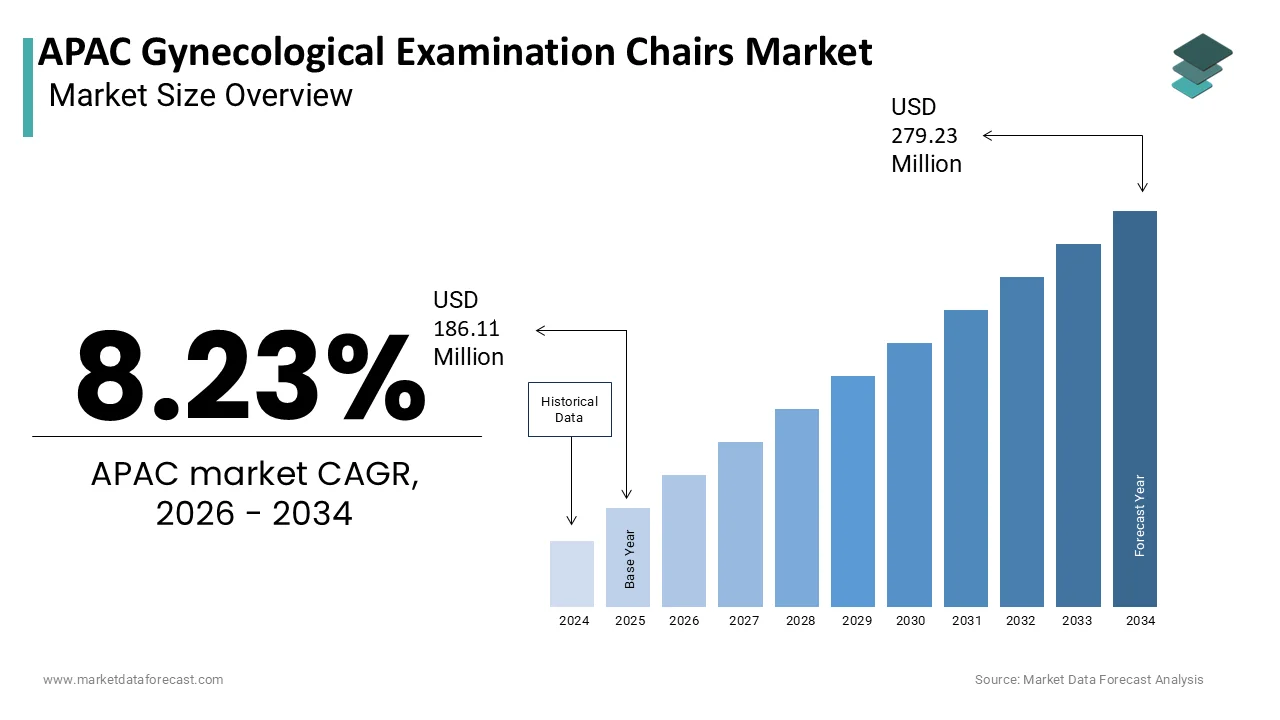
The APAC Gynecological Examination Chairs Market size was valued at USD 186.11 million in 2025, stands at USD 201.43 million in 2026, and is anticipated to reach USD 279.23 million by 2034, expanding at a compound annual growth rate (CAGR) of 8.23% during the forecast period from 2026 to 2034. Growth is heavily driven by government maternal health infrastructure expansion programs, rising institutional delivery rates across transitioning economies, and the widespread adoption of advanced electric examination furniture in private healthcare networks.
Key Executive Metrics (At-a-Glance)
- 2025 Base Valuation: USD 186.11 Million
- 2026 Current Valuation: USD 201.43 Million
- 2034 Forecast Valuation: USD 279.23 Million
- Forecast Period: 2026–2034
- Compound Annual Growth Rate (CAGR): 8.23% (2026–2034)
- Dominant Product Type Segment: Non-Electric (Mechanical) Chairs
- Fastest-Growing Product Type Segment: Electric Gynecological Examination Chairs (14.5% CAGR)
- Dominant End User Segment: Hospitals
- Fastest-Growing End User Segment: Diagnostic Centres (17.2% CAGR)
- Leading Country Markets: China (32.4% share in 2025) and India (24.1% share in 2025)
Core Market Drivers
- Government Maternal Health Initiatives: Public sector investments in rural health and wellness centers (e.g., India's Ayushman Bharat, Indonesia's puskesmas modernization) drive bulk equipment procurement.
- Institutional Delivery Transition: The ongoing shift from home births to facility-based maternity care across middle-income nations accelerates persistent equipment replacement cycles.
Primary Market Restraints & Challenges
- Budget Constraints & Logistics: Severe capital limitations in low-income settings and complex supply chain import bottlenecks restrict modern equipment upgrades.
- Workforce & Maintenance Gaps: Shortages of trained clinical personnel and lack of local technical support services reduce equipment utilization rates and accelerate asset failure.
APAC Gynecological Examination Chairs Market Segmentation Breakdown
| Segment Category | Largest / Dominant Segment | Fastest-Growing / Key Highlight |
|---|---|---|
| By Product Type | Non-Electric (Mechanical) Chairs | Electric Examination Chairs (14.5% CAGR) |
| By End User | Hospitals | Diagnostic Centres (17.2% CAGR) |
| By Country | China (32.4% share) & India (24.1% share) | Southeast Asian Markets & South Korea |
Major Industry Players Profiled
Key corporations shaping the APAC gynecological examination chairs market include Malvestio, Medifa-Hesse AG, Harbin Howell, Oakworks Medicals, Inmoclinc S.A., Favero Health Projects, Hidemar, Combed, Narang Medical Limited, and Zhangjiagang Medwish Medical Products Co. Ltd..
 Download Free Sample Report
APAC Gynecological Examination Chairs Market Size
The APAC Gynecological Examination Chairs Market is projected to grow from USD 186.11 million in 2025 to USD 201.43 million in 2026 and reach USD 279.23 million by 2034, registering a CAGR of 8.23% from 2026 to 2034.
Gynecological examination chairs are specialised medical seats used by doctors to check and treat female reproductive health. They help position patients safely and comfortably for pelvic exams, Pap smears, and ultrasounds. These devices integrate ergonomic positioning mechanisms, adjustable stirrups, and integrated instrument trays designed to optimise clinician access while ensuring patient comfort and dignity during sensitive procedures. According to the World Health Organisation Regional Office for the Western Pacific, 23 million annual births occur in the region, driving institutional infrastructure demand for newborn care and delivery services. As per the United Nations Population Fund State of World Population 2024, maternal deaths have decreased by 34 per cent since 2000, signalling changes in safety that shift long-term healthcare infrastructure requirements across developing nations. As per the Asian Development Bank, a 25 million dollar equity investment was signed with Quadria Capital Fund III LP to improve the quality, accessibility, and affordability of healthcare infrastructure in Southeast Asia and South Asia. This market definition extends beyond simple furniture procurement to encompass infection control compliance, electrical safety standards for powered models, and cultural design considerations addressing modesty concerns prevalent across diverse Asian societies. Regulatory frameworks vary significantly from Japan’s stringent Pharmaceutical and Medical Devices Act to emerging ASEAN harmonisation efforts, creating a complex landscape for manufacturers navigating heterogeneous technical requirements across this vast geographic expanse.
MARKET DRIVERS
Government Maternal Health Infrastructure Expansion Programs: Public Investment in Rural Healthcare Facilities Accelerates Equipment Procurement
National government initiatives aimed at reducing maternal mortality through facility-based delivery promotion are the main reasons behind the growth of the Asia Pacific gynecological examination chairs market. According to the World Bank Health Nutrition and Population Statistics, India's Pradhan Mantri Ayushman Bharat Health Infrastructure Mission supports over 23000 rural health and wellness centres across high-focus states to strengthen neighbourhood health infrastructure. As per the Indonesian Ministry of Health, the puskesmas modernisation program aims to equip over 10000 community health centres with modernised equipment and systems to upgrade public medical supply chains. According to the Philippine Department of Health, structural updates funded via the Universal Health Care Law target nationwide facility upgrades to drive the standardisation of local clinical clinics. Unlike commercial hospital purchases driven by replacement cycles, these public sector programs create bulk procurement waves tied to policy milestones rather than organic demand. These state-led infrastructure investments establish baseline market volume independent of private sector economic fluctuations, ensuring sustained demand even during periods of broader healthcare spending contraction.
Rising Institutional Delivery Rates Across Transitioning Economies: Facility Birth Migration Creates Sustained Replacement Demand Cycles
The continued transition from traditional home births to institutional deliveries across middle-income countries in the region generates persistent demand for these examination chairs, which further accelerates the expansion of the Asia Pacific Gynecological Examination Chairs Market. Healthcare systems are expanding capacity to accommodate increased patient volumes. According to UNICEF Surveys, maternal healthcare utilisation metrics show stark urban-rural disparities that dictate the unequal expansion of local clinical facilities. As per the Bangladesh Demographic and Health Survey 2022, the sharp increase in institutional deliveries has transformed maternal healthcare utilisation patterns across rural and urban divisions. As per Thailand's Ministry of Public Health, high institutional delivery coverage drives a continuous replacement cycle for primary emergency and clinical apparatus. This demographic epidemiological transition creates predictable long-term demand trajectories distinct from mature markets, where replacement dominates over new installation, ensuring growth continuity as each successive cohort of transitioning regions enters a facility-based care paradigm.
MARKET RESTRAINTS
Budget Constraints in Low-Income Healthcare Systems: Capital Expenditure Limitations Suppress Equipment Upgrades in Resource-Poor Settings
Severe financial constraints in low-income nations in the region prevent healthcare facilities from acquiring modern gynaecological examination chairs, which hampers the growth of the Asia Pacific market. This occurs despite documented clinical need and international guideline recommendations. According to the World Health Organisation Global Health Expenditure Database, domestic general government health expenditure per capita in Afghanistan is limited, leaving public healthcare facilities heavily dependent on external donor funding to secure clinical infrastructure. As per the United Nations Population Fund, Papua New Guinea's maternal mortality ratio remains among the highest in the Western Pacific region, highlighting systemic gaps in rural healthcare facility readiness and emergency obstetric care. These systemic funding gaps create artificial demand suppression where epidemiological need vastly exceeds realised procurement, particularly in remote and conflict-affected areas where maternal health outcomes remain poorest.
Supply Chain Fragmentation and Import Dependency Challenges: Logistical Barriers Increase Costs and Delay Equipment Delivery
Complex import procedures, currency volatility, and inadequate domestic manufacturing capacity hinder the expansion of the Asia Pacific Gynecological Examination Chairs Market. This creates supply chain inefficiencies that inflate costs and delay gynaecological examination chair availability across many regional markets. According to the Asian Development Bank Asia-Pacific Trade Facilitation Report, structural customs and logistical constraints in Pacific Island nations elevate transaction costs and border clearance times for imported medical supplies compared to regional hubs. As per the Parliament of Fiji Public Accounts Committee Review, administrative and contract management challenges within the Ministry of Health and Medical Services affect the operational procurement cycles for specialised clinical infrastructure. These logistical frictions function as effective tariffs suppressing demand in geographically disadvantaged regions regardless of clinical need or budget availability, creating persistent access inequities across the Asia Pacific landscape.
MARKET OPPORTUNITIES
Telemedicine Integrated Smart Examination Platforms: Digital Health Convergence Enables Remote Specialist Consultation Capabilities
The integration of telehealth capabilities into these examination chairs offers a transformative opportunity for the Asia Pacific Gynecological Examination Chairs Market. This helps to address specialist shortages across rural and remote Asia Pacific regions through connected diagnostic platforms. According to the International Telecommunication Union, expanding broadband and 5G infrastructure throughout Asia and the Pacific accelerates digital health transformation, allowing regional health centres to adopt telemedicine systems. As per the Royal Flying Doctor Service, remote virtual health deployments utilise telephone and video consultations to bridge the rural clinical access gap, decreasing the need for emergency aeromedical retrievals from regional points. According to the Ministry of Health and Family Welfare of India, the eSanjeevani platform expands virtual clinical consultations across local health and wellness hubs to deliver specialised remote medical expertise. This digital convergence transforms static furniture into diagnostic nodes extending specialist reach while generating recurring software and service revenue streams beyond one-time hardware sales.
Culturally Adapted Design for Modesty-Sensitive Markets: Patient-Centered Ergonomics Addresses Cultural Barriers to Care-Seeking
Developing these examination chairs with cultural sensitivity features offers a major untapped opportunity for the Asia Pacific Gynecological Examination Chairs Market. This design can increase screening uptake and patient satisfaction in conservative regional societies where modesty concerns deter preventive care. According to the Guttmacher Institute, socio-cultural constraints and awareness gaps severely influence reproductive health-seeking patterns and clinical utilisation rates among female populations across South Asia. According to the Ministry of Health of Malaysia, structural design re-evaluations inside multiethnic public clinics optimise patient satisfaction and the physical environment to retain high compliance for clinical follow-up care. As per the Japan Society of Obstetrics and Gynaecology, standardised diagnostic support matrices emphasise clinical environment adjustments to limit patient anxiety and support compliance with preventative checkups. The human-centred design innovations convert cultural barriers into competitive differentiation opportunities, enabling premium positioning in markets where patient experience directly influences health-seeking behaviour and preventive care compliance.
MARKET CHALLENGES
Workforce Shortages Limit Equipment Utilisation Capacity; Human Resource Deficits Create Idle Equipment Despite Availability
A critical shortage of trained gynaecologists, nurses, and midwives across the region prevents the full utilisation of available examination infrastructure, which impedes the growth of the Asia Pacific Gynecological Examination Chairs Market. This creates a paradoxical situation where equipment sits idle while maternal health indicators remain poor. According to the World Health Organisation, global health workforce analyses identify severe shortages of skilled healthcare personnel across developing countries, creating critical constraints in rural clinical delivery and primary health service infrastructure. As per the Philippine Commission on Higher Education, national nursing infrastructure projects aim to modernise the education sector to expand graduate capacities and mitigate local healthcare worker shortages. These human capital constraints mean equipment procurement alone cannot improve maternal health outcomes without parallel workforce development investments, creating coordination challenges between infrastructure donors and training institutions operating on different timelines and funding cycles.
Maintenance Infrastructure Gaps Reduce Equipment Lifespan; Technical Support Deficits Accelerate Premature Asset Failure
The lack of local repair shops and spare parts leads to early breakdowns in these exam chairs, which slows down the expansion of the Asia-Pacific gynaecological examination chairs market. This problem is severe for electric models because remote areas lack necessary expert technicians. According to the Clinton Health Access Initiative, medical asset management frameworks require standardised preventative maintenance protocols to improve the performance and functional lifecycle of local clinical equipment. As per the National Department of Health of Papua New Guinea, environmental and supply chain limitations shorten the operational lifespans of advanced public medical furniture and clinical machinery. The maintenance ecosystem failures transform capital investments into recurring waste streams, undermining the sustainability of equipment donation programs and discouraging future procurement despite genuine clinical need.
REPORT COVERAGE
| REPORT METRIC | DETAILS |
| Market Size Available | 2025 to 2034 |
| Base Year | 2025 |
| Forecast Period | 2026 to 2034 |
| Segments Covered | By Product Type, End User, and Region. |
| Various Analyses Covered | Global, Regional, and Country-Level Analysis, Segment-Level Analysis, Drivers, Restraints, Opportunities, Challenges; PESTLE Analysis; Porter’s Five Forces Analysis, Competitive Landscape, Analyst Overview of Investment Opportunities |
| Countries Covered | India, China, Japan, South Korea, Australia, New Zealand, Thailand, Malaysia, Vietnam, Philippines, Indonesia, Singapore, Rest of APAC |
| Market Leaders Profiled | Malvestio, Medifa-Hesse AG, Harbin Howell, Oakworks Medicals, Inmoclinc S.A.Favero Health Projects Hidemar Combed |
SEGMENTAL ANALYSIS
By Product Type Insights
The non-electric gynaecological examination chairs segment remained the largest in 2025 and occupied a commanding share of the Asia Pacific market. This supremacy of the segment was credited to overwhelming procurement preference in resource-constrained public health systems where capital budgets cannot accommodate powered alternatives. According to the World Bank, healthcare procurement frameworks across emerging Asian markets heavily emphasise budget-sensitive purchasing guidelines for rural clinical infrastructure to optimise basic medical asset distribution. As per According to the Ministry of Health and Family Welfare of India, National Health Mission guidelines emphasize standardizing core medical assets across primary health facilities to guarantee safe, baseline operational capabilities for universal reproductive care. Unlike developed markets where ergonomic efficiency justifies automation investment, developing Asia prioritises functional adequacy and maintenance simplicity over operator comfort. Absence of stable electricity supply in rural facilities across Papua New Guinea, Myanmar, Laos, and remote Philippine islands renders electric models nonfunctional regardless of clinical preference, making manual designs the only viable option for millions of patients served by off-grid or intermittently powered health posts.
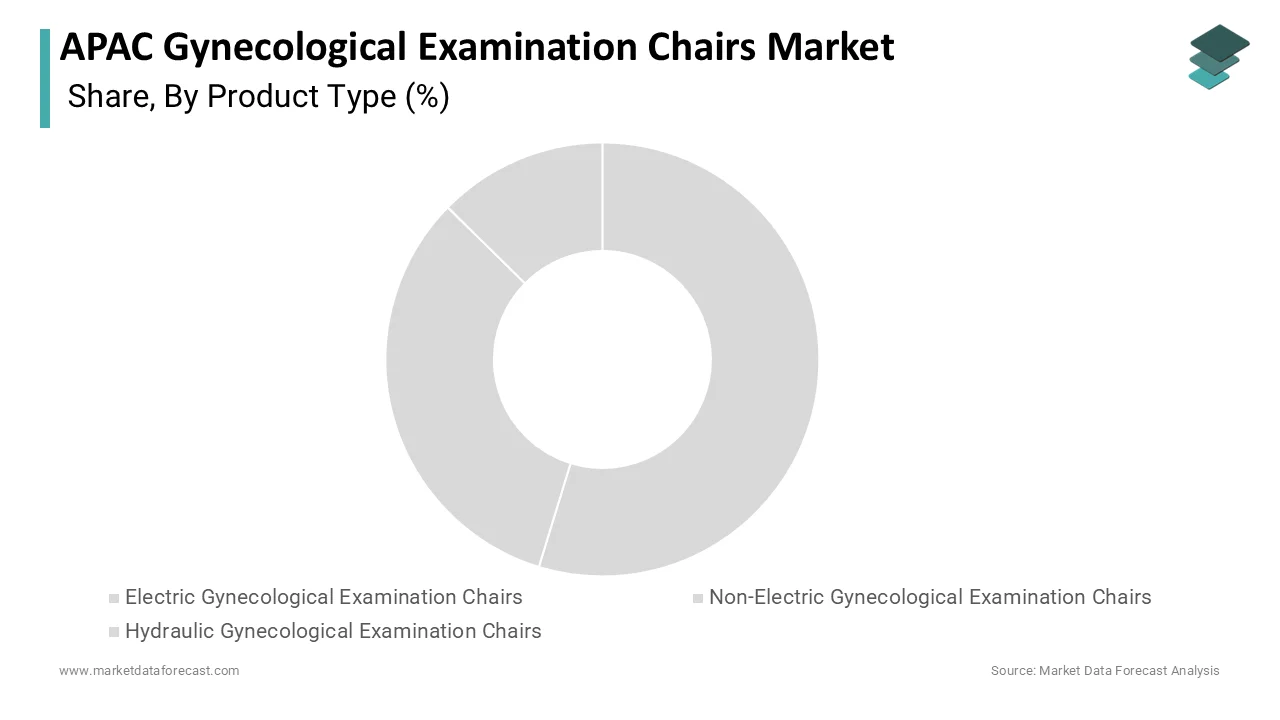
Mechanical simplicity of non-electric examination chairs translates directly to higher functional availability rates in settings lacking biomedical engineering support, extending effective service life beyond powered alternatives. According to the Clinton Health Access Initiative, optimising medical hardware lifecycles inside local health centres depends on structured local preventative service programs rather than relying on external service engineers. As per the Directorate General of Health Services of Bangladesh, medical supply chain management frameworks introduce specialised procurement rules to reduce downstream logistics and maintenance backlogs for regional health units. Training requirements for basic mechanical adjustments can be delivered to auxiliary nurses within four hours versus multi-day certification programs needed for electric system troubleshooting, enabling decentralised maintenance capacity. This reliability advantage makes manual chairs de facto standard in environments where equipment downtime directly compromises maternal health service delivery continuity.
The electric gynaecological examination chairs segment is likely to experience the fastest CAGR of 14.5% from 2026 to 2034 due to rapid expansion of premium private hospital chains and fertility clinics catering to medical tourism and affluent domestic populations across urban Asia Pacific. According to the Ministry of Public Health of Thailand, private tertiary care expansions prioritise advanced robotic and automated patient positioning setups to drive quality indicators for upscale medical tourism hubs. As per Bumrungrad International Hospital, specialized woman’s health infrastructure integrations focus on comprehensive, one-stop medical solutions that leverage cutting-edge diagnostic technology to enhance premium customer care. According to the National Medical Commission of India, modern hospital infrastructure blueprints incorporate ergonomic parameters within reproductive care blocks to elevate patient safety benchmarks during delicate procedures. Medical tourism revenue creates willingness to invest in patient experience enhancements that justify premium pricing through perceived quality differentiation versus basic manual alternatives dominating the public sector.
Demographic ageing among obstetricians and gynaecologists across developed Asia Pacific markets increases demand for electric examination chairs, reducing physical strain during high-volume clinical practice. According to the Korean Medical Association, institutional workplace safety initiatives emphasise proactive physical infrastructure adjustments to mitigate work-induced physical fatigue and strain among female clinical specialists. As per the Ministry of Health of New Zealand, rural primary care fund structures support localised equipment modernisation projects to preserve rural clinical workforce retention and expand care capacity. The demographic imperative transforms electric chairs from luxury items into necessary workplace safety investments, ensuring career longevity for experienced clinicians whose expertise cannot be rapidly replaced amid regional specialist shortages.
By End User Insights
In 2025, the hospitals segment held the majority share in the Asia Pacific gynecological examination chairs market, because of the concentration of facility-based deliveries and surgical procedures requiring multiple examination stations per institution. According to the Indonesian Ministry of Health, national hospital classification and licensing regulations establish strict structural and administrative facility standards to enforce service compliance and quality control. As per the Ministry of Public Health of Thailand, national health statistical monitoring emphasises maternal safety indices to continuously evaluate institutional birth readiness and medical capital sustainability in public hospitals. Even as ambulatory care expands, hospitals retain monopoly over cesarean sections, complicated deliveries, and emergency obstetric interventions, ensuring continued dominance in equipment consumption. This structural centrality of hospital-based maternity care creates a demand floor that smaller end-user categories cannot approach, regardless of growth velocity in alternative care settings.
Academic medical centres embedded within hospital systems generate disproportionate gynaecological examination chair demand through educational training requirements and clinical research protocols absent in purely service delivery facilities. According to the National Medical Commission of India, minimum standard requirements for establishing medical colleges enforce specific infrastructural and space capacities to sustain undergraduate clinical training programs. According to the National Health Commission of China, the multi-tier hospital classification and grading framework evaluates institutional medical hardware, specialised talent, and research capabilities to guide standardisation across teaching hospitals. The academic functions create demand multipliers beyond clinical throughput, ensuring teaching hospitals remain anchor customers for premium and technologically advanced examination chair models that subsequently influence broader market adoption patterns through graduate practitioner familiarity and preference formation.
The diagnostic centres segment is expected to exhibit a noteworthy CAGR of 17.2% during the forecast period owing to national cervical cancer screening initiatives expanding access beyond traditional hospital settings across Asia Pacific. According to the World Health Organisation, the Cervical Cancer Elimination Initiative drives the scaling of national primary and secondary screening services to broaden preventative care availability across developing economies. According to the Ministry of Health and Family Welfare of India, the national health program for non-communicable diseases establishes targeted infrastructure cells within public facilities to support early cancer detection and clinical screenings. The programmatic decentralisation transforms diagnostic centres from ancillary service providers into primary prevention infrastructure nodes, creating equipment demand growth uncorrelated with hospital capital expenditure cycles.
Rapid expansion of assisted reproductive technology clinics across urban Asia Pacific generates premium examination chair demand distinct from general gynaecology applications driving segment growth velocity. According to the International Committee for Monitoring Assisted Reproductive Technologies, global monitoring reports track increasing service volumes and facility capacity updates for specialised fertility care across the Asia-Pacific territory. As per the American Society for Reproductive Medicine, clinical reproduction suites dictate specialised equipment parameters, including advanced visualisation and positioning systems, to maximise procedural safety guidelines. The specialised application segment commands higher unit prices and faster replacement cycles than general diagnostic use, explaining superior growth metrics despite smaller absolute facility counts.
COUNTRY LEVEL ANALYSIS
China Gynecological Examination Chairs Market Analysis
China dominated the Asia Pacific Gynecological Examination Chairs Market and accounted for a 32.4% share in 2025. This dominance of the Chinese market was driven by the world's largest healthcare infrastructure buildout. According to the National Health Commission, China actively upgrades its grass-roots medical infrastructure, medical evaluation furniture, and clinical standards across community and village health clinics to safeguard millions of annual births. As per the National Health Commission, the implementation of the Healthy China 2030 blueprint drives the modernisation and standardised renovation of county-level maternal and child healthcare institutions across China's provinces. Two-child and three-child policy relaxations failed to reverse declining birth rates, yet the government continues infrastructure investment, anticipating future demographic recovery, maintaining demand stability despite utilisation pressures. Provincial centralised procurement platforms aggregate purchasing power, negotiating volume discounts that compress margins but ensure universal equipment access across the urban-rural divide. Manufacturing export orientation also positions Chinese suppliers as dominant exporters to ASEAN, Africa and Latin America, creating dual domestic and international revenue streams insulating against single market cyclicality.
India Gynecological Examination Chairs Market Analysis
India was the next prominent country in the Asia Pacific Gynecological Examination Chairs Market and captured a 24.1% share in 2025. The position of the Indian market was attributed to massive public sector procurement through the National Health Mission and the expansion of emerging private hospitals, which created dual-speed demand dynamics. According to the Ministry of Health and Family Welfare of India, the comprehensive expansion of institutional delivery networks and maternal care infrastructures across district hospitals ensures a steady demand for certified gynaecological and delivery equipment. As per the Ministry of Health and Family Welfare of India, the Ayushman Bharat Health Infrastructure Mission systematically funds the upgrade of thousands of urban and rural health centres to deliver resilient primary care and essential maternal health diagnostics. According to the Ministry of Health and Family Welfare of India, private healthcare operators are expanding specialised tertiary care units and premium women's health wings across major metropolitan hubs to address the rising consumer demand for advanced comfort and diagnostic amenities. Make in India initiative provides price preference for domestically manufactured medical furniture in government tenders. However, state-level implementation variability causes procurement delays. Currency depreciation against the dollar increases imported component costs for electric models, pushing buyers toward manual alternatives despite clinical preference for powered options.
Japan Gynecological Examination Chairs Market Analysis
Japan maintains a noteworthy presence in the Asia-Pacific gynaecological examination chairs market due to mature, replacement-driven demand, stringent regulatory standards, and demographic pressures shaping unique product requirements. According to the Ministry of Economy, Trade and Industry, Japanese Industrial Standards ensure that medical tables and examination apparatuses undergo rigid quality verification to maintain user safety and operational reliability across healthcare facilities. As per the Japan Society of Obstetrics and Gynaecology, evolving nationwide physician workstyle reforms and workplace ergonomics are actively evaluated to minimise physical strain and improve professional working conditions for practitioners. Universal health insurance reimbursement covers examination chair depreciation costs, incentivising regular seven-year replacement cycles versus extended lifespans in cash-constrained markets. Declining birth rates paradoxically increase per-birth equipment intensity as hospitals consolidate services into fewer high-acuity centres requiring more sophisticated examination stations per delivery. Cultural emphasis on patient modesty influences design preferences for enclosed draping systems and quiet motor operation, distinguishing Japanese specifications from other regional markets.
South Korea Gynecological Examination Chairs Market Analysis
South Korea witnesses significant growth in the Asia Pacific Gynecological Examination Chairs Market because of advanced digital health integration, fertility clinic concentration, and KFDA regulatory alignment with international standards. According to the Ministry of Food and Drug Safety, South Korea's medical device exports are continuously expanding into major global markets by leveraging strict product safety certifications and advanced technological refinement. As per the National Health Insurance Service of South Korea, public healthcare policy expands financial support and insurance coverages for fertility and subfertility therapies to assist couples seeking specialised clinical treatments. KFDA Class II medical device classification aligns with EU MDR, facilitating CE marking reciprocity enabling Korean manufacturers Seo Kang Medical and BMT to compete globally without redundant certification costs.
Australia Gynecological Examination Chairs Market Analysis
Australia is a crucial player in the Asia-Pacific gynaecological examination chairs market owing to stringent TGA regulatory oversight, occupational health mandates, and premium pricing tolerance supporting advanced product adoption. According to the Therapeutic Goods Administration, specialised examination furniture and gynaecological chairs must maintain active listings on the Australian Register of Therapeutic Goods following rigorous regulatory compliance audits to ensure patient safety. As per Safe Work Australia, PCBUs possess a strict legislative duty to implement proper ergonomic risk controls and hazard management systems to prevent hazardous manual task injuries among healthcare staff. Medicare Benefits Schedule item numbers for gynaecological consultations implicitly assume appropriate examination equipment availability, creating indirect reimbursement linkage supporting capital investment justification. Geographic dispersion across the continent increases logistics costs, favouring domestic distributors with established service networks over direct import models. Indigenous health equity initiatives fund examination chair deployments in remote Aboriginal communities, addressing historical access gaps through targeted capital grants separate from mainstream procurement channels.
COMPETITIVE LANDSCAPE
Competition within the Asia Pacific gynecological examination chairs market exhibits pronounced stratification characterized by distinct competitive arenas operating under different rules across income tiers and geographic subregions. Premium segments in Japan Australia South Korea and urban China feature oligopolistic competition among multinational manufacturers and sophisticated domestic players competing on technological innovation digital integration and service excellence with limited price sensitivity. Mid tier markets across Southeast Asia and transitioning economies display intense rivalry between Chinese Indian and regional manufacturers where cost performance balance and regulatory compliance determine tender outcomes rather than pure lowest price selection. Low income and donor dependent segments operate under monopsony conditions where multilateral procurement agencies set technical specifications and approved vendor lists creating barriers for suppliers lacking WHO prequalification or UNICEF partnership status. Barriers to entry vary dramatically from minimal in unregulated markets allowing informal workshop production to substantial in jurisdictions requiring clinical validation and post market surveillance favoring established players with regulatory infrastructure. Cultural adaptation requirements create natural moats for locally embedded suppliers understanding patient modesty norms versus global standardizers unable to customize efficiently. Maintenance ecosystem dependencies reward vertically integrated manufacturers controlling spare parts supply chains over importers vulnerable to disruption. This multi layered competitive landscape prevents unified regional strategy forcing participants to maintain parallel business models tailored to specific country contexts rather than pursuing homogeneous pan Asia Pacific approach common in more integrated markets.
KEY MARKET PLAYERS
Some of the companies that are playing a dominating role in the APAC Gynecological Examination Chairs Market include:
- Malvestio
- Medifa-Hesse AG
- Harbin Howell
- Oakworks Medicals
- Inmoclinc S.A.
- Favero Health Projects
- Hidemar
- Combed
TOP LEADING PLAYERS IN THE MARKET
- Narang Medical Limited maintains significant influence across the Asia Pacific gynecological examination chairs market through cost competitive manufacturing and extensive distribution networks serving public health procurement programs in developing nations. The company contributes regionally by supplying WHO prequalified examination furniture to government tenders in India Bangladesh Nepal and African markets leveraging Delhi based production facilities optimized for high volume standardized designs meeting international safety standards. Their partnership with UNICEF Supply Division facilitates bulk procurement for maternal health programs in Pacific Island nations reducing logistics costs through consolidated shipping arrangements. Strategic participation in ASEAN medical device harmonization working groups ensures regulatory alignment across emerging markets accelerating cross border market access. These initiatives reinforce operational accessibility and affordability leadership without relying on market share metrics to demonstrate sustained competitive advantage in resource constrained healthcare environments throughout South and Southeast Asia where price sensitivity dominates procurement decisions.
- Zhangjiagang Medwish Medical Products Co Ltd plays a pivotal role in the Asia Pacific gynecological examination chairs ecosystem through vertically integrated manufacturing combining metal fabrication upholstery and electrical assembly under single facility control enabling rapid customization for diverse regional requirements. The company contributes extensively by exporting to Asia Pacific countries with product portfolios spanning basic manual tables for primary care centers to advanced electric lithotomy chairs for tertiary hospitals reflecting comprehensive market coverage across income segments. Their Jiangsu province manufacturing base benefits from Yangtze River Delta supply chain clustering reducing component lead times versus competitors reliant on dispersed suppliers. Collaboration with Indonesian and Vietnamese distributors enables localized assembly of semi knock down kits circumventing import tariffs while maintaining quality control through centralized core component production. This vertical integration strategy creates cost advantages and supply resilience distinguishing Medwish from trading companies lacking manufacturing depth in price sensitive Asia Pacific procurement landscapes.
- Surgicoal International has established substantial presence in Asia Pacific gynecological examination chairs market through specialization in culturally adapted designs addressing modesty concerns and ergonomic preferences specific to South and Southeast Asian patient populations. The company contributes uniquely by offering enclosed curtain integrated examination chairs heated seating surfaces and female operator friendly controls that increase screening uptake in conservative communities according to published patient satisfaction studies across Pakistan Bangladesh and Malaysia. Their Lahore manufacturing facility serves as regional hub for South Asia reducing delivery times versus Chinese competitors while avoiding Indian import restrictions affecting cross border trade. Investment in biomedical engineering training programs for local technicians in Nepal and Sri Lanka addresses maintenance capacity gaps that historically caused premature equipment failure in donated furniture programs. This human centered localization strategy creates defensible niche positioning against mass market competitors unable or unwilling to adapt products for cultural specificity driving patient compliance and repeat procurement in sensitivity driven markets.
TOP STRATEGIES USED BY KEY MARKET PARTICIPANTS
Key players in the Asia Pacific gynecological examination chairs market employ multifaceted strategic approaches to navigate extreme heterogeneity in purchasing power regulatory maturity and cultural expectations across the region. Cost leadership through vertical integration and localized assembly enables participation in price sensitive public sector tenders dominating developing nation procurement while preserving margins through manufacturing efficiency rather than premium pricing. Cultural adaptation of product designs including modesty features ergonomic adjustments and religious accommodation elements creates differentiation in conservative markets where patient comfort directly influences screening compliance and facility preference. Regulatory navigation through proactive engagement with ASEAN harmonization initiatives and bilateral mutual recognition agreements accelerates market access across fragmented jurisdictions reducing time to revenue versus reactive compliance approaches. After sales service ecosystem development including technician training spare parts depots and remote diagnostic support addresses maintenance infrastructure gaps that historically undermined equipment sustainability building long term customer loyalty beyond transactional sales relationships. Digital health integration embedding teleconsultation capabilities and AI assisted diagnostics transforms static furniture into connected care platforms generating recurring software revenue streams and positioning suppliers as technology partners rather than commodity vendors. Strategic partnerships with multilateral agencies and government health ministries secure preferred supplier status in donor funded programs providing volume stability independent of commercial market cyclicality. These interconnected strategies collectively address fundamental Asia Pacific market dynamics where affordability cultural relevance and operational sustainability determine competitive success beyond technical specifications alone.
MARKET SEGMENTATION
This research report on the Asia Pacific Gynecological Examination Chairs Market has been segmented and sub-segmented into the following categories:
By Product Type
- Electric Gynecological Examination Chairs
- Non-Electric Gynecological Examination Chairs
- Hydraulic Gynecological Examination Chairs
By End User
- Hospitals
- Diagnostic Centers
- Acute Care Centers
- Ambulatory Surgical Centers
- Clinics
By Country
- China
- India
- Japan
- South Korea
- Australia
- New Zealand
- Thailand
- Indonesia
- Philippines
- Vietnam
- Singapore
- Rest of APAC