- Product Description Description
- Table of Contents TOC
- List of Table & Figure LOT
- Get Free Sample PDF Sample PDF
Market Size, 2025
$1.24 BnMarket Estimate, 2026
$1.30 BnMarket Forecast, 2034
$1.88 BnCAGR, 2026–2034
4.75%Asia Pacific Icing and Frosting Market Size
The Asia Pacific Icing and Frosting Market size was expected to be worth USD 1.24 billion in 2025 and is anticipated to be worth USD 1.88 billion by 2034 from USD 1.30 billion in 2026, growing at a CAGR of 4.75% during the forecast period.
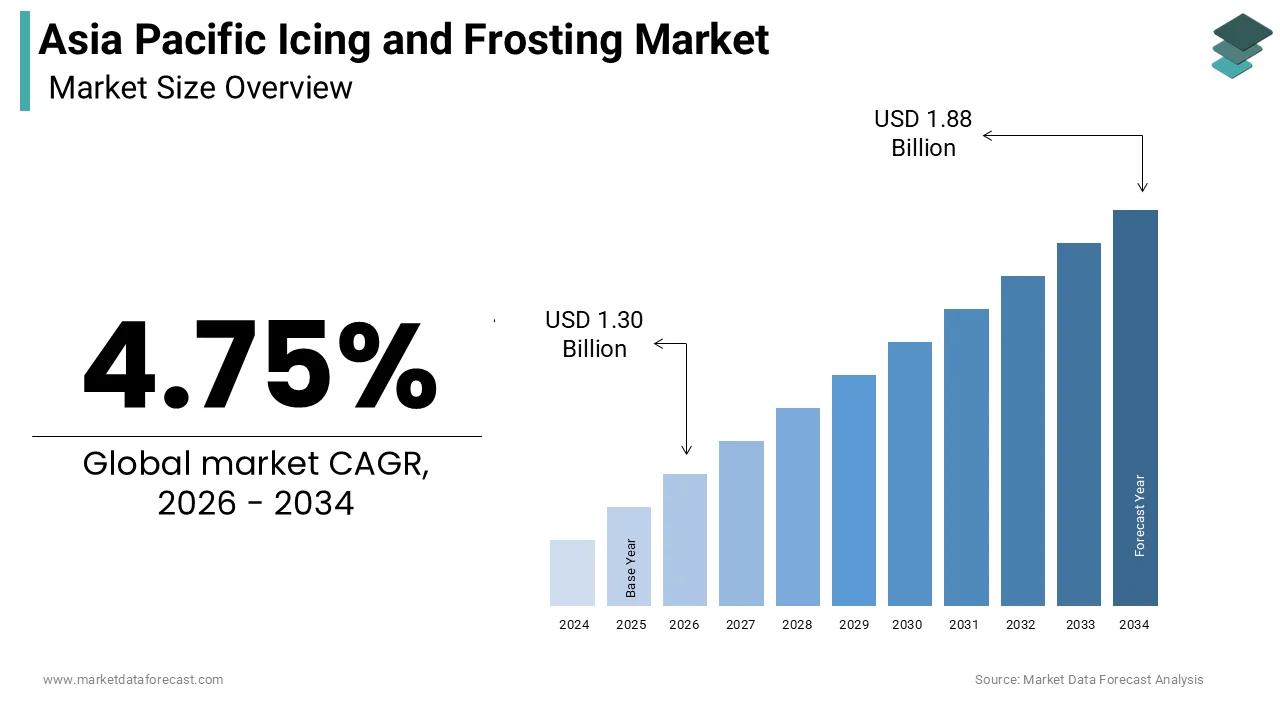
Icing and frosting comprise a diverse range of sweet toppings used to enhance the visual appeal, texture, and flavor of baked goods such as cakes, cupcakes, donuts, and pastries. These products are formulated using ingredients like sugar, fats, milk solids, and stabilizers, available in various forms, including ready-to-use, dry mix, and frozen varieties. The region is witnessing a significant shift in consumer behavior driven by urbanization and the westernization of dietary habits, leading to increased consumption of convenience foods and celebratory baked items. According to the Organisation for Economic Co-operation and Development, Asia is projected to account for 64% of the incremental global sugar demand through 2034, which reflects a growing preference for sweetened food products. As per reports from Mintel and various industry studies, the bakery sector in emerging economies like India and China is expanding, with premium and packaged bakery goods witnessing a steady increase in retail demand. This expansion is further supported by the proliferation of international bakery chains and local artisanal bakeries that prioritize aesthetic presentation, thereby driving demand for high-quality icings and frostings. The rise of social media platforms has also amplified the importance of visually appealing food, which is encouraging both commercial bakers and home enthusiasts to invest in premium decorating solutions. Regulatory bodies in countries such as Japan and Australia enforce strict standards on food additives and labeling, ensuring product safety and quality. These factors collectively create a dynamic environment where innovation in flavor profiles and clean label formulations plays a crucial role in shaping market dynamics across the Asia Pacific region.
MARKET DRIVERS
Surging Demand for Convenience and Ready-to-Eat Bakery Products
The accelerating pace of urban life in the Asia Pacific region has led to a substantial increase in the demand for convenience foods, particularly ready-to-eat bakery items that require minimal preparation time, which is a key market driver. Consumers are increasingly opting for pre-decorated cakes, donuts, and pastries from supermarkets and specialty stores due to their ease of access and consistent quality. For instance, the Southeast Asia bakery products market is projected to grow at a CAGR of 6.36% through 2034 due to the busy lifestyles and evolving consumer preferences. As per the Asian Development Bank, the rising middle class in countries like Vietnam and Indonesia has higher disposable income to spend on premium convenience foods, including those adorned with intricate icings and frostings. This trend encourages manufacturers to produce ready-to-use icing tubes and tubs that allow for quick application without the need for skilled labor. The availability of these products in modern retail outlets and e-commerce platforms further boosts their accessibility. Additionally, the growth of the food service sector, including cafes and quick service restaurants, relies heavily on standardized icing solutions to maintain efficiency and consistency in high-volume operations. The shift away from traditional home baking towards purchasing finished goods ensures a steady demand for industrial and retail-ready icing products, making convenience a primary driver of market expansion in the region.
Influence of Social Media and Visual Food Culture
The pervasive influence of social media platforms has transformed food consumption into a visual experience, which is significantly driving the demand for aesthetically pleasing baked goods adorned with vibrant icings and frostings and contributing to the regional market expansion. Platforms such as Instagram and TikTok have popularized trends like drip cakes, mirror glazes, and elaborate cupcake designs, compelling bakeries and home bakers to prioritize decorative elements. According to data from the International Telecommunication Union, internet and social media penetration in the Asia Pacific region continues to rise rapidly, creating a massive audience for food-related content. As per a survey by Mintel, a significant portion of younger consumers in Asia stated that they are more likely to purchase food items that are visually appealing and shareable online. This phenomenon has led to an increased demand for colorful, textured, and innovative icing products that stand out in digital feeds. Bakeries are investing in high-quality frostings that hold their shape and color under various lighting conditions to maximize visual impact. Furthermore, the rise of influencer marketing encourages brands to launch limited-edition flavors and designs that generate buzz and drive foot traffic. The need for photogenic desserts has elevated icing from a mere topping to a central component of product differentiation, which is fuelling growth in the premium and specialty segments of the market.
MARKET RESTRAINTS
Growing Health Consciousness and Sugar Reduction Trends
The increasing awareness of health and wellness among consumers in the Asia-Pacific region is a significant restraint to the Asia-Pacific icing and frosting market expansion, which is typically high in sugar and saturated fats. Governments and health organizations are actively campaigning against excessive sugar consumption to combat rising rates of obesity, diabetes, and cardiovascular diseases. According to the International Diabetes Federation, the prevalence of diabetes in the Western Pacific Region reached 11.9% in 2021, prompting stricter dietary guidelines and public education initiatives. As per the Ministry of Health in Singapore, the implementation of sugar reduction frameworks and nutritional labeling has influenced consumer choices, leading to an increased demand for lower sugar confectionery products. Many consumers are actively seeking low-sugar and keto-friendly or natural alternatives, which traditional icings often fail to provide. This shift forces manufacturers to reformulate products using alternative sweeteners, which can affect taste, texture, and cost. The perception of icing as an unhealthy indulgence limits its frequency of consumption, particularly among health-conscious demographics. Additionally, parents are increasingly restricting sugary treats for children, reducing household demand. Until the industry can widely adopt clean-label and reduced-sugar formulations that do not compromise on sensory appeal, health concerns will continue to hinder market growth and limit the expansion of traditional icing products.
Volatility in Raw Material Prices and Supply Chain Disruptions
The volatility in prices of key raw materials such as sugar, palm oil, and dairy derivatives that directly impact production costs and profit margins is further hindering the regional market expansion. These commodities are subject to global market fluctuations influenced by weather conditions, geopolitical tensions, and trade policies. According to the World Bank, food price indices have experienced sharp increases in recent years, with sugar and vegetable oil prices reaching historic highs due to supply constraints. As per the International Sugar Organization, production shortfalls in major exporting countries have led to price instability, forcing manufacturers to either absorb costs or pass them on to consumers. In the Asia Pacific region, reliance on imported ingredients exacerbates this vulnerability, particularly for countries with limited domestic production capabilities. Supply chain disruptions, such as those caused by logistical bottlenecks or regional conflicts, further complicate procurement and inventory management. Small and medium-sized enterprises often lack the financial resilience to withstand prolonged price spikes, leading to reduced output or product discontinuation. The unpredictability of input costs makes long-term pricing strategies difficult, affecting competitiveness. Manufacturers must constantly adjust formulations and sourcing strategies to mitigate risks, but the inherent instability of agricultural commodity markets remains a persistent restraint on the consistent growth and profitability of the icing and frosting sector.
MARKET OPPORTUNITIES
Expansion of Plant-Based and Vegan Product Lines
The rising popularity of plant-based diets and veganism in the Asia Pacific region presents a lucrative opportunity for manufacturers to develop and expand their portfolio of dairy-free and egg-free icing products. Traditional frostings often contain butter, milk, or egg whites, which exclude a growing segment of consumers who follow ethical, religious, or health-driven dietary restrictions. For instance, the vegan food market in the Asia Pacific is expected to register a promising CAGR over the forecast period due to the increasing awareness of animal welfare and environmental sustainability. As per the Good Food Institute, there is a surge in demand for vegan alternatives in countries like Australia, India, and China, where consumers are actively seeking cruelty-free options. Manufacturers can capitalize on this trend by formulating icings using coconut oil, almond milk, soy protein, and other plant-based fats that mimic the texture and mouthfeel of traditional dairy products. Innovations in emulsification technology allow for stable and creamy vegan frostings that perform well in various climatic conditions. Labeling these products as vegan certified can enhance their appeal to conscientious consumers and open up new distribution channels in health food stores and specialty boutiques. By addressing this underserved niche, companies can differentiate their brands and capture a loyal customer base that values inclusivity and sustainability in their food choices.
Innovation in Clean Label and Natural Ingredient Formulations
There is a significant opportunity for growth in the Asia Pacific icing and frosting market through the development of clean-label products that utilize natural ingredients and avoid artificial additives. Consumers are becoming increasingly scrutinizing of ingredient lists, preferring products free from synthetic colors, flavors, and preservatives. According to Nielsen, a large majority of consumers in the Asia Pacific region prefer food products with recognizable and natural ingredients, driving demand for transparency in manufacturing. As per the Food Safety and Standards Authority of India, regulatory bodies are tightening norms on artificial additives, encouraging manufacturers to seek natural alternatives. Companies can innovate by using fruit purees, vegetable extracts, and natural sweeteners like stevia or monk fruit to create vibrant and flavorful icings. For instance, beetroot powder can provide red hues, while turmeric offers yellow tones, eliminating the need for synthetic dyes. These natural formulations appeal to health-conscious parents and premium bakery segments that prioritize quality and purity. Additionally, clean-label products often command higher price points, improving profit margins for manufacturers. Collaborating with local suppliers of natural ingredients can also reduce supply chain risks and support regional agriculture. By aligning with the clean label movement, brands can build trust and loyalty among consumers who prioritize health and authenticity, positioning themselves as leaders in the evolving market landscape.
MARKET CHALLENGES
Stringent Regulatory Compliance and Labeling Requirements
Navigating the complex and varied regulatory landscape across different countries in the Asia Pacific region poses a significant challenge for icing and frosting manufacturers. Each country has its own set of food safety standards, permissible additive lists, and labeling requirements, which can be inconsistent and frequently updated. According to the Asia Pacific Economic Cooperation, harmonizing food regulations remains an ongoing challenge, requiring companies to adapt their formulations and packaging for each market entry. As per the Codex Alimentarius, strict limits on certain food colorants and preservatives vary significantly between nations such as Japan, Australia, and Indonesia. Compliance with these diverse regulations requires extensive testing, documentation, and legal expertise, increasing operational costs and time to market. Failure to comply can result in product recalls, fines, and reputational damage. Additionally, the requirement for detailed nutritional information and allergen warnings adds complexity to packaging design and production processes. Small and medium-sized enterprises often struggle to keep up with these regulatory changes, limiting their ability to expand internationally. The need for continuous monitoring of legislative updates and investment in compliance infrastructure acts as a barrier to agility and innovation. Manufacturers must balance the desire for broad market reach with the burden of regulatory adherence, making it a critical operational challenge in the region.
Intense Competition from Local Artisanal and Homemade Alternatives
The Asia Pacific icing and frosting market faces intense competition from a thriving sector of local artisanal bakers and homemade producers who offer customized and fresh alternatives to mass-produced products. The low barrier to entry for home baking businesses, facilitated by social media and delivery apps, has led to a proliferation of small-scale operators who prioritize fresh ingredients and personalized service. According to various regional reports on the gig economy and food services, orders from independent home bakers in Southeast Asia have seen double-digit growth in recent years, indicating a strong consumer preference for bespoke creations. As per national statistics departments in the region, the number of registered home-based food businesses has surged, offering unique flavors and designs that large manufacturers cannot easily replicate. These artisanal providers often use high-quality, local ingredients and avoid preservatives, appealing to consumers seeking authenticity and freshness. They can quickly adapt to trending flavors and designs, maintaining a competitive edge in terms of relevance and novelty. Large manufacturers struggle to match this level of customization and personal connection, often perceived as impersonal or industrial. This fragmentation of the market dilutes the share of established brands and pressures them to innovate continuously to retain customer loyalty. The agility and community focus of local competitors present a persistent challenge to scalable industrial players in the icing and frosting sector.
REPORT COVERAGE
| REPORT METRIC | DETAILS |
| Market Size Available | 2025 to 2034 |
| Base Year | 2025 |
| Forecast Period | 2026 to 2034 |
| CAGR | 4.75% |
| Segments Covered | By Product Type, Application, and Region |
| Various Analyses Covered | Global, Regional & Country Level Analysis; Segment-Level Analysis; DROC, PESTLE Analysis; Porter’s Five Forces Analysis; Competitive Landscape; Analyst Overview of Investment Opportunities |
| Regions Covered | India, China, Japan, South Korea, Australia, New Zealand, Thailand, Malaysia, Vietnam, Philippines, Indonesia, Singapore, and the Rest of APAC |
| Market Leaders Profiled | Wilton Industries, Dawn Food, Real Good Food, Lawrence Foods, Dixie’s Icing, Macphie, Kelmyshop, Orchardicing, Rich Product, Betty Crocker, Pinnacle Foods, and Fruit Fillings are the leaders in the Asia Pacific Icing and Frosting market. |
SEGMENTAL ANALYSIS
By Product Type Insights
The buttercream frosting segment held the major share of the regional market in 2025 and is likely to remain the leading segment in the Asia Pacific icing and frosting market over the next few years due to its versatility, rich flavor profile, and widespread acceptance in both commercial and home baking applications. This type of frosting, made primarily from butter and sugar, offers a smooth texture that is easy to pipe and spread, making it ideal for cakes, cupcakes, and pastries. According to the International Dairy Federation, dairy consumption in the Asia Pacific region continues to rise, reflecting a growing preference for dairy-based ingredients in confectionery. As per industry data from the Australian bakery sector, a majority of decorated cakes sold in retail outlets utilize buttercream as the primary coating due to its stability at room temperature and compatibility with various flavor infusions such as vanilla, chocolate, and fruit extracts. The rise of Western-style bakeries in urban centers across China and India has further cemented buttercream as the standard for celebration cakes. Its ability to hold intricate designs makes it a favorite among professional decorators who cater to the visual demands of social media-driven consumers. Additionally, the availability of high-quality unsalted butter in local markets supports consistent production quality. The familiarity of buttercream taste among Asian consumers, who are increasingly adopting Western dessert preferences, ensures its continued dominance. Manufacturers benefit from established supply chains for dairy ingredients, allowing for cost-effective production and wide distribution. This combination of functional ease, sensory appeal, and cultural adaptation solidifies buttercream as the cornerstone of the regional icing market.
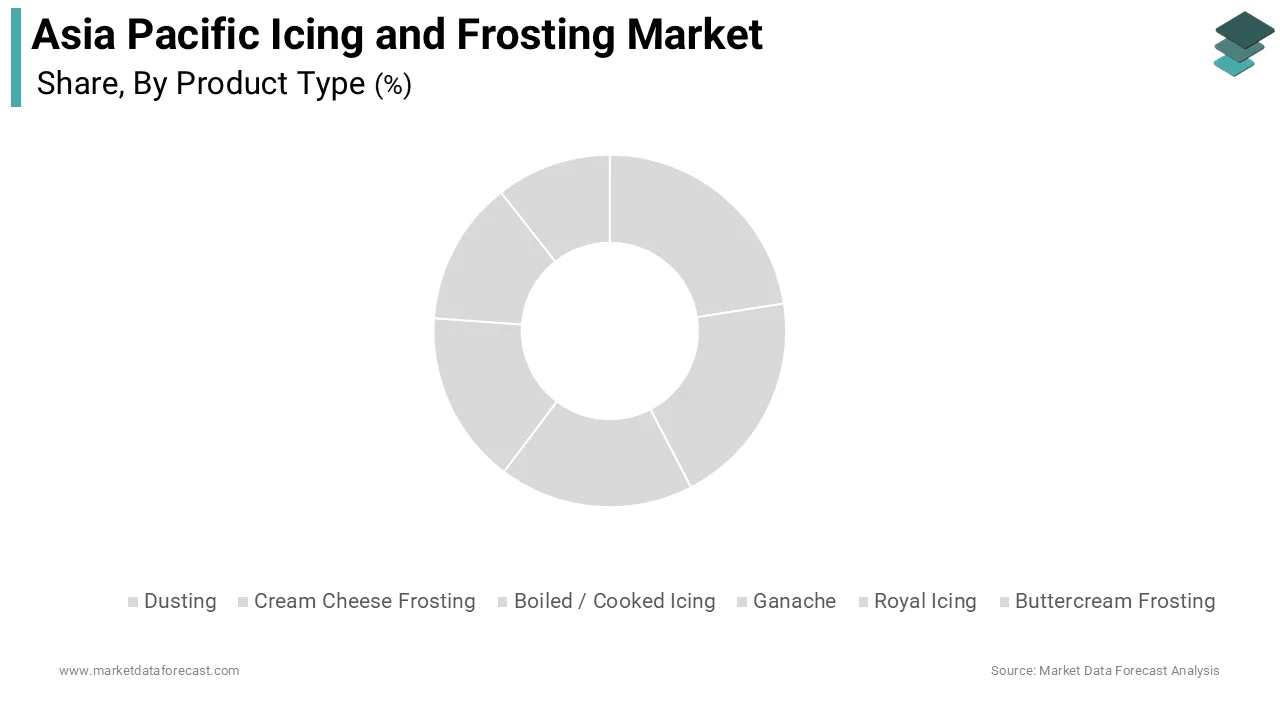
On the other hand, the ganache segment is anticipated to witness the fastest CAGR in the Asia Pacific icing and frosting market over the forecast period as premiumization becomes a key trend. Ganache, a mixture of chocolate and cream, offers a luxurious texture and intense flavor that appeals to affluent consumers seeking indulgent treats. For instance, the bakery products market inthe Asia Pacific is expected to grow at a healthy CAGR over the forecast period, with premium segments like chocolate-based toppings seeing accelerated interest. As per data from cocoa research institutes, consumption of dark and premium chocolate has risen significantly, with consumers associating it with higher quality and sophistication. This trend encourages bakeries to incorporate ganache into high-end cakes, tarts, and macarons, differentiating their offerings from standard buttercream-coated items. The versatility of ganache allows it to be used as a glaze, filling, or whipped topping, catering to diverse culinary applications. Social media platforms showcase glossy chocolate finishes, driving consumer desire for visually striking desserts. Furthermore, the perception of chocolate as a mood enhancer and gift item boosts its usage in celebratory contexts. Manufacturers are innovating with single-origin chocolates and unique flavor pairings like matcha or yuzu to attract niche markets. The ability of ganache to convey premium quality justifies higher price points, encouraging bakeries to adopt it extensively. These factors collectively propel ganache as the fastest-growing segment, reflecting the evolving tastes and spending power of Asian consumers.
By Application Insights
The bakery segment had the leading share of the regional market in 2025 and is expected to continue dominating the Asia Pacific icing and frosting market for the next few years due to the extensive use of these toppings in commercial cake and pastry production. Bakeries, ranging from large industrial facilities to small artisanal shops, rely on icing and frosting to enhance product appeal, extend shelf life, and add value. For instance, the bakery products market in the Asia Pacific is set to reach a valuation of approximately USD 294.61 billion by 2031. As per the China Bakery Association, the number of branded bakery chains has expanded rapidly, with each outlet requiring consistent supplies of ready-to-use or mix-based icings to maintain brand standards. The demand for birthday cakes, wedding cakes, and seasonal pastries creates a steady volume requirement for various types of frostings. Industrial bakeries prefer bulk formulations that offer stability and ease of automation, while independent shops seek customizable options for creative designs. The integration of icing into packaged bakery products, such as donuts and sweet buns, further drives volume. Retailers prioritize visually attractive products to drive impulse purchases, making icing a critical component of sales strategy. The standardized nature of bakery operations allows for efficient procurement and usage of icing products, ensuring this segment remains the primary revenue generator for manufacturers. The continuous opening of new bakery outlets in emerging markets sustains this dominance.
However, the restaurant segment is likely to experience the fastest CAGR in the Asia Pacific icing and frosting market over the forecast period as food service outlets prioritize decadent dessert offerings over the next few years. Restaurants, cafes, and quick service outlets are increasingly offering signature desserts that feature elaborate icing and frosting work to enhance the dining experience and justify premium pricing. According to industry analysis, the food service market in the Asia Pacific is experiencing robust growth, with dessert sales contributing significantly to overall revenue. As per recent industry reports, the adoption of western-style desserts in full-service restaurants has increased, driving demand for high-quality, stable frostings that can withstand plating and service conditions. Chefs are experimenting with artistic presentations, using piping bags and molds to create intricate designs that appeal to diners. The rise of dessert-focused cafes and specialty patisseries within restaurant complexes further amplifies this trend. Restaurants require icings that offer consistent performance in varying temperatures and humidity levels, prompting suppliers to develop specialized formulations. The emphasis on experiential dining encourages operators to invest in premium ingredients, including artisanal frostings. Additionally, the growth of delivery services requires frostings that maintain integrity during transport, creating opportunities for innovative products. This dynamic environment positions the restaurant segment as a key driver of rapid growth and innovation in the market.
REGIONAL ANALYSIS
China Icing and Frosting Market Analysis
China had the leading share of the Asia-Pacific icing and frosting market in 2025 and is expected to remain the largest market for icing and frosting in the Asia-Pacific region over the forecast period as its modernized bakery industry continues to scale over the next few years. The country has seen a surge in demand for Western-style baked goods, particularly among the younger demographic in tier one and tier two cities. According to the USDA Foreign Agricultural Service, the market for baking ingredients in China is projected to grow at a compound annual growth rate of about 7.8% through 2030. As per the China Confectionery and Biscuit Industry Association, the proliferation of international bakery chains and local brands has standardized the use of buttercream and ganache in mass-produced cakes. The rising middle class is willing to spend on premium desserts for celebrations, driving volume in the commercial sector. E-commerce platforms facilitate the distribution of ready-to-use icing products to home bakers, expanding the consumer base. Government regulations on food safety have led to stricter quality controls, favoring established manufacturers with compliant supply chains. The integration of digital marketing and social media trends accelerates the adoption of visually appealing frosting styles. China’s robust manufacturing infrastructure supports the production of cost-effective icing mixes, making them accessible to a wide range of consumers. The market is characterized by intense competition and rapid innovation, with players constantly introducing new flavors and textures to meet evolving tastes.
India Icing and Frosting Market Analysis
India is likely to witness significant growth in its icing and frosting market as the organized bakery sector expands further over the next few years. Traditionally, Indian sweets were syrup-based, but there is a significant shift toward cream and frosting-based desserts, especially in urban areas. For instance, the bakery product market in India has been a significant revenue contributor, with cakes and pastries identified as the most lucrative segment. As per the Ministry of Food Processing Industries, government initiatives to support food processing have encouraged the establishment of modern baking facilities that utilize standardized icing products. The wedding and celebration market is a major driver, with elaborate cakes becoming a staple event feature. Local manufacturers are adapting global recipes to suit Indian palates, incorporating flavors like cardamom, mango, and rose into frostings. The availability of affordable raw materials such as sugar and vegetable fats supports cost-effective production. However, the market remains fragmented with many small-scale, unorganized players. The growing awareness of hygiene and quality is pushing consumers toward branded products. Digital penetration allows smaller bakeries to access premium icing supplies, fostering growth in the semi-urban regions. India’s young population and changing lifestyle habits ensure sustained demand for innovative and affordable icing solutions.
Japan Icing and Frosting Market Analysis
Japan is projected to maintain a mature and sophisticated segment of the Asia Pacific icing and frosting market, focusing on high-quality standards and delicate flavors over the next few years. The Japanese bakery industry is highly developed, with a strong emphasis on precision and aesthetics in dessert presentation. According to the Japan Bakery Products Association, the demand for premium shortcakes and chiffon cakes, which rely heavily on light whipped cream and subtle frostings, remains robust. As per the Ministry of Agriculture, Forestry, and Fisheries, consumers prioritize natural ingredients and clean labels, driving manufacturers to reduce artificial additives and sugar content. The influence of French and European patisserie techniques has led to the widespread use of ganache and buttercream in high-end establishments. Seasonal variations play a crucial role, with limited edition flavors tied to cherry blossoms or autumn harvests driving periodic spikes in demand. The aging population prefers smaller portion sizes and healthier options, prompting innovation in low-sugar and plant-based frostings. Retail convenience stores offer a wide array of pre-packaged, decorated cakes, ensuring consistent volume sales. Japanese consumers are discerning and willing to pay for quality, supporting a premium market segment. The focus on craftsmanship and attention to detail distinguishes the Japanese market, requiring suppliers to maintain exceptional consistency and quality in their icing products.
South Korea Icing and Frosting Market Analysis
South Korea is likely to remain a dynamic and trend-driven market for icing and frosting in the Asia Pacific region, characterized by its vibrant cafe culture and rapid innovation over the next few years. The country has a high density of bakeries and cafes, particularly in Seoul, where visual appeal is paramount. According to industry reports, spending on out-of-home dining and desserts has increased significantly, with Instagram-worthy cakes driving foot traffic. As per the Korean Food Industry Association, there is a strong preference for innovative flavors and textures, such as mochi-infused frostings or matcha-glazed donuts. The influence of pop culture and celebrity endorsements accelerates the adoption of new dessert trends, creating rapid cycles of demand for specific icing styles. Home baking has also gained popularity, with consumers purchasing DIY icing kits and tools. The market is highly competitive, with brands constantly launching new products to capture consumer attention. Health consciousness is rising, leading to demand for low-calorie and natural ingredient options. South Korean manufacturers are quick to adapt to global trends, often introducing unique fusion flavors that blend traditional Korean ingredients with Western frosting techniques. The fast-paced nature of the market requires agility and continuous innovation from suppliers to remain relevant and competitive.
Australia Icing and Frosting Market Analysis
Australia is expected to continue its role as a stable and quality-focused market for icing and frosting in the Asia Pacific region over the next few years. The country has a well-established bakery sector with a focus on fresh, locally sourced ingredients. According to the Australian Bureau of Statistics, household expenditure on bakery products remains consistent, with a growing interest in gourmet and specialty items. As per the Baking Industry Association of Australia, there is a rising demand for clean-label and organic icings, reflecting consumer concerns about health and sustainability. The prevalence of outdoor dining and casual cafes drives the consumption of cupcakes, muffins, and slices topped with various frostings. Australian consumers are educated about food quality and are willing to pay premium prices for ethically sourced and naturally flavored products. The market sees a strong presence of independent bakeries that prioritize craftsmanship and unique flavor profiles. Regulatory standards for food safety and labeling are strict, ensuring high-quality products. The influence of multiculturalism introduces diverse flavors into the icing market, such as native bush fruits or Asian inspired twists. Australia’s mature market focuses on quality differentiation and sustainability, offering opportunities for premium and niche icing products.
COMPETITION OVERVIEW
The competition in the Asia Pacific icing and frosting market is characterized by a mix of multinational corporations and local regional players who compete on quality, price, and innovation. Large global companies leverage their extensive research capabilities and supply chain efficiencies to offer consistent and high-performance products. Local manufacturers often compete by providing customized solutions and lower prices tailored to specific regional tastes and budget constraints. The market sees intense rivalry in the premium segment, where brands differentiate through clean label and organic certifications. Price sensitivity remains a critical factor in emerging markets, prompting companies to optimize cost structures without compromising quality. Intellectual property protection for unique formulations and flavors is increasingly important as innovation accelerates. Distribution networks play a vital role in reaching remote areas and ensuring product availability. Customer service and technical support are key differentiators as bakers seek guidance on product application. The rise of e-commerce has lowered barriers to entry for niche brands, increasing market fragmentation. Companies must continuously innovate and adapt to changing consumer preferences to maintain their market position in this competitive landscape.
KEY MARKET PLAYERS
A few major players in the Asia Pacific icing and frosting market include
- Wilton Industries
- Dawn Food
- Real Good Food
- Lawrence Foods
- Dixie’s Icing
- Macphie
- Kelmyshop
- Orchardicing
- Rich Product
- Betty Crocker
- Pinnacle Foods
- Fruit Fillings
Top Strategies Used by Key Market Participants
Key players in the Asia Pacific icing and frosting market primarily focus on product innovation and localization to meet diverse regional preferences. Companies invest heavily in research and development to create clean-label, vegan, and heat-stable formulations that address specific climatic and dietary needs. Strategic partnerships with local bakeries and distributors help manufacturers gain market insights and expand their reach in emerging economies. Expansion of production facilities in key countries reduces logistics costs and ensures the timely delivery of fresh products. Marketing efforts emphasize visual appeal and ease of use to attract both professional bakers and home enthusiasts. Sustainability initiatives such as sourcing ethical ingredients and reducing packaging waste enhance brand reputation. Digital engagement through social media and online tutorials builds community and drives consumer interest. These strategies enable companies to differentiate their offerings and maintain competitive advantages in a dynamic and growing market.
Leading Players in the Asia Pacific Icing and Frosting Market
- Puratos Asia Pacific Pte Ltd is a leading supplier of bakery ingredients with a strong focus on innovation and quality in the icing and frosting segment. The company provides a wide range of ready-to-use frostings, fillings, and decorative solutions tailored to the diverse tastes of Asian consumers. Recently, Puratos has expanded its research and development capabilities in Singapore to create localized flavors such as matcha and durian. They have strengthened their market position by partnering with major bakery chains to offer customized product solutions. Their commitment to sustainability drives the development of clean-label and plant-based icing options. By investing in technical training for bakers, Puratos ensures proper utilization of its products. This strategic focus on customization and education solidifies their reputation as a trusted partner for professional bakers across the region.
- Cargill Incorporated leverages its global supply chain expertise to provide high-quality fats and sugars essential for premium icing and frosting production. The company offers specialized fat blends that enhance the texture and stability of frostings in tropical climates. Recently, Cargill has launched new plant-based frosting bases in India and China to meet the growing demand for vegan alternatives. They have invested in digital platforms that allow customers to access formulation support and nutritional data easily. By collaborating with local suppliers, Cargill ensures consistent raw material quality and cost efficiency. Their focus on health-conscious formulations includes reduced sugar and trans fat free options. This comprehensive approach enables Cargill to serve both industrial manufacturers and artisanal bakers effectively, strengthening its leadership in the ingredient supply chain.
- Fuji Oil Holdings Inc is a prominent player known for its advanced emulsification technologies that improve the performance of icings and frostings. The company supplies specialized oils and creamers that provide superior mouthfeel and shelf stability to baked goods. Recently, Fuji Oil has introduced new heat-resistant frosting formulations designed specifically for the humid conditions of Southeast Asia. They have expanded their manufacturing facilities in Thailand to increase production capacity and reduce lead times. By engaging directly with pastry chefs through workshops, Fuji Oil gathers valuable insights for product improvement. Their emphasis on technical innovation allows them to offer unique solutions for complex decorating needs. This customer-centric strategy enhances brand loyalty and positions Fuji Oil as a key innovator in the Asia Pacific icing and frosting market.
RECENT HAPPENING NEWS IN THE MARKET
- In March 2024, Puratos Asia Pacific Pte Ltd launched a new line of vegan frostings in Singapore. This launch is anticipated to allow Puratos to capture the plant-based segment and strengthen the Asia Pacific Icing and Frosting Market presence.
- In June 2023, Cargill Incorporated opened a new application center in Mumbai to support local bakers. This opening is anticipated to allow Cargill to provide better technical service and strengthen its Asia Pacific Icing and Frosting Market presence.
- In September 2023, Fuji Oil Holdings Inc introducedheat-resistantt icing formulas for Southeast Asia. This introduction is anticipated to allow Fuji Oil to address climate challenges and strengthen the Asia Pacific Icing and Frosting Market.
- In January 2024, a leading regional supplier partnered with a major bakery chain in China for custom products. This partnership is anticipated to allow the supplier to secure long-term contracts and strengthen the Asia Pacific Icing and Frosting Market presence.
- In May 2023, a global ingredient company acquired a local flavor house in Thailand to expand offerings. This acquisition is anticipated to allow the company to offer localized tastes and strengthen its Asia Pacific Icing and Frosting Market presence.
MARKET SEGMENTATION
This research report on the Asia Pacific Icing and Frosting market has been segmented and sub-segmented based on product type, application, and region.
By Product Type
- Dusting
- Cream Cheese Frosting
- Boiled / Cooked Icing
- Ganache
- Royal Icing
- Buttercream Frosting
By Application
- Bakery
- Restaurant And Family
By Region
- India
- China
- Japan
- South Korea
- Australia
- New Zealand
- Thailand
- Malaysia
- Vietnam
- Philippines
- Indonesia
- Singapore
- Rest of APAC