- Product Description Description
- Table of Contents TOC
- List of Table & Figure LOT
- Get Free Sample PDF Sample PDF
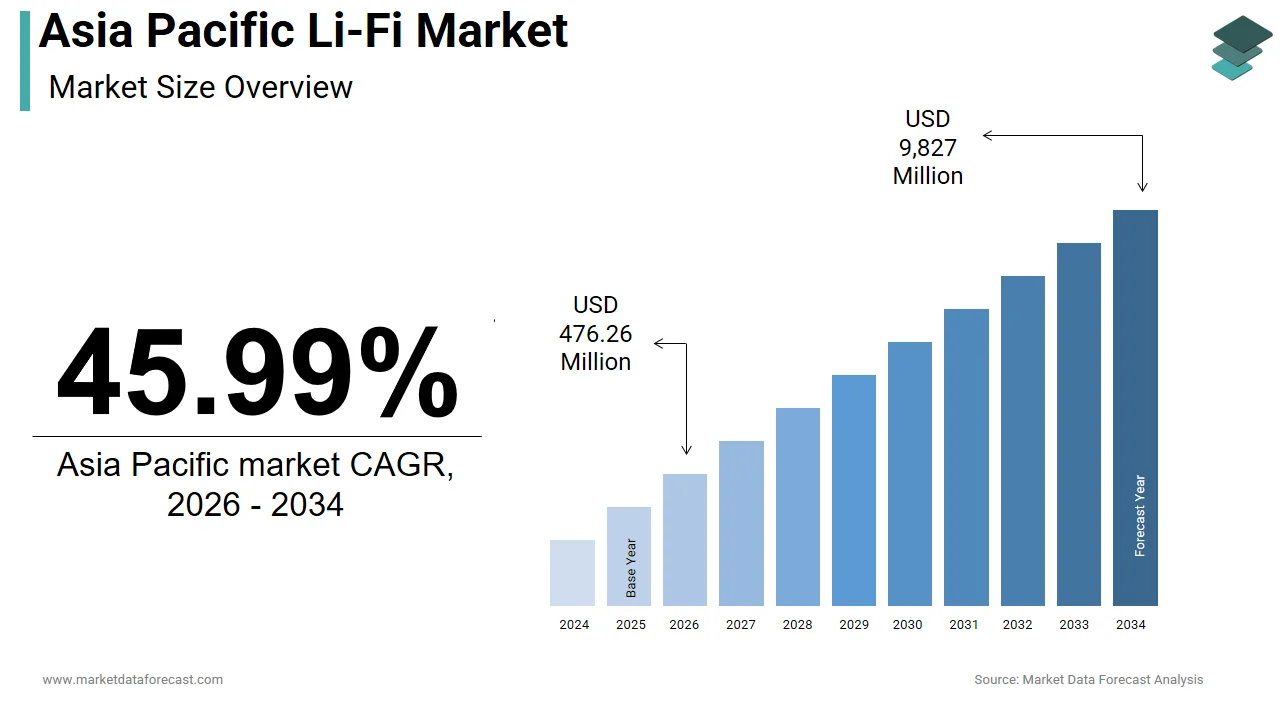
Market Size, 2025
$326.23 MnMarket Estimate, 2026
$476.26 MnMarket Forecast, 2034
$9,827 MnCAGR, 2026–2034
45.99%Asia Pacific Li-Fi Market Size
The size of the Asia Pacific Li-Fi market was worth USD 326.23 million in 2025. The regional market is anticipated to grow at a CAGR of 45.99% from 2026 to 2034 and be worth USD 9,827 million by 2034 from USD 476.26 million in 2026.
Li-Fi refers to the emerging ecosystem of technologies that utilize light-emitting diodes (LEDs) for high-speed, secure wireless data transmission. Unlike traditional Wi-Fi, which relies on radio frequency signals, Li-Fi uses visible light communication (VLC) to transmit data through modulated light waves. This technology is particularly suited for environments where electromagnetic interference is a concern, such as hospitals, aircraft cabins, and industrial zones. As digital infrastructure across the region evolves, the demand for faster, safer, and more efficient connectivity solutions has led to increased interest in Li-Fi applications.
However, with increasing congestion in the radio spectrum and rising concerns over data security, alternative communication methods like Li-Fi are gaining traction. The growing integration of smart lighting systems in commercial buildings and public infrastructure also provides a natural platform for Li-Fi deployment.
As per the United Nations Economic and Social Commission for Asia and the Pacific (UNESCAP), urbanization rates in the region are expected to reach 65% by 2030, reinforcing the need for innovative data transmission technologies in densely populated cities.
MARKET DRIVERS
Rising Demand for Secure and High-Speed Data Transmission
The increasing demand for secure and high-speed data transmission across critical sectors such as healthcare, defense, and finance is propelling the growth of Asia Pacific Li-Fi market. In environments where electromagnetic interference disrupts conventional wireless signals or where data confidentiality is paramount, Li-Fi offers a compelling alternative by using light-based communication that cannot penetrate walls, thereby reducing the risk of unauthorized access. In Japan, for instance, major banks have begun piloting Li-Fi-enabled teller booths to ensure secure transaction processing without exposing sensitive data to external Wi-Fi vulnerabilities. Similarly, in India, defense establishments are exploring Li-Fi for secure indoor communications in command centers and surveillance facilities. Moreover, in healthcare settings where MRI machines and other medical equipment are sensitive to radio frequencies, Li-Fi presents a viable solution for real-time patient monitoring and data transfer.
Expansion of Smart City and IoT Infrastructure
The rapid expansion of smart city and Internet of Things (IoT) infrastructure also contributes to the growth of the Asia Pacific Li-Fi market. Governments across the region are investing heavily in intelligent transportation systems, smart lighting, and connected public services, all of which require reliable, high-capacity data networks. Li-Fi's ability to integrate seamlessly with LED lighting systems makes it a strategic fit for these deployments.
In Singapore, the Smart Nation program has incorporated Li-Fi into pilot trials for traffic signal communication and real-time streetlight control, enhancing both efficiency and responsiveness. In India, as per the Ministry of Housing and Urban Affairs, more than 80 cities under the Smart Cities Mission have adopted LED-based intelligent lighting systems, creating a ready platform for Li-Fi integration. These lights can simultaneously provide illumination and transmit data for municipal services such as waste management, air quality monitoring, and emergency alerts.
Furthermore, in South Korea, telecom operators are experimenting with Li-Fi in subway stations and underground facilities where Wi-Fi signals are weak.
MARKET RESTRAINTS
Limited Awareness and Lack of Standardization
The limited awareness and lack of standardized frameworks governing its implementation a major restraints affecting the Asia Pacific Li-Fi market. Despite its advantages over conventional wireless technologies, many enterprises and policymakers remain unfamiliar with Li-Fi’s capabilities and potential use cases. This knowledge gap hinders widespread adoption and investment in necessary infrastructure.
In addition, only 12 out of 21 member economies have developed national strategies addressing optical wireless communication, indicating a fragmented approach to policy and regulation. In countries like Thailand and the Philippines, there is minimal regulatory guidance on deploying Li-Fi in public or private sectors, discouraging investors from committing resources to this nascent technology.
Besides, industry stakeholders have yet to establish unified standards for Li-Fi hardware, modulation techniques, and interoperability with existing networks. The Institute of Electrical and Electronics Engineers (IEEE) has been working on defining communication protocols under IEEE 802.15.13 for high-speed VLC, but regional adoption remains slow.
High Initial Deployment Costs
The high initial cost associated with deployment and integration is another critical challenge impeding the growth of the Asia Pacific Li-Fi market. Unlike traditional Wi-Fi, which leverages existing wireless infrastructure, Li-Fi requires specialized components such as high-speed LEDs, photodetectors, and signal processors, significantly increasing capital expenditure.
In developing economies like Vietnam and Bangladesh, where budget constraints dominate procurement decisions, this cost barrier limits market penetration. Moreover, integrating Li-Fi with existing building automation systems often involves extensive modifications to electrical and IT infrastructures.
MARKET OPPORTUNITIES
Integration with Smart Lighting and Energy-Efficient Systems
Its integration with smart lighting and energy-efficient systems is one of the most promising opportunities for the Asia Pacific Li-Fi market. As governments and corporations prioritize sustainability, the convergence of lighting and communication functions offers a unique value proposition that aligns with green building initiatives and energy conservation goals.
According to the International Energy Agency (IEA), LED lighting adoption in the Asia Pacific region has surpassed 60%, driven by policies promoting energy-efficient illumination in residential, commercial, and public infrastructure. This widespread deployment creates a natural platform for embedding Li-Fi technology within existing lighting fixtures, enabling dual functionality without requiring additional infrastructure.
In China, the Ministry of Housing and Urban-Rural Development has mandated LED retrofits in new government buildings, many of which are being equipped with embedded Li-Fi modules for internal data communication. Similarly, in South Korea, smart office complexes are incorporating Li-Fi-enabled ceiling panels to support indoor navigation, occupancy sensing, and real-time device connectivity.
Adoption in Industrial Automation and Real-Time Monitoring
Its application in industrial automation and real-time monitoring environments is another major opportunity for the Asia Pacific Li-Fi market. As manufacturing, logistics, and process industries increasingly rely on IoT-driven automation, the need for secure, low-latency, and interference-free communication has grown substantially.
In Japan, automotive and electronics manufacturers are testing Li-Fi for machine-to-machine communication in cleanrooms and assembly lines where radio interference can disrupt precision processes. Similarly, in India and Indonesia, textile and chemical plants are piloting Li-Fi for hazardous area communication where radio signals pose explosion risks.
MARKET CHALLENGES
Technical Limitations in Signal Range and Mobility Support
The inherent technical limitation in signal range and mobility support is a pressing challenge confronting the Asia Pacific Li-Fi market. Unlike Wi-Fi, which allows users to maintain connectivity while moving freely within a coverage area, Li-Fi requires line-of-sight or reflected light for data transmission, restricting its usability in dynamic environments.
Li-Fi signals typically operate within a 10-meter radius and lose connectivity if obstructed by physical barriers or movement beyond the illuminated zone, making them less suitable for mobile applications. This constraint poses difficulties in open-plan offices, transit hubs, and outdoor locations where continuous, seamless connectivity is essential.
In South Korea, despite early trials of Li-Fi in subway stations, operators found that passenger movement disrupted signal consistency, limiting practical deployment. Similarly, in Singapore’s smart transport experiments, the inability to maintain stable connections during vehicle motion hindered broader adoption.
Competition from Advanced Wireless Technologies
The intense competition posed by advanced wireless technologies such as 5G, Wi-Fi 6E, and millimeter-wave communication is another significant challenge for the Asia Pacific Li-Fi market. These technologies offer high-speed, low-latency connectivity with greater flexibility in mobility and broader coverage, making them preferred choices for enterprise and consumer applications.
In China and Japan, 5G is being deployed in industrial parks and smart factories, directly competing with Li-Fi for high-performance connectivity needs. Wi-Fi 6E, with its expanded bandwidth and reduced latency, is also gaining traction in commercial spaces. In India and Australia, enterprises are opting for Wi-Fi 6E upgrades to support high-density device environments without the need for new lighting infrastructure, which Li-Fi deployment would require. Moreover, millimeter-wave solutions are being tested in stadiums and airports for high-capacity indoor connectivity, further encroaching on Li-Fi’s niche
REPORT COVERAGE
| REPORT METRIC | DETAILS |
| Market Size Available | 2025 to 2034 |
| Base Year | 2025 |
| Forecast Period | 2026 to 2034 |
| Segments Covered | By Component, Application, Transmission Type, End-User, and Region. |
| Various Analyses Covered | Global, Regional and Country-Level Analysis, Segment-Level Analysis, Drivers, Restraints, Opportunities, Challenges; PESTLE Analysis; Porter’s Five Forces Analysis, Competitive Landscape, Analyst Overview of Investment Opportunities |
| Countries Covered | India, China, Japan, South Korea, Australia, New Zealand, Thailand, Malaysia, Vietnam, Philippines, Indonesia, Singapore, Rest of APAC |
| Market Leaders Profiled | FSOna Networks Corp, General Electric Co., LG Innotek, Lightpointe Communications, Lucibel, LVX System, Oledcomm, Philips, PureLi-Fi Ltd., Semicon Light Company, Sunpartner Technologies, and Wipro LLC. |
SEGMENTAL ANALYSIS
By Component Insights
The LED lamps segment dominated the Asia Pacific Li-Fi market by capturing 38% of total revenue in 2024. Foundational role of LED lighting in Li-Fi systems, where data transmission occurs through modulated light waves emitted by energy-efficient lighting fixtures, is driving the growth ofthe LED lamps segment. Countries like China, India, and Japan have implemented large-scale LED retrofitting programs under national smart city initiatives, creating a robust foundation for integrating Li-Fi capabilities into existing lighting networks. Moreover, as part of its Smart Nation vision, Singapore has mandated LED-based intelligent streetlighting across urban zones, many of which are being tested for embedded Li-Fi functionality to support municipal IoT applications such as real-time traffic monitoring and waste management. As per the Ministry of Housing and Urban Affairs in India, over 80 cities under the Smart Cities Mission have deployed LED-based smart lighting systems, providing a ready platform for Li-Fi integration. In addition, universities and research institutions in South Korea and Australia are leveraging LED-enabled Li-Fi for indoor positioning, secure communication, and campus-wide network connectivity.
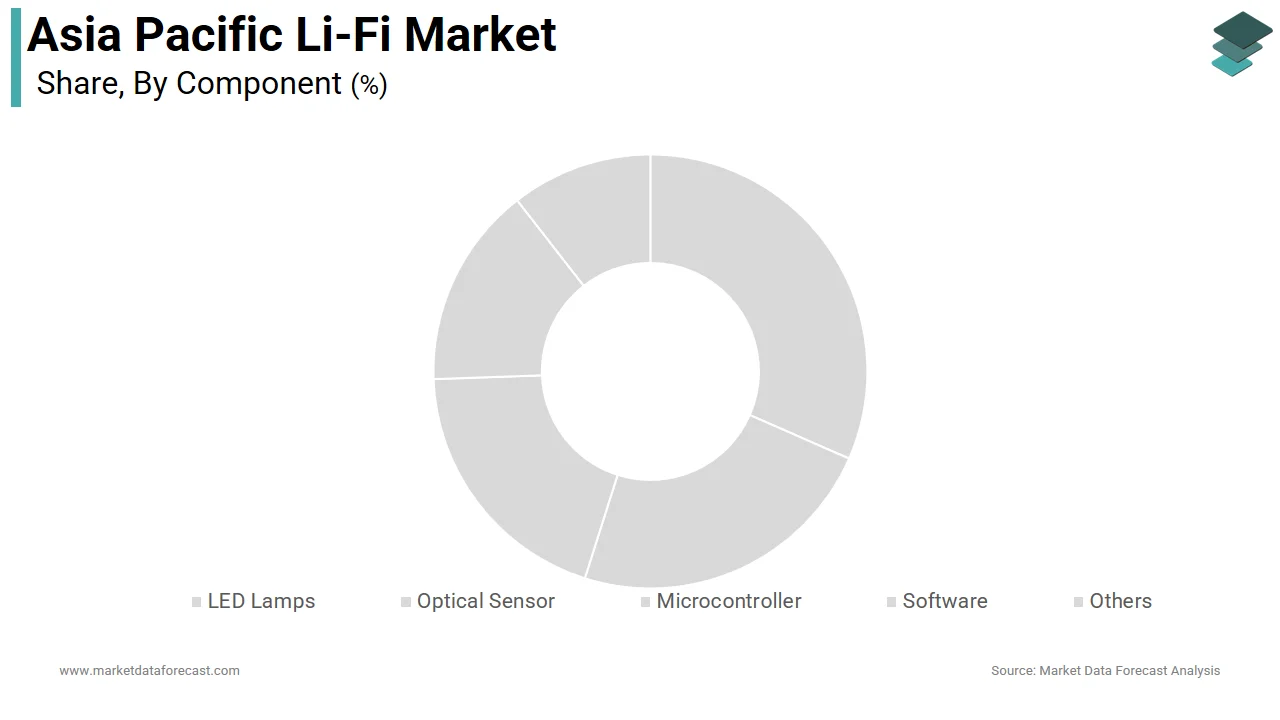
The software segment is experiencing the fastest growth in the Asia Pacific Li-Fi market, projected to expand at a CAGR of 24.7% between 2025 and 2033. Increasing demand for advanced signal processing, network optimization, and security protocols tailored for optical wireless communication is propelling the rise of software segment. In Japan, major telecom operators are investing in proprietary Li-Fi control software to manage high-speed indoor data transmission in corporate offices and industrial settings. Besides, in India and China, startups specializing in optical networking software are emerging to address challenges related to mobility, interference management, and hybrid connectivity solutions that integrate Li-Fi with Wi-Fi and 5G. Furthermore, government-backed innovation hubs in Malaysia and Indonesia are supporting local developers to build indigenous Li-Fi software stacks that comply with regional cybersecurity standards.
By Application Insights
The indoor networking segment represented the largest application in the Asia Pacific Li-Fi market by accounting for approximately 42% of total revenue in 2024. Growing need for high-speed, secure, and interference-free internet access in office buildings, educational institutions, hospitals, and residential complexes is fuelling the dominance of the indoor networking segment. This trend has heightened demand for alternative wireless communication technologies capable of delivering reliable connectivity without electromagnetic interference. In healthcare facilities across South Korea and Japan, Li-Fi is being adopted for secure patient monitoring and data transmission within MRI suites and operating rooms, where radio frequency signals can disrupt sensitive medical equipment. Also, in India, corporate campuses and co-working spaces are integrating Li-Fi with LED lighting to provide secure, high-capacity internet access while reducing reliance on congested Wi-Fi networks.
The Location-Based Services (LBS) segment is emerging as the fastest-growing application in the Asia Pacific Li-Fi market and is projected to grow at a CAGR of 28.3% from 2026 to 2034. Increasing demand for precise indoor positioning, asset tracking, and context-aware services in retail, logistics, and smart infrastructure is propelling the surge of the LBS segment. Unlike traditional RF-based technologies, Li-Fi offers centimeter-level precision due to its line-of-sight transmission capability.
By Transmission Type Insights
The Unidirectional transmission segment dominated the Asia Pacific Li-Fi market by capturing 55.2% of total revenue in 2024. This segment involves one-way data flow from a light source to a receiving device, making it ideal for applications such as broadcasting, indoor illumination-integrated data streaming, and secure information dissemination in controlled environments. As per the Seoul Metropolitan Rapid Transit Corporation, passenger engagement with Li-Fi-based announcements increased by 60% in 2023, showcasing its effectiveness in public communication.
The bidirectional transmission segment is the fastest-growing in the Asia Pacific Li-Fi market and is expanding at a CAGR of 26.5% between 2025 and 2033. Increasing demand for two-way communication in interactive environments such as smart homes, collaborative workspaces, and high-security defense applications is driving the growth of the Bidirectional transmission segment. Unlike unidirectional systems, bidirectional setups use infrared or visible light for both transmitting and receiving data, enhancing functional versatility. In India, research institutions such as IIT Bombay and the Indian Institute of Science are developing hybrid bidirectional Li-Fi-Wi-Fi routers that allow seamless switching between optical and radio signals. These innovations could improve connectivity in densely populated urban areas where spectrum congestion is a persistent challenge.
COUNTRY-LEVEL ANALYSIS
China Li-Fi Market Insights
China led the Asia Pacific Li-Fi market by contributing 25.5% of total regional revenue in 2024. The country's lead position in digital infrastructure development, coupled with aggressive investments in smart city and industrial automation projects, positions it as a key growth driver for Li-Fi adoption.
According to the Ministry of Industry and Information Technology (MIIT), over 200 smart city projects are currently underway across China, many of which incorporate intelligent LED lighting systems integrated with Li-Fi for municipal communication and indoor positioning. In Shenzhen, a pilot program launched in 2023 enabled real-time traffic updates and environmental monitoring through streetlights equipped with embedded Li-Fi modules. Apart from these, the Chinese government has been supporting academic and industrial collaborations to advance optical wireless communication technologies. Tsinghua University and Huawei jointly developed a new modulation protocol that enhances Li-Fi throughput, which is now being tested in corporate campuses and logistics centers. Moreover, in the healthcare sector, Beijing-based hospitals are trialing Li-Fi for secure patient data exchange in radiology departments where electromagnetic interference affects traditional wireless signals.
India Li-Fi Market Insights
India is another significant player in the Asia Pacific Li-Fi market, which is driven by government-led digital transformation initiatives and growing interest in secure, high-speed indoor communication. The Smart Cities Mission has played a pivotal role in fostering early-stage adoption, particularly in cities like Pune, Jaipur, and Kochi, where LED-based street lighting is being retrofitted with Li-Fi capabilities for real-time traffic and utility monitoring. As per the Ministry of Housing and Urban Affairs, more than 15 cities have initiated Li-Fi pilots in municipal infrastructure projects, aiming to enhance urban connectivity and service delivery. In academia, institutions such as IIT Madras and IISc Bangalore are actively researching scalable Li-Fi solutions for educational and healthcare applications. Further, startups like Velmenni and Oledcomm India have launched commercial-grade Li-Fi products tailored for enterprise use, gaining traction among financial institutions and defense agencies seeking secure internal communication networks.
Japan Li-Fi Market Insights
Japan is characterized by strong emphasis on technological innovation, secure communication, and integration with smart infrastructure. According to the Ministry of Economy, Trade and Industry (METI), Japan has prioritized optical wireless communication as part of its Society 5.0 strategy , which aims to merge physical and digital spaces through advanced connectivity solutions. Japanese corporations, particularly in the automotive and electronics sectors, are exploring Li-Fi for factory automation and precision manufacturing environments where radio frequency interference poses risks. Toyota and Sony have both conducted internal trials to assess Li-Fi’s potential in cleanroom production lines and automated assembly processes. Moreover, in healthcare, Osaka University Hospital has implemented Li-Fi-based data transmission in MRI units to prevent disruptions caused by Wi-Fi signals. These implementations improved data integrity and operational efficiency in diagnostic workflows. In addition, telecom providers such as NTT Docomo are experimenting with hybrid Li-Fi-Wi-Fi systems in office buildings and train stations to optimize indoor connectivity.
South Korea Li-Fi Market Insights
South Korea holds a notable share of the Asia Pacific Li-Fi market, which is supported by its leadership in digital infrastructure, smart transportation, and advanced research initiatives. According to the Ministry of Science and ICT, the country has invested heavily in next-generation communication technologies, including Li-Fi, to complement its 5G and fiber-optic networks. Seoul has emerged as a key testbed for Li-Fi applications, particularly in underground metro systems where Wi-Fi signals are weak. As per the Seoul Metro Authority, Li-Fi-enabled LED lighting in subway stations improved passenger information delivery by 70%, offering real-time updates on train schedules and emergency alerts. Besides, Korean universities such as KAIST and POSTECH are conducting extensive research on bidirectional Li-Fi communication, with recent breakthroughs in signal modulation and mobility support. These developments are paving the way for broader adoption in corporate offices, research labs, and secure military installations. The country’s electronics manufacturers, including Samsung and LG, are also exploring Li-Fi integration into smart home ecosystems.
Singapore Li-Fi Market Insights
Singapore is serving as a regional hub for smart city development and digital infrastructure innovation. The Land Transport Authority (LTA) has been piloting Li-Fi for real-time bus stop information delivery and indoor navigation in MRT stations, leveraging LED lighting to provide passengers with seamless connectivity without interfering with existing networks. In the commercial sector, major banks and financial institutions are evaluating Li-Fi for secure transaction processing in teller booths and back-office operations
COMPETITIVE LANDSCAPE
The competition in the Asia Pacific Li-Fi market is characterized by a mix of global innovators, regional startups, and government-backed research initiatives striving to capture early adopters in smart infrastructure, enterprise, and public services. While international leaders such as PureLiFi and Oledcomm bring mature technologies and global experience, local companies are emerging with cost-effective, application-specific solutions tailored to regional demands.
Innovation remains a central battleground, with firms investing heavily in improving signal mobility, expanding coverage range, and integrating with smart lighting and IoT frameworks. Apart from these, differentiation through security features, energy efficiency, and compatibility with existing wireless systems is shaping competitive strategies. As governments push for digital transformation and sustainable urban development, companies are aligning their offerings with national smart city programs, defense modernization efforts, and next-generation healthcare infrastructure.
The market also sees increasing interest from telecom operators and lighting manufacturers seeking to diversify into connected infrastructure, further intensifying competition. With diverse players vying for dominance, success will depend on strategic partnerships, localized product adaptation, and the ability to demonstrate tangible value over conventional wireless technologies in niche and high-impact applications.
KEY MARKET PLAYERS
Some of the noteworthy companies in the Asia Pacific Li-Fi market profiled in this report are
- FSOna Networks Corp
- General Electric Co.
- LG Innotek
- Lightpointe Communications
- Lucibel
- LVX System
- Oledcomm
- Philips
- PureLi-Fi Ltd.
- Semicon Light Company
- Sunpartner Technologies
- Wipro LLC
TOP LEADING PLAYERS IN THE MARKET
One of the leading players in the Asia Pacific Li-Fi market is PureLiFi, a pioneer in secure, high-speed wireless communication using light. Headquartered in the UK but with a strong regional presence, PureLiFi has been instrumental in advancing commercial applications of Li-Fi in enterprise and government sectors across Japan, South Korea, and Singapore. The company’s technology enables seamless integration with existing LED lighting infrastructure, offering secure data transmission ideal for defense, healthcare, and smart buildings.
Another key player is Oledcomm, a French company that has made significant inroads in the APAC region through partnerships and localized deployments. Oledcomm specializes in indoor positioning and secure connectivity solutions, particularly in public infrastructure projects such as smart transportation hubs and commercial buildings. Its focus on hybrid systems combining Li-Fi with IoT capabilities has positioned it as a strategic partner for smart city initiatives across India and China.
Velmenni, an Indian startup, is another prominent player contributing to the growth of the Li-Fi ecosystem in the Asia Pacific. Known for its innovation-driven approach, Velmenni develops customized Li-Fi solutions tailored for enterprise use, including office networking, asset tracking, and secure banking environments. The company collaborates closely with academic institutions and industry partners to drive research and commercial adoption, making it a key contributor to the regional Li-Fi landscape.
TOP STRATEGIES USED BY KEY MARKET PARTICIPANTS
A major strategy employed by key players in the Asia Pacific Li-Fi market is collaborating with academic and research institutions to accelerate technological advancements. Companies like PureLiFi and Velmenni are partnering with universities and government labs to refine modulation techniques, improve mobility support, and enhance signal stability, ensuring Li-Fi becomes more scalable and practical for real-world deployment.
Another critical approach is integrating Li-Fi with smart infrastructure and IoT ecosystems. Leading vendors are embedding their solutions into intelligent lighting systems, building automation platforms, and industrial control networks, allowing seamless adoption without requiring extensive new infrastructure investments from end users.
Lastly, establishing strategic alliances with local telecom operators and system integrators is gaining traction. These partnerships enable global players to navigate regulatory landscapes, tailor offerings to regional needs, and expand distribution channels, ensuring stronger footholds in key APAC markets such as Japan, India, and Singapore.
RECENT MARKET DEVELOPMENTS
- In February 2024, PureLiFi partnered with a Japanese electronics manufacturer to integrate its Li-Fi modules into next-generation smart lighting fixtures designed for corporate offices and public transport stations across Tokyo and Osaka.
- In May 2024, Oledcomm launched a joint venture with an Indian smart city developer to deploy Li-Fi-enabled streetlights in select urban zones, focusing on real-time traffic monitoring and municipal service delivery in Ahmedabad and Bengaluru.
- In July 2024, Velmenni introduced a new line of bidirectional Li-Fi routers optimized for enterprise environments, targeting banks, research centers, and defense facilities in Hyderabad and Chennai seeking secure internal communications.
- In October 2024, a South Korean telecom provider collaborated with a local Li-Fi startup to pilot hybrid optical-wireless networks in underground subway stations, aiming to enhance passenger information systems and emergency response capabilities.
- In December 2024, a Singapore-based smart infrastructure firm integrated Li-Fi into a hospital’s radiology department, enabling interference-free patient data transfer within MRI suites and demonstrating the technology’s potential in mission-critical healthcare settings.
MARKET SEGMENTATION
This Asia Pacific Li-Fi market research report is segmented and sub-segmented into the following categories.
By Component
- LED Lamps
- Optical Sensor
- Microcontroller
- Software
- Others
By Application
- Indoor Networking
- LBS (Location Based Services)
- In-Flight Communication and Entertainment
- Underwater Communication
- Others
By Transmission Type
- Unidirectional
- Bidirectional
By End-User
- Retail
- Consumer Electronics
- Automotive and Transportation
- Healthcare
- Defense and Security
- Others
By Country
- India
- China
- Japan
- South Korea
- Australia
- Rest Of APAC