- Product Description Description
- Table of Contents TOC
- List of Table & Figure LOT
- Get Free Sample PDF Sample PDF
Market Size, 2025
$6.92 BnMarket Estimate, 2026
$8.59 BnMarket Forecast, 2034
$48.32 BnCAGR, 2026–2034
24.10%Asia Pacific Smart Lighting Market Size
The Asia Pacific Smart Lighting Market was worth USD 6.92 billion in 2024. The Asia Pacific market is expected to reach USD 48.32 billion by 2034 from USD 8.59 billion in 2026, rising at a CAGR of 24.10% from 2026 to 2034.
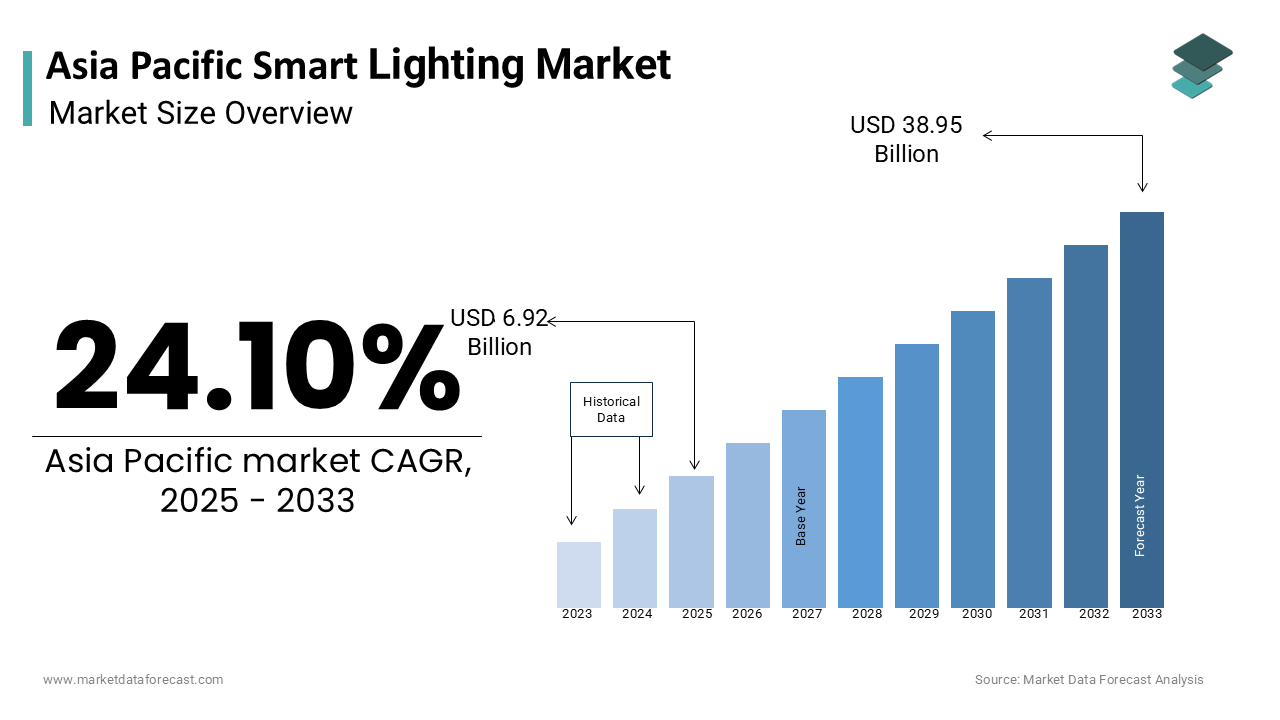
The Asia Pacific smart lighting market is emerging with rapid urbanization and technological innovation. Countries like China, India, and Japan are at the forefront, with China alone contributing nearly 25% of regional revenue due to its robust manufacturing capabilities and smart city initiatives. The proliferation of IoT-enabled devices has fueled demand, with smart lighting systems being integrated into residential, commercial, and industrial spaces. Furthermore, government policies promoting energy efficiency, such as India’s UJALA program, have accelerated adoption. Urban centers like Singapore and Tokyo are adopting smart street lighting systems, which not only enhance safety but also reduce operational costs.
MARKET DRIVERS
Government Initiatives for Energy Efficiency
Government-led initiatives aimed at reducing energy consumption are a significant driver of the Asia Pacific smart lighting market. According to the International Energy Agency, lighting accounts for approximately 15% of global electricity usage, prompting governments to prioritize energy-efficient solutions. In India, the UJALA scheme distributed over 360 million LED bulbs by reducing carbon emissions by 40 million tons annually, as stated by the Bureau of Energy Efficiency. Similarly, China’s "13th Five-Year Plan" emphasized green building standards, which mandate the use of smart lighting systems in new constructions. These policies create a favorable regulatory environment, encouraging both public and private sectors to adopt smart lighting technologies. Additionally, subsidies and tax incentives further lower barriers to entry for small and medium enterprises. For instance, South Korea offers rebates of up to 50% for businesses transitioning to energy-efficient lighting, as per the Korea Energy Management Corporation.
Growing Adoption of Smart Homes and IoT Integration
The rise of smart homes and the integration of IoT technologies are propelling the Asia Pacific smart lighting market forward. Smart lighting systems, equipped with features like voice control, dimming, and scheduling that appeal to tech-savvy consumers seeking convenience and customization. For example, Philips Hue, a leading brand, has witnessed a 40% annual growth in sales across urban centers like Shanghai and Mumbai, as reported by Signify. Moreover, the proliferation of IoT platforms enables seamless connectivity between lighting systems and other smart devices, enhancing the user experience. This trend is particularly pronounced in affluent markets like Japan and Australia, where homeowners prioritize automation and energy savings.
MARKET RESTRAINTS
High Initial Costs and Investment Barriers
The high upfront cost of smart lighting systems remains a significant restraint for the Asia Pacific market, particularly in price-sensitive regions like Southeast Asia and rural India. According to a report by Deloitte, the average installation cost of a smart lighting system is 2-3 times higher than traditional lighting, which is deterring small-scale adopters. For instance, retrofitting an entire office building with smart lighting can require investments exceeding $50,000, as noted by CBRE. While long-term savings on energy bills offset these costs, many consumers lack awareness of the financial benefits, which leads to hesitation. Additionally, the need for compatible infrastructure, such as smart meters and IoT hubs, adds to the overall expense. This financial burden is further exacerbated in developing economies, where access to affordable financing remains limited.
Limited Consumer Awareness and Technical Expertise
Limited awareness and technical expertise among consumers pose another challenge to the growth of the Asia Pacific smart lighting market. According to Nielsen, over 70% of rural households in countries like Indonesia and Vietnam remain unfamiliar with smart lighting systems, which is attributed this to insufficient marketing efforts and low digital literacy. Even in urban areas, misconceptions about complexity and usability persist by discouraging potential buyers. For example, a survey conducted by EY revealed that 45% of Indian consumers believe smart lighting requires extensive technical knowledge for setup and operation. This perception creates resistance, particularly among older demographics who prefer conventional solutions. Furthermore, the lack of skilled technicians capable of installing and maintaining these systems compounds the issue. Addressing these gaps requires targeted education campaigns and workforce development programs to build trust and competence among stakeholders.
MARKET OPPORTUNITIES
Expansion of Smart City Projects
The proliferation of smart city projects across the Asia Pacific region presents a significant opportunity for the smart lighting market. For instance, Singapore’s Smart Nation initiative has installed over 100,000 IoT-enabled streetlights, reducing energy consumption by 40%, as per the Infocomm Media Development Authority. Similarly, cities like Delhi and Bangkok are adopting adaptive lighting systems that adjust brightness based on real-time data by enhancing operational efficiency. These developments create substantial demand for scalable and customizable lighting solutions, which is benefiting manufacturers. Moreover, partnerships with local governments and urban planners enable companies to secure long-term contracts, ensuring steady revenue streams.
Rising Demand for Personalized Lighting Solutions
The growing consumer preference for personalized lighting experiences offers another lucrative opportunity for the Asia Pacific smart lighting market. According to Accenture, over 60% of consumers in the region are willing to pay a premium for products that offer customization, such as color tuning and mood lighting. Brands like Lutron and OSRAM have capitalized on this trend by introducing app-controlled systems that allow users to tailor lighting settings to their preferences. For example, Lutron’s Caséta Wireless system enables users to create dynamic lighting scenes, boosting engagement and satisfaction. Additionally, the integration of AI and machine learning enhances personalization by analyzing user behavior and automating lighting adjustments. This trend is particularly prominent in affluent markets like Japan and Australia, where consumers seek unique and immersive experiences.
MARKET CHALLENGES
Cybersecurity Concerns and Data Privacy Risks
Cybersecurity vulnerabilities and data privacy risks present a formidable challenge to the Asia Pacific smart lighting market, given the interconnected nature of IoT-enabled systems. According to Symantec, cyberattacks targeting IoT devices increased by 600% between 2018 and 2022, raising concerns about the safety of smart lighting networks. For instance, a breach in a smart lighting system could expose sensitive data, such as user preferences and location patterns. This risk is particularly acute in commercial settings, where lighting systems are often integrated with broader building management platforms. A report by Ernst & Young notes that over 50% of businesses in the region hesitate to adopt IoT solutions due to security fears, impacting market growth. Additionally, regulatory frameworks governing data protection remain inconsistent across countries, complicating compliance efforts.
Interoperability Issues Across Devices and Platforms
Interoperability challenges between smart lighting systems and other connected devices pose another significant hurdle for the Asia Pacific market. This fragmentation stems from the absence of universal standards, which is forcing consumers to purchase proprietary ecosystems that limit flexibility. For example, a homeowner using Philips Hue may face difficulties integrating it with non-compatible sensors or switches, as noted by a consumer survey by IDC. Such limitations frustrate users and deter adoption in multi-vendor environments like commercial buildings. Furthermore, frequent software updates and hardware upgrades exacerbate interoperability problems by creating additional costs and complexities.
SEGMENTAL ANALYSIS
By Component Insights
The hardware segment was the largest and held 60.5% of the Asia Pacific smart lighting market share in 2024 owing to the essential role hardware plays in enabling smart lighting functionality. Components like LED fixtures, sensors, and controllers form the backbone of any smart lighting system, which is making them indispensable for both residential and commercial applications. The affordability of LED technology has also contributed to its widespread adoption, with prices dropping by nearly 40% over the past five years, according to the International Energy Agency. Additionally, government mandates promoting energy-efficient lighting have accelerated hardware sales. In India, the UJALA program distributed over 360 million LED bulbs, creating a robust foundation for smart lighting upgrades.
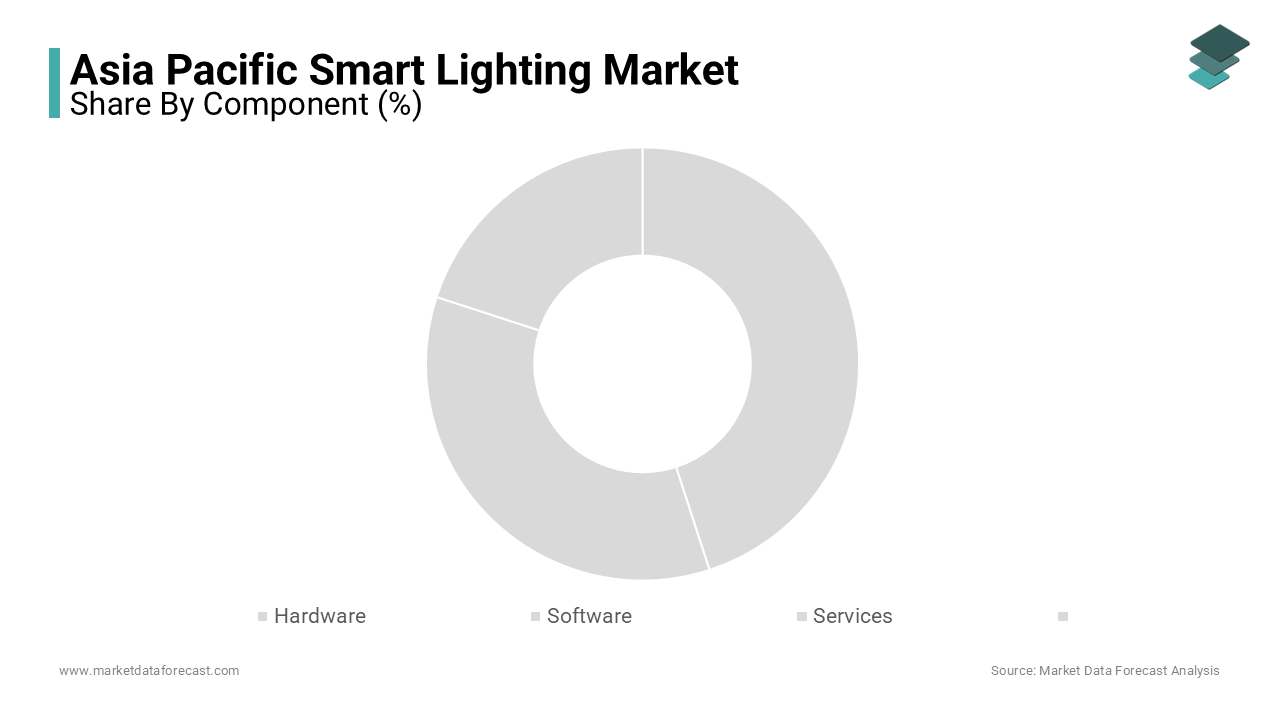
The software segment is lucratively growing with a CAGR of 25.5% from 2026 to 204. The growth of the segment is anticipated to be driven by the increasing complexity of smart lighting systems, which require sophisticated software for automation, analytics, and integration. For example, smart lighting platforms like Philips Hue rely on proprietary software to enable features such as voice control and scheduling, enhancing user convenience. Moreover, the rise of AI-driven analytics allows businesses to optimize energy usage and reduce operational costs. A report by Capgemini reveals that companies adopting AI-based lighting management systems achieve energy savings of up to 35%.
By Connectivity Insights
The wireless connectivity segment is expected to hold a prominent share of the Asia Pacific smart lighting market in 2025. The growth of the segment is attributed to be driven by the flexibility and ease of installation offered by wireless systems in retrofit projects. Technologies like Zigbee, Z-Wave, and Wi-Fi enable seamless communication between devices without the need for extensive wiring, reducing installation costs by up to 40% Additionally, wireless systems are highly scalable by making them ideal for both residential and commercial applications. For instance, in urban centers like Singapore and Seoul, wireless smart lighting solutions are widely adopted in smart homes and office buildings due to their adaptability. Furthermore, advancements in wireless protocols have enhanced reliability and range, addressing earlier concerns about performance.
The wired connectivity segment is projected to grow with a CAGR of 18.4% from 2026 to 2034 owing to the increasing demand for stable and secure connections in industrial and large-scale applications. Wired systems, such as Ethernet and DALI, offer unparalleled reliability and minimal latency by making them suitable for environments requiring precise control, such as hospitals and data centers. Additionally, the integration of Power over Ethernet (PoE) technology has reduced installation complexities, enabling simultaneous power and data transmission.
By Technology Insights
The indoor applications segment led the Asia Pacific smart lighting market share in 2025 due to the growing adoption of smart lighting in residential, commercial, and institutional spaces. For instance, a study by JLL reveals that over 50% of office buildings in major cities like Sydney and Mumbai have integrated smart lighting systems to enhance energy efficiency and occupant comfort. Residential demand is equally strong, with homeowners increasingly investing in smart lighting to create personalized environments. Brands like Lutron and OSRAM have capitalized on this trend, offering app-controlled systems that allow users to customize brightness and color settings.
The outdoor applications segment is likely to experience a significant CAGR of 22.5% from 2026 to 204 with the expansion of smart city initiatives and the need for energy-efficient public infrastructure. For example, cities like Singapore and Tokyo are deploying IoT-enabled streetlights that adjust brightness based on real-time traffic and weather data by reducing energy consumption by up to 40%, as per the Infocomm Media Development Authority. Additionally, outdoor smart lighting enhances public safety by integrating motion sensors and surveillance cameras, which is making it a preferred choice for urban planners. Furthermore, government incentives and public-private partnerships are accelerating adoption, particularly in developing economies like India and Indonesia.
REGIONAL ANALYSIS
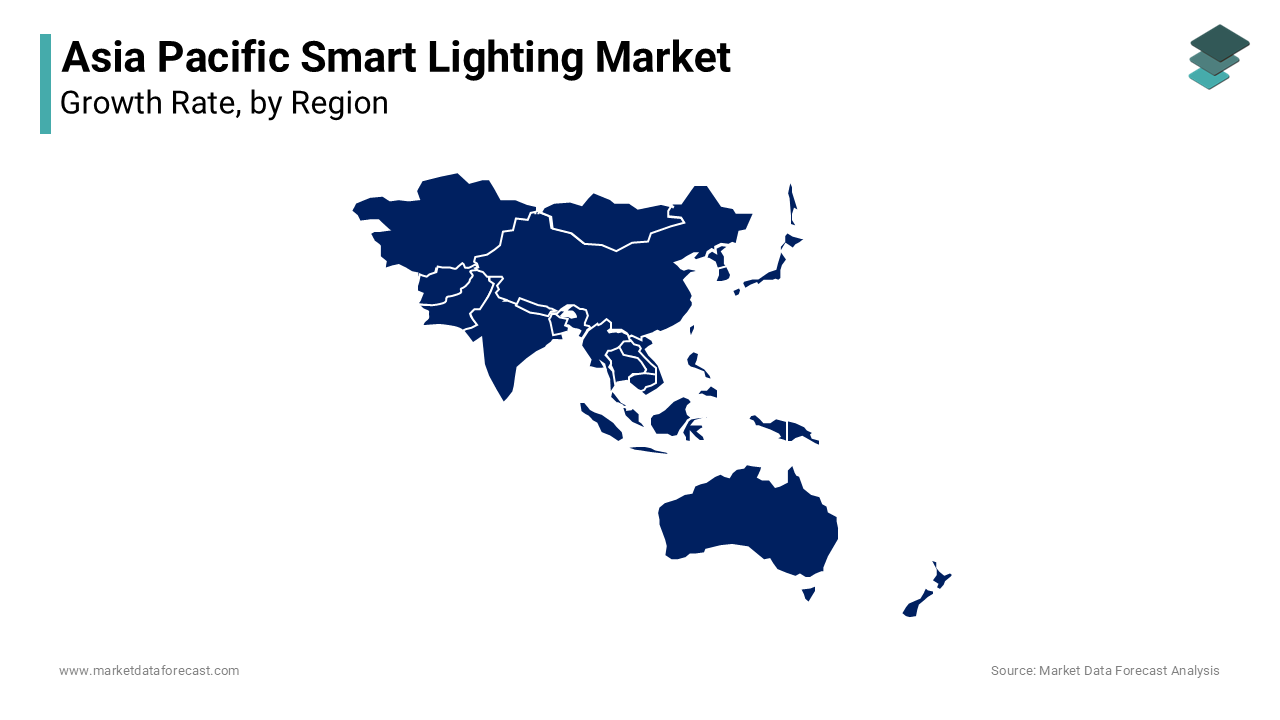
China was the top performer in the Asia Pacific smart lighting market with 30.4% of the share in 2025. Over 500 smart city initiatives are currently underway, with smart lighting playing a critical role in reducing energy consumption and improving urban infrastructure. Additionally, government policies promoting green building standards have spurred demand for energy-efficient lighting solutions.
Japan ranks second in the Asia Pacific smart lighting market with 15.5% of the share in 2025. Japan excels in developing cutting-edge lighting solutions, which are known for their precision engineering and focus on sustainability. For example, Panasonic has introduced smart lighting systems equipped with AI-driven analytics, enabling businesses to optimize energy usage. According to the Japan External Trade Organization, over 60% of commercial buildings in Tokyo utilize smart lighting to enhance operational efficiency. Additionally, the country’s aging population has increased demand for adaptive lighting solutions in healthcare facilities, as per a report by the Japanese Ministry of Health.
South Korea is renowned for its tech-savvy population, where the country has embraced smart lighting as part of its broader digital transformation agenda. This factor is solely attributed to enhancing the growth of the market. Cities like Seoul have implemented smart street lighting systems that integrate with traffic management platforms by reducing energy consumption by 35%, as reported by the Korea Transport Institute. Additionally, the government’s Green Growth Strategy has incentivized businesses to adopt energy-efficient technologies, driving demand for smart lighting solutions.
India's burgeoning urban population and government-led initiatives like the Smart Cities Mission have fueled the growth of the Asia Pacific smart lighting market. For instance, cities like Pune and Ahmedabad have deployed smart streetlights equipped with IoT sensors, thereby reducing operational costs by 40%, as per the Ministry of Housing and Urban Affairs.
Australia smart lighting market is likely to grow with prominent growth opportunities in the coming years. The country’s affluent population and high disposable incomes enable the adoption of premium smart lighting solutions, particularly in residential and commercial spaces. Additionally, Australia’s commitment to sustainability aligns with the adoption of energy-efficient lighting systems.
COMPETITIVE LANDSCAPE
The Asia Pacific smart lighting market is characterized by intense competition, driven by a mix of established multinational corporations and regional players vying for dominance. Global giants like Signify, Panasonic, and OSRAM compete fiercely with local manufacturers such as Syska and Havells, creating a dynamic landscape marked by rapid innovation and aggressive pricing strategies. The market’s diversity spanning developed economies like Japan and Australia to emerging markets like India and Vietnam requires companies to adopt multifaceted approaches to succeed. While larger firms leverage economies of scale and technological expertise, smaller enterprises focus on affordability and niche innovations to carve out their share. Regulatory pressures, environmental concerns, and shifting consumer behaviors further intensify rivalry, compelling brands to prioritize sustainability and digital transformation. E-commerce platforms have also leveled the playing field, enabling new entrants to disrupt traditional distribution channels. The result is a vibrant ecosystem where innovation thrives but only the most adaptable survive.
KEY MARKET PLAYERS
Some of the promising companies that are playing a dominating role in the Asia Pacific smart lighting market include
- Osram Licht AG
- Acuity Brands Inc.
- Eaton Corporation
- Zumtobel Group
- Panasonic Corporation
- Honeywell International Inc.
- Schneider Electric SE
- Cree Lighting
-
Hubbell Incorporated
Top Players in the Asia Pacific Smart Lighting Market
Signify (Philips Lighting)
Signify, formerly Philips Lighting, is a global leader in the smart lighting market and a dominant player in the Asia Pacific region. The company’s innovative product portfolio includes IoT-enabled lighting systems, such as Philips Hue, which cater to both residential and commercial applications. Signify’s commitment to sustainability is evident in its focus on energy-efficient solutions and circular economy initiatives. Signify has set industry benchmarks for connectivity and functionality by integrating AI and Li-Fi technologies into its offerings. Its collaborations with governments and urban planners have enabled large-scale deployments in smart cities by reinforcing its reputation as a pioneer in transforming urban infrastructure through smart lighting.
Panasonic Corporation
Panasonic is a key contributor to the Asia Pacific smart lighting market, leveraging its expertise in electronics and energy-efficient technologies. The company’s smart lighting solutions are designed to enhance energy savings and improve user experience through features like motion sensors and adaptive brightness. Panasonic’s strong presence in Japan and South Korea, coupled with its focus on innovation, allows it to address diverse consumer needs. By integrating AI-driven analytics into its systems, Panasonic enables businesses to optimize operational efficiency while reducing carbon footprints.
OSRAM Licht Group
OSRAM Licht Group is a major player in the smart lighting sector, renowned for its cutting-edge LED technologies and intelligent lighting solutions. The company’s focus on customization and scalability makes its products ideal for both residential and industrial applications. OSRAM’s strategic partnerships with property developers and smart city initiatives have expanded its footprint across the Asia Pacific region. By offering affordable yet high-quality solutions, OSRAM caters to price-sensitive markets like India and Indonesia while maintaining a premium appeal in affluent regions. Its commitment to innovation and sustainability ensures its continued influence in the global smart lighting landscape.
Top Strategies Used by Key Market Participants
Emphasis on Sustainability and Green Solutions
Key players in the Asia Pacific smart lighting market prioritize sustainability as a core strategy to align with global environmental goals. The companies enhance their brand image and appeal to environmentally conscious consumers by developing energy-efficient lighting solutions and adopting eco-friendly manufacturing practices. For instance, many firms focus on creating products that comply with green building standards by ensuring compatibility with sustainable infrastructure projects. This approach not only meets regulatory requirements but also positions brands as responsible innovators. Additionally, sustainability-driven marketing campaigns resonate with consumers, which is fostering long-term loyalty and trust.
Expansion of Smart Ecosystems and Interoperability
To strengthen their market position, leading companies emphasize the integration of smart lighting systems with broader ecosystems. By ensuring interoperability with platforms like Amazon Alexa, Google Home, and Apple HomeKit, brands enhance user convenience and create seamless experiences. This strategy encourages cross-selling opportunities, as consumers are more likely to invest in interconnected devices. Furthermore, partnerships with IoT providers and tech giants enable companies to offer comprehensive solutions that cater to diverse applications, from smart homes to industrial facilities.
Localization and Customization of Offerings
Understanding regional preferences is critical for success in the Asia Pacific market. Key players adopt localization strategies by tailoring product designs, pricing models, and marketing campaigns to suit specific countries and cultures. For example, affordable solutions are introduced in emerging markets, while premium features target affluent consumers in developed regions. Brands also collaborate with local influencers and distributors to amplify their reach and build trust. By addressing unique consumer needs, companies can penetrate untapped markets and establish a strong foothold in the region.
RECENT MARKET DEVELOPMENTS
- In April 2024, Signify partnered with the Singapore government to deploy IoT-enabled streetlights across the city-state. This initiative aimed to reduce energy consumption and enhance public safety through adaptive lighting systems.
- In June 2023, Panasonic unveiled its AI-driven smart lighting system in South Korea, targeting commercial buildings. This system uses machine learning to optimize energy usage and improve operational efficiency.
- In September 2023, OSRAM introduced an affordable smart lighting range in India, priced competitively to tap into the growing middle-class market and increase penetration in rural areas.
- In February 2024, Lutron collaborated with property developers in Australia to integrate smart lighting systems into new residential complexes. This partnership enhanced customer experience by offering personalized lighting solutions.
- In November 2024, Havells launched a localized marketing campaign in Indonesia, partnering with local influencers to promote its energy-efficient smart lighting solutions. This move aimed to build brand awareness and trust among price-sensitive consumers.
MARKET SEGMENTATION
This research report on the Asia Pacific smart lighting market is segmented and sub-segmented into the following categories.
By Component
- Hardware
- Software
- Services
By Connectivity
- Wired
- Wireless
By Application
- Indoor
- Outdoor
By Country
- India
- China
- Japan
- South Korea
- Australia
- New Zealand
- Thailand
- Malaysia
- Vietnam
- Philippines
- Indonesia
- Singapore
- Rest of APAC