- Product Description Description
- Table of Contents TOC
- List of Table & Figure LOT
- Get Free Sample PDF Sample PDF
Market Size, 2025
$7.68 BnMarket Estimate, 2026
$8.41 BnMarket Forecast, 2034
$17.40 BnCAGR, 2026–2034
9.51%Executive Summary: Asia Pacific Lobster Market
- Market Scope: Comprehensive regional Asia-Pacific lobster market analysis covering species types, weight categories, product forms, distribution channels, country-level leadership frameworks, and marine environmental metrics.
- Market Valuation: Valued at USD 7.68 billion (2025 base year), estimated at USD 8.41 billion (2026), and projected to reach USD 17.40 billion by 2034, registering a robust CAGR of 9.51% (2026–2034).
- Primary Growth Drivers: Rising seafood consumption, expanding aquaculture investments, and high demand in major import hubs like China. Key trade, production, and ecological highlights include China importing ~10,500 metric tons of live/fresh lobster in 2023, Indonesia producing >17,500 metric tons of farmed spiny lobster, Australia exporting 7,400 metric tons worth AUD 810 million (with China taking >80%), ~25% of Southeast Asia’s mangroves lost since 1980, and regional coral cover declining by 14% since 2010.
Key Market Segment Metrics (2026–2034)
| Category | Leading Segment (2025 Position) | Fastest-Growing Segment |
|---|---|---|
| By Species Type | Spiny Lobster (dominated species segment with ~64.2% of total volume consumption in 2025) | Rock Lobster (projected to register a 9.4% CAGR through 2034) |
| By Weight Category & Form | 0.76–3.0 lbs Category (led by weight with 62.4% of total sales volume) & Whole Fresh/Live Lobster | Over-3-lbs Segment (10.2% CAGR) & Processed Lobster Meat (11.3% CAGR) |
| By Distribution Channel | Food Service & Hospitality (commanded 65.7% of the distribution market in 2025) | Retail & Direct-to-Consumer Channels (forecasted to grow at a 9.8% CAGR) |
| By Country / Region | China (led the regional market with a 54.1% share in 2025), alongside key production in Indonesia & Australia | Emerging Southeast Asian Aquaculture & Domestic Consumption Hubs |
Major Market Players & Market Structure
Market Structure: Highly competitive Asia-Pacific seafood, aquaculture, and export landscape featuring major regional fishing cooperatives and multinational food corporations competing intensely on supply-chain traceability, hatchery expansion, sustainable farming, and cold-chain logistics. Recent innovations include Japfa’s 2025 lobster hatchery (producing 5 million juvenile spiny lobsters annually) and blockchain-based traceability across 1,200 lobster cages in Vietnam.
Key Companies: Geraldton Fishermen’s Co-operative, Thai Union Group PCL, Maruha Nichiro Corporation, Dongwon Industries, Nippon Suisan Kaisha (Nissui), and Asian Sea Corporation.
 Download Free Sample Report
Asia Pacific Lobster Market Size
The Asia Pacific lobster market size was valued at USD 7.68 billion in 2025, and the market size is expected to reach USD 17.40 billion by 2034 from USD 8.41 billion in 2026. The market's promising CAGR for the predicted period is 9.51%.
Lobster are both wild-caught and aquacultured lobsters. The market is characterized by a blend of artisanal fisheries and emerging mariculture initiatives, the sector primarily revolves around tropical spiny and slipper lobster species, notably Panulirus ornatus and Thenus orientalis. Unlike temperate regions dominated by clawed lobsters, the Asia Pacific region emphasizes warm-water species with high export value, particularly to luxury food markets in East Asia. Meanwhile, Australia’s wild lobster fishery, managed under strict sustainability protocols, contributes significantly to premium live exports, especially during festive seasons in China, as noted by the Australian Fisheries Management Authority.
MARKET DRIVERS
Escalating Demand from High-Income Urban Consumers in East Asia
The rising affluence of urban populations in China, Japan, and South Korea has significantly amplified the demand for premium seafood, with lobster emerging as a symbol of luxury dining. As per the World Bank, urban household disposable income in China increased by 5.1% annually between 2018 and 2022, fostering a cultural shift toward high-value protein consumption. In 2023, China imported around 10,500 metric tons of live and fresh lobster, primarily sourced from Australia, Vietnam, and Indonesia, according to data from China Customs. The preference for live seafood in celebratory and business dining contexts has entrenched lobster as a staple in high-end banquets. This sustained appetite, coupled with expanding cold-chain logistics, has incentivized exporters across the region to prioritize live lobster shipments, reinforcing supply chain investments.
Expansion of Lobster Aquaculture in Southeast Asia
Mariculture of tropical spiny lobsters, particularly in Indonesia and Vietnam, has emerged as a transformative driver in the Asia Pacific lobster market. Traditional reliance on wild seed collection is being supplemented by hatchery-based juvenile production and grow-out farming. These developments reduce dependency on fluctuating wild stocks and enable year-round supply to meet export demands. Moreover, advancements in larval rearing techniques at institutions, enhancing the economic viability of commercial-scale operations.
MARKET RESTRAINTS
Environmental Degradation and Habitat Loss in Coastal Ecosystems
The proliferation of coastal development, mangrove deforestation, and coral reef degradation severely undermines lobster recruitment and nursery habitats across the Asia Pacific. Also, approximately 25% of mangroves in Southeast Asia have been lost since 1980, with Indonesia and the Philippines experiencing the most significant declines. These ecosystems are critical for juvenile lobster survival, particularly for species like Panulirus homarus, which rely on complex benthic structures. Additionally, as per the Global Coral Reef Monitoring Network in 2023, the Asia Pacific region has lost 14% of its coral cover since 2010 due to bleaching and destructive fishing practices. This habitat erosion directly impacts lobster population resilience, reducing natural replenishment.
Stringent Biosecurity and Import Regulations in Key Markets
International trade in live lobster is increasingly constrained by rigorous biosecurity protocols, particularly in major importing nations like China and Japan. These disruptions highlight the vulnerability of export-dependent producers to sanitary standards. Furthermore, the lack of region-wide harmonized health certification protocols complicates cross-border trade.
MARKET OPPORTUNITIES
Integration of Blockchain for Traceability and Consumer Trust
The adoption of digital traceability systems presents a transformative opportunity for enhancing transparency in the Asia Pacific lobster supply chain. With increasing consumer demand for ethically sourced and sustainable seafood, blockchain technology enables end-to-end tracking from harvest to retail. As per the World Wildlife Fund, seafood traceability initiatives have reduced mislabeling incidents in pilot regions. This technological integration not only strengthens brand credibility but also aligns with international sustainability certifications, opening access to premium retail and hospitality sectors.
Development of Value-Added Lobster Products for Domestic Markets
Beyond live exports, there is growing potential in processed and convenience-based lobster products tailored to evolving domestic consumption patterns. In countries like Thailand and Malaysia, urban consumers are increasingly favoring ready-to-eat seafood meals, driven by time constraints and shifting lifestyles. In Japan, major retailers such as Ito Yokado have introduced vacuum-sealed lobster meat and pre-cooked kits, capitalizing on the aging population’s preference for easy preparation. This shift could significantly enhance profitability and reduce reliance on volatile international trade channels.
MARKET CHALLENGES
Climate Variability and Oceanographic Shifts Affecting Lobster Stocks
Climate change-induced ocean warming and altered current patterns are disrupting lobster larval dispersal and settlement cycles across the Asia Pacific. The Indian Ocean Dipole and El Niño events have led to prolonged marine heatwaves, affecting recruitment success in key fishing zones. As per the Intergovernmental Panel on Climate Change’s Sixth Assessment Report, sea surface temperatures in the western Pacific have risen, contributing to range contractions for cold-adapted lobster populations. These fluctuations undermine stock predictability and challenge both fisheries management and aquaculture planning.
Labor Shortages and Skilled Workforce Deficits in Lobster Farming
The expansion of lobster aquaculture is being hindered by a persistent shortage of trained personnel in hatchery management, disease control, and recirculating aquaculture systems. This gap results in suboptimal survival rates and increased operational risks. Vietnam faces a similar challenge. Moreover, the physically demanding nature of cage-based farming deters younger generations, leading to an aging workforce. Without targeted vocational programs and incentives, labor constraints will continue to limit productivity and innovation in the sector.
REPORT COVERAGE
| REPORT METRIC | DETAILS |
| Market Size Available | 2025 to 2034 |
| Base Year | 2025 |
| Forecast Period | 2026 to 2034 |
| CAGR | 9.51% |
| Segments Covered | By Species, Weight, Product Type, Distribution Channel, and Region |
| Various Analyses Covered | Regional & Country Level Analysis, Segment-Level Analysis, DROC, PESTLE Analysis, Porter’s Five Forces Analysis, Competitive Landscape, Analyst Overview on Investment Opportunities |
| Regions Covered | India, China, Japan, South Korea, Australia, New Zealand, Thailand, Malaysia, Vietnam, Philippines, Indonesia, Singapore, and the Rest of Asia-Pacific |
| Market Leaders Profiled | Geraldton Fishermen’s Co-operative, Thai Union Group PCL, Maruha Nichiro Corporation, Dongwon Industries, Nippon Suisan Kaisha (Nissui), and Asian Sea Corporation, and others |
SEGMENTAL ANALYSIS
By Species Insights
The Spiny Lobster segment dominated the Asia Pacific lobster market by capturing an estimated 64.2% of total volume consumption in 2025. This preeminence is because of its widespread availability across tropical coastal zones and strong compatibility with aquaculture systems. Unlike clawed species, spiny lobsters such as Panulirus ornatus and Panulirus homarus thrive in the warm waters of Indonesia, Vietnam, and the Philippines, where mariculture has expanded rapidly. Like,Indonesia alone produced over 17,500 metric tons of farmed spiny lobster in 2023, accounting for more than half of the region’s aquaculture output. The absence of claws does not detract from market value, as demand is driven by meat yield from tails and the suitability for live transport. Further, as per the Australian Institute of Marine Science, wild spiny lobster fisheries in northern Australia are sustainably managed under quota systems, ensuring consistent supply to premium export markets, particularly China.
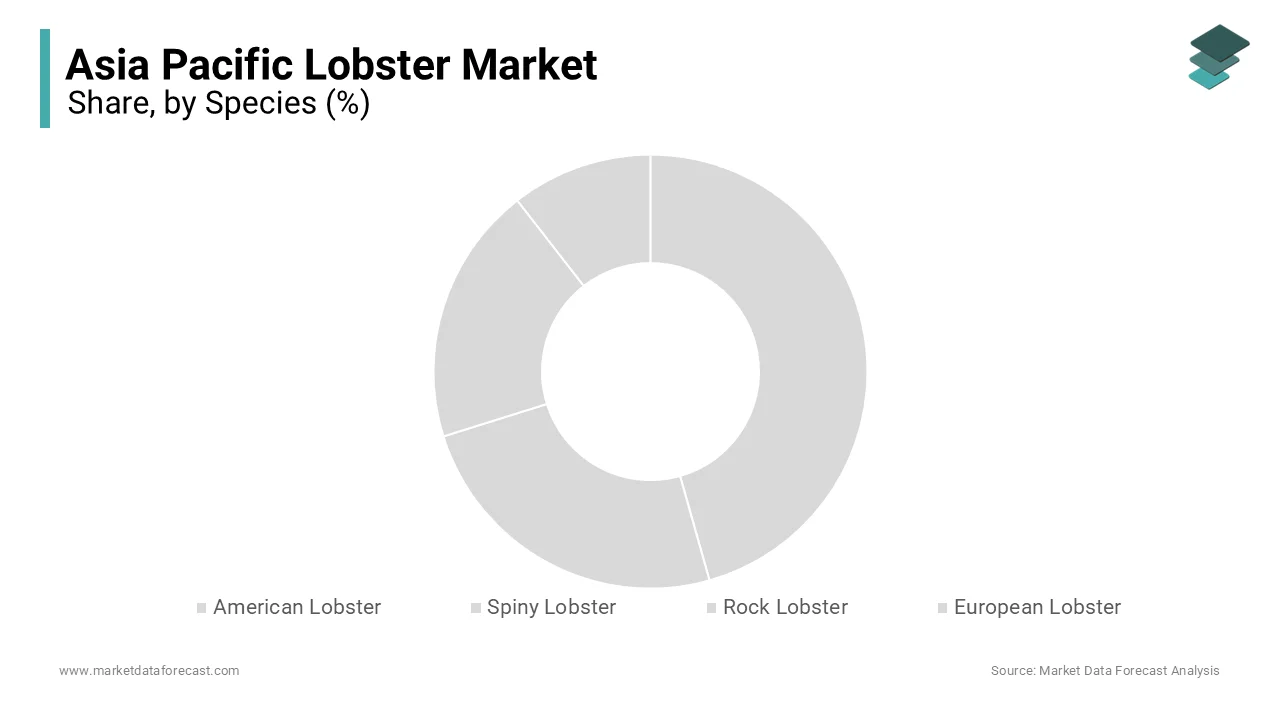
The Rock Lobster segment is projected to register the highest CAGR of 9.4% from 2026 to 2034. It is due to its premium positioning and robust export demand. This growth is primarily fueled by Australia’s dominance in wild-caught rock lobster (Panulirus cygnus and Jasus edwardsii), which commands some of the highest prices in global seafood markets. The preference for live rock lobster during Chinese New Year and other festive occasions has institutionalized seasonal demand spikes. The species’ large size, firm texture, and suitability for high-end culinary applications continue to elevate its desirability.
By Weight Insights
The 0.76 – 3.0 lbs weight segment led the Asia Pacific lobster market by representing a 62.4% of total sales volume in 2025. This dominance is due to its alignment with commercial food service requirements and consumer preferences for portion-controlled, visually impressive servings. Lobsters within this range are ideal for grilling, steaming, and presentation in high-end restaurants across China, Japan, and South Korea, where dining experiences emphasize both flavor and aesthetics. Besides, air freight logistics favor this category, demonstrate optimal survival rates during long-haul transport.
The Over 3 lbs segment is experiencing the fastest growth and is projected at a CAGR of 10.2% from 2026 to 2034. It is driven by rising demand for trophy-sized lobsters in luxury banquets and corporate gifting. These oversized specimens are increasingly viewed as status symbols in elite dining circles, particularly in mainland China and Hong Kong. Moreover, advancements in climate-controlled air cargo, including direct flights from Perth to Guangzhou, have improved survival rates for oversized lobsters, enabling reliable delivery of these premium products.
By Product Type Insights
The Whole Lobster segment prevailed in the market by accounting for substantial share of the Asia Pacific lobster market in 2025. This dominance is attributable to the cultural and culinary emphasis on live, intact presentation in East Asian markets, where freshness is equated with vitality and quality. In China, live whole lobsters are a centerpiece in celebratory meals, particularly during festivals such as Mid-Autumn Festival and Chinese New Year. The rise of e-commerce platforms like JD.com and Alibaba’s Freshippo has further amplified demand, offering same-day delivery of live lobsters to urban consumers.
The Lobster Meat segment is expanding at the fastest pace, with a projected CAGR of 11.3% during the forecast period. It is propelled by the growth of convenience foods and processed seafood in urban centers. Pre-cooked, frozen lobster meat is increasingly integrated into ready-to-eat meals, sushi, and gourmet sandwiches, particularly in Japan, South Korea, and Singapore. Furthermore, food safety advancements, such as high-pressure processing (HPP) adopted by Thai Union Group, have extended shelf life while preserving texture, making lobster meat a viable ingredient for mass-market applications.
By Distribution Channel Insights
The Food Service channel commanded the distribution channel with 65.7% share of the Asia Pacific lobster market in 2025. High-end restaurants, hotels, and catering services remain the primary consumers of live and fresh lobster, particularly in metropolitan hubs such as Tokyo, Shanghai, Seoul, and Singapore. The sector’s dominance is reinforced by the experiential nature of lobster consumption, where preparation methods like live boiling, grilling, and flambe are integral to the dining spectacle. Additionally, Michelin-starred establishments across the region prioritize whole lobster sourcing to maintain culinary authenticity.
The Retail channel is growing at a CAGR of 9.8% from 2026 to 2034 and is emerging as the fastest-expanding distribution route due to the proliferation of premium supermarkets and online grocery platforms. Consumers in urban centers are increasingly purchasing live and frozen lobster for home consumption, driven by rising disposable incomes and improved cold-chain infrastructure. Enhanced last-mile delivery networks and consumer confidence in product freshness are accelerating this shift toward retail democratization.
REGIONAL ANALYSIS
China Asia Pacific Lobster Market Insights
China stood as the undisputed epicenter of lobster demand in the Asia Pacific region by accounting for 54.1% share in 2025. The country functions primarily as a consumption and re-export hub rather than a producer, importing vast quantities of live rock and spiny lobster from Australia, Vietnam, and Indonesia. Chinese consumers associate lobster with prosperity, making it a staple during festive banquets and corporate gifting. The expansion of cold-chain logistics and e-commerce platforms like Pinduoduo and Tmall has enabled even second- and third-tier cities to access premium seafood. Furthermore, the General Administration of Customs has streamlined quarantine procedures for approved suppliers, facilitating faster clearance and reducing mortality rates during transit.
Australia Asia Pacific Lobster Market Insights
Australia is the leading exporter and a critical supplier within the regional lobster ecosystem. The country’s wild rock lobster fishery, particularly in Western Australia, is among the most valuable single-species fisheries in the Southern Hemisphere. In 2023, Australia exported 7,400 metric tons of lobster, generating AUD 810 million in revenue, with China absorbing over 80% of this volume. The Western Australian Department of Primary Industries and Regional Development emphasizes that strict quota systems and ecological monitoring have maintained stock sustainability, earning Marine Stewardship Council certification for its main lobster fishery. Additionally, Australia has invested in rapid air freight corridors, including direct cargo flights from Perth to Guangzhou, ensuring live lobsters arrive within 12 hours of harvest, a critical factor in maintaining market competitiveness.
Indonesia Asia Pacific Lobster Market Insights
Indonesia has emerged as a powerhouse in lobster aquaculture. Once primarily a wild seed collector, the country has transformed into the world’s largest producer of farmed spiny lobster. Government policies banning the export of juvenile lobsters in 2020 redirected supply toward domestic grow-out farms, catalyzing sector growth. This shift has not only boosted food security but also increased export earnings from processed and live adult lobsters.
Vietnam Asia Pacific Lobster Market Insights
Vietnam occupies a strategic position in the Asia Pacific lobster market as a major aquaculture and processing hub. The country’s coastal provinces, especially Khanh Hoa and Phu Quoc, host over 14,000 floating cages dedicated to spiny lobster farming. A key advantage lies in its proximity to China and competitive labor costs, enabling rapid scaling of operations. Moreover, Vietnam has developed specialized cold-chain logistics for live exports, with direct flights from Cam Ranh International Airport to Guangzhou and Shanghai. The Mekong Delta Development Research Institute notes that integration with regional trade agreements such as the RCEP has reduced tariffs and streamlined customs procedures, enhancing export efficiency.
Japan Asia Pacific Lobster Market Insights
Japan remains a high-value market for premium lobster products. The country imports significant quantities of cold-water species, including Canadian American lobster and New Zealand rock lobster, to meet the demands of its sophisticated culinary sector. The Ministry of Economy, Trade and Industry highlights that aging demographics and shrinking domestic fisheries have increased reliance on imports. Additionally, Japan’s stringent food safety standards have led to partnerships with certified suppliers in Australia and Canada, ensuring traceability and quality. The rise of premium convenience stores like Seijo Ishii and Delica Mart has also created new retail avenues for gourmet lobster products, sustaining demand despite economic headwinds.
COMPETITIVE LANDSCAPE
Competition in the Asia Pacific lobster market is intensifying as producers, processors, and exporters strive to capture growing premium seafood demand amid tightening biological and regulatory constraints. While Australia maintains a stronghold in wild-caught rock lobster exports, Southeast Asian nations like Indonesia and Vietnam are rapidly advancing aquaculture capabilities, challenging traditional supply hierarchies. Domestic value addition is becoming a focal point, with countries seeking to retain more economic benefit from raw exports. The market is witnessing a shift from volume-based competition to differentiation through sustainability certifications, traceability, and speed of delivery. Emerging players are leveraging technology and strategic alliances to enhance efficiency, while established firms defend their positions through brand reputation and logistics superiority. Regulatory compliance, climate resilience, and labor capacity further shape competitive dynamics, creating a fragmented yet highly strategic landscape.
KEY MARKET PLAYERS
The key players in the Asia Pacific lobster market are
- Geraldton Fishermen’s Co-operative
- Thai Union Group PCL
- Maruha Nichiro Corporation
- Dongwon Industries
- Nippon Suisan Kaisha (Nissui)
- Asian Sea Corporation
TOP PLAYERS IN THE MARKET
- Australian Premium Foods operates as a leading integrated seafood enterprise, specializing in the harvesting, processing, and global distribution of Western Rock Lobster. The company plays a pivotal role in linking Australia’s sustainable wild fisheries with high-demand markets across Asia, particularly China and Japan. It has strengthened its position through investments in cold-chain logistics and direct air freight partnerships, ensuring live lobsters reach consumers within 12 hours of capture. In recent years, the company has expanded its compliance framework to meet China’s stringent biosecurity requirements, enabling uninterrupted exports. It also collaborates with indigenous fishing enterprises, reinforcing supply chain resilience and ethical sourcing credentials, which are increasingly valued by premium importers in the region.
- Japfa Ltd. is a prominent agri-food company with growing influence in Indonesia’s aquaculture sector, particularly in spiny lobster farming. Through its subsidiary PT Central Proteina Prima, Japfa has pioneered scalable lobster hatchery and grow-out systems, contributing to Indonesia’s transition from wild seed exportation to domestic value-added production. The company has invested in research partnerships with the Indonesian Research Institute for Mariculture to enhance larval survival rates and optimize feed efficiency. Japfa has also established traceability protocols using digital monitoring systems across its farming clusters in East Java and Nusa Tenggara. These advancements have positioned the company as a key enabler of Indonesia’s national lobster self-sufficiency and export modernization strategy.
- Thai Union Group has extended its global seafood leadership into the premium lobster segment through strategic acquisitions and product innovation. While traditionally known for tuna, the company has leveraged its processing infrastructure in Thailand to become a major player in frozen lobster meat and value-added products for the Asia Pacific retail and food service sectors. Thai Union sources spiny lobster from sustainable aquaculture farms in Vietnam and Indonesia, applying high-pressure processing (HPP) technology to preserve freshness without preservatives. The company has also partnered with Alibaba’s Freshippo to supply ready-to-cook lobster meals in China, aligning with urban consumer trends. Its focus on food safety, traceability, and sustainability certifications strengthens its access to high-end distribution networks.
TOP STRATEGIES USED BY KEY MARKET PLAYERS
Key players in the Asia Pacific lobster market are prioritizing vertical integration, investing from hatchery to harvest and export logistics to ensure supply consistency and quality control. Companies are expanding cold-chain infrastructure, including temperature-monitored air freight and live transport systems, to minimize mortality and meet premium market demands. Strategic partnerships with governments and research institutions are enhancing breeding technologies and disease management. Digital traceability platforms using blockchain are being adopted to assure compliance with import regulations. Additionally, firms are diversifying product formats, shifting toward ready-to-eat and portioned offerings to capture retail growth. Market expansion into secondary Chinese cities and e-commerce channels is also accelerating, supported by localized marketing and rapid delivery networks.
RECENT HAPPENINGS IN THE MARKET
- In June 2023, Australian Premium Foods launched a dedicated live lobster airbridge between Perth and Guangzhou, ensuring same-day delivery to major Chinese distributors and reducing post-harvest mortality by 30%.
- In January 2025, Japfa Ltd. inaugurated a new lobster hatchery facility in Lombok, Indonesia, capable of producing 5 million juvenile spiny lobsters annually, significantly boosting domestic seed supply for grow-out farms.
- In September 2023, Thai Union Group partnered with Alibaba’s Freshippo to introduce pre-cooked, ready-to-heat lobster meals in 20 Chinese cities, tapping into the rising demand for premium convenience seafood.
- In March 2025, Vietnam’s Cam Hai Aquaculture Cooperative implemented blockchain-based traceability across 1,200 lobster cages in Nha Trang, enabling real-time monitoring for export compliance and consumer transparency.
- In November 2023, the Western Australian Department of Primary Industries and Regional Development approved a new AI-powered monitoring system for lobster fishing vessels to enhance stock assessment accuracy and sustainability reporting.
MARKET SEGMENTATION
This research report on the Asia Pacific lobster market has been segmented and sub-segmented based on the following categories.
By Species
- American Lobster
- Spiny Lobster
- Rock Lobster
- European Lobster
By Weight
- 0.5 – 0.75 lbs
- 0.76 – 3.0 lbs
- Over 3 lbs
By Product Type
- Whole Lobster
- Lobster Tail
- Lobster Meat
- Lobster Claw
By Distribution Channel
- Food Service
- Retail
By Country
- India
- China
- Japan
- South Korea
- Australia
- New Zealand
- Thailand
- Malaysia
- Vietnam
- Philippines
- Indonesia
- Singapore
- Rest of Asia Pacific