- Product Description Description
- Table of Contents TOC
- List of Table & Figure LOT
- Get Free Sample PDF Sample PDF
Market Size, 2025
$219.06 BnMarket Estimate, 2026
$241.47 BnMarket Forecast, 2034
$526.33 BnCAGR, 2026–2034
10.23%Asia Pacific Medical Suction Device Market Size
The Asia Pacific medical suction device market was valued at USD 219.06 billion in 2025, is estimated to reach USD 241.47 billion in 2026, and is projected to reach USD 526.33 billion by 2034, growing at a CAGR of 10.23% from 2026 to 2034.

A medical suction device refers to the electromechanical and manual systems designed to remove fluids, secretions, and debris from patients’ airways, surgical sites, and body cavities during clinical procedures. These devices are integral to emergency care, anesthesia, critical care, and home healthcare settings, ensuring airway patency and preventing aspiration. With increasing healthcare infrastructure development and rising awareness of patient safety protocols, the demand for reliable, portable, and infection-controlled suction devices has become a cornerstone of modern medical practice in the region.
MARKET DRIVERS
Expansion of Surgical and Critical Care Infrastructure in Emerging Economies
The rapid expansion of surgical and intensive care capacity in countries like India, Indonesia, and Vietnam is a primary driver of medical suction device demand. As governments invest in strengthening healthcare systems, the number of hospital beds equipped with critical care capabilities has risen significantly. These infrastructure upgrades are accompanied by the procurement of both wall-mounted and portable suction units, with a growing preference for silent, energy-efficient models. The integration of suction devices into standardized operating room configurations ensures consistent demand across public and private healthcare expansions.
Rising Incidence of Respiratory Diseases and Chronic Conditions
The escalating prevalence of respiratory ailments such as chronic obstructive pulmonary disease (COPD), bronchiectasis, and pneumonia is significantly increasing the clinical need for suction devices across inpatient and home care settings. India and China together represent the largest COPD patient populations. In Japan, where 12% of the population is over 75 years old, age-related dysphagia and secretion management have made portable suction units essential in long-term care facilities. The post-pandemic emphasis on airway management has further institutionalized suction equipment in primary clinics and ambulance services, reinforcing its role in routine and emergency respiratory care.
MARKET RESTRAINTS
Limited Access to Advanced Devices in Rural and Underserved Areas
A significant barrier to market growth is the uneven distribution of advanced medical suction devices, particularly in rural and remote regions across the Asia Pacific. Inmany countries, health centers lack access to electric suction units, relying instead on outdated manual models that are less effective and more labor-intensive. The lack of reliable electricity further limits the use of electromechanical systems, forcing clinics to depend on hand-operated bulbs or wall units with inconsistent vacuum pressure. This technological gap compromises patient outcomes in obstetric emergencies, pediatric care, and trauma management. Without targeted investment in power infrastructure and device procurement, the disparity between urban hospitals and rural clinics will continue to constrain market penetration.
Stringent Regulatory Pathways and Delayed Approvals
Divergent regulatory frameworks across Asia Pacific countries create significant delays in the commercialization of new medical suction devices. In markets like China and India, approval processes for Class II and III medical devices can take 18 to 24 months due to complex documentation, clinical evaluations, and local testing requirements. Countries such as Thailand and Vietnam are strengthening conformity assessment procedures, requiring ISO 13485 certification and local representative appointments. These regulatory hurdles increase time-to-market and discourage innovation entry, particularly for small and medium enterprises. The absence of regional harmonization, unlike the EU’s MDR or ASEAN’s incomplete medical device directive, forces companies to navigate fragmented compliance landscapes, limiting the availability of advanced suction technologies in high-need areas.
MARKET OPPORTUNITIES
Growth of Home Healthcare and Ambulatory Care Services
The expanding home healthcare sector presents a transformative opportunity for portable and battery-operated medical suction devices. With aging populations and rising chronic disease burdens, countries like Japan, South Korea, and Australia are shifting care delivery from hospitals to homes to reduce costs and improve quality of life. Many of these patients require airway management due to neuromuscular disorders, tracheostomies, or post-stroke complications. Portable suction units with low noise, long battery life, and ease of sterilization are increasingly prescribed for domestic use. Additionally, ambulance fleets across Malaysia and the Philippines are upgrading to compact, high-performance suction systems, reflecting a broader trend toward mobile emergency care. This shift is driving demand for lightweight, user-friendly, and infection-safe devices.
Integration of Smart Features and Infection Control Innovations
Advancements in smart technology and infection prevention are opening new growth avenues for medical suction devices. Additionally, the use of antimicrobial tubing, disposable canisters, and closed-suction systems is gaining traction in response to rising hospital-acquired infection rates. New devices with single-use components and HEPA filtration are being prioritized in procurement, signaling a shift toward safer, smarter, and more automated airway management solutions.
MARKET CHALLENGES
High Cost of Advanced Devices in Price-Sensitive Markets
The high acquisition and maintenance cost of advanced electric and smart suction devices limits their adoption in low- and middle-income countries across the Asia Pacific. While a basic manual suction pump costs under USD 50, a fully featured electric unit with digital controls and backup batteries can exceed USD 1,200, placing it beyond the budget of many rural clinics. According to the World Bank, public health spending per capita in Laos and Myanmar remains below USD 50 annually, severely restricting medical equipment procurement. Even in larger hospitals, budget constraints often lead to delayed replacements or reliance on refurbished units, which may not meet current safety standards. Private providers in tier-2 cities also face financial pressure, opting for lower-cost models despite reduced durability. This cost barrier stifles innovation uptake and perpetuates reliance on outdated technology, particularly in regions where patient volumes are high but funding is limited.
Lack of Standardized Training and Maintenance Protocols
A critical operational challenge is the absence of standardized training for healthcare workers in the proper use and maintenance of medical suction devices. In many parts of the Asia Pacific, especially in remote clinics, staff are not adequately trained in vacuum calibration, infection control, or troubleshooting mechanical failures. Improper use, such as excessive suction pressure or incorrect catheter insertion can lead to mucosal damage, hypoxia, or ineffective clearance. Besides, poor maintenance practices, including failure to clean canisters or replace filters, increase the risk of cross-contamination. Without structured training programs and device stewardship policies, even high-quality equipment may underperform, undermining patient safety and clinical outcomes.
SEGMENTAL ANALYSIS
By Type Insights
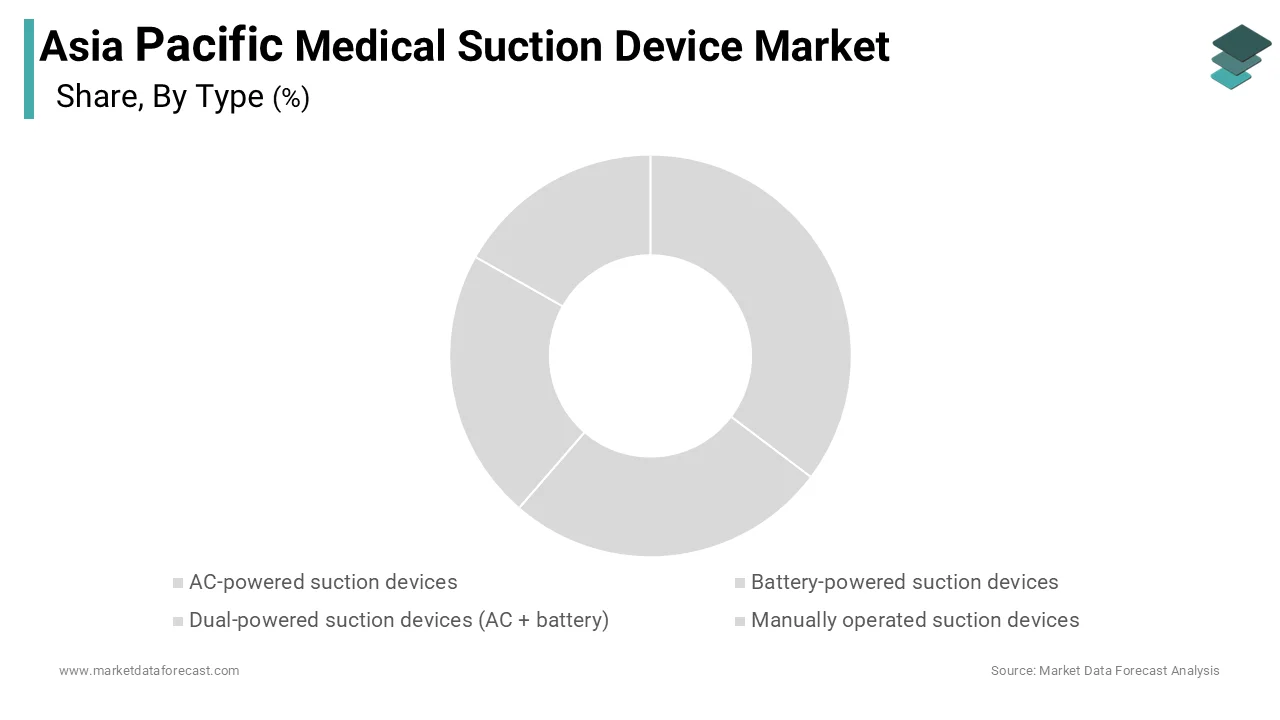
The AC-powered suction device segment was the dominant type in the Asia Pacific market by accounting for a 44.1% in 2025. This dominance is primarily driven by its widespread integration into fixed clinical environments such as operating rooms, intensive care units, and emergency departments. In large hospitals across China and India, centralized AC-powered systems are standard infrastructure, providing continuous, high-vacuum suction essential during complex surgeries and critical care interventions. A further key factor is the reliability and consistent performance of AC-powered devices in settings with stable electricity. The durability, low maintenance, and compatibility with hospital-wide vacuum networks make AC-powered units the backbone of institutional suction capability, ensuring their continued leadership in the regional market.
The battery-powered suction devices segment is the fastest-growing and is projected to grow at a CAGR of 10.4% from 2025 to 2033. This rapid expansion is fueled by the rising demand for portable, reliable suction in mobile and resource-limited settings. In rural India and Indonesia, where ambulance services are expanding under national health missions, battery-powered units are becoming standard equipment. An additional critical driver is the increasing use of these devices in home healthcare and long-term care facilities, particularly for patients with tracheostomies or neuromuscular disorders. Further, battery-powered models with long-life lithium-ion batteries and silent operation are preferred in pediatric and neonatal transport. The World Health Organization’s Emergency Medical Teams initiative has also recommended battery-powered suction as essential equipment in disaster response kits, leading to procurement by NGOs and government agencies across flood- and typhoon-prone regions like the Philippines and Vietnam. This convergence of mobility, reliability, and emergency preparedness is accelerating adoption.
By Application Insights
The surgical application segment commanded the market by capturing a52.5% of total sales in 2025. This lead position is supported by the sheer volume and complexity of surgical procedures performed across the region, where suction is indispensable for maintaining clear operative fields in general, neuro, orthopedic, and obstetric surgeries. In China, over 80 million surgical procedures were conducted in 2022 alone, with nearly every operation requiring at least one suction unit. The expansion of specialty hospitals and day-surgery centers in countries like Thailand and Malaysia has further increased demand for dedicated suction systems in operating theaters. The institutionalization of standardized surgical protocols that mandate suction availability is a major contributing factor. In India, the National Accreditation Board for Hospitals & Healthcare Providers (NABH) requires all accredited facilities to have functional suction devices in every operating room, driving procurement across public and private sectors. The rise in minimally invasive and laparoscopic procedures also relies on precise, low-pressure suction control. Hence, the demand for high-performance suction devices remains deeply embedded in procedural infrastructure.
The airway management segment is the fastest-growing application and is expected to grow at a CAGR of 9.8% from 2025 to 2033. This surge is driven by the escalating prevalence of acute and chronic respiratory conditions requiring emergency and long-term airway clearance. In India and Indonesia, where air pollution levels consistently exceed WHO guidelines, hospitalizations for COPD and asthma have risen sharply. A different key driver is the growing focus on pre-hospital and emergency airway management. The integration of suction protocols into basic and advanced life support training has increased device deployment in ambulances and emergency response units. Further, the post-pandemic emphasis on airway safety in ICUs has led to the adoption of closed suction systems to reduce aerosolization and infection risk. This shift underscores the expanding role of suction beyond surgery into dynamic, life-saving respiratory care.
By Portability Insights
The wall-mounted suction device segment led the majority market share at 55.3% of total sales in 2025. This dominance is credited to its integration into permanent hospital infrastructure, particularly in operating rooms, ICUs, and emergency departments, where continuous, high-capacity suction is essential. In large medical centers across China and South Korea, centralized vacuum systems supply wall-mounted units in every procedural and critical care bed. The reliability and high vacuum flow rate, often exceeding 40 L/min, offered by wall-mounted systems, which are critical during major surgeries and trauma resuscitation, is a primary driver. The durability and low operational cost of these fixed systems make them economically favorable for high-utilization environments. This entrenched role in institutional care infrastructure ensures the segment’s continued dominance.
The handheld suction devices segment is the fastest-growing and is projected to grow at a CAGR of 11.2% from 2025 to 2033. This acceleration is driven by the rising demand for portability in emergency response, home care, and remote clinical settings. In India, the National Health Stack has integrated handheld suction units into its community health worker kits, witha large number of devices distributed to auxiliary nurse midwives (ANMs). These compact units are essential during childbirth in rural areas to prevent neonatal aspiration. A further major factor is the expansion of ambulance and pre-hospital care networks across Southeast Asia. The aging population in Japan and South Korea is also driving demand for lightweight, easy-to-operate devices in home and long-term care settings. This versatility across emergency, domiciliary, and mobile care is propelling the segment’s rapid expansion.
By End User Insights
The hospitals and clinics segment spearheaded the market by accounting for a 63.8% of total sales in 2025. This growth of the segment is supported by the high volume of clinical procedures, inpatient care, and emergency interventions conducted in institutional settings. In China, over 3.8 billion outpatient visits were recorded in 2022, according to the National Health Commission, many of which involved procedures requiring suction support. The presence of operating theaters, ICUs, and emergency rooms ensures consistent demand for both wall-mounted and portable units. The accreditation and regulatory requirements that mandate suction availability in healthcare facilities are a key driver. Similarly, in Australia, the National Safety and Quality Health Service Standards specify suction as essential equipment in procedural areas. The expansion of specialty hospitals has further increased procurement. Besides, the post-pandemic focus on infection control has led to the adoption of disposable suction canisters and closed systems in ICUs. This institutional dependency on reliable, high-performance suction ensures the segment’s overwhelming market presence.
The homecare segment is the fastest-growing end-user and is projected to grow at a CAGR of 12.1% during the forecast period. This rapid growth is fueled by the rising prevalence of chronic respiratory conditions, neuromuscular disorders, and geriatric care needs that require long-term airway management outside hospitals. Portable, quiet, and user-friendly devices are increasingly prescribed for domestic use. A different critical driver is government and insurance support for home-based care to reduce hospital burden and costs. Similarly, Australia’s NDIS funds suction equipment for individuals with disabilities. The Global Strategy on Digital Health 2020–2025, endorsed by WHO, encourages home monitoring technologies, further legitimizing decentralized care. With aging populations and rising chronic disease burdens, the shift toward home-based suction management is redefining care delivery and driving unprecedented market expansion.
COUNTRY-LEVEL ANALYSIS
China Medical Suction Device Market Insights
China maintained the largest position in the Asia Pacific medical suction device market by capturing 29.5% of regional demand in 2025. The country’s dominance is driven by its vast healthcare infrastructure, high surgical volume, and aggressive hospital modernization programs. With around 36,000-38,000 hospitals and 138,000 ICU beds, China has institutionalized suction devices as standard equipment in all tertiary and secondary facilities. The Made in China 2025 initiative has also spurred domestic production of advanced medical devices, including smart suction units with IoT integration. Additionally, the expansion of rural healthcare networks under the Healthy China 2030 plan has increased procurement of portable models for township clinics, ensuring broad market penetration.
India Medical Suction Device Market
India is characterized by a rapidly expanding healthcare ecosystem and rising government investment in medical infrastructure. The country’s demand is fueled by a high burden of respiratory diseases, growing surgical volumes, and the proliferation of private hospitals. Like, over 30 million people in India suffer from COPD, necessitating widespread availability of suction devices. The Pradhan Mantri Ayushman Bharat Health Infrastructure Mission has allocated INR 64,180 crore (USD 7.7 billion) for upgrading 17,788 rural health centers and establishing 11,024 critical care hospitals, each requiring suction systems. Additionally, the rise of telemedicine and home healthcare startups has increased demand for portable units. With medical device manufacturing incentives under the PLI scheme, India is emerging as a regional hub for cost-effective, locally produced suction devices.
Japan Medical Suction Device Market
Japan is distinguished by its technologically advanced healthcare system and aging population. The country’s demand is centered on high-precision, quiet, and infection-safe suction devices for use in ICUs, long-term care facilities, and homes. Additionally, Japan’s prowess in medical robotics and minimally invasive surgery has increased demand for integrated suction solutions in laparoscopic and neurosurgical procedures. The country’s stringent regulatory standards and focus on patient safety position it as a premium market for advanced, reliable suction technologies.
Australia Medical Suction Device Market
Australia holds a significant share, with demand driven by high healthcare standards, well-established emergency services, and a strong focus on patient safety. The country’s National Safety and Quality Health Service Standards require suction availability in all procedural and critical care areas, ensuring universal adoption in hospitals. According to the Australian Institute of Health and Welfare, about 7.7 million surgical procedures were performed in 2021-2022, each relying on suction support. Furthermore, the National Disability Insurance Scheme funds suction devices for home use, supporting the growth of the homecare segment. Australia’s regulatory rigor and emphasis on innovation make it a model market for high-compliance, advanced suction solutions.
South Korea Medical Suction Device Market
South Korea is marked by a highly digitized healthcare system and strong government support for medical technology. The country’s demand is concentrated in advanced hospitals, emergency response units, and homecare settings for the elderly. The government’s Digital Health Innovation Strategy has incentivized the integration of connected medical devices, including IoT-enabled suction units. Moreover, South Korea has one of the world’s fastest-aging populations, with 17.5% of citizens over 65, increasing demand for home-based airway management. The Ministry of Food and Drug Safety has streamlined approvals for innovative suction devices, accelerating market entry. This blend of technological sophistication and demographic pressure positions South Korea as a high-growth, high-value market.
TOP LEADING PLAYERS IN THE MARKET
Medtronic plc
Medtronic is a pivotal player in the Asia Pacific medical suction device market, offering advanced airway management solutions integrated into critical care and surgical ecosystems. The company’s Kendall and Covidien-branded suction units are widely used in hospitals across Japan, Australia, and India for their reliability, precision vacuum control, and infection-resistant design. The company has strengthened its regional footprint by collaborating with hospital networks in Thailand and Malaysia to support emergency preparedness programs. Additionally, Medtronic has invested in clinical training initiatives for ICU and OR staff, enhancing device utilization and safety. Their integration of suction technology into broader patient monitoring and anesthesia platforms reinforces their position as a comprehensive solutions provider.
GE Healthcare
GE Healthcare plays a significant role in the Asia Pacific market by delivering high-performance, hospital-grade suction devices as part of its broader anesthesia and critical care portfolio. Its Aestiva and Aisys anesthesia systems are equipped with integrated suction controls, widely adopted in operating rooms across China, India, and Australia. The company has expanded its service network in Indonesia and Vietnam to ensure rapid technical support and device calibration. GE also partners with government health programs in Bangladesh and the Philippines to supply cost-effective, durable suction units for rural clinics. Their emphasis on interoperability with digital health platforms and adherence to global safety standards positions GE as a trusted provider in both public and private healthcare sectors.
Scholly Fiberoptic GmbH
Scholly Fiberoptic has emerged as a key innovator in the Asia Pacific medical suction device market, specializing in high-precision, fiber-optic-integrated suction systems for minimally invasive and endoscopic procedures. While traditionally known for imaging, the company has expanded its portfolio to include micro-suction units that combine illumination, irrigation, and aspiration in single-channel endoscopic tools, widely used in neurosurgery and ENT procedures in South Korea, Singapore, and Australia. The company has strengthenedits regional presence through collaborations with leading surgical robotics firms and teaching hospitals to integrate its devices into advanced surgical workflows. By focusing on niche, high-value applications requiring superior optical and fluid management precision, Schölly has carved a differentiated position in the premium segment of the market.
TOP STRATEGIES USED BY KEY MARKET PARTICIPANTS
Key players in the Asia Pacific medical suction device market are leveraging product innovation, strategic partnerships, and localized service expansion to strengthen their competitive positioning. A primary strategy is the integration of digital and smart technologies, including IoT-enabled monitoring, real-time pressure feedback, and compatibility with hospital information systems to enhance clinical decision-making. Companies are also focusing on developing compact, portable, and battery-operated devices tailored for pre-hospital, homecare, and rural use, aligning with shifting care delivery models. Strategic collaborations with government health agencies and NGOs facilitate large-scale procurement in underserved regions, improving market penetration. Firms are investing in training programs for healthcare providers to ensure proper device use and reduce complications. Additionally, manufacturers are expanding local assembly and service centers in India, Indonesia, and Vietnam to reduce costs and improve after-sales support. Regulatory alignment with country-specific standards ensures faster approvals, while sustainability initiatives, such as reusable canister systems, appeal to environmentally conscious institutions.
KEY MARKET PLAYERS
Some of the companies that are playing a dominating role in the global Asia Pacific Medical Suction Device Market include
- Stryker Corporation
- Medtronic plc
- Cardinal Health, Inc.
- GE Healthcare
- Philips Healthcare
- Fisher & Paykel Healthcare Corporation Ltd.
- CONMED Corporation
- Becton, Dickinson and Company (BD)
- Smiths Medical (ICU Medical)
- Drägerwerk AG & Co. KGaA
- Teleflex Incorporated
- Vyaire Medical, Inc.
- Hamilton Medical AG
- Analogic Corporation
- Beijing Aeonmed Co., Ltd.
- Shenzhen Mindray Bio-Medical Electronics Co., Ltd.
- Nihon Kohden Corporation
- Olympus Corporation
- ZOLL Medical Corporation
COMPETITION OVERVIEW
The competition in the Asia Pacific medical suction device market is characterized by a blend of global medical technology leaders and agile regional manufacturers competing on innovation, reliability, and adaptability. Multinational corporations dominate through advanced product portfolios and integration with broader clinical ecosystems, while local players offer cost-effective alternatives for price-sensitive markets. Differentiation is increasingly driven by device intelligence, portability, and infection control features rather than basic functionality. The rise of home healthcare and emergency response systems has intensified demand for handheld and battery-powered models, reshaping product development priorities. Regulatory diversity and varying healthcare infrastructure across countries require tailored market entry strategies. Companies that combine technological sophistication with robust training and service networks are gaining an advantage. As clinical standards evolve, the competitive landscape is shifting from standalone devices to integrated, patient-centered airway management solutions in the Asia Pacific medical suction device market.
RECENT MARKET DEVELOPMENTS
- In January 2025, Medtronic launched its VacuAide Pro portable suction system in South Korea and Singapore, featuring smart monitoring and extended battery life to enhance emergency and home care applications in the Asia Pacific medical suction device market.
- In March 2025, GE Healthcare expanded its technical service network across Indonesia and Vietnam, establishing 12 new support hubs to improve maintenance and calibration for hospital-grade suction units in the Asia Pacific medical suction device market.
- In August 2025, Schölly Fiberoptic introduced its SuctionVision™ integrated endoscopic suction technology in Japan, combining fiber-optic imaging with precise aspiration for minimally invasive surgeries in the Asia Pacific medical suction device market.
- In November 2025, Medtronic partnered with a major public hospital network in Thailand to supply smart suction units for ICU upgrades under a national critical care enhancement program in the Asia Pacific medical suction device market.
- In April 2025, GE Healthcare launched the CARESCAPE™ Suction Module in New Zealand, enabling seamless integration with patient monitors and ventilators to improve airway management in intensive care settings in the Asia Pacific medical suction device market.
MARKET SEGMENTATION
This research report on the Asia Pacific Medical Suction Device Market has been segmented and sub-segmented into the following.
By Type
- AC-powered suction devices
- Battery-powered suction devices
- Dual-powered suction devices (AC + battery)
- Manually operated suction devices
By Portability
- Wall-mounted suction devices
- Handheld suction devices
- Portable/Compact suction devices
- Transport/EMS suction devices
By Application
- Surgical applications
- Airway management
- Obstetrics & gynecology
- Dental
- Research & diagnostics
By Country
- China
- India
- Japan
- South Korea
- Australia
- New Zealand
- Thailand
- Indonesia
- Philippines
- Vietnam
- Singapore
- Rest of APAC