Asia Pacific Milk Replacers Market By Type (Medicated, And Non-Medicated), Livestock (Ruminants, And Swine), Source (Milk-based, Non-milk-based, And Blended), Form (Powdered, And Liquid), And Region And By Region - Industry Analysis, Size, Share, Growth, Trends, And Forecasts (2026 to 2034)

ID: 3077
Pages: 145

Market Size, 2025

$1.28 Bn

Market Estimate, 2026

$1.39 Bn

Market Forecast, 2034

$2.73 Bn

CAGR, 2026–2034

8.78%

Asia Pacific Milk Replacers Market Size

Asia Pacific Milk Replacers Market size was calculated to be USD 1.28 billion in 2025 and is anticipated to be worth USD 2.73 billion by 2034, from USD 1.39 billion in 2026, growing at a CAGR of 8.78% during the forecast period.
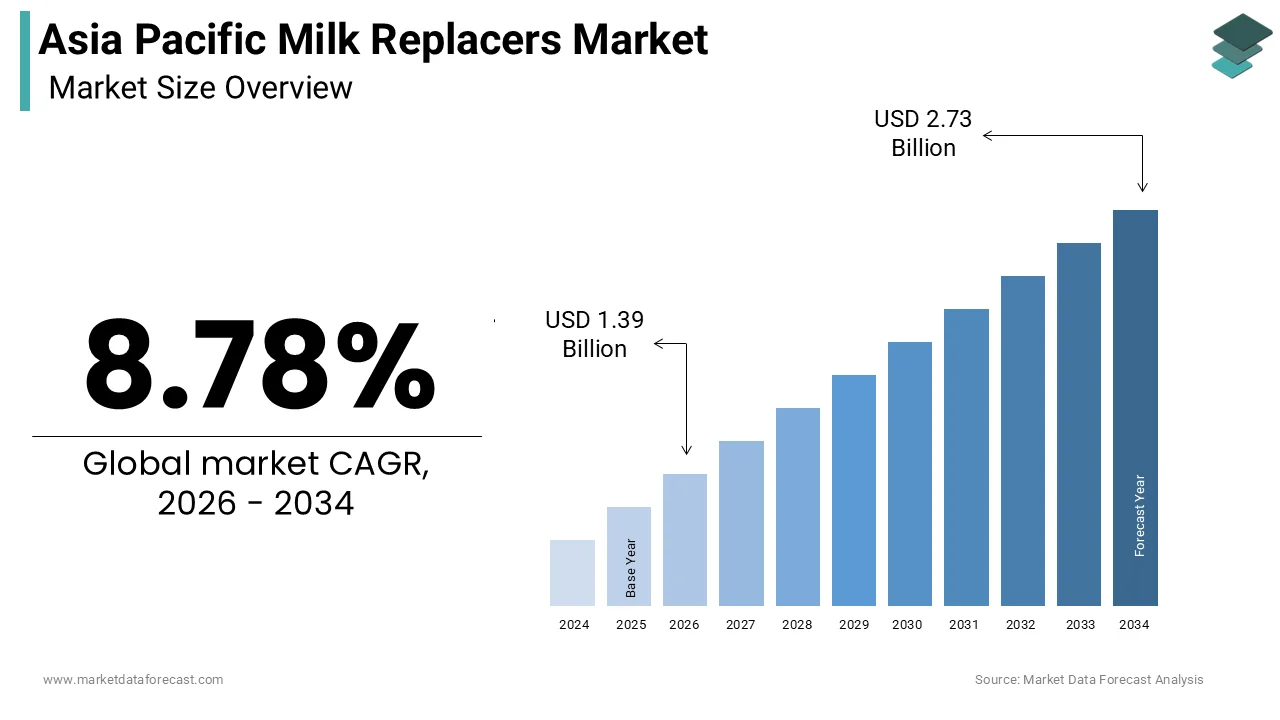
Asia Pacific Milk Replacers Market size was calculated to be USD 1.28 billion in 2025 and is anticipated to be worth USD 2.73 billion by 2034

It captures 20% of the global market share. A milk replacer is commonly utilized as an alternative to feed the offspring of animals if the mother’s milk is not available.

A widely popular technique of precision nutrition, growing consumption of milk worldwide, cutting edge technological advancements in Milk Replacers and growth/investment opportunities are few of the trends in this market. Liquid milk replacers are capturing the growing demand as they are quite easy to digest, and provide nutrition to offspring needed in the right amount.

Major factors fuelling this market include the growing milk prices, increasing awareness of cost-benefits and nutritional aspects of milk replacer products, very wide ranging acceptance of precise nutrition techniques, growing concerns for the mortality and sundry health-related aspects, as well as an increase in nutritional mismatches in the early birth stage of livestock offspring.

Increasing input costs of milk replacer proteins coupled with availability and increasing utilization of waste or trans-species milk as an alternative are the primary factors hampering the development of this market. Many limitations on the range of milk replacers available to the formulators to undertake the development have arisen due to the strict regulatory controls imposed by the government on the usage of antibiotics. Further, feed cannot be manufactured without government sanction.

Segmental Analysis

Asia Pacific Milk Replacers Market By Type

  • Medicated
  • Non-medicated

Non-medicated accounts for the largest share. It is because of its degenerate prices. On the other hand, medicated is the fastest growing segment

Asia Pacific Milk Replacers Market By Livestock

  • Ruminants
  • Swine
  • Others (equine and pets)

Asia Pacific Milk Replacers Market By Source

  • Milk based
  • Non-milk based
  • Blended

Asia Pacific Milk Replacers Market By Form

  • Powder
  • Liquid

In 2018, powder milk replacers segment was the largest and fastest growing segment because of ease of use, handling, and storage.

Regional Analysis

  • China
  • India
  • Japan
  • South Korea
  • Australia

Asia-Pacific is the rapidly developing market. It is the third largest market globally. Rising demand in India and China is due to the fact that the livestock bearers are getting cost-conscious and the market is getting better organized.

Key Players in the Market

Following are the major players in the market Cargill (U.S.), Archer Daniels Midland Company (U.S.), CHS Inc. (U.S.), Land O’ Lakes (U.S.), and Lactalis Group (France), Glanbia, Plc (Ireland), VanDrie Group (Netherlands), FrieslandCampina (Netherlands), Nutreco N.V. (Netherlands), and Alltech (U.S.).

Trusted by 500+ companies. We respect your privacy and never share your data.

Please wait. . . . Your request is being processed

Frequently Asked Questions

1. What is driving the growth of the Asia Pacific Milk Replacers Market?

The market is driven by the expansion of the livestock industry, increasing demand for high-quality animal nutrition, rising dairy and meat production, and growing adoption of scientifically formulated feed products.

2. Which type of milk replacer holds the largest share of the APAC Milk Replacers Market?

Calf milk replacers hold the largest market share due to the expanding dairy industry and the need to improve calf health, growth, and productivity.

3. Which application dominates the APAC Milk Replacers Market?

The calf rearing segment dominates the market, followed by milk replacers for piglets, lambs, kids (young goats), and foals.

4. What are the major ingredients used in milk replacers?

Milk replacers typically contain milk proteins, whey protein, vegetable proteins, fats and oils, vitamins, minerals, amino acids, probiotics, and other nutritional additives.

5. What challenges does the APAC Milk Replacers Market face?

The market faces challenges such as fluctuating raw material prices, limited awareness among small-scale farmers, disease outbreaks in livestock, and supply chain disruptions.

6. Which end-user segment accounts for the largest market share?

Commercial dairy farms account for the largest market share due to their widespread use of milk replacers for efficient calf management and improved production performance.

7. What trends are shaping the APAC Milk Replacers Market?

Key trends include the development of high-protein formulations, functional feed ingredients, antibiotic-free products, precision livestock nutrition, and sustainable feed solutions.

8. How is technological innovation impacting the APAC Milk Replacers Market?

Innovations in feed formulation, nutritional science, ingredient processing, and precision feeding technologies are improving the quality, digestibility, and effectiveness of milk replacers.

9. What opportunities exist in the APAC Milk Replacers Market?

Opportunities include increasing commercial livestock farming, expanding dairy production, growing demand for premium animal nutrition, and rising investments in feed technology.

10. What is the future outlook for the APAC Milk Replacers Market?

The market is expected to witness steady growth during the forecast period, driven by expanding livestock farming, increasing demand for high-quality animal nutrition, technological advancements in feed formulations, and rising awareness of efficient calf and young animal management.

Related Reports

Access the study in MULTIPLE FORMATS
Purchase options starting from $ 2000

Didn’t find what you’re looking for?
TALK TO OUR ANALYST TEAM

Need something within your budget?
NO WORRIES! WE GOT YOU COVERED!

REACH OUT TO US

Call us on: +1 888 702 9696 (U.S Toll Free)

Write to us: sales@marketdataforecast.com

Click for Request Sample