- Product Description Description
- Table of Contents TOC
- List of Table & Figure LOT
- Get Free Sample PDF Sample PDF
Market Size, 2025
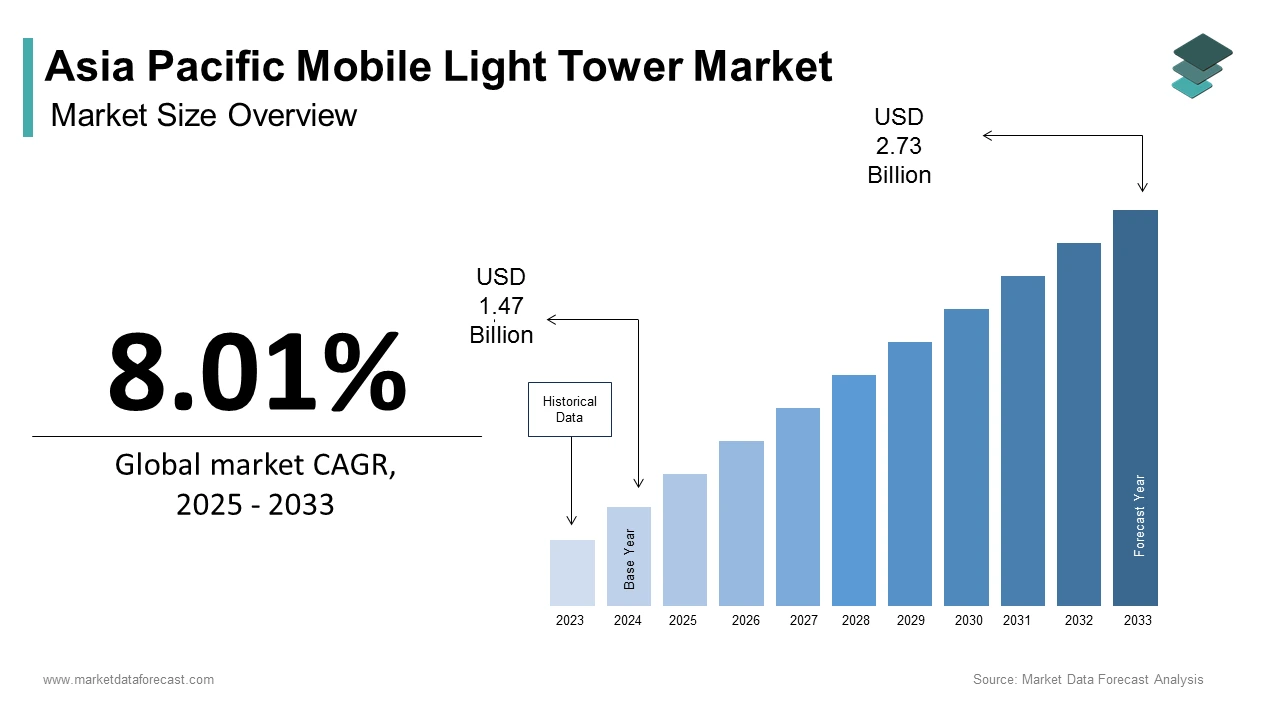
$1.47 BnMarket Estimate, 2026
$1.59 bnMarket Forecast, 2034
$2.95 BnCAGR, 2026–2034
8.01%Asia Pacific Mobile Light Tower Market Size
The Asia Pacific Mobile Light Tower Market size was calculated to be USD 1.47 billion in 2025 and is anticipated to be worth USD 2.95 billion by 2034, from USD 1.59 billion in 2026, growing at a CAGR of 8.01% during the forecast period.
The mobile light tower typically feature telescopic masts, high-intensity discharge or LED lighting, and are powered by diesel generators, solar energy, or hybrid systems. In India, the Ministry of Road Transport and Highways reported that over 40,000 kilometers of new roads were under construction in 2023, necessitating extensive use of mobile lighting systems. Similarly, in Australia, the Department of Defence has deployed mobile light towers in remote military training zones to enhance nighttime visibility and security.
MARKET DRIVERS
Expansion of Infrastructure and Construction Projects
The rapid expansion of infrastructure and construction activities across the region is driving the growth of the Asia Pacific mobile light tower market. In India, the National Highways Authority of India (NHAI) reported that over 10,000 km of highways were under construction in 2023, with mobile light towers being extensively used for nighttime work and site security. In China, the Ministry of Housing and Urban-Rural Development noted that mobile light towers are now standard equipment on construction sites due to extended work hours and safety regulations. In the Philippines, the Department of Public Works and Highways emphasized that mobile lighting for accelerating infrastructure development in remote island provinces.
Increasing Demand from the Oil, Gas, and Mining Sectors
The growing reliance on these units in the oil, gas, and mining industries, where operations often take place in remote and hazardous environments is fuelling the growth of the Asia Pacific mobile light tower market. As per the International Energy Agency (IEA), oil and gas exploration activities in the Asia Pacific region increased by 8% in 2023 in offshore fields in Australia, Malaysia, and Vietnam. In India, the Oil and Natural Gas Corporation (ONGC) has mandated the deployment of mobile lighting units at exploration sites to enhance visibility and worker safety. Similarly, in Indonesia, mobile light towers are being deployed in coal and nickel mining zones to support extended work hours and emergency operations.
MARKET RESTRAINTS
High Operational and Maintenance Costs
The high operational and maintenance costs associated with diesel-powered units is hindering the growth of the Asia Pacific mobile light tower market. According to the International Renewable Energy Agency (IRENA), diesel generators account for over 70% of mobile light tower power sources in the region, with fuel expenses making up nearly 40% of total operating costs. Additionally, the frequent use of mobile light towers in harsh environments leads to rapid wear and tear, increasing repair and replacement costs. As per the Australian Institute of Petroleum, maintenance expenses for mobile light towers in mining and construction applications can exceed USD 2,000 annually per unit.
Regulatory and Environmental Compliance Pressures
The tightening of environmental and noise regulations, which are increasingly limiting the use of conventional diesel-powered units is hampering the growth of the Asia Pacific mobile light tower market. According to the United Nations Environment Programme (UNEP), several countries in the region have introduced stricter emissions standards to combat air pollution and carbon emissions. In South Korea, the Ministry of Environment imposed noise restrictions on construction equipment, affecting the deployment of high-noise mobile lighting units in urban areas. In India, the Central Pollution Control Board (CPCB) has mandated stricter emission norms under Bharat Stage VI (BS-VI) standards, prompting companies to seek alternative lighting solutions.
MARKET OPPORTUNITIES
Adoption of Solar-Powered and Hybrid Mobile Light Towers
The growing adoption of solar-powered and hybrid lighting solutions with the environmental concerns and technological advancements is creating new opportunities for the growth of the Asia Pacific mobile light tower market. According to the International Energy Agency (IEA), solar-powered lighting systems are increasingly being integrated into mobile towers to reduce dependency on diesel and lower operational costs. In India, the Ministry of New and Renewable Energy (MNRE) has encouraged the deployment of solar-based mobile lighting in rural development and disaster relief operations. The Indian Army, for instance, has adopted solar-powered mobile light towers for border infrastructure projects to ensure energy independence in remote locations. Similarly, in Australia, the Department of Defence has procured hybrid mobile light towers equipped with solar panels and battery storage to support operations in environmentally sensitive areas.
Increasing Use in Disaster Relief and Emergency Response Operations
The increasing frequency of natural disasters and humanitarian crises across the Asia Pacific region is prompting the growth of the Asia Pacific mobile light tower market. According to the United Nations Office for Disaster Risk Reduction (UNDRR), the number of climate-related disasters in the region increased by 50% between 2010 and 2023, necessitating rapid deployment of temporary lighting solutions. In Indonesia, the National Disaster Management Authority (BNPB) has expanded its fleet of mobile light towers to support response efforts in earthquake-affected regions and flood-prone areas. In the Philippines, the Department of National Defense has integrated mobile lighting units into its disaster response protocols to aid nighttime search and rescue missions.
MARKET CHALLENGES
Limited Awareness and Technical Expertise in Rural and Remote Areas
The limited awareness and technical expertise regarding the benefits and operation of these systems in rural and remote regions is hampering the growth of the Asia Pacific mobile light tower market. In countries like Myanmar, Laos, and Papua New Guinea, where infrastructure development is expanding, the absence of trained personnel to operate and maintain mobile light towers hampers adoption. As per the International Labour Organization (ILO), only 15% of construction workers in rural areas of the Asia Pacific region have received formal training in operating advanced lighting equipment. In India, the Ministry of Skill Development and Entrepreneurship has identified a significant skills gap in the construction sector, particularly in handling high-intensity lighting systems. Additionally, in Indonesia, the Directorate General of Electricity reported that many local municipalities lack technical manuals and support services for mobile light towers.
Supply Chain and Logistics Constraints in Remote Locations
The difficulty in transporting and supplying equipment to remote and geographically dispersed locations is also to impede the growth of the Asia Pacific mobile light tower market. According to the World Bank, logistical inefficiencies in countries like the Philippines, Indonesia, and Papua New Guinea result in higher delivery times and increased costs. In the Philippines, the Department of Transportation reported that delivering mobile light towers to island provinces can take up to three weeks due to limited ferry and air transport options. Similarly, in India, the Border Roads Organisation (BRO) has faced challenges in transporting mobile light towers to high-altitude border regions due to narrow roads and extreme weather conditions.
REPORT COVERAGE
| REPORT METRIC | DETAILS |
| Market Size Available | 2025 to 2034 |
| Base Year | 2025 |
| Forecast Period | 2026 to 2034 |
| CAGR | 8.01% |
| Segments Covered | By Market Type, Light Type, Fuel Type And Country |
| Various Analyses Covered | Regional and Country Level Analysis; Segment-Level Analysis; DROC; PESTLE Analysis; Porter’s Five Forces Analysis; Competitive Landscape; Analyst Overview of Investment Opportunities |
| Regions Covered | India, China, Japan, South Korea, Australia, New Zealand, Thailand, Malaysia, Vietnam, Philippines, Indonesia, Singapore, And the Rest Of Asia-Pacific |
| Market Leaders Profiled | Atlas Copco AB, Generac Power Systems Inc., Doosan Portable Power, Wacker Neuson SE, United Rentals Inc., Larson Electronics LLC, Progress Solar Solutions, J C Bamford Excavators Ltd. (JCB), Allmand Bros. Inc., Terex Corporation, Ocean’s King Lighting Science & Technology Co. Ltd., Youngman Woolverstone Pvt. Ltd., Olikara Lighting Towers Pvt. Ltd. |
SEGMENTAL ANALYSIS
By Market Type Insights
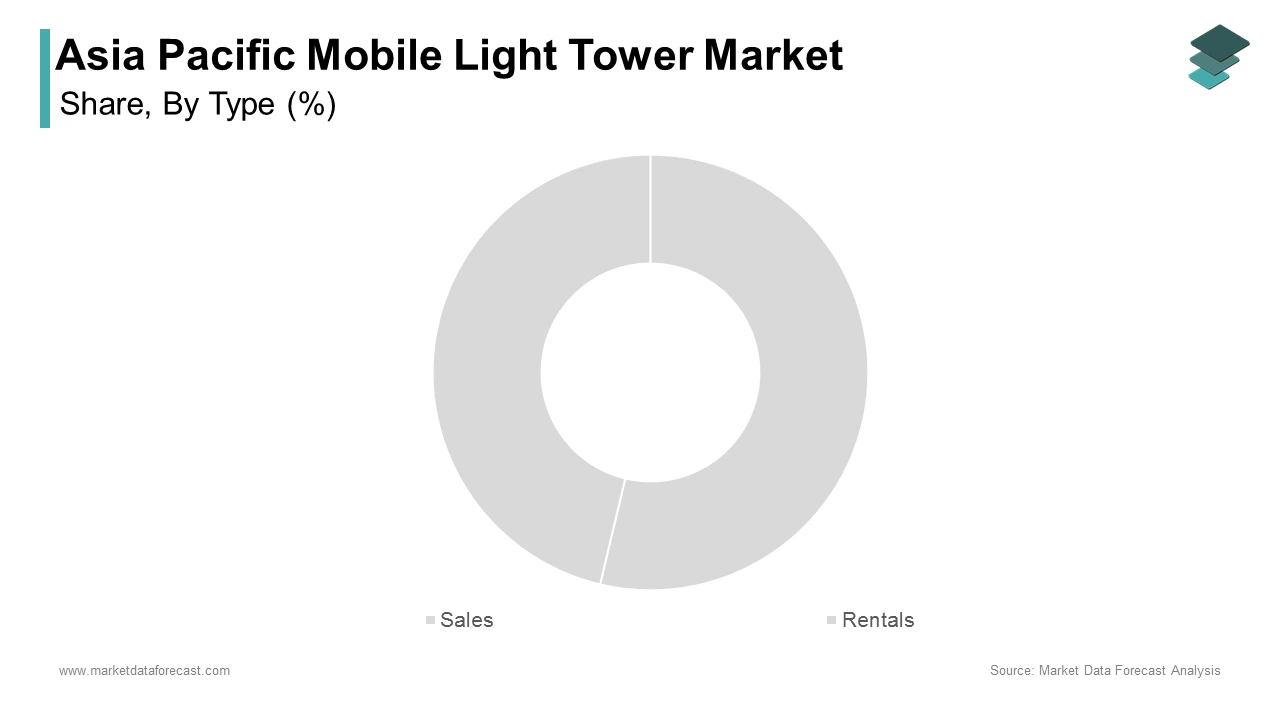
The rental segment dominated the Asia Pacific mobile light tower market by capturing dominant share in 2025 with the increasing preference for short-term equipment leasing among construction, mining, and disaster response sectors. In India, the Construction Industry Development Council (CIDC) reported that nearly 85% of contractors opt for rentals to meet temporary lighting needs on highways and urban development projects.
The sales segment is anticipated to grow with a CAGR of 11.8% from 2026 to 2034 with the increasing ownership by government agencies, large-scale industrial enterprises, and military organizations that require long-term, dedicated lighting solutions. According to the International Energy Agency (IEA), several national defense and infrastructure bodies are investing in permanent fleets of mobile light towers to support continuous operations in remote and strategic locations. In China, the Ministry of Emergency Management reported that over 40% of new mobile light tower acquisitions in 2023 were made by state-owned enterprises and disaster relief agencies. In India, the Border Roads Organisation (BRO) procured over 1,200 mobile light towers in 2023 for permanent deployment along border regions.
By Light Type Insights
The metal halide lighting segment held 58.3% of the Asia Pacific mobile light tower market share in 2025 due to the widespread use of metal halide lamps in traditional mobile light towers in construction and mining applications where high-intensity illumination is required. According to the International Energy Agency (IEA), metal halide lamps offer superior brightness and coverage compared to conventional lighting sources, making them a preferred choice in large-scale outdoor operations. In India, the Ministry of Road Transport and Highways reported that over 70% of mobile light towers deployed on national highway projects in 2023 used metal halide lighting due to its proven performance and cost-effectiveness.
The Light Emitting Diodes (LEDs) segment is lucratively to grow with a CAGR of 14.2% from 2026 to 2034 with the increasing adoption of energy-efficient, long-lasting lighting solutions in both government and private sector applications. According to the International Renewable Energy Agency (IRENA), LED-based mobile light towers consume up to 50% less power than metal halide units while providing equivalent or superior illumination. In China, the Ministry of Industry and Information Technology reported that LED lighting is now mandated for new mobile light tower procurements in government infrastructure and military projects.
By Fuel Type Insights
The diesel-powered segment was the largest and held a prominent share of the Asia Pacific mobile light tower market due to the widespread availability of diesel generators, their proven reliability in remote locations, and established maintenance networks. According to the International Energy Agency (IEA), diesel remains the most commonly used fuel source for mobile lighting units in construction, mining, and disaster response applications across the region. In India, the Oil and Natural Gas Corporation (ONGC) reported that over 80% of mobile light towers used in exploration and drilling sites in 2023 were diesel-powered.
The hybrid segment is expected to register a CAGR of 15.6% from 2026 to 2034 with the increasing demand for fuel-efficient and environmentally sustainable lighting solutions in both government and private sector applications. According to the International Renewable Energy Agency (IRENA), hybrid mobile light towers combine solar power with diesel backup, significantly reducing fuel consumption and carbon emissions. In Japan, the Ministry of Economy, Trade and Industry (METI) has mandated the use of hybrid-powered mobile lighting units in disaster-prone regions to ensure energy resilience and reduce dependency on fossil fuels. In South Korea, the Ministry of Environment has promoted hybrid lighting in urban construction sites to comply with stricter emissions regulations.
REGIONAL ANALYSIS
India Mobile Light Tower Market Insights
India led the Asia Pacific mobile light tower market by accounting for 28.3% of share in 2025 with the massive infrastructure development initiatives, including road construction, urban expansion, and border security projects, have driven significant demand for mobile lighting solutions. According to the Ministry of Road Transport and Highways, over 10,000 km of national highways were under construction in 2023, necessitating extensive use of mobile light towers for nighttime operations. The Border Roads Organisation (BRO) also reported that more than 1,200 mobile light towers were deployed along India’s northern and northeastern borders to support infrastructure development in high-altitude regions. Additionally, the Ministry of Home Affairs has expanded the use of mobile lighting in disaster response operations, particularly in cyclone- and flood-prone states.
China Mobile Light Tower Market Insights
China ranked second with 22.3% of the Asia Pacific mobile light tower market share in 2025 with the expanding construction and mining industries, coupled with increasing investments in emergency response infrastructure, have fueled the adoption of mobile lighting solutions. According to the Ministry of Emergency Management, China deployed over 8,000 mobile light towers in 2023 for disaster relief operations, particularly in earthquake-prone provinces such as Sichuan and Yunnan. The Ministry of Housing and Urban-Rural Development also reported that mobile light towers are now standard equipment on large-scale infrastructure projects, including airport expansions and high-speed rail construction.
Australia Mobile Light Tower Market Insights
Australia mobile light tower market is estimated to grow with highest CAGR in the forecast period. The country’s vast mining and energy exploration sectors are the primary drivers of mobile lighting adoption. According to the Australian Mines and Metals Association (AMMA), over 60% of new mining projects in Western Australia and Queensland in 2023 included mobile light towers as essential equipment for night operations and site security. In addition, the Australian Renewable Energy Agency (ARENA) has supported the deployment of hybrid and solar-powered mobile light towers in environmentally sensitive zones.
Japan Mobile Light Tower Market Insights
Japan mobile light tower market growth is likely to grow with the emphasis on disaster preparedness and infrastructure resilience has driven the widespread use of mobile lighting in emergency response operations. According to the Cabinet Office’s Disaster Management Headquarters, Japan deployed over 2,000 mobile light towers in 2023 for post-disaster recovery efforts following typhoons and earthquakes. The Ministry of Economy, Trade and Industry (METI) has mandated the use of LED and hybrid-powered mobile lighting units in urban construction and public infrastructure projects to reduce energy consumption. Additionally, the Self-Defense Forces have expanded their mobile lighting fleets for rapid deployment in remote and disaster-affected areas.
Indonesia Mobile Light Tower Market Insights
Indonesia mobile light tower market growth is likely to steadily during the forecast period. The country’s archipelagic geography and growing infrastructure investments have increased the need for mobile lighting in construction, mining, and disaster relief operations. According to the Ministry of Public Works and Housing, Indonesia launched over 200 infrastructure projects in 2023, including ports, bridges, and rural electrification initiatives, all requiring mobile lighting support. The National Disaster Management Authority (BNPB) also reported that mobile light towers were extensively deployed in flood- and earthquake-affected regions to support nighttime rescue and recovery efforts. In the mining sector, the Directorate General of Mineral and Coal reported that over 40% of new coal and nickel extraction sites in 2023 utilized mobile lighting for extended work hours.
LEADING PLAYERS IN THE ASIA PACIFIC MOBILE LIGHT TOWER MARKET
Cortec Group (Multitel)
Cortec Group is a leading global manufacturer of mobile light towers with a strong presence in the Asia Pacific region. The company is known for its durable, high-performance lighting solutions tailored for construction, mining, and emergency response applications. Cortec has contributed significantly to advancing mobile lighting technology by integrating LED and hybrid power systems that enhance efficiency and reduce environmental impact. Its products are widely used across infrastructure and defense projects by making it a key player in shaping the market’s technological evolution and operational standards.
Haulotte Group
Haulotte Group is a prominent player in the Asia Pacific mobile light tower market, offering a diverse range of high-mast lighting solutions designed for versatility and performance. The company is recognized for its innovative engineering and commitment to safety, sustainability, and user-friendly design. Haulotte’s contributions to the global market include the development of compact, energy-efficient mobile lighting units that cater to both industrial and municipal applications. Its expanding distribution network and focus on hybrid and electric-powered models have positioned it as a leader in the transition toward greener lighting solutions across the region.
Wacker Neuson Group
Wacker Neuson has established a strong foothold in the Asia Pacific mobile light tower market through its reliable and technologically advanced product lineup. The company is known for its robust engineering, durability, and adaptability to harsh environments, making its mobile light towers a preferred choice in construction and disaster relief operations. Wacker Neuson’s contributions to the global market include the integration of smart lighting controls, fuel-efficient systems, and modular designs that enhance deployment flexibility. Its commitment to quality and innovation continues to reinforce its competitive edge in the mobile lighting industry.
TOP STRATEGIES USED BY KEY MARKET PARTICIPANTS
Product Innovation and Technological Advancement
Leading players are continuously investing in research and development to introduce technologically advanced mobile light towers that offer improved energy efficiency, longer operational life, and enhanced mobility. This includes the integration of LED lighting, hybrid power systems, and smart control features to meet evolving customer demands and regulatory standards.
Expansion into Emerging Markets and Strategic Partnerships
To strengthen their regional presence, companies are expanding into high-growth markets in Southeast Asia, India, and Oceania. Strategic partnerships with local distributors, government agencies, and construction firms help them penetrate new customer segments and enhance after-sales service networks.
Focus on Sustainable and Environmentally Friendly Solutions
Manufacturers are prioritizing the development of hybrid and solar-powered mobile light towers with increasing environmental regulations and customer preference for greener alternatives. This shift aligns with global sustainability goals and supports long-term market positioning in environmentally conscious markets.
KEY MARKET PLAYERS AND COMPETITIVE OVERVIEW
Major Players of the Asia Pacific Mobile Light Tower Market include Atlas Copco AB, Generac Power Systems Inc., Doosan Portable Power, Wacker Neuson SE, United Rentals Inc., Larson Electronics LLC, Progress Solar Solutions, J C Bamford Excavators Ltd. (JCB), Allmand Bros. Inc., Terex Corporation, Ocean’s King Lighting Science & Technology Co. Ltd., Youngman Woolverstone Pvt. Ltd., Olikara Lighting Towers Pvt. Ltd.
The Asia Pacific mobile light tower market is characterized by a mix of global leaders, regional specialists, and emerging local manufacturers, creating a competitive and dynamic environment. While international players dominate with their advanced technologies and established distribution networks, regional companies are gaining traction by offering cost-effective and locally adapted solutions. The competition is intensifying as manufacturers focus on innovation, sustainability, and service excellence to differentiate themselves. The demand for high-performance, fuel-efficient, and environmentally friendly lighting solutions is driving companies to invest in hybrid and LED-based technologies. Additionally, the growing emphasis on disaster preparedness and infrastructure development is expanding the market’s scope beyond traditional sectors. This evolving landscape is fostering a more diversified and resilient market structure across the Asia Pacific.
RECENT HAPPENINGS IN THE MARKET
- In January 2025, Cortec Group launched a new line of solar-powered mobile light towers designed specifically for remote infrastructure and disaster relief applications in the Asia Pacific region by enhancing its sustainability and operational flexibility.
- In March 2025, Haulotte Group expanded its regional distribution network by establishing a new service and training center in Southeast Asia that aimed at improving after-sales support and technical expertise for customers.
- In June 2025, Wacker Neuson introduced an AI-integrated mobile light tower with adaptive brightness control, which is targeting smart city and urban infrastructure projects across India and China.
- In September 2025, a leading Japanese equipment manufacturer entered into a joint venture with an Australian rental services provider to offer mobile light tower solutions tailored for mining and defense operations in remote locations.
- In November 2025, a major South Korean construction equipment firm launched a mobile light tower rental program targeting infrastructure and emergency response sectors by aiming to capture a growing share of the rental market in Southeast Asia.
MARKET SEGMENTATION
This research report on the Asia Pacific Mobile Light Tower Market has been segmented and sub-segmented based on market type, light type, fuel type and region.
By Type
- Sales
- Rentals
By Light Type
- Metal Halides
- LEDs
By Fuel Type
- Diesel
- Hybrid
- Direct
By Region
- India
- China
- Japan
- South Korea
- Australia
- New Zealand
- Thailand
- Malaysia
- Vietnam
- Philippines
- Indonesia
- Singapore
- Rest of Asia-Pacific