- Product Description Description
- Table of Contents TOC
- List of Table & Figure LOT
- Get Free Sample PDF Sample PDF
Market Size, 2025
$4.53 BnMarket Estimate, 2026
$4.65 BnMarket Forecast, 2034
$8.74 BnCAGR, 2026–2034
8.2%Executive Summary: Asia Pacific Mushroom Cultivation Market
- Market Scope: In-depth regional evaluation of the Asia Pacific mushroom cultivation market, covering standard and exotic mushroom types, cultivation typologies, and country-level production dynamics.
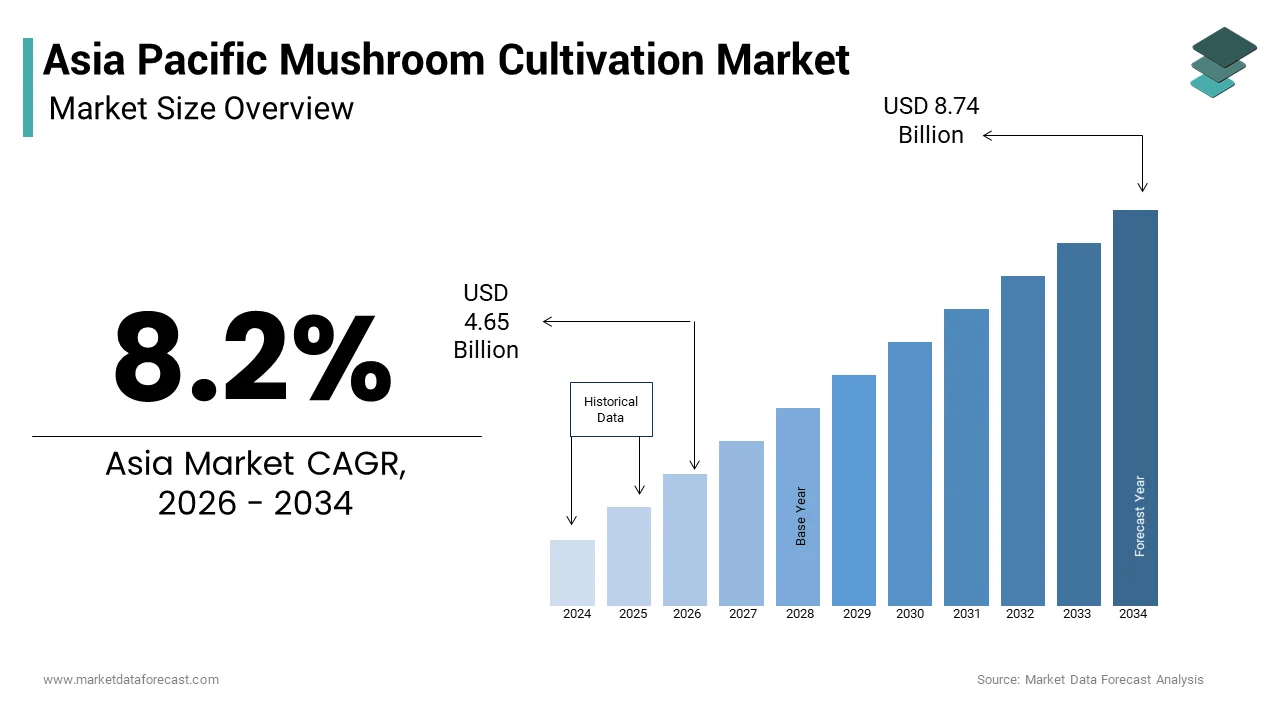
- Market Valuation: Valued at USD 4.53 billion in 2025, reaching USD 4.65 billion in 2026, and projected to scale up to USD 8.74 billion by 2034, expanding at a steady CAGR of 8.2% from 2026 to 2034.
- Primary Growth Drivers: High per capita mushroom consumption, rapid expansion of the vegan and plant-based demographic, widespread adoption of modern indoor/controlled-environment farming techniques, and rising awareness of the health and functional benefits of mushrooms.
Key Market Segment Metrics (2026–2034)
| Category | Leading Segment (2025 Position) | Fastest-Growing Segment |
|---|---|---|
| By Mushroom Type | Button and Shiitake mushrooms (commanding major regional volume share due to deeply rooted culinary traditions and mass retail availability) | Oyster and specialty exotic varieties (surging rapidly driven by demand for diverse textures and functional health applications) |
| By Cultivation Practice | Conventional farming methods (holding baseline production dominance across rural and semi-urban agricultural setups) | Controlled-environment automation & smart climate systems (expanding rapidly to optimize year-round yields) |
| By Application & Form | Fresh market consumption (anchoring the largest share across domestic retail, wet markets, and food services) | Processed and nutraceutical extracts (growing with the rise of functional foods, powders, and dietary supplements) |
| By Country / Territory | China and Japan (dominating overall output volume, technological infrastructure, and per capita consumption standards) | India and Southeast Asian nations (emerging as fast-growing cultivation hubs supported by commercial investments and rising export demands) |
Major Market Players & Market Structure
Market Structure: A fragmented yet rapidly consolidating ecosystem featuring international biotech substrate providers, specialized agro-tech entities, and large-scale domestic cultivation enterprises across key APAC corridors.
Key Companies: Monaghan Mushrooms, Walsh Mushrooms Group, Italspwan, Mushroom SAS, Mycelia, South Mill Mushrooms Sales, Smithy Mushrooms Ltd., Hirano Mushroom LLC, Rheinische Pilz Zentrale GmbH, and Fujishukin Co. Ltd.
 Download Free Sample Report
Asia Pacific Mushroom Cultivation Market Size
The Asia Pacific mushroom cultivation market size was valued at USD 4.53 billion in 2025 and is anticipated to reach USD 4.65 billion in 2026, from USD 8.74 billion by 2034, estimated to account for the prominent growth rate among the other regions, projecting a compound annual growth rate of 8.2% during the forecast period of 2026 to 2034. The market value is expected to increase more during the outlook period due to the high production, consumption,n and exportsand the increasing vegan population in this area.
Higher per capita mushroom consumption and adoption of modern mushroom cultivation techniques in Asia Pacific region is one of the major factors driving the growth of the market of Mushroom Cultivation in this locale. Increasing investments by companies for research and development to implement new technologies in the field also propels the expansion of the Asia Pacific mushroom cultivation market.
Increasing consumption of mushrooms in some countries such as India and Japan, augmenting production, and a surge in the vegan population are some of the factors that help the growth of the market for Mushroom Cultivation in the Asia Pacific region. One of the major driving factors of the Asia Pacific Mushroom Cultivation market is the rising consumption of processed food items and the increasing consumer awareness regarding the health benefits of mushrooms in the APAC market.
High prices and low public awareness about functional mushrooms are some of the restraints that affect the growth of the mushroom cultivation market in the Asia Pacific region.
REPORT COVERAGE
| REPORT METRIC | DETAILS |
| Market Size Available | 2025 to 2034 |
| Base Year | 2025 |
| Forecast Period | 2026 to 2034 |
| CAGR | 8.2% |
| Segments Covered | By Type, and Country |
| Various Analyses Covered | Global, Regional & Country Level Analysis, Segment-Level Analysis, DROC, PESTLE Analysis, Porter’s Five Forces Analysis, Competitive Landscape, Analyst Overview on Investment Opportunities |
| Regions Covered | India, China, Japan, Australia, Canada, Vietnam and etc |
| Market Leaders Profiled | Monaghan Mushrooms (Ireland), Walsh Mushrooms Group (Ireland), Italspwan (Italy), Mushroom SAS (Italy), Mycelia (Belgium), South Mill Mushrooms Sales (US), Smithy Mushrooms Ltd. (UK), Hirano Mushroom LLC (Kosovo), Rheinische Pilz Zentrale GmbH (Germany), Fujishukin Co. Ltd. (Japan) |
COUNTRY ANALYSIS
Asia Pacific Mushroom Cultivation market is expanding due to the increasing consumption of mushrooms in some countries such as India and Japan, as well as rising production and an increasing vegan population. Also, higher per capita mushroom consumption and the adoption of modern farming techniques propel the growth of the revenue in the Asia Pacific region. This area is also expected to hold the dominance of the market over the conjecture period.
KEY MARKET PLAYERS
These are the market players that dominate the Asia Pacific mushroom cultivation market.
- Monaghan Mushrooms (Ireland)
- Walsh Mushrooms Group (Ireland)
- Italspwan (Italy)
- Mushroom SAS (Italy)
- Mycelia (Belgium)
- South Mill Mushrooms Sales (US)
- Smithy Mushrooms Ltd. (UK)
- Hirano Mushroom LLC (Kosovo)
- Rheinische Pilz Zentrale GmbH (Germany)
- Fujishukin Co. Ltd. (Japan)
MARKET SEGMENTATION
This research report on the APAC mushroom cultivation market is segmented and sub-segmented into the following categories.
By Type
- Oyster Mushroom
- Button Mushroom
- Shiitake Mushroom
- Other Types
- Nameko
- Maitake
- Enoki
- Mane
- Straw
- Shimji
By Country
- India
- China
- Japan
- South Korea
- Australia
- New Zealand
- Thailand
- Malaysia
- Vietnam
- Philippines
- Indonesia
- Singapore
- Rest Of APAC