- Product Description Description
- Table of Contents TOC
- List of Table & Figure LOT
- Get Free Sample PDF Sample PDF
Market Size, 2025
$1.34 BnMarket Estimate, 2026
$1.44 BnMarket Forecast, 2034
$2.6 BnCAGR, 2026–2034
7.7%Executive Summary: APAC Neisseriaceae Infections Market
- Market Scope: Regional analysis of Asia Pacific's Neisseriaceae infections sector, detailing bacterial types like N. Gonorrhoeae and N. Meningitidis, disease indications, antibacterial drug classes, and country-level profiles for the 2026-2034 period.
- Market Valuation: Valued at USD 1.34 billion in 2025, reaching USD 1.44 billion in 2026, and projected to expand to USD 2.60 billion by 2034, growing at a robust CAGR of 7.70% from 2026 to 2034.
- Primary Growth Drivers: Favorable regulatory policies, greater use of recycled/reprocessed medical equipment, rising prevalence of Neisseriaceae infections, continuous R&D operations, and the development of sensitive screening technologies like Nucleic Acid Amplification Tests (NAAT).
Key Market Segment Metrics (2026-2034)
| Category | Leading Segment (Base Position) | Fastest-Growing / High-Growth Segment |
|---|---|---|
| By Type of Bacteria | N. Gonorrhoeae (dominated base year, driven by high incidence rates and sexually transmitted infection screening volumes) | N. Meningitidis (anticipated at a high growth rate, fueled by invasive meningococcal disease awareness and vaccination initiatives) |
| By Disease | Gonorrhea (captured major market share supported by widespread public screening and rising infection prevalence) | Meningitis & Septicemia (projected at high CAGR, propelled by critical care demands and acute infectious disease management) |
| By Antibacterial Drugs | Beta-Lactam Antibiotics & Tetracycline (held dominant market share backed by standard empirical treatment protocols) | Glycopeptides & Rifamycins (registering high growth driven by resistant strain management and targeted therapies) |
| By Country | China & India (market leaders backed by massive patient populations, rising healthcare expenditures, and reprocessed equipment utilization) | South Korea & Japan (key regional growth hubs driven by advanced screening technologies and robust healthcare infrastructure) |
Major Market Players & Industry Landscape
Market Structure: Competitive pharmaceutical and biotechnology landscape characterized by major players advancing anti-infective drug development and diagnostic testing solutions during the 2026-2034 forecast period.
Key Companies: Aphios Corporation, Basilea Pharmaceutica Ltd., Pfizer, Inc., GSK plc, AstraZeneca plc, Adenium Biotech ApS, Dainippon Sumitomo Pharma Co., Ltd., and Theravance, Inc.
 Download Free Sample Report
APAC Neisseriaceae Infections Market Size
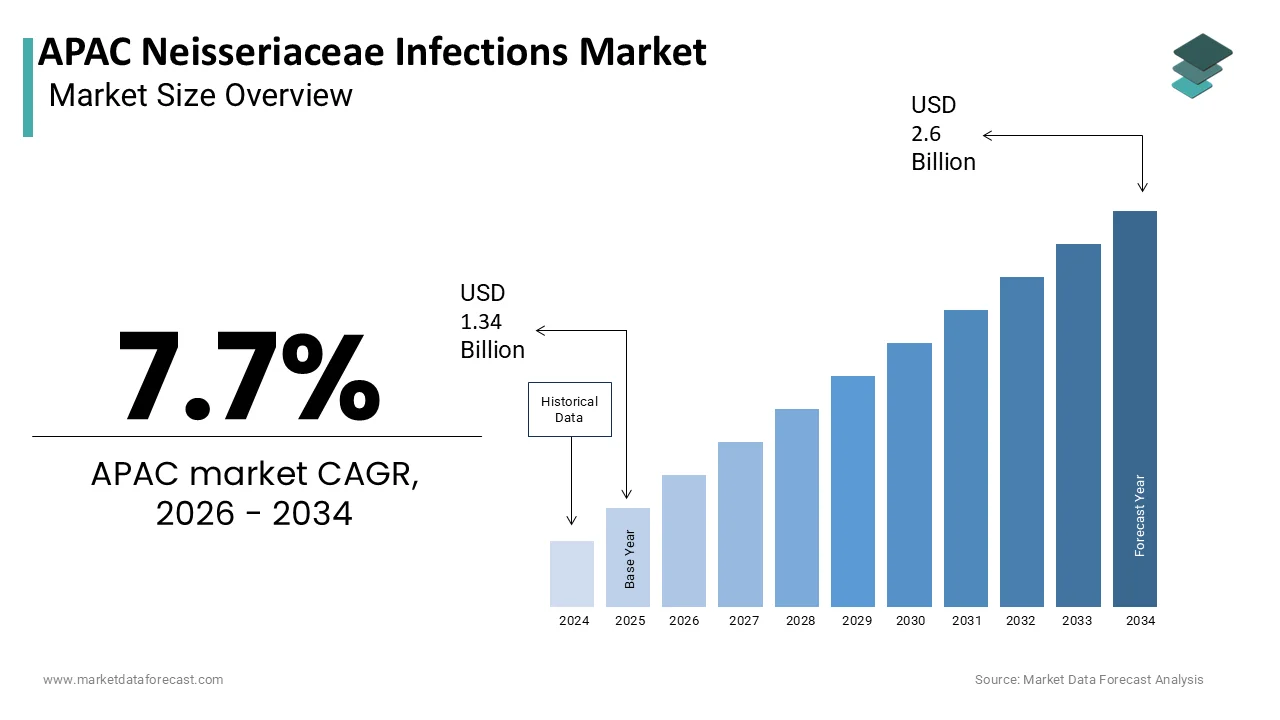
The APAC Neisseriaceae Infections Market is projected to grow from USD 1.34 billion in 2025 to USD 1.44 billion in 2026 and reach USD 2.60 billion by 2034, registering a CAGR of 7.70% during the forecast period from 2026 to 2034.
The growth in the Asia Pacific can be attributed to favorable regulatory policies and greater use of recycled medical devices in the healthcare market. Furthermore, lower prices and higher quality of recycled medical equipment, rising prevalence of Neisseriaceae infections, and continuous R&D operations in APAC are a few other key factors propelling the market forward. Increased screening and the development of more sensitive and precise screening technologies such as Nucleic Acid Amplification (NAAT) Tests are likely to blame for the rise in Neisseria gonorrhea infections. Despite this, the increased prevalence of gonorrhea and the advent of novel diagnostic technologies are expected to move the market for gonorrhea treatments forward. Bacteria are the most ubiquitous microorganisms present in the environment, and they play a critical role in the progression of any disease infection in people and animals.
In addition, the risk of gonorrhea has increased as the prevalence of homosexuality and bisexuality has increased. Expanding public awareness of infections and diseases, as well as rising medical expenses, enhance these variables. As a result of these factors, the market is expected to rise steadily.
Although laboratory tests are exceedingly sensitive, their high prices and technical constraints make them impossible to use daily, limiting their impact on STI control and management. Moreover, people are becoming aware of the long-term implications of Neisseria gonorrhoeae infections. Furthermore, the increased prevalence of infectious diseases is a significant stumbling barrier to the market's advancement to the higher end. Obstacles such as government austerity, high treatment and R&D expenditures, and a lack of awareness about the symptoms, on the other hand, may hinder the market's growth.
MARKET SEGMENTATION
This research report on the Asia Pacific Neisseriaceae infections market has been segmented and sub-segmented into the following categories:
By Type of Bacteria:
- N. Meningitidis
- N. Gonorrhoeae
- N. Sicca
- N. Flava
- N. Elongata
- N. Cinerea
- Others
By Disease:
- Gonorrhea
- Septicemia
- Meningitis
- Sinusitis
- Otitis
- Pneumonia
- CNS
- Urinary
- Respiratory Infections
By Antibacterial Drugs:
- Aminoglycosides (Streptomycin)
- B-Lactum Antibiotics (Penicillin)
- Clavulanic Acid (Augmentin)
- Glycopeptides (Vancomycin)
- Polypeptides (Bacitracin)
- Rifamycins (Rifampicin)
- Chloramphenicol
- Tetracycline
By Country:
- India
- China
- Japan
- South Korea
- Australia
- New Zealand
- Thailand
- Malaysia
- Vietnam
- Philippines
- Indonesia
- Singapore
- Rest of APAC
Geographically, APAC is one of the fastest-growing regions in the world; reprocessed medical equipment is advantageous to the healthcare and medical businesses, as well as helpful in treating a large number of patients. The majority of developed and developing countries in Asia pacific have used all of their resources to bring the pandemic under control. As a result, there has been an increase in the use of reprocessed medical equipment such as ventilators and cylinders in China and India, which is helping the market generate share. According to the Centers for Disease Control and Prevention (CDC), China recorded more than 300,000 new cases of gonorrhea in 2012, up 4% from 2011. As a result, the rising prevalence of illnesses has become a critical component in regional market development.
KEY MARKET PLAYERS:
Companies playing a notable role in the Asia Pacific Neisseriaceae Infections market are Aphios Corporation, Basilea Pharmaceuticals Ltd., Pfizer, Inc., GSK plc, AstraZeneca plc, Adenium Biotech ApS, Dainippon Sumitomo Pharma Co., Ltd., Theravance, Inc., and Pfizer, Inc. amongst many others.