- Product Description Description
- Table of Contents TOC
- List of Table & Figure LOT
- Get Free Sample PDF Sample PDF
Market Size, 2025
$0.53 BnMarket Estimate, 2026
$0.62 BnMarket Forecast, 2034
$2.31 BnCAGR, 2026–2034
17.84%Asia Pacific Optical Sensor Market Size
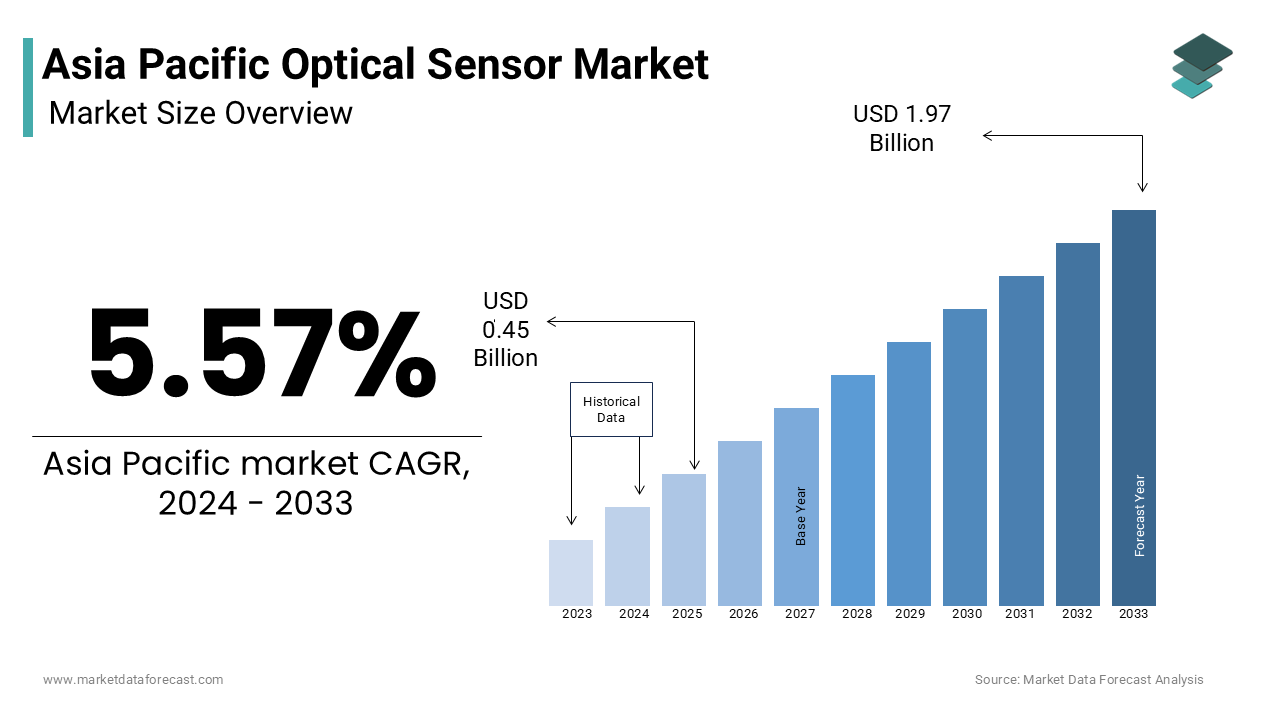
The Asia Pacific Optical Sensor Market size was valued at USD 0.53 billion in 2025 and is anticipated to reach USD 0.62 billion in 2026 from USD 2.31 billion by 2034, growing at a CAGR of 17.84% during the forecast period from 2026 to 2034.
Optical sensor is used to detect and measure light across various wavelengths to enable automation, precision monitoring, and intelligent decision-making in industrial, consumer, healthcare, and automotive systems. These sensors operate on principles such as absorption, reflection, and refraction, converting optical signals into electrical outputs to facilitate real-time feedback in complex environments. Their applications range from ambient light detection in smartphones to advanced imaging in medical diagnostics and position sensing in robotics. A defining feature of the region is its role as a global manufacturing and technology innovation hub, where the proliferation of smart devices and automated infrastructure has embedded optical sensing into everyday systems.
In Japan, optical sensors are present in most of industrial robots deployed in automotive assembly lines, ensuring precision in welding, painting, and part alignment. India’s Smart City Mission has integrated optical sensors into traffic management and waste monitoring systems across urban centers, enhancing urban responsiveness. Additionally, the expansion of fiber-optic networks has created a foundational infrastructure that supports high-speed data transmission and sensing applications. These systemic technological shifts underscore the optical sensor’s evolution from a niche component to a critical enabler of digital intelligence across the Asia Pacific.
MARKET DRIVERS
Expansion of Consumer Electronics with Integrated Optical Sensing Capabilities
The relentless growth of the consumer electronics industry in Asia Pacific is a primary catalyst for the demand for optical sensors, as manufacturers embed advanced sensing technologies into smartphones, wearables, and home automation systems. Devices now routinely feature ambient light sensors, proximity detectors, fingerprint scanners, and time-of-flight sensors for facial recognition and augmented reality. Wearable devices such as smartwatches and fitness bands, produced primarily in Taiwan and Vietnam, rely on photoplethysmography (PPG) optical sensors to monitor heart rate and blood oxygen levels. As consumer expectations shift toward seamless, intuitive interfaces, optical sensors have become indispensable for enabling responsive, context-aware devices. The region’s dominance in electronics manufacturing ensures sustained demand, making consumer electronics the most influential growth engine for the optical sensor market.
Rising Adoption of Automation and Industry 4.0 in Manufacturing Infrastructure
The acceleration of industrial automation and smart manufacturing across Asia Pacific is significantly increasing the deployment of optical sensors in robotics, quality control, and process monitoring systems. As nations pursue advanced manufacturing strategies, such as China’s Made in China 2025, Japan’s Society 5.0, and India’s Smart Manufacturing Mission, optical sensors have become essential for enabling precision, safety, and real-time diagnostics. In automotive production, optical sensors are used for object detection, alignment verification, and defect identification on assembly lines. According to the International Federation of Robotics, Asia accounts for 70% of global industrial robot installations, with over 500,000 units deployed annually in China alone. These robots rely heavily on optical encoders, vision systems, and laser displacement sensors to perform high-accuracy tasks. In semiconductor fabrication plants across Taiwan and South Korea, optical sensors monitor wafer alignment, particle contamination, and etching depth with nanometer-level precision. As factories transition from manual oversight to fully connected ecosystems, optical sensors serve as the eyes of automation, making them a foundational technology in the region’s industrial transformation.
MARKET RESTRAINTS
Supply Chain Vulnerability and Dependence on Specialized Raw Materials
Its reliance on a fragile global supply chain for specialized materials such as rare-earth elements, optical-grade glass, and semiconductor wafers is a critical constraint on the Asia Pacific optical sensor market. Disruptions in the availability of these inputs can delay production and inflate costs, particularly for high-performance sensors used in medical and aerospace applications. The concentration creates geopolitical and logistical risks, as demonstrated during the 2022 export restrictions on gallium and germanium, both critical for optoelectronic components. Also, Taiwan’s semiconductor industry, a major consumer of optical sensors, depends on imported fused silica and photomasks. In India, the lack of domestic optical glass manufacturing forces complete reliance on imports from Japan and Germany, increasing lead times and vulnerability to currency fluctuations. Without regional diversification of material sources or investment in alternative materials, the market remains exposed to external shocks, limiting scalability and resilience in high-growth sectors.
High Calibration and Integration Complexity in Diverse Operating Environments
The deployment of optical sensors in real-world applications is often hindered by technical challenges related to calibration, environmental interference, and system integration. Unlike simple electronic components, optical sensors require precise alignment, stable lighting conditions, and protection from dust, moisture, and temperature fluctuations to maintain accuracy. In outdoor or industrial settings across Southeast Asia, humidity and particulate matter can degrade lens performance and cause false readings. Like, a portion of optical sensor failures in tropical climates are due to condensation and contamination, particularly in agricultural and transportation monitoring systems. In automotive applications, sensor performance must be validated across extreme temperatures and vibration conditions, requiring extensive testing. Additionally, integrating optical sensors with existing control systems, such as PLCs or IoT platforms, requires specialized firmware and communication protocols, increasing development time and cost. Without standardized interfaces, modular designs, and localized technical support, the complexity of integration remains a significant barrier to widespread deployment.
MARKET OPPORTUNITIES
Growth of Autonomous and Electric Vehicles Requiring Advanced Optical Sensing Systems
The rapid development of autonomous and electric vehicles (EVs) across Asia Pacific presents a transformative opportunity for the optical sensor market, as these vehicles rely heavily on LiDAR, camera systems, and infrared sensors for navigation, safety, and energy management. LiDAR units, which use pulsed laser light to create 3D maps of surroundings, are becoming standard in higher-end EVs produced by NIO, XPeng, and BYD. In Japan, Toyota and Honda are integrating infrared cabin sensors to monitor driver alertness and occupancy, enhancing safety in semi-autonomous modes. Additionally, optical sensors are used in battery thermal monitoring and solar roof integration in EVs. With governments across the region setting aggressive electrification targets, the demand for reliable, high-performance optical sensing will surge, positioning the automotive sector as a key growth frontier.
Expansion of Smart Infrastructure and Urban Sensing Networks
The proliferation of smart city initiatives across Asia Pacific is creating vast new applications for optical sensors in traffic management, environmental monitoring, and public safety systems. Municipalities are deploying optical sensing networks to enhance urban efficiency and responsiveness. These sensors enable adaptive traffic signals and congestion pricing, reducing commute times. In India, the Smart Cities Mission has integrated optical cameras and infrared sensors into waste bin monitoring systems, triggering alerts when containers are full and optimizing collection routes. In Australia, optical sensors are used in wildlife detection systems along highways to prevent animal-vehicle collisions. Additionally, fiber-optic distributed sensing is being adopted in Japan and South Korea to monitor structural health in bridges and tunnels. As urban populations grow and infrastructure ages, optical sensors offer a scalable, non-invasive solution for continuous monitoring, making them central to the next generation of intelligent, resilient cities.
MARKET CHALLENGES
Miniaturization and Power Efficiency Demands in Portable and Wearable Devices
The increasing demand for smaller, low-power sensors to fit within compact consumer and medical devices without compromising performance. As wearables, hearing aids, and implantable medical devices become more sophisticated, designers face pressure to reduce sensor footprint and energy consumption while maintaining accuracy. In medical applications, such as continuous glucose monitors and pulse oximeters, miniaturized PPG sensors must function reliably under motion artifacts and varying skin tones. Without breakthroughs in nanophotonics, flexible substrates, and AI-driven noise filtering, the race to miniaturize risks sacrificing performance, limiting the potential of next-generation portable technologies.
Cybersecurity and Data Integrity Risks in Networked Optical Sensing Systems
As optical sensors become increasingly connected within IoT and industrial networks, they are exposed to cybersecurity threats that can compromise data integrity, system functionality, and user privacy. Unlike isolated sensors, networked optical systems transmit sensitive visual and positional data that, if intercepted or manipulated, can lead to operational failures or surveillance breaches. In smart city deployments, unsecured optical cameras and traffic sensors can be hijacked for malicious purposes. The Australian Cyber Security Centre warns that many optical sensing devices lack built-in encryption or firmware update mechanisms, making them vulnerable to zero-day exploits. In healthcare, wearable optical sensors that transmit biometric data via Bluetooth are susceptible to eavesdropping. Additionally, adversarial attacks using laser pulses can blind or saturate optical sensors, disrupting critical systems. As connectivity expands, ensuring end-to-end security, from sensor node to cloud, has become a paramount challenge, requiring collaboration between hardware developers, software providers, and regulatory bodies to establish robust protection frameworks.
REPORT COVERAGE
| REPORT METRIC | DETAILS |
| Market Size Available | 2025 to 2034 |
| Base Year | 2025 |
| Forecast Period | 2026 to 2034 |
| CAGR | 17.84% |
| Segments Covered | By Sensor Type, Application and Country |
| Various Analyses Covered | Regional & Country Level Analysis, Segment-Level Analysis, DROC, PESTLE Analysis, Porter’s Five Forces Analysis, Competitive Landscape, Analyst Overview on Investment Opportunities |
| Countries Covered | India, China, Japan, South Korea, Australia, New Zealand, Thailand, Malaysia, Vietnam, the Philippines, Indonesia, Singapore, and the Rest of APAC. |
| Market Leaders Profiled | Sony Corporation, Samsung Electronics, Panasonic Corporation, Omron Corporation, Keyence Corporation, STMicroelectronics, ams-OSRAM AG, Honeywell International Inc., Texas Instruments, Analog Devices Inc., ROHM Co., Ltd., Hamamatsu Photonics K.K., Fujifilm Corporation, SICK AG, Banner Engineering, Hokuyo Automatic Co., Ltd., Baumer Holding AG, Microchip Technology, and Neubrex Co., Ltd. |
SEGMENTAL ANALYSIS
By Sensor Type Insights
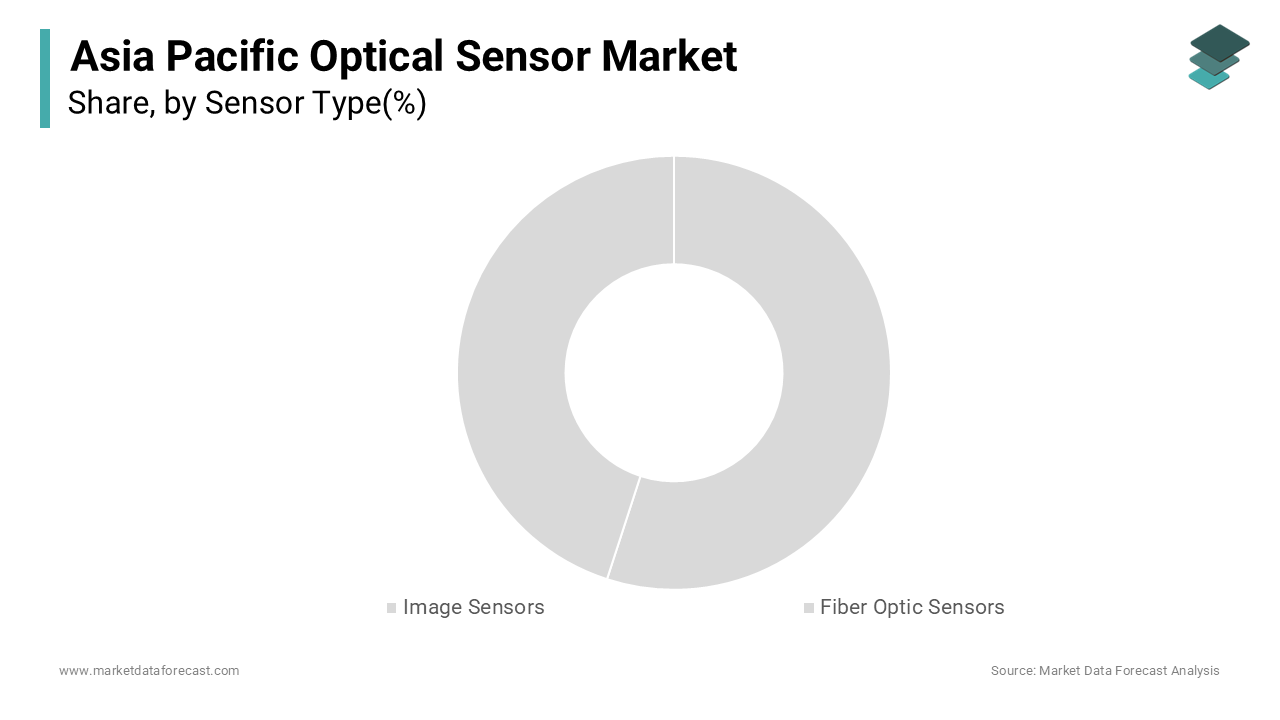
The image sensors segment dominated the Asia Pacific optical sensor market by capturing an estimated 34.5% share in 2024. The demand for high-performance image sensors is primarily fueled by the smartphone industry, where multi-lens camera systems have become standard. South Korea’s Samsung and LG, along with Chinese OEMs like Xiaomi, Oppo, and Huawei, have driven innovation in large-pixel sensors, computational photography, and under-display cameras, increasing per-device sensor count. Sony, headquartered in Japan, remains the world’s largest image sensor manufacturer, supplying a large share of global smartphone sensors. The company’s production facilities in Nagasaki and Kumamoto serve as critical nodes for high-end CMOS sensors used in flagship models. Moreover, the rise of foldable smartphones has created demand for flexible and ultra-thin image sensors. Beyond smartphones, image sensors are now embedded in smart home devices, drones, and security systems, further expanding their footprint. The integration of AI-powered image processing in devices manufactured across Vietnam and India has intensified the need for higher frame rates and low-light performance, reinforcing the dominance of this segment.
Beyond consumer electronics, image sensors are increasingly deployed in precision-driven sectors such as industrial automation and medical diagnostics. In semiconductor manufacturing, high-resolution image sensors are used for wafer inspection, defect detection, and alignment verification. In medical endoscopy, miniaturized CMOS image sensors enable real-time visualization in minimally invasive surgeries. Also, in ophthalmology and dermatology, image sensors power retinal scanners and skin analysis tools. India’s Ayushman Bharat Digital Mission has accelerated the adoption of portable imaging devices in rural clinics, many of which rely on compact image sensors. As automation and digital health expand, image sensors are evolving from consumer accessories to mission-critical components, solidifying their position as the largest segment in the market.
The fiber optic sensors segment is projected to grow at the highest CAGR of 10.7% from 2026 to 2034. These optic sensors are gaining traction due to their immunity to electromagnetic interference, durability in extreme conditions, and ability to provide distributed sensing over long distances. These capabilities make fiber optic sensors indispensable for ensuring the safety and longevity of critical infrastructure in a region prone to earthquakes, typhoons, and urban congestion. The energy industry is a major adopter of fiber optic sensors for temperature, pressure, and flow monitoring in wells, pipelines, and offshore platforms. In renewable energy, these sensors are used to monitor wind turbine blade integrity and solar farm performance. Additionally, hydrogen storage facilities in South Korea and Japan use fiber Bragg grating sensors to monitor thermal expansion and leakage in high-pressure tanks. As energy systems become more complex and safety-critical, the demand for reliable, long-range sensing is propelling the fiber optic segment into a phase of accelerated growth.
By Application Insights
The consumer electronics application segment held the largest share of the Asia Pacific optical sensor market with 42.6% of total revenue in 2025. This dominance is anchored in the region’s role as the world’s manufacturing and innovation hub for smartphones, wearables, laptops, and smart home devices. The integration of multiple optical sensors in smartphones, such as ambient light, proximity, image, and fingerprint sensors, has become standard across all price tiers. Each flagship smartphone now contains an average of six optical sensors, including under-display fingerprint modules, LiDAR scanners, and infrared emitters for facial recognition. Chinese brands like Oppo and Vivo have introduced AI-driven camera systems that rely on multiple image sensors for depth mapping and low-light enhancement. Additionally, wearables such as smartwatches and fitness bands use photoplethysmography (PPG) sensors to monitor heart rate and blood oxygen. This deep embedding of optical sensors into everyday devices ensures sustained demand and market leadership.
Beyond mobile devices, optical sensors are increasingly integrated into smart speakers, security cameras, robotic vacuums, and home automation systems. In South Korea, Samsung and LG have embedded ambient light and proximity sensors into refrigerators, air conditioners, and washing machines to enable adaptive operation. As households embrace connected living, the consumer electronics segment continues to absorb optical sensing technology at scale, reinforcing its market dominance.
The automotive application segment is experiencing the fastest growth in the Asia Pacific optical sensor market, with a projected CAGR of 12.1% from 2026 to 2034. This surge is driven by the rise of electric and autonomous vehicles requiring advanced sensing systems. Governments across Asia Pacific are aggressively promoting electric vehicles (EVs) through subsidies, infrastructure development, and emission regulations, directly increasing demand for optical sensors in battery management, lighting, and driver assistance systems. As EV adoption accelerates, the need for reliable, high-performance optical sensing for safety and efficiency is driving rapid market expansion.
The development of Advanced Driver Assistance Systems (ADAS) and autonomous driving is a key catalyst for optical sensor integration. LiDAR, camera-based vision systems, and infrared sensors are essential for object detection, lane keeping, and pedestrian recognition. In Japan, Toyota and Honda have mandated ADAS in all new models, increasing optical sensor demand. As regulatory frameworks evolve and consumer demand for safety grows, the automotive sector is poised to become the most dynamic application for optical sensors in the region.
REGIONAL ANALYSIS
China Optical Sensor Market Insights
China led the Asia Pacific optical sensor market by commanding 36.5% of regional revenue in 2024. As the world’s manufacturing powerhouse, China’s dominance is driven by its vast electronics production ecosystem and aggressive investment in smart technologies. The country produces a large share of global smartphones, all of which incorporate multiple optical sensors. Shenzhen and Dongguan have emerged as hubs for sensor module assembly, supported by a dense network of suppliers and contract manufacturers. The Made in China 2025 initiative has prioritized advanced sensing for industrial automation, with a significant portion industrial robots deployed annually, each relying on optical encoders and vision systems. Additionally, the government’s push for EVs and smart cities has accelerated demand for LiDAR, infrared, and image sensors. With strong domestic demand, policy support, and technological scaling, China remains the central engine of optical sensor growth in the region.
Japan Optical Sensor Market Insights
Japan stands out for its leadership in high-precision sensor technology and industrial integration. The country is home to global sensor giants like Sony, Hamamatsu Photonics, and Keyence, which supply advanced image sensors, photodetectors, and fiber optic systems worldwide. Japan’s Society 5.0 strategy emphasizes human-centric automation, driving adoption in robotics, healthcare, and smart infrastructure. In healthcare, optical sensors are embedded in endoscopes, glucose monitors, and wearable diagnostics. Additionally, Japan’s aging population has spurred demand for fall-detection and occupancy sensors in elderly care homes. With a strong R&D base, rigorous quality standards, and deep integration into high-tech industries, Japan maintains a premium position in the optical sensor value chain.
South Korea Optical Sensor Market Insights
South Korea is a key innovator in display-integrated and automotive optical sensing. The country’s leadership in semiconductor and display manufacturing—led by Samsung and LG—has enabled breakthroughs in under-display fingerprint sensors, OLED proximity detection, and miniaturized CMOS image sensors. In the automotive sector, Hyundai and Kia are integrating LiDAR and infrared cabin monitoring systems into their EVs, supported by domestic suppliers like Hanwha Q CELLS and AISIN. Additionally, the Smart City Master Plan in Seoul and Busan includes optical-based traffic and air quality monitoring. With strong government-industry collaboration and a focus on next-generation mobility, South Korea is a pivotal player in shaping the future of optical sensing.
India Optical Sensor Market Insights
India is emerging as a high-growth market driven by digitalization and manufacturing expansion. The Production-Linked Incentive (PLI) scheme has boosted smartphone and electronics production, all incorporating optical sensors. The Smart Cities Mission has deployed optical sensors in several urban centers for traffic, waste, and energy monitoring. In healthcare, portable diagnostic devices with optical sensors are being rolled out in rural clinics under the Ayushman Bharat program. However, domestic manufacturing remains limited, with most sensors imported from Japan and Taiwan. With rising urbanization, digital infrastructure, and government support, India is poised for accelerated optical sensor adoption.
Singapore Optical Sensor Market Insights
Singapore serves as a strategic innovation and testing hub for advanced sensing technologies. Despite its small size, the nation leads in smart city deployment, with the Smart Nation Initiative installing a large number of optical sensors for real-time urban monitoring. These sensors optimize traffic flow, detect crowd density, and monitor air quality. The Agency for Science, Technology and Research (A*STAR) is developing next-generation optical sensors for biomedical applications, including non-invasive glucose monitoring and lab-on-a-chip diagnostics. In manufacturing, Singapore’s precision engineering sector uses optical sensors in semiconductor packaging and robotics. Additionally, the country is a testbed for autonomous vehicles, with optical sensing systems validated in real-world conditions. As a center for innovation and policy experimentation, Singapore plays a disproportionate role in shaping the region’s optical sensor future.
Top Players in the Asia Pacific Optical Sensor Market
Sony Semiconductor Solutions Corporation
Sony Semiconductor Solutions stands as a preeminent force in the Asia Pacific optical sensor market, renowned for its pioneering advancements in CMOS image sensor technology. The company has redefined imaging performance across consumer electronics, industrial systems, and automotive applications, setting global benchmarks for resolution, low-light sensitivity, and miniaturization. Its sensors are integral to flagship smartphones, digital cameras, and machine vision systems worldwide. By consistently pushing the boundaries of pixel architecture and signal processing, Sony has established a reputation for technological leadership that influences product roadmaps across multiple industries. The company’s deep integration with major OEMs and its commitment to R&D have enabled it to maintain a first-mover advantage in emerging domains such as stacked sensors and event-based vision. Globally, Sony’s innovations serve as reference designs for competitors and partners alike, reinforcing its role as a technology architect in the optical sensing ecosystem.
Hamamatsu Photonics K.K.
Hamamatsu Photonics is a cornerstone of high-performance optical sensing, specializing in photomultiplier tubes, infrared detectors, and scientific-grade imaging devices. The company’s expertise lies in precision applications where sensitivity, speed, and spectral accuracy are paramount, including medical diagnostics, environmental monitoring, and quantum research. Its sensors power advanced equipment such as PET scanners, flow cytometers, and spectrometers, making them indispensable in laboratories and healthcare facilities across the globe. Hamamatsu’s commitment to fundamental photonics research has led to breakthroughs in single-photon detection and terahertz imaging, positioning it at the forefront of next-generation sensing. The company’s collaboration with academic and governmental institutions has further amplified its influence, enabling the translation of cutting-edge science into practical solutions. By maintaining an unwavering focus on quality and innovation, Hamamatsu has become a trusted partner in mission-critical applications, shaping the evolution of optical sensing beyond consumer markets.
Samsung Electronics (Device Solutions Division)
Samsung Electronics’ Device Solutions Division has emerged as a transformative player in the optical sensor market through its integration of sensor technology into semiconductor and display systems. The company excels in developing image sensors tailored for mobile devices, particularly in under-display and ultra-slim configurations that align with the design demands of modern smartphones. Its ISOCELL technology has redefined low-light photography and pixel density, enabling high-resolution imaging in compact form factors. Beyond consumer applications, Samsung is advancing optical sensing in automotive and industrial domains, leveraging its semiconductor expertise to develop specialized sensors for ADAS and IoT systems. The company’s vertical integration from chip design to system integration allows for rapid innovation and seamless compatibility with its broader electronics ecosystem. Globally, Samsung’s sensor solutions are setting new standards for performance and scalability, particularly in emerging markets where cost-effective, high-quality components are in high demand, reinforcing its position as a key driver of optical sensing adoption.
Top Strategies Used by Key Market Participants
One major strategy employed by leading firms is vertical integration of sensor design, fabrication, and system-level application development to ensure optimal performance and compatibility. By controlling the entire value chain, companies can tailor sensor characteristics to specific use cases, accelerate time-to-market, and differentiate through proprietary technologies.
Another critical approach is strategic collaboration with automotive OEMs, medical device manufacturers, and industrial automation leaders to co-develop application-specific optical sensors. These partnerships enable deep integration into end products, ensuring alignment with functional requirements, regulatory standards, and performance benchmarks.
A third key strategy is investment in next-generation technologies such as event-based vision, quantum photonics, and AI-enhanced sensing to maintain technological leadership. Companies are focusing on research in neuromorphic imaging, multi-spectral detection, and edge processing to unlock new capabilities in autonomy, diagnostics, and smart infrastructure, positioning themselves at the forefront of future sensing paradigms.
KEY MARKET PLAYERS
Some of the companies that are playing a dominating role in the Europe Optical Sensor Market include
- Sony Corporation
- Samsung Electronics
- Panasonic Corporation
- Omron Corporation
- Keyence Corporation
- STMicroelectronics
- ams-OSRAM AG
- Honeywell International Inc.
- Texas Instruments
- Analog Devices Inc.
- ROHM Co., Ltd.
- Hamamatsu Photonics K.K.
- Fujifilm Corporation
- SICK AG
- Banner Engineering
- Hokuyo Automatic Co., Ltd.
- Baumer Holding AG
- Microchip Technology
- Neubrex Co., Ltd.
COMPETITIVE LANDSCAPE
The competitive landscape of the Asia Pacific optical sensor market is characterized by a blend of technological stratification, regional specialization, and evolving collaboration models. At the high end, Japanese and South Korean firms dominate with precision-engineered sensors for medical, industrial, and scientific applications, leveraging decades of expertise in materials science and photonics. Meanwhile, Chinese and Taiwanese companies are rapidly advancing in volume-driven segments, particularly in consumer electronics, where cost efficiency and scalability are paramount. The market is witnessing a shift from commoditized components to intelligent sensing systems, where differentiation arises not just from hardware but from embedded algorithms, calibration accuracy, and system integration. Startups and research institutions are increasingly challenging incumbents by introducing novel architectures such as bio-inspired sensors and flexible photonics, often in partnership with larger players. Competition is further intensified by the convergence of optical sensing with AI, 5G, and IoT, requiring firms to expand beyond traditional engineering into software and data analytics. Regional governments are also shaping the landscape through industrial policies, subsidies, and smart city initiatives that favor domestic suppliers. Success in this environment demands not only technical excellence but also agility in adapting to rapidly changing application demands, regulatory environments, and supply chain dynamics. The most resilient players are those that combine innovation with ecosystem integration, positioning themselves as enablers of intelligent systems rather than mere component vendors.
RECENT MARKET DEVELOPMENTS
- In January 2023, Sony Semiconductor Solutions launched a new stacked CMOS image sensor with integrated AI processing for smartphones, enabling real-time object recognition and enhancing low-light performance in devices manufactured across China and Vietnam.
- In May 2023, Hamamatsu Photonics established a joint research lab with the University of Tokyo to develop next-generation infrared sensors for non-invasive medical diagnostics, focusing on early disease detection through breath and blood analysis.
- In September 2023, Samsung Electronics partnered with Hyundai Motor Group to co-develop custom LiDAR and in-cabin optical monitoring systems for upcoming electric vehicle models, aiming to enhance autonomous driving safety and driver wellness tracking.
- In February 2024, ams-OSRAM opened a new optical sensor packaging facility in Penang, Malaysia, to strengthen supply chain resilience and support growing demand from Southeast Asian automotive and industrial clients.
- In April 2024, LG Innotek introduced a miniaturized time-of-flight sensor for wearable devices, designed to improve gesture control and fitness tracking accuracy in smartwatches produced in South Korea and India.
MARKET SEGMENTATION
This research report on the Asia Pacific Positive Displacement Pumps Market is segmented and sub-segmented into the following categories.
By Sensor Type
- Image Sensors
- Fiber Optic Sensors
By Application
- Consumer Electronics
- Automotive
By Country
- India
- China
- Japan
- South Korea
- Australia
- New Zealand
- Thailand
- Malaysia
- Vietnam
- Philippines
- Indonesia
- Singapore
- Rest of APAC