- Product Description Description
- Table of Contents TOC
- List of Table & Figure LOT
- Get Free Sample PDF Sample PDF
Asia Pacific Overhead Conductor Market Size
The Asia Pacific overhead conductor market size was valued at USD 392.69 million in 2025 and is anticipated to reach USD 422.81 million in 2026 from USD 763.67 million by 2034, growing at a CAGR of 7.67% during the forecast period from 2026 to 2034.
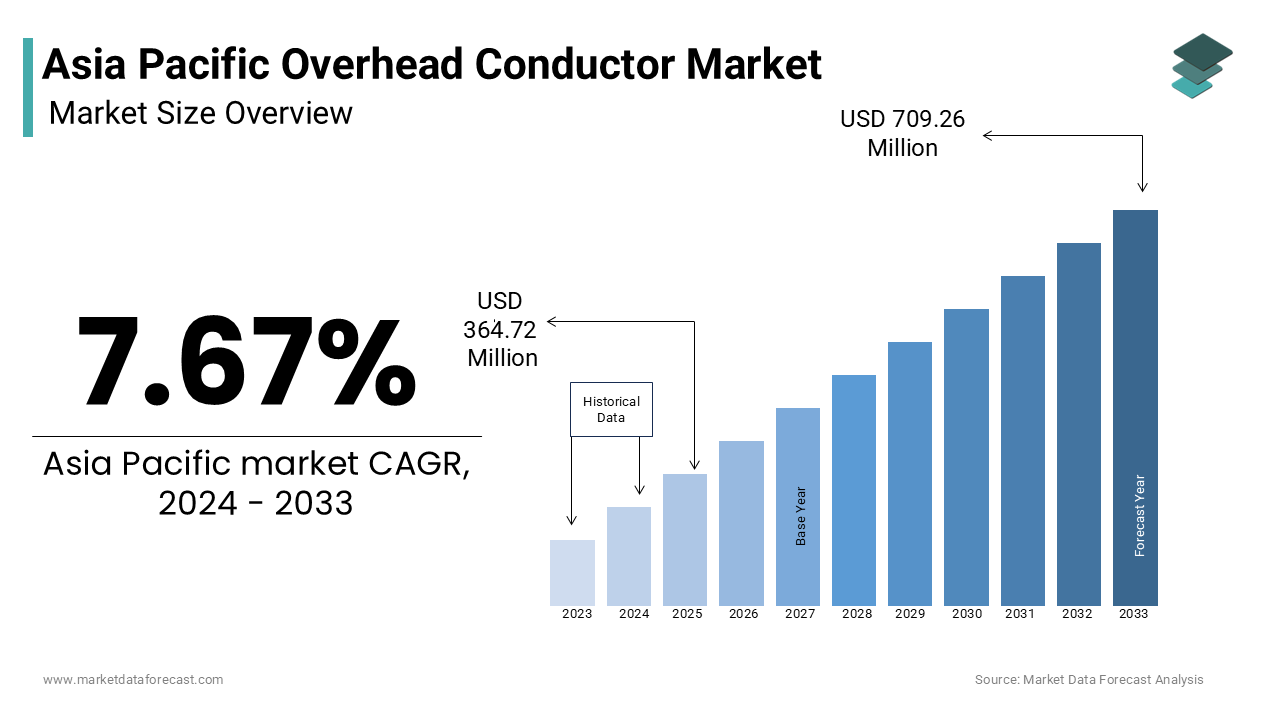
The overhead conductor is primarily made of aluminum, copper, and steel alloys, which are essential for carrying high-voltage electricity over long distances in both urban and rural settings. The demand for reliable and efficient power transmission systems has surged across the region. Countries such as China, India, Japan, and Australia have been at the forefront of this growth, driven by government investments in smart grid technologies and rural electrification programs. As per the International Energy Agency, electricity demand in the Asia Pacific region is expected to grow by over 60% by 2040, significantly influencing the need for robust overhead transmission infrastructure.
MARKET DRIVERS
Surge in Renewable Energy Integration
The increasing integration of renewable energy sources into national power grids is boosting the growth of the Asia Pacific overhead conductor market. Countries like China, India, and Australia are aggressively investing in solar and wind energy to meet rising electricity demand and reduce carbon emissions. According to the International Renewable Energy Agency, renewable energy capacity in the Asia Pacific region reached 1,250 gigawatts in 2023, with solar and wind contributing over 60% of that capacity. These renewable sources are often located in remote or rural areas, necessitating extensive overhead transmission infrastructure to transport electricity to urban load centers. Overhead conductors are preferred for such long-distance transmission due to their cost-effectiveness and scalability. For instance, in India, the Green Energy Corridor project, aimed at evacuating renewable power from remote locations, has led to a significant increase in demand for high-capacity aluminum conductor steel-reinforced (ACSR) cables.
Expansion of Rural Electrification Programs
The widespread implementation of rural electrification programs across developing nations in the region is also fuelling the growth of the Asia Pacific overhead conductor market. Governments in countries such as India, Indonesia, and the Philippines have prioritized extending electricity access to remote and underserved populations, leading to a surge in demand for overhead transmission and distribution infrastructure. These programs predominantly rely on overhead distribution lines due to their lower installation and maintenance costs compared to underground systems. For example, India’s Power Grid Corporation reported that between 2020 and 2023, over 1.2 million kilometers of overhead lines were constructed under rural electrification initiatives, significantly boosting conductor demand. Additionally, in the Philippines, where over 15% of rural households were not connected to the national grid as of 2022, the Department of Energy has launched several grid expansion projects that depend heavily on aluminum and ACSR conductors.
MARKET RESTRAINTS
Fluctuations in Raw Material Prices
The volatility in raw material prices for aluminum and copper, which constitute the primary components of most overhead conductors is slightly degrading the growth of the Asia Pacific overhead conductor market. These metals are subject to global supply chain disruptions, geopolitical tensions, and fluctuating demand from other industrial sectors, leading to unpredictable pricing trends. According to the London Metal Exchange, aluminum prices increased by over 25% in 2022 due to energy shortages in China and supply constraints in Europe. These price surges have directly impacted the production costs of overhead conductors, squeezing profit margins for manufacturers and increasing procurement costs for utility companies. In response, some governments and power utilities have delayed or scaled back infrastructure projects to manage budget constraints. For instance, in Australia, several planned rural electrification projects faced postponements in 2023 due to rising conductor costs. In India, the Ministry of Power issued directives to state utilities to explore alternative materials and cost-saving measures.
Environmental and Regulatory Constraints
Environmental regulations and land acquisition issues are increasingly is also to degrade the growth of the Asia Pacific overhead conductor market. Governments across the region are tightening environmental norms to mitigate deforestation, habitat disruption, and carbon emissions associated with large-scale infrastructure projects. In countries like Malaysia and Indonesia, new transmission line projects must undergo extensive environmental impact assessments before approval, often delaying implementation by several months or even years. According to the Asian Development Bank, regulatory compliance costs for overhead line projects have increased by up to 18% in the past five years due to stricter environmental guidelines. Additionally, land acquisition challenges, particularly in densely populated areas of India and the Philippines, have led to project cost escalations and community resistance. For example, in India, the Right of Way Act was introduced to streamline land acquisition for transmission projects, yet implementation delays persist due to local opposition and bureaucratic hurdles.
MARKET OPPORTUNITIES
Growth of Smart Grid Infrastructure
The development and expansion of smart grid infrastructure presents a significant opportunity for the Asia Pacific overhead conductor market. Governments and utility providers in the region are increasingly investing in smart grids to enhance energy efficiency, reduce transmission losses, and integrate renewable energy sources more effectively. According to the International Smart Grid Action Network, smart grid investments in the Asia Pacific region surpassed USD 20 billion in 2023, with China and Japan leading the way. These smart grid systems rely on advanced transmission infrastructure, including high-performance overhead conductors capable of handling fluctuating power loads and real-time monitoring. South Korea has also initiated smart grid pilot programs on Jeju Island and in Seoul, which include upgrades to existing overhead conductor networks to support bidirectional power flows and real-time load management.
Urbanization and Industrialization in Emerging Economies
The rapid urbanization and industrialization in emerging economies across the Asia Pacific region are creating substantial opportunities for the growth of the Asia Pacific overhead conductor market. Countries such as Vietnam, Indonesia, and the Philippines are experiencing unprecedented economic growth, leading to increased electricity consumption and the need for expanded power infrastructure. According to the United Nations, the urban population in the Asia Pacific region is projected to grow by over 1.2 billion people by 2050, with urbanization rates in countries like India and Indonesia expected to surpass 50% within the next decade. This demographic shift is driving the demand for reliable and efficient power transmission systems to support residential, commercial, and industrial sectors. Overhead conductors are widely used in expanding distribution networks to meet the rising energy needs of growing cities. In Vietnam, for instance, the government has launched a national power development plan that includes the construction of over 20,000 kilometers of new transmission lines by 2030, primarily using aluminum and ACSR conductors.
MARKET CHALLENGES
Right-of-Way and Land Acquisition Issues
The difficulty in securing right-of-way (ROW) and resolving land acquisition disputes is ascribed to hinder the growth of the Asia Pacific overhead conductor market. These delays not only increase project costs but also hinder the timely expansion of power infrastructure. Similarly, in Indonesia, the complex bureaucratic process for land acquisition has resulted in prolonged project timelines, with some transmission projects delayed by over two years. In the Philippines, where land ownership is often fragmented and community opposition is strong, several planned overhead line projects have been stalled due to legal challenges and environmental concerns.
Technological Limitations and Aging Infrastructure
The prevalence of aging infrastructure and technological limitations in certain parts of the region is also a challenging factor for the growth of the Asia Pacific overhead conductor market. Many countries, particularly in Southeast Asia and the Pacific Islands, continue to operate on outdated power transmission systems that are inefficient and prone to frequent outages. According to the World Bank, in countries such as Papua New Guinea and Laos, over 40% of the existing transmission infrastructure is more than 30 years old, leading to high transmission losses and reduced grid reliability. While modern overhead conductors offer enhanced conductivity and durability, the retrofitting or replacement of old infrastructure remains a costly and time-consuming endeavor.
SEGMENTAL ANALYSIS
By Product Insights
The conventional conductor segment was the largest and held a dominant share of the Asia Pacific overhead conductor market in 2024 with the widespread deployment of aluminum conductor steel-reinforced (ACSR) and all-aluminum alloy conductors (AAAC) in both urban and rural power distribution networks. According to the International Energy Agency, over 85% of transmission lines in countries like India and Indonesia still rely on conventional conductor types due to their cost-effectiveness and compatibility with existing infrastructure. Additionally, the continued expansion of rural electrification programs in emerging economies has further reinforced the demand for these conductors. In India alone, the Ministry of Power reported that more than 1.1 million kilometers of conventional overhead lines were installed between 2020 and 2023 under the Deen Dayal Upadhyaya Gram Jyoti Yojana. The extensive use of these conductors in standard transmission applications and their affordability make them the backbone of the region’s power infrastructure, ensuring sustained dominance in the market.
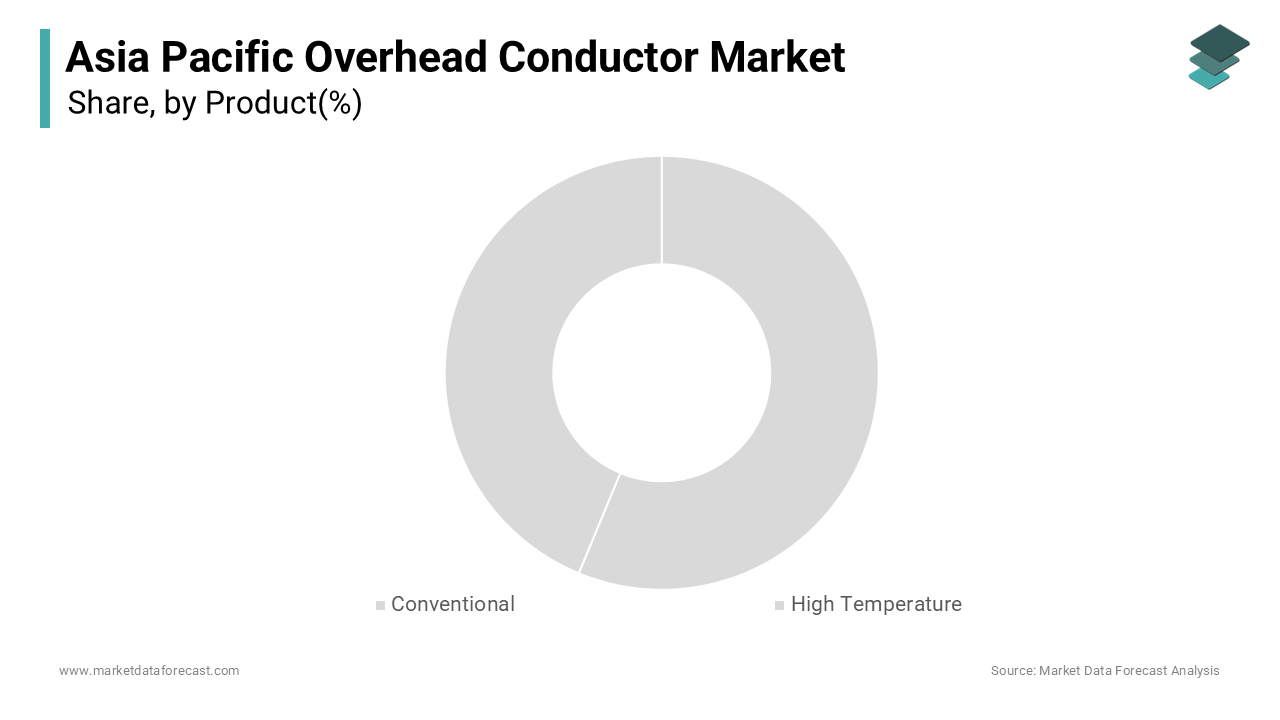
The high temperature conductor segment is projected to register a CAGR of 7.8% from 2025 to 2033 with the increasing demand for high-capacity, low-sag conductors that can operate efficiently under high thermal stress without compromising structural integrity. In China, the State Grid Corporation has incorporated HTLS conductors in over 20 ultra-high voltage (UHV) transmission projects since 2020, enabling power transmission over 3,000 kilometers with minimal losses. Additionally, in India, the Power Grid Corporation reported a 40% increase in HTLS conductor procurement in 2023 compared to the previous year, driven by the need for efficient power evacuation from renewable energy parks.
By Rated Strength Insights
The high strength conductors egment held a dominant share of the Asia Pacific overhead conductor market in 2024 with the composed of aluminum conductor steel-reinforced (ACSR) cables, which are widely used in medium and high-voltage transmission lines due to their mechanical durability and cost-effectiveness. According to the International Energy Forum, over 70% of transmission infrastructure in India and Indonesia continues to rely on high strength conductors for long-distance power delivery across diverse terrains. These conductors offer an optimal balance between tensile strength and conductivity, making them ideal for applications in both rural and semi-urban power distribution networks. In India, the Power Grid Corporation reported that more than 90% of new transmission line projects launched between 2021 and 2023 utilized high strength conductors due to their compatibility with existing grid infrastructure and ease of maintenance.
The ultra-high strength conductor segment is anticipated to witness a CAGR of 8.3% from 2025 to 2033 with the increasing adoption of advanced composite core conductors, such as carbon fiber-reinforced aluminum conductor composite core (ACCC), which offer superior tensile strength and reduced sag under high thermal loads. According to the World Bank, the demand for ultra-high strength conductors has surged in countries like China and South Korea, where grid modernization and renewable energy integration require high-capacity transmission solutions. In China, the State Grid Corporation has deployed ACCC conductors in over 15 ultra-high voltage (UHV) transmission lines since 2021, significantly enhancing grid efficiency and reducing line losses. Similarly, in South Korea, the Korea Electric Power Corporation (KEPCO) has integrated ultra-high strength conductors into its smart grid expansion projects to support bidirectional power flows and accommodate distributed energy resources. Additionally, in Japan, where land constraints limit the expansion of transmission corridors, the Ministry of Economy, Trade and Industry (METI) has mandated the use of ultra-high strength conductors in new grid infrastructure to maximize capacity within existing ROWs.
By Current Type Insights
The HVAC segment was the largest and held a significant share of the Asia Pacific overhead conductor market in 2024 with the widespread use of alternating current transmission systems across the region, which are well-suited for long-distance power transmission and distribution. According to the International Energy Agency, over 90% of existing transmission infrastructure in countries like India, Indonesia, and the Philippines operates on HVAC technology, making it the backbone of the regional power grid. HVAC systems are preferred for their compatibility with conventional power generation sources, ease of integration with existing substations, and lower initial investment compared to HVDC systems.
The HVDC segment is projected to grow with an anticipated CAGR of 9.1% from 2025 to 2033 with the increasing deployment of ultra-high voltage direct current (UHVDC) transmission systems in China and India to efficiently transport large volumes of electricity over ultra-long distances with minimal losses. According to the International Smart Grid Action Network, HVDC transmission efficiency is approximately 15–20% higher than HVAC systems, making it ideal for interconnecting remote renewable energy sources with urban load centers. Additionally, in Australia, A Better Grid, a government-backed initiative is exploring HVDC technology for connecting offshore wind farms to the mainland.
REGIONAL ANALYSIS
China Overhead Conductor Market Insights
China was the top performer of the Asia Pacific overhead conductor market by accounting for 28.3% of share in 2024. China has been aggressively expanding its power transmission infrastructure to support industrial growth and integrate renewable energy sources. According to the National Energy Administration of China, the country added over 35,000 kilometers of new transmission lines in 2022, primarily using high-capacity aluminum and ultra-high strength conductors. The State Grid Corporation has been at the forefront of this expansion, investing over USD 90 billion in grid modernization projects, including ultra-high voltage direct current (UHVDC) transmission corridors. Additionally, China’s renewable energy capacity reached 1,200 gigawatts in 2023, necessitating extensive overhead conductor networks to evacuate power from remote wind and solar farms to urban centers.
India Overhead Conductor Market Insights
India was ranked second with 22.3% of the Asia Pacific overhead conductor market share in 2024. The country’s rapid urbanization, expanding industrial sector, and aggressive rural electrification programs have fueled significant demand for overhead transmission infrastructure. According to the Central Electricity Authority, India added over 25,000 circuit kilometers of transmission lines in 2022. The Power Grid Corporation reported that over 1.1 million kilometers of rural distribution lines were constructed under the Deen Dayal Upadhyaya Gram Jyoti Yojana, significantly boosting conductor demand. Additionally, the Green Energy Corridor project, aimed at evacuating renewable power from central and southern states, has led to increased deployment of high-temperature low-sag (HTLS) conductors.
Japan Overhead Conductor Market Insights
Japan overhead conductor market growth is anticipated to grow eventually in the next coming years with the presence of advance infrastructure and ongoing grid modernization efforts. According to the Ministry of Economy, Trade and Industry (METI), Japan’s electricity demand has remained relatively stable, but the country has been upgrading its transmission systems to enhance grid reliability and integrate renewable energy sources. The Tokyo Electric Power Company (TEPCO) reported that over 60% of new overhead lines installed in 2023 utilized advanced conductors capable of withstanding seismic activity and extreme weather conditions. Additionally, Japan’s commitment to phase out coal-fired power plants and increase renewable energy capacity to 30% by 2030 has spurred investment in new transmission corridors, particularly in Hokkaido and Kyushu.
South Korea Overhead Conductor Market Insights
South Korea overhead conductor market growth is likely to be driven by its strategic investments in smart grid technologies and renewable energy integration. According to the Korea Electric Power Corporation (KEPCO), the country added over 4,500 kilometers of new transmission lines in 2022, with a growing emphasis on high-efficiency conductors. The government’s Green New Deal policy, launched in 2020, aims to increase renewable energy’s share in the power mix to 30% by 2040, necessitating extensive overhead transmission infrastructure. KEPCO has been deploying high-temperature low-sag (HTLS) conductors in new grid expansion projects to support bidirectional power flows and reduce congestion. Additionally, the Ministry of Trade, Industry and Energy has mandated the use of ultra-high strength conductors in urban power corridors to maximize capacity within limited right-of-way spaces.
Australia Overhead Conductor Market Insights
Australia overhead conductor market growth is likely to grow with the expanding renewable energy sector and grid modernization initiatives. According to the Australian Energy Market Operator (AEMO), the country’s renewable energy capacity surpassed 30 GW in 2023, with large-scale solar and wind farms located in remote regions such as Queensland and South Australia. These projects require extensive overhead conductor networks to transmit power to major consumption centers like Sydney and Melbourne. The Australian government’s Rewiring the Nation plan, which allocates AUD 20 billion for grid upgrades, has accelerated the deployment of high-capacity aluminum and HTLS conductors. Additionally, the Powerlink Corporation reported that over 1,200 kilometers of new overhead lines were commissioned in 2023 to support the integration of renewable energy into the National Electricity Market.
COMPETITIVE LANDSCAPE
The Asia Pacific overhead conductor market is characterized by intense competition among global and regional players striving to capture a larger market share. The market comprises established multinational firms and a growing number of local manufacturers, particularly in countries like India, China, and Southeast Asia. Competition is primarily driven by product innovation, technological differentiation, and localized manufacturing capabilities. Companies are increasingly focusing on developing advanced conductor solutions that align with regional energy policies and infrastructure development goals. Strategic partnerships, mergers, and acquisitions are commonly used to expand geographic reach and enhance production efficiency. Additionally, players are investing in sustainable manufacturing practices and supply chain optimization to maintain a competitive edge. The presence of a large number of suppliers also leads to price sensitivity, prompting firms to differentiate through quality, performance, and after-sales service.
KEY MARKET PLAYERS
The key players in the Asia Pacific Overhead Conductor Market include
- Prysmian Group
- Nexans
- General Cable Technologies Corporation
- Southwire Company, LLC
- ZTT Group
- Apar Industries Limited
- Sumitomo Electric Industries, Ltd.
- Lamifil
- NKT A/S
- Sterlite Power
Top Players in the Asia Pacific Overhead Conductor Market
Fujikura Ltd. (Japan)
Fujikura Ltd. is a leading manufacturer of high-performance overhead conductors, known for its advanced materials and innovative conductor technologies. The company has a strong presence across Asia Pacific and plays a pivotal role in supplying conductors for ultra-high voltage transmission projects. Fujikura's focus on research and development has enabled the production of high-temperature low-sag (HTLS) conductors that are widely used in modern grid infrastructure. Its products are integral to enhancing grid efficiency and reliability in countries undergoing energy transition.
Southwire Company, LLC (U.S.-based, with significant APAC operations)
Southwire has established a strong foothold in the Asia Pacific market through strategic partnerships and localized manufacturing units. The company is recognized for its broad portfolio of aluminum and copper-based overhead conductors tailored for both urban and rural applications. Southwire emphasizes sustainable manufacturing practices and digital integration in conductor production, by aligning with regional energy efficiency goals. Its commitment to quality and innovation supports the expansion of resilient power networks across emerging economies in the region.
KEI Industries Ltd. (India)
KEI Industries is one of India’s largest manufacturers of conductors and plays a role in supporting the country’s expanding power infrastructure. The company supplies a wide range of conventional and high-efficiency conductors for transmission and distribution networks. KEI has been instrumental in enabling rural electrification and renewable energy integration through cost-effective and durable conductor solutions.
Top Strategies Used by Key Market Participants
Technological Innovation and R&D Investment
Leading players are heavily investing in research and development to design high-performance conductors that offer superior conductivity, strength, and thermal resistance. Companies are focusing on developing high-temperature low-sag (HTLS) and ultra-high strength conductors to meet evolving grid requirements and support renewable energy integration.
Strategic Collaborations and Joint Ventures
To strengthen their regional presence and enhance production capabilities, key players are entering into strategic alliances with local manufacturers and utility providers. These collaborations facilitate technology transfer, reduce operational costs, and improve market penetration across emerging economies in the Asia Pacific region.
Expansion of Manufacturing and Distribution Networks
Market participants are expanding their production facilities and distribution channels to ensure timely delivery of conductors across remote and high-demand regions. This includes setting up new manufacturing units and logistics hubs to support large-scale infrastructure projects and reduce dependency on imports.
RECENT MARKET DEVELOPMENTS
- In January 2023, Fujikura Ltd. launched a new line of high-temperature low-sag conductors designed specifically for tropical climates by enhancing grid reliability in Southeast Asia.
- In June 2023, KEI Industries expanded its manufacturing facility in Gujarat, India, to increase production capacity and better serve the growing demand for rural electrification and renewable energy projects.
- In October 2023, Southwire announced a strategic partnership with a local Indonesian distributor to strengthen its supply chain and improve access to remote island regions requiring new transmission infrastructure.
- In February 2024, Nexans, a global cable solutions provider, entered the Vietnamese market through a joint venture with a domestic manufacturer, which is aiming to support the country’s smart grid development initiatives.
- In May 2024, Sumitomo Electric Industries collaborated with a major Chinese utility to supply next-generation composite core conductors for an ultra-high voltage transmission project connecting western renewable energy zones to eastern load centers.
MARKET SEGMENTATION
This research report on the Asia Pacific overhead conductor market is segmented and sub-segmented into the following categories.
By Product
- Conventional
- ACSR
- AAAC
- ACAR
- AACSR
- AAC
- High Temperature
- Tal
- ZTAl
- Others
- Others
- ACFR
- ACCR
- ACCC
- CRAC
- Gap Conductors
- Others
By Rated Strength
- High Strength
- Extra High Strength
- Ultra High Strength
By Current Type
- HVAC
- HVDC
By Voltage
- 132 kV to 220 kV
- > 220 kV to 660 kV
- > 660 kV
By Country
- India
- China
- Japan
- South Korea
- Australia
- New Zealand
- Thailand
- Malaysia
- Vietnam
- Philippines
- Indonesia
- Singapore
- Rest of APAC