- Product Description Description
- Table of Contents TOC
- List of Table & Figure LOT
- Get Free Sample PDF Sample PDF
Market Size, 2025
$0.82 BnMarket Estimate, 2026
$0.89 BnMarket Forecast, 2034
$1.79 BnCAGR, 2026–2034
9.1%Asia Pacific Pharmacy Automation System Market Report Summary
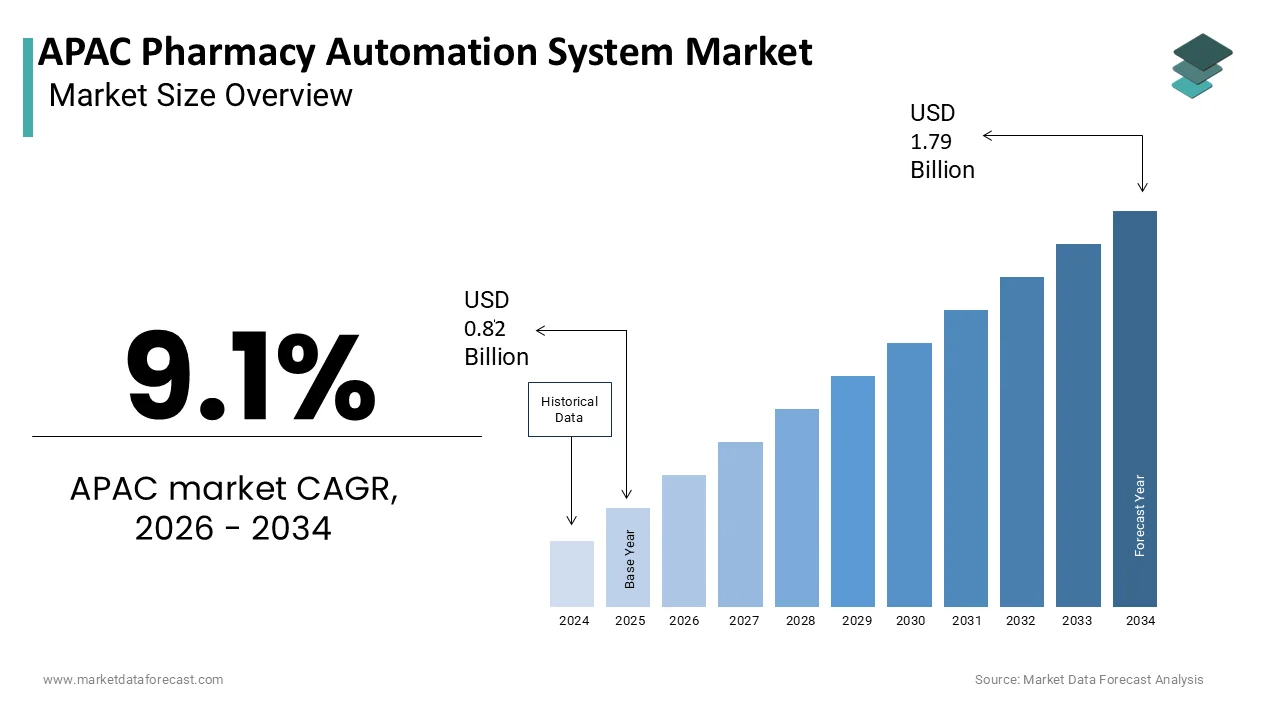
The Asia Pacific Pharmacy Automation System Market was valued at USD 0.82 billion in 2025 and is projected to reach USD 1.79 billion by 2034, growing from USD 0.89 billion in 2026 at a CAGR of 9.10% during the forecast period. Growth is driven by rapid population aging, government-led digital health initiatives, increasing medication safety requirements, and rising adoption of automated pharmacy workflows. However, high capital investment requirements, workforce resistance to automation, and regulatory fragmentation continue to restrain market growth.
Key Market Trends
- Increasing adoption of automated medication dispensing systems to improve patient safety and reduce medication errors.
- Growing integration of pharmacy automation systems with telehealth platforms and electronic prescribing.
- Rising establishment of centralized pharmacy fulfillment centers by retail pharmacy chains.
- Expansion of digital health infrastructure supporting interoperable pharmacy ecosystems.
- Increasing demand for AI-enabled inventory management and automated dispensing technologies.
Segmental Insights
- Based on product, automated medication dispensing systems held the largest market share in 2025, driven by regulatory compliance, patient safety initiatives, and widespread adoption across hospitals.
- Based on end user, inpatient pharmacies dominated the market in 2025, supported by increasing automation to reduce medication errors, improve workflow efficiency, and meet hospital accreditation standards.
- Automated packaging and labeling systems are the fastest-growing product segment, projected to register a CAGR of 20.2%, driven by expanding centralized dispensing facilities, retail pharmacy consolidation, and high-volume prescription fulfillment.
Regional Insights
- India led the market in 2025, accounting for 21.3% of the regional market, supported by expanding organized pharmacy chains, government digital health initiatives, and cost-effective domestic automation solutions.
- China holds a significant share, driven by smart hospital programs, large-scale retail pharmacy consolidation, and strong domestic manufacturing capabilities.
- Japan is a prominent market, supported by its aging population, widespread pharmacy automation adoption, and advanced healthcare digitization.
- South Korea contributes notably through government automation incentives, retail pharmacy modernization, and rapid digital healthcare adoption.
- Australia remains an important market, driven by electronic prescribing mandates, advanced healthcare infrastructure, and increasing integration of automated pharmacy solutions.
Competitive Landscape
The market is highly competitive, with multinational automation providers and regional manufacturers competing through digital health integration, localized product development, technical support networks, and strategic partnerships. Companies are investing in centralized pharmacy automation, telehealth integration, modular automation platforms, and workforce training programs to strengthen their presence across the Asia Pacific region.Prominent players in the market include Becton, Dickinson and Company (BD), Omnicell, Inc., Baxter International Inc., ScriptPro LLC, KUKA AG, TCGRx Pharmacy Workflow Solutions, RxSafe, Inc., Cerner Corporation (Oracle Health), Capsa Healthcare, Parata Systems LLC, ARxIUM Inc., and Talyst Systems LLC.
APAC Pharmacy Automation System Market Size
The APAC Pharmacy Automation System Market is projected to grow from USD 0.82 billion in 2025 to USD 0.89 billion in 2026 and reach USD 1.79 billion by 2034, registering a CAGR of 9.1% from 2026 to 2034.
According to the World Health Organization Regional Office for the Western Pacific, medication errors account for approximately 15% of all adverse events in hospitals across member states, creating urgent clinical imperatives for automated verification systems beyond mere operational convenience. As per the Asian Development Bank, healthcare workforce shortages in developing Asia will reach 2.8 million personnel by 2030, making labor substitution through automation a strategic necessity rather than optional efficiency enhancement. As per Japan’s Ministry of Health, Labour and Welfare, over 35% of community pharmacies had adopted some form of automated dispensing technology by the end of 2024 as part of national digital health transformation initiatives addressing super-aged society pressures. Consequently, this market functions as both a patient safety infrastructure and a demographic adaptation mechanism, with adoption patterns reflecting distinct national priorities ranging from elderly care support in East Asia to hospital capacity optimization in Southeast Asia and retail chain consolidation in Oceania.
MARKET DRIVERS
Accelerating Demographic Aging Creates Structural Labor Substitution Demand
Rapid population aging across East and Southeast Asia generates irreversible demand for pharmacy automation as shrinking working-age cohorts cannot sustain manual dispensing volumes required by growing elderly patient populations, which is a key factor propelling the growth of the Asia-Pacific pharmacy automation system market. According to the United Nations Economic and Social Commission for Asia and the Pacific, the region’s population aged 65 and above will increase from 470 million in 2024 to 890 million by 2040, representing an 89% surge in medication-dependent individuals while the working-age population grows only 3% during the same period. According to Japan’s National Institute of Population and Social Security Research, the pharmacist shortage will reach 45000 full-time equivalents by 2035 despite current workforce expansion efforts, making automated dispensing essential for maintaining service levels as each remaining pharmacist must handle 60% more prescriptions than the 2020 baseline. According to Statistics Korea, the population aged 65 and above reached 19.2% of the total in 2024, surpassing the youth population for the first time and triggering government subsidies covering 50% of automation equipment costs for community pharmacies serving elderly dense neighbourhoods. According to the National Bureau of Statistics of China, the working-age population declined by 6.6 million in 2024 alone, while chronic disease prevalence among the elderly exceeded 75% according to Chinese Center for Disease Control and Prevention data. These demographic trajectories transform pharmacy automation from productivity enhancement into an existential operational requirement, creating non-discretionary demand anchored in the mathematical certainty of workforce contraction rather than discretionary technology adoption cycles.
Government Digital Health Mandates Accelerate Technology Integration
National digital health transformation policies across Asia Pacific create regulatory pull factors mandating or incentivizing pharmacy automation integration as foundational infrastructure for interoperable healthcare ecosystems, which is further aiding the regional market growth. According to Australia’s Department of Health and Aged Care, the Electronic Prescribing mandate effective January 2024 requires all community pharmacies to possess digital dispensing capabilities compatible with the My Health Record system, effectively making automation-ready infrastructure a prerequisite for continued Medicare reimbursement eligibility. As per the Ministry of Health Singapore, 150 million SGD was allocated in 2024 specifically for pharmacy automation under the Healthcare Transformation Fund, targeting an 80% adoption rate in polyclinics and public hospitals by 2026 as part of the Smart Nation health digitization roadmap. According to the Ministry of Public Health Thailand, the National Digital Health Strategy was implemented, requiring all tertiary hospitals to achieve HIMSS Stage 6 electronic medical record maturity by 2025, with automated dispensing systems serving as a mandatory component for medication administration verification modules. According to the National Health Authority of India, the Ayushman Bharat Digital Mission integrated pharmacy module in 2024 mandates barcode scanning and digital inventory tracking for all empanelled hospitals serving 500 million beneficiaries, creating compliance-driven demand across previously low automation penetration segments. Unlike voluntary technology adoption subject to ROI calculations, these regulatory frameworks establish mandatory baselines transforming automation from a competitive differentiator into a license to operate, ensuring sustained procurement regardless of individual facility financial performance or management technology appetite.
MARKET RESTRAINTS
High Capital Investment Barriers Exclude Small Scale Operators
Substantial upfront costs for pharmacy automation systems create prohibitive entry barriers for independent pharmacies and small hospital facilities dominating many Asia Pacific markets outside developed urban centers, which is a significant impediment to the Asia-Pacific pharmacy automation system market growth. According to the Frost & Sullivan Asia Pacific Healthcare Technology Assessment 2024, the average installed cost for a comprehensive robotic dispensing system ranges from 180000 to 350000 USD in Southeast Asian markets, representing 3 to 5 years of net operating profit for a typical independent pharmacy generating 60000 USD annual earnings. According to the Ministry of Health Indonesia pharmacy census, 78% of registered community pharmacies operate as single-outlet businesses with floor space below 100 square meters, physically incompatible with standard automated dispensing cabinets requiring a minimum 15 square meter footprint plus utility infrastructure. According to the Philippine Pharmacists Association position paper, Philippine Health Insurance Corporation reimbursement rates remain 40% below actual dispensing costs, preventing capital accumulation necessary for automation investment among PhilHealth-accredited providers serving the majority of the population. Even in wealthier markets, financing constraints persist, and according to SME Bank Malaysia, only 12% of pharmacy loan applications for automation equipment received approval in 2024 due to insufficient collateral and uncertain cash flow projections. This capital intensity creates a two-tier market where large chains and public hospitals achieve automation benefits while independent operators serving rural and underserved communities remain locked in manual workflows, perpetuating geographic and socioeconomic disparities in medication safety and access quality.
Workforce Resistance and Change Management Deficits Delay Implementation
Cultural attachment to traditional dispensing practices and insufficient change management resources create implementation friction, delaying or preventing realization of automation benefits even after capital investment, which is also hampering the Asia-Pacific pharmacy automation system market expansion. According to the International Pharmaceutical Federation Asia Pacific Workforce Survey 2024, 62% of pharmacists in Vietnam, Thailand, and Indonesia expressed concern that automation would diminish professional identity centered on manual compounding and patient counseling relationships rather than enhance it through task reallocation. According to the Japan Society of Hospital Pharmacists, 35% of automation installations in regional hospitals experienced utilization rates below 50% within the first two years due to staff workarounds reverting to manual processes when encountering unfamiliar error messages or workflow interruptions. According to the Pharmacy Guild of Australia, 28% of Electronic Prescribing mandated upgrades in 2024 required remedial training interventions exceeding vendor standard packages as older practitioners struggled with interface navigation and exception handling protocols. Training deficits compound resistance, and according to the ASEAN Pharmacy Education Standards Framework assessment, only 14% of pharmacy schools across ASEAN include automation competency modules in core curriculum, graduating professionals unprepared for technology-enabled practice environments. This human factor creates hidden implementation costs often excluded from vendor proposals and ROI models, causing project failures that generate negative word of mouth, suppressing subsequent adoption waves in relationship-driven markets where peer experience outweighs vendor marketing claims.
MARKET OPPORTUNITIES
Central Fill Facility Emergence Enables Economies of Scale for Chain Operators
Consolidation of retail pharmacy networks and emergence of central fill distribution models is a prominent opportunity for the Asia-Pacific pharmacy automation system market. According to the IQVIA Asia Pacific Retail Pharmacy Tracker 2024, the top 10 pharmacy chains in Australia, Japan, and South Korea now operate 45% of community pharmacy outlets, up from 28% in 2019, enabling capital-intensive automation investments amortized across hundreds of dispensing points rather than individual store economics. According to company operational disclosures, Alibaba Health and JD Health established 12 regional central fill centers between 2023 and 2024, each processing 50000 prescriptions daily through fully automated sorting and packaging lines serving affiliated online and offline pharmacy networks. According to internal efficiency metrics, Apollo Pharmacy commissioned an automated central fill facility in Chennai in early 2024 with capacity to serve 400 stores across Tamil Nadu and Karnataka, reducing per-prescription dispensing cost by 42% compared to decentralized manual operations. This hub-and-spoke model transforms automation ROI calculus from marginal unit economics to strategic network advantage, enabling mid-sized chains to compete with large operators through shared infrastructure rather than individual store scale. As regulatory frameworks in Malaysia, Thailand, and the Philippines evolve to permit centralized dispensing for chronic medications currently restricted to point of care, the addressable market for central fill automation expands beyond early adopter markets into a mainstream growth phase.
Integration with Telehealth Platforms Creates End-to-End Digital Dispensing Ecosystems
Convergence of telemedicine consultation platforms with automated dispensing infrastructure enables seamless digital prescribing to fulfillment workflows, capturing value from the integrated patient journey rather than isolated transaction automation, which is another significant opportunity for the regional market. According to the Doctronic Asia Pacific Digital Health Monitor 2024, telehealth consultations in Australia, Singapore, and South Korea generated 185 million electronic prescriptions in 2024, representing 38% of primary care prescribing volume and creating a structured demand stream for automation systems capable of receiving and processing digital orders without manual transcription. According to partnership announcement documentation, Singapore’s WhiteCoat and Doctor Anywhere platforms integrated directly with Guardian Pharmacy automated dispensing network in 2024, enabling 2-hour delivery for teleconsulted medications through API connected robotic fulfillment centers. According to platform usage analytics, the MedAdvisor platform in Australia achieved integration with 2200 community pharmacy automation systems by the end of 2024, enabling patients to request repeats via the app that trigger automated dispensing queue prioritization, reducing wait times by 65%. This integration transforms automation from a back-office efficiency tool into a patient-facing service differentiator, enabling premium pricing and customer retention in competitive retail markets. As national digital health infrastructures mature andcross-platformm interoperability standards emerge, telehealth automation integration becomes table stakes rather than competitive advantage, creating sustained upgrade demand across the installed base seeking to maintain relevance in digitally native patient engagement models.
MARKET CHALLENGES
Regulatory Fragmentation Across Jurisdictions Complicates Product Standardization
Divergent pharmacy automation regulations across Asia Pacific nations prevent vendors from achieving economies of scale through standardized product portfolios, which is forcing costly customization and delayed market entry and challenging the regional market. According to the Asian Harmonization Working Party Medical Device Regulatory Assessment 2024, only 8 of 21 surveyed APAC jurisdictions have specific classification frameworks for pharmacy automation equipment, with remaining markets applying inconsistent interpretations ranging from general electrical appliance to Class II medical device depending on local authority discretion. According to Pharmaceuticals and Medical Devices Agency regulations, Japan requires separate type testing for each robotic dispenser model variant, including minor software updates, adding 6 to 9 months to approval timelines versusCE-markedd equivalents accepted in Singapore and Australia without additional validation. According to Ministry of Health Indonesia regulations effective 2024, Bahasa language interfaces and local data residency are mandated for all pharmacy automation systems, requiring dedicated engineering resources for a market with annual sales volume insufficient to justify development investment according to multinational vendor financial disclosures. According to the Thai Pharmacy Council position statement, the Food and Drug Administration of Thailand interprets automated dispensing as a pharmaceutical manufacturing activity triggering GMP facility requirements inappropriate for retail settings. This regulatory mosaic prevents pan-regional product strategies and forces vendors to maintain multiple SKUs, documentation sets, and validation protocols, fragmenting R&D budgets and compressing margins in markets already characterized by price sensitivity and extended sales cycles.
Power Infrastructure Instability Compromises System Reliability and Uptime
Unreliable electrical supply across developing Asia Pacific creates operational risks for automation systems designed for stable power environments, which is causing downtime, data corruption,n and premature component failure that undermines user confidence and further challenges the Asia-Pacific pharmacy automation system market. According to the World Bank Enterprise Surveys 2024, firms in the Philippines, Vietnam, and Indonesia experience an average of 12 power outages monthly lasting 3.8 hours each, with healthcare facilities reporting higher frequency due to grid prioritization favoring industrial and residential consumers over commercial services. According to a multi-country assessment by the Asian Development Bank, 45% of pharmacy automation installations in Cambodia, Laos, and Myanmar experienced motherboard or servo motor failures attributable to voltage fluctuations within the first 18 months despite nominal surge protection, inflating total cost of ownership by 35% versus manufacturer specifications. According to the Philippine Pharmacists Association infrastructure survey, backup power coverage remains inadequate, with only 28% of community pharmacies in provincial Philippines possessing functional UPS systems, leaving automated dispensing vulnerable during brownouts common during typhoon season. Even when backup exists, fuel costs consume 20 to 30% of operating budgets according to Health Finance Initiative cost analyses, forcing rationing decisions that prioritize refrigeration over automation during extended outages. Solar hybrid solutions require 3 to 4 times conventional system investment according to UNDP clean energy program estimates, exceeding typical pharmacy capital capacity. Until grid reliability improves or affordableoff-gridd solutions scale, automation adoption in emerging APAC markets will remain constrained to urban centers with stable infrastructure, limiting addressable market despite underlying clinical and operational need.
REPORT COVERAGE
| REPORT METRIC | DETAILS |
| Market Size Available | 2025 to 2034 |
| Base Year | 2025 |
| Forecast Period | 2026 to 2034 |
| Segments Covered | By Product, End User, and Region. |
| Various Analyses Covered | Global, Regional and Country-Level Analysis, Segment-Level Analysis, Drivers, Restraints, Opportunities, Challenges; PESTLE Analysis; Porter’s Five Forces Analysis, Competitive Landscape, Analyst Overview of Investment Opportunities |
| Countries Covered | India, China, Japan, South Korea, Australia, New Zealand, Thailand, Malaysia, Vietnam, Philippines, Indonesia, Singapore, Rest of APAC |
| Market Leaders Profiled | Becton, Dickinson and Company (BD), Omnicell, Inc., Baxter International Inc., ScriptPro LLC, KUKA AG, TCGRx Pharmacy Workflow Solutions, RxSafe, Inc., Cerner Corporation (Oracle Health), Capsa Healthcare, Parata Systems LLC, ARxIUM Inc., Talyst Systems LLC. |
SEGMENTAL ANALYSIS
By Product Insights
The automated medication dispensing systems segment dominated the market with the leading share of the regional market and is estimated to maintain leadership in the Asia-Pacific pharmacy automation system market over the forecast period because hospital accreditation standards and patient safety regulations across developed Asia Pacific nations explicitly require automated verification for high-alert medications and controlled substances. According to the Joint Commission International Asia Pacific Accreditation Report 2024, 92% of accredited hospitals in Singapore, Australia, Japan, and South Korea have installed automated dispensing cabinets in emergency departments, intensive care units, and surgical wards as mandatory infrastructure for maintaining certification status. According to official implementation tracking data, the National Health Commission of China issued Hospital Smart Pharmacy Construction Guidelines in 2023 requiring all tertiary Grade A hospitals to achieve 80% automated dispensing coverage for inpatient medications by the end of 2025, triggering synchronized procurement waves across 1600 facilities. According to Australian Commission on Safety and Quality in Health Care compliance documentation, the National Safety and Quality Health Service Standards Version 3 mandates electronic medication management with automated decision support for all public hospitals, effectively making manual dispensing non-compliant for acute care settings serving 13 million annual admissions. Unlike retail or outpatient segments where automation remains a discretionary efficiency enhancement, hospital inpatient dispensing represents regulatory-compelled expenditure insulated from economic cycles and ROI scrutiny. This compliance-driven demand ensures automated dispensing systems maintain product segment leadership through institutional mandate rather than voluntary adoption, creating predictable replacement cycles aligned with accreditation renewal timelines and government funding allocations for hospital infrastructure modernization.
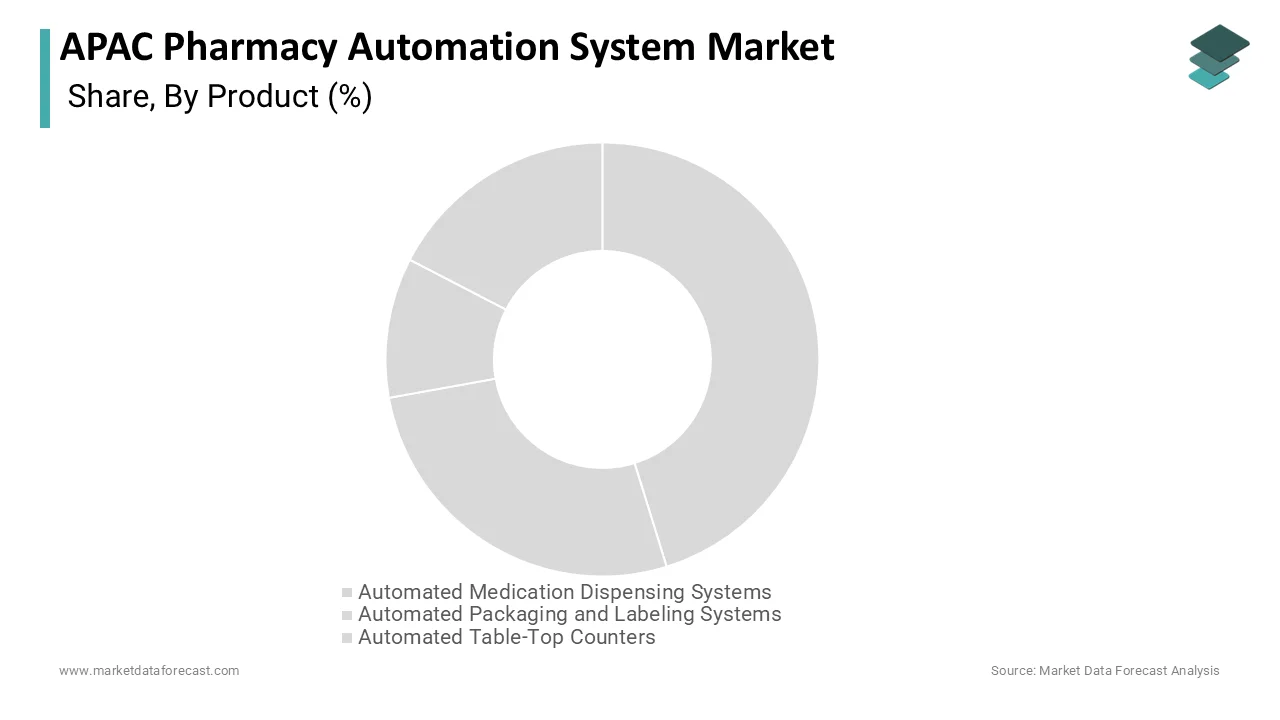
On the other hand, the automated packaging and labeling systems segment is expected to record the fastest CAGR of 20.2% over the forecast period as retail pharmacy chains and hospital networks consolidate dispensing operations into centralized fulfillment hubs requiring high-throughput unit-dose preparation capabilities. According to the IQVIA Asia Pacific Retail Pharmacy Consolidation Tracker 2024, the top 10 pharmacy chains in Australia, Japan, and South Korea now operate 45% of community outlets through hub-and-spoke models with central fill facilities processing chronic medication prescriptions for hundreds of satellite stores, creating concentrated demand for automated blister packaging and labeling lines. According to company operational disclosures, Alibaba Health and JD Health commissioned 8 regional automated packaging centers between 2023 and 2024, each capable of producing 120000 unit-dose packages daily with integrated barcode verification and patient-specific labeling. According to internal efficiency metrics, Apollo Pharmacy inaugurated a Chennai central fill facility in early 2024 with a fully automated packaging line serving 400 stores across Tamil Nadu and Karnataka, reducing per-prescription packaging labor cost by 58% versus decentralized manual operations. Unlike dispensing systems serving individual sites, packaging automation achieves economies of scale proportional to network size, making ROI increasingly attractive as chain operators expand geographic coverage. As regulatory frameworks in Malaysia, Thailand, and the Philippines evolve to permit centralized chronic medication dispensing currently restricted to point of care, the addressable market expands beyond early adopter markets into the mainstream growth phase, sustaining accelerated segment expansion.
By End User Insights
The inpatient pharmacies segment led the market by accounting for the major share of the Asia-Pacific pharmacy automation system market in 2025 due to inherent clinical complexity, regulatory scrutiny, and zero tolerance for medication errors in hospital environments serving critically ill patients. According to the Asian Hospital Federation Patient Safety Benchmarking Report 2024, medication errors in APAC hospitals occur at a rate of 8.7 per 1000 patient days without automation versus 1.2 per 1000 with automated dispensing and verification systems, representing an 86% error reduction that justifies capital investment regardless of financial return metrics. According to National Healthcare Security Administration policy documentation, China tied hospital reimbursement rates to medication safety performance indicators in 2024 DRG payment reform, penalizing facilities exceeding national adverse event benchmarks and creating direct financial incentive for automation adoption across 28000 public hospitals. According to the Australian Commission on Safety and Quality in Health Care implementation guide, National Safety and Quality Health Service Standards mandate closed-loop medication administration with barcode scanning at bedside for all public hospitals, requiring upstream automated dispensing infrastructure to generate scannable unit doses compatible with electronic medication administration records. According to the Ministry of Health, Labour and Welfare enforcement notification, the Medical Service Act revision 2023 in Japan requires hospitals with over 300 beds to maintain automated high alert medication management systems as a condition for insurance billing eligibility, affecting 4200 facilities nationwide. Unlike outpatient settings where errors typically cause manageable harm, inpatient medication mistakes can result in immediate mortality or severe disability, making automation non-negotiable risk mitigation infrastructure rather than discretionary efficiency enhancement. This clinical imperative ensures the inpatient segment maintains end-user leadership through patient safety primacy over economic considerations.
However, the outpatient pharmacy segment is anticipated to showcase a CAGR of 22.7% over the forecast period in the regional market as retail pharmacy chains pursue automation-enabled consolidation strategies transforming the fragmented mom-and-pop landscape into scaled network operations with centralized fulfillment capabilities. According to the IQVIA Asia Pacific Retail Pharmacy Market Intelligence 2024, pharmacy chain penetration increased from 28% in 2019 to 45% in 2024 across Australia, Japan, South Korea, and urban China, with acquiring operators systematically automating acquired locations to achieve operational synergies and margin expansion. According to company investor presentation materials, Chemist Warehouse in Australia completed the acquisition of 180 independent pharmacies in 2024, committing 120 million AUD to automated dispensing and packaging upgrades across the acquired network to reduce per-prescription labor cost by 40%. According to annual securities filing disclosures, Nihon Chouzai in Japan expanded automated prescription processing to 85% of its 850-store network by the end of 2024, achieving a 25% operating margin improvement versus the industry average through technology-enabled staffing optimization. According to the cooperative annual report, Onnuri Pharmacy Cooperative in South Korea upgraded 600 member pharmacies with standardized automated dispensing systems in 2024 as a competitive response to large chain expansion, demonstrating automation accessibility beyond corporate-owned networks. This consolidation-driven automation creates a self-reinforcing cycle where automated operators achieve cost advantages, enabling further acquisitions, accelerating segment growth beyond organic new openings, and ensuring the outpatient segment sustains the fastest growth trajectory through structural industry transformation rather than incremental demand expansion.
COUNTRY LEVEL ANALYSIS
India Pharmacy Automation System Market Analysis
India held the dominant position in the Asia-Pacific pharmacy automation system market in 2025 with 21.3% of the regional market, functioning as a high-volume emerging leader driven by rapid retail chain expansion, government digital health mandates, and a domestic manufacturing ecosystem enabling cost accessible automation solutions. According to the Indian Pharmaceutical Alliance Retail Pharmacy Survey 2024, organized pharmacy chains expanded from 8500 outlets in 2020 to 22000 in 2024, with Apollo, MedPlus, and Netmeds collectively installing 3500 automated dispensing and packaging systems during this period to support centralized fulfillment models serving tier 2 and tier 3 cities. According to the National Health Authority implementation dashboard, the Ayushman Bharat Digital Mission pharmacy module implemented in 2024 mandates barcode scanning and digital inventory tracking for all 28000 empanelled hospitals serving 500 million beneficiaries, creating compliance-driven demand across previously low automation penetration segments. According to Make in India pharmaceutical equipment initiative documentation, domestic manufacturers including Pharmarack and MediBuddy offer automated dispensing systems priced 60% below imported equivalents, enabling SME pharmacies to access automation previously restricted to large chains. However, workforce readiness remains constrained, and according tothe Pharmacy Council of India education standards review, only 12% of pharmacy colleges include automation competency modules in the curriculum, graduating professionals unprepared for technology-enabled practice and limiting utilization efficiency despite hardware availability. Power instability in tier 2 and tier 3 cities causes 15 to 20% downtime in automation installations according to industry field service data, inflating total cost of ownership and suppressing ROI realization despite strong underlying demand drivers.
China Pharmacy Automation System Market Analysis
China accounted for a substantial share of the AAsia-Pacificpharmacy automation system market in 2025 by operating as the largest single national market characterized by state-led smart hospital mandates, massive retail chain consolidation, and a domestic technology ecosystem rivaling global vendors in capability and scale. According to the China National Health Commission Smart Pharmacy Construction Progress Report 2024, 78% of tertiary Grade A hospitals achieved the 80% automated dispensing coverage target ahead of the 2025 deadline, representing installation base exceeding 1250 facilities with comprehensive robotic dispensing and storage systems. According to company operational disclosures, Alibaba Health and JD Health established 12 regional central fill centers between 2023 and 2024, each processing 50000 prescriptions daily through fully automated sorting and packaging lines serving affiliated online and offline pharmacy networks. According to China Pharmaceutical Equipment Industry Association market analysis, domestic vendors including Sinopharm Equipment and Shanghai Pharma Machinery capture 65% of the hospital automation market through price competitiveness and regulatory alignment, offering systems 40% cheaper than imported equivalents while meeting national smart hospital certification requirements. However, foreign vendor participation faces restrictions, and according to the Cyberspace Administration of China enforcement guidelines, cybersecurity data localization requirements effective 2024 mandate domestic server hosting and source code escrow for all pharmacy automation systems handling patient data, increasing compliance costs and delaying market entry for multinational players. Retail automation outside major chains remains limited, and according to the National Medical Products Administration registry, only 8% of independent pharmacies possess any automation despite 680000 total registered outlets, indicating significant untapped potential constrained by capital barriers and fragmented ownership structure.
Japan Pharmacy Automation System Market Analysis
Japan represents a notable share of the Asia-Pacific pharmacy automation system market by functioning as a mature technology leader distinguished by super-aged society adaptation, universal automation adoption in community pharmacies, and sophisticated integration with national health insurance and long-term care systems. According to the Japan Ministry of Health, Labour and Welfare Pharmacy Digitalization Survey 2024, 82% of community pharmacies nationwide have adopted automated dispensing or tablet counting systems, with penetration exceeding 95% in urban prefectures Tokyo, Osaka, and Kanagawa, reflecting near saturation in high-density markets. According to the MHLW subsidy program execution report, government subsidies covering 50% of automation equipment costs for pharmacies serving elderly dense neighborhoods allocated 45 billion JPY in fiscal year 2024, accelerating adoption among small operators unable to afford full-price systems. According to Ministry of Internal Affairs digital health statistics, integration with My Number Card national ID and the electronic prescription exchange system enables seamless digital workflow from clinic consultation to automated dispensing without paper intermediaries, processing 420 million electronic prescriptions annually. According to Japan Pharmaceutical Manufacturers Association equipment division data, domestic vendors including Yuyama, Takazono, and TOSHO dominate with 88% combined market share through decades of product refinement tailored to Japanese pharmacy workflows and regulatory requirements. However, market growth faces saturation headwinds, and according to Fuji Keizai's healthcare equipment market forecast, replacement cycles are lengthening to 10 to 12 years as the installed base matures and incremental demand shifts from new installations to software upgrades and maintenance services. Rural depopulation creates a paradoxical challenge, where automation is most needed in workforce-scarce regions yet least affordable due to low prescription volumes, requiring innovative shared service models or mobile automation solutions not yet commercially viable.
South Korea is estimated to grow at a healthy CAGR in the Asia-Pacific pharmacy automation system market over the forecast period as an advanced technology adopter characterized by rapid retail chain consolidation, government digital health incentives, and a domestic vendor ecosystem competing effectively with global players. According to the Korean Pharmaceutical Association Community Pharmacy Automation Status Report 2024, automated dispensing system penetration reached 68% in chain pharmacies and 35% in independents, up from 42% and 18% respectively in 2020, reflecting accelerated adoption driven by workforce shortages and competitive pressures. According to the cooperative annual report, Onnuri Pharmacy Cooperative upgraded 600 member pharmacies with standardized automated dispensing systems in 2024 as a collective bargaining strategy, achievinga 30% cost reduction versus individual procurement. According to the Ministry of Health and Welfare budget execution documentation, the government’s Smart Pharmacy Support Program allocated 28 billion KRW in 2024, providing 40% equipment subsidies for small pharmacies adopting automation, targeting 1500 facilities in underserved rural and elderly dense urban areas. According tothe Korea Health Industry Development Institute market assessment, domestic vendors including Juwon Tech, Pharmaplan, and Medifuture capture 55% of the market through localized product design and responsive service networks, outperforming multinational competitors in the mid-tiersegment. According to Health Insurance Review and Assessment Service operational statistics, integration with the DUR national safety system and electronic prescription platform enables real-time interaction checking and claims adjudication within automated dispensing workflow, processing 1.2 billion prescriptions annually. However, intense price competition compresses margins, and according to the Korea Pharmaceutical Distributors Association pricing survey, the average system selling price declined 22% between 2020 and 2024 as domestic entrants proliferate and group purchasing organizations negotiate aggressive discounts, challenging vendor sustainability.
COMPETITIVE LANDSCAPE
Competition in the APAC pharmacy automation system market is characterized by stratified dynamics where multinational leaders dominate premium hospital and chain segments while domestic and Chinese vendors capture volume-driven emerging market applications through cost competitiveness and regulatory alignment. Incumbent advantage stems from regulatory approvals, digital health integration, and service networks, creating substantial entry barriers despite price sensitivity across most national markets outside Japan and Singapore. Competitive differentiation increasingly centers on local adaptation capability and total cost of ownership rather than technical specifications as buyers prioritize operational sustainability and workforce compatibility over advanced features inresource-constrainedd environments. Government procurement creates a parallel competitive arena where national smart hospital mandates and universal health coverage expansion determine market access independently of commercial sales capabilities. Regional heterogeneity prevents unified competitive strategies; success in Japan requires workflow specialization and elderly care integration while Southeast Asia demands affordability and power resilience. Emerging Chinese vendors gain share through aggressive pricing and local assembly partnerships but struggle with service infrastructure and regulatory compliance required for sustained institutional relationships. Telehealth and central fill convergence create new battlegrounds where integration capability matters more than standalone hardware performance. Ultimately, competition rewards contextual adaptation and ecosystem alignment over technological superiority in this uniquely diverse regional landscape spanning mature saturated markets and nascent high-growth opportunities simultaneously.
KEY MARKET PLAYERS
Some of the companies that are playing a dominating role in the Asia Pacific Pharmacy Automation System Market include:
- Becton, Dickinson and Company (BD)
- Omnicell, Inc.
- Baxter International Inc.
- ScriptPro LLC
- KUKA AG
- TCGRx Pharmacy Workflow Solutions
- RxSafe, Inc.
- Cerner Corporation (Oracle Health)
- Capsa Healthcare
- Parata Systems LLC
- ARxIUM Inc.
- Talyst Systems LLC
TOP LEADING PLAYERS IN THE MARKET
- Omnicell Inc maintains a significant presence across Asia Pacific through comprehensive automated dispensing and medication management solutions serving hospitals and retail chains with localized service infrastructure addressing regional maintenance challenges. The company strengthened its position by establishing authorized service centers in Bangkok and Ho Chi Minh City during early 2024, reducing equipment repair turnaround times from weeks to days for Southeast Asian customers previously dependent on Singapore-based technicians. Omnicell actively participates in national digital health integration initiatives, including Australia’s Electronic Prescribing mandate and Singapore’s telehealth platform partnerships, ensuring system compatibility withgovernment-mandatedd workflows. Strategic collaborations with Zuellig Healthcare in the Philippines and DKSH in Thailand enable last-mile distribution and technical support across geographically fragmented markets where direct operations remain economically unviable. Training programs for pharmacy technicians in Vietnam and Indonesia address workforce competency gaps limiting automation utilization while building brand loyalty among next-generation professionals. This combination of service localization, regulatory alignment, and partnership-driven market access sustains leadership through operational reliability rather than product specifications alone in markets where after-sales support determines long-term value realization and repeat procurement decisions.
- Yuyama Co Ltd contributes significantly to the APAC pharmacy automation market through specialized dispensing and packaging systems optimized for Japanese workflows and increasingly adapted for ASEAN market requirements with cost-competitive positioning. The company reinforced market presence by opening a Hanoi representative office in 2024, partnering with FPT Healthcare to provide localized service and Bahasa Vietnamese interface customization, reducing response times and improving user adoption versus the previous Australia-based support model. Yuyama dominates Japan’s community pharmacy automation segment through decades of product refinement tailored to national health insurance claiming systems and elderly care workflows, creating a reference base supporting regional expansion. Partnerships with Kalbe Farma in Indonesia and local distributors in Malaysia enable technology transfer and local assembly, reducing costs by 30 to 40 percent versus fully imported systems,s according to partnership announcements. Compact system designs suispace-constraineded urban pharmacies across dense Asian cities where Western form factors prove incompatible with typical floor plans. This focus on appropriate technology, local adaptation, and knowledge transfer aligns with emerging market affordability and usability requirements distinct from premium segments dominated by multinational competitors focused on feature richness over contextual fit.
- BD Rowa advances APAC pharmacy automation market through high-throughput robotic dispensing and central fill solutions serving large hospital networks and consolidated retail chains requiring scale-efficient automation infrastructure. The company strengthened its position by commissioning a Shanghai demonstration center in mid-2024, showcasing integrated central fill and telehealth fulfillment workflows to prospective Chinese customers navigating smart hospital certification requirements and retail consolidation trends. BD Rowa maintains a strong presence in Australia and New Zealand through PBS and Pharmac claiming system integration, enabling seamless reimbursement processing within automated dispensing workflows critical for public payer compliance. Strategic focus on central fill automation aligns with emerging hub-and-spoke models adopted by Chemist Warehouse, Apollo Pharmacy, and Alibaba Health,h creating concentrated demandfor high-capacityy systems amortized across hundreds of dispensing points. Service partnerships with local distributors in South Korea and Thailand ensure technical support accessibility despite complex import regulations and foreign ownership restrictions limiting direct operations. This targeting of consolidation-driven demand captures premium value opportunities distinct from fragmented independent pharmacy markets where smaller vendors compete on price, positioning BD Rowa as an infrastructure partner for network operators pursuing automation-enabled scale advantages rather than individual store efficiency gains.
TOP STRATEGIES USED BY KEY MARKET PARTICIPANTS
Key players establish local service infrastructure and technical training programs addressing maintenance deficits and workforce shortages that limit automation utilization across diverse APAC markets. Companies pursue national digital health integration, ensuring system compatibility withgovernment-mandatedd electronic prescribing and claiming workflows that determine market access eligibility. Vendors develop localized product variants with language interfaces, compact form factors, and pricing aligned with emerging market affordability constraints rather than offering uniform global portfolios. Strategic partnerships with domestic distributors and manufacturers enable market entry in jurisdictions with foreign ownership restrictions and complex regulatory environments while leveraging local relationships and market knowledge. Central fill and telehealth integration capabilities target consolidation-driven demand from retail chains and digital health platforms, creating premium segment opportunities distinct from fragmented independent pharmacy markets. Modular system architectures permit phased adoption and scalable upgrades accommodating capital constraints and evolving regulatory requirements without forcing upfront full automation investment. Training collaborations with pharmacy schools and professional associations build automation competency pipelines addressing workforce readiness gaps that suppress utilization efficiency despite hardware availability across the region.
MARKET SEGMENTATION
This research report on the Asia Pacific pharmacy automation systems market has been segmented and sub-segmented into the following categories.
By Product
- Automated Medication Dispensing Systems
- Centralized Automated Dispensing Systems
- Robots/Robotic Automated Dispensing Systems
- Carousels
- Decentralized Automated Dispensing Systems
- Automated unit-dose Dispensing Systems
- Pharmacy-Based Automated Dispensing Systems
- Ward-Based Automated Dispensing Systems
- Centralized Automated Dispensing Systems
- Automated Packaging and Labeling Systems
- Automated unit-dose Packaging & Labeling Systems
- Automated Multi-Dose Packaging & Labeling Systems
- Automated Table-Top Counters
- Automated Medication Compounding Systems
- Automated Storage and Retrieval Systems
- Other Pharmacy Automation Systems
By End User
- Inpatient Pharmacies
- Acute Care Settings
- Long-Term Care Facilities
- Outpatient Pharmacies
- Outpatient/Fast-Track Clinics
- Hospital Retail Settings
- Retail Pharmacies
- Pharmacy Benefit Management Organizations and Mail-Order Pharmacies
By Country
- India
- China
- Japan
- South Korea
- Australia
- New Zealand
- Thailand
- Malaysia
- Vietnam
- Philippines
- Indonesia
- Singapore
- Rest of APAC