- Product Description Description
- Table of Contents TOC
- List of Table & Figure LOT
- Get Free Sample PDF Sample PDF
Market Size, 2025
$0.60 BnMarket Estimate, 2026
$0.64 BnMarket Forecast, 2034
$1.10 BnCAGR, 2026–2034
6.96%Asia Pacific Portable Generators Market Size
The Asia Pacific portable generators market size was valued at USD 0.60 billion in 2025 and is anticipated to reach USD 0.64 billion in 2026 from USD 1.10 billion by 2034, growing at a CAGR of 6.96% during the forecast period from 2026 to 2034.

The portable generators are a wide range of compact, mobile power generation units designed to provide temporary electricity in both residential and industrial applications. These generators, typically powered by diesel, gasoline, or increasingly by inverter-based technologies, are essential for backup power during grid failures, remote operations, construction sites, and disaster relief efforts. The demand for portable generators has surged across the region due to rapid urbanization, rising infrastructure development, and an increase in extreme weather events that disrupt regular power supply. Countries such as China, India, Japan, and Australia have seen significant adoption of portable generators, driven by both industrial expansion and growing consumer awareness about energy reliability. According to data from the International Energy Agency, electricity demand in the Asia Pacific region is projected to grow at a compound annual rate of over 3% through 2030, further reinforcing the need for decentralized power solutions like portable generators. Technological advancements, including fuel-efficient engines and low-emission models, have also contributed to market evolution.
MARKET DRIVERS
Rising Frequency of Natural Disasters and Power Outages
One of the primary drivers of the Asia Pacific portable generators market is the increasing frequency of natural disasters and power outages across the region. Countries such as the Philippines, Indonesia, India, and Japan are frequently hit by typhoons, earthquakes, floods, and cyclones, which severely impact grid stability and cause prolonged power disruptions. According to the United Nations Office for Disaster Risk Reduction (UNDRR), the Asia-Pacific region accounted for nearly half of all global disaster events between 2000 and 2021, with over 1,600 major incidents recorded. In 2022 alone, the Economic and Social Commission for Asia and the Pacific (ESCAP) reported that climate-related disasters affected more than 50 million people across the region, leading to widespread infrastructure damage and power grid failures. These recurrent disruptions have prompted both government agencies and private entities to invest heavily in backup power systems. For instance, in the aftermath of Typhoon Rai in the Philippines in December 2021, approximately 4.5 million people were left without electricity, prompting emergency procurement of portable generators by local authorities and humanitarian organizations. Similarly, in India, frequent load-shedding in rural and semi-urban regions has made portable generators a necessity for small businesses and households.
Expansion of Construction and Industrial Sectors
Another significant driver of the Asia Pacific portable generators market is the robust expansion of the construction and industrial sectors across emerging economies. Countries such as China, India, Vietnam, and Thailand are witnessing unprecedented infrastructure development, including roadways, bridges, commercial complexes, and housing projects. According to the Asian Development Bank (ADB), infrastructure investments in the Asia-Pacific region are expected to reach $1.7 trillion annually until 2030 to meet the growing demands of urbanization and economic growth. This surge in construction activity necessitates reliable off-grid power solutions, especially in remote locations where grid connectivity is either absent or unreliable. Portable generators play a crucial role in powering construction equipment, lighting, and tools at project sites. In India, the Ministry of Housing and Urban Affairs reported that over 8,000 smart cities and industrial clusters are under development, requiring continuous power support beyond the grid. Furthermore, the industrial sector, particularly in manufacturing and mining, relies heavily on portable generators to maintain productivity during unplanned outages. As per the Confederation of Indian Industry (CII), the manufacturing sector in India grew by 9.8% year-on-year in the first quarter of 2023, contributing significantly to the demand for backup power systems. In China, the National Bureau of Statistics recorded a 6.2% rise in industrial output in the same period, further boosting the need for portable power solutions.
MARKET RESTRAINTS
Stringent Emission Norms and Regulatory Standards
One of the key restraints impeding the growth of the Asia Pacific portable generators market is the implementation of stringent emission norms and regulatory standards aimed at curbing air pollution and promoting cleaner energy alternatives. Governments across the region are increasingly adopting environmental regulations that limit the use of fossil fuel-based generators, particularly those emitting high levels of carbon monoxide, nitrogen oxides, and particulate matter. For instance, in 2023, China’s Ministry of Ecology and Environment introduced stricter emission standards for internal combustion engines, aligning them closely with European Union directives. These standards require manufacturers to adopt advanced emission control technologies, thereby increasing production costs and retail prices of conventional portable generators. Similarly, in India, the Central Pollution Control Board (CPCB) has mandated compliance with Bharat Stage VI (BS-VI) emission norms, which apply not only to automobiles but also to non-road mobile sources such as generators. As a result, many small-scale manufacturers who cannot afford to upgrade their production facilities are being phased out of the market. According to a report published by the Federation of Indian Chambers of Commerce and Industry (FICCI), nearly 30% of domestic portable generator producers struggled to meet BS-VI requirements in the initial phase of implementation. Moreover, countries like Australia and Japan have already begun incentivizing the adoption of clean energy alternatives such as solar inverters and battery storage systems, reducing the appeal of traditional portable generators.
Volatility in Fuel Prices and Supply Chain Disruptions
Fuel price volatility and supply chain disruptions represent another critical challenge restraining the growth of the Asia Pacific portable generators market. Diesel and gasoline-powered generators dominate the market, particularly in developing nations where access to stable electricity grids remains limited. However, fluctuating crude oil prices have led to increased operational costs for end users, discouraging long-term investment in fuel-dependent generator sets. According to the International Energy Forum (IEF), crude oil prices in 2023 saw a year-on-year variation of up to 25%, largely influenced by geopolitical tensions and shifting global demand patterns. This instability has directly impacted the affordability of portable generators, especially among small businesses and individual consumers. In addition to fuel costs, supply chain bottlenecks have disrupted the availability of critical components such as engines, alternators, and control panels, which are primarily sourced from China, South Korea, and Japan. The Logistics Performance Index (LPI) released by the World Bank in 2023 indicated that several Asia Pacific countries experienced delays in import-export logistics due to port congestion and semiconductor shortages, affecting the timely delivery of generator units. For example, in India, the All India Manufacturers Organization (AIMO) reported that component lead times for portable generators increased by 40% during the first half of 2023 compared to the previous year.
MARKET OPPORTUNITIES
Growing Adoption of Hybrid and Inverter-Based Generators
A significant opportunity within the Asia Pacific portable generators market lies in the growing adoption of hybrid and inverter-based generators, driven by technological advancements and increasing environmental consciousness. Unlike traditional generators that run solely on fossil fuels, hybrid models integrate battery storage systems with renewable energy sources such as solar power, enabling efficient and sustainable operation. Inverter technology allows for precise voltage regulation and reduced fuel consumption, making these generators ideal for sensitive electronics and residential applications.
According to a report by BloombergNEF, the Asia Pacific region accounted for over 60% of global solar PV installations in 2023, indicating a strong foundation for integrating renewable energy into portable power systems. In countries like Japan and South Korea, where energy efficiency and emissions reduction are national priorities, there has been a marked shift toward inverter-based generators. Moreover, companies such as Honda and Yamaha have expanded their product portfolios to include lightweight, fuel-efficient inverter generators suited for outdoor activities, home use, and small enterprises. In India, the Ministry of New and Renewable Energy (MNRE) has launched initiatives to promote hybrid power systems, offering financial incentives to manufacturers and end users.
Increasing Demand in Rural Electrification and Off-Grid Applications
Another substantial opportunity in the Asia Pacific portable generators market stems from the rising demand for off-grid power solutions in rural and underserved regions. Despite significant progress in electrification programs, millions of people in countries such as Bangladesh, Myanmar, Nepal, and parts of Indonesia and the Philippines still lack access to a stable electricity supply. According to the International Energy Agency (IEA), as of 2023, approximately 80 million people in South and Southeast Asia remained without electricity access, primarily in remote and hilly terrains where extending the national grid is economically unviable. Portable generators offer a practical solution for powering homes, small businesses, healthcare centers, and educational institutions in these areas. Governments and non-governmental organizations (NGOs) have increasingly turned to decentralized power systems to bridge the energy gap. In India, for instance, the Deendayal Upadhyaya Gram Jyoti Yojana (DDUGJY) program has emphasized the deployment of off-grid power systems, including portable generators, to improve rural electrification. Additionally, micro-enterprises and agricultural operations in rural areas rely on portable generators to run machinery, irrigation pumps, and processing units. In Indonesia, the Ministry of Energy and Mineral Resources reported that over 12% of rural businesses used portable generators as their primary power source in 2023.
MARKET CHALLENGES
Technological Complexity and High Cost of Advanced Models
One of the foremost challenges facing the Asia Pacific portable generators market is the technological complexity and high cost associated with advanced generator models. While these innovations offer improved efficiency, noise reduction, and fuel economy, they also create a pricing barrier for budget-conscious consumers in developing economies. According to a market analysis conducted by the India Energy Storage Alliance (IESA), the average price of an inverter-based portable generator is 30–50% higher than that of a conventional model, depending on power capacity and brand. In countries like Vietnam and the Philippines, where per capita income remains relatively low, this price differential limits widespread adoption. Furthermore, the complexity of modern generator systems requires specialized maintenance and technical expertise, which may be lacking in certain regions. As per the Indonesian Institute of Sciences (LIPI), nearly 40% of portable generator owners in rural Indonesia faced difficulties in accessing after-sales service and spare parts for high-end models. This disparity between technological advancement and accessibility poses a significant challenge to market penetration in lower-income segments across the Asia Pacific region.
Competition from Alternative Energy Solutions
The Asia Pacific portable generators market faces increasing competition from alternative energy solutions, particularly solar inverters, battery storage systems, and microgrids. As governments and consumers become more environmentally conscious, there is a growing shift towards clean and sustainable power sources that eliminate dependency on fossil fuels. According to the International Renewable Energy Agency (IRENA), the installed capacity of off-grid solar systems in the Asia Pacific region reached 15 gigawatts in 2023, which is reflecting a year-on-year growth of 22%. Moreover, advancements in lithium-ion battery technology have enabled the proliferation of portable power stations, which offer silent, zero-emission power for camping, outdoor events, and emergency use. Companies like EcoFlow and Jackery have gained significant traction in markets such as South Korea and Singapore, where consumers prefer eco-friendly and easy-to-use alternatives.
REPORT COVERAGE
| REPORT METRIC | DETAILS |
| Market Size Available | 2025 to 2034 |
| Base Year | 2025 |
| Forecast Period | 2026 to 2034 |
| CAGR | 6.96% |
| Segments Covered | By Application, Fuel Type, Power Rating and Country. |
| Various Analyses Covered | Global, Regional & Country Level Analysis, Segment-Level Analysis, DROC, PESTLE Analysis, Porter’s Five Forces Analysis, Competitive Landscape, Analyst Overview of Investment Opportunities |
| Regions Covered | India, China, Japan, South Korea, Australia, New Zealand, Indonesia, Vietnam, Philippines, Singapore, Thailand, Malaysia, Rest of APAC. |
| Market Leaders Profiled | Honda Motor Co., Ltd., Yamaha Motor Co., Ltd., Generac Power Systems, Inc., Briggs & Stratton Corporation, Cummins Inc., Kohler Co., Atlas Copco AB, Hyundai Power Products, Wacker Neuson SE, and Kirloskar Oil Engines Limited. |
SEGMENTAL ANALYSIS
By Application Insights
The emergency application segment was accounted in holding a significant share of the Asia Pacific portable generators market in 2024. According to the Economic and Social Commission for Asia and the Pacific (ESCAP), the region experienced more than 1,500 disaster events between 2000 and 2022, with nearly 40% occurring in the last five years alone. In India, the Central Electricity Authority reported a peak power deficit of 3.7% in fiscal year 2023, further reinforcing the need for emergency power solutions across both urban and rural areas. Additionally, hospitals, data centers, and telecommunication infrastructure increasingly depend on portable generators during grid failures to ensure uninterrupted operations.
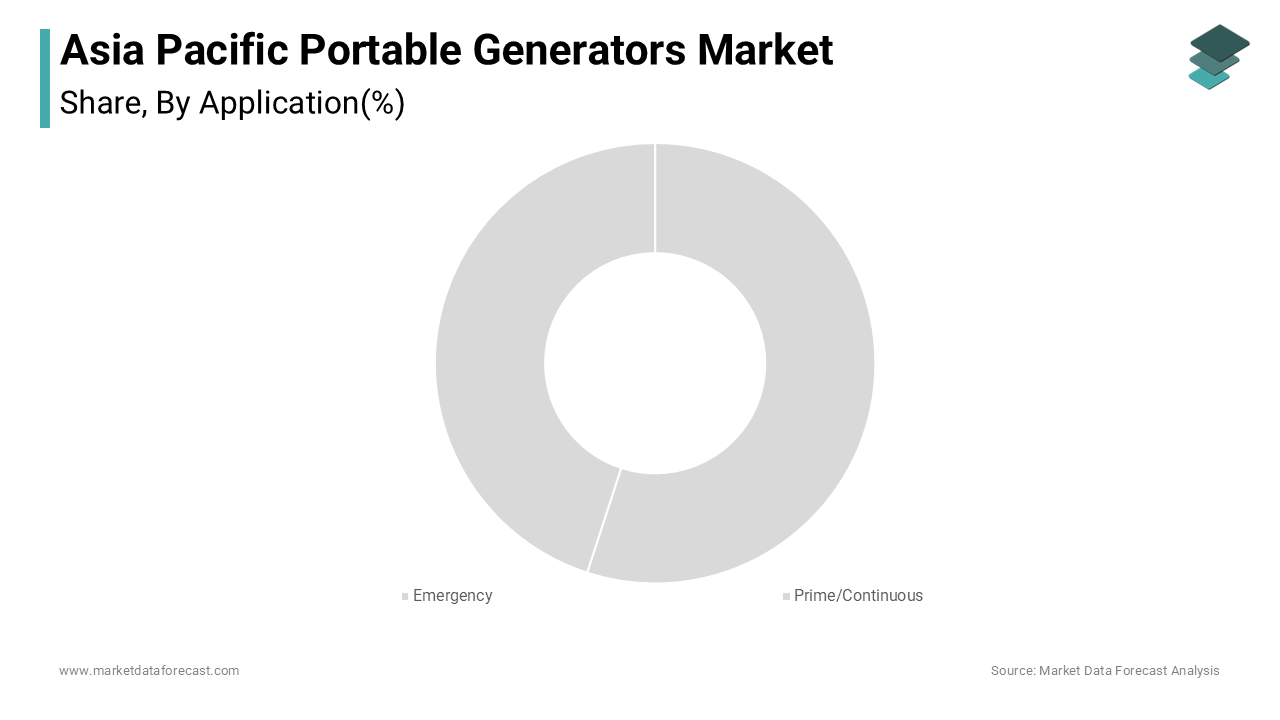
The prime/continuous application segment is projected to grow with a CAGR of 6.8% in the next coming years. Unlike emergency applications that cater to short-term power needs, prime/continuous use involves long-duration or continuous operation of portable generators in settings such as construction sites, mining operations, and manufacturing facilities where grid power is either insufficient or unavailable. In India, the Ministry of Housing and Urban Affairs reported that over 8,000 smart cities and industrial clusters are under development, all requiring reliable off-grid power support. Moreover, the manufacturing sector in China expanded by 6.2% in 2023, according to the National Bureau of Statistics, boosting the demand for continuous power supply systems. The agriculture sector in countries like Thailand and the Philippines also relies heavily on portable generators for irrigation and processing units in remote areas.
By Fuel Type Insights
The diesel-powered segment was the largest by capturing 58.1% of the Asia Pacific portable generators market share in 2024 due to the diesel’s high energy density, reliability, and widespread availability across both developed and developing economies in the region. Diesel generators are extensively used in industrial, commercial, and emergency applications where long runtime and robust performance are critical. According to the International Energy Agency (IEA), diesel consumption in the Asia Pacific region reached 6.2 million barrels per day in 2023, with a significant portion attributed to non-road applications including portable generators. In India, diesel remains the preferred fuel for large-scale construction and agricultural operations due to its efficiency and lower volatility compared to gasoline. The Indian Oil Corporation reported that diesel sales in the country grew by 5.4% in fiscal year 2023, indicating strong underlying demand across sectors. Moreover, diesel engines offer superior durability and require less frequent maintenance compared to gasoline models, making them ideal for heavy-duty and prolonged usage. As per the Japan Internal Combustion Engine Association, diesel generator sales in Japan accounted for over 70% of commercial portable power units in 2023.
The natural gas-powered segment is swiftly emerging with a projected CAGR of 7.4% from 2025 to 2033 with the increasing environmental awareness, government incentives for cleaner energy alternatives, and the expansion of natural gas infrastructure across key markets such as China, Australia, and South Korea. According to the International Gas Union (IGU), natural gas consumption in the Asia Pacific region rose by 6.9% in 2023, supported by investments in liquefied natural gas (LNG) terminals and distribution networks. In China, the National Development and Reform Commission has been actively promoting natural gas as a cleaner alternative to coal and diesel, offering subsidies for businesses adopting gas-based power solutions. Additionally, in Australia, the Department of Industry, Science, and Resources reported that renewable natural gas (RNG) production capacity expanded by 20% in 2023, supporting the shift toward low-emission power generation.
By Power Rating Insights
The below 5 kW power rating segment was the largest by accounting for 52.3% of the Asia Pacific portable generators market share in 2024. In countries like India and Indonesia, where grid instability persists in semi-urban and remote regions, households frequently rely on sub-5 kW generators for essential lighting, refrigeration, and mobile charging. According to the Central Electricity Authority (CEA), over 100 million Indians still face intermittent power supply issues, driving demand for compact, affordable generators. Similarly, in the Philippines, the Department of Energy reported that 40% of rural households use portable generators for daily activities, with most opting for models below 5 kW due to their affordability and ease of operation.
The 10–20 kW power rating segment is anticipated to witness a CAGR of 7.2% from 2025 to 2033. This power range offers sufficient capacity to support small-scale manufacturing units, construction equipment, retail outlets, and healthcare facilities without being overly bulky or expensive. Additionally, governments in the region are investing heavily in decentralized healthcare infrastructure, particularly in rural clinics and mobile medical units, which often rely on 10–20 kW generators for uninterrupted operations. In Indonesia, the Ministry of Health recorded a 14% increase in portable generator procurement for rural health centers in 2023 compared to the prior year. Moreover, the hospitality and tourism industries in countries like Thailand and the Philippines are adopting higher-capacity generators to ensure seamless service delivery in off-grid resorts and coastal properties.
REGIONAL ANALYSIS
India Portable Generators Market Insights
India portable generators market held 18.2% of the in 2024. The country's robust demand is driven by persistent grid instability, rapid industrialization, and expanding rural electrification programs. Despite significant improvements in national power infrastructure, the Central Electricity Authority (CEA) reported that India faced a peak power deficit of 3.7% in fiscal year 2023, particularly affecting states like Uttar Pradesh, Bihar, and West Bengal. Moreover, the Indian government's push for energy resilience through initiatives like the Deendayal Upadhyaya Gram Jyoti Yojana (DDUGJY) and the Pradhan Mantri Sahaj Bijli Har Ghar Yojana (Saubhagya) has further boosted market demand.
China Portable Generators Market Insights
China portable generators market was positioned second by holding 26.5% of the share in 2024. According to the National Bureau of Statistics of China, the country’s industrial output expanded by 6.2% year-on-year in the first quarter of 2023, reflecting strong activity in manufacturing, construction, and mining sectors that heavily rely on portable generators. The Ministry of Housing and Urban-Rural Development reported that over 10 billion square meters of new construction space was added in 2022, necessitating temporary and backup power sources at project sites. China is also a leading exporter of portable generators, with companies such as Cummins, Kohler, and local manufacturers dominating global supply chains. As per the China General Machinery Industry Association (CGMIA), generator exports grew by 8.5% in 2023, with a significant portion destined for Southeast Asia and Africa. Moreover, the government’s focus on disaster preparedness and emergency response has led to increased procurement of portable generators for public safety agencies.
Japan Portable Generators Market Insights
Japan portable generators market is likely to grow with highest CAGR in the next coming years. According to the Japan Meteorological Agency (JMA), the country recorded over 1,500 seismic events in 2023, including several magnitude-6+ quakes that triggered rolling blackouts. In response, Japanese households, businesses, and government institutions maintain a high level of readiness, with many opting for portable generators as essential backup power source.
COMPETITIVE LANDSCAPE
The competition in the Asia Pacific portable generators market is marked by the presence of both global leaders and strong regional manufacturers, creating a dynamic and fragmented landscape. Established international brands such as Honda, Cummins, and Yamaha coexist with local players who offer cost-effective alternatives, particularly in emerging economies. This diversity leads to intense rivalry centered around product differentiation, pricing strategies, and after-sales service excellence. Consumers benefit from a wide range of choices, from budget-friendly gasoline models to high-end diesel-powered units designed for industrial use. Innovation plays a critical role, with companies continuously introducing advanced features such as fuel efficiency, noise reduction, and hybrid compatibility to meet evolving consumer preferences. Additionally, the growing emphasis on sustainability has prompted manufacturers to shift toward cleaner technologies, further intensifying competition as firms strive to align with environmental regulations while maintaining performance standards.
KEY MARKET PLAYERS
Major companies operating in the Asia Pacific portable generators market include
- Honda Motor Co., Ltd.
- Yamaha Motor Co., Ltd.
- Generac Power Systems, Inc.
- Briggs & Stratton Corporation
- Cummins Inc.
- Kohler Co.
- Atlas Copco AB
- Hyundai Power Products
- Wacker Neuson SE
- Kirloskar Oil Engines Limited
Top Players in the Asia Pacific Portable Generators Market
One of the leading players in the Asia Pacific portable generators market is Honda Motor Co., Ltd. Known for its high-quality and fuel-efficient generator models, Honda has a strong presence across both residential and commercial segments. The company emphasizes technological innovation, offering inverter-based generators that are lightweight, quiet, and suitable for sensitive electronics. Its extensive distribution network and brand reputation for reliability make it a preferred choice among consumers in countries like Japan, India, and Australia.
Another major player is Cummins Inc., a global powerhouse in power generation solutions. Cummins has a diverse product portfolio catering to industrial, construction, and emergency backup applications. The company's focus on durable, high-performance diesel generators has earned it a strong foothold in markets such as China and Southeast Asia.
Yamaha Corporation is also a key contributor to the market, particularly in the consumer and small-scale commercial segments. Yamaha’s portable generators are known for their compact design, low noise levels, and integration with inverter technology. The company has successfully captured niche markets where portability and clean power output are essential in recreational and residential applications across developed Asia Pacific countries.
Top Strategies Used by Key Market Participants
Key players in the Asia Pacific portable generators market adopt several strategic approaches to maintain and enhance their competitive edge. One of the primary strategies is product innovation and technological advancement, where companies invest heavily in R&D to develop energy-efficient, low-emission, and smart-enabled generator models tailored for diverse applications.
Another crucial strategy is expanding regional presence through localized production and distribution networks by allowing companies to better serve regional demand, reduce logistics costs, and comply with local regulations. This includes setting up manufacturing units, service centers, and partnerships with local distributors.
The strategic mergers, acquisitions, and collaborations play a vital role in strengthening market position. Companies frequently engage in alliances with technology providers or acquire smaller firms to enhance product portfolios, access new customer bases, and accelerate growth in emerging markets within the Asia Pacific region.
RECENT MARKET DEVELOPMENTS
- In May 2023, Honda Motor Co., Ltd. launched a new line of ultra-quiet inverter generators specifically designed for urban residential and outdoor recreational use in the Asia Pacific region. This move aimed to strengthen its dominance in the consumer segment by addressing the rising demand for eco-friendly and noise-compliant power solutions.
- In August 2023, Cummins Inc. expanded its manufacturing facility in China to increase production capacity for industrial-grade portable generators, which is targeting rapid infrastructure growth in Southeast Asia and reinforcing its supply chain resilience in the region.
- In November 2023, Yamaha Corporation partnered with a renewable energy startup in India to integrate solar-compatible features into its portable generator models by enhancing product versatility and appealing to environmentally conscious consumers.
- In February 2024, Kirloskar Electric Company introduced a localized assembly unit in Indonesia to cater to growing rural electrification initiatives and improve after-sales service efficiency, thereby strengthening its regional footprint.
- In March 2024, Atlas Copco acquired a small but innovative portable generator manufacturer in South Korea to expand its product portfolio and gain access to advanced hybrid generator technologies by supporting its strategy to capture a larger share of the premium market segment.
MARKET SEGMENTATION
This research report on the Asia Pacific portable generators market is segmented and sub-segmented into the following categories.
By Application
- Emergency
- Prime/Continuous
By Fuel Type
- Gasoline
- Diesel
- Natural Gas
- Others
By Power Rating
- Below 5 kW
- 5 – 10 kW
- 10 – 20 kW
By Country
- India
- China
- Japan
- South Korea
- Australia
- New Zealand
- Thailand
- Malaysia
- Vietnam
- Philippines
- Indonesia
- Singapore
- Rest of APAC