- Product Description Description
- Table of Contents TOC
- List of Table & Figure LOT
- Get Free Sample PDF Sample PDF
Market Size, 2025
$6.55 BnMarket Estimate, 2026
$6.9 BnMarket Forecast, 2034
$10.52 BnCAGR, 2026–2034
5.41%Asia Pacific Positive Displacement Pumps Market Size
The Asia Pacific Positive Displacement Pumps Market size was valued at USD 6.55 billion in 2025 and is anticipated to reach USD 6.9 billion in 2026 from USD 10.52 billion by 2034, growing at a CAGR of 5.41% during the forecast period from 2026 to 2034.
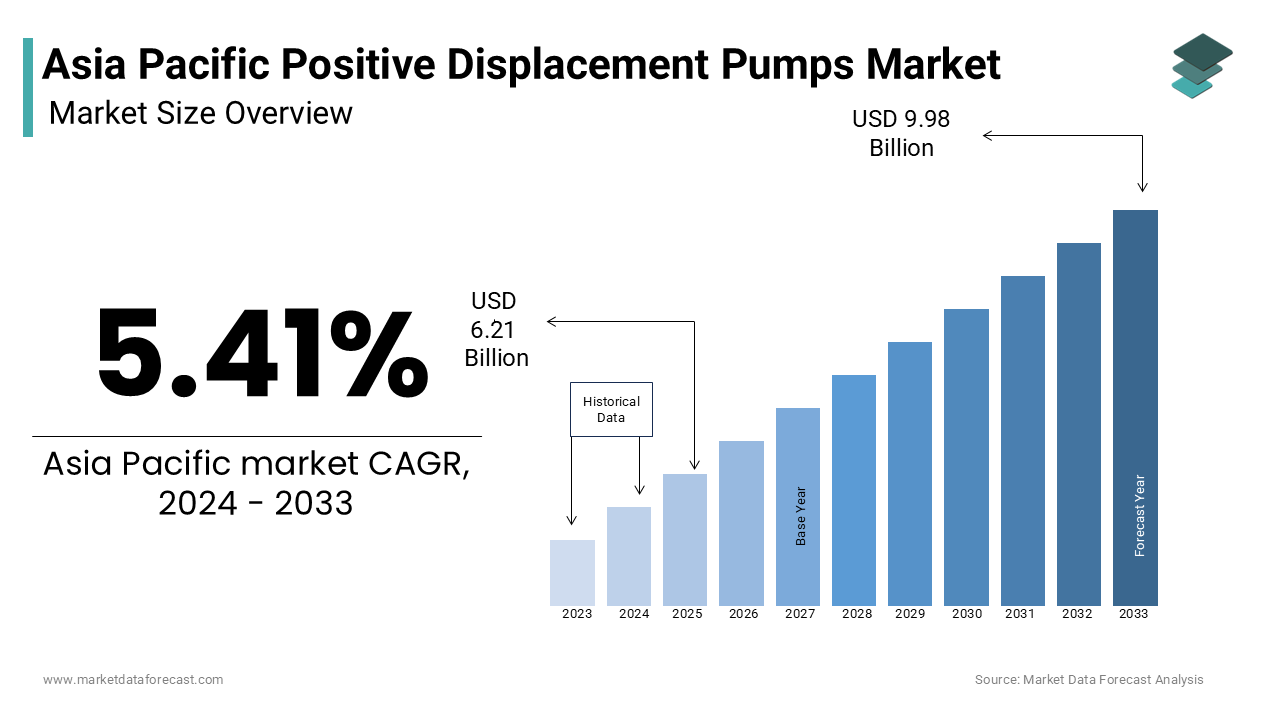
Positive displacement pumps are essential components in industrial fluid handling systems, known for their ability to move fluids by trapping a fixed amount and forcing it into a discharge pipe. These pumps are widely used across sectors such as oil & gas, chemical processing, food & beverage, pharmaceuticals, and water treatment due to their efficiency in handling viscous liquids, high-pressure applications, and precise metering requirements. In the Asia Pacific region, the demand for positive displacement pumps has been growing steadily, driven by expanding industrial infrastructure and increasing adoption of process automation. Like, industrial energy use in the region rose by notably annually between 2010 and 2022, showing the increasing reliance on energy-efficient pumping systems.
These trends underscore the strategic importance of positive displacement pumps in supporting the region’s industrial growth and process efficiency, making the Asia Pacific a critical market for pump manufacturers and system integrators alike.
MARKET DRIVERS
Expansion of the Chemical and Petrochemical Industries
The rapid expansion of the chemical and petrochemical industries is a primary driver fueling the growth of the positive displacement pumps market in the Asia Pacific. These sectors rely heavily on positive displacement pumps due to their ability to handle high-viscosity fluids, maintain consistent flow rates, and operate under extreme pressure conditions—key requirements in refining and chemical processing applications.
These pumps are particularly favored in applications involving resins, adhesives, and heavy oils, where precision and reliability are critical.
These materials require precise metering and high-pressure transfer, where positive displacement pumps play a crucial role. As the chemical and petrochemical industries continue to grow across the region, the demand for these specialized pumps is expected to remain strong.
Increasing Demand from the Food & Beverage Industry
The rising demand from the food & beverage sector is another significant driver of the positive displacement pumps market in the Asia Pacific. These pumps are widely used in this industry due to their ability to handle shear-sensitive and viscous products such as syrups, dairy, sauces, and edible oils without compromising product integrity. Their design ensures minimal turbulence and consistent flow, making them ideal for hygienic and high-viscosity applications.
Like, the Asia Pacific region accounted for a significant portion of global food processing. Companies such as Nestlé and Danone have expanded their production facilities in China, incorporating more rotary and lobe pumps to ensure product consistency and safety.
These units increasingly rely on diaphragm and peristaltic pumps for handling viscous liquids and semi-solids. Thus, the food & beverage industry remains a key growth engine for the positive displacement pumps market in the Asia Pacific because of consumer preferences shift toward processed and packaged foods.
MARKET RESTRAINTS
High Initial Investment and Maintenance Costs
A major restraint affecting the Asia Pacific positive displacement pumps market is the high initial investment and ongoing maintenance costs associated with these pumps. Compared to centrifugal pumps, positive displacement pumps often require more complex engineering, specialized materials, and advanced sealing mechanisms, which drive up procurement and installation expenses. This cost barrier is particularly challenging for small and medium-sized enterprises (SMEs) that form a significant portion of the industrial base in many Asia Pacific countries.
According to the Asian Development Bank, SMEs contribute to over 40% of GDP and 60% of employment in the Asia Pacific region. Moreover, maintenance costs can be significant due to the precision engineering and wear-prone components in positive displacement pumps. Also, maintenance and repair expenses for these pumps can 20-30% in challenging operating environments.
This economic reality hampers the widespread adoption of positive displacement pumps, particularly among smaller players, limiting overall market penetration.
Supply Chain Disruptions and Raw Material Shortages
The persistent issue of supply chain disruptions and raw material shortages is another critical restraint impacting the Asia Pacific positive displacement pumps market. The manufacturing of these pumps involves a range of critical materials such as stainless steel, cast iron, ceramics, and elastomers, which are sourced globally. Over the past few years, geopolitical tensions, pandemic-related shutdowns, and logistical bottlenecks have significantly affected the availability and pricing of these materials.
Like, lead times for industrial components such as precision bearings and high-grade alloys remained above 20 weeks. Furthermore, manufacturers faced delays in component deliveries from Southeast Asia due to prolonged port congestion and labour shortages.
These disruptions not only slow down production but also inflate costs, making it difficult for companies to meet rising demand efficiently. Therefore, project timelines are extended, and some potential buyers delay procurement, creating a ripple effect across the market.
MARKET OPPORTUNITIES
Growth in Renewable Energy and Green Industrial Applications
The growing integration of these pumps in renewable energy and green industrial applications is a significant opportunity emerging in the Asia Pacific positive displacement pumps market. With increasing emphasis on sustainability and carbon reduction, industries are shifting toward cleaner energy sources such as biofuels, hydrogen, and solar thermal systems, where positive displacement pumps play a crucial role in fluid handling and process optimization.
In India, as per the Ministry of New and Renewable Energy, the country’s biogas production capacity expanded in fiscal year 2023, with rotary and diaphragm pumps playing a key role in slurry transfer and digestion processes.
This shift toward green energy not only supports environmental goals but also presents a compelling growth avenue for the positive displacement pumps market.
Expansion of Smart Manufacturing and Industry 4.0 Initiatives
The rapid adoption of smart manufacturing and Industry 4.0 technologies across the Asia Pacific region is creating a significant opportunity for the positive displacement pumps market. As industries integrate digital monitoring, automation, and predictive maintenance systems, the demand for intelligent and high-precision pumping solutions is on the rise.
In Japan, robot density in Japanese manufacturing plants reached 419 robots per 10,000 employees in 2023, necessitating extensive deployment of intelligent pumping systems for coolant circulation, lubrication, and process fluid transfer.
This technological evolution is transforming traditional pump applications into data-driven, adaptive systems, offering a substantial growth opportunity for manufacturers of smart and high-performance positive displacement pumps across the Asia Pacific.
MARKET CHALLENGES
Cybersecurity Vulnerabilities in Smart Pumping Systems
The increasing risk of cybersecurity threats targeting smart pumping systems integrated with Industrial Internet of Things (IIoT) and digital monitoring platforms is a growing challenge confronting the Asia Pacific positive displacement pumps market. As pump manufacturers and industrial operators adopt connected systems for remote diagnostics, predictive maintenance, and real-time performance tracking, they expose themselves to potential cyber intrusions that can disrupt operations and compromise safety.
The lack of standardized security protocols in legacy pump control infrastructure makes these systems particularly susceptible to breaches.
Also, ransomware attacks on manufacturing facilities increased, with control systems serving as entry points for broader network infiltration. In one notable case, a chemical plant was forced to halt production temporarily after unauthorized access to its fluid transfer pump network disrupted process flows.
Besides, the growing use of wireless and cloud-connected pumping systems introduces further exposure to eavesdropping and data manipulation. Addressing these vulnerabilities requires significant investment in secure firmware updates, network segmentation, and intrusion detection systems, adding complexity and cost to pump deployment strategies.
Regulatory and Standardization Hurdles Across Diverse Markets
The Asia Pacific positive displacement pumps market faces considerable regulatory and standardization challenges due to the region’s vast diversity in compliance requirements, certification procedures, and technical specifications. Unlike the European Union or North America, where harmonized standards simplify cross-border trade, the Asia Pacific lacks a unified framework for industrial pump certifications, leading to fragmented market access conditions. The overlapping and sometimes conflicting regulations create compliance complexities for multinational pump vendors.
Furthermore, discrepancies in environmental and safety regulations complicate product design and localization efforts. The absence of a coordinated regulatory ecosystem hampers the seamless deployment of positive displacement pumps across borders, discouraging smaller firms from entering niche markets.
REPORT COVERAGE
| REPORT METRIC | DETAILS |
| Market Size Available | 2025 to 2034 |
| Base Year | 2025 |
| Forecast Period | 2026 to 2034 |
| CAGR | 5.41% |
| Segments Covered | By Product Type, Capacity, Pump Characteristics, End-Use and Country |
| Various Analyses Covered | Regional & Country Level Analysis, Segment-Level Analysis, DROC, PESTLE Analysis, Porter’s Five Forces Analysis, Competitive Landscape, Analyst Overview on Investment Opportunities |
| Countries Covered | India, China, Japan, South Korea, Australia, New Zealand, Thailand, Malaysia, Vietnam, the Philippines, Indonesia, Singapore, and the Rest of APAC. |
| Market Leaders Profiled | Grundfos, Flowserve Corporation, Sulzer Ltd., Xylem Inc., KSB SE & Co. KGaA, SPX Flow, Inc., ITT Inc., Ebara Corporation, Weir Group PLC, and Iwaki Co., Ltd. |
SEGMENTAL ANALYSIS
By Product Type Insights
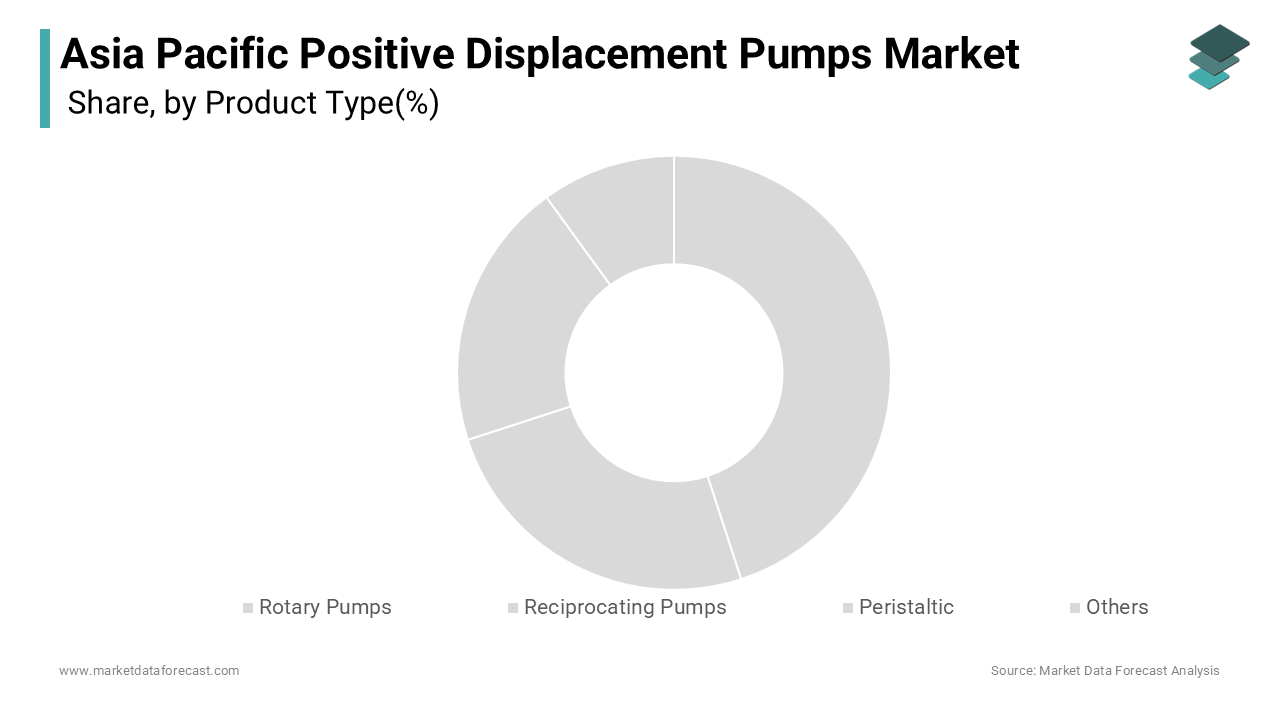
The rotary pumps segment dominated the Asia Pacific positive displacement pumps market by capturing 42.4% of total revenue in 2025. The expansion of the chemical and petrochemical industries, particularly in China and India is one key driver behind rotary pump dominance. This segment includes gear pumps, lobe pumps, and screw pumps, which are widely used across industries such as chemical processing, oil & gas, food & beverage, and pharmaceuticals due to their efficiency in handling high-viscosity fluids.
Like, the Asia Pacific region accounted for a significant share of global chemical industry, with rotary pumps being a preferred choice for transferring viscous materials like resins, crude oils, and polymers. In China, chemical production output grew in 2023, driving demand for reliable fluid transfer systems.
An additional significant factor is the growing adoption of rotary pumps in the food & beverage sector, where they are valued for maintaining product integrity during transfer processes. Apart from these, technological advancements in compact and hygienic rotary pump designs have expanded their use in pharmaceutical manufacturing.
The peristaltic pumps segment is projected to grow at the highest CAGR of 9.4% between 2026 and 2034 in the Asia Pacific positive displacement pumps market. The rising demand for sterile and contamination-free pumping solutions in the healthcare and life sciences sectors is a major growth driver. This rapid expansion is also driven by their increasing deployment in water treatment, biopharmaceuticals, and environmental monitoring applications, especially in countries like India, South Korea, and Australia.
In addition, the proportion of the population aged 65 and above in the Asia Pacific is expected to rise rapidly, necessitating greater reliance on medical devices equipped for drug delivery and dialysis. In Japan, the number of peristaltic pump-based infusion devices prescribed increased in 2023.
Furthermore, the adoption of peristaltic pumps in water and wastewater treatment facilities has surged due to their ability to handle abrasive and corrosive fluids without mechanical seals. Moreover, environmental regulations promoting clean water initiatives are boosting peristaltic pump usage across Southeast Asia. These trends reinforce the segment's robust growth trajectory, making peristaltic pumps one of the most dynamic categories in the regional market.
By Capacity Insights
The medium capacity pumps segment represented the prominent capacity in the Asia Pacific positive displacement pumps market by contributing 46.4% of total value in 2025. The increasing deployment of medium-capacity pumps in small-to-midsize manufacturing units, especially in emerging economies such as India, Indonesia, and Vietnam, is one of the primary drivers behind this segment’s dominance. These pumps typically operate within a flow range of 100–1,000 liters per minute, making them ideal for a wide array of industrial applications including chemical blending, food processing, and general-purpose fluid transfer.
According to the Asian Development Bank, SMEs contribute to over 45% of employment and 40% of GDP in many Asia Pacific economies, and these enterprises often require cost-effective, versatile pumping solutions that can adapt to multiple production lines.
Additionally, the growth of the food & beverage industry has significantly contributed to the demand for medium-capacity pumps. Furthermore, infrastructure development in urban areas is also fueling the need for medium-capacity pumps in municipal water distribution and sewage management. Thus, the medium capacity pumps segment continues to maintain its leading position in the regional market is due to the rising industrialization and expanding utility network.
The high capacity pumps segment is emerging as the fastest-growing in the Asia Pacific positive displacement pumps market and is recording a CAGR of 8.9% between 2026 and 2034. The surge of this segment is primarily driven by the expansion of large-scale industrial infrastructure, particularly in the oil & gas, mining, and power generation sectors across China, India, and Australia.
Like, Asia Pacific added over 150 GW of new industrial and power generation capacity in 2023, much of which required high-capacity pumping systems for cooling, lubrication, and fuel transfer. In addition, Indian government also brought to light that thermal power plant construction projects rose in fiscal year 2023. Further, Australia’s mining sector has also been a major contributor to the growth of this segment.
The demand for high-capacity pumps is expected to sustain its upward trend across the Asia Pacific because governments continue investing in energy and industrial mega-projects.
By Pump Characteristics
The standard pumps segment command under this category of the Asia Pacific positive displacement pumps market by accounting for 51.3% of share in 2025. Their extensive use in mid-sized manufacturing units, particularly in countries like Thailand, Malaysia, and the Philippines, is one of the main reasons for the dominance of standard pumps. These pumps are designed for general industrial applications and are widely used in sectors such as food processing, chemicals, and water treatment due to their reliability, ease of maintenance, and cost-effectiveness.
A further significant factor is the high replacement demand for aging pump infrastructure, especially in older industrial zones across Japan and South Korea.
Apart from these, the availability of standardized components and after-sales support makes standard pumps more accessible compared to customized or specialized variants. Hence, standard pumps continue to be the backbone of the Asia Pacific positive displacement pumps market owing to the steady industrial growth and a preference for cost-efficient solutions.
The engineered pumps segment is projected to register the highest CAGR of 9.1% between 2026 and 2034 in the Asia Pacific positive displacement pumps market. The growth of this segment is primarily attributed to the increasing demand for customized pump solutions in complex industrial applications, particularly in the chemical, pharmaceutical, and renewable energy sectors. Among the other the key drivers behind the rise of engineered pumps is the expansion of specialty chemical manufacturing, where precise control over fluid properties and process conditions is critical.
Further, major growth lever is the integration of engineered pumps in hydrogen and biofuel production plants, which require highly specialized fluid handling equipment.
Besides, the pharmaceutical industry’s shift toward precision manufacturing and continuous processing methods is boosting demand for engineered pumps capable of maintaining exact dosing and flow consistency. Therefore, engineered pumps are gaining prominence across high-value industrial sectors in the Asia Pacific owing to the growing emphasis on sustainability, customization, and process optimization.
REGIONAL ANALYSIS
China Positive Displacement Pumps Market Insights
China stood as the top contributor to the Asia Pacific positive displacement pumps market by holding a dominant 36.4% share in 2025. This lead position is underpinned by the country’s massive industrial base, rapid digital transformation, and aggressive push toward smart manufacturing and electrification. The Chinese government has been instrumental in fostering pump adoption through initiatives like “Made in China 2025” and the “14th Five-Year Plan”, which prioritize automation, robotics, and advanced fluid handling technologies. Also, the country’s oil & gas boom has created a substantial demand for high-pressure positive displacement pumps. Companies like Sinopec and CNPC are leading the charge, integrating sensor-enabled pump systems for real-time performance monitoring. Beyond traditional industries, the semiconductor and electronics manufacturing sectors remain major consumers of precision-engineered pumps. With continued investment in AIoT, smart cities, and industrial automation, China’s positive displacement pumps market is poised for sustained growth.
India Positive Displacement Pumps Market Insights
India is the fastest growing in the Asia Pacific positive displacement pumps market. The country’s market is being propelled by rapid industrialization, government-backed digitization efforts, and surging investments in infrastructure and clean energy. One of the primary drivers of pump adoption in India is the expansion of the renewable energy sector. Moreover, the Make in India initiative has catalyzed growth in domestic manufacturing, particularly in electronics and automotive segments. The smart city program is another major growth lever. So, India is rapidly evolving into a key player in the positive displacement pumps ecosystem across the Asia Pacific is because of rising investments in AI, IoT, and industrial automation.
Japan Positive Displacement Pumps Market Insights
Japan is known for its advanced manufacturing capabilities and early adoption of automation technologies, Japan continues to be a key market for high-performance and precision-engineered pumps. The country’s industrial robotics sector serves as a major driver of pump demand. Companies like Fanuc and Yaskawa Electric are embedding intelligent pump arrays into robotic arms to enhance flexibility and safety in production lines. Moreover, Japan’s aging population and focus on elderly care have spurred innovation in pump-based assistive technologies. The pharmaceutical industry, particularly in biologics and precision medicine, also contributes significantly to pump demand. Thus, Japan maintains a leading role in shaping the regional positive displacement pumps landscape due to a strong foundation in precision engineering and a commitment to Industry 4.0.
South Korea Positive Displacement Pumps Market Insights
South Korea is making it the fourth-largest contributor in 2023, The semiconductor industry remains a cornerstone of pump adoption in South Korea. In the automotive sector, South Korea is witnessing a surge in electric and autonomous vehicle development. Additionally, the government’s push for smart factories has accelerated pump integration in SMEs. South Korea’s technological prowess and strategic investments in next-generation industries ensure its continued prominence in the regional positive displacement pumps market.
Australia Positive Displacement Pumps Market Insights
Australia captures a modest but stable share of the Asia Pacific positive displacement pumps market. While not as large as other markets, Australia’s pump demand is characterized by high-value applications in mining, energy, and environmental monitoring. The mining industry is a key driver of pump deployment, given the country’s vast natural resource reserves and reliance on automation for safety and efficiency. Companies like Rio Tinto and BHP have invested heavily in automated haulage and drilling systems, which depend on high-pressure pumps for lubrication and cooling. The energy sector, particularly renewables, is another major growth area. Additionally, environmental monitoring initiatives are expanding pump usage in water treatment, air quality assessment, and agricultural irrigation. Despite its smaller size, Australia’s positive displacement pumps market is distinguished by high-tech applications and a focus on sustainability, positioning it as a steady performer in the regional landscape.
Top Players in the Asia Pacific Positive Displacement Pumps Market
One of the leading players in the Asia Pacific positive displacement pumps market is Sundyne Corporation. Known for its high-performance, sealless pumps and compressors, Sundyne serves critical industries such as oil & gas, chemical processing, and power generation. The company has a strong presence in the region through its distribution partnerships and localized service centers, enabling it to cater to the growing demand for reliable and energy-efficient pumping solutions tailored to harsh operating conditions.
Another key player is Colfax Corporation, a global leader in industrial technology with a strong foothold in the pump manufacturing sector through its subsidiary, Imo Pump Inc. Colfax has been actively expanding its product portfolio and service capabilities in the Asia Pacific to meet the evolving needs of process industries. The company emphasizes innovation, reliability, and customer-centric engineering, positioning itself as a preferred partner for high-duty applications across refineries and chemical plants.
The third major player is Flowserve Corporation, a global manufacturer of industrial pumps with a significant presence in the Asia Pacific region. Flowserve offers a wide range of positive displacement pumps designed for high-pressure and high-viscosity applications. The company’s strategic investments in localized manufacturing, digital solutions, and aftermarket services have reinforced its market position, particularly in sectors such as oil & gas, mining, and power generation.
Top Strategies Used by Key Market Participants
A primary strategy adopted by leading players in the Asia Pacific positive displacement pumps market is product innovation and customization. Companies are focusing on developing high-efficiency, durable, and application-specific pump solutions that meet the stringent requirements of industries such as chemicals, pharmaceuticals, and energy. This includes integrating advanced materials and digital monitoring capabilities to enhance performance and reduce downtime.
Another critical approach is expanding regional presence through localized manufacturing and distribution networks. Key players are establishing or expanding production facilities, service centers, and sales offices in emerging markets across the Asia Pacific to improve customer accessibility, reduce lead times, and comply with local regulatory standards. These efforts also support after-sales service and maintenance offerings, which are crucial for long-term customer relationships.
Lastly, strategic partnerships and collaborations with local distributors and engineering firms are being leveraged to strengthen market reach and technical support. By aligning with regional partners, global pump manufacturers can better understand local industry needs, accelerate product adoption, and enhance service delivery. These collaborative efforts also facilitate integration into large-scale infrastructure and industrial projects across the region.
KEY MARKET PLAYERS
Some of the key players in the Asia Pacific Positive Displacement Pumps Market include
- Grundfos
- Flowserve Corporation
- Sulzer Ltd.
- Xylem Inc.
- KSB SE & Co. KGaA
- SPX Flow, Inc.
- ITT Inc.
- Ebara Corporation
- Weir Group PLC
- Iwaki Co., Ltd.
COMPETITIVE LANDSCAPE
The competition in the Asia Pacific positive displacement pumps market is shaped by a mix of global multinational corporations and regionally strong players, all striving to capture market share through innovation, localized offerings, and strategic expansion. With rising industrialization and increasing demand for process efficiency across sectors such as oil & gas, chemicals, food & beverage, and pharmaceuticals, the market has become highly dynamic and competitive. Global players leverage their technological expertise, brand reputation, and extensive distribution networks, while domestic manufacturers capitalize on cost advantages and proximity to end-users.
The market is witnessing a growing emphasis on product differentiation, particularly in terms of energy efficiency, durability, and compatibility with Industry 4.0 technologies. Companies are investing in digital integration, predictive maintenance capabilities, and smart pump systems to meet evolving customer expectations. Additionally, the push toward sustainability and environmental compliance is influencing product development strategies, with manufacturers focusing on leak-proof designs, energy-saving models, and materials that reduce environmental impact.
As industrial infrastructure continues to expand across the region, competition is intensifying not only in terms of pricing but also in after-sales service, customization, and technical support. This environment fosters continuous innovation and adaptation, where agility, customer responsiveness, and strategic positioning determine long-term competitiveness.
RECENT MARKET DEVELOPMENTS
- In January 2025, Sundyne announced the launch of its next-generation magnetic drive pump, specifically designed for high-pressure and high-temperature applications in the Asia Pacific chemical and petrochemical industries. This product aims to enhance operational efficiency while reducing maintenance needs, reinforcing Sundyne’s position in demanding industrial environments.
- In March 2025, Colfax Corporation expanded its service center network in Southeast Asia, opening new technical support hubs in Thailand and Vietnam. This move supports faster response times, localized repairs, and improved customer service, strengthening Colfax’s ability to serve key industrial clients in the region.
- In June 2025, Flowserve partnered with a Singapore-based digital solutions provider to integrate predictive analytics into its pump monitoring systems, enhancing real-time diagnostics and maintenance planning for industrial clients across the Asia Pacific. This collaboration aligns with the broader trend of digital transformation in industrial fluid handling.
- In September 2025, Sundyne entered into a strategic distribution agreement with a leading Indian industrial equipment supplier, expanding its reach into the subcontinent’s growing process industries. This partnership enables Sundyne to better serve mid-sized manufacturers seeking high-performance pumping solutions.
- In December 2025, Colfax Corporation acquired a local pump engineering firm in South Korea, allowing it to enhance its customization capabilities and better serve the country’s semiconductor and electronics manufacturing sectors, which require precision fluid handling systems.
MARKET SEGMENTATION
This research report on the Asia Pacific Positive Displacement Pumps Market is segmented and sub-segmented into the following categories.
By Product Type
- Rotary Pumps
- Vane
- Screw
- Lobe
- Gear
- Progressing Cavity (PC)
- Others
- Reciprocating Pumps
- Piston
- Diaphragm
- Plunger
- Others
- Peristaltic
- Others
By Capacity
- Low Capacity Pumps
- Medium Capacity Pumps
- High Capacity Pumps
By Pump Characteristics
- Standard Pumps
- Engineered Pumps
- Special Purpose Pumps
By Raw Material
- Bronze
- Cast Iron
- Polycarbonate
- Stainless Steel
- Others
By End Use
- Oil and Gas
- Water and Wastewater
- Automotive
- Chemicals and Petrochemicals
- Others
By Country
- India
- China
- Japan
- South Korea
- Australia
- New Zealand
- Thailand
- Malaysia
- Vietnam
- Philippines
- Indonesia
- Singapore
- Rest of APAC