- Product Description Description
- Table of Contents TOC
- List of Table & Figure LOT
- Get Free Sample PDF Sample PDF
Market Size, 2025
$13918.89 MnMarket Estimate, 2026
$14644.09 MnMarket Forecast, 2034
$21984.55 MnCAGR, 2026–2034
5.21%Asia Pacific Pumps Market Size
The Asia Pacific pumps market size was valued at USD 13918.89 million in 2025 and is anticipated to reach USD 14644.09 million in 2026 from USD 21984.55 million by 2034, growing at a CAGR of 5.21% during the forecast period from 2026 to 2034.
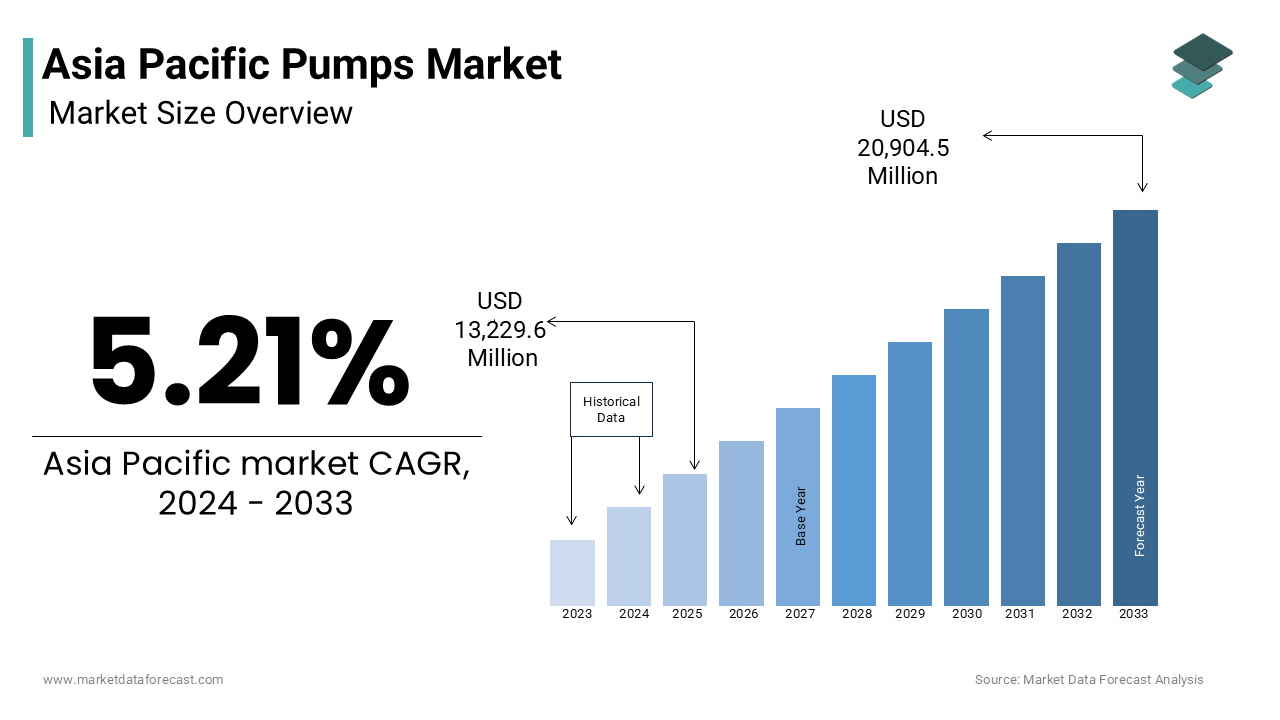
The pumps are components in fluid handling systems, facilitating the movement of liquids, gases, and slurries across diverse operational environments. In China, the Ministry of Housing and Urban-Rural Development reported that urban wastewater treatment capacity expanded by 12% in 2024. In Southeast Asia, ASEAN Economic Community efforts have enhanced cross-border infrastructure investments, supporting the growth of pump manufacturing and deployment.
MARKET DRIVERS
Expansion of Industrial and Manufacturing Sectors
The rapid expansion of industrial and manufacturing sectors in emerging economies such as India, Vietnam, and Indonesia is fuelling the growth of the Asia Pacific pumps market. According to the United Nations Industrial Development Organization (UNIDO), manufacturing value added in Asia increased by 5.8% in 2024, outpacing global averages. This industrial growth has heightened the demand for process pumps used in chemical, food and beverage, pharmaceutical, and textile industries. These developments require extensive pumping systems for water treatment, coolant circulation, and waste management. Similarly, in Vietnam, the General Statistics Office indicated that industrial output grew by 7.3% in 2024 in electronics and garment manufacturing, both of which rely heavily on fluid handling equipment.
Increasing Investment in Water and Wastewater Infrastructure
The increasing investment in water and wastewater infrastructure, which is driven by growing urbanization, government initiatives, and environmental concerns is escalating the growth of the Asia Pacific pumps market. In China, the Ministry of Water Resources reported that in 2024, over 200 new wastewater treatment plants were commissioned, requiring extensive use of centrifugal, submersible, and sludge handling pumps. The country’s 14th Five-Year Plan allocates significant funding for water infrastructure modernization, including flood control and water recycling projects. Similarly, in India, the Ministry of Jal Shakti stated that the Jal Jeevan Mission had provided piped water to over 120 million rural households by 2024, necessitating the deployment of millions of water supply pumps.
MARKET RESTRAINTS
High Maintenance and Operational Costs
The high maintenance and operational costs associated with industrial and municipal pumping systems is restricting the growth of the Asia Pacific pumps market. According to the International Energy Agency, pumps account for nearly 20% of global industrial electricity consumption, making energy efficiency a concern for operators. In Southeast Asia, the Department of Public Works and Highways in the Philippines noted that municipal water supply systems experienced frequent pump failures due to poor maintenance practices and lack of skilled technicians. These challenges are making it difficult for small and medium enterprises (SMEs) and municipal authorities to justify new pump investments without clear cost-saving mechanisms.
Regulatory and Environmental Compliance Pressures
The stringent regulatory and environmental compliance requirements are another significant restraint for the growth of the Asia Pacific pumps market. Governments across the region are implementing stricter emissions and energy efficiency standards to curb industrial pollution and promote sustainable water management. According to the United Nations Environment Programme, several Asian countries have adopted new energy performance standards for pumps under the broader framework of the Paris Agreement. In Japan, the Ministry of Economy, Trade and Industry has set ultra-low energy consumption benchmarks for municipal and industrial pumps, requiring manufacturers to invest in advanced engineering and materials. These regulatory pressures are increasing production costs and R&D expenditures for pump manufacturers, which is making it more challenging to maintain competitive pricing while complying with evolving environmental mandates.
MARKET OPPORTUNITIES
Growth of Smart and IoT-Enabled Pumping Systems
The increasing adoption of smart and IoT-enabled pumping systems presents a significant opportunity for the Asia Pacific pumps market. Manufacturers are integrating digital technologies such as remote monitoring, predictive maintenance, and real-time analytics into pump systems to enhance efficiency and reduce downtime. Similarly, in India, the Smart Cities Mission has prompted the deployment of intelligent water distribution systems with smart pumps that adjust flow rates based on demand. In South Korea, the Korea Institute of Industrial Technology noted that smart pump adoption in manufacturing and building automation systems grew by 18% in 2024.
Expansion of Renewable Energy and Green Infrastructure Projects
The expansion of renewable energy and green infrastructure projects is creating new growth opportunities for the Asia Pacific pumps market. Governments and private entities are investing in solar, wind, and hydroelectric power generation, all of which require specialized pumping systems for cooling, water management, and fluid transfer. According to the International Renewable Energy Agency, Asia accounted for over 60% of global renewable energy investments in 2024. In Southeast Asia, the ASEAN Centre for Energy noted that Vietnam and Indonesia are expanding their solar and biomass energy sectors, further driving demand for process and circulation pumps.
MARKET CHALLENGES
Supply Chain Disruptions and Component Shortages
The ongoing disruption in global supply chains and shortages of components such as motors, control modules, and bearings is likely to act as a great challenging factor for the growth of the Asia Pacific pumps market. The semiconductor shortage, which began in 2021, has continued to impact the production of smart and digitally integrated pump systems. According to the U.S. Chamber of Commerce’s 2024 supply chain report, 60% of pump manufacturers in Asia faced delays in sourcing microchips and electronic control units. As per the Maritime and Port Authority of Singapore, container dwell times at the port averaged 8 days in 2024, compared to the pre-pandemic average of 3 days.
Skilled Labor Shortage and Technical Expertise Gaps
The shortage of skilled labor and technical expertise required for pump installation, maintenance, and repair is also to hinder the growth of the Asia Pacific pumps market. According to the International Labour Organization, many countries in the region are experiencing a gap between industrial demand and the availability of trained engineers and technicians. In India, the National Skill Development Corporation reported that in 2024, only 5% of the workforce in the industrial equipment sector had formal training in pump system operations and maintenance. These workforce challenges are increasing labor costs, delaying project timelines, and limiting the ability of manufacturers and service providers to scale operations in response to market demand.
SEGMENTAL ANALYSIS
By Type Insights
The centrifugal pump segment was accounted in holding a dominant share of the Asia Pacific pumps market in 2025 with the growing investment in municipal water infrastructure. In China, the Ministry of Water Resources reported that in 2024, over 200 new wastewater treatment plants were commissioned, requiring extensive use of centrifugal pumps for fluid transfer and circulation.
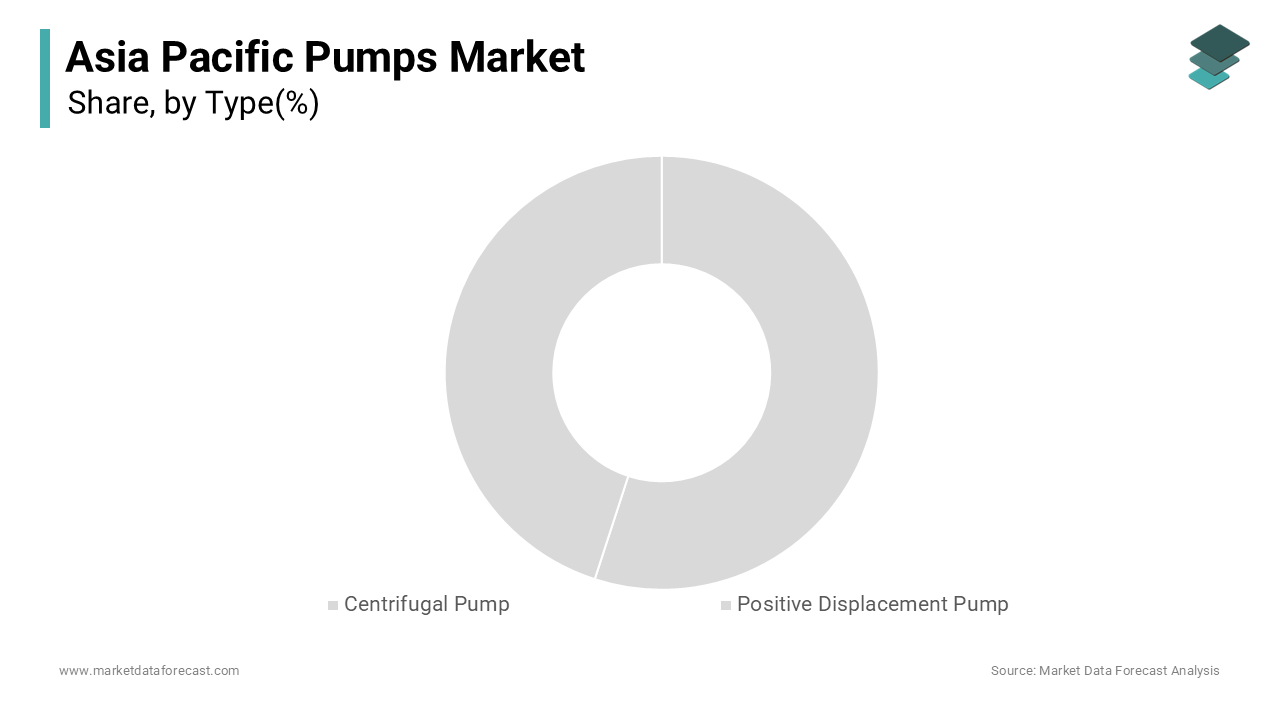
The positive displacement pump segment is projected to register CAGR of 7.4% from 2026 to 2034 with the rapid expansion is the rising investment in energy infrastructure, particularly in unconventional oil and gas production. According to the International Energy Agency, Asia’s oil and gas production increased by 5.2% in 2024, with countries like India and China investing in enhanced oil recovery techniques that require positive displacement pumps for efficient fluid transfer. In India, the Ministry of Petroleum and Natural Gas reported that crude oil production from onshore fields increased by 8% in 2024, necessitating the use of progressive cavity and reciprocating pumps for extraction and transport.
By End Use Insights
The water & wastewater segment dominated the Asia Pacific pumps market by capturing 35.3% of share in 2025 with the increasing investment in municipal water supply and wastewater treatment systems. Similarly, in India, the Jal Jeevan Mission has driven the installation of millions of water supply pumps, particularly in rural areas where access to clean water remains a challenge. In Southeast Asia, the ASEAN Secretariat noted that Indonesia and the Philippines are investing heavily in urban sanitation projects, with new pumping stations being built to manage stormwater and sewage. These infrastructure developments are significantly boosting the demand for water and wastewater pumping systems across the Asia Pacific region.
The industrial application segment is projected to grow with a CAGR of 7.9% from 2026 to 2034 with the increasing investment in industrial parks and special economic zones, particularly in India, Vietnam, and Indonesia. According to the United Nations Industrial Development Organization (UNIDO), manufacturing value added in Asia increased by 5.8% in 2024, outpacing global averages. In India, the Department for Promotion of Industry and Internal Trade reported that the manufacturing sector contributed over 17% to GDP in 2023, with new industrial parks and special economic zones being established across the country. These developments require extensive pumping systems for coolant circulation, process water management, and waste handling.
REGIONAL ANALYSIS
China Asia Pacific Pumps Market Analysis
China was the largest and held 37.4% of the Asia Pacific pumps market share in 2025 with the expansion of municipal and industrial water treatment systems. According to the Ministry of Water Resources, China commissioned over 200 new wastewater treatment plants in 2024, significantly boosting demand for both centrifugal and submersible pumps. Additionally, the Ministry of Housing and Urban-Rural Development reported that urban wastewater treatment capacity expanded by 12% in 2023, reinforcing the need for advanced pumping solutions. In the industrial sector, the National Energy Administration indicated that chemical and petrochemical industries expanded by 6.5% in 2023, further driving pump demand.
India Asia Pacific Pumps Market Analysis
India pumps market was next by capturing 22.3% of share in 2024 with the expansion of the Jal Jeevan Mission, which has driven the installation of millions of water supply pumps across rural India. Additionally, the Department for Promotion of Industry and Internal Trade reported that the manufacturing sector contributed over 17% to GDP in 2024, with new industrial parks and special economic zones being established across the country. These developments require extensive pumping systems for coolant circulation, process water management, and waste handling.
Japan Asia Pacific Pumps Market Analysis
Japan pumps market growth is likely to grow with the high pump penetration, technological innovation, and a strong emphasis on energy efficiency and reliability. The country’s aging infrastructure and the need for replacement and modernization of municipal and industrial pumping systems is additionally to grow in the next coming years. According to the Japan Pump Manufacturers Association, over 40% of existing municipal pumps in Japan are more than 25 years old, necessitating upgrades to improve efficiency and reduce downtime. Additionally, the Ministry of Economy, Trade and Industry reported that in 2024, investments in smart water management systems increased by 12%, with a focus on IoT-enabled pumps and real-time monitoring technologies. In the industrial sector, the Japan Machinery Federation noted that pump demand in the semiconductor and pharmaceutical industries grew by 6% in 2023.
South Korea Asia Pacific Pumps Market Analysis
South Korea pumps market growth is likely to grow with the high consumer demand for precision-engineered and energy-efficient pump systems, particularly in industrial and municipal applications. According to the Korea Institute of Industrial Technology, smart pump adoption in manufacturing and building automation systems grew by 18% in 2024. Additionally, the Ministry of Land, Infrastructure and Transport reported that investments in water recycling and desalination projects increased by 10% in 2023.
Indonesia Asia Pacific Pumps Market Analysis
Indonesia pumps market growth is driven by rapid urbanization, expanding manufacturing and mining sectors, and government investments in water and sanitation infrastructure. Additionally, the Ministry of Public Works and Housing reported that urban wastewater coverage increased by 15% in 2024, reinforcing the need for efficient pumping systems. In the industrial sector, the Indonesian Ministry of Industry noted that manufacturing output grew by 6.1% in 2023, particularly in food and beverage, textiles, and chemicals, all of which require extensive fluid handling systems.
KEY MARKET PLAYERS
Some of the key market players in the Asia Pacific pumps market include
- Grundfos Holding A/S (Denmark)
- Flowserve Corporation (U.S.)
- Sulzer Ltd. (Switzerland)
- KSB SE & Co. KGaA (Germany)
- Ebara Corporation (Japan)
- Xylem Inc. (U.S.)
- The Weir Group PLC (U.K.)
- ITT Inc. (U.S.)
- Wilo SE (Germany)
- SPX FLOW, Inc. (U.S.)
COMPETITIVE LANDSCAPE
The Asia Pacific pumps market is highly competitive, featuring a mix of global leaders, regional players, and local manufacturers vying for market share across diverse industrial and infrastructure sectors. Established multinational companies such as Grundfos, Ebara, and KSB maintain a strong presence due to their advanced technologies, extensive distribution networks, and long-standing relationships with government and industrial clients. At the same time, regional manufacturers and domestic brands are gaining traction by offering cost-effective, customized pump solutions tailored to local needs and regulatory environments.
Competition is intensifying as companies focus on differentiation through energy efficiency, digital integration, and after-sales service excellence. The increasing adoption of smart pumps and IoT-enabled systems is reshaping the market, with players investing in R&D to introduce innovative products that improve performance and sustainability. Additionally, the expansion of e-commerce and digital procurement platforms is changing how pumps are marketed and distributed, allowing manufacturers to reach new customer segments more efficiently.
Top Players in the Asia Pacific Pumps Market
Grundfos (Asia Pacific Operations)
Grundfos maintains a strong presence in the Asia Pacific pumps market, offering a comprehensive portfolio of water and industrial pumping solutions. The company is known for its energy-efficient and smart pump technologies, which cater to municipal, industrial, and commercial applications. Grundfos plays a key role in promoting sustainable water management and has been actively involved in large-scale infrastructure and water conservation projects across the region. Its commitment to innovation, customer-centric solutions, and digital integration has made it a preferred partner for governments and industries seeking reliable and future-ready pumping systems.
Ebara Corporation
Ebara Corporation is a leading player in the Asia Pacific pumps market, which is known for its high-performance centrifugal pumps used in water supply, wastewater treatment, and industrial applications. The company has a strong technological foundation and is recognized for its advanced R&D capabilities in fluid dynamics and materials engineering. Ebara’s extensive product lineup includes pumps designed for extreme conditions by making it a trusted name in sectors such as power generation, chemical processing, and marine engineering. Its long-standing reputation for reliability and performance has positioned it as a key contributor to both regional and global pump industry standards.
KSB SE & Co. KGaA (Asia Pacific Division)
KSB has a well-established presence in the Asia Pacific region, delivering high-quality industrial and infrastructure-focused pumping solutions. The company specializes in pumps and systems for power plants, water utilities, oil and gas, and building services. KSB’s commitment to energy efficiency, durability, and precision engineering has earned it a strong reputation across various sectors in the region. With localized service centers and strategic partnerships, KSB supports customers with tailored pump solutions and comprehensive after-sales support, which is reinforcing its position as a key global player in the pumps industry.
Top Strategies Used by Key Market Participants
One of the primary strategies employed by leading pump manufacturers in the Asia Pacific region is product innovation and digital integration. Companies are investing heavily in smart pump technologies that feature IoT connectivity, real-time monitoring, and predictive maintenance capabilities to enhance efficiency and reduce downtime.
Another key strategy is expanding regional presence through localized manufacturing and distribution networks. Major players are setting up production facilities, service centers, and partnerships in emerging markets to improve accessibility, reduce lead times, and cater to region-specific industrial and infrastructure needs.
The sustainability and energy efficiency initiatives are shaping strategic decisions. Manufacturers are developing high-efficiency pumps, adopting eco-friendly materials, and aligning with international standards to meet growing regulatory requirements and consumer demand for greener solutions across Asia Pacific.
RECENT MARKET DEVELOPMENTS
- In January 2024, Grundfos launched a new line of IoT-enabled water circulation pumps in China, designed for smart building and municipal water applications by enhancing its digital footprint in the region.
- In March 2024, Ebara Corporation expanded its manufacturing facility in India to increase production capacity for industrial and wastewater pumps, which is supporting the country’s growing infrastructure and sanitation initiatives.
- In May 2024, KSB partnered with a leading Southeast Asian engineering firm to provide customized pump solutions for new power generation and desalination projects, which is strengthening its presence in the industrial and water sectors.
- In August 2024, a major Japanese pump manufacturer introduced a localized service center in Indonesia to improve after-sales support and reduce maintenance downtime for municipal and industrial clients.
- In October 2024, Wilo Group launched a new energy-efficient pump series in South Korea tailored for commercial building automation by aligning with the country’s green infrastructure development goals.
MARKET SEGMENTATION
This research report on the Asia Pacific Pumps Market is segmented and sub-segmented into the following categories.
By Type
- Centrifugal Pump
- Positive Displacement Pump
By End-Use
- Agriculture
- Water & Wastewater
- Infrastructure Application
- Mining
- Industrial Application
By Country
- India
- China
- Japan
- South Korea
- Australia
- New Zealand
- Thailand
- Malaysia
- Vietnam
- Philippines
- Indonesia
- Singapore
- Rest of APAC