- Product Description Description
- Table of Contents TOC
- List of Table & Figure LOT
- Get Free Sample PDF Sample PDF
Market Size, 2025
$12.84 BnMarket Estimate, 2026
$13.86 BnMarket Forecast, 2034
$25.50 BnCAGR, 2026–2034
7.92%Executive Summary: Asia Pacific Pre-Harvest Equipment Market
- Market Scope: Comprehensive regional pre-harvest equipment market analysis covering primary/secondary tillage, planting, irrigation, plant protection, and fertilizing tools, alongside smallholder mechanization frameworks and precision ag tech integration.
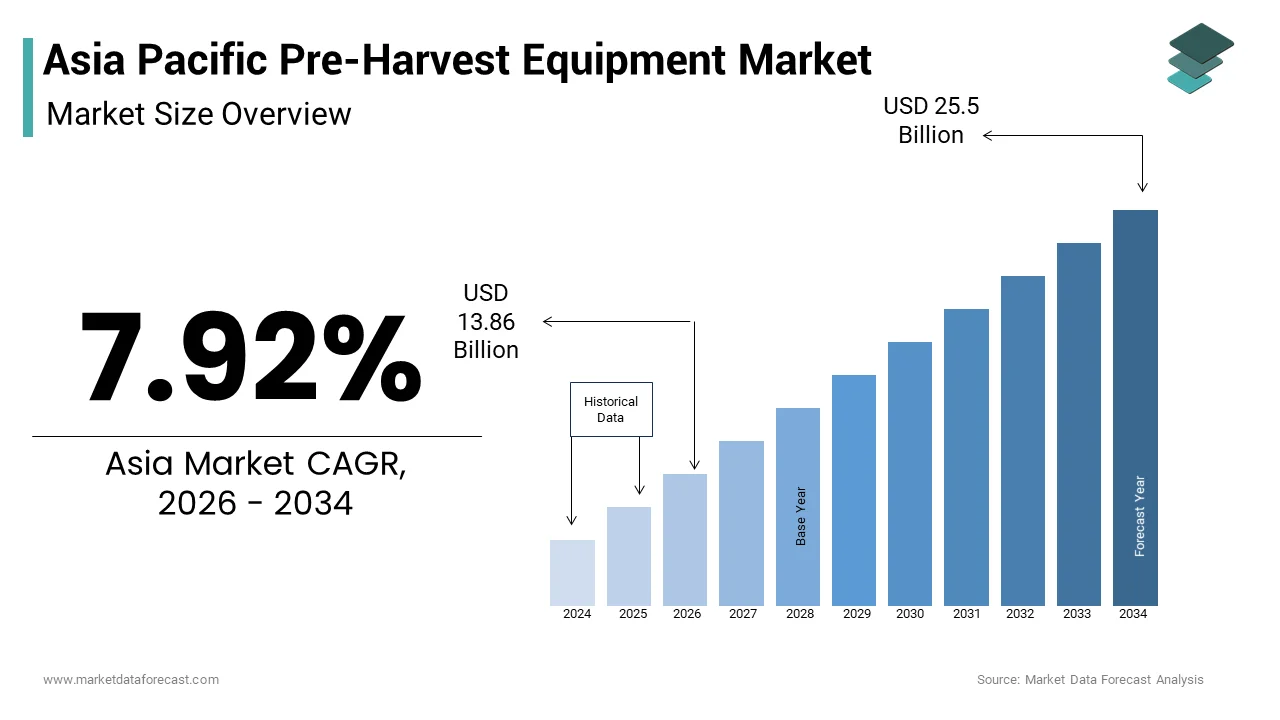
- Market Valuation: Valued at USD 12.84 billion (2025), estimated at USD 13.86 billion (2026), and projected to reach USD 25.50 billion by 2034, registering a strong CAGR of 7.92% (2026–2034).
- Primary Growth Drivers: Increasing government initiatives and financial subsidies for agricultural mechanization (such as India's SMAM scheme), rising labor shortages and escalating farm wages across rural Asia, and the growing demand for sustainable, resource-efficient farming practices.
Key Market Segment Metrics (2026–2034)
| Category | Leading Segment (2025 Position) | Fastest-Growing Segment (2026–2034) |
|---|---|---|
| By Type | Planting Equipment (captured 26.4% share in 2025, driven by seed drills, planters, and government-backed sowing modernization programs) | Irrigation Equipment (projected to grow at a CAGR of 8.9% due to intensifying water scarcity, droughts, and micro-irrigation adoption) |
| By Country | India (top performer accounting for 28.3% market share in 2025, driven by rural economies and supportive mechanization subsidies) | Vietnam and Indonesia (experiencing rapid growth due to expanding export agribusinesses, rice mechanization, and government pilot projects) |
Major Market Players & Market Structure
Market Structure: Highly competitive landscape characterized by global machinery leaders and regional manufacturing brands. Differentiation centers around product localization for smallholders, strategic financing partnerships, digital integration (GPS guidance, IoT monitoring), and robust after-sales support networks.
Key Companies: Deere & Company (John Deere), Kubota Corporation, AGCO Corporation, CNH Global, Mahindra & Mahindra Ltd., Valmont Industries Inc., Iseki & Company Ltd., and Yanmar Co., Ltd.
 Download Free Sample Report
Asia Pacific Pre-Harvest Equipment Market Size
The Asia Pacific pre-harvest Equipment market size was valued at USD 12.84 billion in 2025 and is anticipated to reach USD 13.86 billion in 2026 and USD 25.5 billion by 2034, growing at a CAGR of 7.92% from 2026 to 2034.
The pre-Harvest Equipment, such as seeders, planters, sprayers, cultivators, irrigation systems, and soil preparation tools, enhances efficiency, productivity, and yield quality during the growing phase of crops. In the Asia-Pacific region, agriculture remains a critical economic pillar, which employs a large portion of the population across countries like India, China, Indonesia, Vietnam, and Thailand. As per the Food and Agriculture Organization (FAO), over 40% of the labor force in Asia is engaged in agriculture, which shows the significance of modernizing farming practices through mechanization. Precision sowing, efficient nutrient application, pest control, and water management are all made possible by pre-harvest technology and are and are essential components of high-yield, sustainable agriculture. In recent years, governments in several APAC countries have launched initiatives to promote farm mechanization among smallholder farmers who constitute the majority of the agricultural base.
MARKET DRIVERS
Increasing Government Initiatives for Agricultural Mechanization
Growing regional government support for agricultural mechanization is one of the key factors driving the Asia Pacific pre-harvest equipment market. Many APAC nations are implementing policies and subsidies to encourage farmers to adopt modern machinery, particularly in regions where manual labor dominates and productivity remains low. For instance, the Indian government has been actively supporting farm mechanization through schemes like the Sub-Mission on Agricultural Mechanization (SMAM), which provides financial assistance to farmers for purchasing pre-harvest equipment such as power tillers, seed drills, and transplanters. According to the Ministry of Agriculture and Farmers Welfare, over 1.5 million farm machines were distributed under this scheme between 2020 and 2023, which significantly boosted adoption rates. Similarly, in China, the Ministry of Agriculture and Rural Affairs has introduced targeted subsidies for small and marginal farmers to access affordable machinery, which leads to increased mechanization levels even in remote areas.
Rising Labor Shortages and Increasing Farm Wages
The increasing lack of agricultural labor and corresponding rise in wages, which forces farmers to look for mechanical alternatives, is another major factor driving the Asia Pacific pre-harvest equipment market. Younger generations are leaving behind an elderly rural workforce in many regions of Asia as they migrate to metropolitan areas in search of better career possibilities. According to the International Labour Organization (ILO), rural labor participation in Southeast Asia declined by approximately 12% over the past decade, with fewer youth willing to engage in labor-intensive farming activities. This trend is particularly pronounced in countries like Thailand, Malaysia, and the Philippines, where labor shortages have led to unmet demand during planting and crop maintenance seasons. In response, farmers are increasingly investing in pre-harvest equipment to compensate for the lack of manpower. Additionally, rising minimum wages in rural areas, especially in India and Indonesia, have further incentivized the shift toward mechanization. As per a 2024 study by the International Fund for Agricultural Development (IFAD), the average daily wage for farm labor in India rose by 18% since 2020, which shows the economic viability of adopting pre-harvest machinery.
MARKET RESTRAINTS
High Initial Investment Cost of Advanced Equipment
The huge initial investment needed to purchase complex and technologically advanced equipment is a constraint affecting the Asia Pacific pre-harvest equipment market. Small-scale farmers, who control the majority of the agricultural land in many APAC nations, are unable to afford the modern equipment. Moreover, imported machinery from global manufacturers often comes with higher price tags compared to locally manufactured alternatives, which limits accessibility. According to the survey by the Indian Council of Agricultural Research (ICAR), only 35% of surveyed farmers could afford mid-range tractors or seed drills without external financial support, which shows the affordability challenge. Additionally, the lack of after-sales service and spare parts availability in rural areas further discourages investment.
Limited Awareness and Technical Expertise Among Farmers
The lack of technical knowledge and awareness among farmers about the advantages and appropriate use of modern agricultural equipment is another significant restraint affecting the Asia Pacific pre-harvest equipment market. Adoption of pre-harvest technologies is still inconsistent despite their availability because of a lack of education and training, especially in rural and remote areas. According to a 2024 report by the Food and Agriculture Organization (FAO), nearly 60% of smallholder farmers in Southeast Asia lack formal training on operating advanced farm machinery, which results in uncertainty and a hesitancy to purchase new equipment. Traditional farming techniques are still widely used, and many farmers believe that modern equipment is either unnecessary or hard to maintain. According to field research carried out in India by the National Institute of Agricultural Extension Management (MANAGE), less than 40% of interviewed farmers had received any form of demonstration or guidance on using mechanized seeding or spraying equipment.
MARKET OPPORTUNITIES
Expansion of Smart and Precision Farming Technologies
The increasing integration of precision and smart farming technology into agricultural operations is an important opportunity for influencing the Asia Pacific pre-harvest equipment market. Innovations such as GPS-guided tractors, automated seeders, drone-based spraying systems, and IoT-enabled soil monitoring devices are transforming how farmers manage pre-harvest activities. According to the Asia-Pacific Association of Agricultural Research Institutions (APAARI), precision agriculture adoption in the region has increased by more than 25% over the past five years, which is driven by government-backed digital farming initiatives and private-sector investments. Countries like Japan, South Korea, and Australia are leading in integrating automation and data analytics into farming, while emerging economies like India and Indonesia are rapidly catching up. In Japan, for example, autonomous tractors and AI-powered planting systems are being deployed to address labor shortages and optimize resource use. As per the Ministry of Agriculture, Forestry and Fisheries (MAFF), over 30% of Japanese farms now utilize some form of precision technology, which includes automated seed drills and variable-rate fertilizer applicators. The use of smart pre-harvest equipment is anticipated to increase throughout Asia-Pacific due to rising internet penetration, agritech services based on mobile apps, and easier access to financing alternatives.
Growing Demand for Sustainable and Resource-Efficient Farming Practices
Expanding demand for sustainable and resource-efficient farming practices presents a strong growth opportunity for the Asia Pacific Pre-Harvest Equipment Market. Pre-harvest machinery is needed for conservation agriculture, zero-tillage farming, and effective nutrient management, which are becoming more and more popular as concerns about climate change, water shortages, and soil degradation increase. According to the International Water Management Institute (IWMI), rice cultivation alone accounts for more than 40% of freshwater withdrawals in Asia, which prompts the need for water-saving techniques such as direct-seeded rice. In recent years, DSR use has increased dramatically in Bangladesh and India due to government incentives and research organizations. In addition, organizations like the International Rice Research Institute (IRRI) have been promoting mechanical transplanters and drum seeders that reduce water usage and labor requirements while maintaining high yields. According to IRRI's 2023 impact assessment, the Philippines' adoption of mechanical transplanters has resulted in a 25% reduction in water use and a 30% reduction in labor expenses, which shows the equipment's observable advantages.
MARKET CHALLENGES
Lack of Infrastructure and After-Sales Support in Rural Areas
Lack of infrastructure and after-sales support in rural farming communities are the major challenges faced by the Asia Pacific Pre-Harvest Equipment Market. Effective deployment and maintenance are hampered by inadequate service centers, restricted electrical supplies, and poor road connections, even if the use of advanced technology is increasing. According to the World Bank’s 2023 Rural Infrastructure Assessment Report, more than 40% of rural roads in South Asia are unpaved, which makes it challenging to carry heavy machinery and increases wear and tear. Additionally, in many parts of Southeast Asia, unreliable power supply limits the use of electric-powered or digitally integrated equipment, which forces farmers to rely on older, less efficient models. Another pressing issue is the shortage of trained technicians and the availability of spare parts in remote locations.
Fragmented Supply Chain and Dependence on Imported Components
A complex supply chain and reliance on imported components provide challenges for the Asia Pacific pre-harvest equipment market, which includes cost structures, manufacturing schedules, and market response. Many manufacturers depend on overseas suppliers for critical parts such as engines, sensors, and electronic controls, exposing them to trade disruptions and currency fluctuations. According to the United Nations Economic and Social Commission for Asia and the Pacific (UNESCAP), nearly 70% of agricultural machinery manufacturers in Southeast Asia source at least 40% of their components internationally from China, Japan, and South Korea. This dependency increases vulnerability to geopolitical tensions, shipping delays, and fluctuating import tariffs. Moreover, the lack of standardized manufacturing practices across different countries leads to inefficiencies in product development and quality control.
REPORT COVERAGE
| REPORT METRIC | DETAILS |
| Market Size Available | 2025 to 2034 |
| Base Year | 2025 |
| Forecast Period | 2026 to 2034 |
| CAGR | 7.92% |
| Segments Covered | By Type and Region. |
| Various Analyses Covered | Global, Regional and Country Level Analysis, Segment-Level Analysis, DROC, PESTLE Analysis, Porter’s Five Forces Analysis, Competitive Landscape, Analyst Overview of Investment Opportunities |
| Regions Covered | India, China, Japan, South Korea, Australia, New Zealand, Thailand, Malaysia, Vietnam, Philippines, Indonesia, Singapore, and the Rest of APAC |
| Market Leaders Profiled | Deere & Company (U.S.), CNH Global (The Netherlands), AGCO Corp (U.S.), and other market players are Mahindra & Mahindra Ltd (India), Valmont Industries Inc.(U.S.), Iseki & Company Ltd(Japan), etc. Deere & Company. |
SEGMENTAL ANALYSIS
By Type Insights
The planting equipment segment led the market by capturing a 26.4% in the Asia Pacific Pre-Harvest Equipment Market in 2025. This segment includes a wide array of machinery, such as seed drills, planters, and air seeders, that are crucial for efficient crop establishment. One of the key drivers behind its dominance is the increasing focus on improving sowing efficiency and reducing seed wastage through mechanized planting solutions. Additionally, government-backed agricultural modernization programs have prioritized the adoption of planting equipment in countries like India and China, where smallholder farming is prevalent. As per the Indian Ministry of Agriculture, over 1 million seed drills were distributed under farm mechanization schemes between 2020 and 2023, which indicates strong policy support. Furthermore, shifting labor dynamics and rising wage costs have accelerated the transition from manual transplanting and broadcasting to mechanical planting methods. In Southeast Asia, rice mechanization initiatives have led to increased adoption of direct seeding and mechanical transplanters, which shows the crucial role of planting equipment in the regional pre-harvest market.
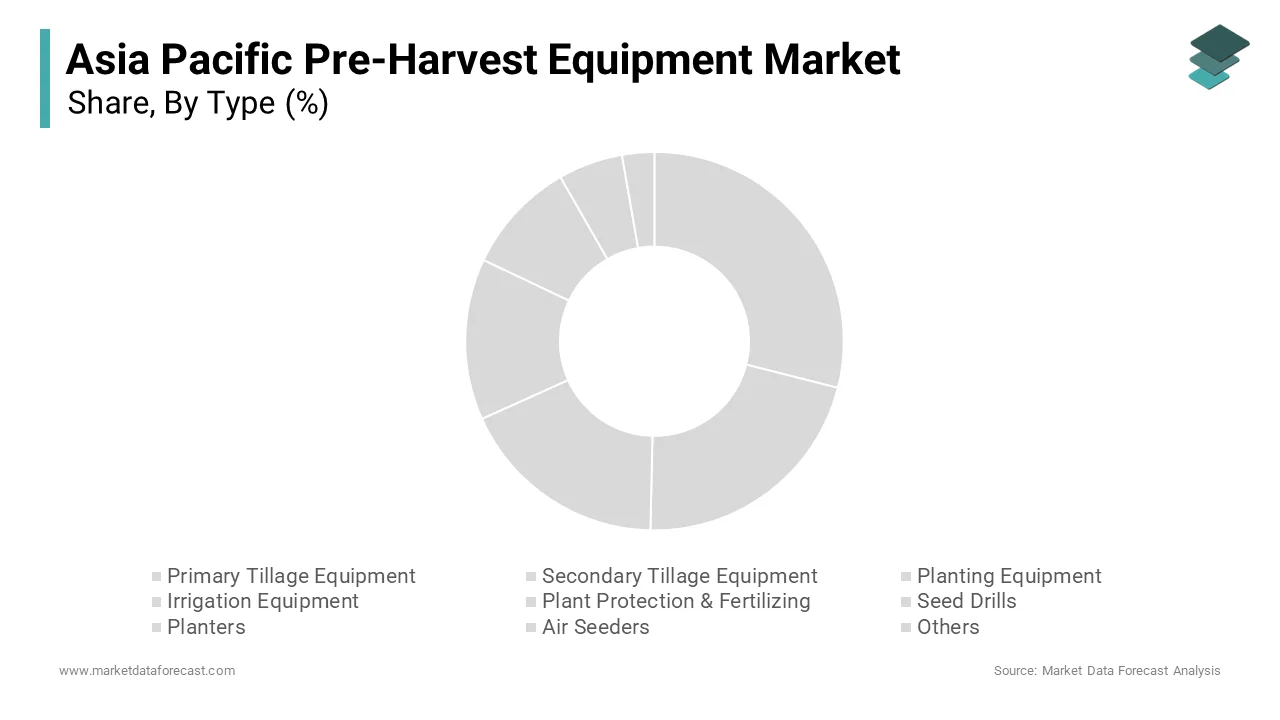
The irrigation equipment segment is estimated to register a CAGR of 8.9% during the forecast period, owing to the urgent need for water-efficient farming practices across the Asia-Pacific region. Farmers are spending more on sprinkler systems, drip irrigation, and smart irrigation controllers as a result of climate change's worsening effects on drought and depletion of freshwater supplies. A major growth factor is the growing adoption of micro-irrigation technologies, especially in water-intensive crops like rice, cotton, and sugarcane. According to the International Water Management Institute (IWMI), drip irrigation systems can reduce water usage by up to 50% while increasing crop yields by 20–40%, which makes them an attractive investment for both small and large-scale farmers. In addition, governments in countries like India, Thailand, and Vietnam are offering subsidies and financial incentives to promote sustainable irrigation solutions. According to the National Bank for Agriculture and Rural Development (NABARD), with the help of extension services and advantageous lending programs, India's micro-irrigation coverage increased by more than 1.2 million hectares between 2021 and 2023. Additionally, real-time soil moisture tracking and automatic irrigation scheduling are made possible by integration with IoT-based monitoring systems, which improves resource optimization.
COUNTRY-LEVEL ANALYSIS
India
India was the top performer in the Asia Pacific Pre-Harvest Equipment Market in 2025 by accounting for 28.3% of the share 2025. India, the region's largest producer of agricultural products, is a major factor in the need for modern pre-harvest technology due to its extensive rural economy and significant dependence on farming. The Sub-Mission on Agricultural Mechanization (SMAM) has played a pivotal role in distributing subsidized equipment to small and marginal farmers. According to the Ministry of Agriculture and Farmers Welfare, over 1.5 million machines were subsidized between 2020 and 2023, which includes seed drills, power tillers, and sprayers. Additionally, rising labor shortages due to urban migration and increasing farm wages have further incentivized the shift from manual to mechanized operations. According to the Indian Council of Agricultural Research (ICAR), labor expenses in Indian agriculture have increased by over 18% since 2020, which supports the idea that pre-harvest equipment adoption is economically viable.
China
China was positioned second with 22.7% of the Asia Pacific pre-harvest equipment market share in 2025. China continues to make significant investments in advanced pre-harvest technology to ensure food security for its enormous population, even though its agricultural system is more automated than that of other APAC countries. A key growth driver is the country’s strategic focus on smart and digital agriculture. According to the Chinese Academy of Agricultural Sciences, mechanization levels in major grain-producing provinces have surpassed 85%, with planting and fertilizing equipment seeing rapid uptake. In addition, rural income growth and consolidation of land holdings have enabled more farmers to afford modern machinery. China has a strong local manufacturing environment and significant R&D investments, which will allow it to continue leading the Asia-Pacific area in agricultural mechanization.
Vietnam
Vietnam's pre-harvest equipment market is likely to grow with gaining huge traction during the forecast period. Vietnam offers outstanding possibilities despite its smaller scale when compared to China and India. These opportunities are fueled by developing export-oriented agribusinesses, increased rice agriculture, and increasing government support for mechanization. According to the Ministry of Agriculture and Rural Development (MARD), the adoption of mechanical transplanters and drum seeders increased by 20% in 2023, which is supported by training programs and localized manufacturing partnerships. Simultaneously, the private sector is playing an increasing role in promoting sustainable farming practices. Local farmers now have access to reliable and affordably priced equipment due to the expansion of distribution networks by companies like Yanmar and Kubota.
Indonesia
Indonesia's vast agricultural land, diverse cropping patterns, and increasing focus on food self-sufficiency show an abundance of opportunity that will enhance the growth of the Asia Pacific pre-harvest equipment market. The Indonesian Ministry of Agriculture has launched several pilot projects to introduce mechanized planting and weeding tools in rural areas, which aim to increase yield efficiency and reduce reliance on manual labor. As per the Center for Agricultural Technology Dissemination (Pusdatin), mechanization rates in rice fields increased by 15% between 2021 and 2023, which is driven by targeted interventions and farmer education programs. Additionally, rising rural incomes and increasing collaboration with international equipment manufacturers are facilitating broader access to modern tools.
Philippines
The Philippines' pre-harvest equipment market is likely to have steady growth throughout the forecast period, with the gradual transformation in farming practices in rice and corn production. A key growth factor is the implementation of the Rice Competitiveness Enhancement Program (RCEP), which provides financial assistance to farmers for purchasing modern agricultural machinery. According to the Department of Agriculture (DA), over 100,000 pieces of farm equipment were distributed under this program in 2023 alone, which includes seeders, transplanters, and rotary tillers. Moreover, increasing vulnerability to climate-related disruptions has spurred interest in resilient and efficient farming technologies.
KEY MARKET PLAYERS
Deere & Company (U.S.), CNH Global (The Netherlands), AGCO Corp (U.S.), and other market players are Mahindra & Mahindra Ltd (India), Valmont Industries Inc.(U.S.), Iseki & Company Ltd(Japan), etc. Deere & Company is the market player that is dominating the Asia Pacific Pre-Harvest Equipment Market.
Top Players In The Market
John Deere
John Deere is a global leader in agricultural machinery and plays a pivotal role in shaping the pre-harvest equipment market in the Asia-Pacific region. This company is well-known for producing high-performing and long-lasting agricultural equipment, and it provides a wide selection of planting, tillage, and irrigation options that are suited to various farming environments. John Deere’s strong R&D focus and commitment to sustainable agriculture have reinforced its market presence and contributed to advancements in smart farming technologies across the region.
Kubota Corporation
Kubota is a dominant player in the Asia-Pacific market, particularly in Southeast Asia and Japan, where it has a deep-rooted distribution network and localized product development strategies. The company provides a wide array of pre-harvest machinery designed for small to medium-scale farms by making it accessible to a large base of farmers. Kubota’s focus on fuel-efficient, compact, and easy-to-maintain equipment has made it a preferred brand among rural communities.
AGCO Corporation
AGCO is recognized for its innovative and technologically advanced pre-harvest equipment, including planters, seed drills, and precision farming tools. The company has been actively expanding its presence in the Asia-Pacific region by forming strategic partnerships and enhancing after-sales support. AGCO’s focus on digital integration and sustainability aligns with evolving agricultural practices, which makes them a key contributor to the modernization of farming systems in emerging markets.
Top Strategies Used by Key Market Participants
Localization of Product Design and Manufacturing
Leading players are designing their equipment to suit local farming conditions, soil types, and crop patterns across different APAC countries. Companies enhance affordability and usability by setting up regional manufacturing units and adapting product features to meet smallholder needs, which encourages adoption in rural regions.
Strategic Partnerships with Governments and Financial Institutions
Government agencies and banks are working with large manufacturers to provide subsidized equipment and financing alternatives to increase accessibility for small-scale farmers. These partnerships help reduce financial barriers and encourage widespread mechanization, especially in developing economies.
Digital Integration and Smart Farming Solutions
Companies are increasingly incorporating GPS guidance, IoT-based monitoring, and automated control systems into pre-harvest equipment. This shift toward precision agriculture not only enhances productivity but also supports resource efficiency, which aligns with broader sustainability goals and attracts tech-savvy younger generations to farming.
COMPETITION OVERVIEW
The competition in the Asia Pacific Pre-Harvest Equipment Market is characterized by a mix of global giants and regional manufacturers striving to capture market share through innovation, localization, and customer-centric service models. Established players like John Deere, Kubota, and AGCO dominate due to their strong brand reputation, extensive distribution networks, and continuous investment in research and development. However, the rise of domestic brands offering cost-effective alternatives has introduced new dynamics, particularly in price-sensitive markets such as India and Indonesia. The market remains highly fragmented with vendors competing not only on technological superiority but also on ease of operation, durability, and post-purchase support. Strategic acquisitions, collaborative research initiatives, and targeted marketing campaigns are shaping the market's evolution. Additionally, rising focus on climate-resilient farming and water-efficient technologies is redefining competitive positioning. The competitive environment is predicted to become more intense as governments continue to push for agricultural modernization and private sector investments increase.
RECENT HAPPENINGS IN THE MARKET
- In January 2024, John Deere launched an updated line of compact tractors and seed drills specifically designed for smallholder farmers in Southeast Asia, which aims to increase adoption rates in rural and underserved markets.
- In March 2024, Kubota Corporation entered into a joint venture with a leading Indian agricultural finance provider to introduce flexible leasing options for farmers purchasing Kubota’s pre-harvest machinery.
- In June 2024, AGCO Corporation announced the expansion of its precision planting technology portfolio in Australia with the introduction of GPS-enabled seeders designed for large-scale grain farming operations.
- In September 2024, Yanmar Co., Ltd. unveiled a new series of solar-powered irrigation pumps integrated with smart control systems aimed at environmentally conscious farmers across the Philippines and Vietnam.
- In November 2024, a Chinese agricultural machinery manufacturer partnered with a Japanese electronics firm to develop AI-driven soil analysis tools that integrate with existing pre-harvest equipment, which marks a significant step toward intelligent farming ecosystems in the Asia-Pacific region.
MARKET SEGMENTATION
This research report on the Asia-Pacific pre-harvest equipment market is segmented and sub-segmented into the following categories.
By Type
- Primary Tillage Equipment
- Secondary Tillage Equipment
- Planting Equipment
- Irrigation Equipment
- Plant Protection & Fertilizing
- Seed Drills
- Planters
- Air Seeders
- Others
By Country
- India
- China
- Japan
- South Korea
- Australia
- New Zealand
- Thailand
- Malaysia
- Vietnam
- Philippines
- Indonesia
- Singapore
- Rest of APAC