- Product Description Description
- Table of Contents TOC
- List of Table & Figure LOT
- Get Free Sample PDF Sample PDF
Market Size, 2025
$1.41 BnMarket Estimate, 2026
$1.48 BnMarket Forecast, 2034
$2.19 BnCAGR, 2026–2034
5.01%Executive Summary: Asia Pacific Reciprocating Air Compressor Market
- Market Scope: Comprehensive Asia Pacific reciprocating air compressor market analysis covering mechanism types, lubrication variants, manufacturing application segments, regional country leadership frameworks, and industrial compressed air standards across the region.
- Market Valuation: Valued at USD 1.41 billion (2025), estimated at USD 1.48 billion (2026), and projected to reach USD 2.19 billion by 2034, registering a steady CAGR of 5.01% (2026–2034).
- Primary Growth Drivers: Rapid industrialization across emerging economies, significant investments in manufacturing infrastructure, and rising demand from the oil and gas, automotive, and construction sectors. Key industry trends include increasing adoption of energy-efficient models to comply with environmental regulations, expansion of small-scale industries requiring cost-effective solutions, and durability enhancements in single-acting compressors.
Key Market Segment Metrics (2026–2034)
| Category | Leading Segment (2025 Position) | Fastest-Growing Segment |
|---|---|---|
| By Mechanism & Lubrication | Single-acting segment (dominated due to cost-effectiveness and intermittent operations); Oil-filled lubrication (largest share) | Double-acting segment (gaining traction for high-pressure use) and oil-free segment (growing significantly due to food/pharma hygiene standards) |
| By Application & Industry | Manufacturing application segment (accounted for 38.1% of the market share in 2025) | Oil and gas, automotive, and construction sectors requiring heavy-duty compressed air infrastructure |
| By Technology & Efficiency | Standard reciprocating compressor systems, conventional valves, and standard cooling designs | Energy-efficient models, advanced oil-free variants, and optimized units for mining operations |
| By Region / Country | China (led the market with a 34.2% share in 2025, followed by India at 18.2%, Japan, South Korea, and Australia) | Rapidly growing manufacturing and industrial automation hubs across emerging Asia Pacific economies |
Major Market Players & Market Structure
Market Structure: Highly competitive Asia Pacific compressed air equipment landscape driven by specialized product launches (such as Kirloskar Pneumatic’s oil-free reciprocating compressors for pharma), localized joint ventures, and energy-optimized mining partnerships.
Key Companies: Atlas Copco, Ingersoll Rand, Kirloskar Pneumatic Company Limited, Cook Compression, Chart Industries, Frank Compressors, Galaxy Auto Service Equipment Co., Ltd., IDEX Corporation, General Electric Company, and KAESER KOMPRESSOREN.
Asia Pacific Reciprocating Air Compressor Market Size
The Asia Pacific reciprocating air compressor market was valued at USD 1.41 billion in 2025 and is anticipated to reach a valuation of USD 1.48 billion in 2026 and USD 2.19 billion by 2034, growing at a CAGR of 5.01%, from 2026 to 2034.
A reciprocating air compressor is a type of positive displacement machine that uses pistons driven by a crankshaft to deliver compressed air at high pressure. These compressors are widely used in industrial, automotive, construction, and energy sectors due to their ability to generate high-pressure output and operate efficiently under varying load conditions.
MARKET DRIVERS
Growth of Manufacturing and Industrial Sectors Across Emerging Economies
One of the primary drivers fueling the Asia Pacific reciprocating air compressor market is the expansion of manufacturing and industrial activities, particularly in emerging economies such as India, Indonesia, and Vietnam. These countries are experiencing a surge in foreign direct investment (FDI) and domestic capital expenditure aimed at enhancing production capacities and automating processes. According to the United Nations Industrial Development Organization (UNIDO), the value of manufacturing output in Southeast Asia grew by nearly 7% in 2023, with Vietnam and Thailand leading the way. This industrial resurgence has resulted in heightened demand for reliable compressed air systems, especially in metalworking, textile, food processing, and automotive component manufacturing sectors, where reciprocating compressors are extensively deployed.
Moreover, governments in these regions are actively promoting industrial parks and special economic zones (SEZs) to attract global manufacturers. As per the Department of Industrial Policy and Promotion (DIPP) in India, over 40 new industrial clusters were established in 2023 alone, each requiring robust compressed air infrastructure for operational efficiency.
Rising Demand from Oil & Gas and Energy Infrastructure Projects
Another significant driver contributing to the growth of the Asia Pacific reciprocating air compressor market is the increasing number of oil & gas exploration and energy infrastructure projects across the region. Reciprocating compressors play a crucial role in upstream, midstream, and downstream operations, including natural gas transportation, refining, and pipeline maintenance. As per the International Energy Agency (IEA), China and India collectively accounted for over 60% of global energy demand growth in 2023, prompting substantial investments in fossil fuel extraction and renewable energy integration. In Australia, the country's liquefied natural gas (LNG) export boom has led to an uptick in compressor installations at processing plants. The Australian Petroleum Production & Exploration Association (APPEA) reported that new gas field developments in Western Australia and Queensland required extensive use of reciprocating compressors for both drilling support and plant operations.
MARKET RESTRAINTS
Preference Shift Toward Rotary Screw Compressors in Continuous Operation Applications
A major restraint affecting the growth of the Asia Pacific reciprocating air compressor market is the increasing preference for rotary screw compressors in continuous operation environments. Unlike reciprocating compressors, which are better suited for intermittent use, rotary screw models offer higher efficiency, lower maintenance requirements, and smoother operation over long periods, which are making them more suitable for large-scale manufacturing and process industries. According to the European Committee for Fluid Power (ECFP), rotary compressors now account for over 70% of the industrial air compressor market in developed Asian economies like Japan and South Korea, where automation and 24/7 production lines dominate. Furthermore, as per the Indian Society of Compressing Equipment Manufacturers (ISCEM), many Tier-1 and Tier-2 suppliers in the automotive industry have transitioned to rotary screw systems due to their reliability and reduced downtime. This shift has limited the penetration of reciprocating compressors in certain high-volume production settings.
Regulatory Pressure for Energy Efficiency and Emission Reductions
Another critical constraint impacting the Asia Pacific reciprocating air compressor market is the tightening of regulatory norms concerning energy efficiency and carbon emissions. Governments across the region are increasingly enforcing compliance with international standards such as ISO 50001 and ASME’s energy management guidelines, which are pushing industries to adopt more sustainable and efficient equipment. For example, as per the Ministry of Economy, Trade and Industry (METI) in Japan, all new industrial compressors must meet minimum efficiency performance standards (MEPS) by 2025, which reciprocating models often struggle to achieve without costly modifications. In India, the Bureau of Energy Efficiency (BEE) introduced star labeling for industrial compressors, influencing purchasing decisions toward more efficient types.
MARKET OPPORTUNITIES
Expansion of Small-Scale Industries and Workshops Requiring Cost-Effective Solutions
A promising opportunity for the Asia Pacific reciprocating air compressor market lies in the proliferation of small-scale industries, repair shops, and localized manufacturing units that require affordable and durable compressed air solutions. These businesses typically operate on tight budgets and do not need the high continuous-flow capacity provided by rotary screw compressors, making reciprocating models an ideal fit. According to the International Labour Organization (ILO), micro, small, and medium enterprises (MSMEs) in Southeast Asia have grown by nearly 8% annually over the past five years, with Indonesia, the Philippines, and Vietnam witnessing the highest increases. Many of these enterprises engage in welding, paint spraying, and pneumatic tool use, all of which rely heavily on reciprocating compressors. Additionally, as per the Federation of Indian Chambers of Commerce & Industry (FICCI), approximately 65% of MSMEs in India still prefer reciprocating compressors due to their lower initial cost and ease of maintenance compared to more complex rotary systems.
Growing Use in Maintenance and Field Service Applications
Another emerging opportunity for reciprocating air compressors in the Asia Pacific region is their increasing deployment in maintenance, repair, and field service operations. These compressors are well-suited for mobile and temporary applications due to their portability, rugged design, and adaptability to diverse working conditions. In Japan, the Ministry of Land, Infrastructure, Transport and Tourism emphasized the importance of regular railway maintenance, leading to increased procurement of lightweight, diesel-powered reciprocating compressors for trackside servicing. Similarly, in Australia, mining and construction firms frequently deploy reciprocating compressors for on-site tool operation and equipment servicing in harsh environments.
MARKET CHALLENGES
Technological Limitations and Higher Maintenance Requirements
One of the key challenges facing the Asia Pacific reciprocating air compressor market is the inherent technological limitations associated with these machines, particularly in terms of efficiency, noise levels, wear, and tear. Compared to newer rotary screw and centrifugal models, which is reciprocating compressors tend to be less energy-efficient, produce more vibration, and require frequent maintenance due to the mechanical stress placed on components like valves, piston rings, and connecting rods. According to the Japan Society of Mechanical Engineers (JSME), reciprocating compressors consume up to 15–20% more energy than equivalent rotary models when operated continuously by making them less attractive to large-scale industrial users seeking to reduce operational costs. Additionally, as per the Indian Society of Compressing Equipment Manufacturers (ISCEM), small workshop owners often lack access to trained technicians capable of performing timely maintenance, which is leading to premature failures and downtime.
Supply Chain Disruptions and Component Shortages
Another pressing challenge affecting the Asia Pacific reciprocating air compressor market is the ongoing volatility in global supply chains, particularly concerning critical components such as precision-engineered valves, bearings, and control systems. Many manufacturers in the region rely on imported raw materials and sub-assemblies, exposing them to delays and cost fluctuations caused by geopolitical tensions, trade restrictions, and logistics bottlenecks. Furthermore, as per the Korea International Trade Association (KITA), rising freight costs and container shortages during the first half of 2023 delayed shipments of key components from Europe and North America, forcing some companies to scale back production.
REPORT COVERAGE
| REPORT METRIC | DETAILS |
| Market Size Available | 2025 to 2034 |
| Base Year | 2025 |
| Forecast Period | 2026 to 2034 |
| CAGR | 5.01% |
| Segments Covered | By Technology, Lubrication, Application, And Region. |
| Various Analyses Covered | Global, Regional, and Country-Level Analysis, Segment-Level Analysis, DROC, PESTLE Analysis, Porter’s Five Forces Analysis, Competitive Landscape, Analyst Overview of Investment Opportunities |
| Regions Covered | India, China, Japan, South Korea, Australia, New Zealand, Thailand, Malaysia, Vietnam, Philippines, Indonesia, Singapore, and the Rest of APAC |
| Market Leaders Profiled | Cook Compression, Chart Industries, Frank Compressors, Galaxy Auto Service Equipment Co., Ltd, IDEX Corporation, General Electric Company, Ingersoll Rand, KAESER KOMPRESSOREN, MAT Holding, Inc., Gardner Denver, ELGi, Sollant Group, Atlas Copco AB, BAUER GROUP. |
SEGMENTAL ANALYSIS
By Technology Insights
The single-acting segment accounted for a dominant share of the Asia Pacific reciprocating air compressor market in 2025. A key factor behind this dominance is the cost-effectiveness and simplicity of design associated with single-acting compressors. These machines are ideal for intermittent operations such as tire inflation, pneumatic tool operation, and paint spraying activities commonly found in repair shops, construction sites, and light manufacturing units. Additionally, governments across Southeast Asia have been promoting micro-enterprise development through credit schemes and infrastructure support.
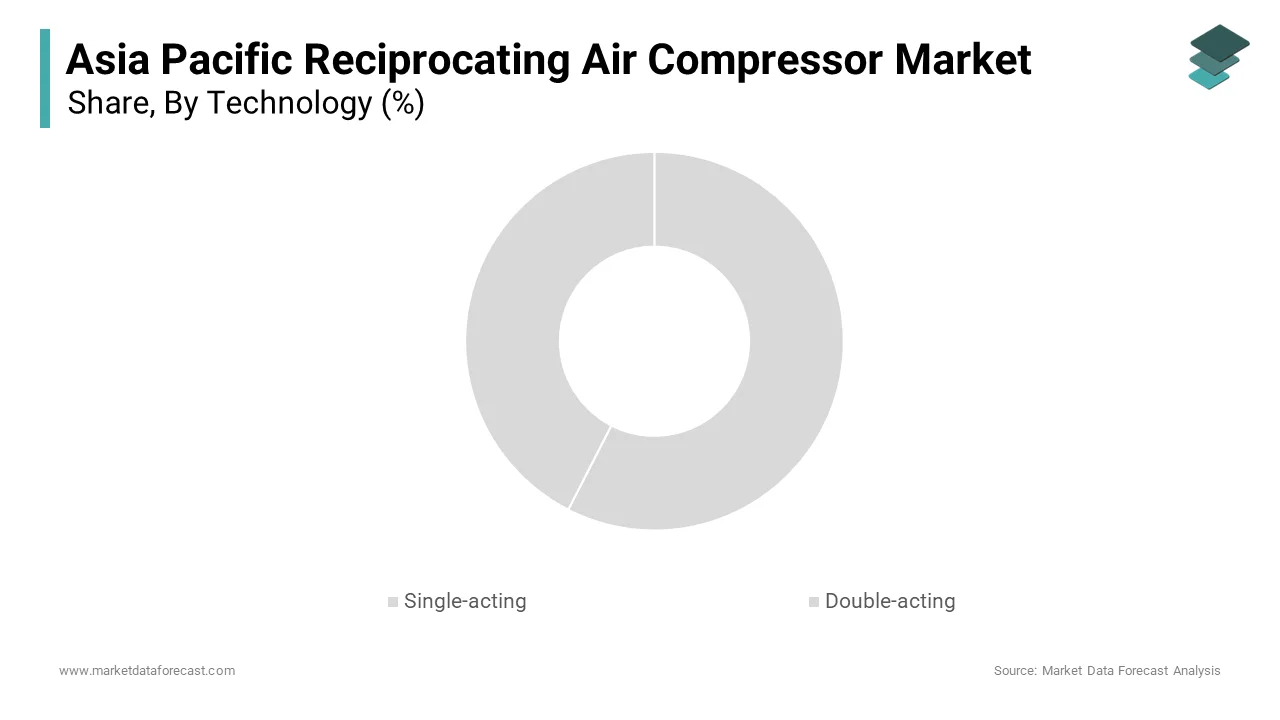
The double-acting segment is more likely to gain a CAGR of 5.8% from 2025 to 2033 with the rising deployment of double-acting compressors in oil & gas and chemical processing facilities. Unlike single-acting models, these compressors deliver compressed air on both the upward and downward strokes of the piston, making them more efficient and suitable for heavy-duty applications. According to the International Energy Agency (IEA), China and India collectively accounted for over 60% of global energy demand growth in 2023, prompting investments in upstream and midstream compressor installations.
By Lubrication Insights
The oil-filled segment held a prominent share of the Asia Pacific reciprocating air compressors market in 2025. The growth of the segment is attributed to be driven by the superior cooling and lubrication properties offered by oil-based systems. These compressors operate more efficiently under continuous load conditions, reducing wear and extending service life. As per the China General Machinery Industry Association, nearly 75% of automotive component manufacturers in China rely on oil-filled compressors for metal stamping, painting, and assembly line operations. Moreover, the Indian Society of Compressing Equipment Manufacturers (ISCEM) noted that oil-lubricated models remain the preferred choice for textile mills, food processing plants, and pharmaceutical facilities due to their ability to handle high-pressure demands without overheating. Additionally, government initiatives aimed at boosting domestic manufacturing capabilities, such as India's Production-Linked Incentive (PLI) scheme and China’s Made in China 2025 program, have further reinforced the adoption of oil-filled compressors across large-scale production environments.
The oil-free segment is more likely to grow with an expected CAGR of 6.4% throughout the forecast period, driven by the rising demand from the healthcare and pharmaceutical sectors, where even trace amounts of oil can compromise product quality. According to the Japan Pharmaceutical Manufacturers Association (JPMA), nearly 90% of new drug manufacturing facilities built in Japan in 2023 incorporated oil-free compressors to ensure sterile production environments. Additionally, the food and beverage industry is increasingly adopting oil-free compressors to prevent contamination risks in packaging, bottling, and ingredient handling processes.
By Application Insights
The manufacturing sector accounted in holding 38.1% of the Asia Pacific reciprocating air compressor market share in 2025, with the widespread use of compressed air in production lines, particularly in metalworking, electronics assembly, textile weaving, and automotive part fabrication. As per the China General Machinery Industry Association, over 80% of industrial enterprises in China rely on reciprocating compressors for operations ranging from paint spraying to CNC machine actuation. Moreover, in Vietnam and Indonesia, export-oriented manufacturing hubs have expanded rapidly, with garment, footwear, and electronics plants incorporating compressed air systems for automation and tooling applications.
The oil & gas sector is projected to expand at a CAGR of 7.1% from 2025 to 2033, with the increasing reliance on compressed air for pipeline purging, valve actuation, and drilling support operations. According to the International Energy Agency (IEA), China and India together accounted for over 60% of global energy demand growth in 2023, prompting significant investments in LNG terminals, offshore rigs, and gas transmission networks. Additionally, in Malaysia and Indonesia, state-owned oil companies launched several deep-sea exploration projects, each requiring robust air compression systems for subsea equipment testing and pressure regulation.
COUNTRY-LEVEL ANALYSIS
China Reciprocating Air Compressor Market Analysis
China was the top performer in the Asia Pacific reciprocating air compressor market, with 34.2% of the share in 2025, with the country’s strategic push toward self-reliance in machinery production, particularly through the "Made in China 2025" initiative. According to the National Development and Reform Commission (NDRC), domestic compressor manufacturers received substantial policy support and funding to enhance energy efficiency and technological capabilities. Additionally, the rapid expansion of the oil & gas and petrochemical industries has fueled demand for high-pressure reciprocating compressors.
India Reciprocating Air Compressor Market Analysis
India reciprocating. The Indian market held 18.2% of the share in 2025. According to the Indian Society of Compressing Equipment Manufacturers (ISCEM), the Indian market was valued at around USD 540 million last year, supported by rising industrialization and government-backed manufacturing incentives. Additionally, the government’s Production-Linked Incentive (PLI) scheme has spurred investment in local manufacturing, particularly in the automotive, electronics, and textiles industries. The Department of Industrial Policy and Promotion (DIPP) reported a 7.6% increase in manufacturing output in 2023, directly influencing demand for compressed air systems.
Japan Reciprocating Air Compressor Market Analysis
Japan reciprocating air compressor market is likely to grow with the fastest CAGR in the coming years. A key factor supporting growth is the country’s advanced manufacturing ecosystem, particularly in semiconductor fabrication, precision engineering, and robotics. Many of these industries require specialized compressed air systems capable of delivering precise pressure levels and minimal downtime. According to the Japan Society of Mechanical Engineers (JSME), over 60% of new industrial automation projects in 2023 integrated reciprocating compressors for pneumatic actuation and tooling applications. Moreover, the Japanese Ministry of Economy, Trade and Industry (METI) has implemented strict energy efficiency regulations, encouraging firms to upgrade to high-performance reciprocating models that align with environmental standards.
South Korea Reciprocating Air Compressor Market Analysis
South Korea's reciprocating air compressor market is likely to grow with prominent growth opportunities during the forecast period. A major growth driver is the country’s leadership in high-tech manufacturing, particularly in memory chip and display panel production. These industries require highly reliable compressed air systems for dust-free environments and precision tooling. According to the Korea Institute of Industrial Technology (KITECH), over 70% of semiconductor fabrication plants in South Korea utilize reciprocating compressors for cleaning, etching, and deposition processes.
Australia Reciprocating Air Compressor Market Analysis
Australia's reciprocating air compressor market is likely to grow in the coming years. One of the primary growth factors is the country’s booming liquefied natural gas (LNG) and mineral extraction industries, which require robust compressed air systems for drilling, excavation, and material handling. According to the Australian Petroleum Production & Exploration Association (APPEA), natural gas exports grew by 12% in 2023, driving demand for high-pressure reciprocating compressors in offshore platforms and processing plants. Additionally, the Australian government’s commitment to sustainable industrial practices has influenced the selection of compressors based on energy efficiency and emissions reduction. The Department of Climate Change, Energy, the EnvEnvironmentnd Water reported that over 40% of new industrial equipment procurements in 2023 included provisions for energy-saving features.
COMPETITIVE LANDSCAPE
The competition in the Asia Pacific reciprocating air compressor market is marked by a blend of global leaders and regionally dominant manufacturers vying for market share through differentiation, localization, and technological advancements. As industries across the region continue to modernize, the demand for reliable and efficient compressed air systems has intensified, prompting suppliers to refine their product offerings and service capabilities. Global players leverage their brand reputation, engineering expertise, and established supply chains to maintain leadership positions, while regional firms capitalize on cost advantages and deep-rooted customer relationships. The market also sees increasing pressure from alternative technologies like rotary screw compressors, which are gaining traction in continuous-operation environments. However, reciprocating models remain indispensable in niche applications that require portability, intermittent use, or high-pressure output. Additionally, regulatory shifts toward sustainability and emissions reduction are influencing product development strategies, making adaptability a key determinant of success in this evolving landscape.
KEY MARKET PLAYERS
These are the market players that are dominating the Asia Pacific reciprocating air compressor market include are
- Cook Compression
- Chart Industries
- Frank Compressors
- Kirloskar Pneumatic Company Limited
- Galaxy Auto Service Equipment Co., Ltd.
- IDEX Corporation
- General Electric Company
- Ingersoll Rand
- KAESER KOMPRESSOREN
- MAT Holding, Inc.
- Gardner Denver
- ELGi
- Sollant Group
- Atlas Copco AB
- BAUER GROUP
Top Players In The Market
- Atlas Copco is a globally recognized leader in industrial compressors and has a strong presence in the Asia Pacific reciprocating air compressor market. The company offers a wide range of high-performance, energy-efficient solutions tailored for industries such as oil & gas, manufacturing, and construction. With dedicated R&D centers across the region and a robust distribution network, Atlas Copco plays a key role in setting industry standards for reliability and innovation.
- Ingersoll Rand, now integrated into Gardner Denver, is a major contributor to the reciprocating air compressor segment in the Asia Pacific. The company serves diverse sectors, including automotive, chemical processing, and infrastructure development, which is known for its durable and technologically advanced products. Its strategic partnerships with local distributors and investment in after-sales service networks have strengthened its foothold in emerging markets.
- Kirloskar Pneumatic is a leading Indian manufacturer of reciprocating air compressors and holds significant influence in the domestic and regional markets. The company specializes in cost-effective, rugged compressors suited for small-scale industries and field applications.
Top Strategies Used By Key Market Participants
- Among key players in the Asia Pacific reciprocating air compressor market, one of the most prevalent strategies is product innovation and customization. Companies are increasingly developing compressors tailored for specific industries such as healthcare, food processing, and oil & gas by ensuring compliance with sector-specific performance and safety requirements.
- Another critical approach is expanding regional presence through localized manufacturing and distribution networks. Companies reduce logistics costs, improve delivery times, and better serve customers with maintenance and technical support by establishing production facilities closer to demand centers. Firms are focusing on enhancing after-sales services and digital integration. Offering predictive maintenance, remote monitoring, and extended warranty programs helps build long-term customer relationships and ensures optimal equipment performance over time.
RECENT MARKET NEWS
- In January 2023, Atlas Copco launched a new line of compact, high-pressure reciprocating compressors designed specifically for small workshops and mobile repair services across Southeast Asia by aiming to expand its reach in the MSME segment.
- In August 2023, Ingersoll Rand (Gardner Denver) expanded its service center network in India, which is opening five new technical support hubs to enhance after-sales service and spare parts availability for industrial clients.
- In March 2025, Kirloskar Pneumatic introduced an upgraded series of oil-free reciprocating compressors targeted at the pharmaceutical and food processing sectors in South Korea by aligning with stringent hygiene regulations.
- In October 2025, a Japanese industrial equipment manufacturer entered into a joint venture with a Chinese compressor component supplier to localize production and reduce manufacturing costs for reciprocating models used in factory automation.
- In February 2025, an Australian distributor partnered with a European compressor technology firm to bring energy-optimized reciprocating units to mining and resource extraction operations in Western Australia.
MARKET SEGMENTATION
This research report on the Asia Pacific Reciprocating air compressor market is segmented and sub-segmented into the following categories.
By Technology
- Single-acting
- Double-acting
By Lubrication
- Oil Free
- Oil Filled
By Type
- Stationary
- Portable
By Application
- Manufacturing
- Food & Beverage
- Semiconductor & electronics
- Healthcare/Medical
- Oil & Gas
- Home Appliances
- Energy
- Others
By Country
- India
- China
- Japan
- South Korea
- Australia
- New Zealand
- Thailand
- Malaysia
- Vietnam
- Philippines
- Indonesia
- Singapore
- Rest Of APAC