- Product Description Description
- Table of Contents TOC
- List of Table & Figure LOT
- Get Free Sample PDF Sample PDF
Market Size, 2025
$12.49 BnMarket Estimate, 2026
$13.65 BnMarket Forecast, 2034
$27.76 BnCAGR, 2026–2034
9.28%Asia Pacific Recycled Plastics Market Report Summary
The Asia Pacific recycled plastics market was valued at USD 12.49 billion in 2025, is estimated to reach USD 13.65 billion in 2026, and is projected to reach USD 27.76 billion by 2034, growing at a CAGR of 9.28% during the forecast period. Market growth is driven by increasing environmental awareness, stringent government regulations on plastic waste management, and rising demand for sustainable materials across industries. The growing adoption of circular economy practices, along with increasing investments in recycling infrastructure, is further supporting market expansion. In addition, rising demand from packaging, automotive, and construction sectors is contributing to strong growth across the region.
Key Market Trends
- Increasing regulatory pressure to reduce plastic waste is driving demand for recycled plastics.
- Rising adoption of circular economy practices is supporting sustainable material usage.
- Growing investments in recycling infrastructure are boosting market development.
- Increasing demand for eco friendly packaging solutions is accelerating market growth.
- Technological advancements in recycling processes are improving efficiency and material quality.
Segmental Insights
- Based on type, the polyethylene terephthalate PET segment was the largest and held 36.6% of the Asia Pacific recycled plastics market share in 2025. This dominance is attributed to its widespread use in packaging applications and ease of recyclability.
- Based on recycling process, the mechanical recycling segment accounted for 84.1% of the Asia Pacific recycled plastics market share in 2025. The segment’s growth is driven by cost effectiveness, established processing technologies, and large scale adoption.
- Based on application, the packaging segment dominated with 44.7% of the Asia Pacific recycled plastics market share in 2025, supported by high demand for sustainable packaging materials across food and beverage and consumer goods industries.
Regional Insights
- The Asia Pacific recycled plastics market is experiencing strong growth across major countries, supported by regulatory initiatives and industrial demand.
- China was the largest contributor, accounting for 38.8% of the Asia Pacific recycled plastics market share in 2025, driven by large scale manufacturing base, strict waste management policies, and increasing focus on sustainability.
Competitive Landscape
The Asia Pacific recycled plastics market is highly competitive, with key players focusing on capacity expansion, advanced recycling technologies, and strategic collaborations to strengthen their market position. Companies are investing in sustainable processing solutions, improving material quality, and expanding global supply chains. Prominent players in the Asia Pacific recycled plastics market include Veolia, SUEZ Group, Indorama Ventures Public Company Limited, Reliance Industries Limited, KW Plastics Recycling Division, Biffa plc, Cleanaway Waste Management Limited, PLASgran Ltd, China National Sword Program, Jayplas, Seraphim Plastics LLC, Green Ant Plastic Recycling, Kuusakoski Group, MBA Polymers Inc, Enviroplast Inc, Delta Plastics of the South, Revive, Alpek SAB de CV, LyondellBasell Industries Holdings B V, and others.
Asia Pacific Recycled Plastics Market Size
The Asia Pacific Recycled Plastics Market size was valued at USD 12.49 billion in 2025 and is anticipated to reach a valuation of USD 27.76 billion by 2034 from USD 13.65 billion in 2026, with a CAGR of 9.28% during the forecast period 2026 to 2034.
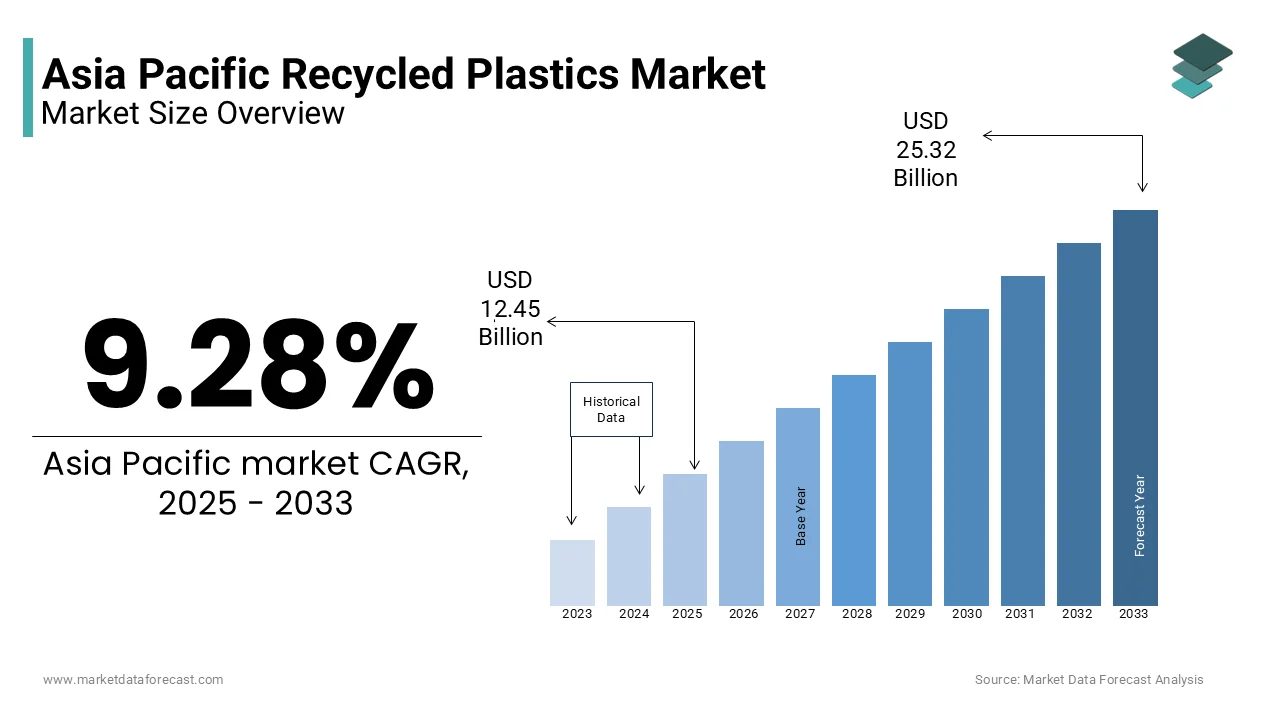
According to the United Nations Environment Programme, the Asia Pacific region generates approximately 50% of the world’s plastic waste due to its large population and rapid industrialization. Furthermore, according to the World Bank, annual plastic waste in East Asia and the Pacific could double by 2030 without urgent action, highlighting the urgency of effective recycling infrastructure. As per the Organisation for Economic Co-operation and Development, only 9% of plastic waste globally is successfully recycled, indicating significant room for improvement in the APAC region. Regulatory frameworks, such as China’s National Sword policy, have reshaped global trade dynamics, forcing regional nations to develop domestic recycling capabilities. The definition extends beyond simple waste management to include advanced technologies, like chemical depolymerization, which restore plastics to their monomer state. Consumer awareness regarding marine pollution and microplastics is driving demand for recycled content in packaging and textiles. This market is characterized by a transition from informal waste picking sectors to formalized industrial operations, supported by government incentives and corporate sustainability commitments.
MARKET DRIVERS
Stringent Government Regulations and Extended Producer Responsibility Policies
Government mandates and Extended Producer Responsibility (EPR) schemes is majorly driving the growth of the Asia-pacific recycled plastics market. Nations across the region are implementing strict laws requiring manufacturers to manage the end-of-life disposal of their plastic products, thereby creating a guaranteed demand for recycled materials. According to the United Nations Environment Programme, several APAC countries, including Japan, South Korea, and Australia, have enacted comprehensive EPR legislation that holds producers financially and physically responsible for recycling targets. In India, the Plastic Waste Management Amendment Rules mandate specific minimum percentages of recycled plastic in packaging applications by 2025. As per the Ministry of Ecology and Environment in China, bans on single-use plastics and mandatory recycling quotas have forced industries to integrate recycled content into their supply chains. These regulatory pressures compel multinational corporations operating in the region to source recycled plastics to comply with local laws and avoid penalties. The European Union’s influence on global supply chains also prompts APAC exporters to adopt higher recycling standards to maintain market access. Governments are further supporting this shift through subsidies for recycling facilities and taxes on virgin plastic production. As per the Asian Development Bank, policy interventions are essential to correct market failures and incentivize investment in recycling infrastructure. This regulatory landscape creates a stable and growing market environment where compliance drives procurement decisions, ensuring consistent demand for high-quality recycled resins.
Rising Corporate Sustainability Commitments and Brand Owner Initiatives
The increasing adoption of sustainability goals by major brand owners and multinational corporations is further fuelling the expansion of the Asia-pacific recycled plastics market. Companies are publicly committing to using higher percentages of post-consumer recycled (PCR) content in their packaging and products to meet environmental, social, and governance (ESG) criteria. According to the Ellen MacArthur Foundation, over 1,000 organizations globally, including many APAC-based entities, have signed the New Plastics Economy Global Commitment, pledging to make all plastic packaging reusable, recyclable, or compostable by 2025. Major consumer goods companies, such as Unilever, Nestle, and Coca-Cola, have set ambitious targets to incorporate at least 25% to 50% recycled plastic in their packaging by 2030. As per NielsenIQ, consumers in the Asia Pacific region increasingly prefer brands that demonstrate environmental responsibility, with 73% of respondents willing to change consumption habits to reduce environmental impact. This consumer pressure, combined with corporate pledges, creates a robust demand pull for recycled plastics. Retailers and e-commerce platforms are also prioritizing sustainable packaging solutions to enhance brand image and customer loyalty. The fashion industry in APAC is similarly shifting towards recycled polyester derived from plastic bottles, driven by initiatives like the Sustainable Apparel Coalition. These corporate actions stimulate investment in recycling technologies and supply chain transparency, ensuring a steady flow of capital into the sector. The alignment of business strategy with sustainability goals ensures long-term market growth and innovation.
MARKET RESTRAINTS
High Costs of Collection Sorting and Processing Infrastructure
The elevated costs associated with the collection, sorting, and processing of plastic waste is a significant restraint on the Asia-pacific recycled plastics market. Unlike virgin plastics, which benefit from economies of scale and subsidized fossil fuel prices, recycled plastics often incur higher production costs due to labor-intensive collection and complex sorting requirements. According to the World Bank, the cost of collecting and transporting waste in many APAC cities often exceeds the value of the recovered materials, making recycling economically unviable without subsidies. In developing nations, informal waste pickers dominate the collection sector, leading to inefficiencies and contamination issues that increase processing expenses. As per the Asian Development Bank, inadequate infrastructure for separate waste collection results in mixed waste streams that are difficult and expensive to sort effectively. Advanced sorting technologies, such as optical separators and artificial intelligence systems, require substantial capital investment, which many small and medium-sized recyclers cannot afford. Furthermore, the volatility of oil prices affects the competitiveness of recycled plastics, as when crude oil prices drop, virgin plastic becomes cheaper, undermining the economic case for recycling. The lack of standardized pricing mechanisms for recycled resins adds financial uncertainty for buyers and sellers. As per the International Labour Organization, formalizing the informal waste sector requires significant investment in training and equipment, further raising operational costs. These financial barriers hinder the scalability of recycling operations and limit the availability of high-quality recycled materials in the market.
Quality Degradation and Contamination Issues in Recycled Resins
Quality degradation and contamination of recycled plastic resins is further hampering the Asia-pacific recycled plastics market growth. Mechanical recycling processes often result in polymer chain breakdown, leading to reduced mechanical strength, thermal stability, and aesthetic quality compared to virgin plastics. According to the American Chemistry Council, repeated melting and reprocessing can cause discoloration, odor, and loss of integrity, limiting the use of recycled plastics in food contact and medical applications. In the APAC region, inconsistent waste segregation at the source leads to high levels of contamination from food residues, labels, and other materials. As per the United Nations Industrial Development Organization, contamination rates in collected plastic waste in some APAC countries can exceed 30%, requiring extensive and costly cleaning processes. The presence of hazardous substances and additives in post-consumer waste further complicates the recycling process and raises safety concerns. Regulatory standards for food-grade recycled plastics are stringent, and many local recyclers struggle to meet these specifications due to technological limitations. As per the Food and Drug Administration, achieving food contact compliance requires advanced decontamination technologies, such as solid-state polycondensation, which are not widely available in the region. This quality gap restricts the market for recycled plastics to lower-value applications, such as construction materials and non-food packaging. Until technological advancements improve the quality and consistency of recycled resins, their penetration into premium market segments will remain limited.
MARKET OPPORTUNITIES
Advancements in Chemical Recycling Technologies
The emergence and scaling of chemical recycling technologies is a promising opportunity for the Asia-pacific recycled plastics market. Unlike mechanical recycling, chemical recycling breaks down plastic polymers into their original monomers or feedstocks, allowing for the production of virgin-quality plastics from mixed and contaminated waste. According to the McKinsey Center for Future Mobility, chemical recycling could handle up to 20% of global plastic waste by 2030, offering a solution for hard-to-recycle plastics. In the APAC region, countries like Japan and South Korea are investing heavily in pyrolysis and depolymerization facilities to complement existing mechanical recycling infrastructure. As per the Japan Chemical Industry Association, several pilot plants are operational, demonstrating the feasibility of converting mixed plastic waste into naphtha and other chemical building blocks. This technology enables the creation of closed-loop systems where plastics can be recycled indefinitely without quality loss, addressing the limitations of mechanical recycling. Major petrochemical companies in the region are partnering with waste management firms to secure feedstock supplies for chemical recycling units. The ability to process multi-layer and flexible plastics, which are currently difficult to recycle mechanically, opens new revenue streams. As per the International Energy Agency, chemical recycling can significantly reduce greenhouse gas emissions compared to incineration or landfilling. Government support through research grants and favorable policies further accelerates commercialization. This technological leap positions APAC as a leader in next-generation recycling solutions, attracting global investment and fostering innovation.
Expansion of Recycled Content in Construction and Automotive Sectors
The integration of recycled plastics into the construction and automotive industries offers substantial growth opportunities for the Asia-pacific recycled plastics market. These sectors require durable and cost-effective materials, making them ideal candidates for utilizing high-volume recycled plastic grades. According to the Global Cement and Concrete Association, the use of recycled plastic aggregates in concrete and asphalt can reduce material costs and environmental impact while maintaining structural integrity. In India and Southeast Asia, recycled plastic is increasingly used in road construction where it enhances durability and resistance to water damage. As per the Ministry of Road Transport and Highways in India, thousands of kilometers of roads have been constructed using waste plastic, demonstrating scalability and performance benefits. The automotive industry in APAC is also adopting recycled plastics for interior components, underbody shields, and insulation parts to reduce vehicle weight and carbon footprint. Major automakers, such as Toyota and Hyundai, have set targets to increase the use of sustainable materials in their vehicles. As per the International Organization of Motor Vehicle Manufacturers, the shift towards electric vehicles emphasizes lightweighting, which recycled plastics can support. Collaborations between recyclers and manufacturers are driving the development of specialized grades tailored for industrial applications. This diversification reduces reliance on packaging markets and creates stable, long-term demand. Regulatory incentives for green building and sustainable manufacturing further support this expansion.
MARKET CHALLENGES
Fragmented and Informal Waste Collection Systems
The fragmented nature of waste collection systems dominated by informal sectors poses a significant challenge to the Asia-pacific recycled plastics market. In many APAC countries, waste management is largely handled by informal waste pickers who operate outside formal regulatory frameworks, leading to inefficiencies and data gaps. According to the International Labour Organization, an estimated 15 million people work as waste pickers globally, with a significant concentration in Asia lacking social protection and standardized practices. This informality results in inconsistent supply volumes and variable quality of collected plastics, hindering the planning and operation of formal recycling facilities. As per the World Bank, the lack of integrated waste management systems means that a large portion of recyclable materials is lost to landfills or the environment before reaching processors. Formal recyclers struggle to establish reliable supply chains due to the decentralized and unorganized nature of collection. The absence of traceability makes it difficult to verify the origin and composition of waste, affecting the quality of recycled output. As per the Asian Development Bank, integrating informal workers into formal systems requires significant policy intervention and investment in infrastructure. Without structured collection networks, recyclers face higher transaction costs and supply uncertainties. This structural fragmentation impedes the scaling up of recycling operations and limits the industry’s ability to meet growing demand for high-quality recycled materials.
Lack of Standardized Quality Certifications and Testing Protocols
The absence of standardized quality certifications and testing protocols for recycled plastics is further challenging the regional market expansion. Buyers often hesitate to purchase recycled resins due to concerns about consistency, performance, and safety, particularly in sensitive applications. According to the International Organization for Standardization, while standards for virgin plastics are well established, comprehensive and universally accepted standards for recycled plastics are still evolving in many APAC countries. As per the Bureau of Indian Standards and other national bodies, the lack of harmonized testing methods makes it difficult to compare products from different suppliers and ensure compliance with international requirements. This uncertainty leads to risk aversion among manufacturers, who prefer the predictable quality of virgin plastics. The variability in recycling processes and feedstock quality further complicates the establishment of uniform standards. As per the United Nations Industrial Development Organization, the lack of certification hinders international trade as exporters struggle to prove the quality of their recycled materials to global buyers. Developing and implementing robust certification schemes requires collaboration between governments, industry associations, and technical experts. Without clear quality benchmarks, the market remains fragmented and inefficient. Addressing this challenge is crucial for building confidence among stakeholders and facilitating the broader adoption of recycled plastics across diverse industries.
REPORT COVERAGE
| REPORT METRIC | DETAILS |
| Market Size Available | 2025 to 2034 |
| Base Year | 2025 |
| Forecast Period | 2026 to 2034 |
| CAGR | 9.28% |
| Segments Covered | By Type, Recycling Process, Application, and Region |
| Various Analyses Covered | Global, Regional, & Country Level Analysis; Segment-Level Analysis; DROC; PESTLE Analysis; Porter’s Five Forces Analysis; Competitive Landscape; Analyst Overview of Investment Opportunities |
| Regions Covered | India, China, Japan, South Korea, Australia, New Zealand, Thailand, Malaysia, Vietnam, Philippines, Indonesia, Singapore, and the Rest of Asia-Pacific |
| Market Leaders Profiled | Veolia, SUEZ Group, Indorama Ventures Public Company Limited, Reliance Industries Limited, KW Plastics Recycling Division, Biffa plc, Cleanaway Waste Management Limited, PLASgran Ltd., China National Sword Program, Jayplas, Seraphim Plastics LLC, Green Ant Plastic Recycling, Kuusakoski Group, MBA Polymers, Inc., Enviroplast Inc., Delta Plastics of the South, Revive, Alpek SAB de CV, LyondellBasell Industries Holdings B.V., and Others |
SEGMENTAL ANALYSIS
By Type Insights
The polyethylene terephthalate or PET segment accounted for the highest share of 36.6% of the regional market in 2025 due to the extensive use of recycled PET in beverage bottles and polyester fibers for the textile industry. PET is highly recyclable and retains its properties well after processing, making it a preferred choice for closed-loop applications. According to the International Bottled Water Association, PET accounts for the majority of plastic packaging used in the beverage sector globally and is creating a consistent supply of post-consumer waste. In the APAC region, the rapid growth of the ready-to-drink beverage market generates substantial volumes of PET waste available for recycling. As per the Textile Exchange, the demand for recycled polyester (rPET) in the fashion industry has surged, with major brands committing to sustainable sourcing targets. The ability of rPET to replace virgin polyester in clothing, carpets, and upholstery provides a lucrative outlet for recyclers. Furthermore, regulatory mandates in countries like Japan and South Korea require minimum recycled content in packaging, further boosting demand. The established collection infrastructure for PET bottles in urban areas ensures a steady feedstock supply. Technological advancements in washing and extrusion have improved the quality of rPET, enabling its use in food-grade applications. This combination of robust demand from multiple sectors and improving recycling technologies sustains the leadership of the PET segment.

On the other hand, the polypropylene or PP segment is projected to register the highest CAGR of 8.2% over the forecast period in this regional market owing to the growing adoption of recycled PP in the automotive and consumer durable goods sectors where weight reduction and cost efficiency are critical. PP is widely used in automotive interior components, such as dashboards, bumpers, and door panels, due to its durability and flexibility. According to the International Organization of Motor Vehicle Manufacturers, the APAC region is the largest producer of automobiles globally, driving significant demand for lightweight materials. Automakers are integrating recycled PP to meet sustainability goals and reduce carbon footprints without compromising performance. As per the Society of the Plastics Industry, recycled PP offers a cost-effective alternative to virgin resin while maintaining essential mechanical properties. The growth of the home appliance market in emerging economies, like India and Vietnam, also contributes to demand for recycled PP in housings and internal parts. Regulatory pressures to reduce plastic waste in electronics and appliances are prompting manufacturers to incorporate recycled content. Innovations in compatibilizers and additives have enhanced the quality of recycled PP, allowing it to meet stricter automotive standards. The versatility of PP in various applications, combined with environmental regulations, ensures its status as the fastest-growing segment.
By Recycling Process Insights
The mechanical recycling segment held the dominant position in the Asia-pacific recycled plastics market in 2025 with 84.1% of the regional market share. The growth of the mechanical recycling segment in this regional market is attributed to the mature technology, lower operational costs, and widespread availability of mechanical recycling facilities across the region. Mechanical recycling involves sorting, washing, shredding, and melting plastic waste to produce granules, which is a straightforward and energy-efficient process compared to chemical alternatives. According to the United Nations Environment Programme, mechanical recycling remains the most common method for processing plastics globally due to its economic viability. In APAC countries like China, India, and Thailand, numerous small and medium-sized enterprises operate mechanical recycling units, catering to local demand. As per the World Bank, the low capital investment required for mechanical recycling makes it accessible for informal and formal sectors alike. The process is well suited for single-stream plastics, such as PET and HDPE, which are abundant in municipal waste. Established supply chains and market acceptance of mechanically recycled resins further reinforce its dominance. Although quality degradation is a concern, advancements in sorting and cleaning technologies have improved the output quality. Government policies favoring immediate waste diversion from landfills support the continued expansion of mechanical recycling. The scalability and proven track record of this process ensure it remains the backbone of the regional recycling industry.
However, the chemical recycling segment is experiencing the fastest growth within the Asia-pacific recycled plastics market and is anticipated to record a CAGR of 13.1% over the forecast period owing to the technology’s ability to process mixed, contaminated, and multi-layer plastics that are unsuitable for mechanical recycling. Chemical recycling breaks down polymers into monomers or feedstocks, enabling the production of virgin-quality plastics, thus supporting true circularity. According to the McKinsey Center for Future Mobility, chemical recycling is essential for achieving high recycling rates, as it complements mechanical methods by handling complex waste streams. In the APAC region, countries like Japan and South Korea are investing heavily in pyrolysis and depolymerization technologies to address plastic waste challenges. As per the Japan Chemical Industry Association, several commercial-scale plants are being developed to convert plastic waste into naphtha and other chemical building blocks. Major petrochemical companies are partnering with waste management firms to secure feedstock and integrate recycled materials into their production lines. Regulatory support for advanced recycling technologies and corporate commitments to use certified circular plastics are boosting market confidence. The ability to produce food-grade and high-performance plastics from waste opens new market opportunities. Although currently limited by high costs and energy requirements, technological advancements and economies of scale are expected to drive rapid adoption.
By Application Insights
The packaging segment led the market by accounting for 44.7% of the Asia-pacific market share in 2025. The growth of the packaging segment in the regional market can be credited to the stringent regulations requiring recycled content in packaging and aggressive sustainability targets set by multinational consumer goods companies. Packaging represents the largest source of plastic waste, making it a primary focus for recycling initiatives. According to the Ellen MacArthur Foundation, global commitments by brand owners to use post-consumer recycled content in packaging have created a robust demand for recycled resins. In the APAC region, governments in countries like Australia and India are implementing Extended Producer Responsibility schemes that mandate specific recycling rates for packaging materials. As per the NielsenIQ survey, consumers in Asia Pacific increasingly prefer brands with sustainable packaging, influencing purchasing decisions. Major retailers and e-commerce platforms are transitioning to recycled plastic packaging to enhance their environmental credentials. The versatility of recycled PET and HDPE in producing bottles, containers, and films ensures widespread adoption. Technological improvements in decontamination processes have enabled the use of recycled plastics in food contact applications, expanding market potential. The continuous growth of the retail and food delivery sectors further amplifies demand. This alignment of regulatory pressure, consumer preference, and corporate strategy ensures the packaging segment remains the largest application area.
On the other end, the automotive segment is anticipated to register the fastest CAGR of 9.5% over the forecast period in this regional market owing to the automotive industry’s push towards lightweighting to improve fuel efficiency and reduce emissions in both internal combustion and electric vehicles. Recycled plastics offer a sustainable and cost-effective solution for manufacturing non-structural interior and exterior components. According to the International Organization of Motor Vehicle Manufacturers, the APAC region accounts for more than half of global vehicle production, creating substantial demand for automotive materials. Automakers are increasingly incorporating recycled polypropylene and acrylonitrile butadiene styrene in dashboards, door panels, and underbody shields. As per the Sustainable Materials Management Coalition, the use of recycled materials helps manufacturers meet corporate sustainability goals and regulatory requirements for end-of-life vehicle recycling. Governments in Japan, South Korea, and China are promoting green manufacturing practices, encouraging the use of secondary raw materials. Collaborations between recyclers and automotive OEMs are driving the development of high-quality recycled grades that meet rigorous safety and performance standards. The shift towards electric vehicles, which emphasize sustainability throughout the supply chain, further accelerates adoption. This convergence of environmental regulations, performance benefits, and industry commitment positions the automotive segment as a high-growth area.
REGIONAL ANALYSIS
China Recycled Plastics Market Analysis
China dominated the recycled plastics market in Asia-pacific in 2025 with 38.8% of the regional market share. The dominance of China in the Asia-pacific market is primarily by the transition from being a global waste importer to developing a robust domestic recycling infrastructure following the National Sword policy. According to the Ministry of Ecology and Environment, China has implemented strict regulations on plastic waste management and promoted the development of circular economy industries. The country is the world’s largest producer and consumer of plastics, generating significant volumes of post-industrial and post-consumer waste. As per the China Plastics Processing Industry Association, the capacity for mechanical recycling has expanded rapidly with investments in advanced sorting and washing technologies. Government initiatives, such as the 14th Five Year Plan, emphasize resource efficiency and pollution control, driving demand for recycled materials. The presence of a large manufacturing base, particularly in packaging and textiles, creates strong domestic demand for recycled resins. Challenges include uneven collection systems in rural areas and quality consistency issues. However, the scale of operations and policy support ensure China remains the dominant force in the regional market. Innovation in chemical recycling is also gaining traction as major petrochemical firms seek to integrate circular solutions.
India Recycled Plastics Market Analysis
India held a significant and rapidly growing position in the Asia-pacific recycled plastics market in 2025 due to a large informal waste picking sector that feeds into a growing formal recycling industry. According to the Central Pollution Control Board, India generates millions of tons of plastic waste annually, with a high recovery rate due to the economic value of scrap. The government has introduced the Plastic Waste Management Amendment Rules, which mandate Extended Producer Responsibility and minimum recycled content in packaging. As per the Ministry of Road Transport and Highways, the use of waste plastic in road construction has been mandated for certain categories of roads, providing a unique and large-scale application for recycled plastics. The textile industry in India is also a major consumer of recycled polyester, contributing to market growth. Challenges include the need for modernization of recycling facilities and standardization of quality. However, government incentives and increasing corporate sustainability commitments are driving investment in formal recycling infrastructure. The young population and rising consumption patterns ensure a steady supply of waste and demand for recycled products. India’s focus on sustainable development goals positions it as a key growth engine in the region.
Japan Recycled Plastics Market Analysis
Japan represents a mature and technologically advanced market for recycled plastics in the Asia-Pacific region. The country is known for its sophisticated waste management systems and high recycling rates, driven by strict legislation and public awareness. According to the Ministry of the Environment, Japan achieves a plastic recycling rate of over 80%, although a significant portion is used for thermal recovery. The Container and Packaging Recycling Law mandates specific recycling obligations for businesses and municipalities, fostering a structured collection system. As per the Japan Plastics Recycling Promotion Cooperation Association, there is a strong emphasis on chemical recycling technologies to handle mixed plastics and produce high-quality feedstocks. Major chemical companies are investing in depolymerization plants to support circular economy goals. The automotive and electronics industries in Japan are leading adopters of recycled plastics due to corporate sustainability targets. Consumer awareness and willingness to pay for sustainable products support the market. Challenges include an aging population affecting waste collection labor and limited domestic waste growth. However, Japan’s technological leadership and export of recycling expertise contribute significantly to the regional landscape. The focus is shifting towards high-value chemical recycling to complement mechanical methods.
South Korea Recycled Plastics Market Analysis
South Korea holds a developed position in the Asia-pacific recycled plastics market owing to the advanced waste separation protocols and strong government support for circular economy initiatives. According to the Ministry of Environment, South Korea has implemented comprehensive recycling laws and aims to reduce plastic waste by 50% by 2030. The country is a leader in chemical recycling technology with several pilot and commercial projects underway to convert plastic waste into raw materials. As per the Korea Environmental Corporation, the volume of recycled plastics used in packaging and industrial applications is increasing due to regulatory mandates and corporate commitments. Major conglomerates are investing in recycling facilities to secure sustainable material supplies. The electronics and automotive sectors are key drivers of demand for high-quality recycled resins. Public participation in waste separation is high, ensuring a clean feedstock supply. Challenges include limited land for waste management facilities and high labor costs. However, the strong regulatory framework and technological innovation position South Korea as a key player in advanced recycling solutions. The government’s Green New Deal further accelerates investment in sustainable infrastructure.
COMPETITIVE LANDSCAPE
The competition in the Asia-pacific Recycled Plastics Market is characterized by a mix of large multinational corporations and numerous local recyclers operating in a fragmented landscape. Major players leverage their technological expertise financial resources and global networks to dominate high value segments such as food grade rPET and automotive grades. They compete on product quality consistency and sustainability certifications which are critical for securing contracts with multinational brand owners. Local recyclers often focus on cost leadership and serve domestic markets with lower grade recycled plastics. The entry of chemical recycling technologies is reshaping competitive dynamics by enabling the processing of mixed and contaminated waste streams. Regulatory pressures and extended producer responsibility schemes are driving consolidation as companies seek to comply with stricter standards. Partnerships and collaborations are common strategies to enhance supply chain security and share technological advancements. Price volatility of virgin plastics influences competitiveness requiring recyclers to maintain operational efficiency. Innovation in sorting and cleaning technologies serves as a key differentiator. The market is evolving towards greater transparency and traceability driven by consumer and regulatory demands. This dynamic environment requires continuous adaptation and investment to maintain competitive advantage and achieve sustainability goals.
KEY MARKET PLAYERS
Some of the notable key players in the Asia Pacific recycled plastics market are
- Veolia
- SUEZ Group
- Indorama Ventures Public Company Limited
- Reliance Industries Limited
- KW Plastics Recycling Division
- Biffa plc
- Cleanaway Waste Management Limited
- PLASgran Ltd.
- China National Sword Program
- Jayplas
- Seraphim Plastics LLC
- Green Ant Plastic Recycling
- Kuusakoski Group
- MBA Polymers, Inc.
- Enviroplast Inc.
- Delta Plastics of the South
- Revive
- Alpek SAB de CV
- LyondellBasell Industries Holdings B.V.
- Others
Top Players in the Market
- Indorama Ventures is a global leader in petrochemicals and recycling with a significant presence in the Asia-pacific Recycled Plastics Market. The company specializes in producing high quality recycled polyethylene terephthalate rPET for packaging and textile applications. Recent actions include expanding its recycling facilities in Thailand and India to increase production capacity and meet growing demand. Indorama actively partners with brand owners to develop closed loop supply chains ensuring consistent supply of certified recycled materials. The company invests in advanced sorting and washing technologies to enhance product quality and sustainability credentials. By integrating vertical operations from collection to polymer production Indorama strengthens its market position. Its commitment to circular economy principles drives innovation and supports global sustainability goals. This strategic focus enables the company to serve diverse industries while reducing environmental impact and fostering long term growth in the regional recycling sector.
- Veolia Environmental Services is a key player in the Asia-pacific Recycled Plastics Market offering comprehensive waste management and recycling solutions. The company operates advanced facilities that process post consumer and post industrial plastic waste into high value recycled resins. Recent actions involve launching new chemical recycling projects in Australia and Japan to handle complex plastic streams. Veolia collaborates with municipalities and corporations to improve collection systems and increase recycling rates. The company leverages digital technologies to optimize waste sorting and tracking enhancing operational efficiency. By focusing on innovation and sustainability Veolia strengthens its reputation as a trusted partner in circular economy initiatives. Its extensive network and technical expertise enable it to address diverse recycling challenges across the region. This holistic approach supports clients in meeting regulatory compliance and sustainability targets driving market expansion and environmental stewardship.
- Mitsubishi Chemical Corporation is a prominent contributor to the Asia-pacific Recycled Plastics Market through its innovative sustainable material solutions. The company focuses on developing advanced recycling technologies including chemical recycling to produce virgin quality plastics from waste. Recent actions include establishing partnerships with local waste management firms in Japan and Southeast Asia to secure feedstock supplies. Mitsubishi Chemical invests in research and development to create bio based and recycled plastic blends for automotive and electronics applications. The company promotes circular economy practices by engaging with stakeholders across the value chain. By leveraging its technological prowess Mitsubishi Chemical strengthens its market position as a leader in sustainable materials. Its commitment to carbon neutrality and resource efficiency drives continuous improvement and innovation. This strategic direction ensures the company remains at the forefront of the evolving recycling landscape in the Asia Pacific region.
Top Strategies Used by the Key Market Participants
Key players in the Asia-pacific Recycled Plastics Market primarily focus on vertical integration to secure stable feedstock supplies and control production costs. Companies invest heavily in advanced mechanical and chemical recycling technologies to improve product quality and expand application ranges. Strategic partnerships with brand owners and waste management firms facilitate closed loop systems and enhance supply chain transparency. Expansion into emerging markets through joint ventures and acquisitions allows companies to capture growing demand. Sustainability certifications and compliance with international standards build trust and differentiate products in competitive markets. Innovation in eco design and recyclable packaging solutions supports customer sustainability goals. These strategies collectively enable participants to navigate regulatory complexities and drive sustainable growth in the dynamic regional recycling industry.
MARKET SEGMENTATION
This research report on the Asia Pacific recycled plastics market has been segmented and sub-segmented based on the following categories.
By Type
- PET
- HDPE
- LDPE
- PP
- Others
By Recycling Process
- mechanical
- chemical
By Application
- packaging
- construction
- textile
- automotive
- others
By Country
- China
- Japan
- India
- South Korea