Asia Pacific Smart Electric Meter Market Size, Share, Growth, Trends, And Forecast Research Report, Segmented By Phase, End-User, And Country (India, China, Japan, South Korea, Australia, New Zealand, Thailand, Malaysia, Vietnam, Philippines, Indonesia, Singapore and Rest of APAC), Industry Analysis From (2026 to 2034)
Market Size, 2025
$3.10 BnMarket Estimate, 2026
$3.40 BnMarket Forecast, 2034
$7.11 BnCAGR, 2026–2034
9.67%Asia Pacific Smart Electric Meters Market Summary
The Asia Pacific smart electric meter market was valued at USD 3.10 billion in 2025 and is anticipated to reach USD 3.40 billion in 2026 and USD 7.11 billion by 2034, growing at a CAGR of 9.67% from 2026 to 2034.
Key Market Trends & Insights
- China dominated the Asia Pacific smart electric meter market Market in 2025
- India commands a significant share throughout the forecast period.
- Japan holds a notable share of the Asia Pacific market in 2025.
- Based on Phase, The single-phase segment leading the Asia Pacific market in 2025
- Based on End-User, The residential sector led the market in 2025.
Market Size & Forecast
2026 Market Size: USD 3.40 Billion
2034 projected Market Size: USD 7.11 Billion
CAGR (2026 to 2034): 9.67%
China: Largest Market in 2026
India: Strongest Growth Region
Asia Pacific Smart Electric Meter Refers Market Size
The Asia Pacific smart electric meter market was valued at USD 2.83 billion in 2025 and is anticipated to reach USD 3.10 billion in 2025 and USD 6.15 billion by 2033, growing at a CAGR of 9.67% during the forecast period from 2026 to 2034.
Smart electric meter refers to the advanced digital metering systems capable of two-way communication, real-time energy consumption monitoring, remote disconnection, outage detection, and integration with grid management platforms. Unlike traditional electromechanical meters, smart meters enable utilities and consumers to optimize electricity usage through data transparency and automated billing. Across the region, deployment is closely tied to national energy modernization agendas, urban infrastructure upgrades, and decarbonization goals.
Countries such as India and Indonesia face persistent issues with technical and commercial losses. In response, governments are mandating meter replacement programs to enhance billing accuracy and reduce energy theft. Moreover, rapid urbanization is intensifying pressure on aging power networks, necessitating intelligent grid infrastructure. Regulatory frameworks in nations like Australia and Singapore have evolved to support time-of-use (TOU) tariff structures, which require smart meter deployment to function effectively. The integration of renewable energy sources, particularly rooftop solar, further amplifies the need for bidirectional energy tracking, positioning smart meters as critical enablers of a decentralized and resilient power ecosystem.
MARKET DRIVERS
Government-Led National Smart Metering Programs to Reduce Energy Losses
The implementation of large-scale government-backed replacement initiatives aimed at curbing non-technical losses and improving utility revenue collection is a primary catalyst for smart electric meter adoption across the Asia Pacific. These meters enable remote monitoring, tamper detection, and automated disconnection, directly targeting electricity theft, a persistent issue in states like Uttar Pradesh and Bihar. The programs are not only improving operational efficiency but also enhancing consumer trust through transparent billing. The financial viability of utilities hinges on accurate metering, especially as cross-subsidization models strain under inefficiencies. By replacing outdated infrastructure with smart systems, governments are laying the foundation for financially sustainable power distribution, making this a foundational driver of market expansion.
Integration of Renewable Energy and Prosumer Models Requiring Bidirectional Metering
The accelerating deployment of distributed energy resources (DERs), particularly rooftop solar photovoltaic (PV) systems, is creating an urgent need for smart meters capable of bidirectional energy measurement. The shift transforms consumers into prosumers who both consume and feed electricity back into the grid, necessitating net metering or feed-in tariff mechanisms that rely on smart meter data. Without accurate bidirectional tracking, utilities cannot compensate prosumers fairly or manage grid stability. Japan has responded by mandating smart meter installation for all new solar-connected homes. These developments are compelling utilities to upgrade legacy infrastructure to support dynamic pricing, load balancing, and voltage regulation. As decentralized generation expands, smart meters are no longer optional upgrades but essential components of a modern, responsive, and inclusive energy ecosystem.
MARKET RESTRAINTS
High Upfront Capital Costs Deterring Utility Investment in Developing Economies
The substantial initial investment required for smart meter deployment remains a critical barrier, particularly for state-owned utilities in low- and middle-income countries across the Asia Pacific. The cost of a single smart meter, including communication modules, installation, and backend integration, is significantly higher than that of conventional meters. For utilities already grappling with financial deficits, such as India’s distribution companies (discoms), large-scale procurement is fiscally challenging. While government subsidies exist, delays in disbursement and complex approval processes slow implementation. Additionally, the need for complementary investments in communication networks, such as NB-IoT or RF mesh infrastructure, and data management systems further escalates total project costs. Without sustained financial support and innovative financing models, many utilities are forced to prioritize grid stability over digital transformation, delaying smart meter adoption and perpetuating inefficiencies in energy distribution.
Cybersecurity Vulnerabilities and Data Privacy Concerns Limiting Consumer Acceptance
The digitization of metering infrastructure introduces significant cybersecurity risks, raising concerns among regulators and consumers alike. Smart meters generate granular data on household energy usage patterns, potentially revealing personal behaviours such as occupancy, appliance use, and daily routines. Incidents of cyber intrusions have further eroded trust. Moreover, the interconnected nature of smart grids makes them susceptible to cascading failures—hackers could theoretically manipulate thousands of meters simultaneously to destabilize the grid. The absence of harmonized cybersecurity standards across the region exacerbates the issue. Without robust encryption, data anonymization, and regulatory oversight, public resistance could hinder large-scale deployment, particularly in regions where digital literacy is low and institutional trust is fragile.
MARKET OPPORTUNITY
Expansion of Advanced Metering Infrastructure (AMI) in Tier-2 and Tier-3 Cities
The gradual extension of smart metering beyond metropolitan centers into secondary and tertiary urban areas presents a significant growth frontier. While cities like Sydney, Singapore, and Tokyo have achieved high smart meter penetration, vast segments of the population in smaller urban hubs remain underserved. These areas often suffer from higher AT&C losses, making them ideal candidates for automated metering. Similarly, in Indonesia, PLN is prioritizing smart meter deployment in provincial capitals like Medan and Makassar, where manual meter reading inefficiencies contribute to revenue leakage. The declining cost of communication technologies, such as LoRaWAN and NB-IoT, is enabling cost-effective coverage in geographically dispersed areas. Municipal governments are also integrating smart meters into broader smart city initiatives, linking them to energy dashboards and outage management systems. As digital infrastructure improves and consumer awareness grows, these emerging urban centers are poised to become high-volume markets for smart meter vendors, offering long-term scalability and reduced dependency on pilot-based implementations.
Convergence with Home Energy Management Systems (HEMS) and IoT Ecosystems
Smart meters are increasingly serving as foundational nodes in integrated home energy ecosystems, unlocking new value propositions for consumers and service providers. By interfacing with Home Energy Management Systems (HEMS), smart meters enable real-time monitoring of appliance-level consumption, automated load scheduling, and demand response participation. This integration empowers consumers to reduce bills. Additionally, utility providers are leveraging HEMS data to offer personalized energy plans, predictive maintenance, and carbon footprint tracking. As 5G and AI-driven analytics mature, smart meters will evolve from passive data collectors to active energy coordinators, managing EV charging, solar storage, and grid interactions. This convergence is transforming the smart meter from a utility asset into a consumer-facing digital platform, opening avenues for subscription-based services and value-added offerings.
MARKET CHALLENGES
Interoperability and Standardization Gaps Across Vendors and Networks
The lack of uniform technical standards for communication protocols, data formats, and device certification is a persistent obstacle to seamless smart meter integration across the Asia Pacific. Utilities often deploy meters from multiple vendors using different technologies—some relying on RF mesh, others on cellular NB-IoT or PLC—leading to fragmented networks that hinder centralized monitoring. The fragmentation increases operational costs and delays grid modernization. Moreover, proprietary firmware and closed architectures limit third-party innovation and prevent integration with emerging platforms like HEMS or electric vehicle charging networks. The absence of a unified certification regime also allows substandard devices to enter the market. Without regional harmonization, utilities face long-term lock-in with specific vendors, reducing competitive pressure and innovation. Establishing open, interoperable standards is essential to ensure scalability, security, and future-proofing of smart metering infrastructure.
Skilled Workforce Shortage for Deployment, Maintenance, and Data Management
The successful implementation of smart metering systems requires a specialized workforce proficient in telecommunications, data analytics, cybersecurity, and field operations—expertise that remains scarce across much of the Asia Pacific. Also, there is a significant deficit of skilled energy digitalization professionals in the region, particularly in countries like the Philippines, Bangladesh, and Vietnam. Utilities often rely on external contractors for installation, leading to inconsistent quality and post-deployment failures.
Furthermore, the transition from manual to automated systems demands new competencies in data interpretation and predictive analytics. This knowledge gap limits the utilization of meter-generated insights for load forecasting, outage prediction, and tariff optimization. Training programs are often fragmented and lack standardization, with no unified certification framework across the region. As smart meter networks expand, the human capital bottleneck threatens to undermine system reliability and delay the realization of full operational benefits, necessitating coordinated investment in technical education and upskilling initiatives.
REPORT COVERAGE
| REPORT METRIC | DETAILS |
| Market Size Available | 2025 to 2034 |
| Base Year | 2025 |
| Forecast Period | 2026 to 2034 |
| CAGR | 4.73% |
| Segments Covered | By Phase, End-User, Country |
| Various Analyses Covered | Global, Regional, and Country-Level Analysis; Segment-Level Analysis; DROC; PESTLE Analysis; Porter’s Five Forces Analysis; Competitive Landscape; Analyst Overview of Investment Opportunities |
| Regions Covered | India, China, Japan, South Korea, Australia, New Zealand, Thailand, Malaysia, Vietnam, Philippines, Indonesia, Singapore, and the Rest of APAC |
| Market Leaders Profiled | ABB Ltd., General Electric, Holley Technology Ltd., Elster Group SE, Iskraemeco D.D., Itron, Inc., Landis+Gyr, Schneider Electric SE, Siemens AG |
SEGMENTAL ANALYSIS
By Phase Insights
Single-phase Smart Electric Meters
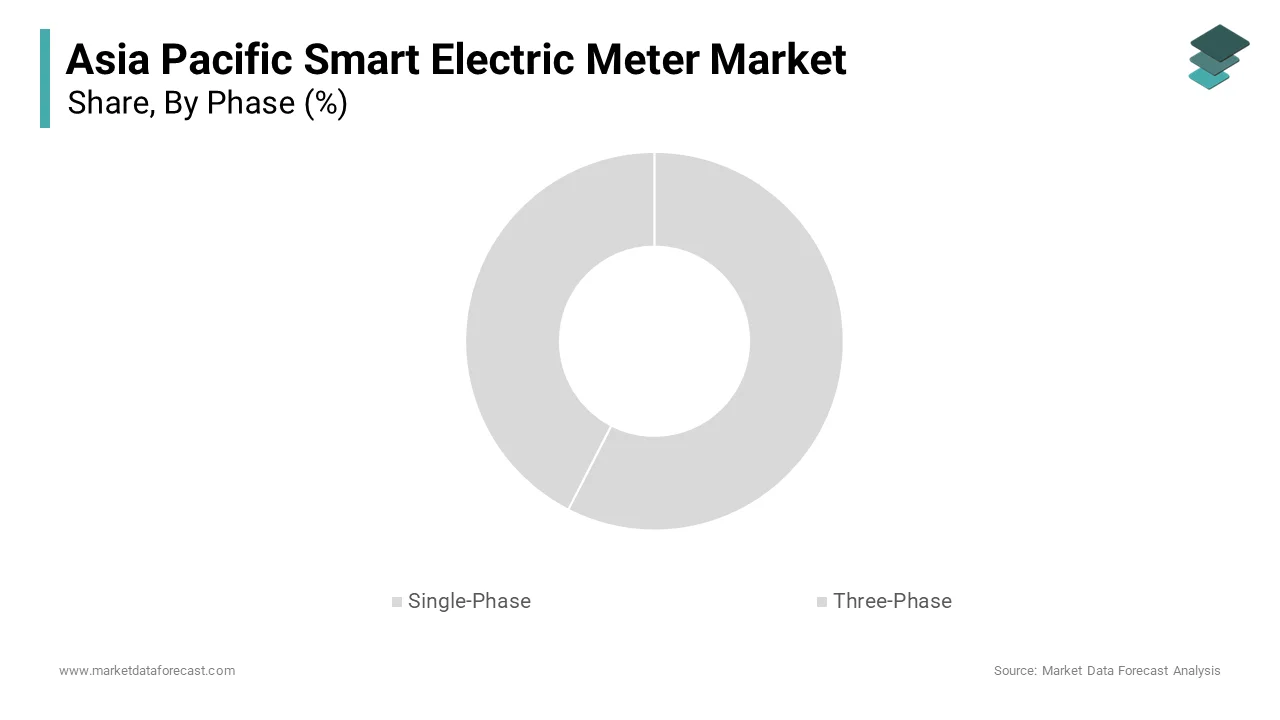
The single-phase smart electric meters segment dominated the Asia Pacific market by capturing 65.3% share in 2025. This overwhelming share is primarily driven by their widespread deployment in residential households, which constitute the largest consumer segment for electricity in the region. These meters are cost-effective to produce and install, averaging low compared to that for three-phase variants per unit, making them ideal for large-scale rollouts in price-sensitive markets. Besides, single-phase meters are central to reducing aggregate technical and commercial (AT&C) losses. Their integration with mobile-based prepaid platforms has also enhanced consumer engagement, particularly in regions with low banking penetration. As governments prioritize universal metering coverage and revenue protection in the residential sector, single-phase meters remain the cornerstone of smart grid modernization across the region.
Three-phase Smart Electric Meters
The three-phase smart electric meters segment is experiencing the most rapid growth in the Asia Pacific market and is expanding at a CAGR of 13.6% from 2025 to 2033. This acceleration is fueled by rising electricity demand from commercial complexes, industrial parks, and data centers, which require higher load capacity and precise energy monitoring. These meters enable utilities to monitor load imbalances, detect phase faults, and enforce time-of-use tariffs for large consumers, improving grid stability and revenue accuracy. Another key driver is the integration of distributed energy resources (DERs) at the commercial-industrial level. Moreover, three-phase meters are essential for demand response programs. With industrial electrification and digital factory initiatives gaining momentum, the demand for high-precision, grid-interactive three-phase meters is set to intensify.
By End-use Insights
Residential
The residential sector led the market by accounting for 57.3% of the Asia Pacific smart electric meter market by volume. This dominance is due to the sheer scale of household electrification and the urgent need to modernize legacy metering systems in densely populated urban and peri-urban areas. In countries like India and Indonesia, where residential consumers make up a notable share of total utility customer bases, smart meter rollouts are prioritized to eliminate manual reading inefficiencies and curb energy theft. As per the Central Electricity Authority of India, AT&C losses averaged 15.41% in 2022–2023. Prepaid smart meters have gained particular traction in low-income neighborhoods, where they enable pay-as-you-go models and reduce disconnection disputes. Additionally, government mandates such as India’s RDSS and Indonesia’s PLN Smart Meter Program are explicitly focused on residential coverage. As urbanization continues and digital payment ecosystems mature, the residential segment remains the primary engine of smart meter adoption across the region.
Commercial
The commercial segment is emerging as the fastest-growing end-use category in the Asia Pacific smart electric meter market and is projected to grow at a CAGR of 14.1% from 2025 to 2033. This surge is driven by the rapid expansion of retail spaces, office complexes, shopping malls, and hospitality establishments, all of which require granular energy monitoring to manage operational costs and meet sustainability targets. Real-time data from smart meters enables facility managers to identify energy-intensive equipment, optimize HVAC usage, and participate in demand response programs. In Singapore, commercial buildings using smart meter-integrated energy management systems reduced consumption over two years. Additionally, the rise of green building certifications, such as LEED and Green Mark, has made smart metering a prerequisite for compliance. In South Korea, a notable share of new commercial developments in Seoul are equipped with advanced metering infrastructure. As commercial operators face increasing pressure to decarbonize and improve energy efficiency, smart meters are becoming indispensable tools for operational intelligence and regulatory compliance.
COUNTRY-LEVEL ANALYSIS
China Market Analysis
China dominated the Asia Pacific smart electric meter market at 31.8%. The country’s position is anchored in its state-driven, nationwide smart grid initiative, making it the most extensive rollout globally. State Grid Corporation of China and China Southern Power Grid have standardized procurement, ensuring uniformity in technology and communication protocols across provinces. The focus has shifted from basic AMI deployment to next-generation meters with edge computing capabilities, capable of supporting distributed energy integration and dynamic pricing. Additionally, China’s dominance in manufacturing has enabled cost-efficient production of meters, with domestic firms like Holley Metering and Wasion Group supplying not only the domestic market but also exporting to Southeast Asia and Africa.
India Market Analysis
India commands a significant share of the Asia Pacific smart electric meter market. The country’s market is defined by one of the most ambitious smart metering programs in the world. The program is financially supported by the central government fund, addressing the capital constraints of distribution companies. A key driver is the reduction of AT&C losses. Smart meters have already demonstrated results. The integration of prepaid models has also improved cash flow for discoms. Moreover, India’s push for digital infrastructure has facilitated seamless consumer onboarding.
Japan Market Analysis
Japan holds a notable share of the Asia Pacific smart electric meter market, as per data from the Federation of Electric Power Companies of Japan (FEPC). The country’s market is characterized by high technological maturity, regulatory foresight, and strong integration with energy resilience strategies. Unlike reactive rollouts in other nations, Japan’s deployment is closely aligned with its post-Fukushima energy policy, emphasizing demand-side management and grid stability. Smart meters are essential for time-of-use tariffs and emergency load shedding, particularly during peak summer and winter periods. Moreover, Japan’s aging population and declining birth rate have increased the need for remote monitoring and automated billing, enhancing consumer acceptance. The country is also a leader in R&D, with firms like Toshiba and Panasonic developing next-generation meters with AI-based anomaly detection.
Australia Market Analysis
Australia is another key player in the Asia Pacific smart electric meter market. The country’s market is distinguished by early adoption, high consumer engagement, and strong regulatory support. Deployment began in the late 2000s, setting a precedent for other states. The primary driver has been the need to support dynamic pricing models in a deregulated energy market, where time-of-use tariffs are widely used to manage peak demand. The Australian Competition and Consumer Commission found that households with smart meters reduced peak usage when exposed to higher off-peak incentives. Additionally, the surge in rooftop solar, installed in a portion of homes, has made bidirectional metering essential for fair compensation under feed-in tariffs. The Therapeutic Goods Administration does not regulate meters, but the Australian Standard AS/NZS 4268 ensures safety and interoperability. With plans to integrate smart meters into virtual power plants and EV charging networks, Australia is positioning itself as a testbed for next-generation energy services, leveraging its advanced grid infrastructure and tech-savvy population.
South Korea Market Analysis
South Korea holds a distinct position in the Asia Pacific smart electric meter market. The country’s market is defined by technological innovation, government-industry collaboration, and integration with its broader smart city agenda. Today, smart meters are mandatory for all new buildings and are deeply embedded in energy efficiency programs. Moreover, South Korea’s focus on digital sovereignty has led to the development of secure, domestically controlled communication networks like K-GridNet, minimizing reliance on foreign technology. The rise of AI-powered energy assistants and integration with home IoT ecosystems further enhances consumer value.
COMPETITIVE LANDSCAPE
The competitive environment in the Asia Pacific smart electric meter market is characterized by a blend of global technology leaders and regionally rooted manufacturers vying for dominance through innovation, scale, and strategic alliances. Established multinationals such as Landis+Gyr and Itron maintain strong positions in advanced markets like Australia, Japan, and Singapore, where regulatory rigor and grid sophistication favor high-performance, secure systems. These players emphasize interoperability, cybersecurity, and integration with smart city infrastructure, leveraging long-standing relationships with utility operators. At the same time, Chinese manufacturers like Holley Metering and Wasion Group dominate through cost efficiency, high-volume production, and alignment with national electrification agendas, particularly in India and Southeast Asia. Their ability to deliver compliant, reliable meters at competitive prices has made them preferred suppliers for government-led rollouts. Emerging local players in India and Indonesia are also gaining traction by offering tailored solutions for regional grid conditions. Differentiation is increasingly driven by software capabilities—remote diagnostics, predictive analytics, and over-the-air updates—rather than hardware alone. Intense competition is evident in bidding processes for utility contracts, where price, delivery timelines, and after-sales support are critical. As the market evolves toward grid intelligence and prosumer integration, competition is shifting from transactional sales to long-term ecosystem partnerships, reshaping vendor roles in the energy value chain.
KEY MARKET PLAYERS
A few market players in the Asia Pacific smart electric meter market analysis
- ABB Ltd
- General Electric
- Holley Technology Ltd.
- Elster Group SE
- Iskraemeco D.D.
- Itron, Inc.
- Landis+Gyr
- Schneider Electric SE
- Siemens AG
Top Players In The Market
- Holley Metering has established a formidable presence in the Asia Pacific smart electric meter market through its large-scale manufacturing capabilities and deep integration with China’s national grid modernization initiatives. The company supplies advanced single-phase and three-phase meters equipped with NB-IoT and RF mesh communication for utilities across China, India, and Southeast Asia. It has expanded its footprint by securing supply contracts under India’s RDSS program. Holley also invested in a regional technical support center in Singapore to provide real-time assistance to international clients. By collaborating with local regulators on interoperability standards, the company has strengthened its credibility. Its focus on cost-effective, high-volume production and compliance with international certifications such as IEC 62056 has positioned Holley as a key enabler of mass smart meter deployment across emerging markets in the region.
- Landis+Gyr has played a pivotal role in shaping the smart metering landscape across the Asia Pacific through its deployment of secure, scalable, and future-ready Advanced Metering Infrastructure (AMI) solutions. The company’s Axon smart meters are widely used in Australia, Japan, and Singapore, where regulatory demands for grid resilience and data accuracy are stringent. The company has also localized its offerings by integrating with Australia’s National Electricity Market (NEM) protocols and supporting time-of-use billing structures. In India, it collaborated with state utilities to deploy prepaid smart meters with remote disconnection capabilities, addressing revenue protection needs. Landis+Gyr has enhanced its regional presence by establishing a cybersecurity lab in Tokyo to test firmware vulnerabilities and ensure compliance with evolving data protection norms. Its emphasis on open standards, long-term upgradability, and integration with distributed energy resources has solidified its reputation as a trusted technology partner for forward-looking utilities.
- Wasion Group has emerged as a major force in the Asia Pacific smart electric meter market by combining high-volume manufacturing with technological innovation tailored to emerging economies. The company supplies millions of single-phase and three-phase meters annually to utilities in China, India, Indonesia, and the Philippines, focusing on affordability without compromising reliability. Wasion has also strengthened its R&D by partnering with the China Electricity Council to develop meters compatible with renewable integration and demand response systems. The company has expanded its service network across Southeast Asia, offering training, installation support, and lifecycle management. By aligning its product roadmap with government-led electrification and loss-reduction programs, Wasion has positioned itself as a critical enabler of grid digitalization in high-growth, cost-sensitive markets.
Top Strategies Used By The Key Market Participants
Key players in the Asia Pacific smart electric meter market are employing multifaceted strategies to solidify their positions amid rising demand and technological complexity. A dominant approach is localization of technology, where companies adapt communication protocols, firmware, and hardware designs to meet regional grid standards and consumer behavior. Firms like Holley and Wasion have tailored meters for high-humidity environments and unstable networks common in Southeast Asia. Strategic partnerships with national utilities and government agencies are widespread, enabling vendors to align with large-scale deployment programs such as India’s RDSS and Indonesia’s PLN initiative. Product differentiation is achieved through advanced features like edge computing, bidirectional measurement, and cybersecurity hardening, particularly in mature markets like Japan and Australia. Capacity building via training programs and technical support hubs enhances customer retention and ensures proper installation. Companies are also investing in R&D to integrate smart meters with emerging applications such as virtual power plants, electric vehicle charging, and home energy management systems. Mergers and acquisitions are being leveraged to expand service portfolios—Landis+Gyr, for instance, acquired IoT platform providers to enhance data analytics capabilities. Additionally, vendors are focusing on lifecycle management, offering firmware updates and remote diagnostics to extend product usability. These coordinated strategies reflect a shift from hardware supply to comprehensive energy data solutions, ensuring long-term relevance in a rapidly evolving digital grid ecosystem.
RECENT MARKET NEWS
- In January 2023, Holley Metering launched its edge-computing-enabled smart meter in Guangzhou, featuring onboard data processing and anomaly detection, allowing utilities to respond faster to grid irregularities and improving operational efficiency across urban distribution networks in China and Southeast Asia.
- In June 2022, Landis+Gyr partnered with Singapore Power to deploy its Gridstream® RF mesh network across 500,000 households, enabling two-way communication, real-time outage management, and dynamic pricing integration, reinforcing its position as a technology leader in smart grid infrastructure.
- In September 2023, Wasion Group secured a contract with Indonesia’s PLN to supply 800,000 dual-mode smart meters supporting NB-IoT and PLC communication, enhancing deployment flexibility in mixed urban-rural environments and strengthening its foothold in one of Southeast Asia’s largest utility markets.
- In March 2025, Landis+Gyr established a cybersecurity testing laboratory in Tokyo, dedicated to validating firmware integrity and resilience against cyber threats in smart meters, ensuring compliance with Japan’s stringent data protection regulations, and building trust among utility partners.
- In November 2023, Holley Metering inaugurated a technical support and training center in Singapore, offering real-time deployment assistance, firmware updates, and certification programs for utility engineers across Southeast Asia, enhancing service reliability and customer retention in high-growth markets.
MARKET SEGMENTATION
This research report on the Asia Pacific smart electricity meters market is segmented and sub-segmented into the following categories.
By Phase
- Single-Phase
- Three-Phase
By End-use
- Residential
- Commercial
- Industrial
By Country
- India
- China
- Japan
- South Korea
- Australia
- New Zealand
- Thailand
- Malaysia
- Vietnam
- Philippines
- Indonesia
- Singapore
- Rest of APAC
Frequently Asked Questions
What is an electric meter?
An electric meter measures the amount of electrical energy consumed by homes, businesses, or industries, enabling accurate billing and energy monitoring. It is a critical component of power distribution networks across the region.
Why is the electric meter market growing in Asia Pacific?
Rapid urbanization, expanding electricity access, and government efforts to modernize aging power infrastructure are driving strong demand for new and upgraded meters across the region.
What are smart meters, and how are they different?
Smart meters are digital meters that record energy use in real time and send data automatically to utilities, enabling two-way communication and remote monitoring. Unlike traditional meters, they eliminate manual readings and support dynamic pricing.
Which countries are leading smart meter adoption?
China, Japan, South Korea, and Australia are at the forefront due to strong government backing and advanced grid infrastructure. India and Southeast nations are scaling up pilot programs for wider rollout.
Are utilities the main buyers of electric meters?
Yes, national and regional power distribution companies are the primary purchasers, especially during large-scale meter replacement or grid modernization projects. Some industrial and commercial users also invest in advanced meters for energy management.
How do prepaid meters benefit consumers and utilities?
Prepaid meters allow users to pay for electricity in advance, improving payment discipline and reducing billing disputes. Utilities benefit from lower collection costs and reduced revenue losses.
What challenges exist in deploying smart meters?
High upfront costs, data privacy concerns, lack of interoperability standards, and limited technical expertise in rural areas slow down adoption in some countries across the region.
Is there a push for local manufacturing of meters?
Yes, countries like India and Vietnam are encouraging domestic production to reduce import dependence and support local industry. This also helps tailor meter designs to regional voltage levels and environmental conditions.
How does renewable energy affect meter demand?
As solar panels and rooftop wind systems grow, bidirectional meters are needed to track both consumption and surplus power fed back into the grid. This is increasing demand for advanced metering solutions.
What’s next for the electric meter market in Asia Pacific?
The future lies in fully integrated smart grids, where meters act as data hubs for load balancing, outage detection, and consumer energy management—supporting cleaner, more efficient power systems.
Related Reports
Access the study in MULTIPLE FORMATS
Purchase options starting from
$ 2000
Didn’t find what you’re looking for?
TALK TO OUR ANALYST TEAM
Need something within your budget?
NO WORRIES! WE GOT YOU COVERED!
Call us on: +1 888 702 9696 (U.S Toll Free)
Write to us: sales@marketdataforecast.com