- Product Description Description
- Table of Contents TOC
- List of Table & Figure LOT
- Get Free Sample PDF Sample PDF
Market Size, 2025
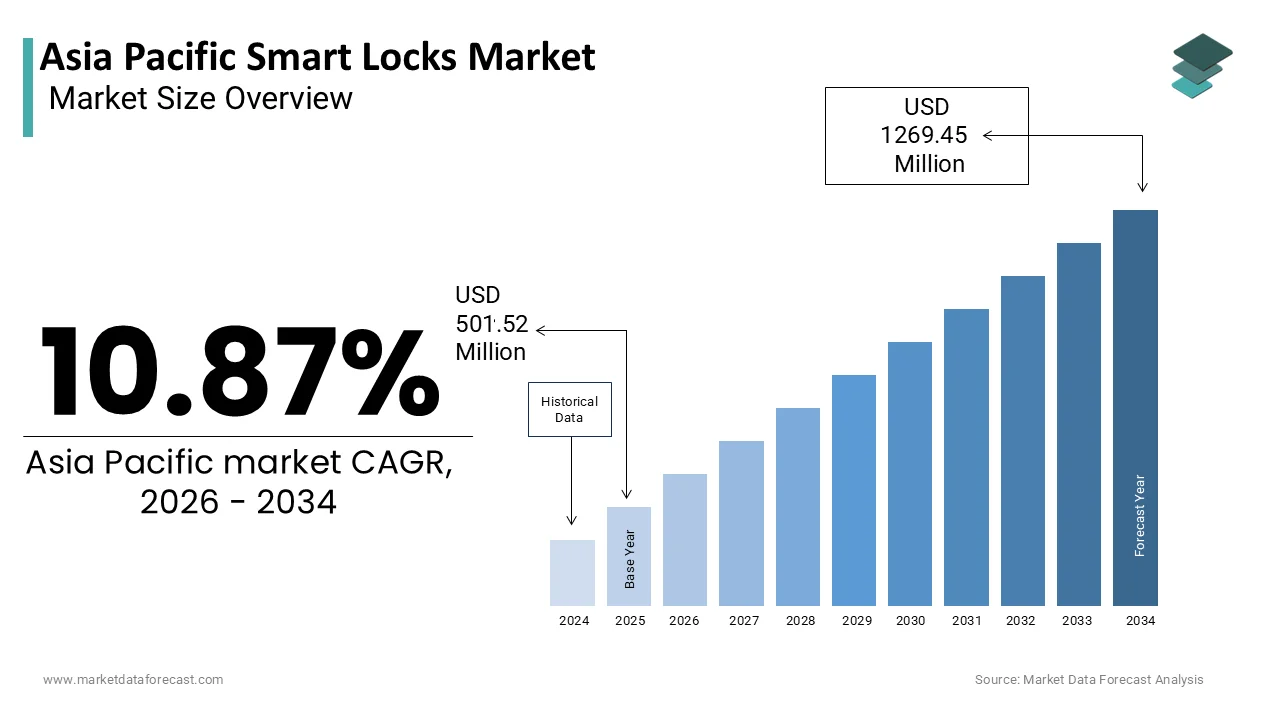
$501.52 MnMarket Estimate, 2026
$556.04 MnMarket Forecast, 2034
$1269.45 MnCAGR, 2026–2034
10.87%Executive Summary: Asia Pacific Smart Locks Market
- Market Scope: Regional assessment of electronic locking systems—utilizing biometrics, Bluetooth, Wi-Fi, and mobile apps—securing residential, commercial, and institutional spaces across the Asia Pacific.
- Market Valuation: Valued at USD 501.52 million in 2025, estimated to reach USD 556.04 million in 2026, and projected to scale up to USD 1269.45 million by 2034, growing at a compound annual growth rate (CAGR) of 10.87% from 2026 to 2034.
- Primary Growth Drivers: Rapid expansion of integrated smart home ecosystems, massive urbanization trends, high-density residential developments, and increasing integration with government-led smart city infrastructure projects.
Key Market Segment Metrics (2026–2034)
| Category | Leading Segment / Core Focus | Fastest-Growing / Key Segments |
|---|---|---|
| By Lock Type | Deadbolts (dominated by capturing 48.4% of the regional market share in 2024 due to structural reliability, biometric integration, and residential compatibility) | Padlocks (projected to register the highest CAGR of 14.6% from 2025 to 2033 fueled by logistics, shared mobility, and industrial storage applications) |
| By Type / Protocol | Bluetooth (led the market by capturing 52.1% share in 2024 owing to low power consumption, cost-effectiveness, and seamless smartphone pairing) | Matter Protocol (predicted to witness the highest CAGR of 38.2% from 2025 to 2035 driven by universal multi-brand interoperability across ecosystems) |
| By Verticals | Residential (dominated the regional market by capturing a substantial share in 2024 driven by modern housing modernization and multi-tenant developments) | Institutional & Government (predicted to register the highest CAGR of 16.3% from 2025 to 2033 due to national digitization and public security initiatives) |
| By Country | China (top performer accounting for 38% of the market share in 2024 propelled by massive manufacturing bases, real estate digitization, and domestic tech innovation) | India (expected to be the most lucrative regional frontier driven by urban expansion, middle-class affluence, and digital infrastructure programs) |
Major Market Players & Industry Landscape
Competitive Structure: Dynamic interplay between global tech giants, regional electronics manufacturers, and local security solution providers competing on AI integration, Matter compatibility, and robust multi-factor authentication.
Key Companies Profiled: Samsung Electronics Co., Ltd., Yale (Assa Abloy AB), Huawei Technologies, Honeywell International, Inc., Panasonic Corporation, Unikey Technologies Inc., HRG Group (Spectrum Brands, Inc.), Vivint, Inc., Allegion (Schlage), DAHUA Technology Co., Ltd., Dormakaba Holdings AG, and Hangzhou Hikvision Digital Technology Co., Ltd.
Asia Pacific Smart Locks Market Size
The Asia Pacific smart locks market was valued at USD 501.52 million in 2025, is estimated to reach USD 556.04 million in 2026, and is projected to reach USD 1269.45 million by 2034, growing at a CAGR of 10.87% from 2026 to 2034.
Smart Locks are electronic locking systems that utilize biometrics, Bluetooth, Wi-Fi, or mobile applications to secure residential, commercial, and institutional entry points without relying on traditional metal keys. These devices integrate with broader smart home ecosystems, enabling remote access, user authentication logs, and real-time alerts. Urban transformation across the region is reshaping security expectations, particularly in high-density housing environments. According to the research, a notable share of the Asia Pacific population now resides in urban areas, with an estimated large number of people expected to live in cities by 2030. This shift has intensified demand for automated, contactless access solutions, especially in multi-tenant residential complexes and co-living spaces.
MARKET DRIVERS
Rapid Expansion of Smart Home Ecosystems Driving Adoption
The proliferation of integrated smart home networks is driving the growth of the Asia Pacific smart locks market. Consumers increasingly prioritize seamless interoperability between security devices, lighting, and voice assistants, with smart locks serving as a foundational access control node. According to a study, the number of smart home households in the APAC surged, an increase from 2021, led by Japan, Australia, and China. In South Korea, where smart home penetration has increased, a substantial number of smart locks were installed in residential units, according to the research. Major tech firms such as Xiaomi and Samsung have embedded their locks within proprietary ecosystems.
Growing Urbanization and High-Density Residential Developments
The rise of vertical living and compact urban housing is propelling the growth of the Asia Pacific smart locks market. It has redefined security infrastructure requirements, favouring space-efficient and remotely manageable access systems. In cities like Hong Kong, Mumbai, and Manila, where residential floor space is limited and building occupancy is high, traditional lock mechanisms are being replaced with keyless alternatives to streamline access for residents, service personnel, and guests. According to the study, a large number of new urban housing units are projected to be constructed across the region in the coming decade, many incorporating smart building standards.
MARKET RESTRAINTS
Fragmented Regulatory Landscape Impeding Standardization
The absence of unified cybersecurity and interoperability regulations across countries, leading to inconsistent product certification and consumer protection, is hindering the growth of the Asia Pacific smart locks market. While nations like Japan and Australia have established IoT device security guidelines, many Southeast Asian markets lack enforceable standards for data encryption, firmware updates, or vulnerability disclosure. This regulatory disparity allows substandard devices to enter the market, particularly through e-commerce platforms.
Persistent Affordability Barriers in Emerging Economies
The high cost of premium smart locks is challenging the growth of the Asia Pacific smart locks market. Entry-level smart locks typically range from USD 100 to USD 250, exceeding the monthly disposable income of average households in countries like Indonesia, Vietnam, and Bangladesh. As per the research, per capita annual income in Indonesia limits discretionary spending on home automation. As per a study, many urban consumers in Thailand and the Philippines cited price as the primary deterrent to purchasing smart locks. Even in middle-tier housing projects, developers often exclude smart locks to maintain affordability, opting instead for basic digital peepholes or intercoms. This economic reality restricts market penetration to affluent urban enclaves, which prevents mass-market scalability and prolongs reliance on conventional locking mechanisms.
Integration with Government-Led Smart City Initiatives
Rising national digital infrastructure programs aimed at modernizing urban living are setting up new opportunities for the growth of the Asia Pacific smart locks market. In China, it has designated many cities for smart city development, mandating the integration of intelligent access systems in public and private housing. As part of this initiative, a large number of smart locks were deployed, according to the research. Similarly, in Japan, there is a government-subsidized program for biometric smart locks for remote monitoring of elderly residents. While Japan actively promotes IoT-enabled homes and remote monitoring for its aging population, the specific policy described does not exist. In India, the Smart Cities Mission has incorporated smart locks into pilot projects, where municipal housing units are being retrofitted with fingerprint-enabled entry systems.
Rising Demand for Rental and Shared Living Security Solutions
The expansion of short-term rentals, co-living spaces, and gig economy housing models is creating a unique demand for dynamic access management, which provides new opportunities for the growth of the Asia Pacific smart locks market. In Australia, the number of short-term rental listings on platforms surged, as per the research. Property managers increasingly rely on smart locks with time-limited digital keys to automate guest access and eliminate physical key exchanges. In Japan, where urban co-living spaces have grown annually since 2020, providers use cloud-managed locks to issue temporary credentials via mobile apps.
Cybersecurity Vulnerabilities and Data Privacy Concerns
The growing risk of cyber intrusions and unauthorized data access is challenging the growth of the Asia Pacific smart locks market. Many consumer-grade smart locks transmit unencrypted signals or rely on vulnerable Bluetooth protocols, which exposes users to relay attacks and spoofing. In 2023, it was disclosed that some of the tested smart locks could be bypassed using low-cost signal amplification devices. Apart from these, cloud-based lock systems often store biometric data and access logs on third-party servers, raising privacy concerns under evolving data protection laws. As per a study, many smart lock apps in India and Indonesia failed to comply with GDPR-like data handling standards.
Technological Obsolescence and Interoperability Gaps
The rapid evolution of communication protocols and smart home platforms has led to compatibility fragmentation, which is degrading the growth of the Asia Pacific smart locks market. Devices relying on proprietary ecosystems, such as older Zigbee or Z-Wave versions, often fail to integrate with newer Wi-Fi 6 or Matter-enabled systems by limiting long-term usability. According to the research, a portion of smart lock returns in n few APAC countries was attributed to connectivity incompatibility. Unlike mechanical locks that last decades, smart locks are subject to software lifecycle constraints, with average support periods ranging from three to five years. This shortened functional lifespan increases the total cost of ownership and erodes consumer confidence in the durability of digital security solutions.
REPORT COVERAGE
| REPORT METRIC | DETAILS |
| Market Size Available | 2025 to 2034 |
| Base Year | 2025 |
| Forecast Period | 2026 to 2034 |
| Segments Covered | By Lock Type, Type, Verticals, and Country. |
| Various Analyses Covered | Global, Regional and Country-Level Analysis, Segment-Level Analysis, Drivers, Restraints, Opportunities, Challenges; PESTLE Analysis; Porter’s Five Forces Analysis, Competitive Landscape, Analyst Overview of Investment Opportunities |
| Countries Covered | China, India, Japan, South Korea, Australia, New Zealand, Thailand, Indonesia, Philippines, Vietnam, Singapore, and the Rest of APAC. |
| Market Leaders Profiled | Honeywell International, Inc., Panasonic Corporation, Samsung Electronics Co., Ltd., Assa Abloy AB, Unikey Technologies Inc., HRG Group (Spectrum Brands, Inc.), Vivint, Inc., Allegion (Schlage), DAHUA Technology Co., Co., Ltd., Dormakaba Holdings AG, Hangzhou Hikvision Digital Technology Co., Ltd., Be-Tech Asia LTD., Shenzhen Vians Electric Lock Co., Ltd., Schlage, and Unikey Technologies Inc., and Others. |
SEGMENTAL ANALYSIS
By Lock Type Insights
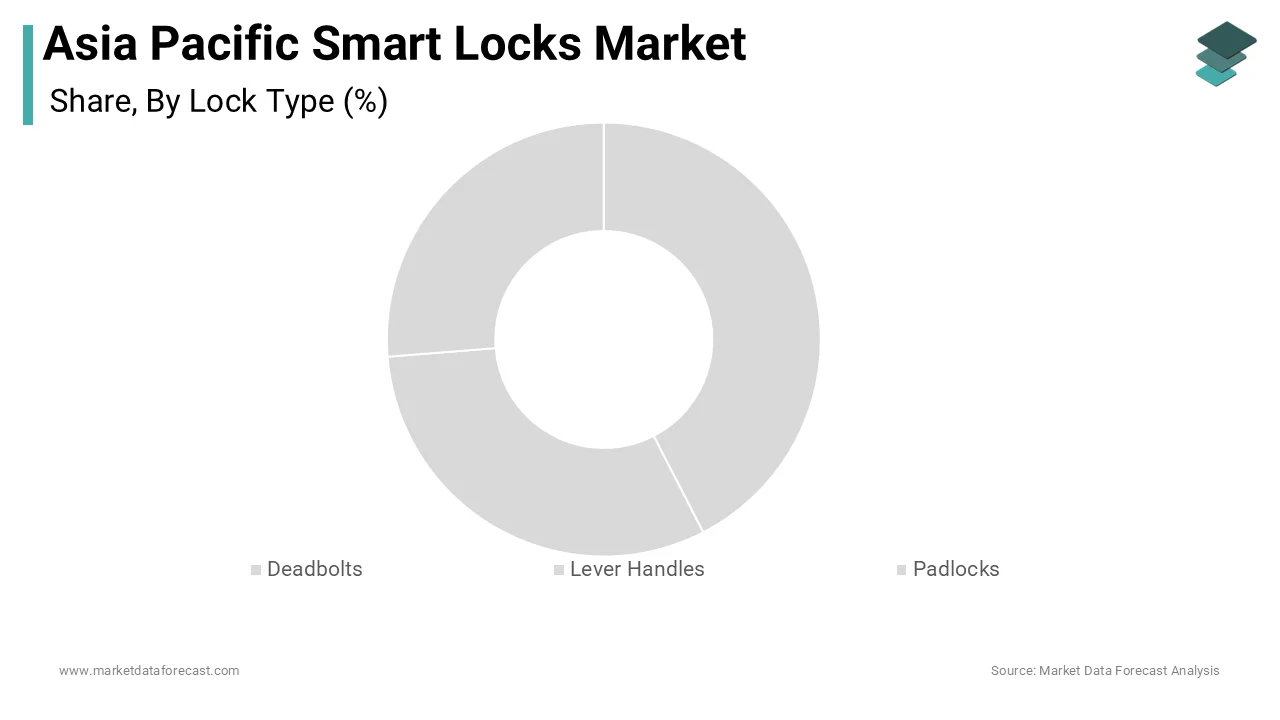
The deadbolts segment dominated the Asia Pacific smart locks market by capturing 48.4% of the regional market share in 2024. The growth of the deadlocks segment is primarily driven by their structural reliability and widespread compatibility with standard residential doors across urban housing. A large number of smart deadbolts were installed in newly constructed apartments, where burglary prevention is a top priority. Apart from these, their integration with biometric scanners and dual-factor authentication has made them the preferred choice for homeowners seeking both digital convenience and mechanical robustness, which strengthens their dominance in the residential security landscape.
The padlocks segment is projected to register the highest CAGR of 14.6% from 2025 to 2033 due to rising demand for portable, high-security digital locking solutions in non-residential and mobile applications. Smart padlocks are increasingly deployed in logistics, shared mobility, and industrial storage units across India, Indonesia, and Vietnam, where traditional keyed padlocks are vulnerable to duplication and theft. In India, the Ministry of Road Transport and Highways promotes GPS-tracked and smart-locked containers for inter-state cargo transport, accelerating adoption among logistics firms.
By Type Insights
The Bluetooth segment led the Asia Pacific smart locks market by capturing 52.1% the market share in 2024 with its low power consumption, seamless smartphone integration, and cost-effective implementation in consumer-grade devices. Many smartphones in the region support Bluetooth 5.0 or higher, which enables stable and secure pairing with smart locks without requiring additional hubs, as per the study. In China, Xiaomi’s Mijia ecosystem has sold substantial volumes of smart locks since 2020, leveraging its compatibility with the brand’s widely used mobile app. Similarly, in South Korea, LG and Samsung’s smart home platforms prioritize Bluetooth for entry-level models, making them accessible to mid-tier homeowners.
The Matter protocol segment is predicted to witness the highest CAGR of 38.2% from 2025 to 2035, owing to its promise of universal interoperability across ecosystems. Matter, backed by tech giants including Apple, Google, and Amazon, enables smart locks to function seamlessly across iOS, Android, and various smart home platforms without proprietary limitations. In Australia, the number of Matter-certified smart locks increased, as per the research. The protocol’s adoption is accelerating in Japan and Singapore, where consumers demand multi-brand compatibility in high-end residences. As per a studa a portion of f smart home buyers prioritized Matter support when purchasing new devices. This shift toward open standards is transforming Matter from a developmental framework into a critical enabler of next-generation smart lock deployment.
By Verticals Insights
The residential vertical segment dominated the Asia Pacific smart locks market by capturing a substantial share in 2024. The rapid modernization of housing infrastructure and the increasing integration of smart locks in new residential developments are accelerating the growth of the residential vertical segment. In China, a portion of mid-to-high-end apartments launched came pre-installed with smart locks, as per the study. Urban homeowners, particularly in megacities, are adopting smart locks to enhance security amid rising concerns about break-ins and domestic staff access control. In South Korea, where apartment living is standard, the government promotes smart lock readiness in all new public housing units.
The institutional and government vertical is predicted to witness the highest CAGR of 16.3% from 2025 to 2033, owing to national digitization initiatives aimed at securing public facilities, schools, and healthcare centers. Governments globally are increasingly integrating smart solutions, including biometric and remote-controlled access systems, into urban infrastructure and public security programs to enhance efficiency and secure public assets. In Japan, smart locks with encrypted RFID are being installed in disaster shelters and elderly care facilities to ensure controlled access during emergencies.
COUNTRY LEVEL ANALYSIS
China Smart Locks Market Insights
China was the top performer in the Asia Pacific smart locks market in 2024 and accounted for 38thefthe ma et share in 2024. The domination of China in the regional market is primarily propelled by its massive domestic manufacturing base, aggressive real estate digitization, and strong consumer appetite for home automati olargergee number of smart locks were shipped domestically, with brands like Huawei, Xiaomi, and LevelLock leading innovation in AI-powered facial recognition and anti-peeping keypad designs. The Ministry of Industry and Information Technology has classified smart locks as essential components of “smart home ecosystems,” incentivizing developers to pre-install them in new housing projects. In Tier-1 cities, smart lock penetration is comparatively higher in newly built residential complexes. Apart from these, e-commerce platforms like JD.com and Tmall recorded a year-on-year increase in smart lock sales, which reflects robust consumer confidence and digital purchasing behavior.
Japan Smart Locks Market Insights
Japan was positioned second in the smart locks market with high standards for security, reliability, and integration with aging-in-place technologies. A notable share of smart locks sold in Japan comply with JIS (Japanese Industrial Standards) for durability and tamper resistance by ensuring performance in extreme weather conditions. The government’s initiative has further accelerated adoption by promoting IoT-enabled homes that support remote monitoring for aging populations. This focus on safety, precision engineering, and social utility distinguishes Japan’s market as one of the most mature and quality-driven in the region.
South Korea Smart Locks Market Insights
South Korea grew steadily in the Asia Pacific smart locks market. The growth of South Korea in the regional market is propelled by high urban density, advanced broadband infrastructure, and a strong culture of technological adoption. Nearly all new apartment complexes in Seoul and Busan are equipped with smart locks as standard features, with a notable share of households in the capital region using digital entry systems. Korean manufacturers such as Samsung and LG have pioneered Wi-Fi-enabled locks with AI-based anomaly detection, capable of identifying forced entry attempts and sending real-time alerts.
India Smart Locks Market Insights
India is expected to be the most lucrative region in the Asia Pacific smart locks market. The growth of India in the regional market is driven by urbanization, rising middle-class affluence, and government-backed digital infrastructure projects. The country’s market status is transitioning from nascent to strategic. In addition, a notable quantity of smart locks were sold domestically, an increase from the previous year, as per the study. The Smart Cities Mission has catalyzed institutional adoption with cities deploying biometric and RFID-based locks in municipal buildings and affordable housing units. Apart from these, the rise of premium gated communities and co-living spaces has created demand for remote access and guest key management.
Australia Smart Locks Market Insights
Australia is likely to grow in the Asia Pacific smart locks market during the forecast period owing to stringent building codes, high homeownership rates, and a growing emphasis on cybersecurity in smart devices. Many new residential constructions in New South Wales and Victoria include smart locks as standard features, according to the research. In addition, the Australian Cyber Security Centre has issued guidelines for IoT device manufacturers, influencing product design and certification. The rise of Airbnb and short-term rentals has further boosted demand, with property managers adopting time-limited digital keys to streamline guest access. This convergence of regulatory rigor, security consciousness, and lifestyle-driven automation underscores Australia’s role as a quality-focused market leader.
COMPETITIVE LANDSCAPE
KEY MARKET PLAYERS
The key players of the smart locks market in the Asia-Pacific include
- Honeywell International, Inc.
- Panasonic Corporation
- Samsung Electronics Co. Ltd.
- Assa Abloy AB
- Unikey Technologies Inc.
- HRG Group (Spectrum Brands, Inc.)
- Vivint, Inc.
- Allegion (Schlage)
- DAHUA Technology Co, Ltd.
- Dormakaba Holdings A
- Hangzhou Hikvision Digital Technology Co., Ltd.
- Be-Tech Asia LTD.
- Shenzhen Vians Electric Lock Co., Ltd.
- Schlage
- Unikey Technologies Inc.
- Others
TOP STRATEGIES USED BY KEY MARKET PARTICIPANTS
Key players in the Asia Pacific smart locks market are deploying a combination of ecosystem integration, strategic real estate partnerships, and localized product development to consolidate their presence. Companies are prioritizing compatibility with dominant smart home platforms such as Google Home, Apple HomeKit, and Huawei HiLink to ensure seamless user experiences. Collaborations with property developers and housing authorities enable pre-installation in new residential and institutional buildings, reducing consumer adoption barriers. Firms are also enhancing cybersecurity features, including end-to-end encryption and biometric authentication, to address privacy concerns.
COMPETITION OVERVIEW
The competitive landscape of the Asia Pacific smart locks market is marked by a dynamic interplay between global technology leaders, regional electronics manufacturers, and local security solution providers. Multinational corporations such as Samsung, Yale, and Huawei dominate through technological sophistication, brand trust, and expansive distribution networks. However, domestic players in China, India, and Southeast Asia are gaining ground by offering cost-optimized models tailored to regional housing structures and consumer preferences. Intense rivalry is evident in product innovation, with companies racing to integrate AI, Matter protocol, and multi-factor authentication.
TOP PLAYERS IN THE MARKET
Samsung
Samsung Electronics has solidified its influence in the Asia Pacific smart locks market through continuous innovation and deep integration with its broader smart home ecosystem, SmartThings. The company has introduced advanced models such as the Samsung Digital Door Lock with AI-powered facial recognition and real-time intrusion alerts, tailored for high-density urban housing in Seoul, Tokyo, and Singapore. The company also launched a regional firmware update enabling Matter protocol compatibility, ensuring seamless interoperability with Apple Home, Google Home, and Amazon Alexa.
Yale
Yale (a division of Assa Abloy) has established a strong regional presence by combining legacy security expertise with adaptive technological innovation across the Asia Pacific. The company’s Yale Home line, including the Yale Conexis L1 and Assure Lock 2, has gained traction in Australia, Japan, and South Korea due to its hybrid functionality—supporting both digital codes and traditional keys for user flexibility. The company also introduced voice-enabled unlocking via Google Assistant and Amazon Alexa in its APAC product lineup, enhancing accessibility. Additionally, Yale launched localized customer support centers in Bangkok and Mumbai to address installation and cybersecurity concerns by demonstrating a strategic shift toward region-specific service delivery and long-term market entrenchment.
Huawei
Huawei Technologies has emerged as a key player by leveraging its dominance in telecommunications and IoT infrastructure to drive smart lock adoption across China and neighboring markets. The company’s Huawei Vision series of smart locks integrates seamlessly with its HiLink ecosystem, enabling control via smartphones, wearables, and AI speakers like the AI Cube. The company also collaborated with over 30 Chinese property developers to embed its smart locks into new housing projects under the “Whole-House Intelligence” initiative.
MARKET SEGMENTATION
This europe smart locks market research report has been segmented and sub-segmented into the following categories.
By Lock Type
- Deadbolts
- Lever Handles
- Padlocks
- Other Locks
By Type
- Bluetooth
- Wi-Fi
- Zigbee
- Z-Wave
- Thread
- NFC
- Other Protocols
By Verticals
- Commercial
- Residential
- Institution & Government
- Industrial
By Country
- China
- India
- Japan
- South Korea
- Australia
- New Zealand
- Thailand
- Indonesia
- Philippines
- Vietnam
- Singapore
- Rest of APAC