- Product Description Description
- Table of Contents TOC
- List of Table & Figure LOT
- Get Free Sample PDF Sample PDF
Market Size, 2025
$59.74 BnMarket Estimate, 2026
$76.82 BnMarket Forecast, 2034
$574.65 BnCAGR, 2026–2034
28.60 BnAsia Pacific Stationary Battery Storage Market Size
The Asia Pacific Stationary Battery Storage Market size was valued at USD 59.74 billion in 2025 and is anticipated to reach USD 76.82 billion in 2026 from USD 574.65 billion by 2034, growing at a CAGR of 28.60% during the forecast period from 2026 to 2034.
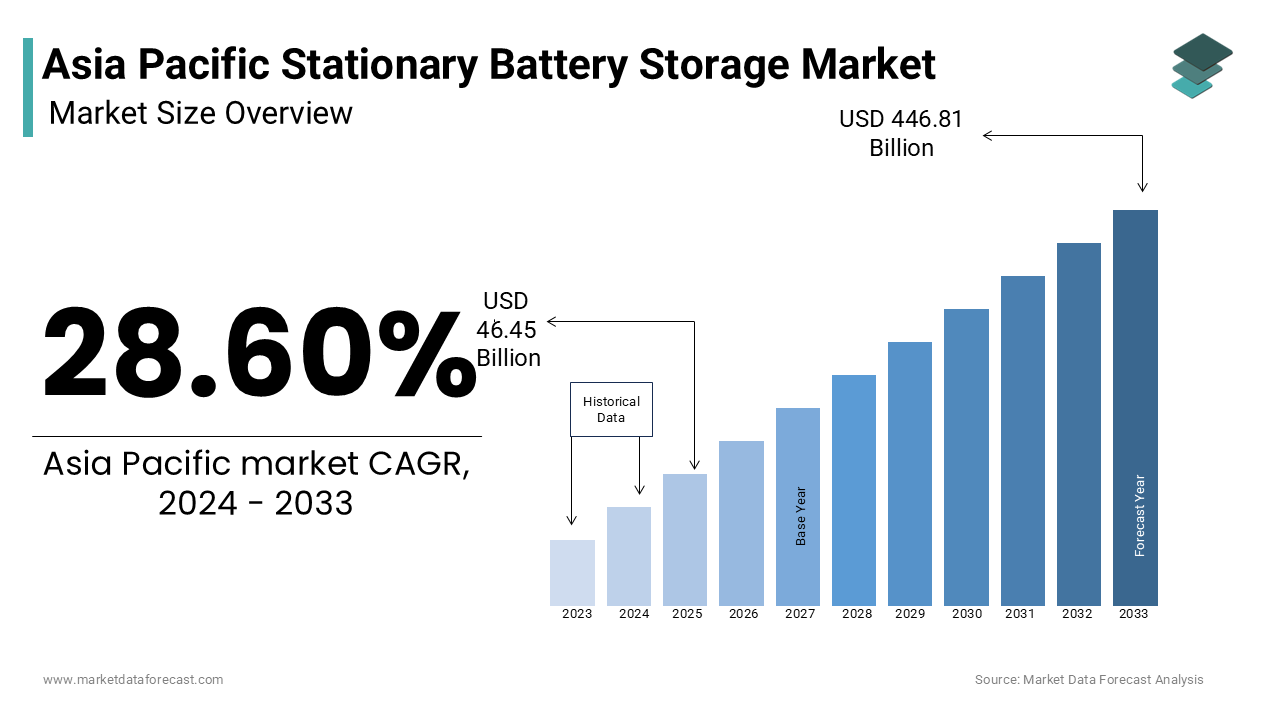
The stationary battery storage is the deployment of large-scale, non-mobile energy storage systems designed to support grid stability, integrate renewable energy, and manage peak demand across utility, industrial, and commercial applications. These systems, primarily based on lithium-ion, lead-acid, and emerging chemistries like sodium-ion and flow batteries, play a crucial role in modernizing energy infrastructure and enhancing energy security. With the increasing penetration of intermittent renewable energy sources such as solar and wind, stationary battery storage has become essential for balancing supply and demand, especially in densely populated and rapidly industrializing nations. According to the International Renewable Energy Agency (IRENA), Asia Pacific accounted for over 60% of global renewable energy capacity additions in 2025, creating a strong foundation for stationary storage adoption. In Japan, post-Fukushima energy policies have accelerated the deployment of battery-based energy systems.
MARKET DRIVERS
Expansion of Renewable Energy Capacity
The rapid expansion of renewable energy capacity such as solar and wind power is propelling the growth of the Asia Pacific stationary battery storage market. These intermittent energy sources require grid-scale storage solutions to ensure consistent power supply and mitigate fluctuations. In China, the National Energy Administration reported that solar PV capacity reached 530 GW in 2025, up from 430 GW in 2022, which necessitated large-scale battery integration to manage surplus generation and stabilize the grid.
Government Incentives and Policy Support
The growing policy support and financial incentives provided by governments to promote clean energy and grid modernization is additionally to fuel the growth of the Asia Pacific stationary battery storage market. China’s National Development and Reform Commission (NDRC) has mandated that several provinces integrate battery storage into new renewable energy projects, with a target of 30 GW of new energy storage capacity by 2025. South Korea’s Ministry of Trade, Industry and Energy has also launched a USD 400 million fund to support the development of domestic battery storage technologies and applications.
MARKET RESTRAINTS
High Capital Expenditure and Cost Volatility
The high initial capital expenditure and cost volatility associated with battery technologies are hindering the growth of the Asia Pacific stationary battery storage market. In countries like Indonesia and the Philippines, where grid infrastructure is still evolving, the upfront investment required for large-scale battery installations often exceeds available budget allocations. Additionally, the fluctuation in raw material prices, especially for lithium, cobalt, and nickel, adds to the financial uncertainty. As per the United States Geological Survey (USGS), lithium prices surged by over 400% in 2022 before stabilizing in early 2025, causing project delays and cost overruns across the region. In India, the Solar Energy Corporation of India (SECI) reported that several utility-scale battery storage tenders were canceled or postponed in 2025 due to pricing concerns.
Lack of Standardized Regulations and Market Frameworks
The lack of standardized regulations and frameworks that govern energy storage integration and operation is also hindering the growth of the Asia Pacific stationary battery storage market. According to the International Energy Agency (IEA), only a few countries in the region have established clear regulatory guidelines for energy storage participation in wholesale electricity markets, grid services, and ancillary applications. In India, the Central Electricity Regulatory Commission (CERC) has only recently begun drafting regulations for energy storage participation in the national power market, delaying project approvals and investor confidence. Similarly, in Australia, the Australian Energy Market Operator (AEMO) has noted that the absence of uniform pricing mechanisms for grid-scale battery services has led to inefficiencies in revenue generation and asset utilization.
MARKET OPPORTUNITIES
Integration with Microgrids and Off-Grid Power Systems
Its integration with microgrids and off-grid power systems in remote and island communities is greatly influencing the growth of the Asia Pacific stationary battery storage market. According to the International Renewable Energy Agency (IRENA), over 60 million people in the Asia Pacific region still lack access to reliable electricity, especially in rural areas of Indonesia, the Philippines, Papua New Guinea, and parts of India. In response, governments and private companies are increasingly deploying hybrid renewable energy systems combined with battery storage to provide stable and sustainable power.
Digitalization and Smart Grid Applications
The increasing digitalization of power systems and the expansion of smart grid applications offer a substantial opportunity for the Asia Pacific stationary battery storage market expansion. According to McKinsey & Company, the integration of AI-driven energy management systems, IoT-enabled monitoring, and blockchain-based grid transactions is transforming how battery storage assets are deployed and optimized. Additionally, in Australia, the Australian Renewable Energy Agency (ARENA) has funded several projects that use machine learning to forecast energy storage needs and optimize discharge cycles. These advancements in digital infrastructure are not only improving the efficiency and responsiveness of battery systems but also opening new revenue streams through dynamic energy trading and grid services, which is boosting market growth.
MARKET CHALLENGES
Technical and Operational Complexity of Battery Systems
The technical and operational complexity associated with deploying and maintaining large-scale battery systems is negatively affecting the growth of the Asia Pacific stationary battery storage market. According to the Electric Power Research Institute (EPRI), battery performance varies based on factors such as ambient temperature, charge-discharge cycles, and system integration with existing grid infrastructure. In tropical countries like Thailand, Malaysia, and Indonesia, high ambient temperatures can reduce battery efficiency and lifespan, increasing maintenance costs and system downtime. Furthermore, the complexity of integrating battery systems with grid operators' dispatch mechanisms poses a challenge for real-time energy management. These technical hurdles require significant investment in training, system design, and adaptive control technologies to ensure the reliability and scalability of stationary battery storage across the Asia Pacific region.
Supply Chain and Raw Material Constraints
The vulnerability of supply chains and the availability of raw materials are expected to degrade the growth of the Asia Pacific stationary battery storage market. According to the International Energy Agency (IEA), the region is heavily dependent on a few countries for key battery components such as lithium, cobalt, and nickel, making the supply chain susceptible to geopolitical tensions and trade restrictions. China, for instance, controls over 60% of global lithium refining capacity, while Indonesia has emerged as a key supplier of nickel, which is essential for high-energy-density battery chemistries. As per the United States Geological Survey (USGS), disruptions in the supply of these materials such as those seen in 2022 due to mining restrictions and export policies can lead to price volatility and project delays. In South Korea, the Korea Battery Industry Association (KBIA) noted that supply chain bottlenecks contributed to a 20% increase in battery manufacturing costs in 2025. Additionally, in Japan, concerns over raw material availability have prompted companies like Panasonic and Toshiba to invest in recycling technologies and alternative chemistries.
REPORT COVERAGE
| REPORT METRIC | DETAILS |
| Market Size Available | 2025 to 2034 |
| Base Year | 2025 |
| Forecast Period | 2026 to 2034 |
| CAGR | 28.60% |
| Segments Covered | By Battery Type, Application and Country |
| Various Analyses Covered | Regional & Country Level Analysis, Segment-Level Analysis, DROC, PESTLE Analysis, Porter’s Five Forces Analysis, Competitive Landscape, Analyst Overview on Investment Opportunities |
| Countries Covered | India, China, Japan, South Korea, Australia, New Zealand, Thailand, Malaysia, Vietnam, the Philippines, Indonesia, Singapore, and the Rest of APAC. |
| Market Leaders Profiled | BYD, Contemporary Amperex Technology Co. Limited (CATL), Hitachi Energy, Hoppecke, Johnson Controls, LG Energy Solution, Panasonic Corporation, Samsung SDI, Siemens Energy, Tesla Inc., Toshiba Corporation, Sungrow Power Supply Co., Ltd., Gotion High-Tech, Delta Electronics Inc., NGK Insulators Ltd., and LG Chem. |
SEGMENTAL ANALYSIS
By Battery Type Insights
The Lithium-ion batteries segment dominated the Asia Pacific stationary battery storage market by accounting for significant share in 2025 with its superior energy density, longer cycle life, and declining manufacturing costs, making it the preferred choice for utility-scale and commercial energy storage applications. In China, the Ministry of Industry and Information Technology reported that lithium-ion battery production capacity reached 2.5 terawatt-hours in 2025, with over 40% allocated for stationary storage applications.
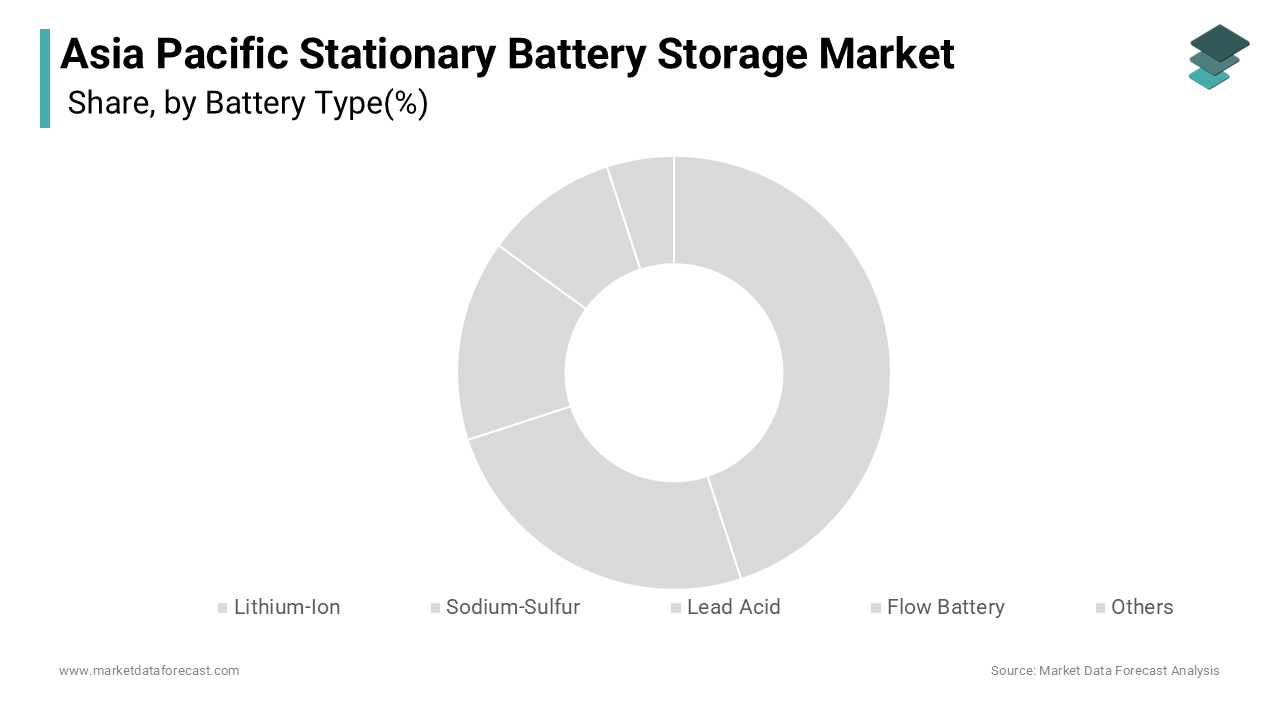
The flow batteries segment is swiftly emerging with an anticipated CAGR of 18.7% from 2026 to 2034 due to their suitability for long-duration energy storage applications, particularly in balancing renewable energy fluctuations and providing grid stability. According to the International Energy Agency (IEA), China alone accounted for over 60% of global vanadium redox flow battery installations in 2025, driven by government-backed energy storage projects. The National Development and Reform Commission (NDRC) of China mandated flow batteries for several 100 MW+ storage projects in Inner Mongolia and Gansu provinces to support wind and solar integration.
By Application Insights
The grid services segment was accounted in holding 55.4% of the Asia Pacific stationary battery storage market share in 2025. According to the International Renewable Energy Agency (IRENA), Asia Pacific accounted for over 60% of global renewable energy additions in 2025, necessitating advanced grid services to manage intermittency and maintain system stability. In China, the State Grid Corporation reported that over 20 GW of battery storage capacity was deployed for grid services in 2025, with a focus on integrating wind and solar power into the national grid. Similarly, in Australia, the Australian Energy Market Operator (AEMO) noted that large-scale battery installations contributed to over 35% of grid balancing services in 2025. In India, the Power Grid Corporation has integrated battery storage into several substation upgrades to manage peak demand and reduce transmission losses.
The frequency regulation segment is deemed to register a CAGR of 17.4% from 2026 to 2034 with the increasing need for real-time grid balancing as renewable energy penetration expands. According to the International Energy Agency (IEA), battery-based frequency regulation is significantly faster and more responsive than conventional methods, making it ideal for maintaining grid stability in high-renewable environments. In South Korea, the Korea Electric Power Corporation (KEPCO) has deployed over 500 MW of battery systems for frequency regulation since 2020, as reported by the Korea Energy Agency (KENEPA). In Japan, Tokyo Electric Power Company (TEPCO) has integrated lithium-ion battery systems into its grid operations to provide sub-second response times for frequency control.
REGIONAL ANALYSIS
China Stationary Battery Storage Market Analysis
China led the Asia Pacific stationary battery storage market by accounting for 35.3% of the market share in 2025. China has aggressively deployed battery storage to support grid stability and integrate solar and wind power as the world’s largest producer and consumer of renewable energy. According to the National Development and Reform Commission (NDRC), China installed over 18 GW of new battery storage capacity in 2025, surpassing its 2025 target of 30 GW ahead of schedule. The State Grid Corporation has mandated battery integration for new renewable projects, particularly in wind-rich provinces like Gansu and Inner Mongolia. Additionally, the Ministry of Industry and Information Technology reported that domestic battery manufacturers such as CATL and BYD have collectively expanded production capacity to over 2.5 terawatt-hours annually.
Australia Stationary Battery Storage Market Analysis
Australia was ranked second in the Asia Pacific stationary battery storage market by capturing 15.3% of share in 2025 with the abundant renewable energy resources and aging grid infrastructure have created a strong demand for battery-based grid support solutions. According to the Australian Energy Market Operator (AEMO), large-scale battery installations in the country grew by 85% in 2025 compared to the previous year. The Hornsdale Power Reserve, operated by Neoen and Tesla, has demonstrated the effectiveness of battery storage in frequency regulation and grid stabilization, leading to the deployment of additional projects in South Australia and New South Wales. The Australian Renewable Energy Agency (ARENA) has also funded several hybrid solar-battery projects to enhance energy security and reduce reliance on fossil fuels.
India Stationary Battery Storage Market Analysis
India stationary battery storage market is growing with prominent growth opportunities with the rising renewable energy expansion and grid modernization have fueled demand for battery-based storage solutions. According to the Central Electricity Authority (CEA), India aims to deploy 27 GW of battery storage capacity by 2030 to support its 500 GW renewable energy target. The Solar Energy Corporation of India (SECI) has initiated multiple tenders for hybrid renewable plus storage projects, with the first 2 GW of bids awarded in 2025. Additionally, the NITI Aayog has recommended the establishment of a national battery storage mission to accelerate domestic manufacturing and reduce import dependence.
Japan Stationary Battery Storage Market Analysis
Japan stationary battery storage market is likely to grow steadily in the next coming years. The country’s post-Fukushima energy policy shift toward renewables and decentralized power systems has driven the adoption of battery storage for grid support and emergency backup applications. According to the Ministry of Economy, Trade and Industry (METI), Japan added over 1.2 GW of battery storage capacity in 2025, with a focus on lithium-ion and sodium-ion technologies. The New Energy and Industrial Technology Development Organization (NEDO) has supported several pilot projects integrating battery storage with microgrids and virtual power plants. Additionally, major companies like Toshiba, Panasonic, and NEC have expanded their stationary battery offerings for commercial and utility-scale applications.
South Korea Stationary Battery Storage Market Analysis
South Korea stationary battery storage market is growing with the rising emphasis on smart grid development and energy transition policies has led to significant investments in battery storage infrastructure. According to the Korea Energy Agency (KENEPA), South Korea installed over 1.5 GW of battery storage in 2025, primarily for frequency regulation and peak load management. The Ministry of Trade, Industry and Energy has mandated that utilities procure battery storage systems to enhance grid reliability and support renewable integration. Leading companies such as LG Energy Solution, Samsung SDI, and SK On have expanded their production capacity to meet both domestic and export demand.
COMPETITIVE LANDSCAPE
The Asia Pacific stationary battery storage market is highly competitive, characterized by the convergence of global battery manufacturers, emerging regional players, and technology innovators. With increasing demand for renewable energy integration, grid modernization, and decentralized power solutions, companies are striving to differentiate themselves through technological advancements, strategic partnerships, and localized service offerings. Established players such as CATL, BYD, and LG Energy Solution leverage their manufacturing scale and R&D capabilities to dominate utility-scale deployments, while smaller firms focus on niche applications and modular storage systems. The market is also witnessing a surge in joint ventures, mergers, and acquisitions as companies seek to expand their regional footprint and enhance product portfolios. Governments across the region are promoting domestic battery manufacturing through policy incentives, further intensifying competition among local and international firms.
KEY MARKET PLAYERS
Some of the companies that are playing a dominating role in the Asia Pacific Stationary Battery Storage Market include
- BYD (Build Your Dreams)
- Contemporary Amperex Technology Co. Limited (CATL)
- Hitachi Energy
- Hoppecke
- Johnson Controls
- Philips
- LG Chem / LG Energy Solution
- Panasonic Corporation
- Samsung SDI
- Siemens Energy
- Tesla, Inc.
- Toshiba Corporation
- Sungrow Power Supply Co., Ltd.
- Gotion
- Delta Electronics, Inc.
- NGK Insulators, Ltd.
Top Players in the Asia Pacific Stationary Battery Storage Market
Contemporary Amperex Technology Co. Limited (CATL)
CATL is a dominant force in the Asia Pacific stationary battery storage market, offering advanced lithium-ion battery solutions tailored for grid-scale energy storage. The company plays a pivotal role in enabling renewable energy integration and grid stability across the region. CATL’s innovations in battery chemistry and system design have made it a preferred supplier for utility and industrial applications. Its strategic partnerships with global energy firms and extensive R&D initiatives have positioned it as a key contributor to the evolution of energy storage technologies worldwide.
BYD Company Ltd.
BYD is a major player in the stationary battery storage sector, known for its proprietary lithium iron phosphate (LFP) battery technology that offers high safety, long life, and stable performance. The company has been instrumental in deploying large-scale battery systems for renewable integration and microgrid applications across Asia Pacific. BYD’s commitment to sustainability and vertical integration in battery manufacturing has allowed it to deliver cost-effective and reliable energy storage solutions by strengthening its presence in both domestic and international markets.
LG Energy Solution
LG Energy Solution has established a strong foothold in the Asia Pacific stationary battery storage market through its high-performance lithium-ion batteries designed for utility and commercial use. The company has been actively involved in deploying battery systems for frequency regulation, peak shaving, and renewable energy storage. LG Energy Solution’s focus on product innovation, strategic collaborations, and localized manufacturing has reinforced its competitive edge and global market influence in the energy storage domain.
Top Strategies Used by Key Market Participants
Vertical Integration and In-House Manufacturing
Leading companies in the Asia Pacific stationary battery storage market are increasingly adopting vertical integration strategies to control raw material sourcing, production, and system deployment. This approach enhances cost efficiency, ensures supply chain resilience, and improves product quality, giving firms a competitive advantage in a rapidly evolving market.
Partnerships with Utilities and Renewable Energy Developers
Key players are forming strategic alliances with utility companies and renewable energy developers to integrate battery storage into new and existing energy projects. These partnerships enable seamless deployment of storage systems, enhance grid compatibility, and open new revenue streams through service-based energy management models.
Investment in R&D and Next-Generation Battery Technologies
To stay ahead in the competitive landscape, market leaders are heavily investing in research and development of advanced battery chemistries such as solid-state, sodium-ion, and flow batteries. These innovations aim to improve energy density, safety, and sustainability while addressing the limitations of current lithium-ion technologies.
RECENT MARKET DEVELOPMENTS
- In February 2024, CATL launched a new line of modular energy storage systems designed specifically for utility-scale applications in Southeast Asia, which is aiming to enhance deployment speed and adaptability across diverse grid conditions.
- In May 2024, BYD announced the establishment of a dedicated energy storage solutions division, focusing on integrated battery systems for commercial and industrial customers across the Asia Pacific region.
- In July 2024, LG Energy Solution partnered with a leading Japanese utility company to deploy a 100 MWh battery storage project in Hokkaido, which is supporting renewable integration and grid stability in northern Japan.
- In September 2024, a major South Korean battery manufacturer entered into a joint venture with an Australian energy firm to develop and operate large-scale battery storage projects across the National Electricity Market.
- In November 2024, a leading Chinese battery storage solutions provider initiated a strategic collaboration with an Indian renewable energy developer to co-develop hybrid solar-plus-storage projects in India’s emerging green energy corridors.
MARKET SEGMENTATION
This research report on the Asia Pacific Stationary Battery Storage Market is segmented and sub-segmented based on categories.
By Battery Type
- Lithium-Ion
- Sodium-Sulfur
- Lead Acid
- Flow Battery
- Others
By Application
- Grid Services
- Frequency Regulation
- Off-Grid
By Country
- India
- China
- Japan
- South Korea
- Australia
- New Zealand
- Thailand
- Malaysia
- Vietnam
- Philippines
- Indonesia
- Singapore
- Rest of APAC