- Product Description Description
- Table of Contents TOC
- List of Table & Figure LOT
- Get Free Sample PDF Sample PDF
Market Size, 2025
$5.20 BnMarket Estimate, 2026
$5.36 BnMarket Forecast, 2034
$6.86 BnCAGR, 2026–2034
3.13%Asia Pacific Stents Market Size
The size of the Asia Pacific stents market was valued at USD 5.20 billion in 2025. This market is expected to grow at a CAGR of 3.13% from 2026 to 2034 and be worth USD 6.86 billion by 2034 from USD 5.36 billion in 2026.

Stents are small, mesh-like medical devices typically used to treat narrowed or weakened arteries in the cardiovascular system. They play a critical role in interventional cardiology in procedures such as percutaneous coronary intervention (PCI), where they help maintain blood flow and prevent arterial collapse. In recent years, the Asia Pacific stents market has gained significant momentum due to rising prevalence of cardiovascular diseases, increasing healthcare expenditure, and growing adoption of advanced treatment modalities. Government initiatives aimed at improving access to healthcare services and increasing awareness about early diagnosis are further contributing to market expansion.
MARKET DRIVERS
Rising Prevalence of Cardiovascular Diseases
The escalating burden of cardiovascular diseases (CVDs) is propelling the growth of the Asia Pacific stents market. These conditions, including coronary artery disease, heart failure, and stroke, are becoming increasingly prevalent due to sedentary lifestyles, poor dietary habits, and rising obesity rates. According to the World Heart Federation, more than 18 million people die from CVDs globally each year, with a significant proportion of these cases occurring in the Asia Pacific region. In countries such as India and China, the incidence of ischemic heart disease has surged dramatically. The Indian Council of Medical Research reports that heart diseases now affect over 50 million Indians, with a notable rise in younger populations. Furthermore, the growing number of percutaneous coronary interventions (PCIs) performed across hospitals in the region supports this trend.
Technological Advancements in Stent Design and Materials
Another key driver propelling the Asia Pacific stents market is the rapid pace of technological innovation in stent design and materials. Manufacturers are investing heavily in research and development to introduce next-generation stents that offer superior biocompatibility, reduced restenosis rates, and enhanced procedural success. Drug-eluting stents (DES), for example, have largely replaced bare-metal stents (BMS) due to their ability to release medication that prevents re-narrowing of the artery. Japan and South Korea lead the region in adopting these advanced technologies. As per the Japanese Circulation Society, over 90% of coronary stents used in Japan are drug-eluting varieties. Additionally, clinical trials conducted in Australia and Singapore have demonstrated favorable outcomes for BVS, encouraging broader adoption.
MARKET RESTRAINTS
High Cost of Advanced Stent Procedures
One major restraint affecting the Asia Pacific stents market is the high cost associated with advanced stent procedures. While technological innovations have improved clinical outcomes, they have also significantly increased the overall treatment expense. For instance, drug-eluting stents (DES) can cost up to three times more than traditional bare-metal stents (BMS), which is making them less accessible to low-income populations. In countries such as India and Indonesia, where a large portion of the population lacks comprehensive health insurance coverage, affordability remains a critical barrier. According to the World Bank, nearly 60% of healthcare expenses in India are out-of-pocket, discouraging patients from opting for expensive cardiac interventions. Additionally, the need for prolonged dual antiplatelet therapy (DAPT) following stent placement adds to the financial burden on patients. As per a study published by the Asian Pacific Society of Cardiology, post-procedural medication costs can account for up to 30% of the total treatment expenditure.
Stringent Regulatory Frameworks and Clinical Trial Delays
Stringent regulatory requirements and prolonged approval timelines for new stent technologies are another significant constraint on the Asia Pacific stents market. For instance, in China, the National Medical Products Administration (NMPA) requires extensive local clinical data before approving novel stent products. Similarly, in India, regulatory reforms under the Central Drugs Standard Control Organization (CDSCO) have introduced stricter norms for device approvals, increasing compliance costs for manufacturers.
MARKET OPPORTUNITIES
Expansion of Healthcare Infrastructure in Emerging Economies
A significant opportunity for the Asia Pacific stents market lies in the ongoing expansion of healthcare infrastructure across emerging economies. Governments in countries such as India, Indonesia, and the Philippines are investing heavily in modernizing hospitals, upgrading catheterization labs, and enhancing diagnostic capabilities, all of which are essential for performing stent-based interventions. India, for example, launched the Ayushman Bharat scheme in 2018, aiming to provide health coverage to over 500 million citizens. As per the Ministry of Health and Family Welfare, this initiative has led to a 40% increase in hospital admissions for cardiac care since its inception. Moreover, private healthcare providers are playing a pivotal role in infrastructure development. Apollo Hospitals and Fortis Healthcare in India, along with Parkway Pantai in Singapore, have expanded their cardiac care units to accommodate the growing number of angioplasty procedures.
Increasing Medical Tourism and Cross-Border Patient Flow
Medical tourism has become a lucrative avenue for the Asia Pacific stents market, driven by the availability of high-quality yet cost-effective cardiac care in select countries. Nations such as Thailand, Malaysia, India, and Singapore have emerged as preferred destinations for international patients seeking affordable and timely cardiovascular treatments. Thailand, for instance, attracts over 4 million medical tourists annually, with cardiology being among the top specialties, according to the Public Health Department of Thailand. The cost of stent implantation in Bangkok is often 60–70% lower than in Western countries, while maintaining global standards of care. India has also capitalized on this trend through initiatives like the Medical Visa Scheme, allowing foreign nationals to access specialized treatments.
MARKET CHALLENGES
Limited Reimbursement Coverage for Stent Procedures
One of the most pressing challenges facing the Asia Pacific stents market is the limited reimbursement coverage for stent-related procedures, particularly in developing economies. In countries like the Philippines and Vietnam, public health insurance schemes provide partial reimbursement for stent procedures, often excluding newer technologies such as bioresorbable vascular scaffolds (BVS). According to the Philippine Health Insurance Corporation (PhilHealth), reimbursement for coronary angioplasty typically covers only basic stent types, forcing patients to pay out-of-pocket for premium options.
In India, although the Ayushman Bharat scheme offers coverage for angioplasty, the reimbursement rates are often insufficient to cover the full cost of advanced stents and medications. As per a study published in the Journal of the American College of Cardiology, nearly 40% of Indian patients undergoing stenting had to make additional payments beyond what was reimbursed.
Shortage of Skilled Interventional Cardiologists and Trained Personnel
Another critical challenge impeding the growth of the Asia Pacific stents market is the shortage of skilled interventional cardiologists and trained personnel required to perform complex stent procedures. In countries like Bangladesh and Nepal, there is a severe deficit of trained interventional cardiologists. According to the Bangladesh Cardiac Society, the country has fewer than 200 interventional cardiologists for a population exceeding 160 million. This disparity severely limits the capacity to perform stent implantations, even when devices and infrastructure are available. Even in more developed markets such as China and India, the distribution of expertise is highly concentrated in urban centers. Rural areas often lack access to specialists, leading to delayed treatment and suboptimal patient outcomes. Moreover, training programs for interventional cardiology remain limited in several Asia Pacific nations. According to the Asia Pacific Heart Rhythm Society, only 10–15% of cardiologists receive formal training in advanced interventional techniques. This skills gap restricts the scalability of stent usage and hinders the market’s ability to meet growing clinical demand.
REPORT COVERAGE
| REPORT METRIC | DETAILS |
| Market Size Available | 2025 to 2034 |
| Base Year | 2025 |
| Forecast Period | 2026 to 2034 |
| Segments Covered | By Product, Material, End Use, and Region. |
| Various Analyses Covered | Global, Regional and Country-Level Analysis, Segment-Level Analysis, Drivers, Restraints, Opportunities, Challenges; PESTLE Analysis; Porter’s Five Forces Analysis, Competitive Landscape, Analyst Overview of Investment Opportunities |
| Countries Covered | India, China, Japan, South Korea, Australia, New Zealand, Thailand, Malaysia, Vietnam, Philippines, Indonesia, Singapore, Rest of APAC |
| Market Leaders Profiled | Abbott Laboratories, B. Braun Melsungen AG, Biotronik SE & Co. KG, Biosensors International Group Ltd., Boston Scientific Corporation, Elixir Medical Corporation, Medtronic Plc, Meril Life Sciences, MicroPort Scientific Corporation, Stryker, Terumo Corporation, W. L. Gore & Associates, and BD (Becton, Dickinson and Company). |
SEGMENTAL ANALYSIS
By Product Insights
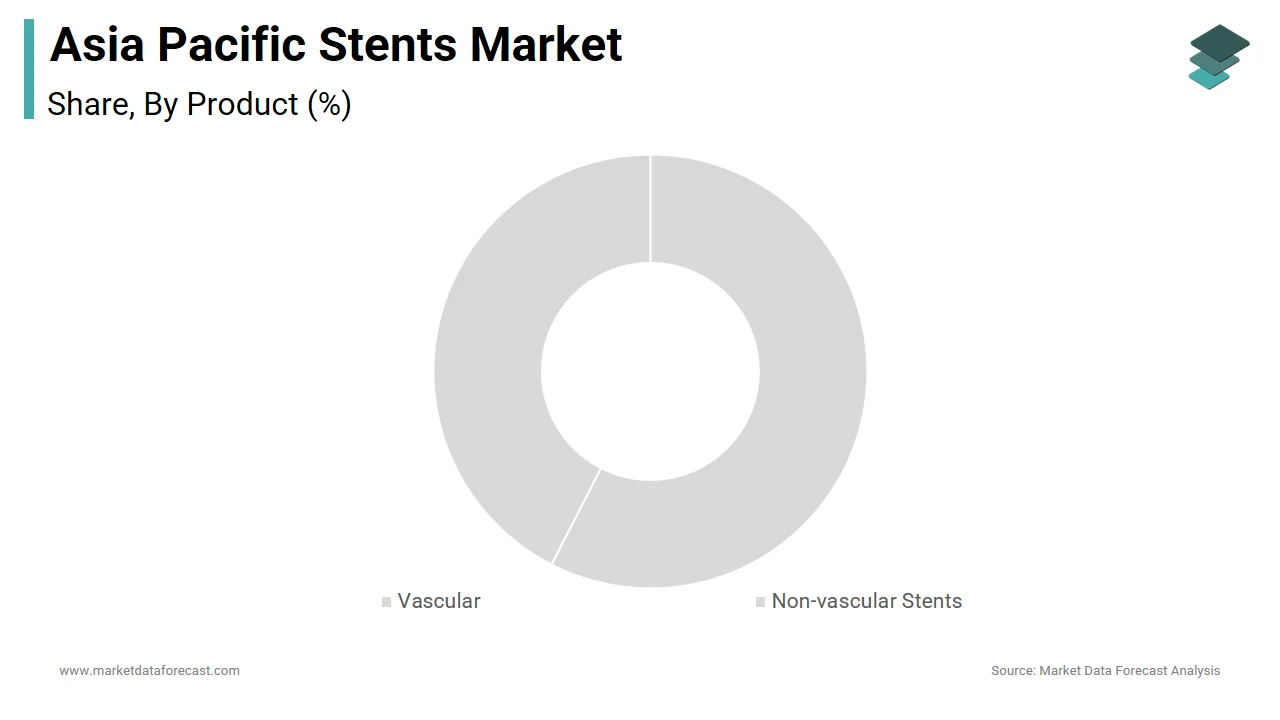
The vascular stents segment dominated the Asia Pacific stents market share in 2025. According to the World Health Organization, cardiovascular diseases are responsible for more than 30% of all deaths in the Asia Pacific, with coronary artery disease being a leading cause. This has led to a surge in percutaneous coronary interventions (PCIs), which heavily rely on vascular stents. Additionally, advancements in stent technology, including drug-eluting and bioresorbable vascular scaffolds, have increased procedural success rates and patient adoption. Japan, for instance, reports that over 90% of coronary stents used are of the drug-eluting variety, as per data from the Japanese Circulation Society.
The non-vascular stents segment is projected to expand with a CAGR of 14.3% throughout the forecast period. A key driver is the rising burden of cancers affecting hollow organs like the bile duct, esophagus, and urinary tract. As per the Asian Pacific Journal of Cancer Prevention, gastrointestinal cancer cases in the region have grown by over 20% in the past five years. Moreover, growing awareness and improved access to minimally invasive endoscopic procedures support this trend. In Singapore, for example, endoscopic retrograde cholangiopancreatography (ERCP) procedures using non-vascular stents have seen a 12% year-on-year increase since 2020, as reported by the Singapore General Hospital.
By Material Insights
The metallic stents segment was the dominant in the Asia Pacific stents market in 2025. One major factor behind their continued dominance is the proven track record of metallic stents in providing structural integrity and immediate luminal support. According to the Japanese Circulation Society, over 90% of coronary stents implanted in Japan are metallic-based, largely due to their reliability and ease of deployment in complex lesions. Additionally, the high prevalence of coronary artery disease in emerging economies fuels sustained demand for metallic stents. Compared to biodegradable or polymer-based stents, metallic variants are more affordable, making them ideal for price-sensitive markets like India and Indonesia.
The non-metallic stents segment is likely to grow with an estimated CAGR of 16.3% during the forecast period. Bioresorbable vascular scaffolds (BVS), a subset of non-metallic stents, have gained attention for their ability to dissolve after healing, thereby avoiding issues such as late stent thrombosis and vessel stiffness. Clinical trials conducted in Australia and South Korea have demonstrated positive outcomes, encouraging wider adoption. Moreover, regulatory support and funding for innovative device development have accelerated market penetration. Additionally, rising consumer preference for minimally invasive treatments with fewer long-term risks is boosting demand.
By End-use Insights
The hospitals segment was accounted in holding a dominant share of the Asia Pacific stents market in 2025. In countries like China and India, government hospitals and private healthcare chains perform thousands of percutaneous coronary interventions (PCIs) annually, driving substantial stent consumption. According to the National Health Commission of China, over 1.2 million PCI procedures were conducted in Chinese hospitals in 2022, with nearly all involving stent implantation. Additionally, hospitals are better equipped with catheterization labs and trained interventional cardiologists, ensuring procedural efficiency and safety. In Japan, the Japanese Circulation Society reports that nearly 95% of all coronary interventions take place in hospitals, reinforcing their central role in stent utilization.
The Ambulatory surgical centers (ASCs) segment is likely to grow with an expected CAGR of 12.3% in the coming years. One of the main drivers is the growing preference for minimally invasive interventions that can be safely performed in outpatient settings. Countries like South Korea and Singapore have seen a notable rise in day-care angioplasty procedures, where patients are discharged within 24 hours post-stent placement. Additionally, ASCs offer lower procedural costs compared to traditional hospitals. In India, the average cost of an angioplasty in an ambulatory center is up to 30% less than in a hospital, making it more accessible to middle-income groups, as reported by the Confederation of Indian Industry. Moreover, regulatory bodies in several Asia Pacific nations are increasingly approving ASCs for complex interventions.
COUNTRY LEVEL ANALYSIS
China Stents Market Insights
China was the top performer in the Asia Pacific home improvement market by accounting for 30.2% of the share in 2024. Moreover, e-commerce platforms like Alibaba and JD.com have transformed how consumers purchase home improvement products, enabling easier access to tools, paints, and fittings. As per the China E-Commerce Research Center, online sales of DIY home products grew by 22% in 2022, reflecting changing consumer behavior.
India Stents Market Insights
India ranked second in the Asia Pacific home improvement market by holding 18.3% of the share in 2024. Urbanization in India has accelerated, with over 30% of the population now residing in cities, according to the Ministry of Housing and Urban Affairs. This has spurred demand for residential construction and renovation projects among young homeowners and first-time buyers.
Additionally, the government’s "Housing for All" initiative aims to provide affordable housing to millions by 2025, indirectly boosting the home improvement industry. Moreover, rising disposable income and a growing do-it-yourself (DIY) culture among millennials are reshaping consumer preferences.
Japan Stents Market Insights
Japan home improvement market is likely to have significant growth opportunities in the coming years. Japan leads in smart home integration, with companies like Panasonic and Mitsubishi Electric offering integrated home automation systems. According to the Japan Smart Home Association, over 25% of new homes include smart lighting and climate control features.
South Korea Stents Market Insights
South Korea's home improvement market growth is driven by a tech-savvy consumer base and strong government backing for sustainable living. The Korean Ministry of Trade, Industry, and Energy reports that over 40% of new apartments incorporate smart home technologies, including automated lighting, security, and ventilation systems. This trend is supported by local electronics giants such as Samsung and LG, which have expanded into the connected home ecosystem. Additionally, the rise of apartment remodeling, known locally as "gapjilgu," has created a booming secondary market for flooring, paint, and kitchen upgrades.
Australia Stents Market Insights
Australia's home improvement market is likely to have a steady pace in the coming years. According to the Australian Bureau of Statistics, over 40% of households undertook some form of home improvement activity in 2022, ranging from kitchen renovations to landscaping. Additionally, stringent building codes and environmental regulations encourage the use of eco-friendly materials and energy-efficient designs. Major retailers such as Bunnings Warehouse maintain a dominant presence, offering a wide range of products and expert advice. Supported by a stable economy and high homeownership rates, Australia’s home improvement market remains a key contributor to regional growth.
COMPETITIVE LANDSCAPE
The competition in the Asia Pacific stents market is marked by a dynamic interplay of innovation, market expansion, and strategic positioning. A handful of global leaders dominate the landscape, leveraging their technological expertise and established distribution channels to maintain strong footholds across diverse markets. However, the rise of domestic manufacturers in China and India, is gradually reshaping the competitive environment. These local players are offering cost-effective alternatives, challenging the pricing power of multinational corporations. In response, global firms are intensifying efforts to penetrate underserved regions through customized product offerings and localized marketing strategies. At the same time, increasing regulatory scrutiny and reimbursement constraints are compelling companies to align more closely with evolving healthcare policies. Innovation remains a critical battleground, with manufacturers racing to develop bioresorbable and ultra-thin strut stents that promise superior clinical outcomes.
KEY MARKET PLAYERS
Some of the noteworthy companies in the Asia Pacific stents market profiled in this report are
- Abbott Laboratories
- B. Braun Melsungen AG
- Biotronik SE & Co. KG
- Biosensors International Group Ltd.
- Boston Scientific Corporation
- Elixir Medical Corporation
- Medtronic Plc
- Meril Life Sciences
- MicroPort Scientific Corporation
- Stryker
- Terumo Corporation
- W. L. Gore & Associates
- BD (Becton, Dickinson and Company)
TOP LEADING PLAYERS IN THE MARKET
One of the leading players in the Asia Pacific stents market is Abbott. The company holds a strong presence through its innovative product portfolio with the XIENCE family of drug-eluting stents. Abbott has consistently focused on developing next-generation stent technologies that offer improved patient outcomes and reduced complications. Its strategic collaborations with regional healthcare providers and investment in local manufacturing facilities have strengthened its foothold in key markets such as China, India, and Japan. Additionally, Abbott’s emphasis on clinical research and regulatory compliance has reinforced its reputation as a trusted leader in the cardiovascular device space. Boston Scientific is another dominant player shaping the dynamics of the Asia Pacific stents market. Known for its extensive range of coronary and peripheral stents, the company has been instrumental in advancing interventional cardiology solutions tailored to diverse patient needs. Boston Scientific has prioritized expanding its distribution network across emerging economies in the region, ensuring broader access to high-quality stent systems. The company also engages in partnerships with local governments and medical institutions to enhance training and awareness around minimally invasive cardiac procedures. Medtronic ranks among the top contributors to the Asia Pacific stents market due to its robust portfolio of vascular intervention products.
TOP STRATEGIES USED BY KEY MARKET PARTICIPANTS
A primary strategy employed by leading companies in the Asia Pacific stents market is continuous product innovation. Manufacturers are investing heavily in research and development to introduce next-generation stents that offer enhanced biocompatibility, reduced restenosis rates, and better procedural outcomes. These innovations not only improve clinical effectiveness but also differentiate products in a highly competitive landscape.
Another key approach is strengthening regional distribution networks. Companies are expanding their presence in both urban and rural areas by partnering with local distributors, hospitals, and government health programs. This ensures wider accessibility of stent products in emerging economies where demand is growing rapidly.
Strategic collaborations and acquisitions also play a crucial role in enhancing market position. Major players are forming alliances with research institutions, entering joint ventures, or acquiring smaller firms to gain access to new technologies and expand their geographic reach. These moves help consolidate their influence and accelerate time-to-market for novel stent solutions.
RECENT MARKET DEVELOPMENTS
- In March 2024, Abbott announced a strategic partnership with a leading Chinese hospital chain to co-develop training programs for interventional cardiologists. This initiative aims to increase awareness and proficiency in using advanced stent technologies across major cities in China.
- In February 2024, Boston Scientific launched a dedicated innovation center in Singapore to support the development of next-generation stent platforms tailored to the region’s patient profiles. The facility focuses on accelerating R&D and fostering collaboration with regional healthcare institutions.
- In January 2024, Medtronic received regulatory approval in India for an updated version of its drug-eluting stent system. The launch was accompanied by a nationwide physician training campaign designed to enhance clinical adoption and improve patient outcomes in high-risk populations.
- In December 2023, Terumo Corporation expanded its manufacturing capabilities in South Korea to meet rising regional demand. The upgraded facility supports increased production of coronary and peripheral stents, which is reinforcing Terumo’s supply chain resilience in the Asia Pacific.
- In November 2023, Biotronik entered into a distribution agreement with a major Indonesian healthcare provider to broaden its stent portfolio’s reach in Southeast Asia. This move enhances Biotronik’s presence in emerging markets and strengthens its competitive position in the region.
MARKET SEGMENTATION
This Asia Pacific stents market research report is segmented and sub-segmented into the following categories.
By Product
- Vascular
- Coronary Stents
- Peripheral Stents
- Iliac Artery Stents
- Femoral Artery Stents
- Carotid Artery Stents
- Renal Artery Stents
- Other Peripheral Stents
- Neurovascular Stents
- Intracranial Stents
- Flow Diverters
- Non-vascular Stents
- Gastrointestinal Stents
- Biliary
- Duodenal
- Colonic
- Pancreatic
- Esophageal Stents
- Pulmonary (Airway) Stents
- Silicone Airway
- Metallic Airway
- Urological Stents
- Others
- Gastrointestinal Stents
By Material
- Metallic Stents
- Non-metallic Stents
By End Use
- Hospitals
- Ambulatory Care Centers (ACS)
- Specialty Clinics
By Country
- India
- China
- Japan
- South Korea
- Australia
- New Zealand
- Thailand
- Malaysia
- Vietnam
- Philippines
- Indonesia
- Singapore
- Rest Of APAC