- Product Description Description
- Table of Contents TOC
- List of Table & Figure LOT
- Get Free Sample PDF Sample PDF
Market Size, 2025
$0.43 BnMarket Estimate, 2026
$0.46 BnMarket Forecast, 2034
$0.79 BnCAGR, 2026–2034
7.07%Asia Pacific Sugar Decorations & Inclusions Market Size, Share, Trends & Forecast (2026–2034)
- Market Scope: Comprehensive assessment of edible embellishments and flavorful particulates (sprinkles, pearls, inclusions) used in the bakery, pastry, and confectionery industries across the APAC region.
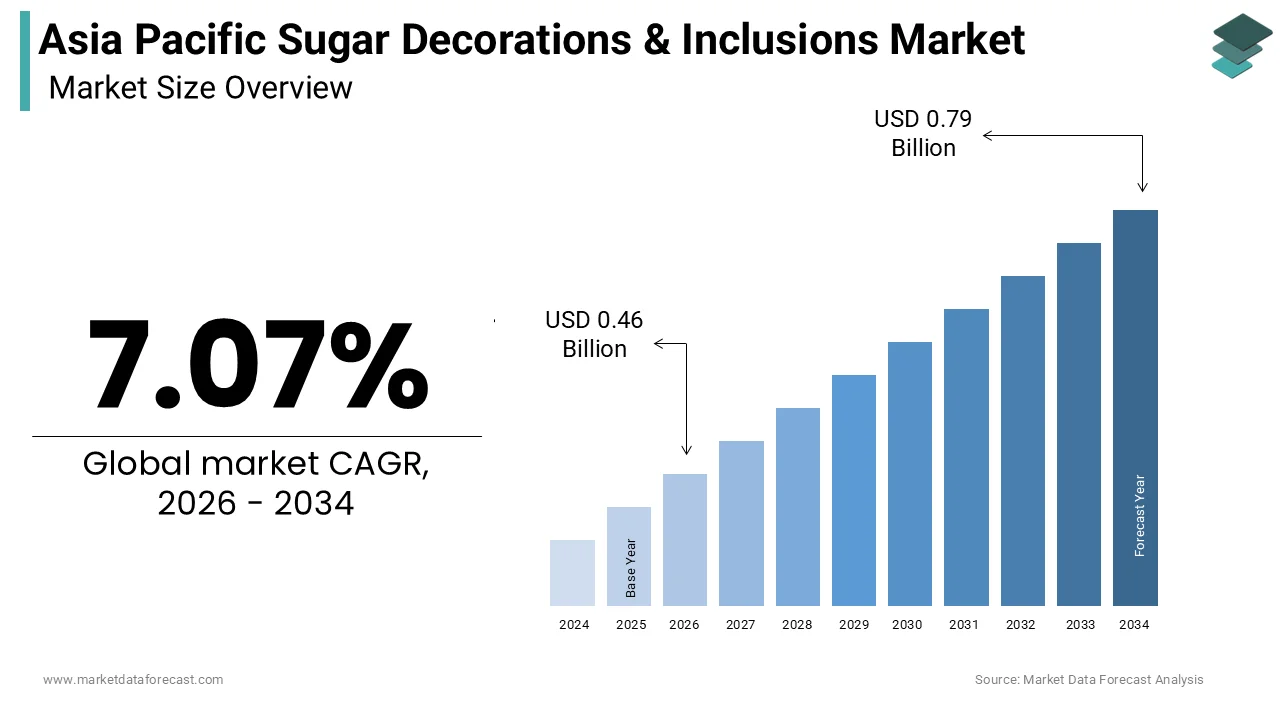
- Market Valuation: Valued at USD 0.43 billion in 2025, estimated at USD 0.46 billion in 2026, and projected to reach USD 0.79 billion by 2034, expanding at a compound annual growth rate (CAGR) of 7.07% from 2026 to 2034.
- Primary Growth Drivers & Challenges: Growth is fueled by rapid urbanization, the rise of organized retail chains, the "Instagrammable" food trend driven by social media, and the expansion of middle-class disposable income. Key challenges include stringent and varying regional regulations on synthetic colorants, price volatility of raw materials (sugar/cocoa), and logistical/cold-chain constraints in remote areas.
Key APAC Sugar Decorations & Inclusions Segment Metrics (2026–2034)
| Category | Leading Segment (Position) | Fastest-Growing Segment |
|---|---|---|
| By Product Type | Sprinkles & Jimmies (Dominant due to high versatility, low cost, and cultural festivity alignment) | Sugar Pearls & Dragées (8.5% CAGR; driven by premiumization in artisanal/high-end baking) |
| By Form | Solid Particulates (Dominant due to storage stability, ease of handling, and multi-industry utility) | Edible Prints & Sheets (9.2% CAGR; high demand for personalization/customization) |
| By End User | Industrial Food Manufacturers (Largest share due to bulk-production standardization and scale) | HoReCa (8.1% CAGR; driven by the rise of specialty cafes and artisanal dessert presentation) |
Major Players & Regional Landscape
Competitive Landscape: Market leaders are focusing on product innovation regarding natural colorants, thematic designs, and hygiene/safety certifications to meet stringent regulatory environments and artisanal demand.
Key Companies: Dr. Oetker, Kerry Group, Barry Callebaut, The Kraft Heinz Company, Signature Brands LLC, Pecan Deluxe Candy Company, Hanns G. Werner GmbH + Co.KG, Carroll Industries NZ Ltd, Cape Foods, and Paulaur Corporation.
Regional Insights: China leads the regional market (28.3% share) backed by a massive bakery/confectionery valuation and urban consumption trends. India (18.8% share) follows, supported by a deep-rooted cultural affinity for sweets and a rapidly professionalizing bakery sector.
Asia Pacific Sugar Decorations & Inclusions Market Size
The Asia Pacific Sugar Decorations & Inclusions Market size was calculated to be USD 0.43 billion in 2025 and is anticipated to be worth USD 0.79 billion by 2034, from USD 0.46 billion in 2026, growing at a CAGR of 7.07% during the forecast period.
Sugar decorations and inclusions are edible embellishments and flavorful particulates added to baked goods and confections. They enhance the dessert's visual appeal. Additionally, they improve its overall texture and flavor profile. This market is deeply intertwined with the region's vibrant food culture, where aesthetics play a pivotal role in consumer purchasing decisions, particularly during festive seasons and celebrations. Driven by population expansion and rising incomes, Asia and the Pacific remain the leading global drivers of sweet intake, with the region projected by the OECD-FAO Agricultural Outlook to account for nearly all global sugar consumption growth over the coming decade. A study indicates that while traditional bakery staples face structural consumption limits in Asia, impulse-led and indulgent snacking formats present a strong runway for expansion across Indonesia, India, and China. The proliferation of social media platforms has further amplified the importance of visual presentation, with consumers increasingly sharing images of aesthetically pleasing desserts online. The Asian Development Bank indicates that the global middle class will expand heavily, with Asia accounting for 85% of this growth and representing two-thirds of the global middle-class population by 2030. Regulatory frameworks regarding food additives and colorants are becoming more stringent across major economies, ensuring safety while encouraging innovation in natural coloring agents. The integration of traditional motifs with modern design techniques characterizes the current landscape as manufacturers strive to balance cultural relevance with contemporary trends.
MARKET DRIVERS
Rising Urbanization and Expansion of Organized Retail Chains Drive Demand
Rapid urbanization and the subsequent expansion of organized retail chains have significantly boosted the growth of the Asia Pacific sugar decorations inclusions market. This increases access to packaged and premium bakery products. The United Nations Development Programme (UNDP) indicates that the Asia-Pacific urban population is projected to expand by 900 million people by 2050, structurally accelerating demand for scalable, modernized urban infrastructure and processed food chains. This demographic shift has spurred the growth of supermarket chains and specialty bakeries that rely on visually attractive products to differentiate themselves in competitive markets. Organized retailers often collaborate with suppliers to create exclusive themed decorations for holidays and local festivals, driving seasonal spikes in demand. The standardization of supply chains ensures consistent quality and availability of sugar inclusions, enabling large-scale production of decorated goods. The presence of international bakery franchises in major cities further accelerates the adoption of standardized decoration techniques and ingredients. This structural transformation in retail and consumption patterns creates a stable and growing market for sugar decoration manufacturers who can cater to both mass market and premium segments.
Influence of Social Media And Digital Marketing On Consumer Preferences
The pervasive influence of social media and digital marketing has transformed consumer preferences, which further propels the expansion of the Asia Pacific sugar decorations inclusions market. This places a premium on the visual appeal of food products, thereby driving demand for intricate sugar decorations. We Are Social reveals that global active social media user identities have reached 5.79 billion, with East and Southeast Asian markets exhibiting some of the highest collective digital engagement rates globally. Platforms like Instagram and TikTok have popularized trends such as drip cake,s unicorn themes, and elaborate cookie designs, which require specialized sugar inclusions to achieve. The digital visibility creates a ripple effect where consumers seek to replicate trending designs at home or purchase them from local artisans, boosting retail sales of sugar sprinkles and edible prints. Influencer collaborations and viral challenges further amplify demand for specific colors and shapes of sugar inclusions. Manufacturers respond by launching limited edition collections aligned with digital trends, ensuring relevance in a fast-paced market. The ability to capture attention in a crowded digital landscape makes aesthetic differentiation critical for brand success. This dynamic environment fosters continuous innovation in design and packaging to meet the evolving expectations of digitally savvy consumers.
MARKET RESTRAINTS
Stringent Regulations On Artificial Colors And Additives Limit Product Options
Stringent regulations on artificial colors and additives are a significant restraint on the Asia Pacific sugar decorations inclusions market. This limits the range of available products and increases compliance costs. The Food Safety and Standards Authority of India actively enforces statutory limits on synthetic colorants in confectionery under national food safety guidelines to eliminate non-permitted industrial chemical dyes. This necessitates a shift toward natural colorants, which are often more expensive and less stable in terms of color intensity and shelf life. The variability in regulatory standards across different countries in the region complicates export strategies for multinational suppliers who must navigate diverse legal frameworks. The ASEAN Secretariat indicates that harmonization of food safety standards remains incomplete, leading to trade barriers and delayed product launches. Small and medium enterprises struggle to afford the testing and certification required for compliant ingredients, reducing their competitiveness. The higher cost of natural alternatives also translates to higher retail prices, which may deter price-sensitive consumers in emerging markets. Regional regulatory shifts toward cleaner ingredient formulations compel manufacturing plants to modify supply portfolios, elevating baseline production costs across processing ecosystems. These financial and operational burdens slow down innovation and limit the variety of decorative options available to bakers and confectioners.
Price Volatility Of Raw Materials Impacts Profit Margins
Price volatility of raw materials such as sugar and cocoa butter greatly impacts the profit margins of manufacturers in the Asia Pacific sugar decorations inclusions market. This creates uncertainty in pricing strategies. The International Sugar Organization illustrates that global sugar markets have faced extreme climate-driven supply contractions, inducing sharp multi-year pricing volatility. This instability makes it difficult for manufacturers to maintain consistent pricing for their products without eroding margins or losing customers to cheaper alternatives. The World Bank Commodities Market Outlook notes that climate anomalies and regional weather disruptions represent acute risks to global agricultural yields, directly driving structural swings in raw food input markets. Manufacturers in the Asia Pacific region who rely on imported raw materials face additional risks from currency fluctuations and trade tariffs. Small-scale producers are particularly vulnerable as they lack the bargaining power to secure long-term supply contracts at fixed rates. The inability to pass on cost increases to consumers in highly competitive markets forces companies to absorb losses or reduce product quality. According to financial reports from major confectionery ingredient suppliers, operating expenses have increased by 12 percent due to raw material price hikes. This economic pressure restricts investment in research and development and limits the ability to expand product lines.
MARKET OPPORTUNITIES
Growth Of Artisanal And Home Baking Segments Creates Niche Opportunities
The rapid growth of artisanal and home baking segments offers a strong opening for the Asia Pacific sugar decorations inclusions market. This creates demand for specialized and premium products. Consumer demands for customization and personal indulgence continue to reshape the global bakery landscape, forcing brands to offer flexible format variations. This trend has led to a surge in demand for unique sugar inclusions, such as edible gold leaf custom-printed sheets and organic sprinkles that allow for individual expression. Manufacturers can capitalize on this trend by offering small-batch premium products with distinctive designs and flavors that appeal to hobbyists and professional artisans. The rise of boutique bakeries that focus on craftsmanship and aesthetics further drives demand for high-quality decorative elements that differentiate their offerings. Collaborations with local artists and designers can help brands create exclusive collections that resonate with cultural values. The willingness of home bakers to experiment with new techniques and ingredients provides a fertile ground for innovation. By catering to this discerning segment, companies can build strong brand loyalty. Consequently, they can command higher price points.
Expansion Into Health-Conscious and Functional Decoration Categories
The expanding interest in health-conscious and functional food products provides a clear path for manufacturers to develop sugar decorations and inclusions that align with wellness trends to ultimately accelerate the expansion of the Asia Pacific market. Health Focus International highlights that a clear majority of shoppers across the Asia-Pacific region actively prioritize clean labels, natural ingredients, and lower sugar intake when selecting foods. This shift creates demand for sugar-free decorations made from alternative sweeteners such as stevia and erythritol, as well as those enriched with vitamins and minerals. The World Health Organization (WHO) Western Pacific Office underscores that rising regional metabolic health risks compel governments to enforce stricter nutritional guidelines and promote sugar reduction. Manufacturers can develop decorations that not only enhance visual appeal but also contribute to nutritional value, such as fiber-rich sprinkles or probiotic-coated dragees. The growing vegan population also seeks plant-based and cruelty-free decorative options, opening new market segments. Partnerships with health food brands and wellness influencers can help promote these innovative products to target audiences. The ability to combine aesthetics with health benefits provides a competitive advantage in a crowded market. Early movers in this space can establish themselves as leaders in the next generation of confectionery ingredients.
MARKET CHALLENGES
Supply Chain Disruptions And Logistics Challenges In Remote Areas
Supply chain disruptions and logistics challenges in remote areas pose a major obstacle to the consistent distribution of these inclusions across the vast region, which holds back the growth of the Asia Pacific sugar decorations inclusions market. The World Bank Logistics Performance Index (LPI) demonstrates that infrastructure quality and supply-chain reliability vary widely across developing Asian economies, directly impacting cross-border distribution efficiencies. Sugar decorations are sensitive to humidity and temperature, requiring controlled storage and transport conditions that are difficult to maintain in regions with unreliable electricity and cold chain facilities. Sources indicate that port congestion bottlenecks and changing customs protocols intermittently alter baseline retail lead times across major regional maritime trade corridors. The fragmented nature of the market, with numerous small islands and rural communities, makes last-mile delivery complex and expensive. The Shanghai Shipping Exchange tracks ongoing structural volatility in containerized freight rates across global shipping lanes due to shifting energy costs and maritime route diversions. Manufacturers face difficulties in ensuring product quality upon arrival, as exposure to heat and moisture can cause clumping and degradation of sugar-based items. The lack of standardized packaging regulations across borders further complicates cross-border trade. These logistical hurdles limit market penetration in underserved areas and increase operational risks for suppliers.
Counterfeit Products And Intellectual Property Theft
The prevalence of counterfeit products and intellectual property theft is a significant barrier to established brands in the Asia Pacific sugar decorations and inclusions market. This undermines brand reputation and revenue. These inferior copies often use substandard ingredients and unsafe colorants, posing health risks to consumers and damaging the credibility of legitimate manufacturers. The ease of replicating simple sugar decorations makes it difficult for companies to protect their proprietary designs and formulations. Small and medium enterprises lack the resources to pursue legal action against infringers, allowing counterfeiters to operate with impunity. The presence of fake products confuses consumers and erodes trust in authentic brands, leading to lost sales. Manufacturers must invest in advanced anti-counterfeit technologies such as holographic labels and QR codes, which add to production costs. This ongoing battle diverts resources from innovation and marketing efforts.
REPORT COVERAGE
| REPORT METRIC | DETAILS |
| Market Size Available | 2025 to 2034 |
| Base Year | 2025 |
| Forecast Period | 2026 to 2034 |
| CAGR | 7.07% |
| Segments Covered | By Product Type, Form, Application, End User, and Region |
| Various Analyses Covered | Global, Regional & Country Level Analysis; Segment-Level Analysis; DROC, PESTLE Analysis; Porter’s Five Forces Analysis; Competitive Landscape; Analyst Overview of Investment Opportunities |
| Regions Covered | India, China, Japan, South Korea, Australia, New Zealand, Thailand, Malaysia, Vietnam, Philippines, Indonesia, Singapore, and the rest of APAC |
| Market Leaders Profiled | Dr. Oetker, Kerry Group, Barry Callebaut, The Kraft Heinz Company, Signature Brands LLC, Pecan Deluxe Candy Company, Hanns G. Werner GmbH + Co.KG, Carroll Industries NZ Ltd, Cape Foods, Paulaur Corporation |
SEGMENTAL ANALYSIS
By Product Type Insights
The sprinkles and jimmies segment dominated the Asia Pacific sugar decorations inclusions market and accounted for a substantial share in 2026. This dominance of the segment was driven by its versatility, affordability, and widespread acceptance across various demographic groups. Studies note that sprinkles, jimmies, and sugar toppings remain dominant product types within the cake decorations market due to their highly versatile, cost-effective applications across mass-produced baked goods. Their low production cost allows manufacturers to offer them at competitive price points, making them accessible to both industrial bakeries and individual consumers. The ease of application requires no specialized skill,s which encourages home bakers and small businesses to use them extensively. Research shows that high-volume commercial bakeries rely heavily on standardized sugar toppings to enhance the shelf appeal of mass-retail product lines. The long shelf life and stability of sprinkles under varying temperature conditions further enhance their appeal to distributors and retailers who prioritize inventory efficiency. Manufacturers continuously innovate with new shapes and colors to keep the product line fresh without increasing costs substantially. This combination of functional benefits and economic advantages ensures that sprinkles remain the cornerstone of the sugar decorations market in the region.
The deep integration of sprinkles into festive and celebration foods across Asia Pacific cultures sustains their market leadership. A study confirms that major regional cultural festivals trigger predictable, massive seasonal spikes in premium, indulgence-driven sweet and confectionery retail sales. These events drive bulk purchasing by households and commercial entities, creating seasonal demand surges that support year-round production capacities. Sprinkles are perceived as symbols of joy and festivity, making them indispensable for party supplies and gift items. The adaptability of sprinkles to local flavor profiles such as matcha, mango, and coconut allows manufacturers to create region-specific variants that resonate with local tastes. Retailers capitalize on this by offering themed sprinkle mixes during holiday seasons, driving higher average transaction values. The emotional connection between consumers and celebratory foods ensures consistent demand regardless of economic fluctuations. This cultural entrenchment provides a stable foundation for the continued dominance of sprinkles in the market.
The sugar pearls and dragées segment is anticipated to witness the fastest CAGR of 8.5% from 2026 to 2034 due to the premiumization trend in artisanal baking and high-end confectionery. These products offer a luxurious aesthetic that distinguishes premium brands from mass market competitors. The perception of sugar pearls as a mark of quality and craftsmanship drives their adoption in upscale cafes and hotels. The Asian Development Bank (ADB) indicates that growing middle-class urban populations and expanding disposable incomes across Asia are fueling a major shift toward high-value, experiential consumption. Manufacturers are responding by introducing larger sizes and unique finishes such as matte, shimmer, and pearlescent effects to cater to diverse design preferences. The ability of dragées to maintain their shape and shine over time makes them ideal for elaborate displays. This shift toward premium aesthetics is transforming sugar pearls from niche items into mainstream luxury ingredients.
Innovation in metallic and natural color finishes is accelerating the growth of the sugar pearls and dragées segment by appealing to modern design sensibilities and health-conscious consumers. The innovation addresses the demand for clean-label products while maintaining the visual impact of traditional synthetic metallics. Statutory rules enforced under the Food Standards Australia New Zealand (FSANZ) Code Schedule 15 rigidly govern the permissible types, maximum limits, and specific conditions under which coloring agents can be used in confectionery products. The rise of social media influencers showcasing intricate cake designs has popularized the use of gold, silver, and rose gold pearls, which photograph well and attract online engagement. Manufacturers are also developing smaller micro pearls for delicate detailing and larger statement pieces for bold design,s catering to diverse creative needs. The technical improvement in coating technologies ensures uniform color distribution and durability, preventing fading or bleeding. These advancements make sugar pearls a versatile tool for modern bakers seeking to differentiate their creations in a competitive digital landscape.
By Form Insights
The solid particulates segment led the Asia Pacific market and captured a significant share in 2026. This leading position of the segment was attributed to its ease of handling, storage stability, and minimal maintenance requirements. Their dry nature allows for long shelf lives without the need for refrigeration or special packaging, which lowers costs for both manufacturers and retailers. The simplicity of application using shakers or spoons makes them accessible to consumers of all skill levels. Also, the robustness of solid forms ensures they retain their texture and appearance even in humid climates common in tropical Asia. Manufacturers benefit from streamlined production processes that allow for high-volume output with consistent quality. This operational efficiency translates into competitive pricing that drives widespread adoption across all market segments.
The wide application range of solid particulates across diverse food categories reinforces their market leadership by ensuring consistent demand from multiple industries. Studies show that solid inclusions are heavily cross-utilized across the packaged food industry, acting as texture enhancers in ice creams, breakfast cereals, and snack bars. This versatility expands the total addressable market beyond traditional baking into the broader convenience food sector. Product innovation strategies implemented by leading multinational food enterprises frequently rely on textural inclusions to improve the sensory appeal and market premiumization of ready-to-eat desserts. The ability to withstand processing conditions such as freezing and mild heating makes them suitable for industrial food manufacturing. The variety of shapes and sizes available allows for customization according to specific product requirements. Manufacturers collaborate with food processors to develop bespoke particulate blends that align with brand identities. This cross-industry utility creates multiple revenue streams and reduces dependency on any single sector. The adaptability of solid particulates to various formulations ensures their continued relevance in evolving food landscapes.
The edible prints and sheets segment is likely to experience the fastest CAGR of 9.2% during the forecast period, owing to the rising demand for personalized and custom designs in celebration cakes and corporate gifts. Edible printing technology allows for high-resolution reproduction of photographs and logos on sugar sheets, meeting this need for customization. The convenience of applying pre-printed sheets reduces the time and skill required for manual decoration, making it attractive for busy bakeries. Hardware production efficiencies have lowered the entry cost of specialized custom printing systems, allowing boutique small businesses to acquire micro-craft tools easily. The ability to produce short runs economically enables bakeries to offer unique designs without significant inventory risks. Social media sharing of personalized cakes further drives demand as consumers seek distinctive items for special occasions. This trend toward personalization is transforming edible prints from a novelty into a standard offering in many bakeries.
Technological advancements in printing quality and speed are accelerating the adoption of edible prints and sheets by improving efficiency and visual fidelity. These improvements reduce production bottlenecks, allowing bakeries to handle larger volumes of custom orders. The development of heat-resistant and moisture-proof edible papers ensures that prints remain intact during baking and storage, enhancing product reliability. The compatibility of edible inks with various dietary requirements,s including vegan gluten-free options, broadens the customer base. Manufacturers are also introducing pre-cut shapes and templates to simplify the application process for users. These technological enhancements make edible printing a viable and scalable solution for modern confectionery businesses.
By Application Insights
In 2026, the bakery and pastry segment held the majority share of the Asia Pacific sugar decorations inclusions market because of its fundamental role in enhancing the visual appeal of breads, cakes, cookies, and pastries. The cultural significance of baked items in festivals and daily consumption ensures steady demand for decorative elements. The versatility of sugar inclusions allows them to complement various flavors and textures, from soft cakes to crunchy cookies. The continuous innovation in bakery products, such as fusion desserts and artisanal breads, creates new opportunities for creative decoration. Manufacturers work closely with bakers to develop trends that align with consumer preferences. This symbiotic relationship ensures that the bakery remains the primary driver of the sugar decorations market.
The rapid growth of cafe culture and specialty dessert shops across the Asia Pacific is reinforcing the dominance of the bakery and pastry application segment. These establishments rely heavily on visually striking desserts to differentiate themselves and attract social media attention. The competitive landscape forces businesses to invest in high-quality decorations to maintain brand image. The trend toward Instagrammable food drives demand for intricate and colorful sugar inclusions. Bakeries are experimenting with layered decorations and thematic presentations to enhance customer experience. This dynamic environment sustains high demand for diverse sugar decoration products.
The confectionery and chocolate segment is on the rise and is expected to be the fastest-growing segment in the market by witnessing a CAGR of 7.8% between 2026 and 2034. This swift expansion of the segment is propelled by the rising demand for premium chocolates and candies featuring decorative elements. Sugar decorations such as dragees, pearls, and sprinkles are used to add texture and visual interest to chocolate bars, truffles, and bonbons. The gifting culture in countries like China and Japan drives demand for beautifully packaged and decorated chocolates during holidays. Manufacturers are incorporating local flavors and traditional motifs into decorations to resonate with regional tastes. The ability of sugar inclusions to enhance the sensory experience of chocolate consumption drives their adoption. This segment offers high-margin opportunities for suppliers who can provide innovative and high-quality decorative solutions.
Innovation in novelty and seasonal candy products is fueling the growth of the confectionery and chocolate application segment by creating excitement and urgency among consumers. Items such as Easter eggs, Halloween treats, and Valentine hearts rely heavily on decorative sugars to convey thematic messages. The short lifecycle of these products encourages frequent innovation and experimentation with new shapes and colors. Manufacturers collaborate with licensors to create branded decorations for popular characters and movies, driving sales among younger demographics. The flexibility of sugar decorations allows for rapid adaptation to trending themes. This agility makes the confectionery segment a dynamic and high-growth area for sugar inclusion suppliers.
By End User Insights
The industrial food manufacturers segment was the largest in the regional market and occupied a commanding share in 2026. This supremacy of the segment was supported by its large-scale production volumes and strict standardization requirements for consistent product quality. These manufacturers prioritize suppliers who can deliver consistent color, size, and quality to maintain brand integrity across multiple batches. The ability of industrial players to negotiate bulk discounts allows them to source decorations at lower costs compared to smaller entities. The need for hygiene and safety certifications further favors large suppliers who can meet rigorous regulatory standards. Industrial manufacturers also drive innovation by requesting custom formulations and shapes for proprietary products. This dominant position ensures that industrial demand dictates overall market trends and production capacities.
The expansion of ready-to-eat and convenience foods is sustaining the leadership of industrial food manufacturers. Industrial manufacturers are responding by launching decorated convenience items such as frosted donuts, coated cookies, and filled pastries. The use of sugar decorations enhances the perceived value of convenience foods, justifying higher price points. Industrial players invest in research to develop decorations that withstand extended shelf lives and varying storage conditions. The scalability of industrial production allows for widespread distribution across urban and rural markets. This reach ensures that sugar decorations become a staple in everyday consumption patterns. The strategic focus on convenience and aesthetics drives continuous demand from this segment.
The HoReCa (Hotel, Restaurant, and Cafe) segment is expected to exhibit a noteworthy CAGR of 8.1% over the forecast period. This rapid growth of the segment is fuelled by the rise of experiential dining and the emphasis on visual presentation. Chefs and patissiers are using elaborate sugar decorations to create signature desserts that enhance the dining experience. The willingness of consumers to pay premium prices for visually stunning desserts supports the adoption of high-quality decorations. In addition, the competitive nature of the hospitality industry drives continuous investment in culinary creativity. Sugar decorations allow for rapid customization and thematic alignment with restaurant concepts. This focus on experience over mere sustenance fuels the rapid growth of the HoReCa segment.
The proliferation of boutique bakeries and specialty cafes is accelerating the growth of the HoReCa sector as these businesses prioritize unique and artisanal offerings. These establishments often source premium sugar decorations to distinguish their products from mass market alternatives. The personal interaction with customers allows these businesses to gather feedback and adapt their decoration choices quickly. The trend toward local sourcing and sustainability also influences their purchasing decisions, favoring suppliers with ethical practices. This segment represents a dynamic and influential group that drives innovation in sugar decorations. Their influence extends to consumer preference,s shaping broader market trends.
REGIONAL ANALYSIS
China Sugar Decorations Inclusions Market Analysis
China was the top performer in the Asia Pacific sugar decorations inclusions market and accounted for a 28.3% share in 2026. This supremacy of the Chinese market was driven by its massive population, growing middle class, and vibrant bakery industry. According to the USDA Foreign Agricultural Service, China has grown into the world's second-largest bakery landscape, with retail valuations spanning up to $83 Billion, driven largely by young consumer demands for premium cakes and pastries. The rising disposable income of urban consumers has led to increased consumption of Western-style pastries and cakes, where sugar decorations are essential. In addition, the Agricultural and Processed Food Products Export Development Authority (APEDA) reveals that China's confectionery market has crossed a $12 Billion valuation, experiencing sharp import surges due to premiumization and a strong consumer shift toward high-end dark chocolate and mini formats. The influence of social media platforms like WeChat and Douyin has popularized trendy dessert design,s driving demand for colorful and intricate decorations. Government initiatives to support the food processing industry have improved infrastructure and supply chain efficiency. Local manufacturers are investing in advanced production technologies to meet quality standards. The prevalence of festivals such as the Mid-Autumn Festival and Chinese New Year creates seasonal spikes in demand for decorated mooncakes and candies. The expansion of international bakery chains into tier two and three cities further broadens the market base. Regulatory improvements in food safety have enhanced consumer confidence in packaged decorated foods. These factors collectively sustain China's dominant position in the regional market.
India Sugar Decorations Inclusions Market Analysis
India was positioned second in the regional market and held an 18.8% share in 2026. This position of the country’s market was supported by a strong cultural affinity for sweets and a rapidly expanding organized bakery sector. The tradition of exchanging sweets during festivals like Diwali and Holi drives substantial demand for colorful sugar inclusions. Also, the Ministry of Food Processing Industries (MoFPI) outlines that the bakery segment represents a critical pillar of India's food processing sector, growing rapidly via organized factory outputs to capture global export shares under HSN Code 1905. The rise of e-commerce platforms has made specialized baking supplies accessible to home bakers in remote areas. Macroeconomic profiles by the Indian Brand Equity Foundation (IBEF) underscore that India's expanding middle class and rising disposable incomes are fundamentally driving the premiumization of consumer goods across organized retail channels. Local manufacturers are innovating with indigenous flavors and natural colors to appeal to health-conscious consumers. The government's focus on improving food safety standards is encouraging the formalization of the sector. International collaborations are bringing advanced decoration technologies to the market. The young demographic profile ensures sustained interest in trendy and visually appealing desserts. These dynamics contribute to steady market growth in India.
Japan Sugar Decorations Inclusions Market Analysis
Japan occupied a significant position in the regional market due to its high standards for quality, precision, and aesthetic refinement in confectionery. In addition, the Japanese Ministry of Foreign Affairs (JapanGov) emphasizes that traditional wagashi confections, such as Nerikiri, leverage plant-based bean pastes to sculpt intricate, artistic reflections of changing seasons. Consumers in Japan prioritize natural ingredients and artistic presentation, driving demand for high-quality and innovative decorations. The Japanese Ministry of Economy, Trade, and Industry (METI) confirms that despite shifting demographics, domestic commerce remains supported by strong high-value retail niches and premium convenience consumption models. The culture of gift giving, especially during Ochugen and Oseibo season,s boosts sales of elaborately decorated boxes of sweets. Local manufacturers are leaders in developing delicate and detailed sugar art techniques. The influence of kawaii culture promotes the use of cute and colorful decorations in snacks and desserts. Regulatory strictness ensures high safety standards, fostering consumer trust. The integration of traditional motifs with modern designs creates unique products that appeal to both domestic and tourist markets. Technological advancements in printing and molding support the creation of complex shapes. This focus on excellence maintains Japan's significant role in the regional market.
South Korea Sugar Decorations Inclusions Market Analysis
South Korea is moving ahead steadfastly in the regional market, owing to its dynamic cafe culture and strong influence of beauty and lifestyle trends on food consumption. Sources indicate that South Korea possesses one of the highest cafe densities globally, creating an incredibly competitive market where brands must rely heavily on hyper-visual aesthetic formats and premium experience spaces to capture consumers. Sugar decorations are crucial for creating Instagrammable desserts that attract young consumers. Also, the Korean Statistical Information Service (KOSIS) indicates that urban household allocations for catering, dining out, and convenient lifestyle food options have scaled upward continuously alongside shifting work-life patterns. The trend of home baking has surged during recent years, with consumers seeking professional-grade decorations for personal use. Local brands are quick to adopt global trends and adapt them with local flavors such as green tea and red bean. The government supports the food industry through innovation grants and export promotion programs. Social media influencers play a significant role in popularizing new decoration styles. The high level of digital connectivity facilitates the rapid dissemination of food trends. This fast-paced environment drives continuous innovation and high demand for diverse sugar inclusions.
Australia Sugar Decorations Inclusions Market Analysis
Australia is likely to expand notably in the regional market during the forecast period due to a strong coffee culture and high consumption of baked goods. Under the official Australian Bureau of Statistics (ABS) ANZSIC framework, industrial food production is formally segmented into Group 117 (Bakery Product Manufacturing) and Class 1182 (Confectionery Manufacturing) to map economic output accurately. Consumers in Australia value high-quality and natural ingredients, driving demand for premium sugar decorations. The multicultural population introduces diverse culinary traditions that incorporate various types of sugar decorations. Health consciousness is leading to demand for organic and reduced sugar options. Local manufacturers are focusing on sustainable packaging and ethical sourcing. The tourism industry boosts demand for souvenir sweets and decorated treats. Regulatory frameworks ensure high safety and labeling standards. The presence of major international brands fosters competition and innovation. The mature retail infrastructure supports the efficient distribution of decoration products. These factors contribute to a stable and sophisticated market environment.
COMPETITION OVERVIEW
The competition in the Asia Pacific sugar decorations inclusions market is characterized by a fragmented landscape comprising global ingredient giants, regional specialists, and numerous small-scale local producers. Multinational corporations leverage technological superiority and extensive distribution networks to dominate industrial and premium segments while local players compete aggressively on price and cultural authenticity in traditional and mass market categories. Product differentiation is increasingly driven by innovation in natural colors, texture stability, and functional benefits rather than mere visual appeal. Price sensitivity remains high in emerging economies, forcing suppliers to optimize cost structures without compromising safety or quality. Regulatory divergence across countries necessitates adaptable compliance strategies, creating barriers for smaller entrants but opportunities for firms with robust quality systems. Social media trends accelerate product lifecycles, demanding agile R and D capabilities to capitalize on viral aesthetics. Private label growth in organized retail intensifies pressure on branded suppliers to demonstrate unique value propositions. Consolidation through acquisitions is common as larger firms seek to acquire niche technologies or local market access. Overall, the competitive environment rewards agility, localization, and technical expertise, enabling participants to thrive amidst the region’s profound cultural and economic heterogeneity.
KEY MARKET PLAYERS
A few major players of the Asia Pacific Sugar decorations inclusions market include
- Dr. Oetker
- Kerry Group
- Barry Callebaut
- The Kraft Heinz Company
- Signature Brands LLC
- Pecan Deluxe Candy Company
- Hanns G. Werner GmBH & Co.KG
- Carroll Industries NZ Ltd
- Cape Foods
- Paulaur Corporation
Top Strategies Used by Key Market Participants
Key players in the Asia Pacific sugar decorations inclusions market employ multifaceted strategies to navigate regional diversity and capture growth opportunities. Companies prioritize localization by establishing regional innovation centers and manufacturing facilities to tailor products to specific cultural preferences and climatic conditions. Strategic partnerships with local distributors and bakery chains facilitate deeper market penetration and faster feedback loops for product development. Manufacturers increasingly invest in clean-label and natural color technologies to comply with stringent regulations and meet health-conscious consumer demands. Digital transformation initiatives, including e-commerce platforms and virtual technical support, enhance customer accessibility and operational efficiency across geographically dispersed markets. Sustainability programs focusing on ethical sourcing and eco-friendly packaging resonate with environmentally aware stakeholders and differentiate brands in competitive segments. Collaborative innovation with end users, such as cafes and home bakers, fosters co-creation of trend-driven designs that generate social media buzz. Diversification into functional and fortified decorations addresses emerging wellness trends beyond pure aesthetics. These integrated approaches enable companies to balance standardization with customization, ensuring relevance across the varied regulatory and cultural landscapes of the Asia Pacific region while building long-term resilience against supply chain and economic volatility.
Leading Players in the Asia Pacific Market
- Cargill Incorporated maintains a significant presence in the Asia Pacific sugar decorations market by leveraging its extensive sweetener expertise and regional manufacturing footprint. The company supplies high-quality sugar bases and specialty inclusions to major confectionery manufacturers across China, India, and Southeast Asia. Cargill recently expanded its innovation center in Singapore to develop natural color solutions specifically for tropical climates, ensuring stability in humid conditions. This strategic investment allows the company to address clean label demands while maintaining the vibrant aesthetics required by local consumers. Furthermore, Cargill collaborates with regional bakeries to create customized decoration blends that align with cultural festivities. By integrating sustainable sourcing practices into its supply chain, the company strengthens relationships with environmentally conscious clients. These initiatives reinforce Cargill’s role as a comprehensive ingredient partner, driving technical excellence and reliability throughout the diverse Asia Pacific confectionery landscape without relying solely on commodity pricing.
- Südzucker AG contributes to the Asia Pacific market through its specialized subsidiary Südzucker Asia, which focuses on premium functional sugar decorations and tailored inclusion solutions. The company actively supports industrial bakers and artisanal patisseries by providing technically advanced sprinkles and dragées that withstand varying processing temperatures. Recently, Südzucker launched a new line of plant-based colored pearls in Japan and Australia to meet rising vegan and allergen-free requirements. This product development demonstrates responsiveness to niche dietary trends, gaining traction in developed Asian markets. Additionally, the company enhanced its digital customer portal to streamline ordering and technical support for regional clients. By prioritizing application-specific research and development, Südzucker differentiates itself through superior product performance and service. These actions solidify its reputation as an innovation leader capable of addressing complex formulation challenges across the heterogeneous Asia Pacific region.
- Barry Callebaut AG influences the Asia Pacific sugar decorations market by integrating decorative inclusions within its broader chocolate and cocoa solutions portfolio. The company provides value-added toppings and textured inclusions designed specifically for pairing with premium chocolate products popular in the region. Barry Callebaut recently inaugurated a state-of-the-art factory in India to localize production of decorations and reduce lead times for South Asian customers. This facility enables faster response to seasonal demand spikes during festivals like Diwali. The company also conducts regular masterclasses for chefs across Thailand and Vietnam to showcase creative applications of their decorative range. By embedding decorations within a complete sensory experience, Barry Callebaut creates cross-selling opportunities and deepens client engagement. These localized manufacturing and educational efforts enhance supply chain resilience and brand loyalty, strengthening its competitive position in the dynamic Asia Pacific confectionery sector.
MARKET SEGMENTATION
This research report on the Asia Pacific sugar decorations inclusions market has been segmented and sub-segmented based on product type, form, application, end user, and region.
By Product Type
- Sprinkles and Jimmies
- Sugar Pearls
- Dragées
By Form
- Solid Particulates
- Others
By Application
- Bakery and Pastry
- Others
By End User
- Industrial Food Manufacturers
- Others
By Region
- India
- China
- Japan
- South Korea
- Australia
- New Zealand
- Thailand
- Malaysia
- Vietnam
- Philippines
- Indonesia
- Singapore
- Rest of APAC