- Product Description Description
- Table of Contents TOC
- List of Table & Figure LOT
- Get Free Sample PDF Sample PDF
Market Size, 2025
$119.48 MnMarket Estimate, 2026
$124.76 MnMarket Forecast, 2034
$176.34 MnCAGR, 2026–2034
4.42%Asia Pacific Tetraethyl Benzene Market Summary
The Asia Pacific tetraethyl benzene market size was valued at USD 119.48 million in 2025 and is anticipated to reach a valuation of USD 124.76 million in 2026 and USD 176.34 million by 2034, growing at a CAGR of 4.42%, from 2026 to 2034.
Key Market Trends & Insights
- Japan was the top performer and leading in the Asia Pacific Market in 2025.
- China is expected to showcase the strongest growth rate of the Asia Pacific market in 2025.
- South Korea's tetraethyl benzene market growth is likely to drive the Asia Pacific market in 2025.
- India's tetraethyl benzene market is capturing an estimated 9% share in 2025.
- Based on the Application, the downstream products segment was the largest and held 54.3% in 2025.
Market Size & Forecast
2025 Market Size: USD 124.76 Million
2034 projected Market Size: USD 176.34 Million
CAGR (2026 to 2034): 4.42%
Japan: Largest Market in 2026
China: Strongest Growth Region
 Download Free Sample Report
Asia Pacific Tetraethyl Benzene Market Size
The Asia Pacific tetraethyl benzene market size was valued at USD 119.48 million in 2025 and is anticipated to reach a valuation of USD 124.76 million in 2026 and USD 176.34 million by 2034, growing at a CAGR of 4.42%, from 2026 to 2034.
The tetraethyl benzene is an aromatic hydrocarbon primarily employed as a specialty solvent and chemical intermediate in high-performance industrial applications. Structurally, TEB consists of a benzene ring substituted with four ethyl groups, conferring enhanced thermal stability and solvency power compared to simpler alkylbenzenes. The compound serves as a precursor in the synthesis of high-temperature resins and is increasingly explored as a dopant in organic semiconductor fabrication, particularly in Japan and South Korea.
MARKET DRIVERS
Expansion of Aerospace and Defense Manufacturing in the Region
The expansion of the aerospace and defense sector is a primary factor propelling the growth of the Asia Pacific tetraethyl benzene market. Countries such as Japan, South Korea, and India are intensifying domestic aircraft and satellite production, necessitating advanced materials capable of withstanding extreme thermal and mechanical stress. Tetraethyl benzene serves as a key intermediate in the synthesis of polyaryl ether ketones and other high-performance polymers used in aircraft insulation and engine components. According to the Japan Aerospace Exploration Agency (JAXA), the country’s domestic aerospace manufacturing output grew by 9.3% annually between 2020 and 2023, driven by Mitsubishi Heavy Industries’ Space Jet program and increased satellite launches. Additionally, Australia’s Defence Science and Technology Group has incorporated TEB-based cleaning agents in missile guidance system assembly due to their non-corrosive, high-purity properties.
Advancement in Organic Electronics and Semiconductor Fabrication
The rapid evolution of organic electronics in display technologies and flexible semiconductors is also expected to boost the growth of the Asia Pacific tetraethyl benzene market. Its unique molecular structure enables uniform dissolution of organic semiconducting materials without degrading sensitive substrates, making it indispensable in thin-film deposition processes. According to the Korea Institute of Science and Technology (KIST), TEB-based formulations have improved charge carrier mobility in organic transistors by up to 18% compared to conventional solvents. Japan’s National Institute of Advanced Industrial Science and Technology (AIST) has validated its use in perovskite solar cell manufacturing, where it facilitates the formation of uniform crystalline layers for efficiency.
MARKET RESTRAINTS
Stringent Environmental and Occupational Safety Regulations
The tightening environmental and occupational health regulations due to its toxicological profile and persistence in ecosystems are restricting the growth of the Asia Pacific tetraethyl benzene market. Classified as a hazardous substance under the Globally Harmonized System (GHS), TEB requires strict containment, ventilation, and personal protective equipment during industrial use. Malaysia’s Department of Occupational Safety and Health recorded 17 industrial incidents involving alkylated benzenes between 2020 and 2023, prompting stricter enforcement of handling protocols. In China, the Ministry of Ecology and Environment included tetraethyl benzene in its 2022 Priority Control Chemicals List, mandating real-time emission monitoring for facilities using more than 10 tons annually.
Limited Production Capacity and High Purity Requirements
Tetraethyl benzene remains a low-volume, high-specialization chemical, with production concentrated in a few advanced petrochemical hubs, which is also hampering the growth of the Asia Pacific tetraethyl benzene market. The alkylation of benzene with ethylene to produce TEB requires precise catalytic control to avoid isomer impurities, necessitating state-of-the-art reactors and zeolite-based catalysts. This scarcity limits supply elasticity and exposes end-users to procurement risks. In 2023, a maintenance shutdown at Mitsubishi Chemical’s Yokkaichi plant caused a six-week delay in TEB deliveries to semiconductor manufacturers in Taiwan, as reported by the Taiwan Semiconductor Equipment Association. Furthermore, the raw material ethylene is prioritized for polyethylene production, creating feedstock competition.
MARKET OPPORTUNITIES
Integration into Next-Generation Battery Electrolyte Research
Emerging research into advanced energy storage systems in the development of novel electrolyte formulations for high-voltage lithium-ion and solid-state batteries, which is leveraging the growth of the Asia Pacific tetraethyl benzene market. Its aromatic structure and electron-donating ethyl groups enhance oxidative stability, making it a promising candidate for use as a cosolvent in electrolytes operating above 4.5 volts. Scientists at the University of Tokyo demonstrated in 2023 that incorporating 10% TEB into carbonate-based electrolytes reduced cathode degradation by 32% in nickel-rich NMC811 batteries, significantly extending cycle life. Similarly, the Korea Institute of Science and Technology (KIST) reported that TEB-based electrolytes exhibited no decomposition after 500 cycles at 5.0 volts, outperforming conventional solvents.
Adoption in High-Performance Lubricant Additives for Electric Vehicles
The proliferation of electric vehicles (EVs) across the Asia Pacific is driving demand for advanced lubricants capable of operating under high thermal loads and electrical stress, creating a new application avenue for tetraethyl benzene. TEB’s high flash point (above 90°C) and low electrical conductivity make it an ideal base for synthetic lubricant additives in motor bearings and gear systems. According to the Korea Automobile Testing & Research Institute, EV lubricants containing alkylated aromatics showed a 25% reduction in wear under 15,000 rpm conditions compared to conventional formulations.
MARKET CHALLENGES
Substitution Threat from Bio-Based and Greener Solvents
The increasing pressure from the development and regulatory promotion of bio-based, less toxic alternatives that threaten its long-term viability in certain applications is quietly inhibiting the growth of the Asia Pacific tetraethyl benzene market. Governments and industrial consortia are prioritizing sustainable chemistry, with Japan’s Ministry of Economy, Trade, and Industry launching the Green Solvent Initiative in 2022 to phase out persistent petroleum-derived solvents. Terpenes derived from citrus and pinene-based solvents, which exhibit comparable solvency with lower environmental impact, are being adopted in precision cleaning and coating applications. As per the Japan Bioindustry Association, sales of bio-based solvents grew by 19% annually between 2020 and 2023, capturing 12% of the specialty solvent market. In South Korea, the Korea Institute of Chemical Technology developed a limonene-epichlorohydrin copolymer that matches TEB’s thermal stability in resin casting, now used by LG Display in pilot production. Additionally, China’s 14th Five-Year Plan for Green Manufacturing mandates a 20% reduction in hazardous solvent use by 2025, incentivizing substitution.
Geopolitical Disruptions in Petrochemical Supply Chains
The production and distribution of tetraethyl benzene in the Asia Pacific are vulnerable to geopolitical tensions and trade volatility, affecting petrochemical feedstocks and specialty chemical logistics. The 2022 Red Sea shipping disruptions, for instance, delayed ethylene shipments from the Middle East to South Korean and Japanese petrochemical plants, causing a 15% drop in alkylbenzene output for two consecutive months, as reported by the Asian Petrochemical Industry Conference. Additionally, customs inspections at major ports like Ningbo and Busan have lengthened lead times for high-purity chemical shipments by up to 18 days, as documented by the ASEAN Federation of Freight Forwarders Associations.
REPORT COVERAGE
| REPORT METRIC | DETAILS |
| Market Size Available | 2025 to 2034 |
| Base Year | 2025 |
| Forecast Period | 2026 to 2034 |
| CAGR | 4.42% |
| Segments Covered | By Application, Country |
| Various Analyses Covered | Global, Regional, and Country Level Analysis; Segment-Level Analysis; DROC; PESTLE Analysis; Porter’s Five Forces Analysis; Competitive Landscape; Analyst Overview of Investment Opportunities |
| Regions Covered | India, China, Japan, South Korea, Australia, New Zealand, Thailand, Malaysia, Vietnam, Philippines, Indonesia, Singapore, and the Rest of APAC |
| Market Leaders Profiled | Angene International, ChemSampCo, LLC, LEAPChem Co., Ltd, Leap Chem Co., Ltd, AHH Chemical Co., Ltd, BOCSCI Inc, Henan Tianfu Chemical Co., Ltd, Sagechem Limited, Antimex Chemical Limited |
SEGMENTAL ANALYSIS
By Application Insights
The downstream products segment was the largest and held 54.3% of the Asia Pacific tetraethyl benzene market share in 2025, with the building block in high-performance polymers, specialty lubricants, and electronic materials. Tetraethyl benzene serves as a precursor in the synthesis of polyaryl ethers and thermally stable resins used in aerospace components, semiconductor encapsulation, and electric vehicle (EV) insulation systems. Additionally, China’s State Grid Corporation has adopted TEB-infused insulating fluids in ultra-high-voltage transformers, citing a 30% reduction in partial discharge incidents, as documented by the China Electric Power Research Institute.
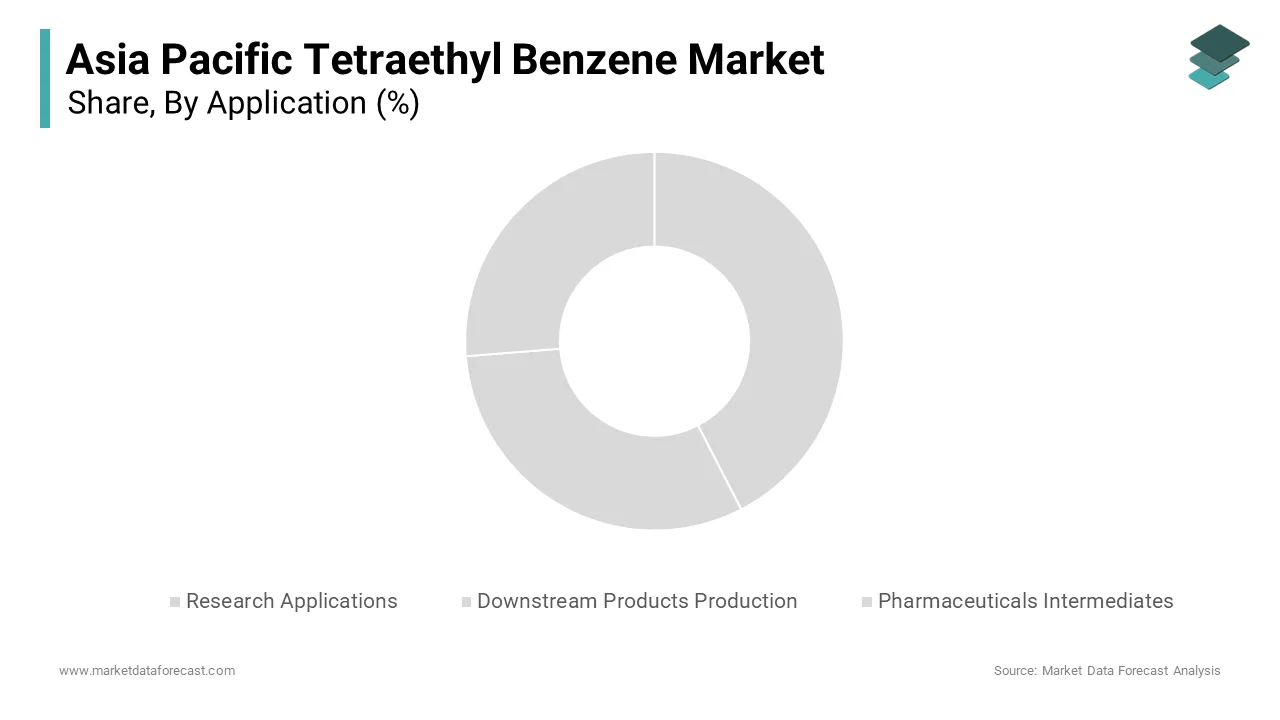
The research applications segment is projected to register a CAGR of 14.8% from 2025 to 2033, owing to the expanding R&D activities in organic electronics, energy storage, and advanced materials science. At the University of Tokyo, researchers have used TEB as a model compound in thin-film transistor studies, demonstrating hole mobilities exceeding 1.5 cm²/V·s under ambient conditions, a finding published in the Journal of Materials Chemistry C in 2023. In India, the Indian Institute of Science has incorporated TEB into investigations on perovskite solar cell stability, where its non-polar nature minimizes ion migration in photoactive layers. Furthermore, Australia’s Commonwealth Scientific and Industrial Research Organisation (CSIRO) is evaluating TEB as a solvent in lithium-sulfur battery electrolytes, reporting a 40% improvement in sulfur utilization efficiency in 2023 trials. Government funding is accelerating this trend; Japan’s New Energy and Industrial Technology Development Organization (NEDO) allocated JPY 8.2 billion in 2023 to organic semiconductor research, with TEB featuring in 17% of funded projects.
COUNTRY-LEVEL ANALYSIS
Japan Tetraethyl Benzene Market Analysis
Japan was the top performer of the Asia Pacific tetraethyl benzene market with 32.1% of the share in 2025 due to its world-class specialty chemical manufacturing and deep integration of TEB into high-tech industrial applications. Japanese firms such as Mitsubishi Chemical and Shin-Etsu Chemical are pioneers in utilizing tetraethyl benzene for advanced polymer synthesis, particularly in aerospace-grade resins and semiconductor encapsulants. Additionally, Japan’s commitment to carbon neutrality by 2050 has spurred research into TEB’s role in high-efficiency energy systems, including solid-state batteries and hydrogen fuel cell components. The National Institute of Advanced Industrial Science and Technology (AIST) reported that 28 active R&D projects in 2023 involved TEB as a functional material.
China Tetraethyl Benzene Market Analysis
China's tetraethyl benzene market was positioned second by holding 28.3% of the share, with its vast industrial base and strategic investments in advanced materials. TEB is increasingly used as an intermediate in the synthesis of high-temperature resistant lubricants for EV drivetrains, with companies like Sinopec developing proprietary formulations for domestic automakers. According to the China Association of Automobile Manufacturers, over 9 million EVs were produced in 2023, each requiring specialized fluids where TEB-based additives enhance thermal stability. In the electronics sector, TEB is being evaluated in next-generation display manufacturing; BOE Technology has initiated pilot lines using TEB-derived solvents for flexible OLED panels.
South Korea Tetraethyl Benzene Market Analysis
South Korea's tetraethyl benzene market growth is likely to grow, as semiconductor and display manufacturing has created a specialized niche for TEB in precision cleaning and resin formulation. As per the Korea Institute of Science and Technology Evaluation and Planning, TEB consumption in semiconductor fabs increased by 16% between 2021 and 2023, driven by the shift to 3nm and sub-3nm chip architectures. Additionally, LG Display has incorporated TEB into its roll-to-roll OLED production, leveraging its high boiling point to prevent film defects during coating. The country’s Green Chemistry Initiative encourages the substitution of hazardous solvents, but TEB remains exempt due to its irreplaceable performance in high-stress applications.
India Tetraethyl Benzene Market Analysis
India's tetraethyl benzene market is capturing an estimated 9% share in 2025, as per the Indian Chemical Council. The country’s position is defined by its expanding research ecosystem and nascent but strategic industrial applications. While large-scale commercial use remains limited, TEB is gaining traction in academic and government-led R&D initiatives focused on organic semiconductors, battery materials, and specialty polymers. The Indian Institute of Science in Bangalore has conducted extensive studies on TEB’s electron-donating properties in perovskite solar cells, achieving a 19% efficiency improvement in prototype devices, as reported in the Journal of Physical Chemistry C in 2023. Additionally, the Defence Research and Development Organisation (DRDO) is evaluating TEB-based fluids for use in high-altitude drone systems due to their low volatility and thermal resilience. The government’s National Mission on Advanced Materials has allocated INR 450 crore for aromatic hydrocarbon research, including TEB derivatives.
Singapore Tetraethyl Benzene Market Analysis
Singapore's tetraethyl benzene market is likely to grow with a prominent CAGR in the coming years. The country hosts several multinational R&D centers, including those of ExxonMobil, BASF, and Merck, which utilize TEB in the development of next-generation electronic materials and specialty coatings. In 2023, ASTAR’s Institute of Materials Research and Engineering demonstrated a TEB-based polymer with a dielectric constant below 2.1, suitable for 6G communication devices. Additionally, Singapore’s stringent environmental regulations under the National Environment Agency ensure that TEB use is confined to closed-loop systems, minimizing ecological risk while enabling high-value applications. The country’s status as a free port and its robust intellectual property protections attract global chemical firms seeking a stable base for Asian operations.
COMPETITIVE LANDSCAPE
The competitive landscape of the Asia Pacific tetraethyl benzene market is characterized by a concentrated, innovation-driven ecosystem dominated by multinational chemical giants and regionally integrated specialty producers. Unlike commodity chemicals, competition is not based on price but on technical performance, purity, and application-specific expertise. Japanese and South Korean firms lead in high-tech integration, embedding TEB into semiconductor, display, and aerospace materials where performance outweighs cost considerations. Multinational players such as ExxonMobil leverage their global R&D networks and advanced manufacturing capabilities to supply ultra-pure grades to research institutions and high-end industrial users. Chinese and Indian companies are gradually entering through state-supported innovation programs, though they remain focused on downstream research rather than large-scale production. Regulatory divergence across countries creates both barriers and opportunities, with Japan and Singapore offering clear approval pathways while others impose strict handling requirements. Intellectual property and technical service capabilities are key differentiators, as customers require extensive support for integration into sensitive processes. The market lacks mass-scale producers, resulting in limited direct competition but high dependency on a few specialized suppliers.
KEY MARKET PLAYERS
These are the market players that are dominating the Asia Pacific tetraethyl benzene market.
- Angene International
- ChemSampCo, LLC
- Mitsubishi Chemical Corporation
- LEAPChem Co., Ltd
- ExxonMobil Chemical
- LG Chem
- Leap Chem Co., Ltd
- AHH Chemical Co., Ltd
- BOCSCI Inc
- Henan Tianfu Chemical Co., Ltd
- Sagechem Limited
- Antimex Chemical Limited
Top Players In The Market
- Mitsubishi Chemical Corporation is a leading innovator in the Asia Pacific tetraethyl benzene market, leveraging its expertise in high-performance materials and specialty aromatics. The company integrates tetraethyl benzene as an intermediate in the development of thermally stable resins for aerospace, semiconductor encapsulation, and 5G infrastructure applications. Its Yokkaichi and Kawasaki facilities employ advanced alkylation technologies to produce ultra-high-purity TEB, meeting stringent specifications for electronic-grade use. In 2023, the company expanded its collaboration with Japan’s New Energy and Industrial Technology Development Organization (NEDO) to develop TEB-based dielectric materials for next-generation power modules. Additionally, Mitsubishi Chemical has strengthened its R&D partnerships with Tokyo Institute of Technology to explore TEB’s role in organic semiconductor fabrication. The company has also enhanced its environmental compliance systems, implementing closed-loop recovery processes to minimize emissions.
- LG Chem plays a pivotal role in advancing the application of tetraethyl benzene in South Korea’s high-tech industrial sectors in electric vehicles, flexible electronics, and energy storage systems. In 2023, LG Chem initiated pilot production of TEB-modified binders for lithium-ion batteries, designed to enhance electrode integrity under rapid charging conditions. The company also collaborates with LG Display to optimize TEB-based coatings for roll-to-roll OLED manufacturing, ensuring uniform film deposition and minimal defect rates. Recognizing the environmental implications, LG Chem has invested in solvent recovery systems at its Daejeon R&D center to reduce waste and improve process sustainability. Furthermore, the company participates in South Korea’s Green Chemistry Initiative, advocating for the responsible use of specialty aromatics in high-value applications.
- ExxonMobil Chemical is a major contributor to the Asia Pacific tetraethyl benzene market through its advanced petrochemical technologies and strategic presence in high-purity specialty solvents. Operating from its integrated complex in Singapore, the company produces alkylated benzenes using proprietary zeolite-catalyzed processes by ensuring consistent quality and performance for demanding industrial applications. ExxonMobil supplies TEB derivatives to electronics manufacturers and research institutions across the region, particularly for use in dielectric fluids and high-temperature lubricants. In 2023, the company launched a new grade of ultra-pure TEB tailored for semiconductor cleaning processes, developed in collaboration with A*STAR’s Institute of Materials Research and Engineering. It also supports regional customers through technical service programs that optimize solvent selection and handling protocols. The company has enhanced its sustainability framework by implementing real-time emission monitoring and solvent recycling systems at its Jurong Island facility.
Top Strategies Used By Key Market Participants
Key players in the Asia Pacific tetraethyl benzene market are deploying advanced R&D collaboration, precision application engineering, and regulatory engagement into their positions. Companies are increasingly partnering with national research institutes and universities to validate performance in next-generation technologies such as organic semiconductors and solid-state batteries. Geographic expansion is focused on establishing technical service hubs in innovation centers like Singapore, Tokyo, and Seoul to provide localized support. Strategic capacity upgrades are being implemented to ensure supply continuity amid growing demand from EV and 5G infrastructure projects. Additionally, firms are actively participating in regulatory consultations to shape safety and handling standards, ensuring market access while maintaining operational flexibility. Intellectual property development is another strategy, with companies filing patents for TEB-derived materials in energy storage and flexible electronics.
RECENT MARKET NEWS
- In January 2023, Mitsubishi Chemical expanded its collaboration with NEDO to develop TEB-based dielectric resins for next-generation power electronics by enhancing its integration into Japan’s 5G and EV infrastructure supply chain.
- In May 2023, LG Chem launched pilot production of TEB-modified battery binders at its Daejeon R&D center, which is aiming to improve thermal stability in high-nickel lithium-ion cells for electric vehicle applications.
- In August 2023, ExxonMobil Chemical introduced a new ultra-pure grade of tetraethyl benzene at its Singapore complex, specifically engineered for semiconductor cleaning and thin-film deposition processes.
- In November 2023, Mitsubishi Chemical implemented a closed-loop solvent recovery system at its Yokkaichi plant, reducing TEB emissions by 40% and strengthening compliance with Japan’s Chemical Substances Control Law.
- In February 2025, LG Chem initiated a joint research program with Seoul National University to explore TEB’s charge transport properties in organic semiconductors by expanding its application scope in flexible electronics.
MARKET SEGMENTATION
This research report on the Asia Pacific tetraethyl benzene market is segmented and sub-segmented into the following categories.
By Application
- Research Applications
- Downstream Products Production
- Pharmaceuticals Intermediates
By Country
- India
- China
- Japan
- South Korea
- Australia
- New Zealand
- Thailand
- Malaysia
- Vietnam
- Philippines
- Indonesia
- Singapore
- Rest of APAC