- Product Description Description
- Table of Contents TOC
- List of Table & Figure LOT
- Get Free Sample PDF Sample PDF
Market Size, 2025
$0.83 BnMarket Estimate, 2026
$0.87 BnMarket Forecast, 2034
$1.26 BnCAGR, 2026–2034
4.73%Executive Summary: Asia Pacific Truck Loader Crane Market
- Market Scope: Comprehensive regional market analysis covering application sectors, end-user types, load capacities, country-level leadership frameworks, and infrastructure development metrics for the Asia-Pacific truck loader crane sector.
- Market Valuation: Valued at USD 0.83 billion (2025), estimated at USD 0.87 billion (2026), and projected to reach USD 1.26 billion by 2034, registering a steady CAGR of 4.73% (2026–2034).
- Primary Growth Drivers: Infrastructure development, expanding logistics networks, self-sufficient transport solutions, road network investments, urban development, freight corridor modernization in Southeast Asia, and e-commerce cargo handling needs. Market challenges include high initial investment costs and stringent emission norms (e.g., India’s Bharat Stage VI), while opportunities lie in electric/hybrid crane-integrated trucks, Indonesian nickel/bauxite mining, and cold chain logistics integration.
Key Market Segment Metrics (2026–2034)
| Category | Leading Segment Position | Fastest-Growing Segment |
|---|---|---|
| By Application / End-User / Capacity | Construction sector (dominated with 35.3% share in 2025) & Contractors (held largest share of 38.3% in 2025) & 10–20 tons segment (led with 32.2% share in 2025) | Mining segment (projected CAGR of 9.2% from 2025–2033) & Fleet operators (expected CAGR of 8.9%) & Over 40 tons segment (fastest-growing at 10.3% CAGR) |
| By Region / Country | China (top performer accounting for 28.3% share in 2025 supported by freight volume and infrastructure modernization) | India (held second position with 20.3% share supported by expanding industrial and road projects) |
Major Market Players & Market Structure
Market Structure: Highly competitive Asia-Pacific truck loader crane landscape centering on compact crane technology for urban logistics, regional manufacturing facility expansions, electric-powered crane model introductions, and logistics distributor service alliances.
Key Companies: Fassi, HIAB, Liebherr Group, Demag Cranes, Terex, Sany Group, Zoomlion, Palfinger, XCMG, Tadano, Grove Cranes, Kobelco Cranes, Jekko, and Kato Works.
Asia Pacific Truck Loader Crane Market Size
The Asia Pacific truck loader crane market was valued at USD 0.83 billion in 2025 and is anticipated to reach a valuation of USD 0.87 billion in 2026 and USD 1.26 billion by 2034, growing at a CAGR of 4.73%, from 2026 to 2034.
The truck loader cranes are widely used in logistics, infrastructure development, construction, and mining industries, where mobility, versatility, and operational efficiency are crucial. Truck loader cranes offer a compact and cost-effective alternative to traditional mobile cranes by combining loading and hauling functions into a single unit by reducing the need for multiple machines on-site. Additionally, as per the International Road Transport Union, road freight remains the dominant mode of cargo movement in the region, with the importance of truck-mounted crane systems.
MARKET DRIVERS
Growth in Infrastructure and Construction Activities
The rapid expansion of infrastructure and construction activities across the region is escalating the growth of the Asia Pacific truck loader crane market. Countries like India, China, and Indonesia are witnessing large-scale investments in road networks, urban development, and industrial parks, which necessitate efficient lifting and transport solutions. This has significantly boosted demand for versatile equipment such as truck loader cranes, which combine mobility with lifting capabilities. In Southeast Asia, countries like Vietnam and the Philippines are also expanding their construction sectors, with government-backed projects aimed at improving transportation and housing.
Expansion of Logistics and Transportation Networks
The expansion of logistics and transportation networks across the Asia Pacific region is another major factor fueling the growth of the truck loader crane market. There is a rising need for efficient cargo handling solutions that integrate mobility with lifting capabilities as e-commerce, manufacturing, and supply chain activities grow. In Australia, where long-distance freight transport is essential due to the country’s vast geography, truck loader cranes are becoming a preferred choice for logistics companies seeking to reduce handling time and labor costs. In emerging markets such as Thailand and Malaysia, government initiatives to modernize freight corridors and logistics hubs have increased the demand for integrated transport solutions. The rise in cold chain logistics and just-in-time delivery models has further reinforced the need for self-loading transport systems.
MARKET RESTRAINTS
High Initial Investment and Maintenance Costs
The high initial investment and maintenance costs associated with these machines are slightly degrading the growth of the Asia Pacific truck loader crane market. Truck loader cranes require significant capital expenditure, particularly for advanced models equipped with high lifting capacities and automation features. In countries like Indonesia and the Philippines, where a large portion of the construction industry is dominated by small-scale contractors, affordability remains a key barrier. As per the Philippine Department of Trade and Industry, less than 20% of SMEs in the logistics and construction sectors can afford to invest in high-end equipment without external financing.
Regulatory and Environmental Compliance Issues
The increasing stringency of regulatory and environmental compliance requirements is additionally hampering the growth of the Asia Pacific truck loader crane market. Governments across the region are implementing stricter emission norms and vehicle safety standards, which impact the design, manufacturing, and operation of commercial vehicles equipped with loader cranes. In India, the implementation of the Bharat Stage VI (BS-VI) emission norms has also resulted in increased costs for crane-integrated trucks, affecting adoption rates among price-sensitive operators. These regulatory pressures, combined with the need for ongoing compliance, pose significant challenges for manufacturers and end-users, which are limiting market expansion in the Asia Pacific region.
MARKET OPPORTUNITIES
Adoption of Electric and Hybrid Truck Loader Cranes
The growing adoption of electric and hybrid-powered crane-integrated trucks is attributed to the growth of the Asia Pacific truck loader crane market. According to the International Energy Agency, electric commercial vehicle sales in the Asia Pacific region grew by over 40% in 2023, which was driven by government incentives and stricter emission norms. In China, the world’s largest market for electric commercial vehicles, major crane manufacturers are collaborating with electric vehicle (EV) companies to develop integrated electric truck loader crane systems. In Japan, where urban freight and logistics companies are under pressure to reduce carbon footprints, electric truck loader cranes are gaining traction for use in city deliveries and last-mile logistics. In India, the Faster Adoption and Manufacturing of Electric Vehicles (FAME II) scheme has incentivized the development of electric commercial vehicles, including crane-equipped trucks.
Expansion of Rental and Leasing Services for Crane Trucks
The expansion of rental and leasing services in emerging economies where upfront costs remain a barrier to ownership is prompting the growth of the Asia Pacific truck loader crane market. According to the Equipment Leasing and Finance Association, the demand for construction equipment rental services in the Asia Pacific region has been growing at a steady pace, with India and Southeast Asian countries leading the trend. Local equipment leasing companies are offering flexible financing options for crane-integrated trucks by enabling small and medium-sized enterprises to access modern machinery without large capital outlays. This growing trend of equipment rental and leasing is expected to drive wider adoption of truck loader cranes across the Asia Pacific among price-sensitive operators who require flexible and cost-effective material handling solutions.
MARKET CHALLENGES
Limited Skilled Workforce for Crane Operations
The limited availability of skilled operators and technicians trained in crane operation and maintenance is limiting the growth of the Asia Pacific truck loader crane market. The effective use of truck loader cranes requires specialized knowledge, including load handling, safety protocols, and equipment diagnostics, which are not widely available in many parts of the region. In countries like Vietnam and the Philippines, where vocational training programs are still evolving, there is a shortage of certified crane operators, leading to inefficiencies and safety concerns. As per the Technical Education and Skills Development Authority (TESDA) in the Philippines, only a fraction of construction and logistics workers have formal training in crane operations, limiting the effective utilization of advanced crane-equipped trucks. The lack of standardized training programs and certification frameworks across the region further complicates workforce development, which is posing a significant challenge to the widespread adoption of truck loader cranes in the Asia Pacific.
Inconsistent Infrastructure Development Across the Region
The inconsistency in infrastructure development across different countries and regions is also hampering the growth of the Asia Pacific truck loader crane market. According to the World Bank's Logistics Performance Index, countries like China, Japan, and Australia rank high in infrastructure quality, facilitating the smooth operation of specialized transport equipment. However, in countries such as Papua New Guinea, Laos, and Cambodia, poor road conditions and limited access to paved highways hinder the use of heavy-duty crane trucks, reducing market potential.
REPORT COVERAGE
| REPORT METRIC | DETAILS |
| Market Size Available | 2025 to 2034 |
| Base Year | 2025 |
| Forecast Period | 2026 to 2034 |
| CAGR | 4.73% |
| Segments Covered | By Application, End-User, Load Capacity, Telescoping Boom Type, Safety Features, Country |
| Various Analyses Covered | Global, Regional and Country Level Analysis; Segment-Level Analysis; DROC; PESTLE Analysis; Porter’s Five Forces Analysis; Competitive Landscape; Analyst Overview of Investment Opportunities |
| Regions Covered | India, China, Japan, South Korea, Australia, New Zealand, Thailand, Malaysia, Vietnam, Philippines, Indonesia, Singapore, and the Rest of APAC |
| Market Leaders Profiled | Fassi, HIAB, Liebherr Group, Demag Cranes, Terex, Sany Group, Zoomlion, Palfinger, XCMG, Tadano, Grove Cranes, Kobelco Cranes, Liebherr, Jekko. |
SEGMENTAL ANALYSIS
By Application Insights
The construction sector dominated the Asia Pacific truck loader crane market by accounting for 35.3% of share in 2025. In China, rapid urbanization and the expansion of smart city initiatives have led to a surge in construction activities in second- and third-tier cities. The Ministry of Housing and Urban-Rural Development reported that urban construction projects increased by 12% in 2022 compared to the previous year. Additionally, in Southeast Asia, countries such as Vietnam and the Philippines are witnessing a boom in residential and commercial construction, further fueling the need for efficient material handling solutions.
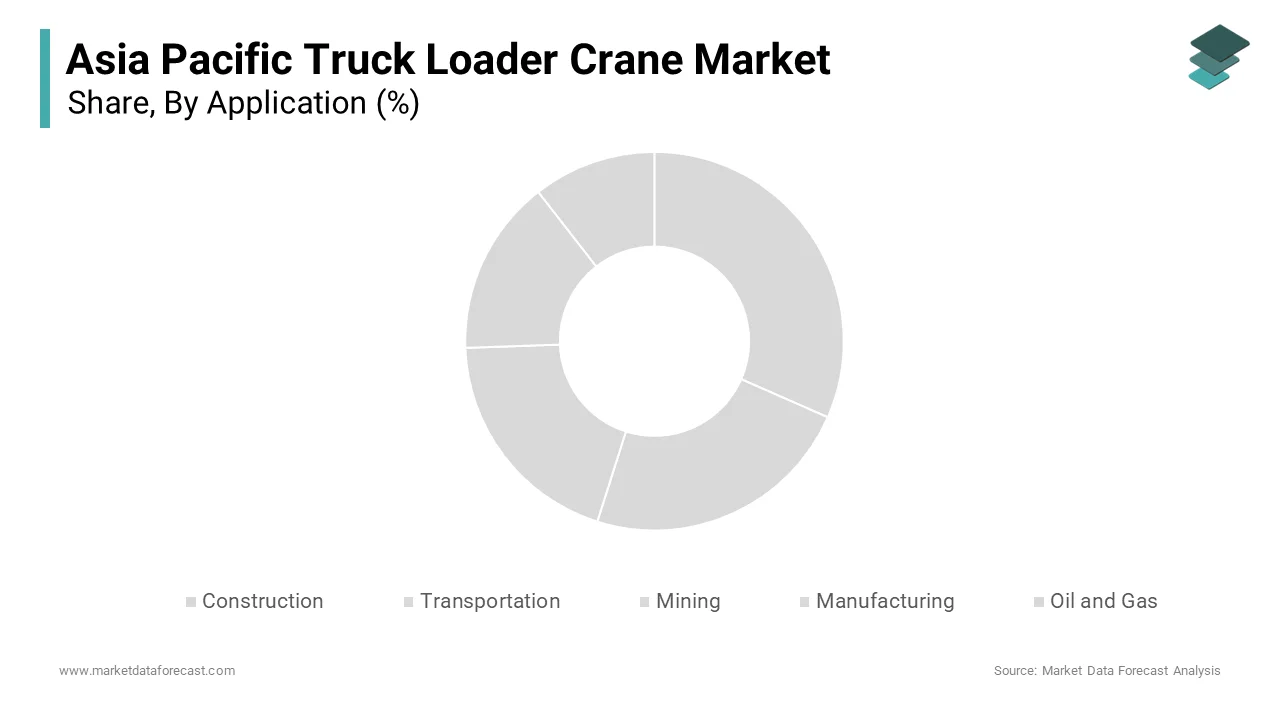
The mining segment is projected to expand with a CAGR of 9.2% from 2025 to 2033. According to the International Council on Mining & Metals, the Asia Pacific region accounts for over 40% of global mineral production, with Australia and China being among the top producers of coal, copper, and rare earth metals. In Indonesia, the government has been promoting the expansion of nickel and bauxite mining to support the growing battery and aluminum industries, leading to increased use of mobile lifting and transport solutions. Additionally, in Mongolia, the government’s push to develop the Oyu Tolgoi copper and gold mine has resulted in greater deployment of truck loader cranes for ore transportation and site logistics.
By End-User Insights
The contractors were accounted for in holding 38.3% of the Asia Pacific truck loader crane market share in 2025. According to the Indian Contractors Association, over 70% of infrastructure projects in India are executed through private contractors, many of whom prefer to use integrated truck loader cranes for their mobility, versatility, and cost-effectiveness. In Southeast Asia, where small and medium-sized contractors play a crucial role in local infrastructure development, the demand for truck loader cranes has been rising due to their ability to perform multiple tasks without the need for separate lifting and transport equipment. Additionally, in Australia, major infrastructure projects such as the Melbourne Metro and Sydney’s WestConnex have seen increased use of truck loader cranes by contracting firms to enhance on-site efficiency.
The fleet operators segment is estimated to grow with a CAGR of 8.9% from 2025 to 2033. According to the World Bank, freight transport demand in the Asia Pacific region is expected to grow by over 6% annually, fueled by rising e-commerce activity and industrial logistics requirements. Similarly, in Japan, where urban congestion and labor shortages are pressing concerns, logistics companies are shifting toward self-loading transport systems to optimize delivery schedules. Additionally, in Australia, major logistics firms such as Toll Group and Linfox are expanding their fleets with truck loader cranes to serve remote and regional areas more efficiently.
By Load Capacity Insights
The 10–20 tons load capacity segment was the largest and held 32.2% of the Asia Pacific truck loader crane market share in 2025. In India, where a large portion of construction and infrastructure projects are mid-sized, cranes in the 10–20 ton range are preferred for their versatility and cost-effectiveness. In China, the Ministry of Transport reported that the majority of cargo transported within cities falls within the 10–20 ton range, further reinforcing the demand for cranes that can efficiently handle this load capacity.
The over 40 tons load capacity segment is likely to witness a CAGR of 10.3% from 2025 to 2033, with the increasing demand for heavy-duty lifting and transport solutions in large-scale infrastructure, mining, and energy projects. According to the International Energy Agency, the Asia Pacific region is investing heavily in renewable energy and large-scale industrial projects, which require high-capacity equipment for transporting oversized components such as wind turbine blades, transformers, and modular construction units.
COUNTRY ANALYSIS
China
China was the top performer of the Asia Pacific truck loader crane market by accounting for 28.3% of the share in 2025. According to the Chinese Ministry of Transport, the country’s freight volume reached over 49 billion tons in 2022, with road transport playing a central role in domestic logistics. This has led to a growing preference for integrated transport solutions such as truck loader cranes, which combine mobility with lifting capabilities. Moreover, the Chinese government’s push for smart city development and infrastructure modernization has spurred the adoption of advanced crane-equipped trucks.
India
India was positioned second in the Asia Pacific truck loader crane market with a 20.3% share in 2025. According to the Indian Ministry of Road Transport and Highways, the country’s road construction rate has increased significantly, with over 30 kilometers of national highways built daily in 2022. Additionally, the Indian logistics sector is expanding rapidly, with e-commerce growth and supply chain modernization driving the need for efficient transport and loading equipment.
Australia
The Australian truck loader crane market is expected to experience a significant CAGR in the coming years. According to the Australian Department of Industry, Science and Resources, the mining sector contributed over AUD 240 billion to the economy in 2022, with companies increasingly adopting integrated transport solutions to improve efficiency. Truck loader cranes are widely used in open-pit mining, quarrying, and bulk material transport due to their ability to handle heavy loads in remote locations. In addition to mining, the logistics and municipal services sectors are also major adopters of truck loader cranes. The Australian Logistics Council reported that freight demand is expected to grow by over 3% annually, necessitating the use of versatile transport equipment.
JapanThe
The Japanese truck loader crane market is likely to grow in the coming years. According to the Japan Automobile Manufacturers Association, the country’s commercial vehicle industry has been evolving to meet the demands of last-mile delivery and urban logistics, with an increasing number of crane-equipped trucks being deployed in city distribution networks. Additionally, Japan’s aging workforce and increasing focus on automation have led to the adoption of advanced truck loader crane systems that reduce manual handling and improve operational efficiency. Companies such as Tadano and Kato Works have been developing specialized crane-integrated trucks tailored to urban logistics and construction applications.
South Korea
South Korea's truck loader crane market is a strong industrial base, and government-led smart logistics initiatives have contributed to the increasing adoption of integrated transport solutions. Additionally, the Korean government’s Smart Logistics Innovation Strategy aims to modernize freight transport and warehouse operations, encouraging the use of multi-functional transport equipment. The Ministry of Land, Infrastructure and Transport has also introduced policies to support the adoption of eco-friendly and automated commercial vehicles, including crane-equipped trucks.
KEY MARKET PLAYERS
Fassi, HIAB, Liebherr Group, Demag Cranes, Terex, Sany Group, Zoomlion, Palfinger, XCMG, Tadano, Grove Cranes, Kobelco Cranes, Liebherr, Jekko. Are the market players that are dominating the Asia Pacific truck loader crane market?.
Top Players In The Market
One of the leading players in the Asia Pacific truck loader crane market is Tadano Ltd., a Japanese manufacturer known for its innovative crane technologies and strong presence in both domestic and international markets. Tadano has been instrumental in advancing integrated crane solutions for commercial vehicles, particularly in urban logistics and construction applications. The company’s focus on reliability, compact design, and adaptability to diverse operational conditions has made it a preferred choice in the Asia Pacific region.
Kato Works Co., Ltd. It is also based in Japan. Kato has built a strong reputation for its high-quality truck-mounted cranes that cater to mid- to heavy-duty applications. The company’s emphasis on engineering excellence and performance in challenging environments has positioned it as a major contributor to the global crane industry in construction and municipal services across Asia.
Sany Group is a leading Chinese equipment manufacturer, is also a dominant force in the Asia Pacific truck loader crane market. Sany has expanded its reach across domestic and international markets with a strong focus on cost-effective, high-performance solutions. The company’s aggressive R&D investments and localization strategies have significantly influenced the adoption of truck loader cranes in emerging economies.
Top Strategies Used By Key Market Participants
The product innovation and customization where manufacturers developing specialized crane models tailored to regional applications such as urban logistics, construction, and mining. This allows companies to meet specific operational demands and enhance user experience.
Another major approach is strategic partnerships with local distributors and logistics firms by enabling manufacturers to strengthen their after-sales service networks, provide timely maintenance, and expand their market reach in both urban and rural areas across the region.
The expanding digital integration and telematics capabilities have become a key focus, with companies incorporating smart monitoring systems into crane-equipped trucks to improve operational efficiency, safety, and remote diagnostics by aligning with the growing trend of connected commercial vehicles in the Asia Pacific market.
COMPETITION LANDSCAPE
The Asia Pacific truck loader crane market is highly competitive, shaped by the presence of both global and regional manufacturers striving to capture market share through product differentiation, strategic alliances, and localized offerings. While Japanese companies such as Tadano and Kato Works have traditionally dominated due to their technological expertise and established distribution networks, Chinese manufacturers like Sany and XCMG are rapidly gaining ground by offering cost-effective and high-performance alternatives.
In addition to product development, companies are focusing on after-sales services, training programs, and digital enhancements to differentiate themselves in a crowded marketplace. The competitive environment is further intensified by the growing demand for electric and hybrid crane-equipped trucks, which is prompting firms to invest in sustainable technologies. As infrastructure expansion and logistics modernization continue across the region, the competition among truck loader crane manufacturers is expected to intensify, with players leveraging innovation, regional partnerships, and service excellence to maintain a strong market position.
RECENT HAPPENINGS IN THE MARKET
- In February 2025, Tadano launched a new line of compact truck loader cranes specifically designed for urban logistics in Southeast Asia, which is aiming to meet the rising demand for efficient last-mile delivery solutions in densely populated cities.
- In June 2023, Sany expanded its manufacturing facility in India to increase local production of truck loader cranes, which supports faster delivery times and cost optimization for regional customers.
- In October 2023, Kato Works formed a strategic alliance with a leading Australian logistics equipment distributor to enhance its service network and improve customer support across the Oceania region.
- In January 2025, XCMG introduced an electric-powered truck loader crane model in China, targeting urban municipalities and logistics hubs seeking low-emission transport and handling solutions.
MARKET SEGMENTATION
This research report on the Asia Pacific truck loader crane market is segmented and sub-segmented into the following categories.
By Application Insights
- Construction
- Transportation
- Mining
- Manufacturing
- Oil and Gas
By End-User
- Contractors
- Fleet Operators
- Owner-Operators
- Government Agencies
- Utilities
By Load Capacity
- Less than 10 tons
- 10-20 tons
- 20-30 tons
- 30-40 tons
- Over 40 tons
By Telescoping Boom Type
- Straight Telescopic
- Articulating Telescopic
- Knuckle Telescopic
- Hydraulic Telescopic
- Electric Telescopic
By Safety Features
- Anti-Two-Blocking System (ABS)
- Anti-lock Braking System (ABS)
- Electronic Stability Control (ESC)
- Rollover Protective Structure (ROPS)
- Fall Arrest System
By Country
- India
- China
- Japan
- South Korea
- Australia
- New Zealand
- Thailand
- Malaysia
- Vietnam
- Philippines
- Indonesia
- Singapore
- Rest of APAC