- Product Description Description
- Table of Contents TOC
- List of Table & Figure LOT
- Get Free Sample PDF Sample PDF
Market Size, 2025
$8,982.85 MnMarket Estimate, 2026
$11,122 MnMarket Forecast, 2034
$61,407 MnCAGR, 2026–2034
23.81%Asia Pacific Virtual Reality Gaming Market Size
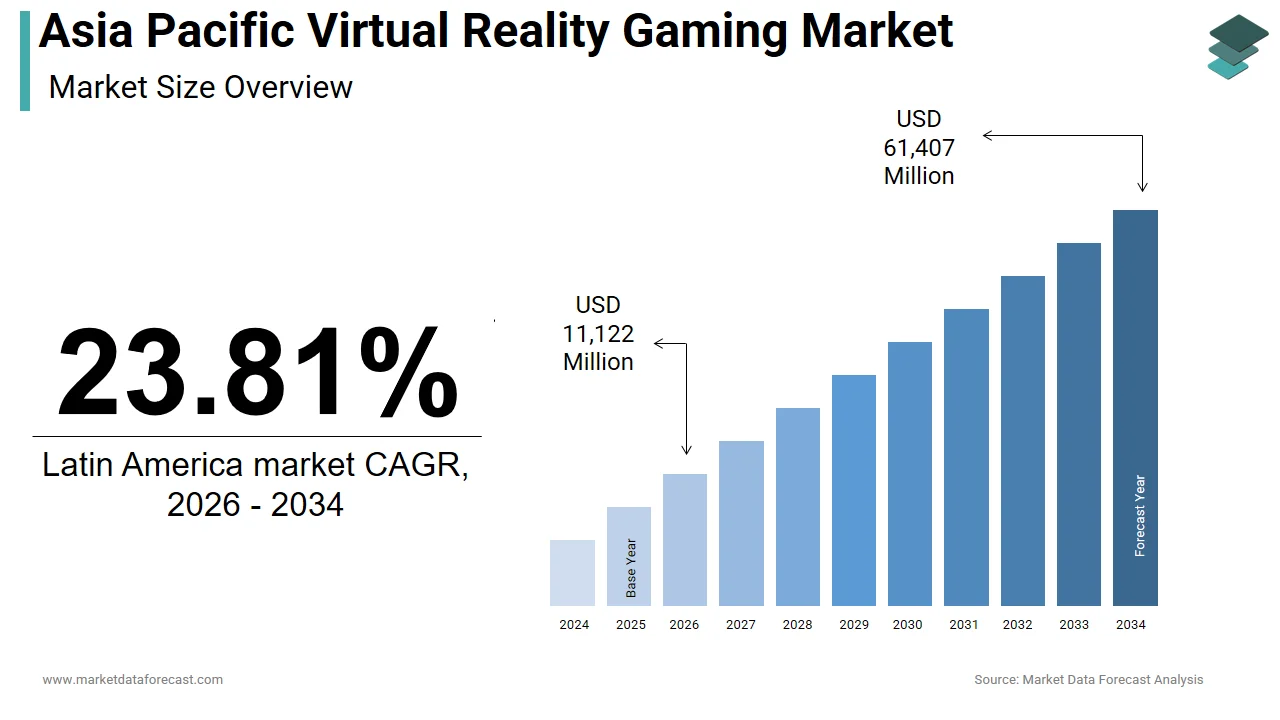
The Asia Pacific virtual reality gaming market was valued at USD 8,982.85 million in 2025, is estimated to reach USD 11,122 million in 2026, and is projected to reach USD 61,407 million by 2034, growing at a CAGR of 23.81% from 2026 to 2034.
Virtual reality gaming refers to the immersive, interactive entertainment experiences delivered through head-mounted displays, motion-tracking sensors, and spatial audio systems that simulate three-dimensional digital environments. Unlike traditional gaming, VR gaming demands physical engagement, leveraging real-time responsiveness and depth perception to create experiential realism. Across the region, the proliferation of high-speed mobile networks and advancements in standalone VR headsets have expanded accessibility beyond niche tech adopters. Countries like Japan and South Korea have integrated VR into cultural preservation projects, such as virtual recreations of historical sites, demonstrating the medium’s broader societal utility.
MARKET DRIVERS
Expansion of 5G Infrastructure Enabling Low-Latency VR Experiences
The rapid deployment of 5G networks across the Asia Pacific is fundamentally transforming the feasibility of cloud-based virtual reality gaming by minimizing latency and enhancing streaming quality. VR gaming requires data transmission rates exceeding 100 Mbps and latency below 20 milliseconds to prevent motion sickness and ensure seamless interaction, conditions now achievable with 5G. This infrastructure enables edge computing-driven VR gaming, where processing occurs closer to the user, reducing lag. In Japan, NTT Docomo demonstrated a cloud VR gaming trial with latency under 15ms in urban areas, paving the way for mass adoption. As 5G penetration deepens in India and Southeast Asia, telecom operators are partnering with game developers to launch VR gaming bundles, making high-fidelity experiences accessible without expensive local hardware.
Rising Consumer Adoption of Standalone VR Headsets in Urban Households
Standalone VR headsets, which operate independently of PCs or consoles, are gaining traction in urban centers across the Asia Pacific due to declining prices and improved usability. Devices like Meta Quest 3 and Pico 4 offer immersive experiences at under USD 500, making them increasingly affordable for middle-income tech adopters. In metropolitan areas such as Singapore and Sydney, VR headsets are being adopted not only for gaming but also for virtual fitness and social interaction, broadening their utility. VR headset sales in Bangkok surged, driven by promotional campaigns and retail demo zones. This shift reflects a growing comfort with immersive interfaces and signals a transition from novelty to mainstream entertainment hardware.
MARKET RESTRAINTS
High Cost of Premium VR Hardware and Content Development
Despite technological advancements, the financial barrier to entry remains a significant impediment to widespread VR gaming adoption. High-end VR headsets such as Valve Index or Varjo XR-4 retail between USD 1,000 and USD 3,000, placing them beyond the reach of average consumers in emerging economies. Even mid-tier standalone devices, when combined with accessories like haptic gloves or tracking base stations, can exceed USD 800. As per the Asian Development Bank, per capita income in countries like the Philippines and Vietnam remains below USD 4,000 annually, limiting discretionary spending on immersive tech. Additionally, developing high-quality VR games requires specialized skills and rendering capabilities. This economic reality restricts both consumer access and developer participation, particularly in lower-income markets where mobile gaming dominates due to affordability.
Persistent Consumer Concerns Regarding Health and Physical Safety
Prolonged use of VR headsets has raised public health concerns, including motion sickness, eye strain, and disorientation, which deter sustained engagement. Regulatory bodies in Japan and Australia have issued advisories recommending usage limits for children under 12 due to potential impacts on visual development. Furthermore, physical safety risks are evident. These concerns are amplified in densely populated urban homes where space for VR movement is limited. As a result, many consumers treat VR gaming as an occasional experience rather than a daily habit, constraining habitual usage and long-term market penetration.
MARKET OPPORTUNITIES
Integration of VR Gaming in Educational and Training Simulations
The convergence of VR gaming technology with educational curricula and corporate training presents a transformative opportunity across the Asia Pacific. Schools and vocational institutions are adopting gamified VR modules to teach complex subjects such as anatomy, engineering, and disaster response. Companies like Boeing and Singapore Airlines use VR simulations derived from gaming engines to train pilots, reducing costs and improving retention. The use of Unreal Engine and Unity in creating realistic, interactive scenarios enables scalable, repeatable learning experiences. This cross-sector application not only validates VR technology but also builds public familiarity, fostering acceptance for recreational gaming.
Growth of Location-Based VR Entertainment Centers in Tier-2 Cities
Location-based VR arcades and experiential zones are emerging as a viable alternative to home-based systems, particularly in tier-2 and tier-3 cities where household spending on high-end tech remains limited. These centers offer premium VR gaming experiences at affordable pay-per-use rates, often incorporating multiplayer arenas, haptic feedback suits, and room-scale tracking. Also, several dedicated VR entertainment venues opened in tire2/3 cities. In Chengdu and Jaipur, local entrepreneurs have partnered with global VR content providers to launch themed gaming pods based on mythology and pop culture. These venues attract youth, families, and tourists, serving as both entertainment hubs and technology introduction points. The model reduces individual ownership barriers while enabling operators to upgrade hardware centrally, ensuring consistent performance and hygiene standards.
MARKET CHALLENGES
Fragmentation of Hardware Standards and Ecosystem Incompatibility
The Asia Pacific VR gaming landscape suffers from a lack of standardized hardware and software ecosystems, leading to interoperability issues that hinder user experience and developer scalability. Major platforms Meta’s Quest, Sony’s PSVR 2, and HTC Vive operate on closed systems with proprietary app stores, controllers, and development tools. In India, most indie game studios avoid VR development due to high porting costs and fragmented SDK requirements. This fragmentation confuses consumers, who may purchase content incompatible with their devices. Without a unified standard, the market risks remaining siloed, limiting economies of scale and slowing innovation, particularly in regions where developer resources are constrained.
Limited Localized Content Tailored to Regional Cultures and Languages
A critical barrier to deeper engagement in the Asia Pacific VR gaming market is the scarcity of culturally relevant content. Most VR games are developed in North America or Europe and feature Western narratives, aesthetics, and languages, reducing relatability for local audiences. Also, only a few commercially available VR titles include full language support for Southeast Asian languages. In Japan and Korea, where gaming culture is highly localized, domestic developers produce VR content, but it rarely reaches broader regional markets. Without authentic, region-specific storytelling, VR gaming risks being perceived as a foreign import rather than an integrated part of local digital culture.
REPORT COVERAGE
| REPORT METRIC | DETAILS |
| Market Size Available | 2025 to 2034 |
| Base Year | 2025 |
| Forecast Period | 2026 to 2034 |
| Segments Covered | By Component, Connecting Device, User, and Region. |
| Various Analyses Covered | Global, Regional and Country-Level Analysis, Segment-Level Analysis, Drivers, Restraints, Opportunities, Challenges; PESTLE Analysis; Porter’s Five Forces Analysis, Competitive Landscape, Analyst Overview of Investment Opportunities |
| Countries Covered | India, China, Japan, South Korea, Australia, New Zealand, Thailand, Malaysia, Vietnam, Philippines, Indonesia, Singapore, Rest of APAC |
| Market Leaders Profiled | Sony Corporation, Microsoft Corporation, Nintendo Co. Ltd., Linden Research, Inc., Electronic Arts Inc., Meta Platforms, Inc., Samsung Electronics Co. Ltd., Google LLC (Alphabet, Inc.), HTC Corporation, Virtuix, Ultraleap Limited, Tesla Studios, Qualcomm Technologies, Inc., Lucidcam.com, and Others. |
SEGMENTAL ANALYSIS
By Component Insights
The hardware segment commanded the largest share of the Asia Pacific virtual reality gaming market at 54.3% of total revenue in 2024. This dominance is primarily driven by the necessity of physical devices, headsets, controllers, sensors, and haptic wearables to access VR experiences, making hardware the foundational layer of the ecosystem. The rising adoption of standalone VR headsets in consumer and commercial settings is a key driver. Devices like Meta Quest 3 and Pico 4 have gained popularity due to their wireless operation, improved resolution, and affordability. These headsets eliminate the need for external PCs or consoles, broadening accessibility. In Japan, electronics retailers reported a year-on-year increase in VR headset sales, reflecting growing consumer confidence. The integration of inside-out tracking and pancake lenses has enhanced visual clarity and comfort, further boosting demand. A further critical factor is enterprise and location-based entertainment (LBE) investments in premium VR hardware. Commercial arcades, training centers, and theme parks across Southeast Asia are deploying high-end tethered and wireless headsets with full-body tracking systems. In South Korea, CJ CGV’s VR Zone chains use HTC Vive Focus 3 and Varjo Aero headsets to deliver immersive multiplayer experiences. The Korea Institute of Science and Technology noted that LBE operators prioritize durability and hygiene, driving demand for enterprise-grade headsets with replaceable face interfaces and robust tracking accuracy.
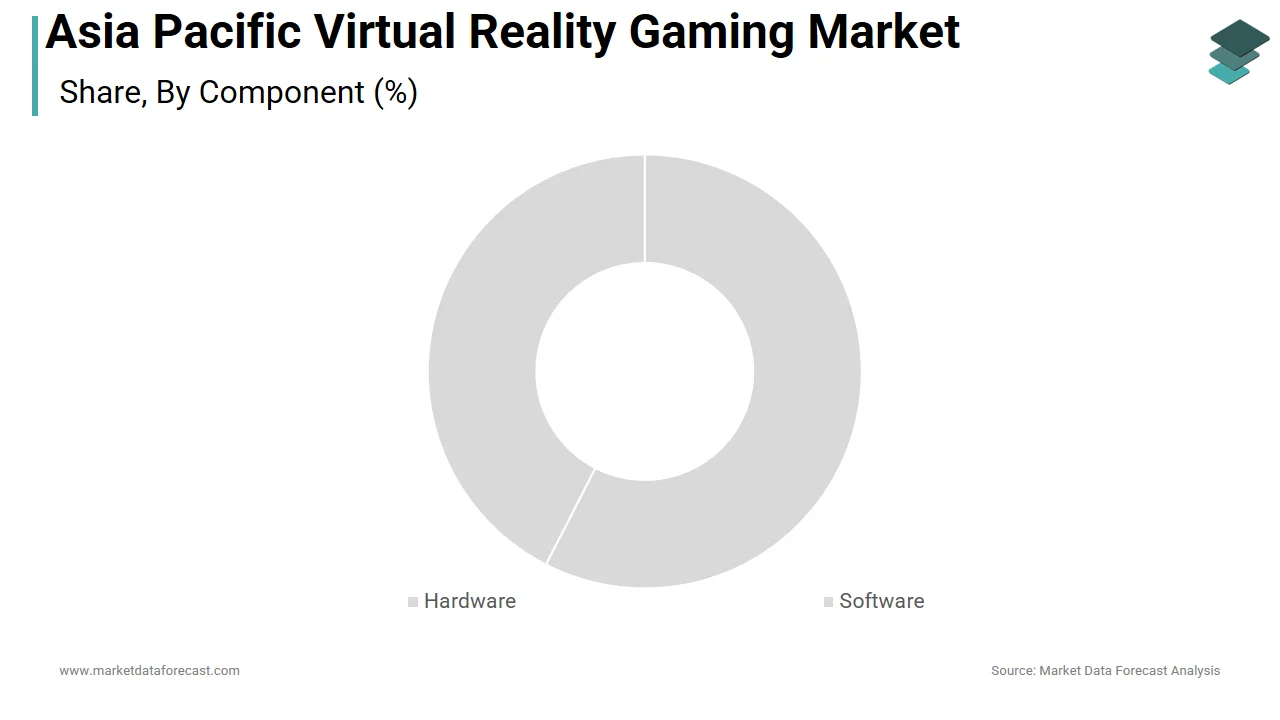
The software segment is the fastest-growing component and is projected to expand at a CAGR of 33.5% from 2026 to 2034. This rapid growth is because of the increasing shift toward content monetization, subscription models, and cloud-based VR gaming platforms. One major driver is the expansion of VR gaming content libraries and digital distribution platforms. SteamVR hosted thousands of VR-compatible titles, while Meta’s Quest Store downloads are high. In China, Pico’s VR app store saw an increase in developer submissions, fueled by government incentives for digital content creation. Indian studios are producing region-specific games based on mythology and cricket, increasing local relevance. Another factor is the adoption of VR game subscriptions and cloud streaming services. Platforms like Shadow VR and PlayStation Plus Premium now offer cloud-based VR gaming, reducing reliance on local hardware. In Australia, Telstra partnered with NVIDIA CloudXR to pilot VR game streaming in metropolitan areas, leveraging 5G networks. This model lowers entry barriers and enables continuous content updates, enhancing user retention and developer revenue. With software margins significantly higher than hardware, this trend is attracting venture capital and strategic investment across the region.
By Connecting Device Insights
The gaming console segment led the market by accounting for 42.4% of VR gaming usage in 2024. This lead position is anchored in the strong presence of Sony’s PlayStation VR2, which leverages the existing PlayStation 5 user base across affluent APAC markets. A primary driver is the deep integration of VR with next-generation gaming consoles and exclusive content. The console’s high refresh rate (120Hz), eye-tracking, and haptic feedback deliver premium immersion, making it the preferred choice for serious gamers. Additionally, retail bundling strategies in Australia and South Korea have boosted uptake. A further contributing factor is the established distribution and service network for consoles in urban markets. Sony, Microsoft, and Nintendo have long-standing partnerships with electronics retailers and service centers across Japan, South Korea, and Singapore. This infrastructure ensures reliable performance and firmware updates, critical for VR functionality. Moreover, regional esports events featuring console-based VR games, such as the Asia VR League in Seoul, have elevated the platform’s visibility and credibility among competitive gamers.
The smartphone-based VR segment is the fastest-growing, projected to grow at a CAGR of 29.8% from 2026 to 2034. Despite lower immersion levels, smartphone VR is gaining traction due to its affordability and accessibility in emerging economies. The high penetration of high-end smartphones capable of supporting VR applications is a key driver. According to Counterpoint Research, APAC dominated global smartphone shipments. In India and Indonesia, flagship models from Samsung, Xiaomi, and OnePlus are increasingly used with low-cost headsets like Google Cardboard clones and locally produced VR viewers. An additional factor is the growth of mobile-first VR content and educational applications. Developers are creating lightweight VR experiences optimized for Android, including virtual campus tours, medical simulations, and language immersion programs. These initiatives lower entry barriers and normalize VR interaction. With 5G rollout enhancing mobile streaming capabilities, cloud-rendered VR content is becoming viable, allowing high-quality experiences without expensive local hardware, further accelerating adoption.
By User Insights
The commercial spaces segment prevailed in the market by contributing 52.6% of total revenue in 2024. This dominance is driven by the proliferation of location-based VR venues, corporate training centers, and public experiential installations that generate recurring revenue. The rapid expansion of VR arcades and entertainment zones in urban and tourist hubs is a major driver. These venues offer premium hardware, multiplayer arenas, and themed experiences, such as zombie survival or space exploration, at affordable hourly rates. The model is particularly effective in densely populated cities where home space is limited, enabling immersive play without requiring personal ownership. A different critical factor is the adoption of VR for corporate training and simulation in high-risk industries. These applications justify high upfront investments and ensure sustained demand for commercial VR solutions.
The individual segment is the fastest-growing and is projected to grow at a CAGR of 27.6% from 2026 to 2034. This surge is fueled by rising disposable incomes, digital literacy, and the normalization of immersive entertainment in households. The increasing affordability and ease of use of standalone VR headsets for home consumers a primary drivers. Devices like Meta Quest 3 and Pico 4 retail below USD 500 and require no external hardware, making them accessible to middle-class households. Platforms like Rec Room and VRChat have also popularized social VR gaming, enabling users to attend virtual concerts, play games, and interact with global peers. A different factor is the integration of VR gaming into digital wellness and fitness routines. Apps like Supernatural and Les Mills Bodycombat VR are being adopted by urban consumers seeking immersive workouts. With rising awareness of mental well-being, VR meditation and relaxation apps are also gaining traction. This shift positions VR gaming not just as entertainment but as a lifestyle tool, broadening its appeal beyond traditional gamers and driving sustained personal adoption.
COUNTRY-LEVEL ANALYSIS
China Virtual Reality Gaming Market Insights
China led the Asia Pacific VR gaming market by holding an estimated 31.7% share of regional revenue in 2024. As the region’s largest digital economy, China’s dominance is underpinned by state-backed technological innovation and a vast consumer base. The country hosts over 600 VR content developers, with games like Zenith: The Last City gaining global traction. Urban VR arcades in cities like Shenzhen and Hangzhou attract millions annually, while 5G-enabled cloud VR trials by China Mobile are expanding access in tier-2 cities.
Japan Virtual Reality Gaming Market Insights
Japan is distinguished by its advanced technological ecosystem and deep-rooted gaming culture. The country’s leadership in robotics and human-computer interaction has fostered innovation in haptic feedback and motion tracking. Sony’s PS VR2 captured a large number of units sold in Japan and neighboring markets. Japanese consumers show a strong preference for high-fidelity, narrative-driven VR experiences, with titles like Tetris Effect: Connected achieving top rankings. Additionally, VR is being integrated into cultural preservation.
South Korea Virtual Reality Gaming Market Insights
South Korea commands a significant share of the market and is leveraging its world-class internet infrastructure and esports culture to drive VR gaming adoption. With 98% internet penetration and the fastest average broadband speed globally, as measured by Ookla in 2024, real-time VR experiences perform optimally. Seoul hosts the annual K-Game VR Festival, attracting developers and investors, while KT and SK Telecom are piloting 5G-powered cloud VR gaming in smart cities.
India Virtual Reality Gaming Market Insights
India is emerging as a high-potential growth frontier. Positioned as a rapidly digitizing economy, India’s VR gaming expansion is fueled by rising smartphone penetration and youth-driven digital consumption. Also, the number of VR startups in India surged, with a focus on edutainment and sports gaming. The National Education Policy 2020’s emphasis on digital learning has spurred VR adoption in schools and coaching centers. While home ownership remains limited, location-based VR venues in cities like Mumbai and Bangalore are growing at 40% annually, as per the Federation of Indian Chambers of Commerce and Industry.
Australia Virtual Reality Gaming Market Insights
Australia is serving as a regional hub for enterprise and premium consumer applications. The country’s strong regulatory framework and high disposable income support early adoption of advanced VR technologies. Telstra’s partnership with NVIDIA on CloudXR enables high-fidelity VR game streaming in urban areas. The mining and healthcare sectors are major adopters of VR simulations, with BHP and Royal Melbourne Hospital using immersive training modules. With robust data privacy laws and a skilled developer base, Australia is positioning itself as a testbed for secure, scalable VR gaming and enterprise solutions.
COMPETITION OVERVIEW
The competition in the Asia Pacific virtual reality gaming market is characterized by a dynamic interplay between global technology leaders and regionally adapted innovators. While companies like Sony and Meta bring advanced hardware and global content ecosystems, local players and subsidiaries such as Pico and HTC Vive are leveraging regional insights to capture niche markets. Differentiation is achieved through hardware performance, content localization, and strategic alliances with telecom and retail networks. The rise of standalone headsets and 5G-enabled streaming has intensified rivalry over user experience and latency optimization. Enterprises are also competing to dominate location-based entertainment and cross-sector applications in education and training. With no single player achieving overwhelming dominance, the market remains fragmented, innovation-driven, and highly responsive to consumer behavior, infrastructure development, and government digital policies across diverse APAC economies.
KEY MARKET PLAYERS
Some of the noteworthy companies in the Asia Pacific virtual reality gaming market profiled in this report are Sony Corporation, Microsoft Corporation, Nintendo Co. Ltd., Linden Research, Inc., Electronic Arts Inc., Meta Platforms, Inc., Samsung Electronics Co. Ltd., Google LLC (Alphabet, Inc.), HTC Corporation, Virtuix, Ultraleap Limited, Tesla Studios, Qualcomm Technologies, Inc., Lucidcam.com, and Others.
TOP LEADING PLAYERS IN THE MARKET
Sony Interactive Entertainment
Sony Interactive Entertainment has been a pivotal force in advancing virtual reality gaming across the Asia Pacific through its PlayStation VR2 platform, seamlessly integrated with the PS5 ecosystem. The company has prioritized high-fidelity immersive experiences, leveraging eye-tracking, haptic feedback, and 4K HDR visuals to set new benchmarks in consumer VR. It launched dedicated VR gaming zones in retail outlets across Tokyo, Seoul, and Sydney to boost consumer engagement. Additionally, Sony collaborated with anime studios like Aniplex to develop VR adaptations of popular franchises such as Demon Slayer, attracting younger demographics. These initiatives have solidified its reputation as a premium provider of console-based VR experiences in the region.
Meta Platforms (Reality Labs)
Meta has significantly influenced the Asia Pacific VR gaming landscape through its Meta Quest series, which delivers standalone, wireless VR experiences accessible to both consumers and enterprises. The company has invested heavily in developer incentives and content expansion. Meta strengthened its regional presence by opening innovation labs in Singapore and Bangalore to accelerate VR application development. In 2024, it introduced localized language support for Hindi, Bahasa, and Thai in Quest games, improving accessibility. Partnerships with telecom providers like Jio in India and Telstra in Australia have enabled bundled 5G-VR offerings. Meta’s focus on social VR gaming through platforms like Horizon Worlds has also driven user engagement, positioning it as a leader in immersive digital interaction.
Pico (ByteDance)
Pico, a subsidiary of ByteDance, has emerged as a dominant player in the Asia Pacific VR gaming market by delivering cost-effective, standalone headsets tailored for diverse regional markets. The company has leveraged ByteDance’s vast content ecosystem to integrate VR gaming with short-form video and social media platforms like TikTok, creating new engagement models. It expanded distribution through e-commerce partnerships with Alibaba, Flipkart, and Shopee, ensuring wide retail reach. Pico also sponsored VR gaming tournaments in Jakarta and Bangkok to build community interest. With localized content development and aggressive pricing, Pico is reshaping accessibility and scalability in the region’s VR gaming space.
TOP STRATEGIES USED BY KEY MARKET PARTICIPANTS
Key players in the Asia Pacific virtual reality gaming market are deploying multifaceted strategies to consolidate their presence and drive adoption. Major approaches include strategic partnerships with telecom operators to bundle VR devices with high-speed internet plans, enhancing accessibility. Companies are investing in localized content development to align with regional cultures, languages, and storytelling traditions. Expanding developer ecosystems through funding programs and SDK enhancements is another priority to enrich the VR game library. Firms are also establishing physical experience centers and retail demos to reduce consumer hesitation. Enterprise collaborations in education, healthcare, and training are being leveraged to diversify revenue streams. Additionally, advancements in standalone hardware and cloud-based streaming are central to reducing dependency on high-end PCs, broadening the user base across emerging economies.
RECENT MARKET DEVELOPMENTS
- In January 2023, Sony Interactive Entertainment launched PlayStation VR2 in Japan, South Korea, and Australia, introducing haptic feedback and eye-tracking features to enhance immersion, marking a significant advancement in console-based virtual reality gaming experiences across the Asia Pacific region.
- In May 2023, Pico partnered with Shopee, a leading Southeast Asian e-commerce platform, to launch exclusive VR headset promotions and gaming bundles during regional shopping festivals, significantly expanding its consumer reach in Indonesia, Thailand, and the Philippines.
- In September 2023, Meta introduced Hindi, Bahasa Indonesia, and Thai language support across its Meta Quest Store, enabling millions of regional users to access localized VR gaming content and improving engagement in India and Southeast Asia.
- In November 2023, HTC Vive collaborated with the Singapore Economic Development Board to establish a VR innovation hub focused on developing enterprise and gaming applications, strengthening its footprint in Southeast Asia’s emerging digital economy.
- In March 2024, ByteDance’s Pico launched the Pico 4 Pro in China and India, featuring advanced eye and facial tracking for social VR interactions, targeting both consumer and enterprise markets to expand its competitive edge in the Asia Pacific virtual reality gaming market.
MARKET SEGMENTATION
This Asia Pacific virtual reality gaming market research report is segmented and sub-segmented into the following categories.
By Component
- Hardware
- Software
By Connecting Device
- Gaming Console
- PC/Desktop
- Smartphone
By User
- Commercial Spaces
- Individual
By Country
- India
- China
- Japan
- South Korea
- Rest Of APAC