- Product Description Description
- Table of Contents TOC
- List of Table & Figure LOT
- Get Free Sample PDF Sample PDF
Market Size, 2025
$127.98 BnMarket Estimate, 2026
$134.20 BnMarket Forecast, 2034
$196.17 BnCAGR, 2026–2034
4.86%Executive Summary: Asia Pacific Windows and Doors Market
- Market Scope: Comprehensive Asia Pacific windows and doors market analysis covering product types, material classifications, operational applications, end-user segments, country frameworks, and green building trends.
- Market Valuation: Valued at USD 127.98 billion (2025), estimated at USD 134.20 billion (2026), and projected to reach USD 196.17 billion by 2034, registering a steady CAGR of 4.86% (2026–2034).
- Primary Growth Drivers: Rapid urbanization, expansion of residential and commercial construction, increasing adoption of energy-efficient building materials, green building regulations, and rising investments in smart cities. Key challenges include volatility in raw material prices and fragmented regional regulations.
Key Market Segment Metrics (2026–2034)
| Category | Leading Segment (2025 Position) | Fastest-Growing Segment |
|---|---|---|
| By Product & Application | Windows and Swinging applications (dominated consumption volume due to standard architectural usage) | Sliding and smart fenestration systems (driven by modern space optimization needs) |
| By Material & End User | uPVC and Aluminum frames alongside Residential construction end-users (led market share) | Composite materials and commercial smart infrastructure developments |
| By Country / Region | China and major regional hubs (accounted for the largest market share backed by massive construction activity) | India, Southeast Asia, and Australia & New Zealand (accelerating via urbanization and green building mandates) |
Major Market Players & Market Structure
Market Structure: Highly competitive construction materials landscape characterized by strong rivalry among regional and global manufacturers investing in IoT-enabled windows and doors, electrochromic smart glass, impact-resistant glazing, modular construction solutions, and thermally efficient frames.
Key Companies: Andersen Corporation, Pella Corporation, JELD-WEN Holding, Inc., YKK AP Inc., LIXIL Corporation, ASSA ABLOY AB, Masonite International Corporation, Ply Gem Holdings, Cornerstone Building Brands, MI Windows and Doors, Deceuninck NV, Aluplast GmbH, Schüco International KG, VEKA AG, and Reynaers Aluminium.
 Download Free Sample Report
Asia Pacific Windows and Doors Market Size
The Asia Pacific Windows and Doors Market is projected to grow from USD 127.98 billion in 2025 to USD 134.20 billion in 2026 and reach USD 196.17 billion by 2034, registering a CAGR of 4.86% from 2026 to 2034.
Windows and doors refers for to the architectural products designed to facilitate ventilation, natural lighting, security, thermal regulation, and aesthetic integration in residential, commercial, and institutional buildings. These components are critical elements in building envelopes, influencing energy performance, occupant comfort, and structural resilience. As urbanization accelerates and construction practices evolve, the demand for advanced fenestration solutions has intensified across the region. A significant factor shaping this market is the rising incidence of extreme weather events, which has heightened the need for impact-resistant and climate-adaptive window and door systems.
A notable share of urban populations in Southeast Asia reside in areas vulnerable to cyclones and flooding, necessitating robust building materials. Besides, rapid urban migration has led to a surge in high-rise construction, particularly in countries like China and India, where vertical living demands specialized glazing and sealing technologies. This demographic shift, combined with evolving architectural preferences favoring glass facades and open-plan designs, has redefined the functional and design expectations of windows and doors. Furthermore, government-led housing initiatives in nations such as Indonesia and the Philippines are incorporating improved ventilation and daylighting standards, reinforcing the role of quality fenestration in public health and energy efficiency.
 MARKET DRIVERS
Expansion of Green Building Standards and Energy Efficiency Regulations
A pivotal force propelling the Asia Pacific windows and doors market is the institutionalization of green building codes and energy performance standards across major economies. Governments and urban planning authorities are increasingly mandating thermal efficiency in building envelopes to reduce energy consumption from heating, cooling, and artificial lighting. Moreover, India’s Energy Conservation Building Code (ECBC) 2017, revised in 2023, mandates improved window-to-wall ratios and solar heat gain coefficients for commercial structures, directly influencing fenestration design. These regulatory frameworks are not only reshaping architectural practices but also driving demand for premium window systems such as uPVC and composite frames. The integration of energy-efficient fenestration into national climate action plans, including Japan’s 2050 carbon neutrality goal, further solidifies this trend as a structural market driver.
Surge in Urban Housing and Affordable Housing Initiatives
The proliferation of urban housing projects, particularly government-backed affordable housing programs, is significantly amplifying demand for standardized, durable, and cost-effective windows and doors across the Asia Pacific region. The projects prioritize prefabricated and modular fenestration systems to ensure rapid deployment and quality consistency. The shift toward factory-produced window units has also improved durability and weather resistance, particularly in tropical climates. As urban populations continue to grow, such large-scale housing developments are institutionalizing modern fenestration as a baseline requirement, fueling sustained market expansion.
MARKET RESTRAINTS
Volatility in Raw Material Supply and Pricing
A critical impediment to the steady growth of the Asia Pacific windows and doors market is the instability in the supply and cost of essential raw materials, particularly aluminum, PVC resin, and float glass. The production of fenestration systems is heavily dependent on these inputs, and fluctuations in their availability directly impact manufacturing timelines and pricing structures. In 2022, China, the world’s largest producer of aluminum, experienced power shortages in Guangdong and Yunnan provinces, leading to a reduction in smelting output. Float glass production, concentrated in China and India, has also faced constraints due to environmental regulations. These supply shocks increase production costs, compress margins, and delay project completions, particularly for small and medium-sized manufacturers lacking hedging capabilities. The reliance on imported materials in countries like Vietnam and Thailand further exacerbates vulnerability, making the entire supply chain susceptible to geopolitical and logistical disruptions.
Prevalence of Informal and Substandard Manufacturing Sectors
The persistence of unregulated and informal manufacturing units across several Asia Pacific countries undermines the quality and safety standards of windows and doors, constraining market maturity and consumer confidence. In nations such as Bangladesh, Myanmar, and parts of rural India, a significant portion of fenestration products are produced by local workshops using recycled or substandard materials, often failing to meet structural or thermal performance benchmarks. The low-cost, non-certified products dominate price-sensitive markets, undercutting formal manufacturers and discouraging investment in innovation. Moreover, the absence of enforcement mechanisms allows non-compliant products to remain widely available. This fragmented quality landscape hampers the adoption of advanced systems such as double-glazed units and smart windows, limiting the market’s evolution toward high-performance solutions.
MARKET OPPORTUNITIES
Integration of Smart Windows and IoT-Enabled Fenestration Systems
The emergence of smart glass and Internet of Things (IoT)-integrated fenestration presents a transformative opportunity for the Asia Pacific windows and doors market, particularly in commercial and premium residential developments. Smart windows, capable of electrochromic tinting, UV filtering, and automated ventilation, are gaining traction in high-rise offices and luxury apartments seeking energy optimization and occupant comfort. These systems reduce cooling loads. In India, companies like SmartTint Solutions have partnered with real estate developers such as DLF and Prestige to deploy electrochromic windows in smart city projects. Furthermore, IoT-enabled door sensors and automated ventilation controls are being adopted in smart homes across Japan and Australia, where homeowners prioritize security and climate responsiveness. With urban centers increasingly embracing smart infrastructure, the convergence of fenestration with digital building ecosystems is poised to redefine market value propositions and open new revenue streams for technology-forward manufacturers.
Adoption of Prefabricated and Modular Construction Techniques
The growing shift toward off-site and modular construction methods across the Asia Pacific region is creating a significant opportunity for standardized, factory-engineered windows and doors. Prefabricated construction reduces on-site labor, accelerates project timelines, and enhances quality control—factors critical in high-density urban environments. These systems require integrated fenestration units that are pre-installed in wall panels, demanding precision manufacturing and compatibility with structural components. This trend is driving demand for unitized window-wall systems and thermally optimized frames that can be mass-produced with consistent tolerances. Manufacturers who align with modular developers stand to gain substantial market share in this evolving construction paradigm.
MARKET CHALLENGES
Divergent Building Codes and Regional Regulatory Fragmentation
One of the most pressing challenges in the Asia Pacific windows and doors market is the lack of harmonized building regulations and fenestration standards across countries and even within national jurisdictions. Each country enforces distinct codes for structural integrity, thermal performance, and wind load resistance, complicating product design and compliance for multinational manufacturers. In Indonesia, for instance, regional building codes vary significantly between Jakarta and Bali due to differing seismic and cyclonic risk profiles. The regulatory disarray increases compliance costs, slows market entry, and discourages innovation. Manufacturers must often customize products for individual markets, reducing economies of scale. Without regional alignment, such as through ASEAN’s proposed construction standards framework, the market remains fragmented, impeding the widespread adoption of advanced fenestration technologies.
Climatic Diversity and Performance Demands Across Geographies
The vast climatic variability across the Asia Pacific region poses a formidable challenge for window and door manufacturers seeking to deliver universally effective products. The same fenestration system that performs optimally in temperate climates like New Zealand or South Korea may fail in the high-humidity, monsoon-prone environments of Thailand or Bangladesh. In tropical regions, condensation, mold growth, and frame degradation are common. Conversely, in colder regions like northern China and Mongolia, inadequate thermal insulation leads to frost formation and heat loss, undermining energy efficiency goals. Besides, cyclone-prone areas such as the Philippines and eastern Japan require impact-resistant glazing capable of withstanding windborne debris, a standard enforced under Japan’s Building Standard Law but inconsistently applied elsewhere. Manufacturers must therefore develop region-specific product lines, increasing R&D and inventory complexity. The absence of universal performance benchmarks forces companies to navigate a patchwork of environmental requirements, limiting scalability and increasing time-to-market for climate-adaptive solutions.
REPORT COVERAGE
| REPORT METRIC | DETAILS |
| Market Size Available | 2025 to 2034 |
| Base Year | 2025 |
| Forecast Period | 2026 to 2034 |
| Segments Covered | By Product, Material, Application, End User, and Region |
| Various Analyses Covered | Regional & Country Level Analysis, Segment-Level Analysis, DROC, PESTLE Analysis, Porter’s Five Forces Analysis, Competitive Landscape, Analyst Overview on Investment Opportunities |
| Regions Covered | India, China, Japan, South Korea, Australia, New Zealand, Thailand, Malaysia, Vietnam, Philippines, Indonesia, Singapore, and the Rest of Asia-Pacific |
| Market Leaders Profiled | Andersen Corporation, ATIS Group, G. Legno, Deceuninck NV, JELD-WEN, Inc., Pella Corporation, Performance Doorset Solutions Ltd., SGM Windows, Vinylguard Windows and Door Systems Ltd., and Weru Group., and others |
SEGMENTAL ANALYSIS
By Product Insights
The windows segment dominated the Asia Pacific windows and doors market by capturing 54.2% share in 2025. This lead position is due to the increasing architectural emphasis on natural lighting, ventilation, and energy efficiency in both residential and commercial construction. The widespread adoption of large-format glazing in high-rise buildings and modern housing designs, particularly in urban centers like Shanghai, Mumbai, and Sydney, is a primary driver. These designs reduce reliance on artificial lighting, contributing to energy savings. Additionally, government-backed green building initiatives mandate improved window-to-wall ratios and thermal performance. The proliferation of prefabricated construction methods further favors factory-installed window units, ensuring precision and quality control. With urbanization driving vertical living and daylight optimization becoming a standard in architectural planning, the windows segment continues to outpace doors in both volume and technological investment.
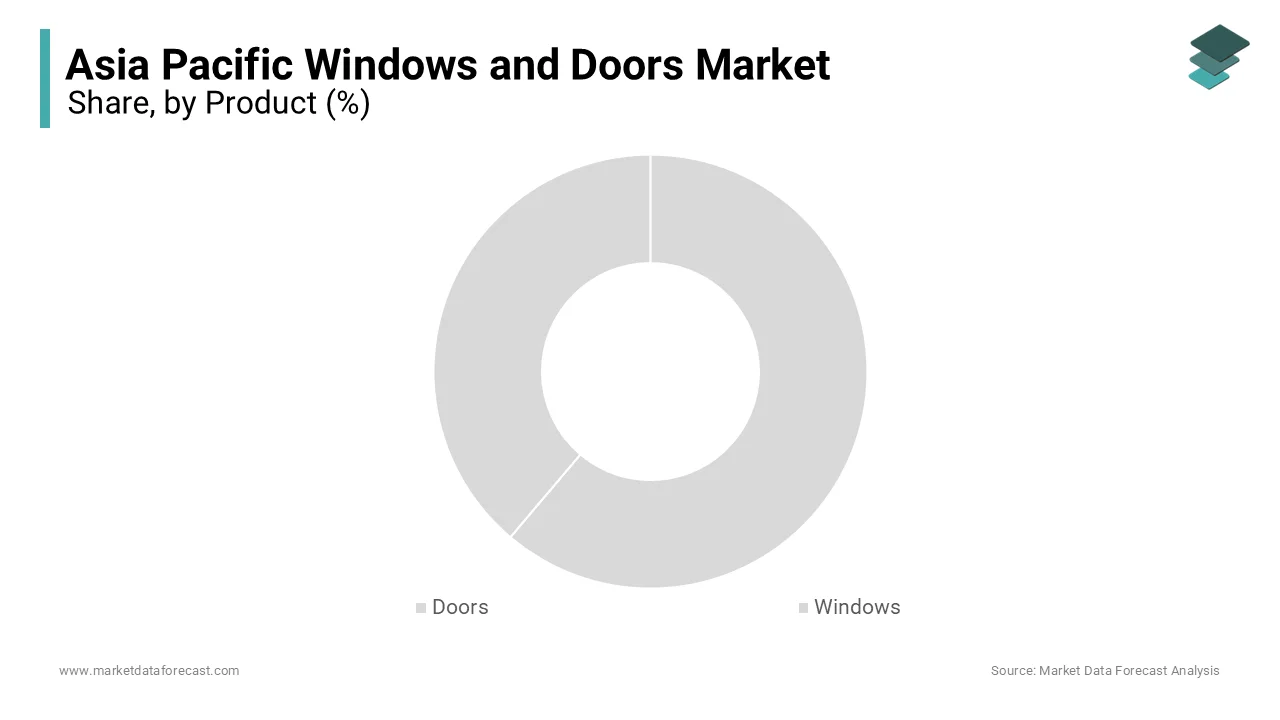
The doors segment is the fastest-growing product category and is projected to expand at a CAGR of 7.9% from 2025 to 2033. This accelerated growth is driven by rising security concerns and the integration of smart access systems in residential and commercial properties. In rapidly urbanizing markets such as Indonesia and the Philippines, crime rates in metropolitan areas have spurred demand for reinforced entry doors with multi-point locking mechanisms and fire-resistant materials. A further key factor is the surge in smart home adoption, particularly in South Korea and Australia, where automated sliding and biometric-entry doors are becoming standard in premium housing. Additionally, commercial buildings are adopting revolving and automatic sliding doors to improve energy retention and accessibility compliance. These regulatory and technological shifts are transforming doors from mere entry points into intelligent, safety-enhanced building components.
By Material Insights
The metal segment led the Asia Pacific windows and doors market by accounting for a 49.5% share in 20245. This dominance is primarily attributed to the widespread use of aluminum in both residential and commercial construction due to its durability, corrosion resistance, and suitability for high-rise applications. Aluminum frames are lightweight yet strong, enabling large glass spans without compromising structural integrity—critical in modern architectural designs. Additionally, aluminum’s recyclability aligns with regional sustainability goals; aluminum in building applications is recovered and reused in Asia Pacific, reducing lifecycle costs. In tropical climates such as Thailand and Malaysia, powder-coated aluminum resists humidity and salt corrosion, extending service life. Also, aluminum fenestration systems contribute to an improvement in thermal performance when thermally broken. Furthermore, government infrastructure projects in countries like Vietnam and the Philippines increasingly specify aluminum for public buildings due to its low maintenance and long warranty periods. With rapid urbanization favoring high-performance, low-degradation materials, metal-based systems remain the preferred choice for modern construction.
The plastic segment, primarily comprising uPVC (unplasticized polyvinyl chloride), is the fastest-growing material category and is anticipated to grow at a CAGR of 8.4% from 2025 to 2033. This growth is fueled by its superior thermal insulation, cost-effectiveness, and ease of installation, making it ideal for energy-efficient housing and mass-market developments. uPVC windows exhibit thermal conductivity lower than aluminum, significantly reducing heat transfer. The material also requires minimal maintenance and resists warping, termites, and moisture, critical in humid climates like Indonesia and Bangladesh. Furthermore, manufacturers are enhancing uPVC profiles with steel reinforcement and multi-chamber designs to improve structural rigidity, broadening its application in multi-story buildings. With rising demand for affordable, climate-responsive housing, uPVC is emerging as a strategic alternative to traditional wood and metal systems.
By Application Insights
The sliding application segment spearheaded the Asia Pacific windows and doors market by holding a 44.6% share in 2025. This dominance is driven by its space-saving functionality and seamless integration with open-plan living and balcony access, particularly in high-density urban housing. In countries like Japan and South Korea, where living spaces are compact, sliding doors and windows maximize usable floor area by eliminating swing radii. Technological advancements have further enhanced the appeal of sliding systems, with multi-track configurations allowing for larger apertures and improved weather sealing. In tropical regions, stackable sliding windows facilitate cross-ventilation while maintaining security. The rise of modular construction has also favored pre-installed sliding units, ensuring precision and reducing on-site labor. With urbanization intensifying and architectural trends favoring fluid spatial transitions, sliding applications remain the most functionally and aesthetically aligned with contemporary design principles.
The folding application segment is the fastest-growing, projected to expand at a CAGR of 9.1% from 2023 to 2030, as per Research Nester. This surge is driven by its ability to create expansive, unobstructed openings that merge indoor and outdoor spaces, ideal for luxury residences, hospitality venues, and commercial terraces. Folding doors, often composed of multiple glazed panels that concertina to one side, significantly enhancing natural ventilation and visual openness. In Thailand, new luxury villas in Phuket and Pattaya installed folding glass systems, catering to high-end tourism and expatriate housing demand. Similarly, in Australia, the popularity of alfresco living has driven adoption in premium suburban homes, with a year-on-year increase in folding door kit sales. Technological improvements in track systems and weatherproof seals have enhanced durability in monsoon and cyclone-prone areas. With rising disposable incomes and a cultural shift toward experiential living spaces, folding applications are redefining architectural boundaries across the region.
By End User Insights
The residential segment spearheaded the Asia Pacific windows and doors market by accounting for a 61.6% in 2025. This dominance is rooted in the region’s massive housing construction activity, driven by urbanization, population growth, and government-led affordable housing initiatives. In India, the Pradhan Mantri Awas Yojana has facilitated the construction of a large number homes since 2015, each requiring multiple window and door units. These projects prioritize cost-effective, durable fenestration solutions such as aluminum and uPVC systems. In urban centers like Shanghai and Manila, high-rise residential towers are incorporating energy-efficient glazing to meet green building standards, further boosting demand. The rise of middle-class homeownership in countries like Vietnam and Malaysia has also increased demand for premium finishes and smart ventilation systems. With housing deficits persisting across the region and urban migration continuing, the residential sector remains the primary engine of fenestration demand.
The non-residential segment is the fastest-growing end-user category and is projected to expand at a CAGR of 8.2% in the coming years. This growth is driven by large-scale commercial, institutional, and infrastructure development across the region. Governments are investing heavily in healthcare, education, and transportation facilities, all of which require high-performance fenestration systems. Moreover, India’s National Infrastructure Pipeline includes 10,000 new public buildings, many featuring curtain wall glazing and automated ventilation systems. The expansion of smart cities is accelerating demand for integrated, energy-efficient fenestration. In Singapore, the Building and Construction Authority mandates green standards for all new commercial buildings, driving adoption of dynamic glazing and automated shading systems. Additionally, the retail and hospitality sectors are incorporating floor-to-ceiling windows and revolving doors to enhance aesthetics and energy retention. With institutional spending rising and urban infrastructure modernizing, the non-residential segment is becoming a key growth vector.
REGIONAL ANALYSIS
China
China stood as the largest national market for windows and doors in the Asia Pacific region by commanding a 36.3% share in 2025. The country’s lead position is anchored in its colossal construction sector. With rapid urbanization and the development of megacities like Shenzhen and Chongqing, demand for modern fenestration systems has surged. Additionally, China’s Green Building Action Plan requires all new public buildings to meet energy efficiency standards, driving adoption of double-glazed and Low-E coated windows. The country is also a major manufacturer, producing a notable share of the world’s aluminum fenestration components. Domestic brands like YKK AP China and Zhongkai Aluminum are expanding into Southeast Asia, leveraging cost and scale advantages. With continued investment in urban infrastructure and sustainability mandates, China remains the dominant force in the regional market.
India
India is positioned as a high-growth emerging market, India’s fenestration sector is driven by large-scale housing programs and rising urbanization. The Pradhan Mantri Awas Yojana has catalyzed the construction of millions of homes, each requiring standardized window and door units. The commercial sector is also expanding. Green building certifications, such as those from the Indian Green Building Council, are influencing the adoption of insulated glazing and thermal-break frames. Besides, the rise of modular construction in affordable housing is favoring pre-fabricated fenestration. Domestic manufacturers like Fenesta and LG Hausys are investing in R&D to develop climate-specific solutions for India’s diverse weather zones. With a young population, rising disposable incomes, and sustained government investment, India’s market is on a steep growth trajectory.
Japan
Japan holds a significant share of the Asia Pacific windows and doors market. As a mature, technology-driven market, Japan emphasizes precision engineering, energy efficiency, and disaster resilience in fenestration design. The country’s stringent Building Standard Law mandates impact-resistant glazing for high-rises and seismic-resistant window frames, ensuring safety in earthquake-prone regions. The aging population has also increased demand for automated sliding doors and low-threshold systems to support accessibility. In commercial construction, smart glass and electrochromic windows are gaining traction in office buildings seeking LEED and CASBEE certifications. Companies like YKK AP and LIXIL are leaders in innovation, exporting advanced systems to other Asian markets. Additionally, Japan’s high rate of building renovation, sustains demand for replacement windows and doors. With a focus on quality, safety, and sustainability, Japan remains a benchmark for high-performance fenestration.
Australia
Australia exhibits high demand for premium, climate-adaptive fenestration solutions. The country’s harsh UV exposure and variable climate necessitate windows with high solar control and thermal insulation. The National Construction Code mandates energy efficiency standards for all new homes, driving adoption of double-glazed and argon-filled units. The rise of bushfire-prone zones has also increased demand for fire-resistant glazing. In the commercial sector, smart windows and automated shading systems are being integrated into green-certified buildings. The popularity of indoor-outdoor living has boosted demand for sliding and folding glass systems. With strong regulatory support and high consumer awareness, Australia remains a leader in advanced, sustainable fenestration.
South Korea
South Korea holds a key share of the Asia Pacific market. The country’s fenestration market is characterized by rapid technological adoption and integration with smart city infrastructure. With a significant share of the population living in urban areas, high-rise residential and commercial buildings dominate, requiring advanced glazing and sealing systems. The rise of smart homes has accelerated demand for IoT-enabled windows with automated ventilation and UV control. Domestic manufacturers like KCC and LG Hausys are investing in electrochromic glass and noise-reducing laminated units for high-density urban environments. Besides, the country’s focus on seismic safety and thermal performance in cold climates drives innovation in multi-chambered and thermally broken frames. With strong R&D investment and urban modernization, South Korea is a leader in next-generation fenestration solutions.
KEY MARKET PLAYERS AND COMPETITIVE LANDSCAPE
Andersen Corporation, ATIS Group, G. Legno, Deceuninck NV, JELD-WEN, Inc., Pella Corporation, Performance Doorset Solutions Ltd., SGM Windows, Vinylguard Windows and Door Systems Ltd., and Weru Group are the key players in the Asia Pacific windows and doors market
The competitive landscape of the Asia Pacific windows and doors market is characterized by a dynamic interplay between global multinationals, regional specialists, and domestic manufacturers, each vying for strategic advantage across diverse regulatory and climatic zones. Established firms such as YKK AP, LIXIL, and Jeld-Wen leverage technological innovation, extensive distribution networks, and compliance with international standards to maintain leadership in premium segments. At the same time, local players in India, China, and Vietnam are gaining ground by offering cost-effective, climate-specific solutions tailored to mass housing and infrastructure projects. The market is witnessing intensified differentiation in product performance, particularly in thermal insulation, noise reduction, and smart integration, where advanced glazing and automated systems are becoming key differentiators. Competitive pressure is further shaped by government procurement policies, green building mandates, and the rise of modular construction, which favor standardized, factory-engineered units. While global brands dominate in commercial and high-end residential applications, regional manufacturers are capturing volume-driven opportunities in affordable housing. The absence of a single dominant player fosters continuous innovation, pricing competition, and strategic positioning, making the region a rapidly evolving hub for architectural fenestration solutions.
TOP PLAYERS IN THE MARKET
YKK AP Inc.
YKK AP Inc. is a leading innovator in architectural fenestration systems across the Asia Pacific, renowned for its high-performance aluminum windows and curtain wall solutions. The company has established a strong presence in Japan, China, and Southeast Asia through strategic collaborations with real estate developers and government infrastructure projects. The company has also expanded its R&D center in Singapore to develop climate-specific solutions for tropical environments, focusing on corrosion resistance and condensation control. YKK AP actively participates in sustainable urban development initiatives, supplying energy-efficient glazing for smart city projects in Thailand and Indonesia. By integrating Building Information Modeling (BIM) compatibility into its product line, the company enhances coordination with architects and contractors. Its commitment to zero-carbon manufacturing, supported by solar-powered production facilities in Japan, reinforces its leadership in sustainable construction. These initiatives underscore YKK AP’s role in shaping high-performance, environmentally responsible fenestration standards across the region.
LIXIL Corporation
LIXIL Corporation is a dominant force in the Asia Pacific windows and doors market, delivering integrated building solutions that combine functionality, design, and sustainability. The company has deepened its regional footprint through localized manufacturing and distribution networks in India, Indonesia, and Australia, ensuring rapid deployment of its REHAU-branded uPVC and aluminum systems. The company introduced its SmartSlide automated door system in South Korea in 2023, featuring sensor-based operation and anti-intrusion technology, catering to smart home demand. LIXIL also launched the “Aqua Design” ventilation window in Thailand, specifically engineered to manage humidity and airflow in tropical climates. Its R&D investments in noise-reducing laminated glass have gained traction in high-density urban markets like Tokyo and Manila. By aligning with national green building codes and investing in modular construction compatibility, LIXIL is positioning itself at the forefront of next-generation residential and commercial fenestration, driving innovation and scalability across diverse regional needs.
Jeld-Wen Holdings, Inc.
Jeld-Wen Holdings, Inc. plays a pivotal role in advancing wood and composite door technologies across the Asia Pacific, particularly in Australia, New Zealand, and Southeast Asia. The company has strengthened its regional presence by introducing climate-adaptive door systems that resist warping, moisture, and termites—critical in humid and coastal environments. The product received certification from the Australian Building Codes Board for use in extreme weather conditions. The company also expanded its digital showroom platform across Southeast Asia, enabling architects and contractors to visualize and customize door designs using augmented reality. In Malaysia, Jeld-Wen collaborated with property developer SP Setia to supply bespoke entry doors for luxury residential projects, emphasizing security and aesthetic integration. Its investment in sustainable sourcing—ensuring 100% of wood comes from FSC-certified forests—aligns with regional environmental standards. By combining material innovation with digital engagement and regulatory compliance, Jeld-Wen is reinforcing its reputation as a provider of resilient, high-design fenestration solutions.
TOP STRATEGIES USED BY KEY MARKET PLAYERS
Key players in the Asia Pacific windows and doors market are deploying multifaceted strategies to consolidate their influence and capture emerging demand. Product innovation remains central, with companies developing thermally broken frames, smart glazing, and IoT-integrated systems to meet energy efficiency and security demands. Strategic partnerships with real estate developers, government housing agencies, and construction firms enable direct integration into large-scale projects. Regional localization is a critical approach, with manufacturers establishing production facilities and R&D centers in high-growth markets to tailor products to climatic and regulatory conditions. Digital transformation is accelerating, as companies adopt BIM compatibility, AR-based visualization tools, and e-commerce platforms to enhance customer engagement. Sustainability initiatives, including recyclable materials and carbon-neutral manufacturing, are increasingly used to align with green building certifications. Mergers and acquisitions are leveraged to gain technological capabilities, while workforce training programs ensure proper installation and compliance. Regulatory alignment with national building codes facilitates faster approvals and market access. Collectively, these strategies reflect a shift toward integrated, performance-driven solutions that combine durability, intelligence, and environmental responsibility across diverse urban and climatic landscapes.
RECENT HAPPENINGS IN THE MARKET
- In March 2023, YKK AP launched its AdvanTech thermal break aluminum window system in Shanghai, designed to reduce heat transfer by 40% and comply with China’s Green Building Action Plan, enhancing energy efficiency in high-rise developments.
- In August 2022, LIXIL partnered with Tata Housing in India to supply REHAU-branded uPVC windows for 10,000 affordable homes under the Pradhan Mantri Awas Yojana, expanding access to durable, energy-efficient fenestration.
- In May 2023, Jeld-Wen introduced its WeatherXterior composite door series in Queensland, certified for use in bushfire and cyclone-prone zones, addressing safety and durability demands in extreme Australian climates.
- In January 2024, LIXIL launched the SmartSlide automated door system in Seoul, integrating motion sensors and anti-intrusion technology to meet rising demand for smart home security in South Korea.
- In July 2023, YKK AP expanded its R&D center in Singapore to develop tropical-specific fenestration solutions, focusing on humidity control, corrosion resistance, and ventilation efficiency for Southeast Asian markets.
MARKET SEGMENTATION
This research report on the Asia Pacific Windows and doors market has been segmented and sub-segmented based on the following categories.
By Product
- Doors
- Windows
By Material
- Wood
- Metal
- Plastic
By Application
- Swinging
- Sliding
- Folding
- Revolving and Others
By End User
- Residential
- Non-residential
By Country
- India
- China
- Japan
- South Korea
- Australia
- New Zealand
- Thailand
- Malaysia
- Vietnam
- Philippines
- Indonesia
- Singapore
- Rest of Asia-Pacific