- Product Description Description
- Table of Contents TOC
- List of Table & Figure LOT
- Get Free Sample PDF Sample PDF
Market Size, 2025
$26.88 BnMarket Estimate, 2026
$28.68 BnMarket Forecast, 2034
$48.18 BnCAGR, 2026–2034
6.7%Asia Pacific Doors Market Size
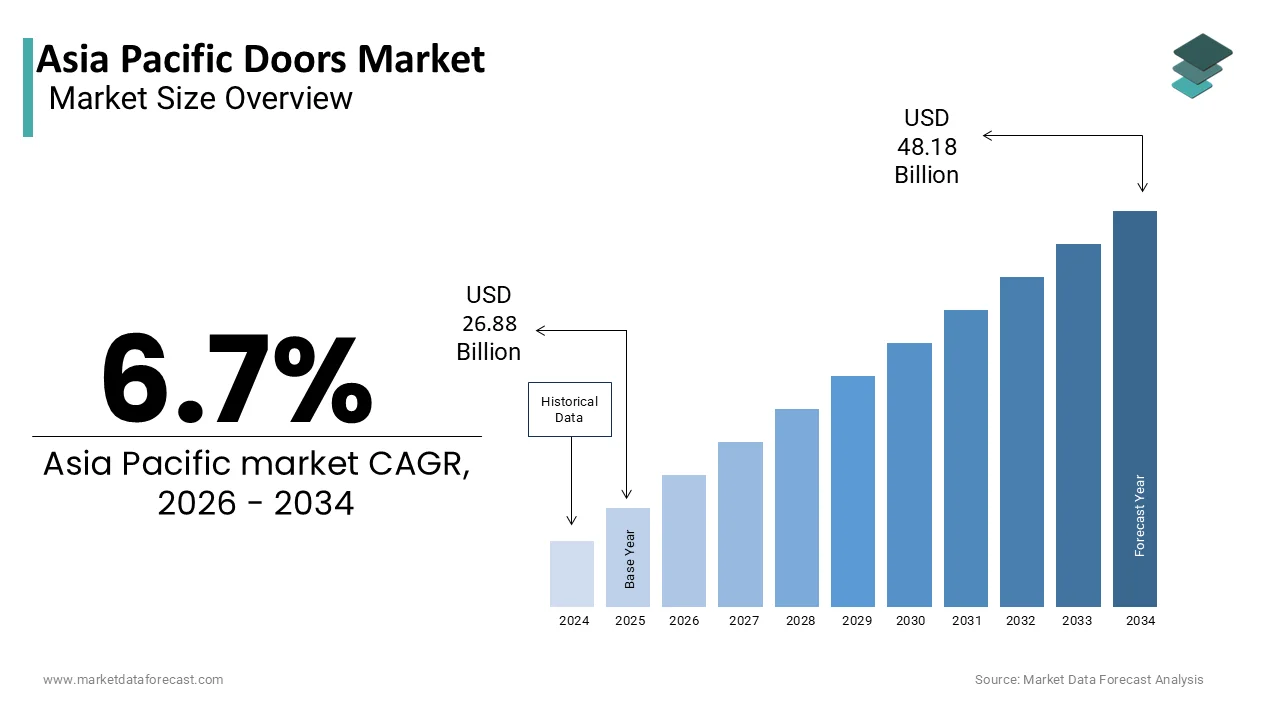
The Asia Pacific doors market was valued at USD 26.88 billion in 2025, is estimated to reach USD 28.68 billion in 2026, and is projected to reach USD 48.18 billion by 2034, growing at a CAGR of 6.7% from 2026 to 2034.
Doors include wooden doors, steel doors, aluminum doors, PVC doors, and composite variants, each catering to distinct consumer preferences and functional requirements. The market has been significantly influenced by the region’s rapid urbanization, infrastructural development, and growing emphasis on security, aesthetics, and energy efficiency in buildings.
In addition, rising disposable incomes and evolving architectural trends have encouraged homeowners and developers to opt for premium, customized, and smart-enabled Composite Doors that enhance convenience and durability.
In Australia and Japan, regulatory bodies such as Standards Australia and the Japan Industrial Standards Committee enforce quality benchmarks for fire-rated and thermally efficient doors, further shaping product development strategies. The increasing green building certifications and sustainability mandates also shiftsthe arket toward eco-friendly materials and modular door solutions. These developments define the changing landscape of the Asia Pacific doors market.
MARKET DRIVERS
Urbanization and Expansion of Residential Construction
The rapid pace of urbanization and the consequent expansion of residential construction activities isaremong the main factors propelling the growth of the Asia Pacific doors market.
According to the United Nations Department of Economic and Social Affairs (UN DESA), approximately 40 million people are added to Asia’s urban population every year, fueling demand for new housing units. Also, in Southeast Asia, countries like Indonesia and the Philippines have seen a surge in mid-rise and high-rise residential developments, where standardized and prefabricated door systems are increasingly preferred for faster construction cycles.
Besides, in China, where government-led urban renewal projects continue to replace old neighbourhoods with modern housing blocks, the demand for durable and aesthetically appealing doors has grown substantially. These trends show the strong correlation between urban expansion and the growth of the doors market across the Asia Pacific.
Rising Demand for Smart and Security-Enhanced Door Systems
The increasing adoption of smart and security-enhanced door systems also drives the growth of the Asia Pacific doors market. As digital transformation permeates the built environment, consumers and developers alike are prioritizing enhanced security features, remote access control, and automation in door design.
In South Korea, leading manufacturers such as Samsung and LG have integrated AI-based facial recognition and smartphone-controlled access into residential doors, particularly in high-end apartment complexes. There is a booming smart home market in South Korea, with Security & Access Controls being a large and growing segment. Similarly, in Australia, the rise in cyber-enabled burglary incidents has led to increased installation of reinforced steel doors with embedded smart sensors. These developments stress the growing importance of advanced door technologies in shaping consumer purchasing behaviour across the region.
MARKET RESTRAINTS
Supply Chain Disruptions and Raw Material Cost Volatility
The persistent disruption in supply chains and volatility in raw material prices are key restraints affecting the Asia Pacific doors market. The sector relies heavily on timber, steel, aluminum, and polymer-based components, all of which have experienced fluctuating availability and pricing in recent years.
In addition, logistics bottlenecks caused by port congestion and container shortages have delayed deliveries and increased freight expenses, as per the World Trade Organization (WTO). These challenges have constrained profit margins for small and medium-sized enterprises (SMEs), many of whom struggle to pass on increased costs to price-sensitive consumers.
Regulatory Hurdles and Standardization Gaps
Regulatory hurdles and inconsistencies in standardization also pose a major challenge to the Asia Pacific doors market, particularly in emerging economies where compliance frameworks are still evolving. Unlike developed markets such as Australia and Japan, where national standards mandate fire resistance, thermal insulation, and safety ratings for doors, several Southeast Asian and South Asian countries lack uniform enforcement mechanisms.
In Indonesia, the Ministry of Public Works and Housing acknowledged gaps in the enforcement of SNI (Indonesian National Standard) norms for building materials, allowing substandard products to enter local markets unchecked. As per the Asian Development Bank (ADB), inconsistent regulations hinder cross-border trade and discourage foreign investment in the sector.
MARKET OPPORTUNITIES
Growth of Green Building Initiatives and Sustainable Materials
The expanding scope of green building initiatives and the use of sustainable materials in door manufacturing is a prominent opportunity in the Asia Pacific doors market. Governments across the region are promoting environmentally responsible construction practices through policy incentives and certification programs.
In Australia, the Green Building Council of Australia (GBCA) requires the use of sustainably sourced wood and non-toxic finishes in certified structures, prompting door manufacturers to adopt FSC-certified timber and water-based coatings. Similarly, in India, the Indian Green Building Council (IGBC) has introduced tax benefits and expedited approvals for builders using eco-friendly materials.
Sustainability is becoming a core criterion in both public and private construction projects, which is expected to significantly grow the demand for green-certified doors in the coming years.
Rise of Prefabrication and Modular Construction Techniques
The increasing adoption of prefabrication and modular construction techniques presents a substantial opportunity for the Asia Pacific doors market. As urban infrastructure projects accelerate, developers are shifting toward off-site manufacturing to reduce construction timelines, labour dependency, and material wastage.
In Japan, where land scarcity and labour shortages are pressing concerns, companies like Sekisui House and Daiwa House have pioneered factory-built homes that integrate pre-installed doors, windows, and internal fixtures. Likewise, in China, state-backed housing projects increasingly utilize modular components to meet mass-housing targets efficiently. This trend is expected to reshape traditional supply chains, offering door manufacturers a new avenue for scalable and repeatable business models.
MARKET CHALLENGES
Intense Competition from Informal and Unregulated Manufacturers
The prevalence of informal and unregulated manufacturers who offer low-cost alternatives without adhering to quality or safety standards is one of the most pressing challenges facing the Asia Pacific doors market. In many parts of South and Southeast Asia, small-scale producers dominate local markets by selling substandard products that undercut established brands. Like, a significant portion of door manufacturing in India occurs outside formal factory settings, often lacking basic certifications for fire resistance, durability, or environmental compliance.
In Bangladesh and Nepal, the absence of strict enforcement mechanisms allows counterfeit or poorly constructed doors to flood local markets, posing risks to both consumers and legitimate businesses. This widespread reliance on informal suppliers hampers the ability of reputable firms to scale operations and maintain profitability.
Apart from these, weak intellectual property protections enable copycat brands to mimic premium designs, eroding brand equity. So, the proliferation of substandard products hurts market integrity and long-term growth prospects.
Labour Shortages and Skilled Workforce Constraints
Labour shortages and a lack of skilled craftsmanship pose a significant challenge to the Asia Pacific doors market, particularly in countries undergoing rapid industrialization and demographic shifts. As construction activity intensifies, the demand for trained carpenters, installers, and technicians has surged, yet workforce availability has not kept pace.
As per the Asian Development Bank (ADB), vocational training programs have not expanded sufficiently to meet the growing demand for skilled workers. This gap affects both large-scale developers and independent retailers, making it difficult to ensure consistent product installation quality.
REPORT COVERAGE
| REPORT METRIC | DETAILS |
| Market Size Available | 2025 to 2034 |
| Base Year | 2025 |
| Forecast Period | 2026 to 2034 |
| Segments Covered | By Material, Mechanism, Product Type, Application, Mode of Application, and Region. |
| Various Analyses Covered | Global, Regional and Country-Level Analysis, Segment-Level Analysis, Drivers, Restraints, Opportunities, Challenges; PESTLE Analysis; Porter’s Five Forces Analysis, Competitive Landscape, Analyst Overview of Investment Opportunities |
| Countries Covered | India, China, Japan, South Korea, Australia, New Zealand, Thailand, Malaysia, Vietnam, Philippines, Indonesia, Singapore, and the Rest of APAC |
| Market Leaders Profiled | Assa Abloy (Sweden), Droma Kaba (Switzerland), (Ireland), Masonite (US), Andersen Corporation (US), Simpson Door Company (US), Jeld-Wen, Inc. (US), PGT (US), Fancy Doors & Mouldings (Canada), Cornerstone Building Brands (US), ARCAT (US), Lacantina Doors (US), Boon Edam (Netherlands), Pella Corporation (US), The Lyon & Billard Lumber Co. (US), Atrium (US), Fenesta (India), Corinthian Doors (Australia), Hormann (Germany), MI Windows and Doors, LLC (US), Novoferm Gmbh (Germany), Marvin (US), Viwintech Window & Door Inc. (US), Therma-Tru Corp. (US), and OCM Industrial Doors (Italy) |
SEGMENTAL ANALYSIS
By Material Insights
The wood segment remained the top-performing material in the Asia Pacific doors market by accounting for 36.4% of the total share in 2025. The deep-rooted preference for wooden interiors in countries like India, Indonesia, and Vietnam, where cultural and historical influences continue to shape architectural choices, is one key growth driver of the wood segment. Also, the enduring popularity of wooden doors is credited to their aesthetic appeal, natural insulation properties, and widespread use in both traditional and modern residential architecture across the region. In addition, in Japan and South Korea, the integration of traditional Japanese and Korean aesthetics into contemporary homes has sustained demand for custom-designed wooden door systems. These factors strengthen wood’s dominant position in the regional doors market.
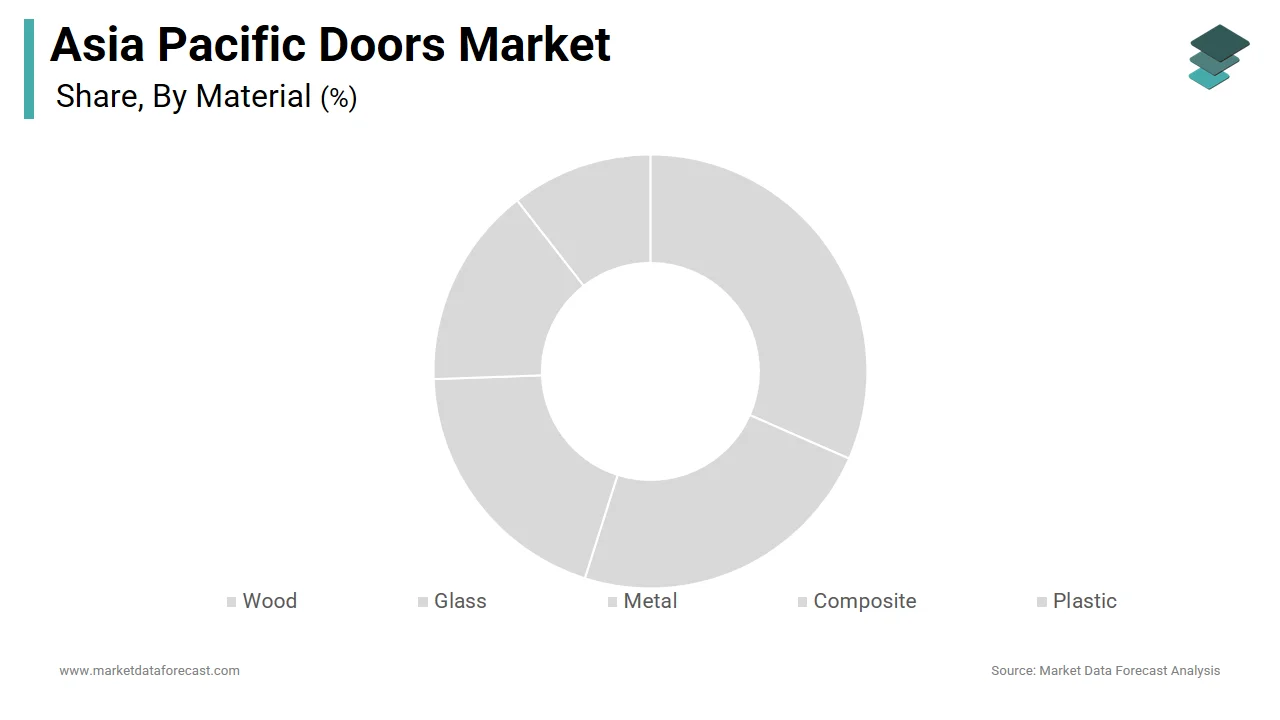
The composite doors segment is emerging as the fastest-growing segment in the Asia Pacific doors market by registering a CAGR of 12.4% between 2025 and 2033. The material’s superior performance characteristics, including enhanced durability, thermal efficiency, and resistance to warping and moisture damage, are fuelling the development of the composite doors segment. In Australia, where extreme weather conditions pose challenges for traditional materials, composite doors have gained traction in both new construction and retrofitting projects. Similarly, in China, government-backed green building initiatives have encouraged manufacturers to adopt composite materials that combine recycled polymers and wwood fibres aligning with sustainability goals. The growing emphasis on performance and longevity is expected to maintain the upward trajectory of this segment across the Asia Pacific.
By Mechanism Insights
The swinging doors segment represented the largest mechanism type in the Asia Pacific doors market by capturing 43.5% of total installations in 2025. The widespread usage in residential and commercial buildings, where ease of access, cost-effectiveness, and design flexibility make them a preferred choice, is mainly attributed to the dominance of the swinging doors segment. The prevalence of swinging doors in apartment complexes, office spaces, and educational institutions across the region is another major contributing factor. For instance, in Japan, where space optimization is crucial, manufacturers have introduced lightweight swinging variants that integrate seamlessly into compact layouts. These trends show the entrenched position of swinging mechanisms in the regional doors market.
The sliding doors segment is witnessing the fastest growth in the Asia Pacific doors market and is expected to register a CAGR of 11.8% during the forecast period. This surge of the sliding doors segment is driven by shifting architectural preferences toward open-space designs and the increasing adoption of space-saving door solutions in urban environments. Like, in India, developers of co-living spaces and micro-apartments are increasingly opting for bi-fold and pocket sliding doors to maximize usable area. The sliding doors are poised to sustain their rapid growth across the Asia Pacific due to the evolving consumer preferences and expanding applications.
By Product Type Insights
The interior doors segment was the prevailing product type in the Asia Pacific doors market by holding 55.1% of the total share in 2025. The growing focus on interior design customization, particularly in urban markets such as Shanghai, Mumbai, and Jakarta, where homeowners and developers seek premium finishes and functional door solutions, is one key driver of the interior doors segment. The high volume of residential and commercial construction activities drives consistent demand for interior partitions that provide privacy, acoustic insulation, and aesthetic value. Also, in Australia, the rise of multi-generational housing has boosted demand for soundproof interior doors that offer enhanced comfort and separation. These dynamics strengthen the dominant role of interior doors in shaping the regional market landscape.
The exterior doors segment is experiencing the fastest growth in the Asia Pacific doors market, with a CAGR of 10.6% in the coming years. This expansion of the exterior doors segment is driven by heightened security concerns, regulatory mandates for energy efficiency, and the increasing adoption of smart entry systems.
In Japan, the Ministry of Land, Infrastructure, Transport and Tourism mandated that all new residential buildings must meet higher insulation and fire-resistance standards, prompting builders to install advanced exterior door systems. Similarly, in South Korea, the proliferation of smart homes equipped with biometric locks and digital access controls has boosted demand for technologically integrated exterior door solutions. So, with rising investments in sustainable and secure housing, exterior doors are set to remain a high-growth segment across the Asia Pacific.
By Mode of Application Insights
The new construction segment remained the popular mode of application in the Asia Pacific doors market by accounting for 62.5% of total installations in 2025. The surge in affordable housing projects backed by government initiatives in countries like India, Indonesia, and the Philippines is mainly propelling the growth of the new construction segment. The continuous expansion of residential and commercial infrastructure, especially in developing economies, fuels steady demand for doors during the initial building phase. These developments stress the critical role of new construction in sustaining the doors market across the region.
The aftermarket segment is the fastest-growing application channel in the Asia Pacific doors market and is likely to register a CAGR of 11.2% in the future. The rising home renovation activities, increased awareness of energy efficiency, and the need for replacing aging door systems in existing buildings are contributing to the growth of the aftermarket segment. Also, in Japan, an aging housing stock has led to a surge in retrofitting projects focused on enhancing security and insulation.
COUNTRY-LEVEL ANALYSIS
China Doors Market Insights
China led with a 26.3% share of the Asia Pacific doors market in 2025. The country's extensive construction sector, coupled with robust domestic manufacturing capabilities, positions it as the dominant player in the regional market. The government’s push for standardized housing through urban renewal and public housing projects has further strengthened the need for mass-produced and prefabricated door solutions. Additionally, the rise of smart home technologies has led to increased integration of electronic locking systems and automated door mechanisms, particularly in Tier-1 cities like Beijing and Shanghai. With continued investment in infrastructure and technological innovation, China remains at the forefront of the door market in the Asia Pacific.
India Doors Market Insights
India is another key player in the Asia Pacific doors market. The country’s booming real estate sector, supported by government-led housing initiatives, is a key contributor to its growing prominence. In addition, rapid urbanization and rising disposable incomes have spurred renovations and home upgrades, fueling the aftermarket segment. Furthermore, the expansion of organized retail and e-commerce platforms has made branded door products more accessible to consumers in Tier-2 and Tier-3 cities. So, India is positioned to maintain strong momentum in the doors market across the Asia Pacific.
Japan Doors Market Insights
Japan is an advanced landscape in the Asia Pacific doors market. Known for its high-quality construction standards and emphasis on energy efficiency, Japan maintains a mature and technologically advanced doors market. The country’s aging population has also driven demand for accessibility-friendly door designs, particularly in senior-friendly housing projects. In addition, the Ministry of Economy, Trade and Industry (METI) has promoted the use of FSC-certified wood and low-emission composites to align with environmental regulations. With continued innovation in smart door technology and sustainable materials, Japan remains a key player in shaping future trends in the regional doors market.
South Korea Doors Market Insights
South Korea is seeing rising demand in the Asia Pacific doors market. The country’s compact urban living spaces and technological advancements have led to a growing preference for smart and space-saving door systems. In response to rising security concerns, leading manufacturers such as Samsung and LG have introduced AI-powered smart entry systems. Moreover, the government’s Green Building Certification Program has encouraged the adoption of thermally insulated and eco-friendly door materials. Hence, South Korea continues to drive innovation in the regional doors market.
Australia Doors Market Insights
Australia’s well-regulated construction industry and focus on sustainability have shaped its distinctive market dynamics. In 2023, the Green Building Council of Australia required the use of FSC-certified timber and non-toxic finishes in certified structures, influencing manufacturers to adopt environmentally responsible practices. Also, bushfire-prone regions have seen increased demand for fire-resistant composite doors, reinforcing the shift toward resilient building materials. So, Australia continues to lead in sustainable and compliant door solutions within the Asia Pacific due to strong institutional support and rising consumer awareness.
KEY MARKET PLAYERS
Some of the noteworthy companies in the Asia Pacific doors market profiled in this report are
- ASSA ABLOY (Sweden)
- dormakaba (Switzerland)
- Masonite (US)
- Andersen Corporation (US)
- Simpson Door Company (US)
- JELD-WEN, Inc. (US)
- PGT Innovations (US)
- Fancy Doors & Mouldings (Canada)
- Cornerstone Building Brands (US)
- ARCAT, Inc. (US)
- LaCantina Doors (US)
- Boon Edam (Netherlands)
- Pella Corporation (US)
- The Lyon & Billard Lumber Co. (US)
- Atrium Corporation (US)
- Fenesta (India)
- Corinthian Doors (Australia)
- Hörmann Group (Germany)
- MI Windows and Doors, LLC (US)
- Novoferm GmbH (Germany)
- Marvin (US)
- Viwintech Window & Door Inc. (US)
- Therma-Tru Corp. (US)
- OCM Industrial Doors (Italy)
TOP LEADING PLAYERS IN THE MARKET
JELD-WEN
JELD-WEN is a globally recognized leader in door manufacturing with a strong presence in the Asia Pacific region. The company offers a comprehensive range of interior and exterior doors, including wood, composite, aluminum, and PVC variants. In the Asia Pacific, JELD-WEN has been instrumental in setting benchmarks for product innovation and sustainability. Its focus on design excellence, energy efficiency, and integration of smart technologies has made it a preferred choice among developers and homeowners. By leveraging its global expertise while adapting to local architectural preferences, JELD-WEN plays a pivotal role in shaping market trends across diverse construction ecosystems in the region.
Godrej Interio
Godrej Interio is a dominant player in the Indian doors market and has expanded its influence across South and Southeast Asia through strategic product development and customer-centric offerings. The company specializes in engineered wood and composite doors that cater to both residential and commercial segments. With a strong emphasis on aesthetics, durability, and space optimization, Godrej Interio has successfully positioned itself as a lifestyle brand rather than just a building material supplier. Its investments in digital marketing, e-commerce integration, and after-sales service have strengthened consumer engagement, making it a key contributor to the regional doorsmarket’ss transformation.
DormaKaba
DormaKaba is a leading provider of advanced door solutions, particularly in the commercial and institutional sectors across the Asia Pacific. Known for its high-performance entrance systems, automated doors, and integrated security solutions, the company has played a crucial role in modernizing building access standards. DormaKaba’s commitment to smart building technologies and sustainable materials aligns with the region’s evolving infrastructure needs. Its partnerships with major real estate developers and government projects have reinforced its market leadership, especially in countries like Singapore, Japan, and Australia, where safety, automation, and energy efficiency are top priorities.
TOP STRATEGIES USED BY KEY MARKET PARTICIPANTS
One major strategy employed by key players in the Asia Pacific doors market is product diversification and customization. Companies are increasingly offering a wide array of door types tailored to different applications, aesthetics, and performance requirements. This includes introducing modular, fire-rated, soundproof, and smart-enabled doors to meet varying consumer demands and regulatory standards across the region.
Another critical approach is technology integration and digital innovation. Leading firms are embedding smart features such as biometric access, remote locking systems, and IoT-enabled monitoring into their door products. Additionally, companies are investing in digital platforms for virtual design consultations, augmented reality-based visualization, and online procurement to enhance customer experience and streamline sales processes.
Lastly, expanding regional footprint through strategic collaborations is a priority for market leaders. Door manufacturers are forming alliances with local distributors, architects, and real estate developers to strengthen market penetration. Some are also acquiring smaller regional brands or establishing joint ventures to gain localized insights and improve supply chain efficiency, ensuring stronger footholds in emerging markets across the Asia Pacific.
COMPETITION OVERVIEW
The competition in the Asia Pacific doors market is intensifying as global giants and regional players vie for dominance in an expanding and diversified industry. Established multinational companies leverage their technological expertise, extensive distribution networks, and brand equity to maintain leadership positions, particularly in developed economies like Australia, Japan, and South Korea. At the same time, domestic manufacturers in India, China, and Southeast Asia are gaining traction by offering cost-effective, locally tailored solutions that cater to specific architectural styles and budget constraints.
Market participants are increasingly focused on differentiation through innovation, sustainability, and enhanced user experiences. Companies are investing in research and development to introduce energy-efficient, durable, and aesthetically appealing door systems that align with evolving consumer preferences and green building certifications. Strategic acquisitions, partnerships, and digital marketing initiatives are also shaping the competitive landscape, enabling firms to expand their reach and reinforce brand loyalty. Additionally, rising demand for smart entry solutions and modular construction methods is prompting traditional door manufacturers to adapt their business models. As urbanization accelerates and disposable incomes rise across the region, the battle for market share is expected to grow more dynamic, with technology adoption and environmental responsibility playing decisive roles in long-term success.
RECENT MARKET DEVELOPMENTS
- In March 2025, JELD-WEN expanded its manufacturing facility in Shanghai to boost production capacity for composite and fire-rated doors catering to the growing Chinese residential and commercial sectors.
- In February 2025, Godrej Interio launched a new line of smart interior doors embedded with acoustic insulation and RFID-based locking features, targeting urban homeowners and office developers in India.
- In January 2025, Hettich introduced an automated sliding door system for high-end residential and hospitality projects in Singapore, integrating voice control and motion sensors for enhanced user experience.
- In November 2023, Kales Interdoors partnered with the Indonesian Ministry of Public Works to supply energy-efficient aluminum doors for government-sponsored housing projects across Sumatra and Java.
- In October 2023, DormaKaba rolled out a nationwide installation service for smart entrance systems in South Korean apartment complexes, leveraging IoT-enabled access control and remote monitoring capabilities.
MARKET SEGMENTATION
This Asia Pacific doors market research report is segmented and sub-segmented into the following categories.
By Material
- Wood
- Glass
- Metal
- Composite
- Plastic
By Mechanism
- Swinging Doors
- Sliding Doors
- Folding Doors
- Overhaed Doors
- Others
By Product Type
- Interior Doors
- Exterior Doors
By Application
- Non-residential
- Residential
By Mode of Application
- Newconstructionn
- Aftermarket
By Country
- India
- China
- Japan
- South Korea
- Australia
- New Zealand
- Thailand
- Malaysia
- Vietnam
- Philippines
- Indonesia
- Singapore
- Rest Of APAC