- Product Description Description
- Table of Contents TOC
- List of Table & Figure LOT
- Get Free Sample PDF Sample PDF
Market Size, 2025
$11.66 BnMarket Estimate, 2026
$12.43 BnMarket Forecast, 2034
$20.80 BnCAGR, 2026–2034
6.64%Global Audiology Devices Market Size
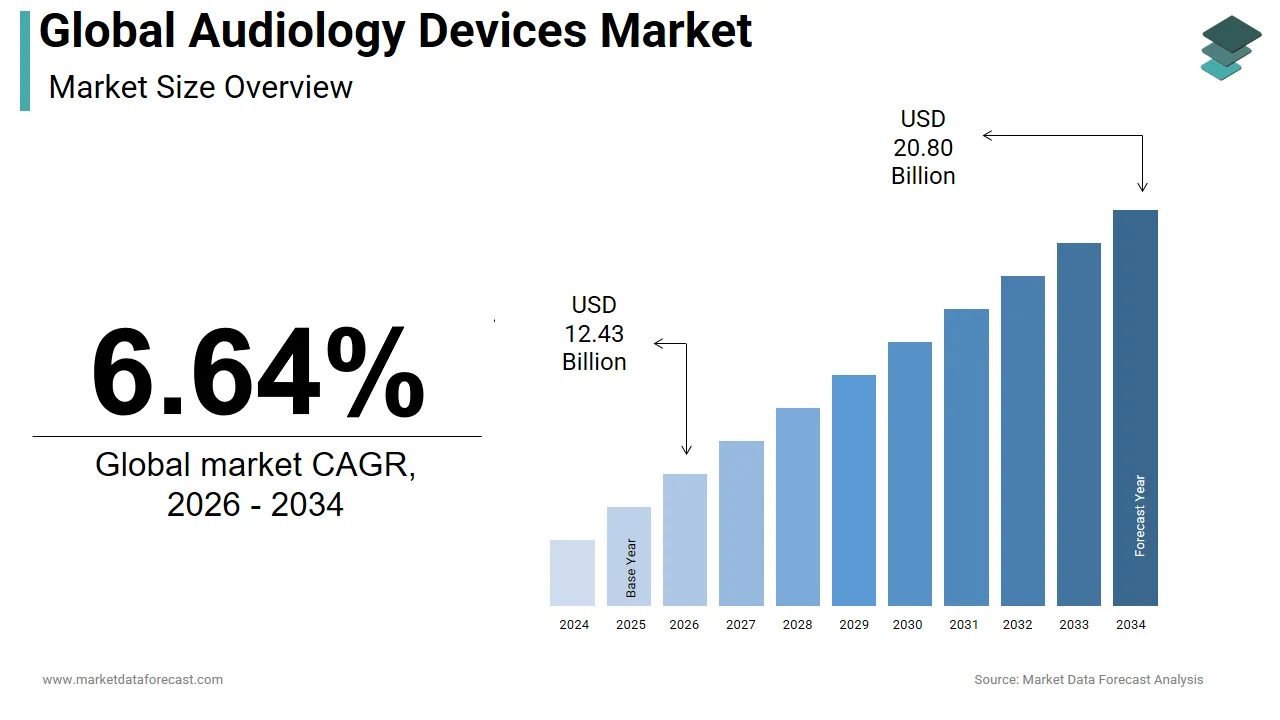
The global audiology devices market was valued at USD 11.66 billion in 2025, is estimated to reach USD 12.43 billion in 2026, and is projected to reach USD 20.80 billion by 2034, growing at a CAGR of 6.64% from 2026 to 2034.
The audiology devices are helpful to people who have sensorineural hearing loss where the patient's ear hair is damaged and cannot correctly receive sound waves or convert them into electronic impulses for the brain's neurons to pick them up. Therefore, audiology devices are a piece of technology placed behind the ear. They can receive and amplify sounds to a higher frequency and convert them to electronic impulses for the residual ear follicles to pick up the sound and send it to the brain. However, audiology devices have restrictions as they can only help with hearing loss due to accidents, medication, etc. They cannot aid in complete hearing loss.
MARKET DRIVERS
The audiology devices market is driven by the growing geriatric population around the world, leading to more need for hearing assistance.
The audiology devices are helpful in the diagnosis and treatment of hearing aids and are excellent support for audiologists. The market is growing due to the rise in the cases of hearing impairments even among the younger populations due to modern lifestyle and prevalent sound pollution worldwide. Additionally, attending aids advancement into remote services like telemedicine and consulting an audiologist through video conferencing without needing to be physically present boosts the market, especially in the post covid era. The technological advancements in the devices used, like developing wireless hearing aids and HAT devices Hearing Assistive Technology), are pushing the market to grow.
The prevalence of ear conditions in the world propels the audiology devices market growth.
Every day more people around the world face hearing impairment. World Health Organization (WHO) predicts that by the year 2050, around 2.5 billion people will have some degree of hearing loss, and over 700 million people will have a hearing disability. Young adults also risk hearing loss due to unhealthy hearing habits. Many hearing impairment problems go untreated and unattended every year. The rising government initiatives toward building better healthcare systems and the investments towards the same are expected to raise the market's prominence.
MARKET RESTRAINTS
The significant drawbacks of the audiology devices market are the high costs associated with hearing aid devices, the social stigma associated with the appearance of a hearing aid, and the way people look at the individuals who use them.
REPORT COVERAGE
| REPORT METRIC | DETAILS |
| Market Size Available | 2025 to 2034 |
| Base Year | 2025 |
| Forecast Period | 2026 to 2034 |
| Segments Covered | By Product, Technology, Sales Channel, & Region. |
| Various Analyses Covered | Global, Regional, and Country-Level Analysis, Segment-Level Analysis, Drivers, Restraints, Opportunities, Challenges; PESTLE Analysis; Porter’s Five Forces Analysis, Competitive Landscape, Analyst Overview of Investment Opportunities |
| Regions Covered | North America, Europe, Asia Pacific, Latin America, Middle East & Africa |
| Market Leaders Profiled | Widex A/S, Sonova Holdings AG, Phonak, Audioscan, MedRx, GN ReSound Group, Starkey Hearing Technologies, William Demant Holdings A/S, NHC/Amplifon, Medtronic, Siemens, MAICO Diagnostics, MED-EL, and Sivatos Pte. Ltd. |
SEGMENT ANALYSIS
By Product Insights
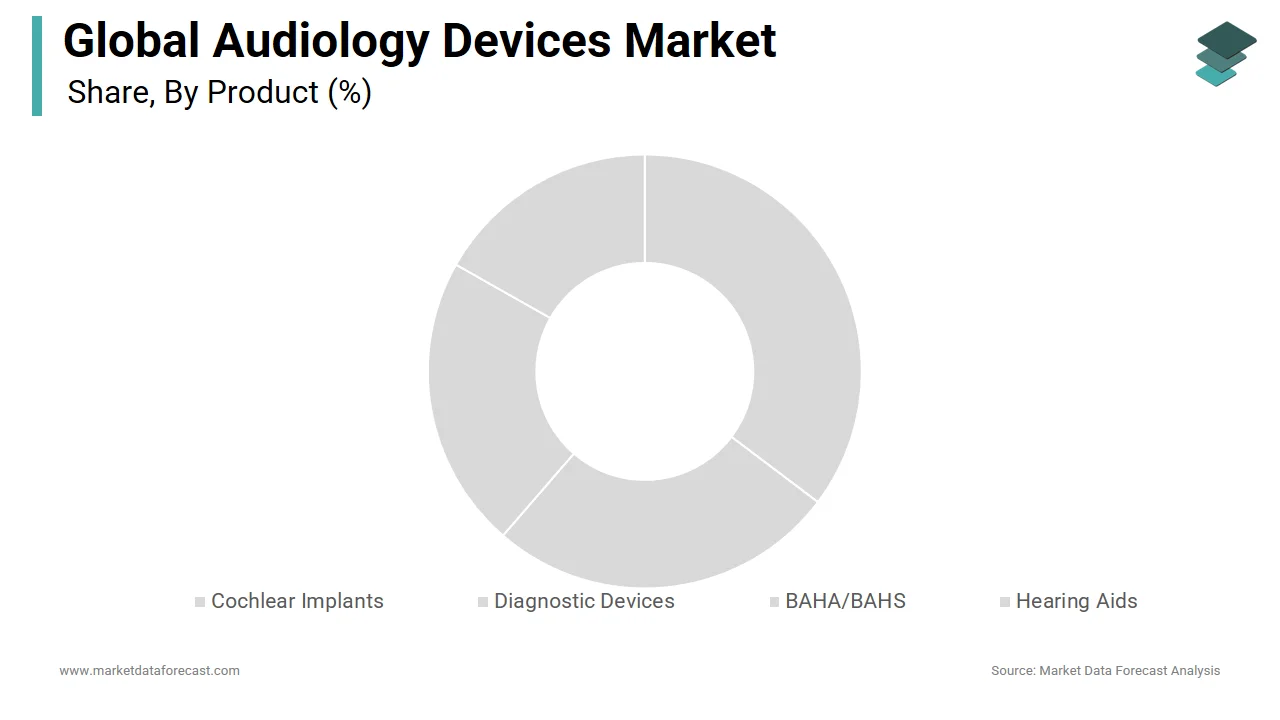
Based on the product, the hearing aids segment dominated the audiology devices market in 2024 and is expected to hold a significant share due to their easy access and awareness among the population; however, the cochlear implants segment is expected to grow drastically during the forecast period owing to the demand for in-canal hearing aids. In addition, diagnostic hearing aids are likely to contribute lucratively to market growth.
By Technology Insights
Digital hearing aids use different devices and Bluetooth technology to connect to the hearing aid devices and are convenient to use. Therefore, the rise in the demand for digital devices due to their adaptive nature has led them to dominate the market.
However, digital devices lack analog devices in some functions, like using an amplifier to better your hearing experience. Therefore, the population may prefer analog aid instead of digital.
By Sales Channel Insights
Although there is a high adoption rate for e-commerce stores due to the digitalization of the world, retail stores dominate the market due to their sheer number of existing stores. A big chain of retail stores in the U.S. sells hearing aid devices. Therefore, they dominate the market and are expected to keep dominating it during the forecast period while the e-commerce segment grows lucratively.
REGIONAL ANALYSIS
Regarding share, North America dominated the global market in 2024 and is expected to continue dominating during the forecast period. This dominance is due to the development of audiology systems, an increase in the number of audiologists, and the introduction of cutting-edge digital platforms by existing suppliers, which can all be credited with expanding the U.S. industry. In addition, introducing patient-centered audiology systems that make it simple to handle the product results in patient compliance is further fueling market expansion.
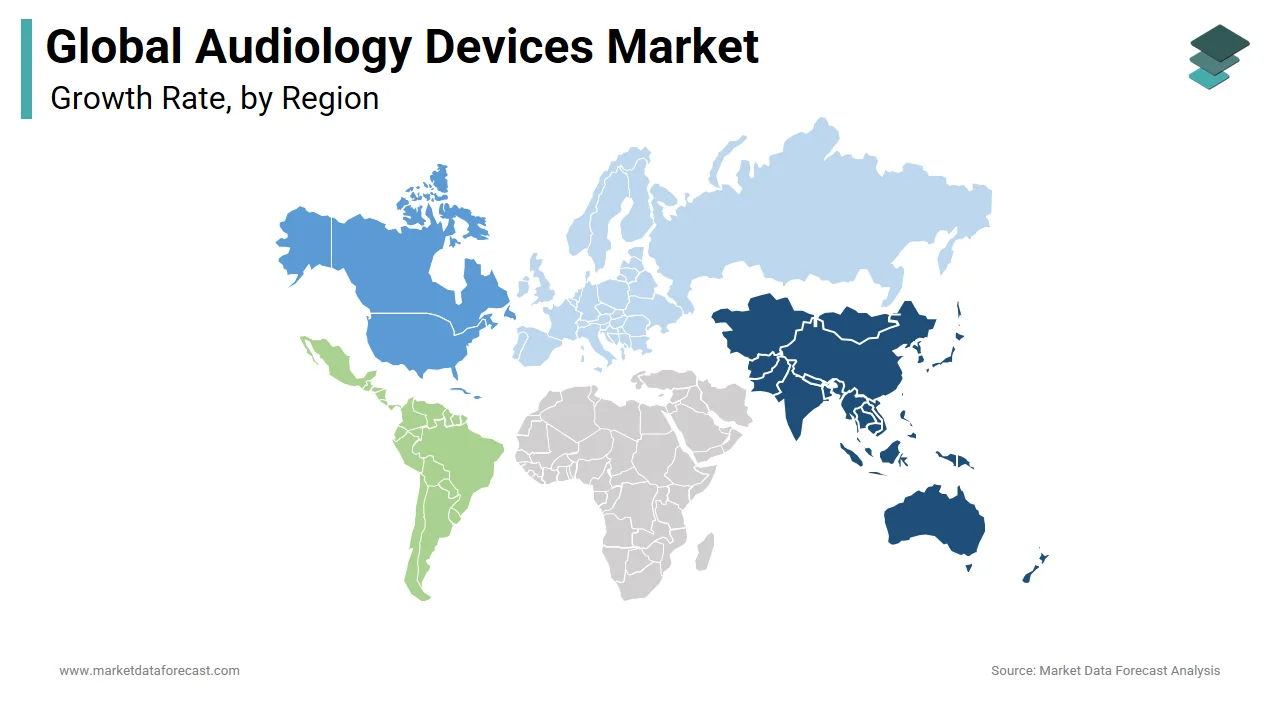
The Asia Pacific region is expected to have a significant CAGR during the forecast period. The market's expansion may be ascribed to factors such as the rising elderly population and age-related hearing issues, the ever-improving healthcare system, rising healthcare costs, and rising consumer product awareness in developing countries like China, India, and Japan, etc.
TOP COMPANIES IN THIS MARKET
Some of the companies that are playing a dominating role in the global audiology devices market include
- Widex A/S
- Sonova Holdings AG
- Phonak
- Audioscan
- MedRx
- GN ReSound Group
- Starkey Hearing Technologies
- William Demant Holdings A/S
- NHC / Amplifon
- Medtronic
- Siemens
- MAICO Diagnostics
- MED-EL
- Sivantos Pte. Ltd
GLOBAL AUDIOLOGY DEVICES MARKET NEWS
- In June 2022, Envoy Medical Corporation, a provider of cutting-edge technologies for hearing loss across the spectrum, announced today that its application for an Investigational Device Exemption (IDE) to launch a clinical trial with its fully implanted Acclaim® cochlear implant had been approved by the U.S. Food and Drug Administration (FDA). The Mayo Clinic in Rochester, Minnesota, will host the single-center Early Feasibility Study for the Acclaim by Envoy Medical. Due to the lack of any components that hearing aids must wear externally, The Acclaim differs from current commercially available cochlear implants. The FDA gave it a Breakthrough Device Designation in 2019. The Acclaim would be the first cochlear implant of its sort created to be fully implanted and use the ear, rather than a microphone, to pick up the sound if the FDA approved it.
- In July 2022, Widex Moment is a revolutionary new hearing aid that amplifies the environment around its wearer, utilizing Pure Sound Technology. This unique "sound experience," aptly called PureSound, processes sound more quickly than ever before to guarantee that the patient may hear every detail. In addition, these devices' AI technology continuously adjusts itself in real-time according to the listening environment.
MARKET SEGMENTATION
This research report on the global audiology devices market has been segmented and sub-segmented based on product, technology, sales channel, and region.
By Product
- Cochlear Implants
- Diagnostic Devices
- BAHA/BAHS
- Hearing Aids
By Technology
- Analog
- Digital
By Sales Channel
- E-Commerce
- Retail Sales
By Region
- North America
- Europe
- Asia-pacific
- Latin America
- Middle East and Africa