- Product Description Description
- Table of Contents TOC
- List of Table & Figure LOT
- Get Free Sample PDF Sample PDF
Market Size, 2025
$26.09 BnMarket Estimate, 2026
$27.58 BnMarket Forecast, 2034
$43.04 BnCAGR, 2026–2034
5.72%Executive Summary: Global Automotive Adaptive Front Lighting System Market
- Market Scope: Comprehensive global analysis of the automotive adaptive front lighting system sector, covering passenger and light commercial vehicle types, exterior/interior applications, controller and sensor components, and regional distribution worldwide.
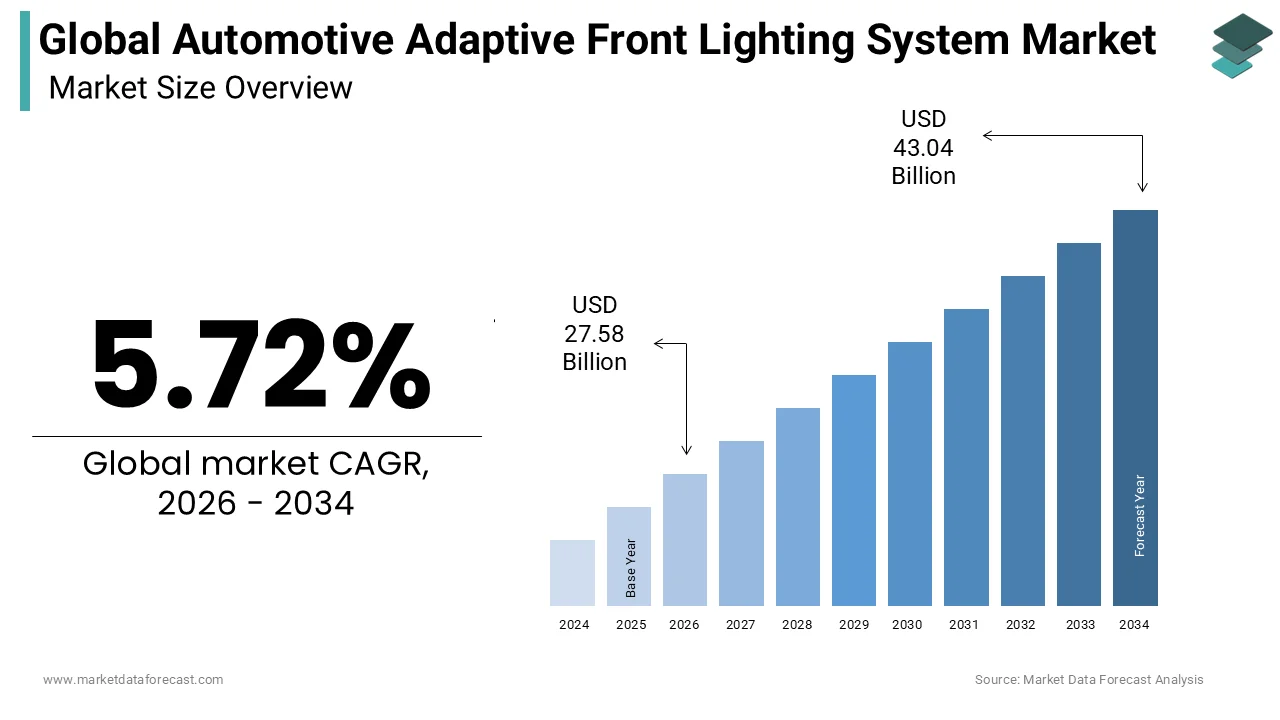
- Market Valuation: Valued at USD 26.09 billion in 2025, reached USD 27.58 billion in 2026, and is projected to scale up to USD 43.04 billion by 2034, registering a compound annual growth rate (CAGR) of 5.72% across the forecast period.
- Primary Growth Drivers: Stringent global safety regulations, matrix LED advancements, rising consumer preferences for active safety features, and high demand for improved low-light visibility and comfort worldwide.
Key Market Segment Metrics
| Category | Leading Segment (Base Position) | Fastest-Growing / High-Growth Segment |
|---|---|---|
| By Vehicle Type & Application | Passenger Vehicles (dominant share driven by massive volume production and model differentiation) & Exterior Lighting (leading share due to mandatory compliance and core nighttime visibility) | Light Commercial Vehicles (10.2% CAGR driven by e-commerce and delivery safety) & Interior Lighting (12.2% CAGR due to cabin personalization and ambient integration) |
| By Component Type | Controllers (largest share as central microcontrollers executing real-time adjustments) | Sensors (12.5% CAGR driven by reliance on cameras and radar for environmental perception) |
| By Region | North America (major share supported by revised NHTSA standards and high vehicle safety tech adoption) | Asia-Pacific (fastest regional growth fueled by massive manufacturing and smart safety mandates) |
Major Market Players & Industry Landscape
Market Structure: Highly competitive global automotive lighting and technology landscape featuring major tier-1 suppliers navigating high manufacturing and integration costs alongside calibration burdens.
Key Companies: Koito Manufacturing Co., Ltd., Valeo SA, HELLA GmbH & Co. KGaA, Stanley Electric Co., Ltd., Marelli Holdings Co., Ltd., Hyundai Mobis, Robert Bosch GmbH, Continental AG, OSRAM GmbH, Lumileds Holding B.V., Texas Instruments Incorporated, Infineon Technologies AG, ZKW Group, SL Corporation, and Varroc Engineering Limited.
 Download Free Sample Report
Global Automotive Adaptive Front Lighting System Market Size
The Global Automotive Adaptive Front Lighting System Market size was calculated at USD 26.09 billion in 2025 and is anticipated to reach USD 43.04 billion by 2034, from USD 27.58 billion in 2026, growing at a CAGR of 5.72% during the forecast period.
Automotive adaptive front lighting systems represent a sophisticated illumination technology that dynamically adjusts the direction, intensity, and shape of headlight beams in real time based on vehicle speed, steering angle, and surrounding traffic conditions. These systems utilize sensors, cameras, and electronic control units to optimize visibility while minimizing glare for other road users, significantly enhancing night-time driving safety. According to the World Health Organization, approximately 1.19 million people die in road traffic crashes annually. As per the European Commission, the implementation of advanced lighting technologies is significant for improving driver reaction times and object recognition distances. Modern iterations integrate matrix LED and laser technologies that can selectively dim specific segments of the light beam to avoid dazzling oncoming drivers while maintaining maximum illumination on the road ahead. According to the National Highway Traffic Safety Administration, adaptive driving beam technology improves safety for pedestrians and bicyclists by making them more visible at night. Regulatory bodies such as the United Nations Economic Commission for Europe have updated regulations to permit more complex beam patterns, facilitating the adoption of these intelligent systems. The integration of adaptive lighting with autonomous driving features further amplifies its utility, ensuring that sensor suites receive optimal visual data for obstacle detection. This technological evolution transforms headlights from passive components into active safety elements that communicate with the vehicle environment.
MARKET DRIVERS
Stringent Global Safety Regulations Mandate Advanced Illumination Standards
Government agencies worldwide are enforcing stricter safety standards that require vehicles to incorporate advanced lighting technologies to reduce accident rates and protect vulnerable road users, which is primarily driving the global automotive adaptive front lighting system market. As per the European Union General Safety Regulation, new vehicle types registered after July 2022 must be equipped with adaptive front lighting systems or equivalent advanced lighting technologies. This regulatory push stems from data indicating that nighttime driving accounts for only 25% of total travel time but contributes to a disproportionate number of fatal accidents. The United States Department of Transportation finalized rules in 2022 allowing adaptive driving beams, which were previously prohibited due to concerns about glare, opening a massive market for American automakers to adopt matrix lighting. Japan also revised its security standards to accommodate high-performance adaptive headlights that adjust to weather conditions and road curvature. These legal frameworks compel original equipment manufacturers to integrate adaptive systems as standard equipment rather than optional extras, ensuring widespread penetration across vehicle segments. Compliance with these regulations requires significant investment in research and development, but it guarantees market access in major economies. The harmonization of global standards through the World Forum for Harmonization of Vehicle Regulations facilitates international trade and encourages manufacturers to develop universal platforms. This regulatory environment creates a baseline demand that drives volume production and reduces unit costs through economies of scale.
Rising Consumer Preference for Premium Safety and Comfort Features
Modern car buyers increasingly prioritize advanced safety features and driving comfort, viewing adaptive front lighting systems as essential components of a premium driving experience rather than luxury add-ons, which are further boosting the expansion of the automotive adaptive front lighting system market. For instance, a majority of consumers consider nighttime visibility a critical factor when purchasing a new vehicle, with many willing to pay extra for technologies that enhance safety in low-light conditions. The proliferation of sport utility vehicles and crossovers, which accounted for 55% of global light vehicle sales in 2023 as per S&P Global Mobility, has amplified the need for superior lighting due to their higher ride height and potential for causing glare to smaller cars. Adaptive systems address this concern by automatically leveling the beam and adjusting its range based on load and pitch. Furthermore, the integration of these systems with infotainment displays allows drivers to visualize the lighting adjustments, adding a technological appeal that resonates with younger demographics. Automotive brands use adaptive lighting as a key differentiator in marketing campaigns, highlighting features like cornering lights and highway mode that adapt to specific driving scenarios. The perceived value of these systems extends beyond safety to include aesthetic customization, with some manufacturers offering signature lighting patterns that enhance brand identity. This consumer-driven demand pushes manufacturers to include adaptive lighting in mid-tier models, expanding the total addressable market beyond the luxury segment.
MARKET RESTRAINTS
High Manufacturing and Integration Costs Limit Mass Market Adoption
The substantial cost associated with producing and integrating adaptive front lighting systems remains a primary barrier to their widespread adoption in entry-level and economy vehicle segments. A complete adaptive lighting module, including matrix LED arrays, stepper motors, sensors, and control units, can cost between 300 and 600 dollars per vehicle, significantly higher than the 50 to 100 dollars for standard halogen or basic LED systems. This price differential makes it difficult for automakers to include these systems in budget-friendly models where profit margins are already thin. The complexity of the system requires precise calibration during assembly, increasing labor time and quality control expenses. Additionally, the need for robust thermal management solutions to protect sensitive electronic components from heat generated by high-power LEDs adds further material costs. Supply chain volatility for semiconductor chips, which are essential for the control units, has led to price fluctuations and availability issues, forcing manufacturers to absorb additional costs or delay production. For original equipment manufacturers, balancing the desire for advanced features with cost competitiveness is a constant challenge, often resulting in adaptive lighting being reserved for higher trim levels or optional packages. This segmentation limits the overall volume potential and slows the transition of adaptive lighting from a premium feature to a standard industry norm, particularly in emerging markets where price sensitivity is extreme.
Complexity of Calibration and Maintenance Increases Aftermarket Burden
Adaptive front lighting systems require precise alignment and regular calibration to function correctly, which creates significant challenges for service centers and increases the total cost of ownership for consumers, hampering the automotive adaptive front lighting system market growth. Unlike static headlights that maintain a fixed position, adaptive systems rely on moving parts and sensors that can drift out of alignment due to road vibrations, minor collisions, or suspension wear. According to the Automotive Service Association, misaligned adaptive headlights can reduce effective visibility and cause dangerous glare for other drivers, necessitating frequent professional checks. Calibration typically requires specialized diagnostic equipment and software licenses that many independent repair shops do not possess, forcing vehicle owners to visit authorized dealerships where labor rates are higher. A single calibration procedure can take 30 to 60 minutes and cost between 100 and 200 dollars, depending on the vehicle make and model. Furthermore, if a component such as a steering angle sensor or camera fails, the entire lighting system may default to a safe mode with reduced functionality, requiring complex troubleshooting to restore full performance. The lack of standardized diagnostic protocols across different manufacturers complicates repairs and increases downtime. This maintenance burden discourages some consumers from choosing vehicles with advanced lighting systems, particularly in regions with limited access to specialized service infrastructure, thereby restraining market growth in developing economies.
MARKET OPPORTUNITIES
Integration with Autonomous Driving and Vehicle-to-Everything Technologies
The convergence of adaptive front lighting systems with autonomous driving capabilities and vehicle-to-everything communication networks presents a significant opportunity for the automotive adaptive front lighting system market. As vehicles become more automated, lighting systems evolve from mere illumination tools to communication interfaces that signal intent to pedestrians and other drivers. For instance, adaptive headlights can project warning symbols on the road surface to alert pedestrians of an approaching autonomous vehicle, enhancing trust and safety in mixed traffic environments. According to the Society of Automotive Engineers, level 3 and level 4 autonomous vehicles require redundant sensory inputs, and adaptive lighting plays a crucial role in optimizing camera and lidar performance by providing consistent illumination regardless of ambient light conditions. Integration with vehicle-to-infrastructure systems allows headlights to adjust based on real-time data from smart city networks, such as upcoming curve radii or weather conditions detected by roadside sensors. This connectivity enables predictive lighting adjustments that anticipate road geometry before the vehicle reaches it, improving safety margins. Automakers are exploring dynamic lighting signatures that change color or pattern to indicate autonomous mode activation, creating new branding opportunities. The synergy between lighting, sensing, and connectivity transforms the headlight into a smart node within the broader mobility ecosystem, opening revenue streams for software updates and data services.
Expansion into Emerging Markets with Growing Middle Class Populations
Rising disposable incomes and increasing vehicle ownership in emerging economies such as India, China, and Southeast Asian nations create a fertile ground for the adoption of adaptive front lighting systems, which is another prominent opportunity for the automotive adaptive front lighting system market. The middle class in these regions is expanding rapidly, with consumers increasingly aspiring to own vehicles equipped with features previously available only in luxury segments. According to the International Energy Agency, electric vehicle sales in emerging economies grew by 35% in 2023, and since most electric vehicles come with LED-based lighting architectures, the transition to adaptive systems is technically smoother and more cost-effective. Local manufacturing initiatives in countries like India and Thailand are reducing production costs for automotive components, making advanced lighting systems more affordable for domestic buyers. Government incentives for local production of automotive parts further encourage suppliers to establish facilities in these regions, fostering competition and innovation. As road infrastructure improves and highway networks expand in these countries, the demand for better nighttime visibility grows, driving consumer interest in adaptive lighting. Automakers are introducing localized models with scaled-down adaptive lighting features that balance cost and performance, catering to the specific needs of these markets. This geographic expansion offers manufacturers a new growth vector as saturation levels in mature markets begin to plateau, ensuring long-term sustainability for the industry.
MARKET CHALLENGES
Standardization Gaps Across Global Markets Hinder Uniform Development
The lack of uniform global standards for adaptive front lighting systems creates significant engineering and compliance challenges for manufacturers operating in multiple regions. While the United Nations Economic Commission for Europe has established comprehensive regulations for adaptive driving beams, other regions such as North America and Asia have historically maintained different or more restrictive rules. Although the United States recently updated its federal motor vehicle safety standards to allow adaptive beams, the testing protocols and performance metrics differ from European norms, requiring manufacturers to develop region-specific variants of the same system. This fragmentation increases research and development costs, as engineers must design flexible hardware and software architectures that can comply with diverse regulatory requirements. Inconsistent definitions of what constitutes an adaptive system also lead to confusion among consumers and insurers regarding safety benefits and liability. The absence of a unified global standard slows the pace of innovation, as companies must allocate resources to navigate bureaucratic hurdles rather than focusing on technological advancements. Furthermore, varying approval timelines across jurisdictions delay the global launch of new lighting technologies, reducing the return on investment for early movers. Harmonizing these standards through international cooperation remains a critical but unresolved issue that impedes the efficient scaling of adaptive lighting solutions worldwide.
Supply Chain Vulnerabilities for Critical Electronic Components
The automotive adaptive front lighting system market faces significant risks due to its reliance on specialized electronic components, particularly microcontrollers and power management integrated circuits, which are subject to global supply chain disruptions and another major challenge for the global market. The production of these semiconductors is concentrated in a few geographic regions, making the supply chain vulnerable to geopolitical tensions, natural disasters, and logistical bottlenecks. During the recent global chip shortage, many automakers were forced to produce vehicles without certain advanced features, including adaptive lighting, or to delay deliveries entirely. According to Deloitte, the semiconductor shortage cost the automotive industry over 200 billion dollars in lost revenue between 2020 and 2022, highlighting the fragility of just-in-time manufacturing models. Adaptive lighting systems require high-reliability components that can withstand extreme temperatures and vibrations, limiting the number of qualified suppliers and creating single points of failure. Any disruption in the supply of rare earth materials used in LED phosphors or magnetic motors further exacerbates production delays. Manufacturers are attempting to mitigate these risks by diversifying their supplier base and increasing inventory buffers, but these strategies increase working capital requirements and reduce operational efficiency. The ongoing tension between cost optimization and supply chain resilience remains a persistent challenge that threatens the stability of production schedules and market availability.
REPORT COVERAGE
| REPORT METRIC | DETAILS |
| Market Size Available | 2025 to 2034 |
| Base Year | 2025 |
| Forecast Period | 2026 to 2034 |
| CAGR | 5.72% |
| Segments Covered | By Vehicle Type, Application, Component Type, and Region |
| Various Analyses Covered | Global, Regional & Country Level Analysis; Segment-Level Analysis; DROC, PESTLE Analysis; Porter’s Five Forces Analysis; Competitive Landscape; Analyst Overview of Investment Opportunities |
| Regions Covered | North America, Europe, Asia Pacific, the Middle East and Africa, And Latin America |
| Market Leaders Profiled | Koito Manufacturing Co., Ltd., Valeo SA, HELLA GmbH & Co. KGaA, Stanley Electric Co., Ltd., Marelli Holdings Co., Ltd., Hyundai Mobis, Robert Bosch GmbH, Continental AG, OSRAM GmbH, Lumileds Holding B.V., Texas Instruments Incorporated, Infineon Technologies AG, ZKW Group, SL Corporation, Varroc Engineering Limited |
SEGMENTAL ANALYSIS
By Vehicle Type Insights
The passenger vehicles segment dominated the market by capturing the highest share of the global market in 2025. The dominance of the passenger vehicles segment in the global market can be credited to the high volume of global production and the intense competition among manufacturers to differentiate models through advanced safety and aesthetic features. The sheer scale of passenger car sales ensures that even moderate penetration rates result in substantial unit volumes for adaptive lighting components. The dominance of the passenger vehicle segment is primarily driven by the massive global production volumes, which exceeded 85 million units in 202,3 according to data from the International Organization of Motor Vehicle Manufacturers. This vast base provides a fertile ground for the integration of adaptive front lighting systems as consumers increasingly prioritize safety features that mitigate nighttime driving risks. Surveys indicate that a significant majority of new car buyers consider advanced lighting systems a critical factor in their purchasing decision, viewing them as essential for protecting family members and reducing accident liability. Automakers respond to this demand by making adaptive headlights standard equipment on mid-range trims rather than reserving them for luxury models, thereby expanding the addressable market significantly. The competitive landscape forces manufacturers to continuously upgrade lighting technologies to maintain brand appeal, with matrix LED and laser lighting becoming common differentiators. Furthermore, insurance companies in regions like Europe and North America offer premium discounts for vehicles equipped with certified advanced lighting systems, providing a financial incentive for consumers to choose these configurations. This combination of regulatory pressure, consumer preference, and economic benefit ensures that passenger vehicles remain the primary conduit for adaptive lighting technology deployment globally.

On the other side, the light commercial vehicle segment is the fastest-growing segment and is estimated to record a CAGR of 10.2% during the forecast period, owing to the expansion of e-commerce logistics and the need for enhanced safety in urban delivery operations. The rapid growth of e-commerce has led to a surge in last-mile delivery vehicles operating in dense urban environments where visibility is often compromised by narrow streets, parked cars, and pedestrian traffic. Light commercial vehicles are increasingly equipped with adaptive front lighting systems to improve driver awareness and reduce the risk of accidents involving vulnerable road users. According to the United Nations Conference on Trade and Development, global e-commerce sales reached 4.9 trillion dollars in 2023, driving a corresponding increase in delivery fleet sizes. Companies like Amazon and DHL are prioritizing driver safety and operational efficiency, recognizing that accidents lead to costly delays and reputational damage. Adaptive lighting helps drivers navigate poorly lit areas and detect obstacles earlier, reducing fatigue during long shifts. Regulatory bodies in Europe are also tightening safety standards for commercial fleets, mandating advanced driver assistance systems that often include adaptive lighting as a core component. The economic case for these systems is strengthened by lower insurance premiums and reduced repair costs resulting from fewer collisions. As urban logistics becomes more automated, the integration of adaptive lighting with sensor suites for autonomous delivery robots further accelerates adoption in this segment, making it the fastest-growing category in the market.
By Application Insights
The exterior lighting segment led the market by holding the leading share of the global market in 2025. The growth of the exterior lighting segment in the global market can be credited to the automotive adaptive front lighting system market because it encompasses the primary headlight assemblies that are legally required and critical for nighttime visibility and safety compliance. Exterior lighting dominates the market because it is directly linked to mandatory safety regulations that require vehicles to provide adequate illumination without causing glare to other road users. Adaptive front lighting systems for exterior applications are designed to comply with strict international standards such as those set by the United Nations Economic Commission for Europe and the Society of Automotive Engineers. These regulations mandate specific performance criteria for beam pattern, intensity, and adaptability, driving the adoption of sophisticated exterior lighting solutions. According to the World Health Organization, poor visibility is a contributing factor in nearly half of all fatal nighttime accidents, underscoring the critical importance of effective exterior lighting. Automakers invest heavily in developing exterior adaptive systems that can dynamically adjust to road curvature, weather conditions, and traffic density to maximize safety. The complexity of these systems, which often involve matrix LED arrays and precise motorized controls, results in a higher value per unit compared to interior applications. Furthermore, exterior lighting serves as a key design element for vehicle aesthetics, with manufacturers using unique light signatures to enhance brand recognition. The combination of regulatory necessity, safety imperatives, and design importance ensures that exterior lighting remains the largest and most stable segment in the adaptive lighting market.
On the other hand, the interior lighting segment is the fastest-growing application and is expected to exhibit a CAGR of 12.2% during the forecast period, owing to the rising demand for personalized cabin experiences and ambient lighting integration with vehicle infotainment systems. Interior adaptive lighting is gaining traction as automakers seek to create immersive and personalized cabin environments that enhance user comfort and brand differentiation. Modern vehicles feature multi-color ambient lighting systems that can change intensity and hue based on driving modes, music, or user preferences, creating a unique emotional connection with the driver. According to McKinsey and Company, interior experience is becoming a key differentiator for electric vehicles, with lighting playing a central role in defining the cabin atmosphere. Adaptive interior systems can sync with navigation alerts, warning signals, or entertainment content, providing visual cues that reduce driver distraction and improve usability. The rise of smart surfaces and transparent displays integrates lighting into dashboard and door panels, transforming the interior into a dynamic interface. Consumers are increasingly willing to pay for premium interior packages that include advanced lighting features, viewing them as essential for luxury and comfort. This trend is particularly strong in the electric vehicle segment, where minimalist interiors rely on lighting to define space and mood. The ability to update lighting themes via software allows for continuous refreshment of the cabin experience, fostering long-term customer engagement and satisfaction.
By Component Type Insights
The controllers segment held the largest share of the global market in 2025 because they serve as the central brain that processes sensor data and executes precise lighting adjustments in real time. Controllers dominate the market because they are essential for processing complex inputs from cameras, radar, and steering angle sensors to determine the optimal lighting pattern. These electronic control units run sophisticated algorithms that calculate beam direction, intensity, and shape milliseconds after detecting changes in the driving environment. The increasing complexity of adaptive lighting functions, such as matrix beam masking and predictive cornering, requires powerful microcontrollers with high processing speeds and memory capacity. According to Semiconductor Industry Association data, the automotive sector accounted for 14% of global semiconductor sales in 2023, with lighting controllers representing a significant portion of this demand. The reliability of the controller is critical for safety, as any failure could result in improper lighting and increased accident risk. Manufacturers invest heavily in developing robust controllers that can withstand automotive-grade temperatures and electromagnetic interference. The shift toward domain-centralized architectures in vehicles further elevates the importance of lighting controllers, as they integrate with broader vehicle dynamics systems. This central role ensures that controllers remain the highest value component in the adaptive lighting supply chain, driving their market dominance.
On the other hand, the sensors segment is the fastest-growing component and is predicted to expand at a CAGR of 12.5% during the forecast period, owing to the increasing reliance on camera and radar data for precise environmental perception and adaptive lighting control. Sensors are experiencing rapid growth because adaptive lighting systems increasingly rely on high-resolution cameras and radar to detect objects, road markings, and other vehicles with greater accuracy. Modern systems use stereo cameras to create three-dimensional maps of the road ahead, allowing for precise beam shaping that avoids glaring oncoming drivers while illuminating pedestrians and obstacles. The proliferation of advanced driver assistance systems has lowered the cost of high-quality automotive sensors, making them more accessible for lighting applications. According to Yole Développement, the automotive image sensor market is expected to grow at a double-digit rate, fueled by demand from lighting and safety systems. The integration of lidar sensors in premium vehicles further enhances depth perception, enabling lighting systems to react to distant objects before they become visible to the human eye. This level of precision improves safety and user confidence, driving adoption. As sensor technology advances, smaller and more efficient units are becoming available, facilitating easier integration into compact vehicle designs. The critical role of sensors in enabling next-generation lighting features ensures their rapid growth in the market.
REGIONAL ANALYSIS
North America Automotive Adaptive Front Lighting System Market Analysis
North America dominated the market by accounting for the major share of the global market in 2025 and is expected to see a significant acceleration in market growth as the implementation of adaptive driving beam standards continues to expand over the next few years. The United States represents the largest national market within the region, with the National Highway Traffic Safety Administration updating federal safety standards in 2022 to allow adaptive driving beams. This regulatory shift unlocked a major barrier to entry, enabling American automakers to adopt matrix lighting systems that were previously prohibited due to glare concerns. The popularity of sport utility vehicles and trucks in North America, which account for over 75% of new vehicle sales according to Cox Automotive, creates a strong demand for high-performance lighting due to the higher ride height and potential for causing glare. Consumers in this region prioritize safety and technology features, willing to pay premiums for advanced lighting packages. Major automakers like Ford and General Motors are rapidly integrating adaptive lighting into their flagship models to compete with luxury brands. The presence of leading technology suppliers and a robust aftermarket sector further supports market growth. Additionally, the expansion of electric vehicle production in the United States, with companies like Tesla and Rivian leading innovation, accelerates the adoption of LED-based adaptive systems. The region’s focus on reducing nighttime accidents through technology ensures sustained demand for adaptive lighting solutions.
Europe Automotive Adaptive Front Lighting System Market Analysis
Europe is likely to remain the global innovation leader by leveraging its stringent safety mandates and integration of digital lighting into electrification strategies over the next few years. The European Union General Safety Regulation mandates advanced lighting systems for new vehicle types, creating a compulsory market for adaptive front lighting. Countries like Germany, France, and the United Kingdom are home to major automakers such as Volkswagen, BMW, and Stellantis, which pioneer lighting innovations to maintain their competitive edge. The region has a long history of regulating vehicle lighting through the United Nations Economic Commission for Europe standards, which have historically been more progressive than those in other regions. This regulatory framework has fostered a mature supply chain with companies like Valeo, Hella, and ZKW dominating global production. European consumers are highly aware of road safety issues, with nighttime accident rates driving demand for effective lighting solutions. The dense urban infrastructure and frequent adverse weather conditions in Northern Europe further necessitate adaptive lighting for safe navigation. Additionally, the strong push toward electrification in Europe, with bans on internal combustion engine vehicles planned for 2035 in several countries, accelerates the transition to energy-efficient LED and laser lighting systems. The region’s commitment to sustainability and safety ensures it remains the technological hub for adaptive lighting innovation.
Asia Pacific Automotive Adaptive Front Lighting System Market Analysis
Asia-Pacific is poised to witness the highest regional market growth by capitalising on its vast manufacturing capacity and the rapid adoption of smart safety features across mass-market segments over the next few years. China is the largest automotive market globally, producing over 25 million vehicles annually according to the China Association of Automobile Manufacturers, providing a massive base for adaptive lighting adoption. Local manufacturers like BYD and Geely are increasingly incorporating advanced lighting features to compete with international brands, driving domestic demand. India is also witnessing rapid growth as safety regulations become stricter, with the government mandating better lighting standards for new vehicles. The region benefits from a strong manufacturing ecosystem for electronics and LEDs, reducing component costs and facilitating local production. Japan and South Korea contribute through technological leadership, with companies like Hyundai and Kia exporting vehicles with advanced lighting systems worldwide. The expanding highway networks in Southeast Asia and the rising incidence of nighttime accidents are prompting governments to enforce stricter lighting norms. Consumer awareness of safety features is growing, particularly among younger buyers who view adaptive lighting as a status symbol. The combination of volume growth, regulatory support, and technological advancement positions the Asia Pacific as the key driver of future market expansion.
COMPETITION OVERVIEW
The automotive adaptive front lighting system market features intense competition among established tier one suppliers and emerging technology firms vying for dominance in advanced illumination solutions. Major players differentiate themselves through proprietary matrix LED architectures and laser lighting technologies that offer superior performance and energy efficiency. Innovation cycles are rapid as companies strive to integrate artificial intelligence and predictive algorithms into lighting control units for enhanced safety. Strategic alliances with semiconductor providers and software developers are critical for securing supply chains and enabling advanced functionalities like over-the-air updates. Price competition remains significant in the mass market segment, prompting manufacturers to optimize production processes and adopt modular designs. Regulatory compliance across diverse global markets requires substantial investment in testing and certification, creating barriers for smaller entrants. The shift toward electric vehicles accelerates demand for efficient lighting systems, favoring companies with strong expertise in thermal management and power electronics. Customer relationships with original equipment manufacturers are long-term and sticky, making it difficult for new competitors to displace incumbent suppliers without disruptive technology. Success depends on balancing cost-effectiveness with technological sophistication while meeting stringent safety standards globally.
KEY MARKET PLAYERS
A few major players of the global automotive adaptive front lighting system market include
- Koito Manufacturing Co., Ltd
- Valeo SA
- HELLA GmbH & Co. KGaA
- Stanley Electric Co., Ltd
- Marelli Holdings Co., Ltd
- Hyundai Mobis
- Robert Bosch GmbH
- Continental AG
- OSRAM GmbH
- Lumileds Holding B.V
- Texas Instruments Incorporated
- Infineon Technologies AG
- ZKW Group
- SL Corporation
- Varroc Engineering Limited
Top Strategies Used by Key Market Participants
Key players in the automotive adaptive front lighting system market prioritize research and development to innovate matrix LED and laser technologies that enhance safety and efficiency. Strategic partnerships with semiconductor manufacturers ensure a stable supply of critical control units and sensors required for complex lighting functions. Companies focus on modular platform designs to reduce development costs and accelerate time to market for new vehicle models. Collaboration with autonomous driving developers integrates lighting systems with advanced driver assistance features, creating synergistic value propositions. Expansion into emerging markets through local production facilities helps mitigate tariff barriers and meet regional content requirements. Investment in software capabilities enables over-the-air updates and personalized lighting experiences, increasing customer retention. These strategies collectively drive technological advancement and market expansion while addressing cost and regulatory challenges effectively.
Leading Players in the Global Market
- Valeo SA stands as a global leader in automotive lighting technology with extensive expertise in developing adaptive front lighting systems for major original equipment manufacturers. The company specializes in matrix LED and digital light projection technologies that enhance nighttime visibility while minimizing glare for other road users. Recent strategic initiatives include the launch of next-generation smart vision systems integrated with artificial intelligence to predict road conditions and adjust beam patterns proactively. Valeo collaborates closely with semiconductor suppliers to optimize control unit performance and reduce energy consumption. Their commitment to innovation is evident in partnerships with autonomous driving developers to ensure lighting systems support advanced sensor suites. This focus on intelligent illumination solutions strengthens their position as a preferred supplier for premium and mass market vehicles worldwide.
- Hella GmbH and Co KGaA contributes significantly to the automotive adaptive front lighting system market through its advanced engineering capabilities and comprehensive product portfolio. The company develops high-precision lighting modules that integrate seamlessly with vehicle dynamics and driver assistance systems. Recent actions involve expanding production capacity for matrix LED components to meet growing demand from electric vehicle manufacturers seeking efficient lighting solutions. Hella invests heavily in research and development to create modular platforms that allow for rapid customization across different vehicle segments. Strategic collaborations with software firms enable over-the-air updates for lighting functions, enhancing user experience post-purchase. Their emphasis on quality and technological leadership ensures sustained relevance in the rapidly evolving automotive lighting landscape.
- Koito Industries Ltd plays a pivotal role in the global market by supplying innovative adaptive lighting solutions to leading Asian and international automakers. The company focuses on compact and energy-efficient designs suitable for the diverse requirements of modern vehicle architectures. Recent developments include the introduction of laser lighting technologies that offer superior range and brightness for highway driving applications. Koito strengthens its market position through continuous improvement of manufacturing processes to reduce costs while maintaining high reliability standards. The firm actively participates in industry consortia to shape future lighting regulations and standards. Their ability to deliver scalable solutions for both luxury and economy segments supports broad market penetration and long-term growth in the competitive automotive lighting sector.
MARKET SEGMENTATION
This research report on the Global Automotive Adaptive Front Lighting System market has been segmented and sub-segmented based on vehicle type, application, component type, and region.
By Vehicle Type
- Passenger Vehicles
- Light Commercial Vehicles
- Others
By Application
- Exterior Lighting
- Interior Lighting
By Component Type
- Controllers
- Others
By Region
- North America
- Europe
- Asia Pacific
- Middle East and Africa
- Latin America