Global Automotive Axle and Propeller Shaft Market Size, Share, Trends & Growth Forecast Report, Segmented By Component, Material, Vehicle, Sales Channel, And By Region (North America, Europe, Asia-Pacific, Latin America, Middle East and Africa), Industry Analysis From 2025 to 2033
Global Automotive Axle and Propeller Shaft Market Size
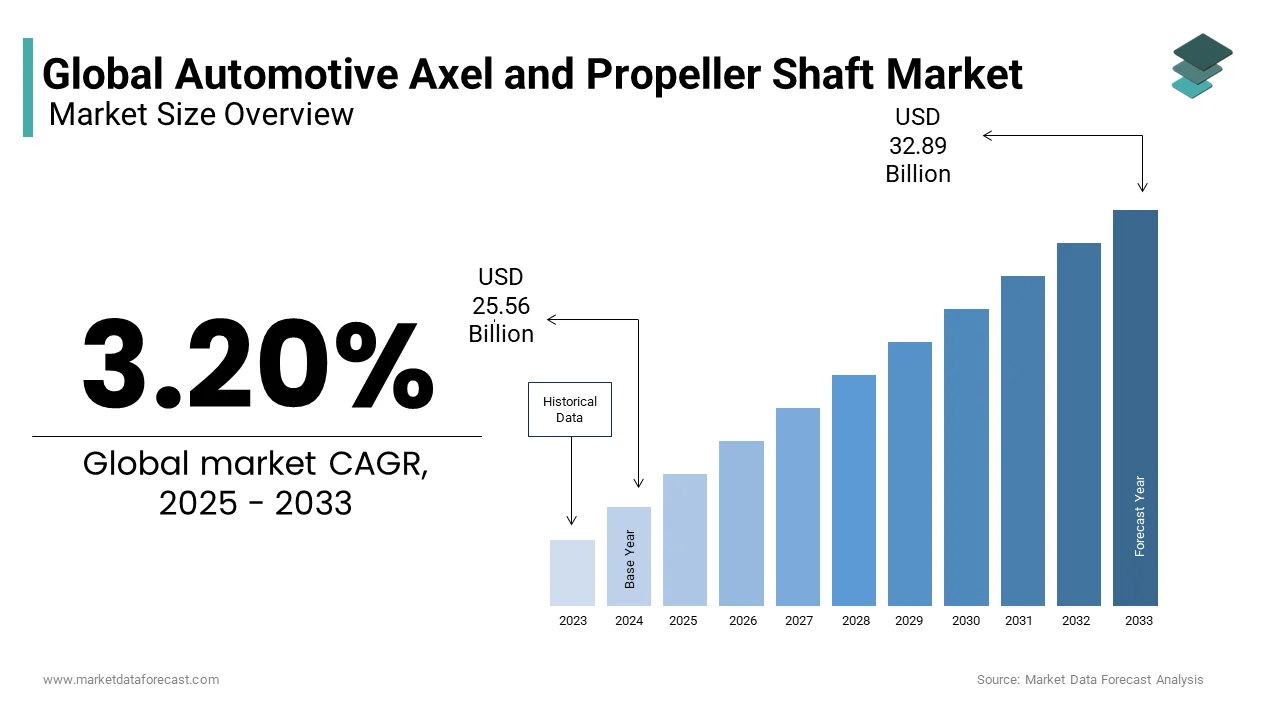
The global automotive axle and propeller shaft market was valued at USD 24.77 billion in 2024 and is anticipated to reach USD 25.56 billion in 2025 from USD 32.89 billion by 2033, growing at a CAGR of 3.20% during the forecast period 2025 to 2033.
MARKET DRIVERS
Growing Vehicle Fleet Drives Automotive Axle and Propeller Shaft Market
The automotive axle and propeller shaft a foundational mechanical subsystems enabling torque transmission and wheel articulation across passenger, commercial, and specialty vehicles. Axles bear vehicular weight while facilitating rotation, whereas propeller shafts relay engine torque from transmission to differential in rear- and all-wheel-drive architectures. According to the U.S. Department of Energy, over 250 million light-duty vehicles operated on American roads in 2023, each requiring at least one axle assembly.
Expanding Freight Transport and AWD Adoption Boost the Automotive Axle and Propeller Shaft Market
The persistent global expansion of commercial freight logistics is directly escalating the growth of the automotive axle and propeller shaft market. According to the International Road Transport Union, global road freight tonnage surpassed 12.5 billion metric tons in 2022, with Asia-Pacific accounting for over 58% of this volume. As per the European Automobile Manufacturers’ Association, Class 8 truck registrations in Europe grew by 7.2% year-over-year in 2023, which directly correlates to increased procurement of reinforced rear axles and multi-piece propeller shafts. The rising penetration of all-wheel-drive and performance-oriented passenger vehicles inherently requires more complex driveline architectures.
MARKET RESTRAINTS
Rise of FWD and EV Architectures Challenges Growth of the Automotive Axle and Propeller Shaft Market
The shift toward front-wheel-drive and single-motor electric vehicle architectures, which inherently eliminate the need for traditional propeller shafts and simplify rear axle requirements, is impelling the growth of the automotive axle and propeller shaft market. According to the International Energy Agency, 75% of battery-electric passenger vehicles sold globally in 2023 utilized front-wheel-drive layouts, predominantly in entry- and mid-tier segments from manufacturers like Tesla Model 3 Rear-Wheel Drive excluded, BYD, and Volkswagen ID.3. Furthermore, as per China’s Ministry of Industry and Information Technology, over 80% of domestically produced EVs under USD 30,000 utilize simplified transaxle systems without propeller shafts. This structural reduction in mechanical content directly constrains addressable market volume for traditional driveline suppliers.
Lightweighting Pressures Limit the Automotive Axle and Propeller Shaft Market
The intensifying lightweighting mandates and material substitution trends, which pressure manufacturers to reduce component mass that often at the cost of traditional forged steel driveline systems, which is hampering the growth of the automotive axle and propeller shaft market. However, as per the American Iron and Steel Institute, high-strength steel still constitutes 54% of automotive structural content due to cost and fatigue resistance.
MARKET OPPORTUNITIES
Rising Driveline Remanufacturing Boosts Automotive Axle and Propeller Shaft Market
The retrofit and remanufacturing aftermarket for commercial vehicle drivelines, which is driven by fleet operators seeking lifecycle cost optimization, is significantly propelling the growth of the automotive axle and propeller shaft market. The Commercial Vehicle Remanufacturers Association states that remanufactured driveline components offer cost savings of 40–60% versus new OEM parts, with a 92% functional equivalence rate verified by SAE International testing protocols. Furthermore, as per the European Remanufacturing Council, the EU’s commercial vehicle reman market grew 8.9% annually between 2020 and 2023, driven by sustainability mandates under the Circular Economy Action Plan.
Torque-Vectoring Tech Fuels Automotive Axle and Propeller Shaft Market
The integration of torque-vectoring and active driveline systems in premium and performance electric vehicles, which require electronically controlled multi-axle architectures, is also prompting the growth of the automotive axle and propeller shaft market. This evolution transforms axles from passive structural elements into high-value mechatronic subsystems, opening premium pricing tiers and technology licensing avenues for specialized suppliers capable of integrating sensors, clutches, and control algorithms.
MARKET CHALLENGES
Low Scale and Fragmented Supply Base Challenge Automotive Axle and Propeller Shaft Market Growth
The declining economies of scale and standardization are certain to pose a challenge for the growth of the automotive axle and propeller shaft market. According to the United Nations Industrial Development Organization, over 60% of global driveline component suppliers operate with annual revenues below USD 50 million, primarily serving regional OEMs or aftermarket channels. The Fraunhofer Institute for Production Systems confirms that small and mid-tier suppliers in India, Turkey, and Southeast Asia account for 44% of global axle forging capacity but lack investment in automation, resulting in 18–22% higher unit labor costs compared to integrated Tier-1 plants. Furthermore, as per the International Trade Administration, tariff and non-tariff barriers across NAFTA, EU, and ASEAN regions add 7–12% to cross-border driveline component logistics, discouraging consolidation.
Legacy Driveline Designs Hinder the Growth of the Automotive Axle and Propeller Shaft Market in the EV Era
The engineering incompatibility between legacy driveline architectures and next-generation electric drivetrains, requiring fundamental redesign rather than incremental adaptation, is an additional factor impeding the growth of the automotive axle and propeller shaft market. According to the Massachusetts Institute of Technology’s Mobility Systems Lab, 73% of existing propeller shaft designs cannot be retrofitted into skateboard-platform EVs due to packaging conflicts with underfloor battery modules. Furthermore, as per Japan’s National Institute of Advanced Industrial Science and Technology, only 19% of surveyed driveline suppliers had completed full digital twin simulations for EV-specific axle loads by 2023.
REPORT COVERAGE
| REPORT METRIC | DETAILS |
| Market Size Available | 2024 to 2033 |
| Base Year | 2024 |
| Forecast Period | 2025 to 2033 |
| CAGR | 3.20% |
| Segments Covered | By Component, Material, Vehicle Type, Sales Channel, and Region. |
| Various Analyses Covered | Global, Regional & Country Level Analysis, Segment-Level Analysis, DROC, PESTLE Analysis, Porter’s Five Forces Analysis, Competitive Landscape, Analyst Overview of Investment Opportunities |
| Regions Covered | North America, Europe, APAC, Latin America, Middle East & Africa |
| Market Leaders Profiled | Meritor, Inc., ZF Friedrichshafen AG, IFA Rotorion - Holding GmbH, American Axle & Manufacturing Holdings, Inc., Gestamp, Dana Incorporated, GKN PLC, Jtekt Corporation, RSB Group, Showa Corporation, Hyundai Wia Corporation, and Others. |
SEGMENTAL ANALYSIS
By Type Insights
The axle type segment dominated the global automotive axle and propeller shaft market in 2024. The growth of the segment is likely to grow with the structurally embedded every wheeled vehicle, regardless of propulsion system, that requires at least one axle assembly to transfer torque and support load, whereas propeller shafts are absent in front-wheel-drive and many single-motor electric vehicles. As per the U.S. Department of Transportation’s National Highway Traffic Safety Administration, 94% of all registered vehicles in America possess live or dead axle configurations, reinforcing the segment’s ubiquity.
The propeller shaft type segment is likely to grow with an anticipated CAGR of 6.8% during the forecast period, with the broader electrification trend, and is propelled by the rising penetration of performance-oriented and dual-motor electric vehicles, which reintroduce propeller shaft architectures to enable torque vectoring and all-wheel-drive functionality. Additionally, according to Porsche AG’s technical disclosures, their Taycan and Macan EV platforms retain carbon-fiber-reinforced propeller shafts to distribute torque between front and rear e-axles with a design replicated by Audi e-tron S and Mercedes-AMG EQE SUV.
By Vehicle Insights
The passenger cars segment was the largest and held 59.3% of the global automotive axle and propeller shaft market share in 2024. The U.S. Bureau of Economic Analysis confirms that passenger vehicles accounted for 76% of total light vehicle sales in North America during 2023, with similar penetration in Europe and Asia. Moreover, the Japan Automobile Dealers Association reports that 91% of domestically sold passenger cars in 2023 included independent rear suspension systems, which still necessitate semi-floating or full-floating axle shafts despite the absence of a live rear axle.
The commercial vehicles segment is projected to expand at a CAGR of 7.4% from 2025 to 2033 with the global surge in e-commerce logistics and infrastructure development, which necessitate heavier, more durable driveline systems. Similarly, the European Automobile Manufacturers’ Association reports that Class 8 truck registrations in the EU rose by 9.1% in 2023, with manufacturers like Daimler Trucks and Volvo specifying reinforced tandem rear axles and multi-piece propeller shafts for durability.
REGIONAL ANALYSIS
Asia Pacific Market Analysis
Asia Pacific was the top performer in the global automotive axle and propeller shaft market by accounting for 44.3% of the share in 202,4, with China’s colossal manufacturing base and India’s accelerating commercial vehicle expansion. India’s Society of Indian Automobile Manufacturers confirms that domestic commercial vehicle production grew by 19% in 2023.
Europe Market Analysis
Europe was positioned second by capturing 26.3% of the automotive axle and propeller shaft market share in 2024. Poland’s Central Statistical Office reports that automotive component exports from the country grew by 11% in 2023, with axle forging facilities supplying 22% of Volkswagen Group’s European axle demand. Sweden’s National Board of Trade states that Volvo Trucks and Scania’s global heavy-duty truck sales increased by 8.7% in 2023, driving regional demand for tandem-drive axles rated for 13-ton payloads.
North America Market Analysis
North America automotive axle and propeller shaft market growth is likely to grow with prominent opportunities during the forecast period. According to the U.S. Department of Energy’s Vehicle Technologies Office, 71% of new trucks sold in America in 2023 specified high-torque drivelines for towing and payload applications, increasing average axle content value by 28% compared to 2020.
Latin America Market Analysis
Latin America's automotive axle and propeller shaft market growth is propelled by Brazil’s commercial vehicle resurgence and Argentina’s localized component manufacturing initiatives. Argentina’s National Institute of Industrial Technology confirms that local content mandates under Mercosur regulations compelled OEMs to source 65% of driveline components domestically in 2023, which is stimulating investment in axle forging and heat-treatment facilities.
Middle East and Africa Market Analysis
The Middle East and Africa automotive axle and propeller shaft market is likely to grow throughout the forecast period. South Africa’s National Association of Automotive Component and Allied Manufacturers states that local axle production grew by 13% in 2023, driven by Ford and Toyota’s regional SUV assembly operations requiring all-wheel-drive systems.
COMPETITIVE LANDSCAPE
The automotive axle and propeller shaft market features intense competition among established engineering conglomerates and agile regional forgers. Incumbents leverage decades of OEM relationships and proprietary metallurgical expertise, while challengers compete on cost and regional responsiveness. Differentiation hinges on adapting legacy architectures for EV torque profiles and integrating mechatronic controls. Collaboration, not confrontation, increasingly defines the landscape with joint ventures on e-axle software and material science.
KEY MARKET PLAYERS
A few of the market players in the global automotive axle & propeller shaft market
- Meritor, Inc.
- ZF Friedrichshafen AG
- IFA Rotorion - Holding GmbH
- American Axle & Manufacturing Holdings, Inc
- Gestamp
- Dana Incorporated
- GKN PLC
- Jtekt Corporation
- RSB Group
- Showa Corporation
- Hyundai Wia Corporation
Top Players In The Market
- GKN Automotive operates as a global engineering leader in driveline systems, supplying axles and propeller shafts to premium OEMs, including BMW, Audi, and Rivian. The company has intensified R&D in torque-vectoring e-axles for EV platforms, launching its third-generation eDrive system in 2023. It expanded production footprints in Poland and China to serve localized EV supply chains. GKN partnered with Nidec to co-develop integrated e-axle modules, enhancing power density while reducing weight. Its focus on electrification-compatible drivelines and lightweight hollow shaft technology positions it at the forefront of next-generation mobility solutions without compromising mechanical robustness.
- American Axle & Manufacturing delivers high-strength axle and propeller shaft systems primarily for trucks, SUVs, and commercial vehicles. It reinforced its position by securing multi-year contracts with GM, Ram, and Ford for next-gen electric truck platforms like the Silverado EV and Ram REV. In 2023, AAM inaugurated a dedicated e-Propshaft development center in Michigan, focusing on carbon-fiber hybrid shafts. It also acquired a controlling stake in a Mexican forging specialist to vertically integrate raw material processing. AAM’s strategy hinges on durability for heavy-duty applications while adapting architectures for electrified torque delivery.
- Dana Incorporated engineers driveline solutions across axle assemblies, propeller shafts, and e-propulsion systems for global OEMs and aftermarket channels. It launched Spicer Electrified™ e-Axles in 2023, targeting medium-duty EVs and off-highway applications. Dana acquired the axles division of Oerlikon Group to bolster European manufacturing capacity and IP in hypoid gear systems. It established joint ventures in India and Brazil to localize production for emerging markets.
RECENT MARKET NEWS
- Several hundred new railcars are being furnished with the inventive lightweight ZF gearbox: E-Rail SH 11 F-N. On account of its aluminum construction, it is 15 percent lighter than the items that are currently available on the North American market. Volume manufacturing of the item, custom-fitted to satisfy the nearby requirements, is done in the US.
- MarineShaft provides services for marine propeller shafts, including straightening. Even the most extreme twists can be set. Regularly, similar straightness as another shaft can be accomplished, and regardless of where on the planet the propeller/rudder harm happens, a fixing is frequently the most beneficial solution.
- The Propeller shaft introduced by Jtekt corporation offers a three-partition structure, and slide-type steady speed widespread joints are perceived to enhance serenity.
- The Bosch eAxle is an across-the-board electrical powertrain. Its parts — electric engine, powerful hardware, and transmission — are joined in a single conservative framework. That lessens the number of components, saves space, and makes the powertrain unit less mind-boggling — all of which improves efficiency and cuts expense.
MARKET SEGMENTATION
This research report on the global automotive axle and propeller shaft market is segmented and sub-segmented into the following categories.
By Component
- Axle Type
- Live Axle
- Dead Axle
- Tandem Axle
- Axle Position
- Front Axle
- Rear Axle
- Propeller Shaft Type
- Single Piece
- Multi-Piece
- Slip-in Tube
By Material
- Steel
- Aluminum
- Carbon Fiber
By Vehicle Type
- Two-Wheelers
- Passenger Cars
- Light Commercial Vehicles (LCVs)
- Heavy Commercial Vehicles (HCVs)
By Sales Channel
- Original Equipment Manufacturer (OEM)
- Aftermarket
By Region
- North America
- Europe
- Asia Pacific
- Latin America
- Middle East and Africa
Frequently Asked Questions
What role do axles and propeller shafts play in vehicles?
Axles support vehicle weight and transfer torque to wheels, while propeller (drive) shafts transmit power from the transmission to the differential—both are critical for drivetrain efficiency, safety, and performance across all vehicle types.
Which vehicle segments drive the highest demand?
Light-duty vehicles (passenger cars and SUVs) dominate volume-wise, but heavy-duty trucks and commercial vehicles generate significant value due to larger, more complex axle and shaft systems.
How is electrification reshaping this market?
EVs often use simplified, integrated e-axles that combine motor, gearbox, and axle—reducing the need for traditional propeller shafts but creating new demand for high-efficiency, compact axle systems.
What materials are trending in axle and shaft manufacturing?
High-strength steel remains standard, but lightweight alloys and composite materials are gaining ground to improve fuel efficiency and reduce emissions—especially in premium and electric vehicles.
Which regions lead global production and consumption?
Asia-Pacific (led by China, Japan, and India) accounts for the largest share due to high vehicle output, while Europe and North America show strong demand for advanced, durable components in premium and commercial segments.
Who are the top global suppliers?
Key players include Dana Incorporated, GKN Automotive (now part of Spectris), American Axle & Manufacturing (AAM), ZF Friedrichshafen, and Hyundai WIA—known for innovation in e-drivetrains, lightweighting, and modular axle systems.
How is ADAS and autonomous driving influencing design?
Advanced driver-assistance systems require precise torque vectoring and responsive drivetrains, pushing axle manufacturers toward smarter, electronically controlled systems with integrated sensors.
Are supply chain issues still a concern?
While post-pandemic disruptions have eased, volatility in steel prices and logistics costs—alongside regional trade policies—continue to challenge just-in-time manufacturing models.
What’s the impact of vehicle safety and durability standards?
Stricter global crash and durability norms are driving demand for stronger, fatigue-resistant axle and shaft designs, particularly in emerging markets upgrading their automotive safety regulations.
What’s the market outlook for 2025–2030?
The market will grow moderately, with e-axles and lightweight drivetrain components leading innovation—balancing the decline in traditional propeller shafts with rising EV adoption and commercial vehicle modernization worldwide.
Related Reports
Access the study in MULTIPLE FORMATS
Purchase options starting from
$ 2500
Didn’t find what you’re looking for?
TALK TO OUR ANALYST TEAM
Need something within your budget?
NO WORRIES! WE GOT YOU COVERED!
Call us on: +1 888 702 9696 (U.S Toll Free)
Write to us: sales@marketdataforecast.com