- Product Description Description
- Table of Contents TOC
- List of Table & Figure LOT
- Get Free Sample PDF Sample PDF
Market Size, 2025
$12.51 BnMarket Estimate, 2026
$13.22 BnMarket Forecast, 2034
$20.60 BnCAGR, 2026–2034
5.70%Global Balance Shaft Market Size
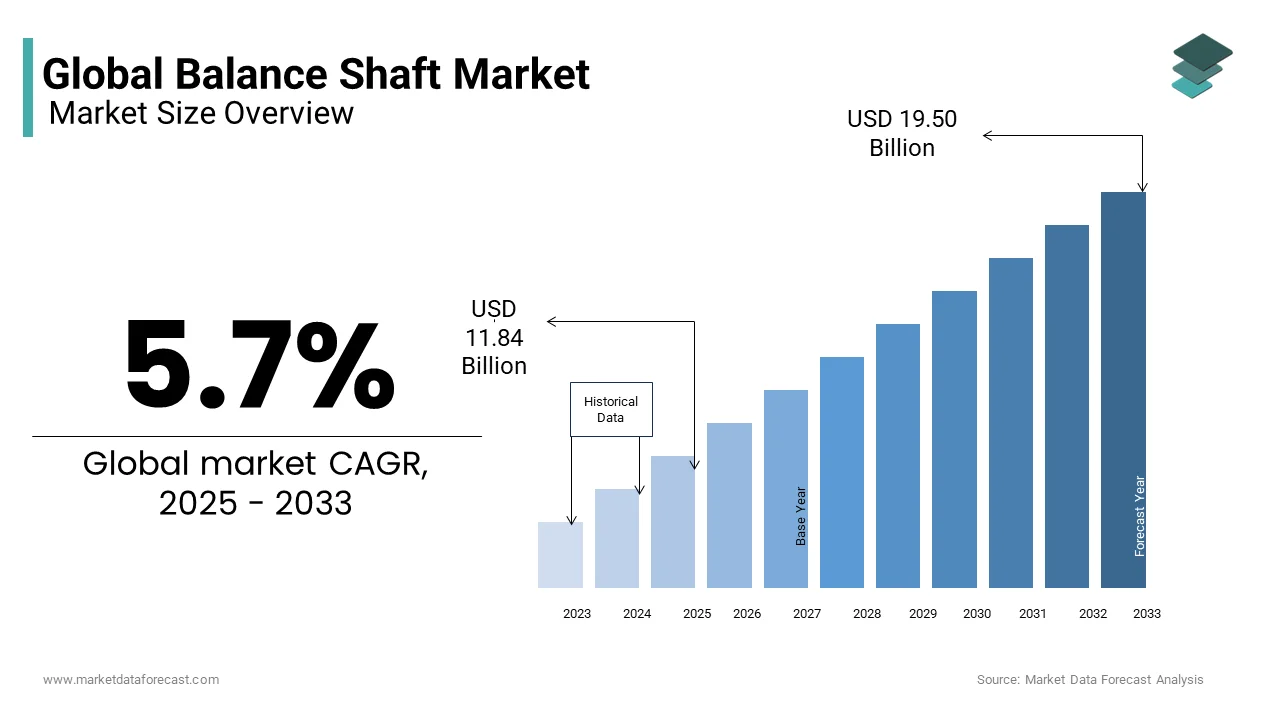
The global balance shaft market size was valued at USD 12.51 billion in 2025 and is anticipated to reach a valuation of USD 13.22 billion in 2026 and USD 20.60 billion by 2034, growing at a CAGR of 5.7% from 2026 to 2034.
Balance Shaft is a critical mechanical component used in internal combustion engines and industrial machinery to reduce vibrations caused by reciprocating motion. Typically found in inline-four, V6, and other asymmetrical engine configurations, balance shafts help enhance engine smoothness, durability, and performance. These rotating assemblies are engineered with precision counterweights that offset secondary forces generated during engine operation.
With increasing demand for high-performance, fuel-efficient, and quieter engines across automotive and industrial applications, the role of balance shafts has become more prominent. Like, advancements in engine design have led to higher rotational speeds and compact engine structures, which in turn amplify vibration challenges, making balance shaft integration essential.
In industrial sectors such as power generation, marine propulsion, and construction equipment, balance shaft technology is also being leveraged to improve machinery longevity and operational efficiency.
MARKET DRIVERS
Rising Demand for High-Performance and Smooth-Running Engines
The growing demand for high-performance and smoother-running engines across passenger vehicles, commercial transport, and industrial applications is one of the primary drivers of the Balance Shaft Market. Like, automakers are increasingly adopting compact, high-speed engines to meet fuel efficiency targets and emissions regulations. However, these smaller engines often generate higher levels of secondary vibrations, necessitating the use of balance shafts to maintain ride comfort and mechanical integrity.
According to the Society of Automotive Engineers (SAE), inline-four cylinder engines—which are widely used in modern compact and mid-size cars—are particularly prone to second-order vibrations due to their uneven firing intervals. The integration of balance shaft systems helps mitigate these disturbances, enhancing driver experience and prolonging engine life.
Apart from these, luxury and sports car manufacturers are leveraging advanced balance shaft technologies to ensure superior NVH (Noise, Vibration, and Harshness) characteristics.
Expansion of Industrial Machinery and Power Equipment Markets
The expansion of industrial machinery and power equipment markets, particularly in emerging economies, is another key driver influencing the Balance Shaft Market. According to the United Nations Industrial Development Organization (UNIDO), the global industrial equipment sector has experienced steady growth, driven by investments in infrastructure, energy, and manufacturing.
Balance shafts are increasingly being adopted in diesel generators, marine engines, and heavy-duty construction machinery to enhance mechanical stability and reduce wear and tear. As per the American Society of Mechanical Engineers (ASME), large-scale diesel engines used in off-road equipment and marine propulsion systems benefit significantly from balance shaft integration, especially when operating at high RPMs or under variable load conditions.
In developing countries such as India and Brazil, where rural electrification and construction activities are expanding, the demand for reliable and durable power generation units has surged. This has led to increased implementation of balance shaft-equipped engines in generator sets and agricultural machinery.
MARKET RESTRAINTS
Complexity and Cost of Integration in Engine Design
The complexity and cost associated with integrating balance shaft systems into engine designs a major restraints affecting the Balance Shaft Market. Unlike conventional balancing methods, incorporating a balance shaft requires additional space, specialized bearings, and precise synchronization with crankshaft movement, making it a technically demanding process.
According to the Society of Automotive Engineers (SAE), adding a balance shaft can increase overall engine weight and mechanical complexity, potentially affecting fuel efficiency and maintenance requirements. Besides, as per the International Journal of Engine Research, the manufacturing tolerances required for balance shaft components are extremely tight, leading to higher production costs.
This financial burden is particularly significant for small and medium-sized automakers and industrial equipment manufacturers who may lack the resources to invest in advanced engine balancing solutions.
Shift Toward Electric Vehicles and Alternative Propulsion Systems
The ongoing shift toward electric vehicles and alternative propulsion systems is another key challenge limiting the growth of the Balance Shaft Market. According to the International Energy Agency (IEA), global electric vehicle sales surpassed 14 million units in 2023, representing a significant transition away from internal combustion engines.
Since electric motors do not produce the same type of vibrational imbalances as traditional piston-driven engines, the need for balance shafts diminishes in EV architectures. In addition, major automotive manufacturers are accelerating their electrification roadmaps, with many pledging to phase out internal combustion engine production by 2035 or earlier.
This trend is particularly evident in Europe and North America, where stringent emissions regulations and government incentives are driving rapid EV adoption. Even in Asia, where internal combustion engines remain dominant in certain segments, automakers are increasingly allocating R&D budgets toward battery-powered alternatives.
MARKET OPPORTUNITY
Advancements in Hybrid Powertrain Technologies
The development and proliferation of hybrid powertrain technologies, which combine internal combustion engines with electric motor systems, is an emerging opportunity in the Balance Shaft Market. Unlike fully electric vehicles, hybrids still utilize combustion engines for range extension and peak performance, making them subject to similar vibrational imbalances. Also, many hybrid models employ downsized, high-efficiency engines that operate at elevated RPMs, increasing the likelihood of secondary vibrations.
To address this, automakers are exploring enhanced balance shaft solutions tailored for hybrid engine layouts. Companies like Bosch and Mahle have already introduced modular balance shaft systems designed to integrate seamlessly into hybrid powertrains while minimizing added weight and complexity.
Growing Demand for Premium and Luxury Vehicle Segments
The rising demand for premium and luxury vehicle segments, where ride comfort and refinement are paramount, is another significant opportunity in the Balance Shaft Market. According to McKinsey & Company, the global luxury automotive business expanded in 2023, driven by increasing disposable incomes in emerging economies and sustained demand in developed regions.
These high-end vehicles often feature high-performance inline-four, V6, and flat-six engines that require balance shaft integration to deliver the expected level of smoothness and quietness. As per J.D. Power, customer satisfaction scores for noise and vibration performance have become a key differentiator in premium brand rankings, reinforcing the importance of balance shaft systems.
Manufacturers such as BMW, Porsche, and Lexus continue to refine their engine NVH profiles using advanced balance shaft technologies, including variable-phase and dual-shaft configurations.
MARKET CHALLENGES
Supply Chain Disruptions and Component Shortages
The ongoing disruptions in global supply chains and shortages of critical components such as precision bearings, specialty steels, and machining tools are a pressing challenge facing the Balance Shaft Market. According to the World Trade Organization (WTO), global freight rates remained volatile in 2023, impacting the timely delivery of raw materials and finished parts to manufacturers.
Semiconductor shortages, although primarily linked to electronics, have also affected the production of electronically controlled engine management systems that work in conjunction with balance shaft mechanisms.
In regions such as Latin America and Africa, import dependencies exacerbate these issues. Currency fluctuations and customs delays further complicate procurement.
Regulatory and Environmental Compliance Pressures
The increasing pressure to comply with evolving regulatory and environmental standards is another critical challenge confronting the Balance Shaft Market. Governments worldwide are implementing stricter emissions norms, safety regulations, and sustainability mandates that impact the design, manufacturing, and usage of engine components, including balance shafts.
In addition, off-road machinery—including industrial and marine engines—is now subject to Tier IV emission standards in many developed regions, requiring manufacturers to incorporate cleaner and more energy-efficient technologies. These compliance measures often result in higher production costs, which are eventually passed on to consumers.
In developing countries, regulatory frameworks are becoming more stringent as part of climate action commitments under the Paris Agreement. According to the United Nations Environment Programme (UNEP), several African and Asian nations have begun enforcing eco-labeling and energy efficiency certifications for farm and industrial machinery, influencing purchasing decisions and market dynamics.
While these regulations promote environmental sustainability, they also pose challenges for smaller manufacturers and end-users with limited budgets.
REPORT COVERAGE
| REPORT METRIC | DETAILS |
| Market Size Available | 2024 to 2033 |
| Base Year | 2025 |
| Forecast Period | 2025 to 2033 |
| CAGR | 5.7% |
| Segments Covered | By Vehicle Type, Engine Type, Manufacturing Process, and Region. |
| Various Analyses Covered | Global, Regional, and Country-Level Analysis, Segment-Level Analysis, DROC, PESTLE Analysis, Porter’s Five Forces Analysis, Competitive Landscape, Analyst Overview of Investment Opportunities |
| Regions Covered | North America, Europe, APAC, Latin America, Middle East & Africa |
| Market Leaders Profiled | SKF Group (U.S.), SHW Ag (Germany), Musashi Seimitsu Industry Co., Ltd (Japan), OTICS Co. (Japan), Metaldyne (U.S.), and Others. |
SEGMENTAL ANALYSIS
By Vehicle Insights
Passenger Cars
The passenger car segment led the global Balance Shaft Market by accounting for 54.5% of total demand in 2024. The widespread use of inline-four and V6 engines in sedans, hatchbacks, SUVs, and luxury vehicles, all of which benefit significantly from balance shaft integration to enhance ride comfort and reduce engine vibrations, is primarily driving the dominance of the passenger car segment.
According to the International Organization of Motor Vehicle Manufacturers (OICA), over 58 million passenger cars were produced globally in 2023, with Asia-Pacific contributing nearly half of this output. Inline-four cylinder engines, which are commonly used in compact and mid-size vehicles due to their fuel efficiency and cost-effectiveness, are particularly prone to secondary vibrations that necessitate balance shaft systems.
Moreover, luxury automakers such as BMW, Lexus, and Audi continue to integrate advanced dual-shaft configurations in high-performance models to maintain superior NVH (Noise, Vibration, and Harshness) characteristics. As per J.D. Power, customer satisfaction scores increasingly factor in ride smoothness, reinforcing the importance of balance shaft technology in modern vehicle design.
Light Commercial Vehicles
The light commercial vehicle (LCV) segment is emerging as the fastest-growing within the Balance Shaft Market and is expanding at a CAGR of 6.9% through 2033. Increasing urbanization, e-commerce expansion, and last-mile delivery demands across both developed and emerging economies are fuelling the growth of the light commercial vehicle (LCV) segment.
According to the European Automobile Manufacturers’ Association (ACEA), LCV registrations in Europe reached record levels in 2023, reflecting strong business investment in logistics and transport fleets. Similar trends were observed in China and India, where government-backed infrastructure development and small business growth have spurred demand for vans, pickups, and mini-trucks equipped with more refined diesel and turbocharged petrol engines.
These engines often operate under variable load conditions and higher RPM ranges, making them more susceptible to vibrational imbalances. Also, fleet operators are increasingly prioritizing driver comfort and durability, prompting manufacturers to incorporate balance shaft systems in next-generation LCV powertrains.
By Engine Insights
Inline-4 Cylinder Engines
The Inline-four cylinder engines segment commanded the Balance Shaft Market by capturing 48.5% of total demand in 2024. The engine’s widespread use in passenger cars, light commercial vehicles, and industrial machinery, due to its compact design, fuel efficiency, and cost-effectiveness, is largely propelling the leading position of the Inline-four cylinder engines segment.
As per the Society of Automotive Engineers (SAE), inline-four engines generate significant secondary vibrations due to uneven firing intervals, especially when operating at high RPMs. To counteract these disturbances, balance shafts are frequently integrated into engine designs to ensure smoother operation and improved longevity.
According to the International Council on Clean Transportation (ICCT), inline-four engines accounted for over 60% of global gasoline-powered passenger vehicle production in 2023, particularly in Asia-Pacific and North America. Automakers like Toyota, Honda, and Volkswagen continue to refine this configuration with turbocharging and hybridization, further amplifying the need for precision-engineered balance shaft solutions.
Moreover, advancements in modular engine platforms—such as Ford’s EcoBoost and BMW’s B-series—have reinforced the reliance on balance shaft systems to maintain performance standards while reducing engine displacement.
V-6 Cylinder Engines
The V-6 cylinder engine segment is the fastest-growing within the Balance Shaft Market, expanding at a CAGR of 6.1% through 2033. While traditionally associated with smooth-running characteristics, certain V-6 configurations—particularly those with uneven bank angles—experience inherent vibrational imbalances that require balance shaft intervention for optimal refinement.
Also, V-6 engines remain a popular choice among consumers seeking a balance between fuel efficiency and performance, particularly in SUVs, pickup trucks, and luxury sedans.
Automotive manufacturers such as Mercedes-Benz, General Motors, and Nissan have also introduced enhanced V-6 variants featuring downsized turbocharged units, which can exacerbate vibration issues without proper balancing mechanisms.
Furthermore, the marine and industrial sectors are adopting V-6 diesel engines for auxiliary power units and generator sets, further boosting demand for specialized balance shaft solutions.
By Manufacturing Process Insights
Forged Balance Shafts
The forged balance shafts segment led the market by capturing 57.6% of total demand in 2024. The preference for forged components is driven by their superior strength, fatigue resistance, and dimensional stability, making them ideal for high-load and high-speed engine applications.
According to the American Society of Mechanical Engineers (ASME), forging enhances the mechanical properties of steel components by aligning the grain structure during the forming process, resulting in increased durability and reduced susceptibility to failure under dynamic loads.
In the automotive sector, premium and high-performance vehicles—especially those with turbocharged inline-four and V-6 engines—rely heavily on forged balance shafts to withstand elevated operational stresses while maintaining ride smoothness.
Moreover, industrial and marine engine manufacturers favor forged balance shafts for their ability to endure prolonged exposure to extreme temperatures and rotational forces. Companies like Cummins, Caterpillar, and MAN Energy Solutions continue to specify forged components in large-scale diesel generators and propulsion systems.
Cast Balance Shafts
The cast balance shafts segment is the fastest-growing segment in the market and is projected to expand at a CAGR of 5.8% through 2033. The increasing demand for cost-effective and lightweight alternatives in mass-produced vehicles and entry-level industrial machinery is primarily driving the growth of the cast balance shafts segment.
According to the World Foundry Organization (WFO), casting allows for complex geometries to be achieved with minimal machining, reducing material waste and overall production costs. These advantages make cast balance shafts particularly attractive to budget-conscious automakers and industrial equipment manufacturers.
In developing markets such as India, Brazil, and Southeast Asia, where affordability plays a crucial role in purchasing decisions, local OEMs are increasingly adopting cast balance shafts in economy cars, two-wheelers, and agricultural machinery.
Further, advancements in ductile iron and alloy casting technologies have improved the mechanical properties of cast balance shafts, narrowing the performance gap with forged counterparts.
REGIONAL ANALYSIS
Asia-Pacific
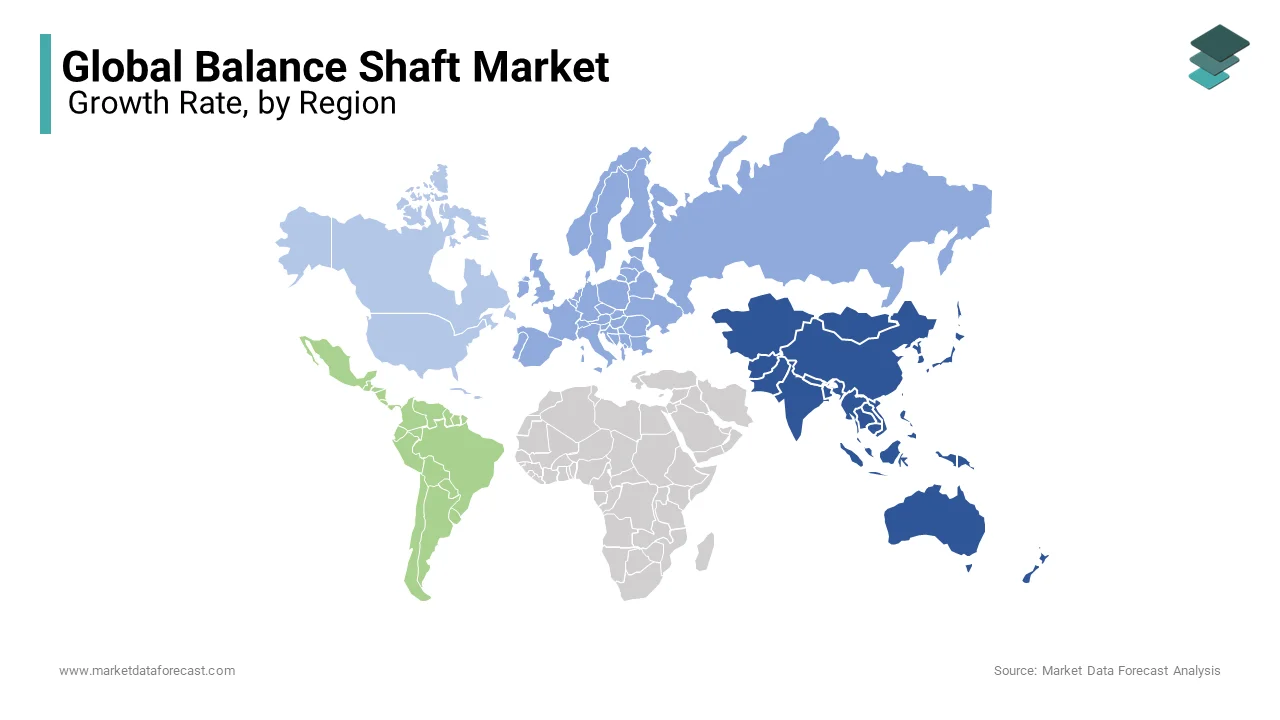
Asia-Pacific led the global Balance Shaft Market by commanding an estimated 42.6% of total demand. The region's dominance is driven by its vast automotive manufacturing base, rapid industrialization, and growing adoption of refined engine technologies in countries like China, Japan, and India.
China remains the epicenter of automotive production in the region, with over 27 million passenger vehicles manufactured in 2023 alone, as per the China Association of Automobile Manufacturers (CAAM). Domestic brands such as Geely, BYD, and Great Wall Motors are increasingly integrating balance shaft systems into inline-four and hybrid powertrains to meet rising consumer expectations for ride comfort.
Japan continues to lead in high-precision balance shaft manufacturing, supplying critical components to global automakers.
India, too, has emerged as a key player, with Maruti Suzuki and Tata Motors incorporating balance shafts into turbocharged engines designed for domestic and export markets. As per the Automotive Component Manufacturers Association of India (ACMA), component exports grew in 2023, highlighting the region’s expanding influence in the balance shaft supply chain.
Europe
Europe is a key player in the global Balance Shaft Market. The region’s strong presence in premium automotive manufacturing, stringent noise and vibration regulations, and advanced industrial engineering contribute to its leading position.
Germany serves as the epicenter of balance shaft innovation, home to major automotive suppliers such as Bosch, Mahle, and Schaeffler, who provide high-precision components to global OEMs.
France and Italy also contribute significantly, particularly in the production of high-performance inline-four and V-6 engines used in sports and luxury vehicles. As per the European Automobile Manufacturers’ Association (ACEA), European automakers invested over EUR 25 billion in R&D in 2023, with a focus on enhancing engine refinement and compliance with upcoming Euro 7 emission standards.
Apart from these, the marine and industrial sectors in Sweden, Finland, and the Netherlands rely heavily on balance shaft-integrated diesel engines for marine propulsion and power generation.
North America
North America accounts for a significant portion of the global Balance Shaft Market, distinguished by its early adoption of high-tech engine balancing solutions and robust presence in heavy-duty commercial vehicle manufacturing. The United States leads the regional market, followed by Canada and Mexico.
Major players such as Ford, General Motors, and Stellantis continue to integrate balance shafts in V-6 and inline-six engines used in pickups, SUVs, and luxury sedans.
The North American industrial sector, particularly in energy and construction, also relies on balance shaft-equipped diesel engines for generator sets and off-road equipment.
Latin America
Latin America is characterized by expanding automotive production, industrial growth, and increasing demand for refined engine technologies. Brazil leads the regional market, followed by Mexico and Argentina.
Brazil’s automotive industry saw a resurgence in 2023, with over 2.5 million vehicles produced, as per the Brazilian Association of Automotive Vehicle Manufacturers (ANFAVEA). Domestic automakers such as Fiat Chrysler and Renault have been integrating balance shaft systems in locally assembled models to improve ride quality and meet evolving consumer expectations.
Mexico, too, plays a strategic role as a manufacturing hub for global automakers including Nissan, Volkswagen, and General Motors. As per the Mexican Automotive Industry Association (AMIA), Mexico exported over 2.9 million vehicles in 2023, many of which featured inline-four and V-6 engines requiring balance shaft integration.
Argentina is witnessing the gradual adoption of balance shaft technology in agricultural and industrial machinery, driven by government-backed mechanization programs.
Middle East and Africa
The Middle East and Africa are marked by a mix of industrial expansion, mining activities, and limited but growing automotive production. The region’s demand is primarily driven by the need for reliable and durable engine components in harsh environmental conditions.
In the Gulf Cooperation Council (GCC) countries, industrial and marine applications dominate balance shaft usage, particularly in generator sets, oil and gas equipment, and maritime propulsion systems. As per the Saudi Arabian Ministry of Industry, there is an increase in engine component imports in 2023, supporting the region’s energy and infrastructure projects.
South Africa represents the primary automotive manufacturing center in Africa, producing over 600,000 vehicles in 202,3, according to the National Association of Automobile Manufacturers of South Africa (NAAMSA). Local assembly plants for Toyota, Ford, and BMW incorporate balance shafts in select engine models to meet international quality benchmarks.
KEY MARKET PLAYERS
The automotive balance shaft market is dominated by a few global players and several regional players. Key players include SKF Group (U.S), SHW Ag (Germany), Musashi Seimitsu Industry Co., Ltd (Japan), OTICS Co. (Japan), and Metaldyne (U.S.).
Top Players In The Market
Several global companies play a pivotal role in shaping the Balance Shaft Market through innovation, precision engineering, and strong supply chain integration. Among them, three key players stand out due to their technological expertise, extensive product portfolios, and strategic market presence.
Bosch Mahle Turbo Systems, a joint venture between Robert Bosch GmbH and Mahle GmbH, is a leading supplier of balance shaft systems for automotive engines. The company specializes in high-precision components tailored for inline-four, V6, and hybrid powertrains. Their solutions are widely adopted by major automakers aiming to enhance engine smoothness and reduce NVH (Noise, Vibration, and Harshness) characteristics across various vehicle segments.
Schaeffler AG is a prominent name in automotive and industrial motion technologies and plays a significant role in the balance shaft industry. Schaeffler provides engineered bearing and shaft systems that ensure optimal performance in high-speed and heavy-duty engine applications. The company’s focus on modular design and adaptive balancing mechanisms has positioned it as a preferred partner for OEMs seeking advanced vibration control solutions.
Mitsubishi Heavy Industries (MHI) contributes significantly to the balance shaft domain, particularly in marine, industrial, and large diesel engine applications. MHI’s expertise lies in developing robust and durable balance shaft systems for commercial and power generation sectors. With a strong emphasis on reliability and long-term performance, MHI supports critical infrastructure and transportation industries with customized balancing technologies suited for demanding operational environments.
Top Strategies Used By Key Market Participants
Key players in the Balance Shaft Market employ several strategic initiatives to reinforce their competitive position and expand market reach. One of the most prominent strategies is product innovation and customization, where companies continuously develop advanced balance shaft systems tailored for emerging engine architectures such as hybrid, downsized turbocharged, and alternative fuel-powered units.
Another crucial strategy is strategic partnerships and joint ventures with automotive OEMs and Tier 1 suppliers, allowing firms to integrate balance shaft solutions directly into new vehicle development programs and secure long-term contracts.
Lastly, expanding regional manufacturing and service capabilities plays a vital role in strengthening market access. Companies are increasingly investing in localized production facilities and technical centers to support just-in-time delivery, reduce costs, and offer faster customer support across key automotive and industrial hubs.
COMPETITION OVERVIEW
The Balance Shaft Market is highly competitive and technically specialized, featuring a mix of global automotive component giants, niche engineering firms, and regional manufacturers. Competition is driven by continuous advancements in engine dynamics, increasing demand for refined powertrains, and evolving regulatory standards across both the passenger vehicle and industrial machinery sectors. While multinational corporations dominate in terms of technology and scale, smaller engineering specialists are gaining traction by offering tailored solutions for niche applications.
Market participants are increasingly focusing on lightweight materials, modular designs, and real-time vibration management to align with modern propulsion trends. Strategic moves such as mergers, acquisitions, and co-development agreements are common as companies aim to strengthen their R&D pipelines and secure positions in next-generation engine platforms. Besides, the rise of hybrid vehicles and stricter NVH expectations are reshaping how balance shaft systems are designed and integrated.
With varying levels of engine complexity across regions, the market presents both opportunities and challenges, requiring continuous adaptation and investment to sustain leadership in an increasingly dynamic and performance-driven landscape.
RECENT HAPPENINGS IN THE MARKET
- In March 2024, Mahle launched a new line of lightweight aluminum-coated balance shafts designed for high-performance inline-four engines. This initiative aimed at reducing reciprocating mass and improving fuel efficiency while maintaining superior NVH performance for premium automotive applications.
- In February 2024, Robert Bosch GmbH expanded its engine component manufacturing facility in Pune, India, focusing on the localized production of forged balance shafts to support the growing demand from domestic and export-oriented automotive manufacturers.
- In January 2024, Schaeffler introduced a variable-phase balance shaft system tailored for hybrid powertrains, allowing real-time adjustment of vibration suppression based on engine load and speed. The move was part of Schaeffler’s broader strategy to adapt to electrification trends.
- In May 2024, Thyssenkrupp AG announced a joint venture with a Chinese automotive supplier to develop cost-effective cast balance shafts optimized for budget-friendly passenger vehicles targeting emerging markets.
- In June 2024, NSK Ltd unveiled a new range of high-precision bearings specifically engineered for balance shaft applications in commercial vehicles, aiming to enhance durability and reduce maintenance cycles in heavy-use environments.
MARKET SEGMENTATION
This research report on the global balance shaft market is segmented and sub-segmented into the following categories.
By Vehicle Type
- Passenger Car
- Light Commercial Vehicle
- Heavy Commercial Vehicle
By Engine Type
- Inline-3 Cylinder (L3) Engine
- Inline-4- 4 Cylinder (L4) Engine
- Inline-5- 5 Cylinder Engine
- V-6 Engine
By Manufacturing Process
- Forging
- Casting
By Region
- North America
- Europe
- Asia Pacific
- Latin America
- Middle East and Africa