Global Automotive Composites Market Size, Share, Trends, and Growth Analysis Report, Segmented By Application, End-User & Region (North America, Europe, Latin America, Asia Pacific, Middle East & Africa), Industry Forecast From 2026 to 2034
Market Size, 2025
$10.14 BnMarket Estimate, 2026
$11.36 BnMarket Forecast, 2034
$28.23 BnCAGR, 2026–2034
12.05%Executive Summary: Automotive Composites Market
- Market Scope: Comprehensive global automotive composites market analysis covering application segments, material types, regional leadership frameworks, and vehicle-weight reduction metrics.
- Market Valuation: Valued at USD 10.14 billion (2025 base year), estimated at USD 11.36 billion (2026), and projected to reach USD 28.23 billion by 2034, registering a high-growth CAGR of 12.05% (2026–2034).
- Primary Growth Drivers: Stringent vehicle emission standards, demand for lightweight materials, and rising electric vehicle (EV) production. Key operational and regulatory highlights include a 10% reduction in vehicle weight improving fuel economy by 6–8%, European regulations capping new passenger car CO&sub2; emissions at 95 grams per kilometer, U.S. CAFE standards targeting 54.5 miles per gallon by 2026, carbon-fiber raw material costs remaining above USD 15 per kilogram, and technological innovations such as Mitsubishi Chemical and Nissan's commercialized composite rear subframe in Thailand reducing component weight by 25%.
Key Market Segment Metrics (2026–2034)
| Category | Leading Segment (2025 Position) | Fastest-Growing Segment |
|---|---|---|
| By Application Segment | Structural Assembly (dominated application segment with 36.3% of total demand in 2025) | Powertrain Components (projected to expand at a 10.3% CAGR) |
| By Material Type | Glass Fiber-Reinforced Composites (led material segment with a 52.5% share in 2025) | Thermoplastic Polymers & Low-Cost Carbon Fibers (projected to grow at a 9.8% CAGR) |
| By End-Use & Production | Passenger Vehicle Manufacturing & Light-Duty Body Panels | Electric Vehicle (EV) Structural & Battery Housing Applications |
| By Region / Country | Asia Pacific (dominated geographically with 41.6% of the global market in 2025) | European & North American EV and Lightweight Manufacturing Hubs |
Major Market Players & Market Structure
Market Structure: Highly competitive global automotive materials and composites landscape featuring leading chemical and manufacturing enterprises competing intensely on low-cost carbon fiber alternatives, thermoplastic composite systems, bio-based resins, advanced recycling technologies, and automated fiber placement (AFP) techniques.
Key Companies: Hexcel Corporation, Mitsubishi Chemical Carbon Fiber and Composites, mouldCAM, SGL Carbon, Teijin, Toray Industries, Nippon Sheet Glass, Solvay, Nippon Carbon, Huntsman International, and BFG International Group.
Global Automotive Composites Market Size
The global automotive composites market size was valued at USD 10.14 billion in 2025 and is anticipated to reach a valuation of USD 11.36 billion in 2026 and USD 28.23 billion by 2034, growing at a CAGR of 12.05%, from 2026 to 2034.
Automotive composites refer to the integration of engineered materials, primarily fiber-reinforced polymers such as carbon fiber reinforced plastic (CFRP) and glass fiber reinforced plastic (GFRP), into vehicle structures and components to achieve superior strength-to-weight ratios. These materials are increasingly deployed in chassis systems, body panels, interior modules, and powertrain enclosures to enhance performance, fuel efficiency, and design flexibility. According to the U.S. Department of Energy, reducing a vehicle’s weight by 10% can improve fuel economy by 6–8%, making composites indispensable in meeting stringent emissions standards.
MARKET DRIVERS
The global regulatory push for reduced vehicle emissions and improved fuel efficiency is a primary driver of demand for automotive composites. Governments worldwide are enforcing stricter CO₂ emission limits, compelling automakers to adopt lightweight materials. The European Commission mandates that the average CO₂ emissions from new passenger cars must not exceed 95 grams per kilometer, a target that has driven widespread adoption of composites in structural and non-structural components. In the United States, the Environmental Protection Agency’s CAFE standards require automakers to achieve an average fleet efficiency of 54.5 miles per gallon by 2026.
The electrification of transportation is another pivotal demand driver, as electric vehicles (EVs) require extensive lightweighting to offset battery mass and extend driving range. The shift toward longer-range, high-performance EVs is accelerating composite adoption beyond luxury segments, making them a strategic enabler of sustainable mobility.
MARKET RESTRAINTS
The high production cost and energy-intensive manufacturing processes associated with advanced fibers like carbon fiber are one major restraint in the automotive composites market. According to the Oak Ridge National Laboratory, the raw material cost of carbon fiber remains above $15 per kilogram. These economic and environmental constraints hinder widespread adoption in cost-sensitive mass-market segments, despite the material’s performance advantages, and necessitate costly infrastructure investments for processing and recycling.
The lack of standardized repair protocols and skilled labor for composite-based vehicle structures is another significant restraint. Unlike steel, which can be welded or hammered back into shape, damaged composites often require specialized patching, resin infusion, or full panel replacement. This technical gap undermines consumer confidence and increases the total cost of ownership, constraining broader acceptance of composite-intensive vehicles.
MARKET OPPORTUNITIES
The development of bio-based and recyclable composite materials, aligning with circular economy principles and automaker sustainability goals, is a transformative opportunity. Companies are increasingly exploring natural fibers such as flax, hemp, and kenaf as partial replacements for glass or carbon fibers. BMW has integrated kenaf-based door panels in its X5 and 5 Series models, reducing weight and petroleum dependency. Thus, bio-based and recyclable composites are emerging as key enablers of sustainable automotive design.
The integration of multifunctional composites that combine structural performance with additional capabilities such as energy storage, thermal regulation, or sensor integration is another emerging opportunity. These advancements position composites not merely as passive materials but as active components in smart, connected, and energy-efficient vehicles, opening premium-value applications across luxury, commercial, and autonomous transport segments.
MARKET CHALLENGES
The scalability of high-volume manufacturing processes is a critical challenge in the automotive composites market. Traditional composite fabrication methods, such as hand lay-up and autoclave curing, are too slow and labor-intensive for mass production. This bottleneck limits adoption to niche or low-volume models, despite proven performance benefits, and necessitates breakthroughs in rapid-cure resins, automated fiber placement, and compression molding to achieve cost and throughput parity with conventional materials.
End-of-life management and recyclability present another persistent challenge, as thermoset composites, commonly used in automotive applications, are inherently difficult to decompose or repurpose. This lack of circularity undermines automakers’ environmental commitments and risks non-compliance with upcoming EU End-of-Life Vehicles Directive amendments, creating a pressing need for scalable, economically viable recycling infrastructure.
REPORT COVERAGE
| REPORT METRIC | DETAILS |
| Market Size Available | 2025 to 2034 |
| Base Year | 2025 |
| Forecast Period | 2026 to 2034 |
| CAGR | 12.05% |
| Segments Covered | By Application, Material, and Region |
| Various Analyses Covered | Global, Regional & Country Level Analysis, Segment-Level Analysis, DROC, PESTLE Analysis, Porter’s Five Forces Analysis, Competitive Landscape, Analyst Overview on Investment Opportunities |
| Regions Covered | North America, Europe, APAC, Latin America, Middle East & Africa |
| Market Leaders Profiled | Hexcel Corporation, Mitsubishi Chemical Carbon Fiber and Composites, Inc., mouldCAM Pty Ltd., SGL Carbon SE, Teijin Limited, Toray Industries Inc., Nippon Sheet Glass Company, Limited, Solvay S.A., Nippon Carbon Co., Ltd., Huntsman International LLC., BFG International Group |
SEGMENTAL ANALYSIS
By Application Insights
The structural assembly segment dominated the automotive composites market by accounting for 36.3% of total demand in 2025. This lead position is due to the increasing integration of composite materials into load-bearing vehicle frameworks such as chassis components, roof rails, and floor panels to achieve substantial weight reduction without compromising safety. With automakers under regulatory pressure to meet emissions targets, structural composites are transitioning from niche luxury applications to strategic enablers of vehicle efficiency and safety.
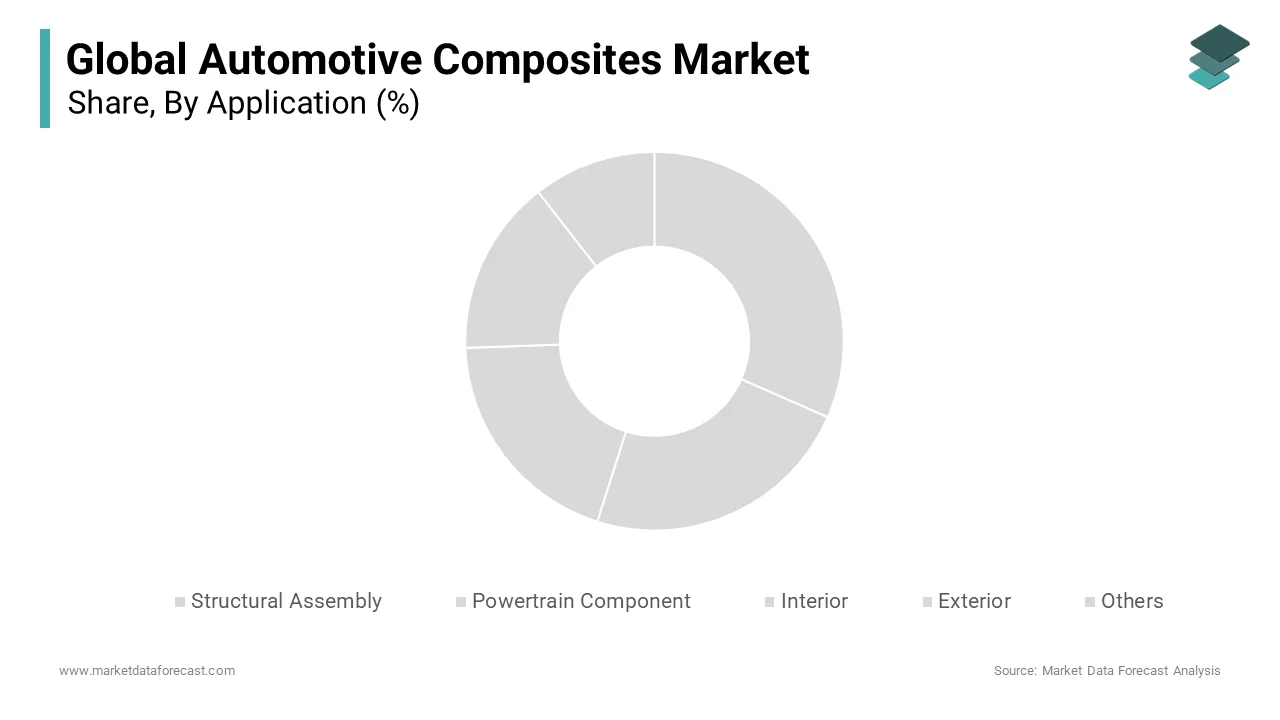
The powertrain component segment is the fastest-growing application area and is projected to expand at a CAGR of 10.3% from 2025 to 2033. This rapid growth is driven by the electrification of propulsion systems, where composites are increasingly used in battery enclosures, motor housings, and transmission shields. Electric vehicle (EV) battery packs require materials that are lightweight, electrically insulating, and thermally stable, properties inherent to advanced composites.
By Material Insights
The Glass fiber-reinforced composites segment represented the largest material by capturing an estimated 52.5% share of the automotive composites market in 2025. Their dominance is rooted in an optimal balance of mechanical performance, cost-effectiveness, and processability, making them ideal for high-volume production. Glass fiber is extensively used in body panels, under-hood components, and semi-structural parts across mainstream vehicle segments. These attributes ensure its continued primacy in cost-sensitive, volume-driven automotive applications.
The Thermoplastic polymers segment is the fastest-growing material segment and is anticipated to grow at a CAGR of 9.8% from 2025 to 2033. This acceleration is fueled by their recyclability, shorter cycle times, and superior impact resistance, qualities increasingly vital in electric and autonomous vehicles. Unlike thermosets, thermoplastics can be reheated and reshaped, enabling closed-loop recycling and alignment with circular economy mandates. With automakers prioritizing sustainability and manufacturing efficiency, thermoplastics are emerging as a transformative alternative to traditional thermoset systems.
COUNTRY ANALYSIS
Asia Pacific led the global automotive composites market by accounting for 41.6% in 2025. As the world’s largest automotive production hub, the region’s demand is driven by rising vehicle output, expanding EV adoption, and government-backed lightweighting initiatives. The China Association of Automobile Manufacturers states that over 9.5 million electric vehicles were produced in 2023. Japan’s automotive sector, led by Toyota and Honda, utilizes glass fiber composites in hybrid vehicle components. India’s push for indigenous EV manufacturing under the PLI scheme has spurred investments in composite component suppliers. The region’s robust supply chain and growing technical expertise position it as the epicenter of composite innovation and volume growth.
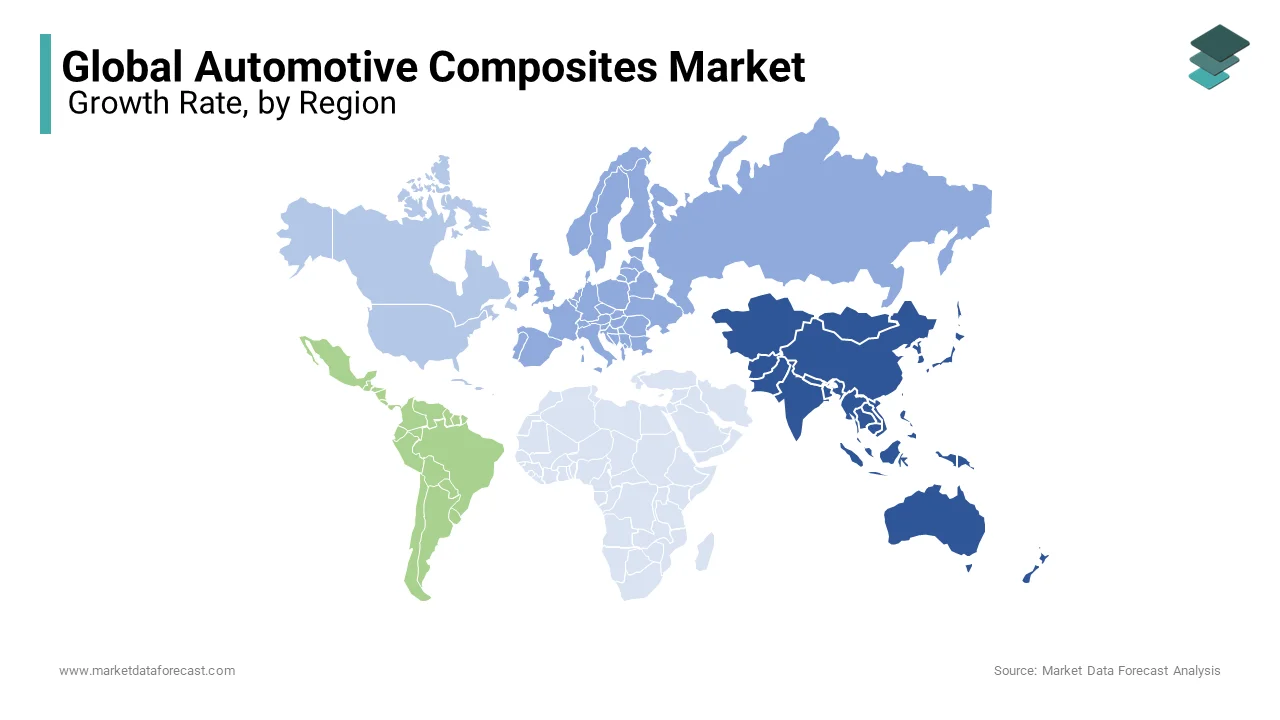
Europe remains a leader in high-performance and sustainable composite applications. Germany, the region’s industrial core, produces over 4 million vehicles annually, with premium automakers like BMW, Mercedes-Benz, and Porsche pioneering CFRP integration in structural components. With stringent emissions regulations and a strong R&D ecosystem, Europe continues to set global benchmarks in advanced material integration and environmental compliance.
North America holds a significant market share, with the United States serving as the primary growth engine. The region’s automotive composites demand is concentrated in light trucks, SUVs, and electric vehicles, where weight reduction directly impacts fuel economy and payload capacity. With strong government-industry collaboration and a focus on performance, North America remains a key innovator in composite application engineering.
Latin America accounts for a notable share of the global market, with Brazil leading regional demand due to its established automotive manufacturing base. Argentina and Mexico are expanding their EV assembly capabilities. However, limited local composite manufacturing and reliance on imported raw materials constrain growth. Despite these challenges, rising urbanization and government incentives for cleaner transportation are gradually increasing composite adoption, particularly in mid-tier vehicles and public transit systems.
The Middle East and Africa collectively represent a small share of the market, with growth concentrated in South Africa and the Gulf Cooperation Council (GCC) nations. While regional composite production remains limited, strategic investments in mobility infrastructure and local assembly are creating new pathways for material adoption, signaling long-term growth potential.
KEY MARKET PLAYERS
Hexcel Corporation, Mitsubishi Chemical Carbon Fiber and Composites, Inc., mouldCAM Pty Ltd., SGL Carbon SE, Teijin Limited, Toray Industries Inc., Nippon Sheet Glass Company, Limited, Solvay S.A., Nippon Carbon Co., Ltd., Huntsman International LLC., BFG International Group. These are the market players that are dominating the global automotive composites market.
Top Players In The Market
Toray Industries is a leading force in the Asia Pacific automotive composites market, renowned for its carbon fiber and prepreg technologies used in high-performance vehicles. The company has deepened its regional footprint by expanding production capacity at its plants in Japan and South Korea to meet rising demand from Japanese OEMs and emerging EV manufacturers in China. It has also formed joint development agreements with Toyota and Hyundai to integrate lightweight composite structures into next-generation platforms. Through its collaboration with the University of Tokyo, Toray is advancing automated lay-up techniques to reduce manufacturing cycle times. These initiatives reinforce its position as a technology pioneer, driving innovation in scalable, high-strength composite solutions tailored to the region’s evolving mobility landscape.
SGL Carbon plays a pivotal role in shaping the Asia Pacific automotive composites ecosystem, particularly in carbon fiber-based components for electric and premium vehicles. The company has strengthened its presence through its joint venture with BMW, which supplies CFRP for the iX and i4 models produced in China and exported across Asia. It has also introduced recyclable carbon fiber-reinforced thermoplastics for use in interior and semi-structural applications, aligning with sustainability mandates in South Korea and Japan. By investing in localized R&D and application engineering, SGL Carbon is bridging the gap between advanced material science and practical automotive integration, enabling faster commercialization and enhanced customer collaboration across the region’s rapidly electrifying vehicle sector.
Mitsubishi Chemical Corporation has significantly influenced the Asia Pacific automotive composites market through its development of high-performance thermoset and thermoplastic materials for structural and powertrain applications. The company supplies advanced sheet molding compounds (SMC) and long-fiber thermoplastics (LFT) to major automakers in Japan, India, and Thailand for use in hoods, liftgates, and battery trays. It also partnered with Nissan to develop a composite rear subframe that reduces weight compared to steel. With innovation centers in Yokohama and Pune, the company is accelerating regional co-engineering efforts, particularly in cost-effective lightweighting solutions for hybrid and electric vehicles, reinforcing its reputation as a strategic materials partner in the region’s transition to sustainable mobility.
Top Strategies Used By The Key Market Participants
Key players in the automotive composites market are leveraging material innovation, strategic partnerships, regional manufacturing expansion, recycling technology development, and application-specific engineering to solidify their competitive advantage. Companies are investing heavily in low-cost carbon fiber, thermoplastic composites, and bio-based resins to improve cost efficiency and sustainability. Collaborations with OEMs enable co-design of composite components tailored to electric and autonomous vehicle architectures. Expansion of local production and technical support centers in high-growth regions enhances responsiveness and reduces supply chain risks. Firms are also advancing closed-loop recycling systems to comply with environmental regulations and support circular economy goals. Digital tools such as simulation software and automated fiber placement are being integrated to optimize performance and reduce development time, ensuring alignment with the automotive industry’s demanding quality, safety, and scalability requirements.
COMPETITION OVERVIEW
The competition in the automotive composites market is intensifying as global material suppliers, chemical giants, and niche innovators vie for dominance in a technically complex and rapidly evolving sector. While established players lead in carbon fiber and large-scale manufacturing, regional firms are gaining traction by offering cost-optimized glass fiber solutions for mass-market vehicles. The battleground has shifted toward sustainability, with recyclable thermoplastics, bio-based fibers, and low-energy production methods becoming key differentiators. Electrification is reshaping demand, favoring companies that can deliver lightweight, multifunctional composites for battery systems and structural integration. Geopolitical factors, raw material security, and localization of supply chains are influencing strategic decisions, with firms increasingly investing in regional R&D and production. The convergence of performance, cost, and environmental compliance is redefining competitive dynamics, creating opportunities for agile, innovation-driven players across the value chain.
RECENT HAPPENINGS IN THE MARKET
- In January 2023, Toray Industries launched a new low-cost carbon fiber grade at its facility in Oita, Japan, specifically engineered for electric vehicle battery enclosures, enabling broader adoption in mass-market EVs across China and Southeast Asia.
- In June 2023, SGL Carbon expanded its technical center in Shanghai, enhancing its capability to support Chinese OEMs in developing and testing lightweight composite components for next-generation electric vehicles and autonomous platforms.
- In September 2023, Mitsubishi Chemical Corporation partnered with Nissan to commercialize a composite rear subframe in Thailand, reducing component weight by 25% and improving fuel efficiency in hybrid SUV models.
- In February 2025, Hexcel inaugurated a new production line in Singapore dedicated to thermoplastic composites, targeting high-volume applications in EV powertrains and interior systems across the Asia Pacific region.
- In May 2025, Teijin established a joint R&D lab with Toyota in Yokohama to accelerate the development of recyclable carbon fiber materials for structural components in hydrogen fuel cell and battery electric vehicles.
MARKET SEGMENTATION
This research report on the automotive composites market is segmented and sub-segmented into the following categories.
By Application Type
- Structural Assembly
- Powertrain Component
- Interior
- Exterior
- Others
By Material Type
- Thermoset Polymer
- Thermoplastic Polymer
- Carbon Fiber
- Glass Fiber
By Country
- North America
- Europe
- Asia-Pacific
- Latin America
- Middle East and Africa
Frequently Asked Questions
What are automotive composites?
Automotive composites are lightweight, strong materials made by combining two or more components—typically a reinforcing fiber (like carbon or glass) and a resin matrix (such as epoxy or polyester). They’re used in vehicles to replace heavier metals, improving fuel efficiency and performance.
Why are composites becoming popular in the auto industry?
Car manufacturers are under pressure to reduce vehicle weight to meet fuel economy and emissions standards. Composites offer high strength-to-weight ratios, corrosion resistance, and design flexibility—making them ideal for modern, eco-friendly vehicles.
Are composites expensive?
Some, like carbon fiber, are more costly than steel or aluminum. However, prices are gradually decreasing due to improved manufacturing techniques and higher production volumes. Glass fiber composites offer a more budget-friendly option.
How do composites help the environment?
Lighter vehicles consume less fuel and emit fewer greenhouse gases. Additionally, bio-based composites (made from renewable sources) and recyclable resins are being developed to reduce environmental impact over a vehicle’s lifecycle.
Which regions are leading in automotive composites?
North America, Europe, and Asia-Pacific are the major markets. Europe leads in innovation and sustainability-focused designs, the U.S. in high-performance applications, and China and India are rapidly expanding due to booming auto industries and EV adoption.
How is electric vehicle (EV) growth affecting composites?
EVs benefit greatly from composites because reducing weight helps extend battery range. Many EV makers are using composites in chassis, body, and battery enclosures to improve efficiency and performance.
Can composites be recycled?
Yes, but it’s more complex than recycling metal. Technologies like pyrolysis and mechanical recycling are being developed to recover fibers and resins. The industry is actively working toward circular economy solutions.
Related Reports
Access the study in MULTIPLE FORMATS
Purchase options starting from
$ 2500
Didn’t find what you’re looking for?
TALK TO OUR ANALYST TEAM
Need something within your budget?
NO WORRIES! WE GOT YOU COVERED!
Call us on: +1 888 702 9696 (U.S Toll Free)
Write to us: sales@marketdataforecast.com