- Product Description Description
- Table of Contents TOC
- List of Table & Figure LOT
- Get Free Sample PDF Sample PDF
Market Size, 2025
$27.49 BnMarket Estimate, 2026
$32.49 BnMarket Forecast, 2034
$130.67 BnCAGR, 2026–2034
18.91%Global Automotive Electric Bus Market Report Summary
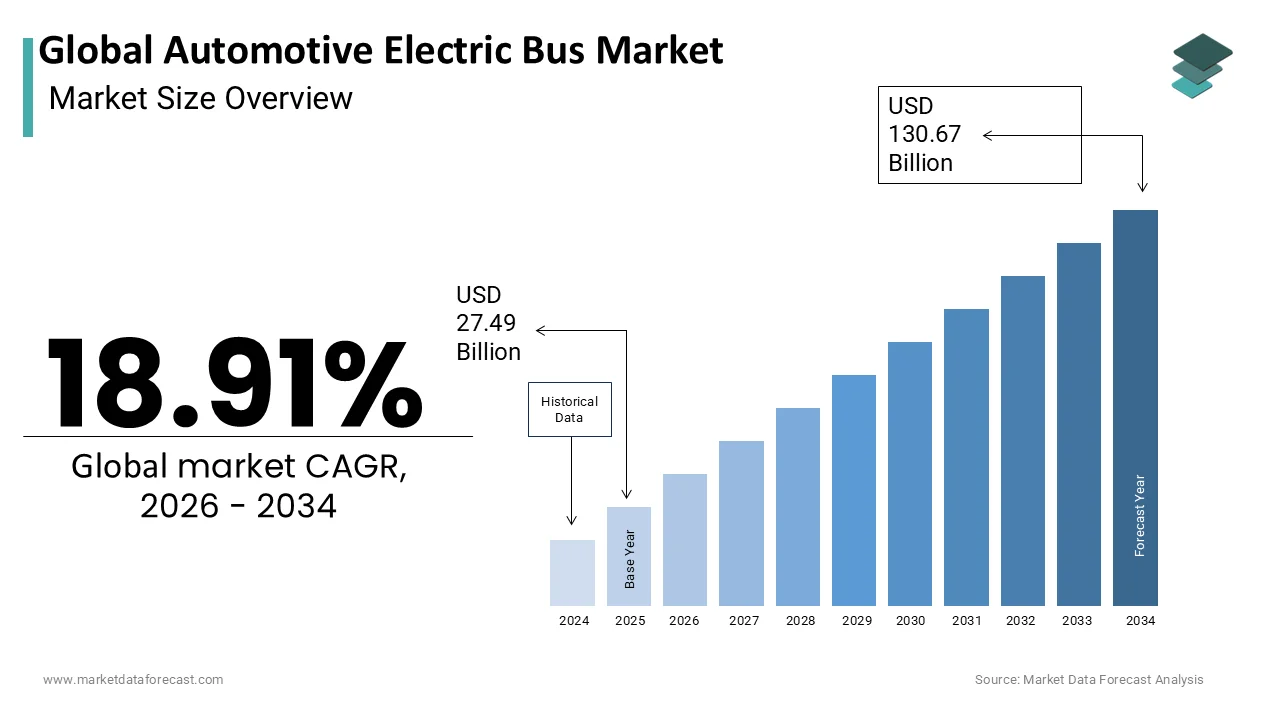
The Automotive Electric Bus Market was valued at USD 27.49 billion in 2025 and is projected to reach USD 130.67 billion by 2034, growing from USD 32.49 billion in 2026 at a CAGR of 18.91% during the forecast period. Growth is driven by stringent emission reduction mandates like the EU Clean Vehicles Directive, declining battery costs, and expansion into emerging markets with large-scale deployments in China and India. High infrastructure costs and grid capacity constraints are shaping market dynamics.
Key Market Trends
- Rising adoption of vehicle-to-grid technology turning buses into mobile energy storage
- Growing deployment of hydrogen fuel cell buses for long-range, heavy-duty routes
- Increasing use of LFP battery chemistry for safety and cost advantages in city transit
- Expansion of local manufacturing initiatives in emerging economies like Brazil and Thailand
- Rising exploration of solid-state battery technology to address range and charging concerns
Segmental Insights
- Based on propulsion, battery electric buses dominated the market in 2025, driven by mature lithium-ion technology and lower total cost of ownership versus diesel.
- Based on application, city transit held the largest share in 2025, supported by predictable fixed routes suited to efficient charging management.
- Hydrogen fuel cell buses is the fastest-growing propulsion segment, projected at a CAGR of 28.5%, driven by advantages in long-range and heavy-duty applications.
Regional Insights
- North America led the market in 2025 by holding 34.2% of the global market share, supported by federal incentives and state-level zero-emission mandates.
- Europe holds a significant share at 23.4%, driven by the EU Clean Vehicles Directive and Norway's near-100% electric bus penetration.
- Asia Pacific is a prominent market supported by China's fleet scale and India's FAME II subsidy scheme.
- Latin America contributes notably due to Chile's large-scale Santiago electric fleet deployment.
- Middle East and Africa is expected to witness considerable growth during the forecast period, driven by national smart city and sustainability visions like Dubai's 2050 electrification target.
Competitive Landscape
The market is highly competitive, with manufacturers focusing on vertical integration, localization, and charging ecosystem partnerships. Companies are investing in next-generation battery technologies and digital fleet management services to strengthen total cost of ownership advantages.
Prominent players in the market include BYD Company Limited, Yutong Bus Co. Ltd., Zhengzhou Yutong Bus Co. Ltd., AB Volvo, Daimler Buses GmbH, Tata Motors Limited, Ashok Leyland Limited, Proterra Inc., NFI Group Inc. (New Flyer), Solaris Bus & Coach sp. z o.o., VDL Bus & Coach B.V., and Ebusco Holding N.V.
Global Automotive Electric Bus Market Size
The Automotive Electric Bus Market is projected to grow from USD 27.49 billion in 2025 to USD 32.49 billion in 2026 and reach USD 130.67 billion by 2034, registering a CAGR of 18.91% during the forecast period from 2026 to 2034.
The automotive electric bus is a battery-powered public transport vehicles that eliminate tailpipe emissions and reduce urban noise pollution. These vehicles serve as components in the transition toward sustainable urban mobility systems, replacing traditional diesel and compressed natural gas fleets. The European transportation sector demonstrates a decisive shift toward electrification,n with the European Commission stating that zero-emission buses must constitute at least 45% of new public bus purchases by 2030 under the Clean Vehicles Directive. This regulatory mandate drives substantial investment in charging infrastructure and fleet modernization across member states. The integration of electric buses into smart city frameworks enables real-time monitoring of energy consumption and route optimization. Municipalities prioritize these vehicles to meet air quality standards and improve public health outcomes.
MARKET DRIVERS
Stringent Environmental Regulations and Emission Reduction Targets
Governments worldwide are implementing rigorous environmental regulations that mandate the phase-out of internal combustion engine vehicles in public transport sectors, which is driving the growth of the automotive electric bus market. The European Green Deal sets ambitious targets for reducing greenhouse gas emissions by 55% by 2030 compared to 1990 levels, creating urgent pressure on municipal transit authorities to adopt zero-emission technologies. According to the World Health Organization, air pollution causes approximately 7 million premature deaths annually, with nitrogen oxides and particulate matter from diesel buses being major contributors in urban centers. Cities like London, Pari, and Berlin have established low-emission zones that restrict or ban diesel buses from entering central areas, effectively forcing fleet operators to transition to electric alternatives. The United Kingdom Department for Transport announced that all new buses purchased in England must be zero-emission capable by 2035, accelerating procurement timelines for electric models. Financial incentives such as purchase subsidies and tax exemptions further lower the total cost of ownership for electric buses, making them economically viable despite higher upfront costs. The California Air Resources Board mandated that 100% of new bus purchases in the state must be zero emission by 204,0 setting a precedent for other regions. These regulatory frameworks create a predictable demand environment, not allowing manufacturers to scale production and invest in research and development. Compliance with these mandates is not optional for public transit agencies,ies facing legal penalties and reputational risks for non-compliance.
Declining Battery Costs and Technological Advancements
The rapid decline in lithium-ion battery prices and improvements in energy densarey is additionally promoting the growth of the automotive electric bus market. Batteries represent approximately 30 to 40% of the total cost of an electric bus,c bus making cost reductions critical for achieving price parity with diesel equivalents. This trend is expected to continue with prices projected to drop below 100 dollars per kilowatt hour by 2026, enabling electric buses to achieve total cost of ownership advantages without subsidies. Advances in solid-state battery technology promise even greater energy densities and faster charging times, addressing range anxiety and operational downtime concerns. This capability enables opportunity charging during short layovers,s reducing the need for large depot charging infrastructure. These technological breakthroughs reduce operational risks and increase confidence among transit agencies considering fleet electrification.
MARKET RESTRAINTS
High Initial Capital Investment and Infrastructure Costs
The substantial upfront capital required for purchasing electric buses and deploying necessary charging infrastructure for cash-strapped municipal transit agencies is limiting the growth of the automotive electric bus market. Electric buses typically cost 50 to 100% more than their diesel counterparts due to expensive battery packs and specialized powertrain components. This price premium strains limited public budgets and requires complex financing arrangements or reliance on government grants, which may be inconsistent or delayed. Additionally, the installation of high-power charging stations involves significant civil works, including grid upgrade, trenching, ng, and electrical panel installations. Depot charging systems require substantial land space and electrical capacity,ity which may not be available in dense urban environments. Fast charging infrastructure along routes demands coordination with utility companies and permitting processes that can take months or years to complete. Small and medium-sized cities lack the financial resources and technical expertise to manage these complex projects effectively.
Grid Capacity Constraints and Energy Supply Challenges
The massive energy demand generated by large-scale electric bus fleets on existing electrical grid infrastructure and stability is also hindering the growth of the automotive electric bus market. Charging hundreds of buses simultaneously at depots creates peak load spikes that can overwhelm local distribution networks and require costly upgrades. According to the International Energy Agency, global electricity demand from transport could increase by 1500 terawatt hours by 2030 if electrification accelerates rapidly. Many urban grids were designed for residential and commercial loads, not for the concentrated high-power demands of heavy-duty vehicle charging. Utility companies face difficulties in upgrading transformers and substations quickly enough to meet the needs of transit agencies. In some cases, grid congestion forces operators to limit charging speeds or stagger charging schedules, reducing operational flexibility. The reliance on fossil fuel-based electricity generation in certain regions undermines the environmental benefits of electric buses unless renewable energy sources are integrated. Smart charging solutions and vehicle-to-grid technologies offer potential mitigation but require advanced software and hardware investments. The lack of standardized communication protocols between buses, chargers,s and grid operators complicates integration efforts.
MARKET OPPORTUNITIES
Integration of Vehicle-to-Grid Technology and Energy Storage
The emergence of vehicle-to-grid technology for electric buses to serve as mobile energy storage assets that stabilize electrical grids and generate additional revenue streams. The integration of vehicle-to-grid technology and energy storage is expected to have a positive impact on the growth of the automotive electric bus market. Electric buses spend most of their time parked at depots, making them ideal candidates for bidirectional charging systems that allow energy flow from battery to grid. According to the National Renewable Energy Laboratory,y vehicle-to-grid capabilities could provide up to 10 gigawatts of flexible capacity in the United States by 2030. Transit agencies can participate in demand response programs by discharging stored energy during peak hours when electricity prices are high and recharging during off-peak periods when rates are low. This arbitrage strategy offsets operational costs and improves the economic viability of electric fleets. Nissan and Volvo have piloted projects where electric buses supply power to buildings or grid nodes during emergencies, enhancing community resilience. The integration of stationary battery storage at depots further optimizes energy usage by capturing excess renewable generation from solar panels. Regulatory frameworks in Europe and Asia are beginning to recognize electric vehicles as a grid resource,s creating new market mechanisms for compensation. This synergy between transport and energy sectors creates a holistic ecosystem that maximizes asset utilization.
Expansion into Emerging Markets and Developing Economies
The rapid urbanization and growing middle-class populations in emerging countries for electric bus adoption are another attribute to fuel the growth of the automotive electric bus market. Countries in Asia, Latin America, and Africa are experiencing unprecedented growth in urban mobility demand,d requiring scalable and clean transit solutions. China has already deployed over 600000 electric buses, es accounting for more than 90% of the global fleet, and serving as a model for other nations. India launched the FAME II scheme, hence providing subsidies for thousands of electric buses in major cities like Delhi and Bangalore to reduce smog. Latin American cities, such as Santiago and Bogota,ogota have successfully integrated large electric fleets, demonstrating feasibility in diverse geographic and climatic conditions. These success stories encourage neighboring countries to follow suit,t leveraging international financing from institutions like the World Bank and Green Climate Fund. Local manufacturing initiatives in countries like Brazil and Thailand aim to reduce costs and create jobs by fostering domestic industry growth. The lower operating costs of electric buses appeal to cash-sensitive operators in developing economies despite higher initial investment. International partnerships facilitate technology transfer and capacity building, accelerating adoption curves.
MARKET CHALLENGES
Supply Chain Vulnerabilities for Critical Raw Materials
The significant risks due to dependence on raw materials, such as lithium, cobalt, and nickel, which are subject to geopolitical tensions and supply constraints, pose a great challenge for the growth of the automotive electric bus market. According to the International Energy Agency, demand for lithium could increase by 40 times by 2040, if electric vehicle adoption targets are met, far outpacing current mining capacities. Price volatility for these materials directly impacts battery costs and vehicle affordability,y causing uncertainty for manufacturers and buyers. The European Commission identified critical raw materials as strategic vulnerabilities, urging diversification of sourcing and recycling initiatives. Labor and environmental concerns in mining regions, such as the Democratic Republic of Cong,o for cobalt raise ethical issues that complicate procurement. Trade restrictions and export controls imposed by producing countries can abruptly limit access to essential components. The long lead times for opening new mines mean supply cannot respond quickly to sudden demand surges. Manufacturers are exploring alternative chemistries such as lithium iron phosphate to reduce reliance on scarce materials, but performance trade-offs remain. Recycling infrastructure for end-of-life batteries is still nascent, limiting circular economy benefits.
Standardization Issues and Interoperability Gaps
The lack of universal standards for charging connectors,s communication protocols, and safety regulations creates fragmentation, which also acts as a barrier for the growth of the automotive electric bus market. Different manufacturers and regions employ varying charging interfaces by forcing transit agencies to invest in multiple charging systems or limit vendor choices. The harmonization of charging standards remains incomplete, leading to inefficiencies and increased infrastructure costs. Proprietary software platforms used by different bus makers often do not communicate with each other or with third-party charging management systems, creating data silos. This interoperability gap prevents optimal fleet management and predictive maintenance across mixed fleets. Safety standards for high voltage systems and battery handling vary by country, complicating international trade and certification processes. The absence of unified testing protocols for battery durability and performance makes it difficult for buyers to compare products objectively. Regulatory bodies struggle to keep pace with rapid technological change,s resulting in outdated or conflicting guidelines. Industry consortia are working toward common standards, but progress is slow due to competitive interests and national preferences.
REPORT COVERAGE
| REPORT METRIC | DETAILS |
| Market Size Available | 2025 to 2034 |
| Base Year | 2025 |
| Forecast Period | 2026 to 2034 |
| Segments Covered | By Propulsion, Application, Length, and Region |
| Various Analyses Covered | Global, Regional and Country-Level Analysis, Segment-Level Analysis, Drivers, Restraints, Opportunities, Challenges; PESTLE Analysis; Porter’s Five Forces Analysis, Competitive Landscape, Analyst Overview of Investment Opportunities |
| Countries Covered | North America, Europe, Asia Pacific, Latin America, Middle East & Africa |
| Market Leaders Profiled |
|
SEGMENTAL ANALYSIS
By Propulsion Insights
The battery electric buses segment accounted for a dominant share of the automotive electric bus market in 2025, owing to the maturity of lithium-ion battery technology and the absence of direct tailpipe emissions, which aligns perfectly with urban air quality goals. Unlike hydrogen fuel cell buses, which require extensive new infrastructure,e battery electric buses can utilize existing electrical grids with manageable upgrades. The operational simplicity of battery electric systems reduces maintenance costs significantly as they have fewer moving parts compared to internal combustion or fuel cell powertrains. The battery electric buses achieve total cost of ownership parity with diesel buses in many major cities due to lower fuel and maintenance expenses. The widespread availability of charging solutions, including depot and opportunity charging, ng supports flexible deployment strategies. Manufacturers like BYD and Yutong have scaled production to drive down unit costs, sts making battery electric options financially accessible for municipal fleets. Regulatory mandates in Europe and China specifically favor zero-emission vehicles, which battery electric technology delivers effectively.
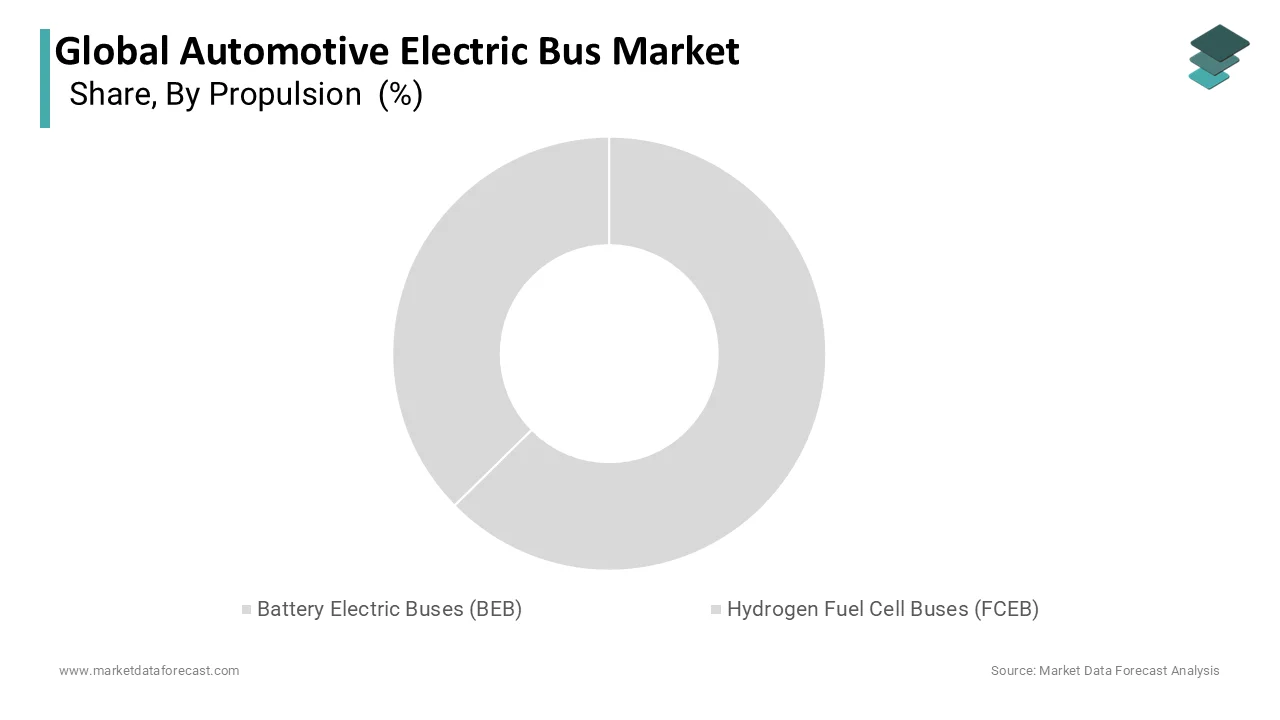
The hydrogen fuel cell buses segment is likely to grow at an anticipated CAGR of 28.5% from 2026 to 2034, with the unique advantages of hydrogen technology for long-range and heavy-duty applications where battery weight and charging time are limiting factors. Fuel cell buses offer refueling times comparable to diesel buses, typically under 15 minutes, enabling continuous operation without long downtime. Governments in Europe and Asia are investing heavily in hydrogen valleys and refueling networks to support this transition. Toyota and Hyundai have launched commercial fuel cell buses demonstrating durability and performance in cold climates where battery efficiency drops. The only emission from fuel cell buses is water vapor,r making them zero-emission vehicles. As green hydrogen production scales up and costs decrease, the economic case for fuel cell buses strengthens.
By Application Insights
The city transit application segment was the largest by holding a significant share of the automotive electric bus market in 2025, with the suitability of electric buses for fixed routes with predictable stop patterns that allow for efficient charging management. Within this segment, the Lithium Iron Phosphate (LFP) battery chemistry leads due to its superior safety profile, le long cycle life, and lower cost compared to Nickel Manganese Cobalt alternatives. LFP batteries are less prone to thermal runaway, making them safer for dense urban environments where buses operate close to pedestrians and buildings. The lower cost of iron and phosphate materials makes the overall vehicle price of mLFP-equipped buses more affordable for municipal budgets. This longevity reduces the need for expensive battery replacements during the vehicle's life. The robustness of LFP chemistry withstands the frequent stop-start cycles typical of city transit routes. Regulatory bodies favor LFP due to its lower environmental impact in mining and recycling.
The intercity coach application segment is expected to grow at the fastest CAGR of 22.4% from 2026 to 2034, owing to the demand for zero-emission long-distance travel and advancements in high-energy-density batteries. Within this segment, Nickel Manganese Cobalt (NMC) battery chemistry is gaining traction due to its superior energy density,y which allows for lighter packs and longer ranges essential for highway speeds and varied terrain. The higher power output of NMC batteries supports rapid acceleration and sustained highway cruising speeds required for coach operations. Volvo Buses launched their intercity electric coach using NMC batteries, es demonstrating the viability of long-distance transport. The demand for premium, comfortable,e and long-distance travel drives adoption among private operators. Government incentives for green tourism and regional connectivity support this expansion. The shift toward sustainable corporate travel policies also boosts demand for green coach services.
By Length Insights
The 10 to 12-meter length segment held a prominent share of the automotive electric bus market in 2025, with the workhorse of urban transit systems offering an optimal balance between passenger capacity and maneuverability. Within this segment, Permanent Magnet Synchronous Motors (PMSM) are the leading motor architecture due to their high efficiency, compact size, and superior torque characteristics. The high power density of PMSM allows for compact motor designs that save space for passengers or batteries. These motors provide instant torque, which is essential for the frequent start-stop cycles of city buses, ensuring smooth acceleration. The reliability of PMSM technology is proven with minimal maintenance requirements over the vehicle's life. ZF Friedrichshafen reported that their PMSM axles are used in thousands of electric buses globally due to their robustness and ease of integration. The mature supply chain for rare earth magnets supports consistent production despite cost fluctuations. Regulatory standards for noise and vibration favor PMSM due to their quiet operation, enhancing passenger comfort.
The articulated bus length segment is expected to register the fastest CAGR of 18.5% from 2026 to 2034, with the need for high-capacity zero-emission transport on busy urban corridors. Within this segment, Axial Flux Motor architecture is emerging as a fast-growing technology due to its exceptional power density and compact form factor. This size advantage is crucial for articulated buses,s where space is at a premium and weight distribution affects handling. The high efficiency of axial flux motors extends range and reduces energy costs. Mercedes-Benz NZz eCitaro G articulated buses are exploring advanced motor technologies to handle heavy loads efficiently. The demand for high-capacity electric buses in megacities drives this growth. Axial flux motors allow for innovative chassis designs that maximize passenger space.
COUNTRY LEVEL ANALYSIS
North America Electric Bus Market Analysis
North America was the outperformer in the global automotive electric bus market by occupying 34.2% of the share in 2025, owing to the federal incentives and state-level mandates. California leads with its Innovative Clean Transit mandate requiring all new bus purchases to be zero emission by 2029. Canada follows with federal funding for green transit projects in major cities like Toronto and Vancouver. The region benefits from a strong local manufacturing presence with companies like New Flyer and Lion Electric producing electric buses domestically. Supply chain localization efforts reduce dependency on imports and create jobs. High labor costs and strict safety standards influence vehicle design and pricing. The vast geographic spread requires diverse solutions, including long-range coaches for rural areas. Utility partnerships are crucial for managing the grid impacts of large fleet charging.
Europe Electric Bus Market Analysis
Europe automotive electric bus market held 23.4% of the market share in 2025, with a strong position through stringent environmental regulations and ambitious climate goals. The European Union Clean Vehicles Directive mandates that 45% of new bus purchases be zero emission by 203,0 driving consistent demand. Norway leads in penetration rate with nearly 100% of new buses being electric due to aggressive tax incentives. The region focuses on high-quality,y durable vehicles with advanced connectivity features. Local manufacturers like Daimler Trucks and Volvo Buses compete with Asian imports through technological innovation. The well-developed charging infrastructure supports widespread adoption. Public acceptance of electric buses is high due to noise reduction and air quality improvements. The region prioritizes sustainable battery sourcing and recycling,g aligning with circular economy principles. The government grants low-interest loans to support municipal investments.
Asia Pacific Electric Bus Market Analysis
Asia Pacific automotive electric bus market growth is likely to have a prominent growth opportunity in the coming years. India is emerging as a significant growth market with the FAME II scheme supporting thousands of electric bus deployments in major cities. South Korea and Japan focus on advanced technology exports and domestic urban renewal. The region benefits from lower manufacturing costs and established battery supply chains. Local governments prioritize air quality improvement in polluted megacities, driving rapid adoption. The scale of deployment allows for significant cost reductions through economies of scale. Export-oriented manufacturers in China supply buses to global markets, influencing international standards. The diversity of the region includes developed markets with high-tech needs and developing markets focusing on affordability. Infrastructure development varies widely but is improving rapidly. Government support remains the primary driver with subsidies and mandates shaping market dynamics.
Latin America Electric Bus Market Analysis
Latin America's automotive electric bus market growth is driven by the increasing investments in government support. Chile leads the region with Santiago operating one of the largest electric bus fleets outside of China, totaling over 1500 units. Colombia, Brazil, and Mexico are following suit with pilot projects and procurement plans. The region leverages international financing and technical assistance to overcome high upfront costs. Local assembly initiatives aim to reduce prices and create jobs. The tropical climate poses challenges for battery cooling but also offers advantages by avoiding extreme cold. Urban congestion and pollution drive political will for electrification. Infrastructure development is progressing with support from utility companies. The success in Santiago serves as a model for other cities, demonstrating feasibility. Awareness of environmental benefits is growing among citizens and policymakers.
Middle East and Africa Electric Bus Market Analysis
The Middle East and Africa automotive electric bus market growth is driven by national vision plans focusing on sustainability and smart cities. According to the Gulf News,s Dubai aims to have 100% of its public transport fleet electric by 2050. South Africa is exploring electric buses in Cape Town and Johannesburg to address energy and environmental challenges. The region faces high temperatures, which require robust battery thermal management systems. Abundant solar energy potential offers opportunities for green charging infrastructure. High fuel subsidies in some countries historically hindered electric adoption,n but reforms are changing this dynamic. International manufacturers are entering the market with customized solutions for hot climates. Government initiatives and mega projects drive initial demand. Pilot projects demonstrate viability in harsh conditions.
COMPETITIVE LANDSCAPE
The competition in the automotive electric bus market is characterized by intense rivalry between established traditional bus manufacturers and agile new entrants specializing exclusively in electric powertrains. Chinese companies leverage massive domestic scale and vertical integration to offer cost-competitive products globally, challenging Western incumbents who respond with premium positioning and localized production. Differentiation increasingly relies on total cost of ownership, software-enabled services, and charging ecosystem integration rather than vehicle specifications alone. Technology convergence blurs boundaries between automotive and energy sectors,s prompting collaborations with battery makers and utility companies. Intellectual property battles over battery chemistry and motor designs intensify, as firms seek sustainable competitive advantages. Consolidation trends emerge as smaller players struggle with R&D costs and supply chain volatility, ty leading to mergers and strategic alliances. Regulatory divergence across regions complicates product standardization,n forcing manufacturers to maintain multiple variants, and increasing complexity and cost.
KEY MARKET PLAYERS
Some of the companies that are playing a dominating role in the Global Automotive Electric Bus Market include
- BYD Company Limited
- Yutong Bus Co., Ltd.
- Zhengzhou Yutong Bus Co., Ltd.
- AB Volvo
- Daimler Buses GmbH
- Tata Motors Limited
- Ashok Leyland Limited
- Proterra Inc.
- NFI Group Inc. (New Flyer)
- Solaris Bus & Coach sp. z o.o.
- VDL Bus & Coach B.V.
- Ebusco Holding N.V.
TOP LEADING PLAYERS IN THE MARKET
- BYD Company Limited is a dominant force in the automotive electric bus market, providing comprehensive electrification solutions for public transit systems worldwide. The company manufactures battery electric buses ranging from minibuses to articulated models, els utilizing proprietary Blade Battery technology for enhanced safety and energy density. Recent actions include expanding manufacturing facilities in Hungary and Brazil to localize production and reduce supply chain risks. BYD actively collaborates with transit authorities to integrate smart charging management systems, thereby optimizing fleet operations and energy consumption. Their vertical integration strategy ensures control over critical components,nents including batteries, motors, and electronic controls. This approach enables rapid innovation and cost competitiveness in global tenders. The company also invests heavily in research and development to improve vehicle range and durability under diverse climatic conditions. BYD’s extensive global service network provides technical support an d spa, re parts, ensuring operational reliability for customers.
- Yutong Bus Co., Ltd. is a major contributor to the automotive electric bus market, specializing in new energy vehicles for international markets. The company offers a diverse portfolio of electric coaches and city buses equipped with advanced thermal management systems suitable for extreme temperatures. Recent initiatives involve launching hydrogen fuel cell buses and establishing overseas assembly plants in countries like Kazakhstan and Egypt to enhance local presence. Yutong focuses on intelligent connected vehicle technologies, integrating telematics and predictive maintenance platforms to improve fleet efficiency. Strategic partnerships with local distributors and operators facilitate market after-sales support in emerging economies. The company emphasizes rigorous testing and certification processes to meet stringent international safety and performance standards. Continuous investment in lightweight materials and aerodynamic design improves energy efficiency and passenger comfort. Yutong’s commitment to customized solutions addresses the specific operational needs of different regions.
- Daimler Truck AG contributes significantly to the automotive electric bus market through its Mercedes-Benz and Setra brands, focusing on premium zero-emission transit solutions. The company produces the eCitaro series featuring modular battery systems and efficient electric axles designed for demanding urban routes. Recent actions include investing in next-generation solid-state battery research and expanding charging infrastructure partnerships across Europe. Daimler Truck integrates digital services like eConsulting to assist operators in planning electrification projects and optimizing the total cost of ownership. Collaboration with technology providers enhances connectivity and autonomous driving capabilities for future mobility concepts. The company prioritizes sustainability throughout the value chain, including green steel usage and battery recycling initiatives. Rigorous validation ensures vehicles meet the highest standards for safety, reliability,y and passenger experience. Strategic focus on European and North American markets leverages existing brand trust and service networks.
TOP STRATEGIES USED BY KEY MARKET PARTICIPANTS
Key players in the automotive electric bus market primarily focus on vertical integration to secure supply chains for components like batteries and motors, rs ensuring production stability and cost control. Companies actively pursue localization strategies by establishing overseas manufacturing plants and assembly lines to reduce tariffs, lower logistics costs, and meet local content requirements. Strategic partnerships with utility providers and charging infrastructure firms enable integrated ecosystem offerings that simplify fleet electrification for transit agencies. Investment in next-generation battery technologies, such as solid-state and sodium-ion, aims to improve energy density, safety,y and reduce reliance on scarce raw materials. Digitalization initiatives, including telematics, predictive maintenance,e and smart charging software, create recurring revenue streams and enhance customer loyalty through operational efficiency. Diversification into hydrogen fuel cell technology addresses long-range and heavy-duty segments where battery limitations persist. Collaborative research with academic institutions and technology startups accelerates innovation in lightweight materials and autonomous driving features.
MARKET SEGMENTATION
This research report on the global automotive electric bus market is segmented and sub-segmented into the following categories.
By Propulsion
- Battery Electric Buses (BEB)
- Hydrogen Fuel Cell Buses (FCEB)
By Application
- City Transit
- Intercity Coach
By Length
- Less than 10 Meters
- 10 to 12 Meters
- More than 12 Meters (Articulated Buses)
By Region
- North America
- Europe
- Asia Pacific
- Latin America
- Middle East & Africa