- Product Description Description
- Table of Contents TOC
- List of Table & Figure LOT
- Get Free Sample PDF Sample PDF
Market Size, 2025
$129.90 BnMarket Estimate, 2026
$144.52 BnMarket Forecast, 2034
$354.27 BnCAGR, 2026–2034
11.86%Global Bus Market Summary
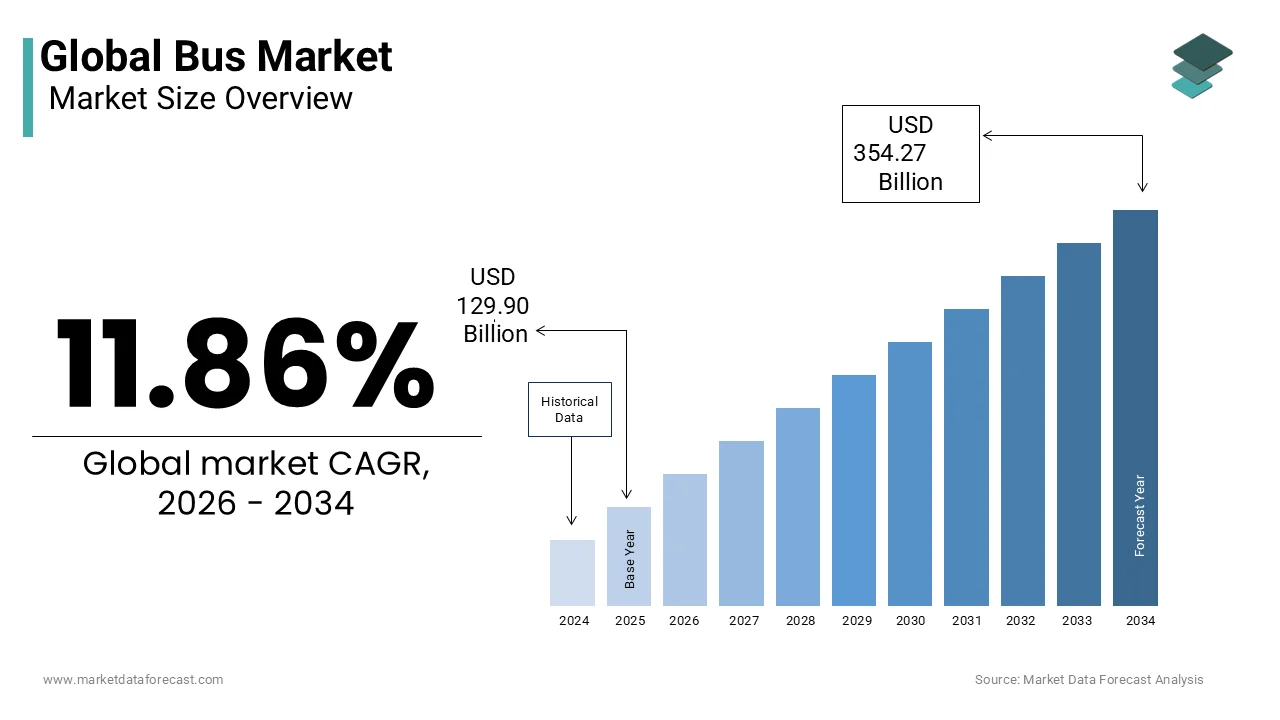
The global bus market was valued at USD 129.90 billion in 2025 and is projected to grow from USD 144.52 billion in 2026 to USD 354.27 billion by 2034, registering a strong CAGR of 11.86% from 2026 to 2034.
Key Market Highlights
- 2025 Market Size: USD 129.90 Billion
- 2026 Estimate: USD 144.52 Billion
- 2034 Forecast: USD 354.27 Billion
- CAGR (2026–2034): 11.86%
- Largest Propulsion Segment: Internal Combustion Engine (ICE)
- Fastest-Growing Segment: Electric & Hybrid (14.8% CAGR)
- Largest Region: Asia Pacific (59.7% share in 2025)
Quick Growth Drivers
- Rapid urbanization in emerging economies
- Government-led electrification mandates
- Expansion of Bus Rapid Transit (BRT) systems
- Policy push under EU Fit for 55 & Clean Vehicles Directive
- Growing Mobility-as-a-Service (MaaS) ecosystems
Principal Restraints
- High upfront costs of electric & hydrogen buses
- Charging & grid infrastructure gaps
- Capital funding deficits in public transit agencies
- Lack of skilled EV maintenance technicians
High-Value Opportunities
- Intelligent Transportation Systems (ITS) integration
- AI-based route optimization & predictive maintenance
- Mobility-as-a-Service (MaaS) adoption
- Public-private partnerships in urban transit
- Hydrogen fuel cell bus pilot programs
Key Market Challenges
- Skilled labor shortages for EV fleet maintenance
- Budget constraints in developing economies
- Infrastructure readiness for electrification
- Managing aging ICE fleets during transition
What Wins Commercially (Competitive Edge)
- Vertical integration in battery & drivetrain manufacturing
- Strong government procurement relationships
- Intelligent fleet management integration
- Localized manufacturing hubs
- Lifecycle service & maintenance contracts
Top Strategic Ask for Executives
- Accelerate EV capacity expansion
- Develop technician training ecosystems
- Secure long-term municipal procurement contracts
- Invest in hydrogen & advanced battery R&D
- Integrate ITS & MaaS capabilities into product offerings
Leading Players
Some of the companies that are playing a dominating role in the global bus market include:
- Zhengzhou Yutong Bus Co., Ltd.
- BYD Company Limited
- Daimler Truck AG
- AB Volvo
- Scania CV AB
- MAN Truck & Bus SE
- Alexander Dennis Limited
- Tata Motors Limited
- Ashok Leyland Limited
- Anhui Ankai Automobile Co., Ltd.
Global Bus Market Size
The global bus market was valued at USD 129.90 billion in 2025 and is projected to grow from USD 144.52 billion in 2026 to USD 354.27 billion by 2034, at a CAGR of 11.86% from 2026 to 2034
A bus refers to the motor vehicles designed for mass passenger transport over short, medium, and long distances, serving urban, intercity, and rural transit needs. As per the study, millions of buses were in operation globally, with Asia-Pacific accounting for a notable share of the fleet, driven largely by high population density and public transport dependency. In India alone, the bus fleet exceeds substantial units, facilitating daily commutes for millions of passengers, according to research. The United States operates a notable number of transit and school buses, emphasizing the sector’s important role in national mobility infrastructure, as reported by the Federal Transit Administration.
MARKET DRIVERS
Urbanization in Emerging Economies Driving Bus Market Growth
The rapid pace of urbanization, particularly in emerging economies, is driving the growth of the bus market. In countries like Nigeria and Indonesia, urban populations are expanding annually, placing immense pressure on existing transit systems. As per the research, cities require significant investments per year in public transport infrastructure to keep pace with demographic growth. Buses remain the most cost-effective mode of mass transit, with notable capital costs per kilometer of bus rapid transit (BRT) systems, compared to those for metro rail, as per the study. This cost efficiency enables governments to deploy high-capacity transit networks rapidly, which is making buses indispensable in managing urban mobility demands.
Policy Push for Low-Emission Transport Boosting Bus Adoption
The global policy push toward low-emission transportation, with governments mandating fleet modernization and clean energy adoption, is additionally enhancing the growth of the bus market. The European Union’s Fit for 55 initiative sets a target for 100% zero-emission urban bus sales by 2035, with an interim goal of a 90% reduction in emissions by 2030. In 2023, the year-on-year increase in electric bus registrations was 39.1%, as per the European Automobile Manufacturers Association (ACEA). China leads the transition, operating significant electric buses, constituting a key share of the global e-bus fleet, supported by national subsidies and local procurement mandates, according to the research. Even in Latin America, cities have deployed electric buses, demonstrating regional commitment.
MARKET RESTRAINTS
High Upfront Costs Hindering Advanced Bus Technology Adoption
High upfront cost of advanced bus technologies, particularly electric and hydrogen-powered models, deters widespread adoption in low- and middle-income countries, restraining the growth of the bus market. The average price of an electric bus in India is more than that of a conventional diesel bus, as per the study. This financial burden is exacerbated by the need for parallel investments in charging infrastructure, grid upgrades, and maintenance training. In Africa, where public transport budgets are constrained, only a few countries have introduced electric buses, according to the research. Even in developed regions, fiscal limitations persist. According to the study, U.S. transit agencies face a notable capital investment gap, severely limiting their ability to replace aging fleets.
Shortage of Skilled Personnel Restricts Modern Bus Operations
Shortage of skilled technical personnel required to operate and maintain modern bus fleets, especially those incorporating electric drivetrains and digital management systems, is restricting the growth of the bus segment. A study revealed that a portion of vocational training programs in Southeast Asia do not include modules on electric vehicle maintenance, creating a growing skills mismatch. In the United Kingdom, there has been a deficit in certified EV technicians, directly impacting fleet uptime and service reliability. Similarly, in Brazil, where the number of electric buses was introduced, a portion of operators cited a lack of trained staff as a primary operational challenge, as per the study. The complexity of battery systems, regenerative braking, and telematics demands specialized knowledge, yet training infrastructure lags behind deployment rates.
MARKET CHALLENGES
Intelligent Transportation Systems: Enhancing Operational Efficiency
Integration of intelligent transportation systems (ITS) within bus networks enhances operational efficiency and passenger experience, and offers an opportunity for the expansion ofthe bus market. A portion of major cities in South Korea and Singapore employ real-time GPS tracking, automated scheduling, and AI-driven demand forecasting across their bus fleets, resulting in an improvement in on-time performance, as per the study. In Europe, the deployment of ITS under the Horizon 2020 program has reduced average waiting times in cities. According to the research, ITS-enabled bus systems can increase ridership due to improved reliability and user information access. Furthermore, data analytics platforms are being used to optimize route planning.
Mobility-as-a-Service (MaaS) Platforms Creating New Growth Opportunities
The expansion of bus-based mobility-as-a-service (MaaS) platforms, which integrate public, private, and on-demand transit into unified digital ecosystems, is providing growth opportunities for the bus market. As per the research, cities implementing MaaS solutions have seen a reduction in private car usage, with buses playing a central role in first- and last-mile connectivity. In India, platforms are partnering with municipal operators to offer real-time tracking, digital ticketing, and multimodal routing, reaching several users. According to a study, MaaS could increase public transport ridership in medium-density cities by 2030.
REPORT COVERAGE
| REPORT METRIC | DETAILS |
| Market Size Available | 2025 to 2034 |
| Base Year | 2025 |
| Forecast Period | 2026 to 2034 |
| Segments Covered | By Propulsion Type and Region. |
| Various Analyses Covered | Global, Regional, and Country-Level Analysis, Segment-Level Analysis, Drivers, Restraints, Opportunities, Challenges; PESTLE Analysis; Porter’s Five Forces Analysis, Competitive Landscape, Analyst Overview of Investment Opportunities |
| Countries Covered | North America, Europe, Asia Pacific, Latin America, the Middle East, and Africa |
| Market Leaders Profiled | Zhengzhou Yutong Bus Co., Ltd., BYD Company Limited, Daimler Truck AG, AB Volvo, Scania CV AB, MAN Truck & Bus SE, Alexander Dennis Limited, Tata Motors Limited, Ashok Leyland Limited, Anhui Ankai Automobile Co., Ltd.
|
SEGMENTAL ANALYSIS
By Propulsion Type Insights
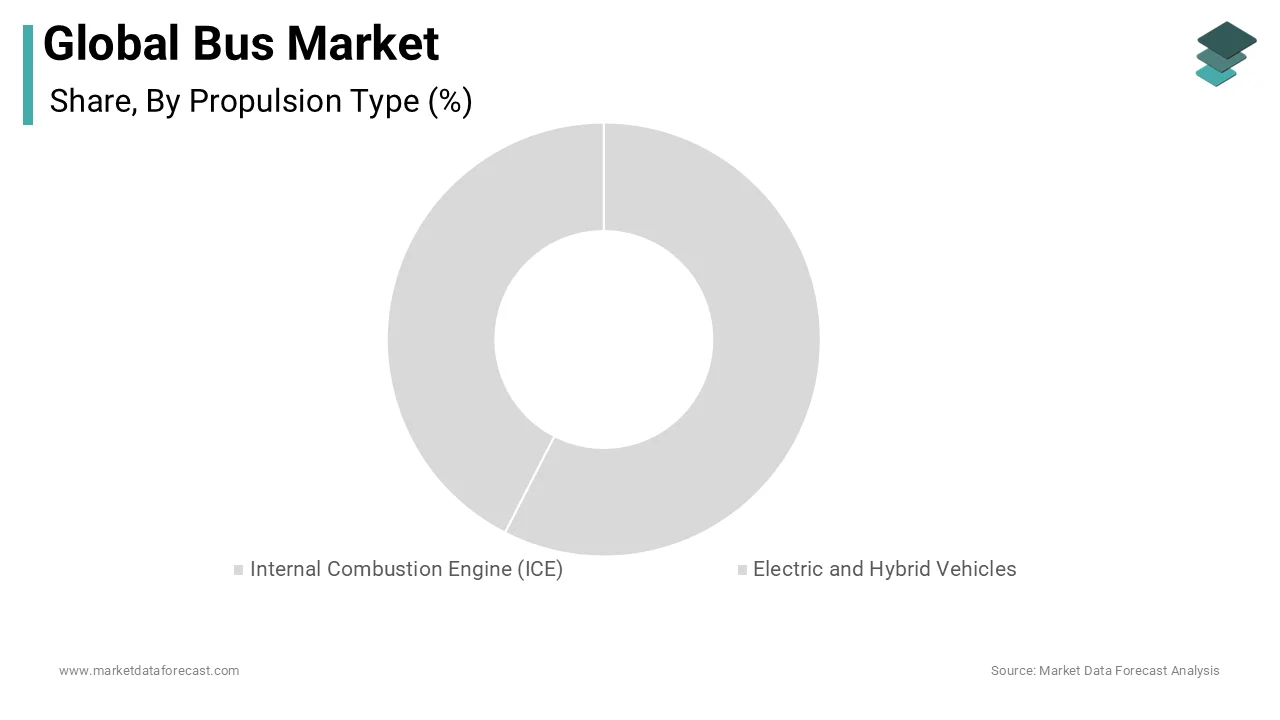
The internal combustion engine (ICE) segment dominated the global bus market share in 2025. The growth of the internal combustion engine (ICE) segment is primarily driven by its established infrastructure, lower initial acquisition cost, and widespread serviceability in remote and rural regions, despite the rise of alternative technologies. In India, a notable share of registered buses operate on diesel, as per the study, underlining the entrenched reliance on conventional engines. The durability of existing refueling networks and the absence of capital for fleet renewal in many developing economies further entrench ICE dominance.
The electric and hybrid vehicle segment is estimated to register the fastest CAGR of 14.8% from 2025 to 2033. The rapid growth of the electric and hybrid vehicle segment can be attributed to aggressive decarbonization policies and substantial public investment in zero-emission transit. China alone accounted for a notable share of global electric bus sales in 2025, with significant units in operation, as per the research. The European Union's Clean Vehicles Directive sets binding national targets for the public procurement of zero- and low-emission buses, accelerating procurement cycles across member states. As per the study, electric bus registrations have increased in recent years.
REGIONAL ANALYSIS
Asia Pacific Bus Market Insights
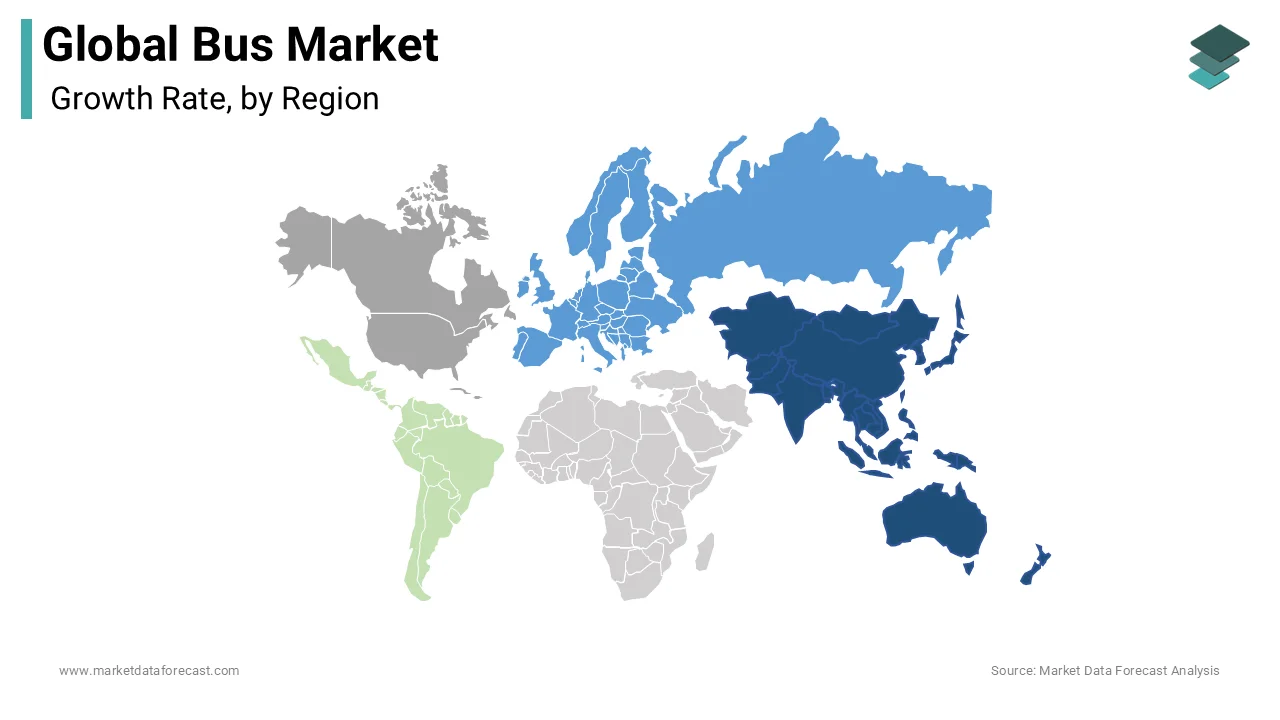
Asia Pacific was the top performer in the global bus market in 2025 and accounted for 59.7% of the global market share in 2025. The domination of Asia Pacific in the global market is primarily driven by its vast population, high urban density, and state-led investments in public mobility. India operates the largest national bus fleet, with a large number of vehicles, facilitating substantial daily trips, according to the study. China, meanwhile, leads in technological advancement, with a notable share of the world’s electric buses in service, supported by national subsidies and city-level mandates. As per the study, a notable number of electric buses were added in 2023 alone. These developments reflect a dual trajectory by scaling conventional transit while pioneering electrification, which makes the Asia Pacific the epicenter of both volume and innovation in the global bus sector.
Europe Bus Market Insights
Europe bus market is driven by technological prowess and regulatory rigor. Germany, the largest national market in Europe, operatesa nu er of buses, with a portion of new procurements in 2023 being electric or hydrogen-powered, according to the study. The Netherlands has achieved near-total electrification of urban routes, with many city buses running on zero-emission powertrains, as per research. Binding targets under the European Green Deal and substantial funding from the Connecting Europe Facility are transitioning Europe from a mature market to a testbed for next-generation transit systems by setting global benchmarks for clean mobility adoption.
North America Bus Market Insights
North America bus market is anticipated to grow steadily with a significant CAGR during the forecast period. The United States maintains a robust network of transit and school buses, forming the backbone of daily mobility across urban and rural communities. However, the fleet’s average age is several years, with transit buses surpassing their useful life, according to the study. This aging infrastructure has spurred federal initiatives such as the Low or No-Emission Vehicle Program, which has allocated a notable amount to support clean bus adoption. Canada, though smaller in scale, is advancing through programs like the Zero Emission Transit Fund, which has committed to modernizing municipal fleets, signaling a shift toward sustainability in a traditionally diesel-dependent region.
Latin America Bus Market Insights
Latin America grew steadily in the global bus market. The growth of Latin America in the global market is driven by the blend of high ridership demand and progressive urban planning. Brazil operates the largest fleet in the region, with a number of buses, primarily serving dense urban corridors in cities, as per the study. The region has embraced bus rapid transit (BRT) systems more extensively than any other developing region. Cities such as Bogotá and Mexico City have become global exemplars. This positions Latin America as a dynamic hub for scalable, cost-effective public transport solutions.
Middle East and Africa Bus Market Insights
The Middle East and Africa are likely to grow in the global bus market. The growth ofthe Middle East and Africa in the global market can be attributed to rising urban populations and increasing government focus on formalizing informal transit. The region is witnessing transformative shifts in mobility infrastructure. Saudi Arabia is spearheading a transit overhaul as part of Vision 2030, investing in public transport. South Africa maintains the most developed bus network in sub-Saharan Africa, with a number of minibus taxis and formal buses serving a portion of urban commuters, according to the study. However, fleet modernization remains a challenge.
KEY MARKET PLAYERS
Companies that play a notable role in the global bus market include Zhengzhou Yutong Bus Co., Ltd., BYD Company Limited, Daimler Truck AG, AB Volvo, Scania CV AB, MAN Truck & Bus SE, Alexander Dennis Limited, Tata Motors Limited, Ashok Leyland Limited, Anhui Ankai Automobile Co., Ltd.
TOP LEADING PLAYERS IN THE BUS MARKET
Ashok Leyland
Ashok Leyland, headquartered in Chennai, India, is a leading commercial vehicle manufacturer with deep integration into the Asia Pacific bus market. The company supplies a wide range of buses across urban, intercity, and electric segments, catering to government transport undertakings and private operators. The company expanded its EV footprint through strategic partnerships with state transport corporations and secured large-scale orders from cities like Bangalore and Hyderabad. It also established a dedicated EV manufacturing facility in Tamil Nadu to scale production. Ashok Leyland is positioning itself at the forefront of India’s public transport transformation due to continuous investment in battery technology and digital fleet management systems, which reinforces its role as a key enabler of modern, efficient, and eco-conscious bus mobility in the region.
BYD Company Ltd.
BYD, a Chinese multinational, has emerged as a global pioneer in electric bus technology, with a dominant presence acrossthe Asia Pacific. The company operates manufacturing and assembly units in China, India, and Southeast Asia, supplying zero-emission buses to major cities, including Singapore, Sydney, and Mumbai. Its vertically integrated supply chain, including battery production and motor systems, enables cost efficiency and rapid deployment. BYD is accelerating electrification and setting new benchmarks for performance and reliability in the Asia Pacific bus market by aligning with national clean energy goals and offering comprehensive after-sales support.
Tata Motors
Tata Motors, one of India’s largest automotive manufacturers, plays a pivotal role in shaping the bus ecosystem across the Asia Pacific. The company offers a comprehensive portfolio of diesel, CNG, and electric buses under its Starbus brand, widely used by state transport corporations and private fleets. Tata has intensified its push into electrification with the launch of the Ultra EV and IntelliBus series, which are now operational in cities such as Ahmedabad, Pune, and Kolkata. The company also introduced AI-powered telematics systems to enhance fleet monitoring and passenger safety.
TOP STRATEGIES USED BY KEY MARKET PARTICIPANTS
Key players in the bus market are deploying a range of strategic initiatives to consolidate their competitive advantage and respond to evolving regulatory and technological landscapes. Major strategies include product innovation, particularly in electric and hydrogen-powered buses, to align with global decarbonization mandates. Companies are increasingly investing in vertical integration, especially in battery and powertrain manufacturing, to control costs and ensure supply chain resilience. Strategic partnerships with municipal governments and public transit agencies are being leveraged to secure large-scale procurement contracts. Joint ventures with technology firms are enabling the integration of intelligent transport systems such as real-time tracking, predictive maintenance, and digital ticketing. Apart from these, localized production through regional manufacturing hubs is enhancing responsiveness to market-specific demands. Capacity expansion, especially in EV assembly and charging infrastructure, is another important focus. These multi-pronged strategies are enabling manufacturers to improve operational efficiency, reduce time-to-market, and strengthen long-term positioning in a rapidly transforming industry.
COMPETITION OVERVIEW
The competition in the bus market is intensifying as traditional manufacturers face pressure from new-age electric vehicle specialists and technology-driven mobility firms. Established players are leveraging their extensive distribution networks and government relationships, while emerging entrants are disrupting the sector with innovative propulsion systems and digital integration. The shift toward sustainable transport has redefined competitive dynamics, with companies racing to scale electric bus production and secure procurement contracts under national green mobility programs. Regional players are increasingly challenging global firms by offering cost-optimized, locally adapted solutions. Moreover, collaboration between bus manufacturers, battery suppliers, and software developers is becoming a key differentiator. The integration of smart technologies such as AI-based fleet management and contactless payment systems is further raising the entry barrier. As cities demand higher reliability, lower emissions, and improved passenger experience, the competitive landscape is evolving. It is shifting beyond hardware to cover service ecosystems, data analytics, and lifecycle management, making innovation and agility important for market growth.
MARKET SEGMENTATION
This research report on the Global Bus Market is segmented and sub-segmented into the following categories.
By Propulsion Type
- Internal Combustion Engine (ICE)
- Electric and Hybrid Vehicles
By Region
- Asia Pacific
- Europe
- North America
- Latin America
- Middle East & Africa