- Product Description Description
- Table of Contents TOC
- List of Table & Figure LOT
- Get Free Sample PDF Sample PDF
Market Size, 2025
$2.49 BnMarket Estimate, 2026
$3.25 BnMarket Forecast, 2034
$27.15 BnCAGR, 2026–2034
30.50%Global Automotive HUD Market Report: Size, Share, Trends & Forecast (2026–2034)
- Market Scope: Comprehensive global automotive Head-Up Display (HUD) industry analysis covering technology types, combiner vs. windshield configurations, vehicle classes, 2D/3D dimensions, sales channels, and regional expansion dynamics.
- Market Valuation: Valued at USD 2.49 billion in 2025, estimated at USD 3.25 billion in 2026, and projected to reach USD 27.15 billion by 2034, registering a remarkable CAGR of 30.50% from 2026 to 2034.
- Primary Growth Drivers: Escalating consumer demand for smart vehicle digital interfaces, rising emphasis on driver safety and distraction reduction, regulatory safety mandates (e.g., Euro NCAP, GSR), and deep integration with ADAS and autonomous driving systems.
Key Automotive HUD Market Segment Metrics (2026–2034)
| Category | Leading Segment (2025 Position) | Fastest-Growing Segment |
|---|---|---|
| By Technology | Conventional HUD (commanded 65.5% market share due to cost-effectiveness and proven reliability) | Augmented Reality HUD / AR-HUD (projected for high growth with immersive, context-aware visuals) |
| By HUD Type | Combiner HUD (captured 58.2% total installations due to compact footprint and easy retrofitting) | Windshield HUD (expanding rapidly via luxury and autonomous vehicle integration) |
| By Vehicle Class | Mid-Segment Vehicles (accounted for 47.1% volume, leveraging HUDs for enhanced driver engagement) | Luxury Cars (growing at a 22.8% CAGR as early adopters of holographic and AR tech) |
| By Region | Europe (led global market share supported by strict safety regulations and luxury automotive manufacturing) | Asia-Pacific (surging due to EV proliferation, smart mobility investments, and manufacturing hubs) |
Major Automotive HUD Companies & Competitive Landscape
Market Structure: Highly competitive global automotive digital cockpit and optics landscape featuring established Tier-1 suppliers competing on optical projection accuracy, AR software integration, thermal management, and cost-efficient scalability across mass-market platforms.
Key Companies: Robert Bosch GmbH, Denso Corporation, Nippon Seiki Co. Ltd., Visteon Corporation, Continental AG, Panasonic Corporation, Yazaki Corporation, Harman International Industries Inc., Garmin Ltd., and MicroVision Inc.
Global Automotive HUD Market Size
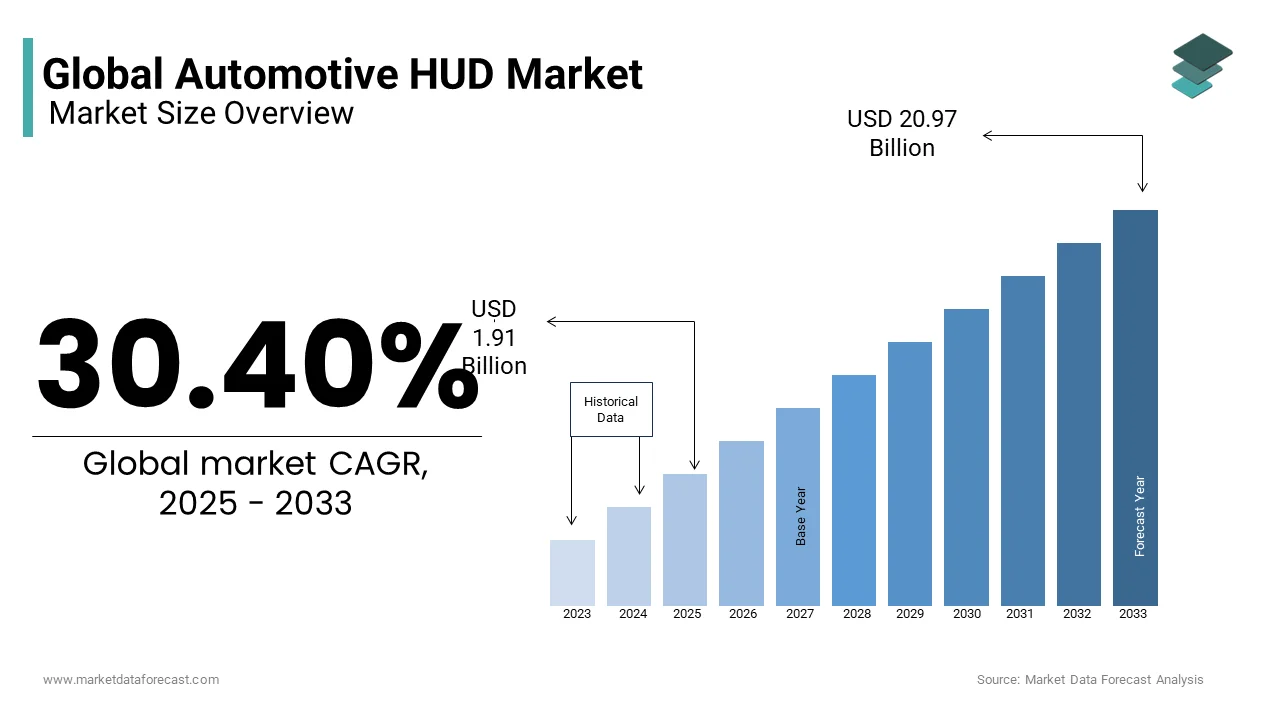
The global automotive HUD market size was valued at USD 2.49 billion in 2025 and is anticipated to reach a valuation of USD 3.25 billion in 2026 and USD 27.15 billion by 2034, growing at a CAGR of 30.50%, from 2026 to 2034.
An automotive Head-Up Display (HUD) is an advanced driver assistance system that projects critical driving information directly into the driver’s line of sight, minimizing the need to look away from the road. These displays typically show speed, navigation instructions, lane departure warnings, and adaptive cruise control data, enhancing situational awareness and safety.
The adoption of HUDs has been growing rapidly in response to increasing consumer demand for smart vehicle interfaces and regulatory pushes toward safer driving technologies. Originally developed for military aviation, HUD systems have transitioned into high-end passenger vehicles and are now becoming more accessible in mid-range models due to advancements in optical projection and augmented reality (AR) integration.
According to the National Highway Traffic Safety Administration (NHTSA), driver distraction contributes to a smaller but significant percentage of all traffic accidents in the United States. HUD technology addresses this by keeping essential data within the driver’s field of vision, thereby reducing cognitive load and reaction times.
Moreover, as per the International Transport Forum, as urban congestion and highway speeds increase globally, there is a growing emphasis on real-time data accessibility for drivers. This shift aligns with the broader movement toward semi-autonomous and fully autonomous vehicles, where intuitive human-machine interfaces like HUDs play a pivotal role in ensuring seamless interaction between the driver and vehicle systems.
MARKET DRIVERS
Rising Demand for Enhanced Driver Safety and Reduced Distraction
A primary driver of the automotive HUD market is the growing emphasis on improving driver safety by reducing visual and cognitive distractions while operating a vehicle. Traditional dashboard instruments require drivers to shift their gaze between the road and the instrument cluster, which can lead to delayed reaction times and increased accident risks.
Automotive HUDs address this challenge by projecting critical driving data—such as speed, navigation cues, and collision alerts—onto the windshield or a dedicated combiner screen, allowing drivers to maintain focus on the road ahead. Also, HUD-integrated vehicles contribute to an improvement in driver responsiveness during emergencies, reinforcing their effectiveness in real-world conditions.
Moreover, regulatory bodies such as the European New Car Assessment Programme (Euro NCAP) are increasingly recognizing HUD technology as a valuable tool in advanced driver-assistance systems (ADAS). As automakers strive to meet higher safety ratings and comply with evolving regulations, the integration of HUDs is becoming a strategic priority, particularly in premium and electric vehicles where digital cockpit experiences are emphasized.
Integration with Advanced Driver-Assistance Systems (ADAS) and Autonomous Driving Technologies
Another significant driver of the automotive HUD market is the rapid integration of HUD systems with advanced driver-assistance systems (ADAS) and autonomous driving technologies. As vehicles evolve toward higher levels of automation, the need for intuitive and real-time information delivery becomes increasingly critical. HUDs serve as a central interface for relaying sensor-based data from cameras, radar, lidar, and GPS modules, enabling drivers to make informed decisions even in complex driving environments.
Likewise, according to the Society of Automotive Engineers (SAE), over 70% of new vehicles launched in 2023 featured some level of ADAS functionality, many of which were equipped with HUDs to display lane-keeping alerts, blind-spot monitoring, and adaptive cruise control indicators. In semi-autonomous vehicles, HUDs enhance trust and usability by visually representing the car's perception of its surroundings, including pedestrian detection, lane boundaries, and route guidance.
Furthermore, major automakers such as BMW, Mercedes-Benz, and Tesla have incorporated augmented reality (AR)-based HUDs that overlay navigation arrows onto the real-world view, improving spatial orientation and reducing cognitive burden.
So, as ADAS capabilities expand, the synergy between HUD technology and vehicle intelligence continues to drive market growth across both luxury and mass-market segments.
MARKET RESTRAINTS
High Cost of Implementation and Limited Affordability in Entry-Level Vehicles
A major restraint affecting the growth of the automotive HUD market is the relatively high cost associated with implementing HUD technology, particularly in entry-level and budget-oriented vehicle segments. HUD systems require sophisticated optical components, projection units, and integration with vehicle sensors and infotainment systems, significantly increasing manufacturing costs.
This pricing constraint is particularly evident in emerging markets, where consumers prioritize affordability over technological enhancements. Moreover, a notable share of buyers in developing regions would not pay extra for HUD-equipped variants unless bundled with other essential features. Consequently, automakers are hesitant to integrate HUDs into lower-tier models without clear consumer demand, slowing down market penetration.
Apart from these, retrofitting aftermarket HUD units remains a niche solution due to compatibility issues and inconsistent performance compared to factory-installed systems.
Technical Complexity and Compatibility Challenges Across Vehicle Platforms
An additional key challenge impeding the expansion of the automotive HUD market is the technical complexity involved in integrating these systems across diverse vehicle platforms and architectures. HUDs must seamlessly interface with multiple electronic control units (ECUs), headlamps, windshield curvature, and driver seating positions, making universal design and installation difficult.
Also, according to the International Journal of Automotive Engineering, HUD calibration varies significantly based on factors such as windshield angle, cabin ergonomics, and ambient lighting conditions. Manufacturers often face additional engineering hurdles when adapting HUD systems for electric vehicles (EVs), where space constraints and battery efficiency considerations further complicate integration.
Moreover, compatibility issues arise when attempting to standardize HUD content across different brands and models. While some manufacturers use proprietary software to customize display settings, others rely on third-party suppliers, leading to inconsistencies in user experience and functional depth.
The automakers push for greater standardization in digital cockpits when there is a lack of uniformity in HUD design and implementation, which continues to pose technical barriers. Overcoming these challenges requires coordinated efforts among OEMs, Tier-1 suppliers, and software developers to ensure interoperability, ease of deployment, and enhanced user satisfaction across vehicle categories.
MARKET OPPORTUNITY
Expansion of Augmented Reality (AR) HUDs in Mass-Market Vehicles
A significant opportunity for growth in the automotive HUD market lies in the expanding adoption of augmented reality (AR) HUDs beyond luxury vehicles and into mainstream automotive segments. Unlike conventional HUDs that project basic information, AR-HUDs overlay dynamic, context-aware visuals onto the real-world driving environment, offering enhanced navigation cues, hazard warnings, and object tracking capabilities.
According to McKinsey & Company, the demand for AR-HUDs is expected to surge as automakers seek to differentiate their offerings through immersive digital experiences. These systems utilize high-resolution projection technology, combined with real-time sensor inputs, to create intuitive visualizations that improve situational awareness and reduce cognitive workload.
In addition to enhancing driver engagement, AR-HUDs are gaining traction in electric and hybrid vehicles, where energy-efficient display technologies and integration with vehicle autonomy features provide added value. Companies such as Bosch, Continental, and Visteon are investing heavily in scalable AR-HUD solutions designed for mid-range vehicle platforms, aiming to reduce costs and facilitate broader market access.
Furthermore, regulatory support for advanced driver-assistance systems (ADAS) and evolving consumer expectations regarding in-cabin technology are accelerating the adoption of AR-HUDs. Therefore, AR-based HUDs are poised to become a standard feature in next-generation vehicles, unlocking substantial growth potential across the global automotive industry.
Increasing Adoption of HUDs in Commercial and Fleet Vehicles for Enhanced Operational Efficiency
Another emerging opportunity in the automotive HUD market is the growing interest in deploying HUD technology within commercial and fleet vehicles to improve operational efficiency, safety, and driver productivity. With logistics and transportation companies under pressure to optimize fuel consumption, reduce downtime, and enhance driver alertness, HUDs offer a compelling solution by providing real-time data directly in the driver’s field of view.
According to the American Transportation Research Institute (ATRI), fatigue and distraction are leading causes of accidents in the freight and delivery sector. HUD-integrated fleet vehicles can mitigate these risks by displaying speed limits, route guidance, engine diagnostics, and collision warnings without requiring drivers to divert attention from the road.
Several major truck manufacturers, including Daimler Trucks North America and Volvo Trucks, have begun incorporating HUDs into their latest heavy-duty models as part of broader digital cockpit upgrades. Also, telematics providers such as Geotab and Samsara are exploring integrations with HUD systems to deliver fleet-specific analytics, such as fuel efficiency metrics and maintenance alerts, directly to drivers.
Beyond long-haul transport, last-mile delivery services and ride-hailing fleets are also showing interest in HUD-enabled vehicles. As companies seek to enhance driver training and reduce accident-related costs, the integration of HUD technology presents a strategic advantage. This trend opens up a new revenue stream for automotive HUD suppliers and accelerates market expansion beyond traditional passenger vehicle applications.
MARKET CHALLENGES
Rapid Technological Evolution Leading to Short Product Lifecycles
One of the foremost challenges facing the automotive HUD market is the rapid pace of technological evolution, which results in shorter product lifecycles and continuous pressure on manufacturers to innovate. Unlike traditional mechanical vehicle components, HUD systems are subject to frequent updates driven by advancements in display technology, augmented reality (AR), and integration with artificial intelligence (AI).
Also, this necessitates ongoing research and development investments to keep pace with shifting consumer expectations and competitive pressures. Companies such as Denso, Panasonic, and Nippon Seiki must continuously refine their offerings to incorporate features like holographic projection, eye-tracking, and dynamic brightness adjustments.
Moreover, the emergence of new materials and manufacturing techniques—such as microLED and laser-based projection—further complicates backward compatibility and scalability across vehicle models. Automakers seeking to introduce next-generation HUDs often face challenges in maintaining consistency across model lines, especially when transitioning from conventional LCD-based displays to more advanced optical systems.
This constant innovation cycle increases development costs and poses financial risks for suppliers, particularly smaller firms lacking the resources to sustain large-scale R&D initiatives.
Regulatory and Standardization Barriers Across Global Markets
A further pressing challenge in the automotive HUD market is the lack of standardized regulations and varying compliance requirements across different regions, which complicates global deployment and increases time-to-market for new products. While some countries have established guidelines for HUD placement, brightness, and driver visibility, others lack comprehensive frameworks, leading to fragmented approval processes.
For instance, Japan mandates strict alignment specifications for HUDs to prevent driver glare, whereas the United States focuses more on occupant protection standards that indirectly influence HUD design.
In Europe, the General Safety Regulation (GSR) allows HUD integration but does not define specific testing protocols, resulting in inconsistent interpretations among certification bodies. This regulatory ambiguity forces automotive suppliers to tailor their HUD designs for individual markets, increasing development costs and delaying product launches.
Moreover, as HUDs become more integrated with autonomous driving systems, concerns around information overload and driver distraction have prompted calls for stricter oversight. Organizations such as the ISO and SAE are working on draft standards for HUD content prioritization and visual ergonomics, but consensus remains elusive.
REPORT COVERAGE
| REPORT METRIC | DETAILS |
| Market Size Available | 2025 to 2034 |
| Base Year | 2025 |
| Forecast Period | 2026 to 2034 |
| CAGR | 30.50% |
| Segments Covered | By Technology, HUD Type, Vehicle Class, Vehicle Type, Propulsion Type, Sales Channel, Dimension Type, Component Type, and Region. |
| Various Analyses Covered | Global, Regional & Country Level Analysis, Segment-Level Analysis, DROC, PESTLE Analysis, Porter’s Five Forces Analysis, Competitive Landscape, Analyst Overview of Investment Opportunities |
| Regions Covered | North America, Europe, APAC, Latin America, Middle East & Africa |
| Market Leaders Profiled | Robert Bosch GmbH, Denso Corporation, Nippon Seiki Co. Ltd., Visteon Corporation, Continental AG, Panasonic Corporation, Yazaki Corporation, Harman International Industries Inc., Garmin Ltd., MicroVision Inc., and Others. |
SEGMENT ANALYSIS
By Technology Insights
Conventional HUD
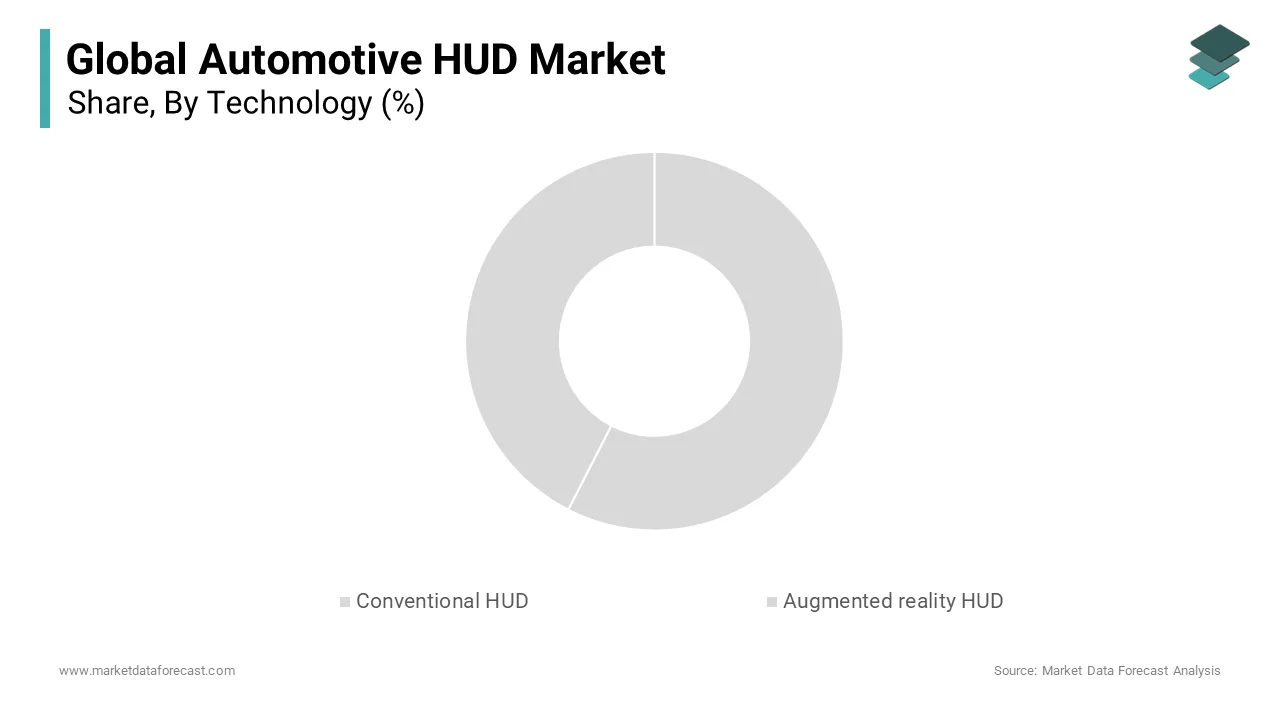
Conventional HUD technology dominated the automotive HUD market, accounting for 65.5% of the total market share in 2025. This segment includes traditional head-up displays that project basic driving information such as speed, fuel levels, and engine diagnostics onto a combiner or windshield.
The continued dominance of conventional HUDs is largely driven by their widespread adoption in mid-segment and luxury vehicles, where cost-effectiveness and proven reliability are key considerations.
Another major factor supporting this segment’s leadership is its established presence in existing vehicle platforms. Major automakers such as Toyota, Honda, and Volkswagen have integrated conventional HUDs into multiple model lines, leveraging economies of scale to reduce production costs. In addition, regulatory bodies have well-defined guidelines for these systems, facilitating smoother certification and deployment across global markets.
Augmented Reality HUD
Augmented Reality Head-Up Displays (AR-HUDs) are experiencing the fastest growth within the automotive HUD market, projected to expand at a CAGR of 24.7% over the years, driven by their ability to deliver highly immersive and context-aware driving experiences.
Unlike conventional HUDs, AR-HUDs project dynamic visualizations that align with real-world objects, enhancing driver awareness through features like lane guidance, pedestrian alerts, and adaptive cruise control indicators overlaid onto the road ahead.
A key driver behind this growth is the integration of AR-HUDs with advanced driver-assistance systems (ADAS). Companies such as BMW, Mercedes-Benz, and Tesla have incorporated AR-HUDs into their latest electric and semi-autonomous vehicles, enabling seamless interaction between the driver and vehicle intelligence. As per the Society of Automotive Engineers (SAE), AR-HUDs improve situational awareness, reducing cognitive load and reaction times in complex driving scenarios.
Furthermore, advancements in projection technologies—such as microLED and laser-based systems—are enabling higher resolution, wider field-of-view, and improved daylight visibility, making AR-HUDs more viable for mass-market adoption.
By HUD Insights
Combiner HUD
The combiner HUD segment secured the biggest market share in the automotive HUD industry, capturing 58.2% of total installations in 2025. A combiner HUD utilizes a dedicated transparent screen positioned on the dashboard to project critical driving data, offering a compact and cost-effective solution for vehicle manufacturers.
A main reason for its dominance is its ease of integration into existing vehicle architectures. Unlike windshield HUDs, which require specialized coating and calibration, combiner HUDs can be retrofitted into various car models without significant modifications to the windshield or cabin structure.
Additionally, the combiner type is widely adopted in electric and hybrid vehicles where space optimization and energy efficiency are prioritized. Automakers such as Hyundai, Kia, and Renault have extensively used combiner HUDs in their EV lineups due to their lightweight design and minimal power consumption. Moreover, consumer preference for modular HUD systems that offer flexibility in display positioning has further reinforced the popularity of combiner HUDs.
Windshield HUD
Windshield HUDs are emerging as the fastest-growing segment in the automotive HUD market, anticipated to expand at a CAGR of 19.4% in the future, fueled by their superior integration with advanced driver-assistance systems (ADAS) and growing adoption in high-end and autonomous vehicles.
Unlike combiner HUDs, windshield HUDs project information directly onto the vehicle's front windshield, providing a larger field of view and enhanced visibility for drivers. Also, windshield HUDs are becoming a preferred option among luxury automakers such as Audi, BMW, and Mercedes-Benz, who are incorporating them into flagship models to elevate the digital driving experience.
One of the key factors contributing to this rapid growth is the alignment of windshield HUDs with augmented reality (AR) capabilities. These systems can overlay navigation cues, lane-keeping indicators, and hazard warnings onto the real-world environment, improving driver responsiveness and safety. Moreover, windshield HUDs enhance spatial orientation, particularly in low-visibility conditions and high-speed environments.
In addition, advancements in optical materials and anti-reflective coatings have addressed previous issues related to glare and distortion, making windshield HUDs more practical for widespread use. As automakers continue to push for greater integration of human-machine interface (HMI) technologies, the windshield HUD segment is set to gain even stronger momentum in the coming years.
By Vehicle Class Insights
Mid-Segment Vehicles
Mid-segment vehicles were the leading consumer base for automotive HUD systems, accounting for 47.1% of total market volume in 2025. This category includes popular sedan and SUV models offered by brands such as Toyota, Honda, Ford, and Hyundai, which are increasingly integrating HUD technology to enhance perceived value and driver engagement.
Automakers are leveraging HUDs as a differentiating feature to attract tech-savvy buyers without significantly increasing vehicle pricing. Another key driver is the growing influence of younger consumers who prioritize in-cabin technology when purchasing vehicles.
Moreover, the integration of HUDs with smartphone connectivity and ADAS functionalities has made them more appealing in mid-range models. As Tier-1 suppliers develop cost-efficient HUD modules tailored for mass production, the mid-segment vehicle class is expected to maintain its leading position in the automotive HUD market.
Luxury Cars
Luxury cars are witnessing the highest growth rate in the automotive HUD market, projected to expand at a CAGR of 22.8% during the forecast period, driven by their role as early adopters of advanced display technologies and digital cockpit innovations.
Luxury automakers such as Mercedes-Benz, BMW, Porsche, and Lexus have been at the forefront of integrating sophisticated HUD systems, including augmented reality (AR)-based projections and holographic displays. These features are marketed as premium enhancements that elevate the overall driving experience while reinforcing brand differentiation.
According to Deloitte’s 2023 Global Automotive Executive Survey, over 80% of luxury vehicle buyers expect HUD integration as part of their digital dashboard configuration, highlighting its significance in brand perception and customer satisfaction. In response, automakers are investing heavily in next-generation HUDs that offer customizable interfaces, eye-tracking, and dynamic content adaptation based on driving conditions.
Moreover, the convergence of HUD technology with Level 2+ and Level 3 autonomous driving systems is accelerating adoption in the luxury segment. HUDs serve as a central interface for relaying sensor-based information, such as lane changes, obstacle detection, and route guidance, ensuring seamless human-machine interaction in semi-autonomous environments.
By Dimension Insights
2D HUD
The 2D HUD segment continued to prevail in the automotive HUD market, capturing a substantial share of the total market in 2025. This segment encompasses traditional flat-display HUDs that project essential driving data such as speed, RPM, and turn-by-turn navigation instructions onto a combiner or windshield surface.
The widespread adoption of 2D HUDs is primarily attributed to their cost-effectiveness, simplicity, and compatibility with existing vehicle architectures. Another major factor contributing to its dominance is the extensive integration of 2D HUDs in both the economy and mid-range vehicle segments. Automakers such as General Motors, Nissan, and Volvo have standardized 2D HUDs across multiple model lines to provide consistent user experiences while maintaining affordability.
Besides, regulatory compliance is more straightforward for 2D HUDs, as they do not introduce complexities related to depth perception or visual overload. Given their entrenched presence in the market and continued support from Tier-1 suppliers, 2D HUDs are expected to maintain their leadership position for the foreseeable future.
3D HUD
3D HUDs are emerging as the fastest-growing segment in the automotive HUD market, projected to expand at a CAGR of 31.2% between 2025 and 2033, driven by their ability to create depth-enhanced visualizations that improve driver attention and spatial awareness.
Unlike traditional 2D HUDs, 3D HUDs utilize multi-layered projection techniques to present information at varying depths, allowing drivers to perceive distance and movement more naturally. According to McKinsey & Company, 3D HUDs are increasingly being integrated into premium and autonomous-ready vehicles to enhance human-machine interaction and support advanced driver-assistance functions.
One of the key growth drivers is the incorporation of 3D HUDs into next-generation electric and autonomous vehicles. Companies such as Mercedes-Benz, BMW, and Sony have demonstrated prototypes featuring holographic HUDs that project navigational arrows, collision warnings, and lane boundaries in three-dimensional space, creating a more intuitive driving experience.
Apart from these, advancements in optical engineering and display materials—such as volumetric projection and light field technology—are enabling clearer and more immersive visuals. Research conducted by the Fraunhofer Institute indicates that 3D HUDs can reduce cognitive workload by up to 25% compared to 2D counterparts, making them a valuable asset in complex urban environments.
So, as automakers strive to differentiate their digital cockpits and meet evolving consumer expectations, 3D HUDs are set to become a defining feature of future mobility.
REGIONAL ANALYSIS
North America Market Analysis
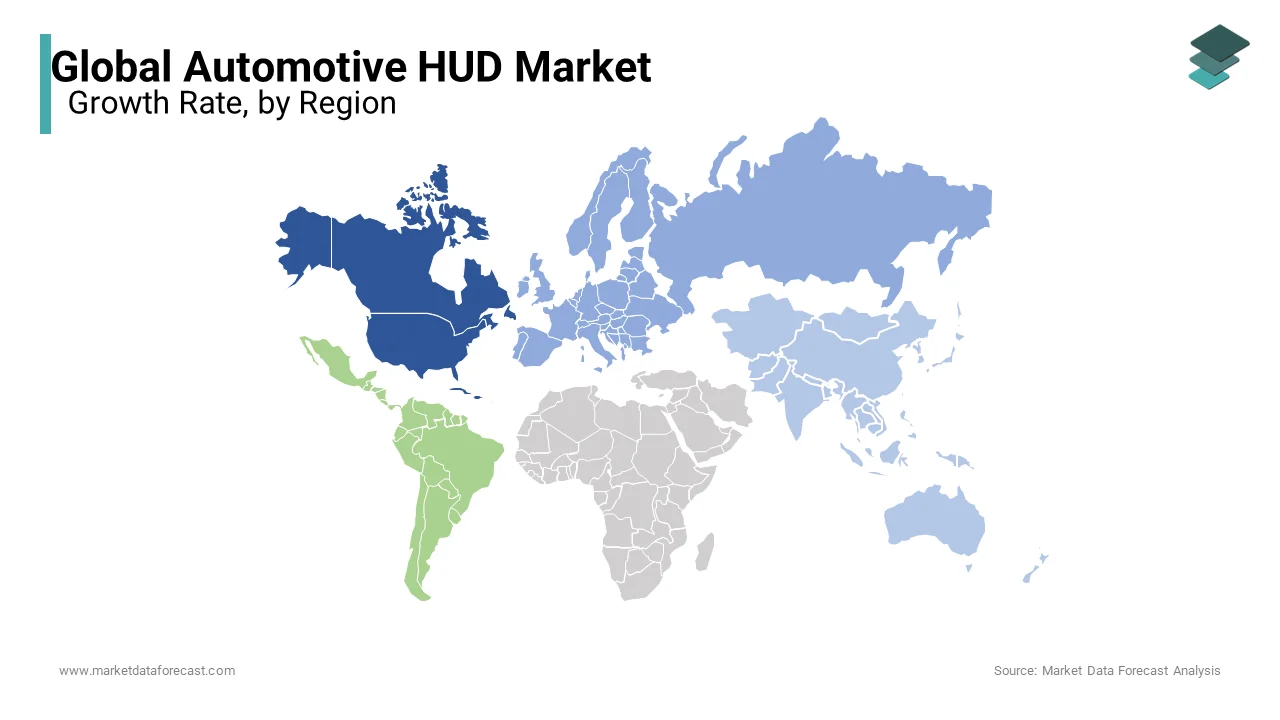
North America maintained a prominent position in the global automotive HUD market, accounting for 28.7% of total regional revenue in 2025. The United States, in particular, serves as a key growth hub due to the strong presence of major automakers, technology innovators, and regulatory agencies advocating for safer and smarter vehicle interfaces.
A primary driver of market expansion in this region is the rising adoption of advanced driver-assistance systems (ADAS) and connected vehicle technologies. Besides, partnerships between Tier-1 suppliers such as Visteon, Denso, and Bosch with American automakers have accelerated the integration of both conventional and augmented reality HUDs. The growing popularity of electric vehicles (EVs), particularly those produced by Tesla, Lucid, and Rivian, has further spurred investment in digital cockpits and heads-up display functionalities.
Then, with continuous technological advancements and supportive government initiatives aimed at improving road safety, North America remains a critical market for automotive HUD development and deployment.
Europe Market Analysis
Europe led the global automotive HUD market with a significant market share in 2025, driven by the region’s strong automotive manufacturing base and early adoption of advanced mobility technologies. Countries such as Germany, France, and the United Kingdom have been at the forefront of integrating HUD systems into both luxury and mainstream vehicle models.
Germany, home to major automotive giants like BMW, Mercedes-Benz, and Audi, plays a pivotal role in shaping the regional HUD landscape. Another key factor supporting market growth is the implementation of stringent road safety regulations by the European Commission. The General Safety Regulation (GSR) mandates the inclusion of advanced driver-assistance features in new vehicles, indirectly boosting demand for HUD-integrated systems that enhance situational awareness.
Also, collaborations between European research institutions and automotive suppliers have led to breakthroughs in projection technology, including laser-based and holographic HUDs. As the region transitions toward electrification and autonomous driving, Europe is expected to maintain its leadership in automotive HUD adoption.
Asia-Pacific Market Analysis
Asia-Pacific contributes majorly to the global automotive HUD market, with China, Japan, and South Korea emerging as key players in both production and technological development. The region’s rapid urbanization, expanding middle-class population, and increasing investments in smart mobility infrastructure have collectively fueled demand for advanced vehicle interfaces.
China, in particular, has seen a surge in HUD adoption due to the proliferation of electric vehicles (EVs) and the government’s push for intelligent transportation systems. In addition, Japanese automakers such as Toyota, Honda, and Mazda have also embraced HUD technology, integrating it into both domestic and export-oriented models. Meanwhile, South Korean firms like Hyundai and LG Electronics are developing next-generation AR-HUD solutions tailored for autonomous driving applications.
In addition to OEM adoption, the region is witnessing strong aftermarket growth, particularly in India and Southeast Asia, where retrofitting HUD units is gaining traction among budget-conscious consumers. As local manufacturing capabilities strengthen and consumer preferences evolve, the Asia-Pacific region is poised to play an increasingly influential role in the global HUD market.
Middle East and Africa Market Analysis
The Middle East and Africa are witnessing growth in the global automotive HUD market, with limited penetration compared to other regions. However, select Gulf Cooperation Council (GCC) countries, particularly the United Arab Emirates and Saudi Arabia, are showing increased interest in advanced vehicle technologies, including digital cockpit solutions.
A key driver of market activity in this region is the presence of affluent consumers who favor luxury vehicles equipped with cutting-edge features. Moreover, fleet modernization programs in sectors such as logistics and ride-hailing are encouraging the adoption of HUD-enabled commercial vehicles. Governments in Qatar and Kuwait have initiated pilot projects exploring the use of HUD-integrated public transport systems to improve safety and operational efficiency.
Despite a relatively low overall market size, the Middle East and Africa present niche opportunities for automotive HUD suppliers targeting premium and commercial vehicle segments, particularly as digital transformation gains momentum across the region.
Latin America Market Analysis
Latin America represents a smaller but gradually evolving segment of the global automotive HUD market. Brazil and Mexico lead the region in terms of automotive manufacturing and consumer interest in digital vehicle features.
The primary driver of HUD adoption in Latin America is the increasing importation of mid-to-high-end vehicles equipped with advanced infotainment and safety systems. Also, Brazil, despite economic challenges, has shown potential for growth due to rising urbanization and the expansion of shared mobility services that prioritize modern fleet upgrades. Local dealerships and independent distributors have also begun offering aftermarket HUD kits tailored for domestic vehicle models, catering to budget-conscious consumers seeking enhanced driving experiences.
While the region still lags in terms of large-scale OEM integration, Latin America offers emerging opportunities for HUD suppliers willing to invest in localized distribution networks and consumer education initiatives, particularly in urban centers with growing demand for connected and safe driving technologies.
COMPETITIVE LANDSCAPE
The competitive landscape of the automotive HUD market is highly dynamic, characterized by rapid technological advancements and an increasing convergence between automotive engineering and digital interface design. A handful of Tier-1 suppliers dominate the space, leveraging deep industry relationships and proprietary optical technologies to secure long-term contracts with major automakers. These companies compete not only on product innovation but also on integration capabilities, cost efficiency, and scalability across different vehicle classes.
New entrants and niche players are emerging with specialized offerings such as 3D projection, eye-tracking, and laser-based HUD systems, challenging traditional manufacturers to accelerate their R&D efforts. Meanwhile, collaborations between established suppliers and software developers are shaping the next phase of HUD evolution, where contextual awareness and adaptive content delivery become standard features.
Automakers are increasingly viewing HUDs as a key component of the digital cockpit experience, prompting suppliers to differentiate themselves through customizable interfaces and compatibility with semi-autonomous driving functions. As competition intensifies, the ability to balance performance, affordability, and regulatory compliance will determine which players lead the market in the coming years.
KEY MARKET PLAYERS
A few of the market players in the global Automotive HUD market include
- Robert Bosch GmbH
- Denso Corporation
- Nippon Seiki Co. Ltd
- Visteon Corporation
- Continental AG
- Panasonic Corporation
- Yazaki Corporation
- Harman International Industries Inc.
- Garmin Ltd
- MicroVision Inc
Top Players in the Market
One of the leading players in the automotive HUD market is Bosch, a global leader in automotive technology and electronics. Bosch has been at the forefront of developing advanced head-up display systems that integrate seamlessly with vehicle infotainment, driver assistance, and navigation systems. The company’s expertise in sensor fusion and digital cockpit technologies has positioned it as a preferred supplier for both conventional and augmented reality HUDs across multiple vehicle segments.
Valeo is a French automotive supplier known for its innovative approach to human-machine interface (HMI) solutions. Valeo has played a crucial role in advancing windshield-based HUD systems that offer enhanced visibility and real-time driving data projection. Its focus on integrating HUDs with ADAS features has made it a strategic partner for several European and Asian automakers seeking to enhance driver safety and engagement.
Denso Corporation is another leading Japanese automotive components manufacturer. Also, Denso has significantly contributed to the evolution of automotive HUDs by pioneering compact, high-resolution display modules tailored for mid-range and luxury vehicles. The company collaborates closely with Toyota and other global OEMs to incorporate HUD technology into next-generation electric and autonomous vehicles, reinforcing its strong presence in the global market.
Top Strategies Used by Key Market Participants
A primary strategy employed by key players in the automotive HUD market is continuous investment in research and development to advance display technologies. Companies are focusing on improving optical clarity, expanding field-of-view, and incorporating holographic and augmented reality elements to create more immersive and intuitive driver experiences.
Another critical approach is strategic partnerships with automakers and tech firms to co-develop integrated digital cockpit solutions. By aligning with OEMs early in the vehicle design process, suppliers ensure seamless integration of HUDs with ADAS, navigation, and connectivity platforms, enhancing their value proposition in new vehicle models.
Lastly, companies are actively expanding their global footprint through localized manufacturing and R&D centers. This enables them to meet regional regulatory requirements, reduce production costs, and respond more effectively to evolving consumer preferences across different automotive markets.
RECENT MARKET NEWS
- In February 2023, Bosch unveiled a next-generation augmented reality HUD system featuring an expanded field of view and dynamic object tracking, positioning itself as a leader in immersive driver interface solutions for future mobility platforms.
- In June 2023, Valeo partnered with a leading Chinese automaker to co-develop an AI-integrated windshield HUD capable of adapting displayed information based on driver behavior and environmental conditions, enhancing situational awareness.
- In October 2023, Denso Corporation launched a lightweight, energy-efficient HUD module specifically designed for electric vehicles, addressing the growing demand for space optimization and battery efficiency in next-generation automotive designs.
- In January 2024, Panasonic Automotive introduced a holographic HUD prototype at CES, showcasing depth-perception enhancements that allow drivers to perceive projected data at varying distances, improving response accuracy in complex driving scenarios.
- In May 2024, Visteon announced a collaboration with a German premium carmaker to integrate its SmartCore platform with a full-windshield AR-HUD system, combining digital instrument clusters and HUD functionalities into a unified digital cockpit architecture.
MARKET SEGMENTATION
This research report on the global automotive HUD market is segmented and sub-segmented into the following categories.
By Technology
- Conventional HUD
- Augmented Reality (AR) HUD
- 3D HUD
By HUD Type
- Windshield HUD
- Combiner HUD
By Vehicle Class
- Economy Cars
- Mid-Segment Cars
- Luxury Cars
By Vehicle Type
- Passenger Cars
- Commercial Vehicles
- Off-Highway Vehicles
By Propulsion Type
- Internal Combustion Engine (ICE)
- Electric Vehicles (EVs)
By Sales Channel
- Original Equipment Manufacturer (OEM)
- Aftermarket
By Dimension Type
- 2D HUD
- 3D HUD
By Component Type
- Hardware
- Software
By Region
- North America
- Europe
- Asia Pacific
- Latin America
- Middle East and Africa