- Product Description Description
- Table of Contents TOC
- List of Table & Figure LOT
- Get Free Sample PDF Sample PDF
Market Size, 2025
$109.89 BnMarket Estimate, 2026
$120.62 BnMarket Forecast, 2034
$254.07 BnCAGR, 2026–2034
9.76%Global Automotive Smart Factory Market Report: Size, Share, Trends & Forecast (2026–2034)
- Market Scope: Comprehensive global automotive smart factory industry analysis covering component types, software solutions, vehicle types, end-user settings, regional leadership frameworks, and cyber-physical automation systems.
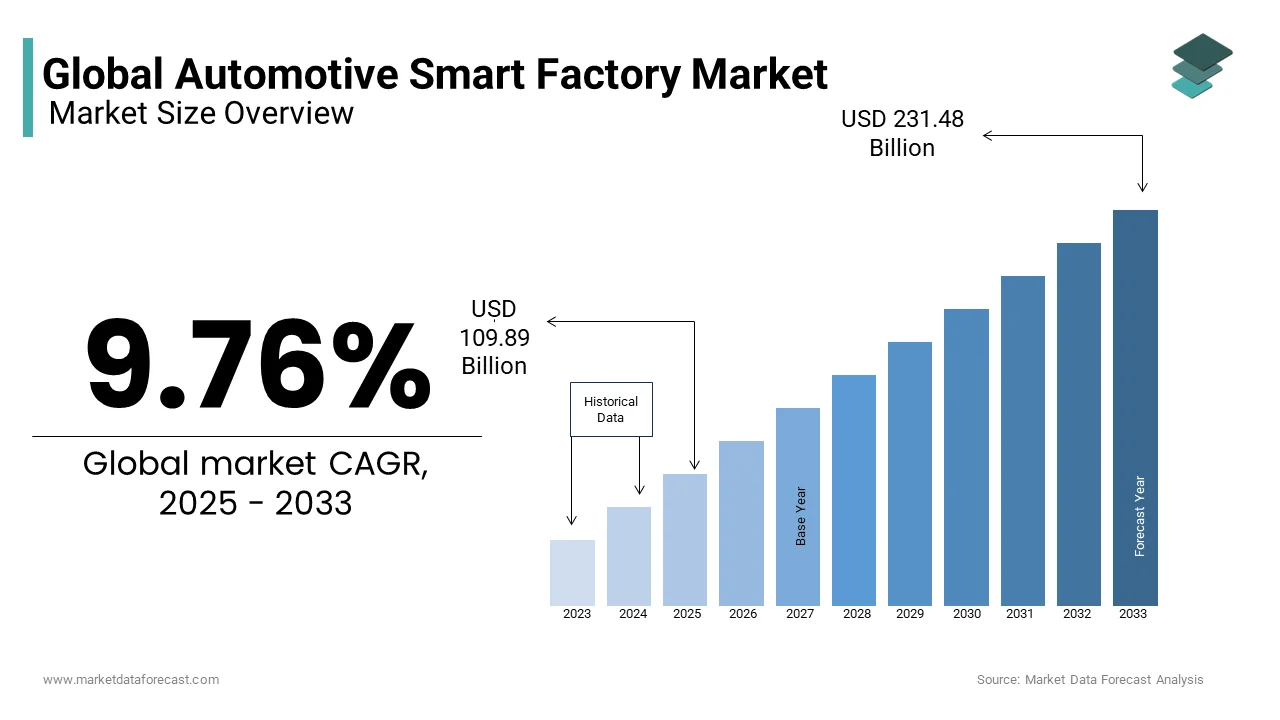
- Market Valuation: Valued at USD 109.89 billion in 2025, estimated at USD 120.62 billion in 2026, and projected to reach USD 254.07 billion by 2034, registering a strong CAGR of 9.76% from 2026 to 2034.
- Primary Growth Drivers: Rapid evolution of the Internet of Things (IoT), increasing deployment of commercial and industrial robots in manufacturing, and the integration of connected enterprises and enterprise resource planning (ERP) systems to optimize material flows and energy consumption.
Global Automotive Smart Factory Market Segment Metrics (2026–2034)
| Category | Leading Segment (2025 Position) | Fastest-Growing Segment |
|---|---|---|
| By Component | Industrial Robots (most substantial revenue-generating segment for automation and productivity) | Refurbished robotics and automated material handling |
| By Solution | Enterprise Resource Planning (ERP) software applications | Production Execution Systems (MES) and rapid data models |
| By Vehicle Type | Passenger Vehicles (held the most substantial portion of market revenue) | Commercial Vehicles (driven by global trade activities) |
| By Region | Asia-Pacific (largest revenue-generating region led by China and Japan) | North America (high adoption of advanced industrial automation) |
Major Automotive Smart Factory Market Players & Industry Structure
Market Structure: Highly competitive global landscape featuring automation conglomerates and technology providers competing on advanced cyber-physical integration, industrial robotics, energy efficiency, and scalable MES software templates.
Key Companies: Schneider Electric, ABB, FANUC, Emerson Electric, General Electric, Yokogawa Electric, Honeywell International, Rockwell Automation, Mitsubishi Electric, Siemens, and Robert Bosch.
Global Automotive Smart Factory Market Size
The global automotive smart factory market size was valued at USD 109.89 billion in 2025 is anticipated to rise from USD 120.62 billion in 2026 to reach from USD 254.07 billion by 2034, growing at a CAGR of 9.76% during the forecast period from 2026 to 2034.
Smart Factory is an advanced foundry that has cyber-physical systems where materials are often moved efficiently across the factory floor. This automation is often deployed within 60 days to streamline and track the materials flow through the power of production. Smart Factory provides data models and factory-specific & MES templates for rapid use.
The expansion of the global automotive smart factory market is propelled by the evolution of the Internet of Things (IoT), increasing the use of enabling technologies in automotive, rising adoption of commercial robots in the manufacturing sector, and connected enterprises alongside production to cater to the increasing population.
MARKET DRIVERS
The factors that are driving the expansion of the global automotive smart factory market are the rising practice of advanced base for manufacturing bases, increased specialization in energy consumption, and improved efficiency of production. The booming industry of refurbished robots and untapped fields like industrial robots and RFID are predicted to create a lot of opportunities for the expansion of the market.
However, the factors that are hampering the expansion of the market are a lack of interoperability & standardization, along with the shortage of trained workers.
REPORT COVERAGE
| REPORT METRIC | DETAILS |
| Market Size Available | 2025 to 2034 |
| Base Year | 2025 |
| Forecast Period | 2026 to 2034 |
| CAGR | 9.76% |
| Segments Covered | By Product Type, Application, End-User, Distribution Channel, and Region. |
|
Various Analyses Covered | Global, Regional & Country Level Analysis, Segment-Level Analysis, DROC, PESTLE Analysis, Porter’s Five Forces Analysis, Competitive Landscape, Analyst Overview of Investment Opportunities |
| Regions Covered | North America, Europe, APAC, Latin America, Middle East & Africa |
| Market Leaders Profiled | Schneider Electric, ABB, FANUC, Emerson Electric, General Electric, Yokogawa Electric, Honeywell International, Rockwell Automation, Mitsubishi Electric, Siemens, and Robert Bosch. |
SEGMENT ANALYSIS
By Component Insights
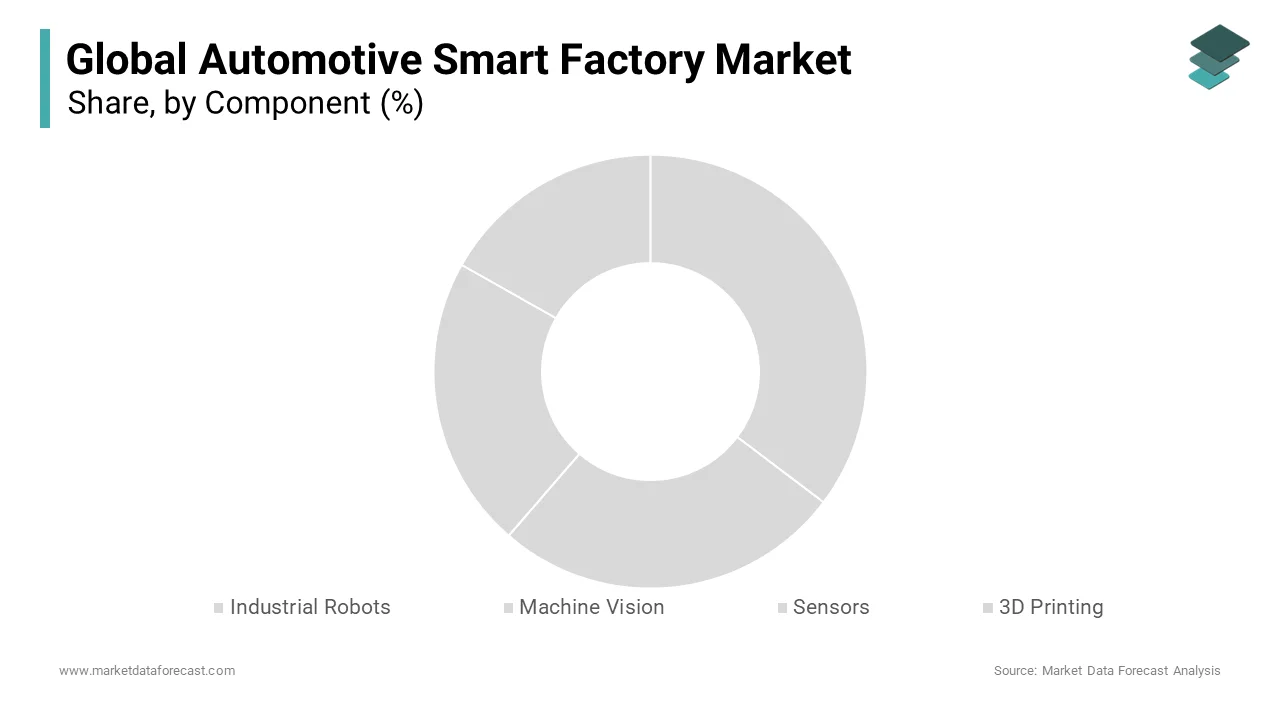
Industrial Robot is the most substantial revenue-generating segment thanks to differentiated products for various purposes. The marketplace for industrial robots is likely to account for the largest share of the worldwide automotive smart factory market during the forecast period. Implementing industrial robotics in smart manufacturing processes can improve productivity, reduce human errors, and increase production volume.
By Solution Insights
Enterprise resource planning (ERP) is the largest revenue-generating segment because of the usage of software applications to embody the processes and products, relationships between activities & functions, procedures, and knowledge flow. The recent trends that are seen within the global automotive smart factory market are the development of Production Execution Systems (MES), data models for rapid usage, and factory-specific templates. Moreover, the increasing industries of refurbished robots are projected to create lucrative growth opportunities within the global automotive smart factory market.
By Vehicle Type Insights
Of the two vehicle types, the passenger vehicles held the most substantial portion of the global automotive smart factory business in terms of revenue in the review period. This segment is also expected to experience a remarkable growth rate in the foreseen years due to the increasing demand for passenger cars in both developed and developing regions. In addition, the rising production units of car manufacturers and investments in research and development activities to introduce innovative products in the market will create enormous growth potential for the market of passenger cars around the world. However, the commercial vehicles segment is also projected to experience a considerable demand in the coming years, attributed to the increased trade activities in several parts of the world.
REGIONAL ANALYSIS
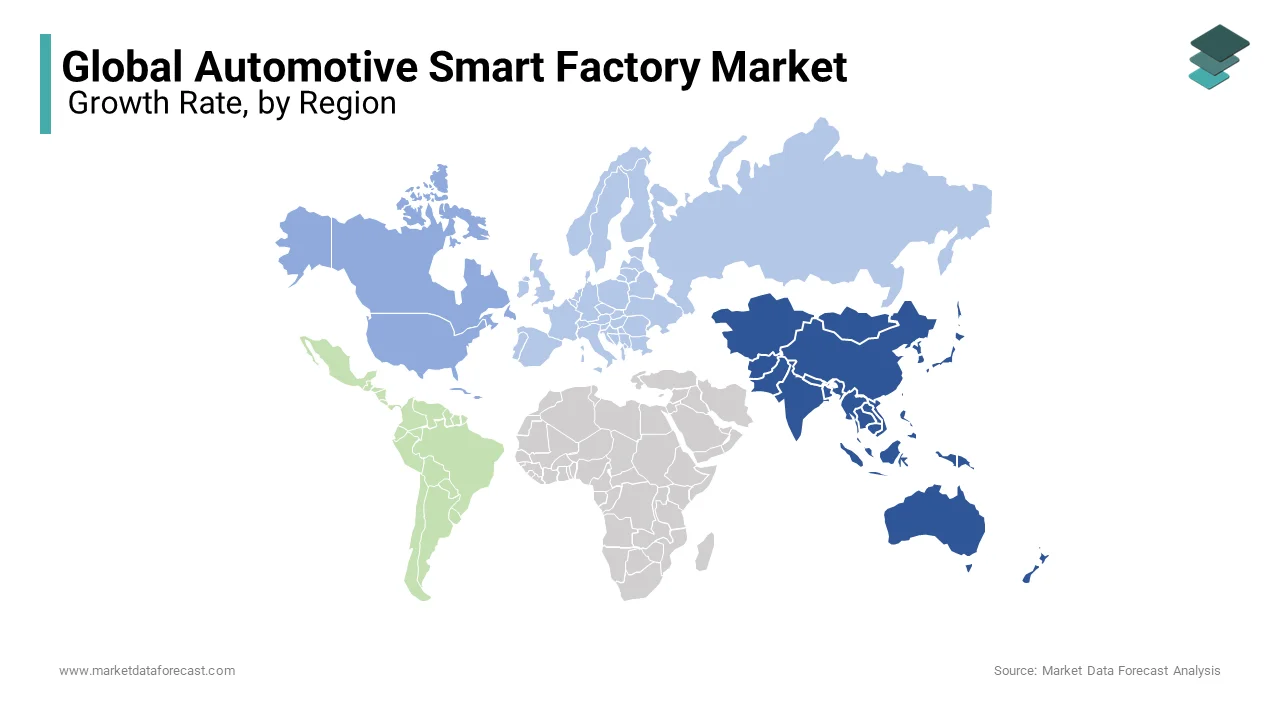
Asia Pacific, followed by North America, is the largest revenue-generating region in the global automotive smart factory market because of its increasing adoption of Smart factories within the automotive industry. Among the varied developing economies in the Asia Pacific, China has been using advanced industrial practices by implementing automation technologies in the manufacturing sector. Information integration and intellectualization are the central focus of government policies, which also contributed to the growth of the Asia Pacific automotive smart factory market. Moreover, various research institutions and organizations are working together to enhance vehicle manufacturing processes in China. Japan is additionally playing a big role in boosting growth in this market. Several leading giants in the automotive industry are opening their production units in the Asia Pacific region, supporting the business expansion.
KEY MARKET PLAYERS
Some of the leading players in the global automotive smart factory market include
- Schneider Electric
- ABB
- FANUC
- Emerson Electric
- General Electric,
- Yokogawa Electric
- Honeywell International
- Rockwell Automation
- Mitsubishi Electric
- Siemens
- Robert Bosch
RECENT MARKET NEWS
- BSES Yamuna Power Ltd (BYPL) and Schneider Electric have signed an agreement to supply safety and residential automation products. The partnership envisages making electricity usage safer, smarter, and more sustainable using technology and creating awareness. This may be accomplished through two programs and by dealing firmly with the Resident Welfare Associations (RWAs), Industrial Welfare Associations, and nominated local electricians in East and Central Delhi. Consumers also will be offered Schneider Electric's Residual Current Circuit Breakers (RCCB), a fireguard that detects earth leakage in one's premises, automatically tripping and disconnecting the electricity supply to the premises/equipment, preventing severe mishaps. It also detects the faulty and intermixing of internal wiring.
- Japan's robot revolution aimed toward compensating for its elderly population and the aging workforce. Advances in robotic computing power, the power to recognize voices and pictures, and machine learning could help the country overcome the handicap of a fast-aging populace. Panasonic has developed a robot that transforms from a bed to a wheelchair, while a startup, Cyberdyne, has created devices that help the infirm move around.
MARKET SEGMENTATION
This research report on the global automotive smart factory market is segmented and sub-segmented into the following categories.
By Product Type
- Hardware
- Software
- Services
By Application
- Body & Assembly
- Paint Shop
- Engine Plant
- Logistics & Warehousing
By End User
- Automotive Manufacturers
- Tier 1 Suppliers
- Contract Manufacturers
By Distribution Channel
- Direct Sales
- System Integrators
- Online Channels
By Region
- North America
- Europe
- Asia Pacific
- Latin America
- Middle East and Africa