- Product Description Description
- Table of Contents TOC
- List of Table & Figure LOT
- Get Free Sample PDF Sample PDF
Market Size, 2025
$12.24 BnMarket Estimate, 2026
$12.94 BnMarket Forecast, 2034
$201.6 BnCAGR, 2026–2034
5.70%Global Automotive Transmission Engineering Services Outsourcing Market Size, Growth, Trends & Forecast (2026–2034)
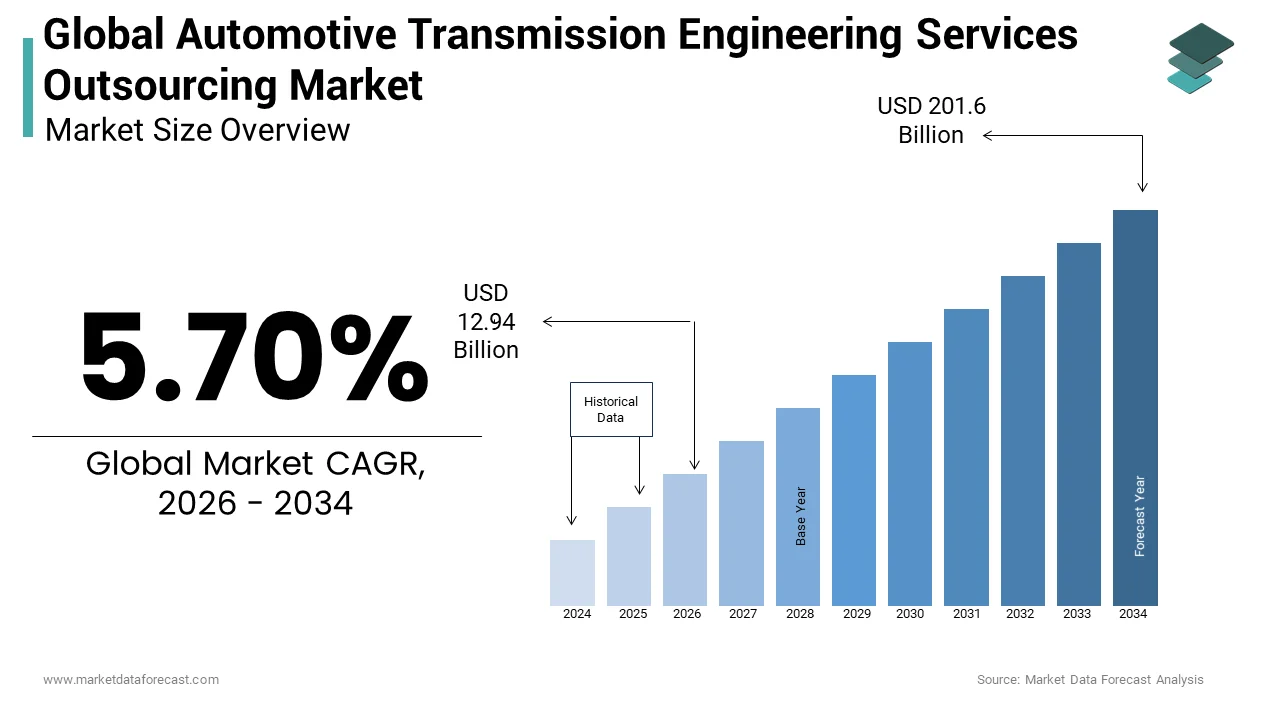
The global automotive transmission engineering services outsourcing market size was valued at USD 12.24 billion in 2025, stands at USD 12.94 billion in 2026, and is anticipated to reach a valuation of USD 20.16 billion by 2034, registering a compound annual growth rate (CAGR) of 5.70% during the forecast period from 2026 to 2034. Growth is heavily driven by the massive automotive industry shift toward electrified powertrains, the proliferation of multi-speed EV transaxles, and the increasing technical complexity of software-defined vehicles.
Key Executive Metrics (At-a-Glance)
- 2025 Base Valuation: USD 12.24 Billion
- 2026 Current Valuation: USD 12.94 Billion
- 2034 Forecast Valuation: USD 20.16 Billion
- Compound Annual Growth Rate (CAGR): 5.70% (2026–2034)
- Dominant Service Segment: Designing secured the largest market share in 2025 due to foundational requirements in establishing initial geartrain geometry, architecture layouts, and control-hardware integration, while simulation and modeling is the fastest-growing segment (CAGR of 6.1%).
- Dominant Transmission Segment: Automatic transmission held the majority market share in 2025, driven by smooth shifting dynamics and consumer preference, whereas dual-clutch transmission projects the fastest growth (CAGR of 7.1%).
- Dominant Powertrain Segment: Conventional powertrain led the market in 2025 supported by established ICE manufacturing footprints, while hybrid powertrain exhibits robust growth (CAGR of 5.7%) due to complex dual-energy architectural integration.
- Regional Market Leadership & Velocity: Asia-Pacific dominates global market consumption and output, heavily backed by manufacturing scale across China, Japan, and regional assembly hubs.
Core Market Drivers
- Proliferation of Electrified Powertrains: The global transition toward hybrid and battery electric vehicle architectures requiring specialized multi-speed EV transaxles and external engineering expertise.
- Software-Defined Vehicle Complexity: The integration of sophisticated electronic control units (ECUs), domain computing networks, and intricate transmission control unit (TCU) software algorithms.
Primary Market Restraints & Challenges
- High Infrastructure Costs & Talent Gaps: Escalating capital expenditure required for advanced dynamometer and NVH testing rigs, compounded by a global shortage of specialized powertrain engineers.
- IP Security & Integration Friction: Prohibitive risks regarding proprietary transmission schematic transfers across borders and integration hurdles across disparate multi-vendor software environments.
Global Automotive Transmission Engineering Services Outsourcing Market Segmentation Breakdown
| Segment Category | Key Offerings / Categories | Largest / Leading Sub-Segment | Fastest Growing Sub-Segment |
|---|---|---|---|
| By Service Type | Designing, Prototyping, Testing, System Engineering & Integration, Simulation | Designing | Simulation and Modeling (6.1% CAGR) |
| By Transmission Type | Automatic Transmission, Manual Transmission, Dual-Clutch Transmission | Automatic Transmission | Dual-Clutch Transmission (7.1% CAGR) |
| By Powertrain | Conventional Powertrain, Hybrid Powertrain | Conventional Powertrain | Hybrid Powertrain (5.7% CAGR) |
| By Region | North America, Europe, Asia-Pacific, Latin America, Middle East & Africa | Asia-Pacific | Asia-Pacific & North America |
Major Industry Players Profiled
Key market participants operating across the global automotive transmission engineering services outsourcing ecosystem include AVL (Austria), FEV GmbH (Germany), IAV GmbH (Germany), Ricardo Plc (U.K.), Intertek Group Plc (U.K.), Porsche Engineering (Germany), Tata Consultancy Services Limited (India), Magna International Inc. (Canada), Magneti Marelli S.p.A (Italy), and Horiba, Ltd. (Japan).
 Download Free Sample Report
Global Automotive Transmission Engineering Services Outsourcing Market Size
The global automotive transmission engineering services outsourcing market size was valued at USD 12.24 billion in 2025 and is anticipated to reach USD 12.94 billion in 2025, and USD 20.16 billion by 2034, growing at a CAGR of 5.70% from 2026 to 2034.
Current Market Definition and Overview
Automotive Transmission Engineering Services Outsourcing refers to the practice where vehicle manufacturers and their Tier-1 parts suppliers hire external engineering firms to design, develop, test, and validate a vehicle’s transmission system. Instead of handling these highly complex and specialized technical tasks using their own in-house teams, automakers outsource them to specialized engineering service providers to cut costs, save time, and access specialized technical skills. As per the International Organization of Motor Vehicle Manufacturers, global automotive production reached 96.4 million units in 2025 as the industry accelerated investments in clean technologies and digital vehicle architectures. According to the International Energy Agency, global electric car sales exceeded 17 million units in 2024, expanding the total global electric fleet to nearly 58 million vehicles on the road. Furthermore, as per the International Organization of Motor Vehicle Manufacturers, worldwide motor vehicle production expanded to 96.4 million units in 2025, driven by an 8% surge in manufacturing momentum across the Asia-Oceania region. Within this complex landscape, independent service providers deliver critical expertise in computer-aided engineering and durability testing, ensuring that modern transmission systems meet strict global efficiency benchmarks.
MARKET DRIVERS
Proliferation of Electrified Powertrains and Multi-Speed EV Transmissions
The global transition toward hybrid and battery electric architectures compels automakers to outsource specialized transmission design to external engineering firms, which drives the growth of the automotive transmission engineering services outsourcing market. According to the International Energy Agency, worldwide electric car sales neared 14 million registered units in 2023, representing a 35% year-on-year increase and expanding the global electric fleet to 40 million vehicles. This massive adoption fuels the Automotive Transmission Engineering Services Outsourcing Market because traditional internal combustion transmission designs are incompatible with high-revving electric motors, requiring outsourced expertise to develop multi-speed transmissions specifically tailored for electric vehicles. Besides, as per BloombergNEF, passenger electric vehicle sales globally are projected to exceed 23 million units in 2026, driven by continuous expansion across emerging markets in Southeast Asia and Latin America. This reliance enables automotive brands to leverage specialized testing infrastructure and advanced simulation software without expanding internal permanent headcount.
Rising Complexity of Software Defined Vehicles and Electronic Control Integration
The integration of sophisticated electronic control units and software-driven gear shifting mechanisms mandates external technical partnerships, which further propels the automotive transmission engineering services outsourcing market. According to the International Energy Agency, the shift toward software-defined vehicles is driven by a complete transition from conventional distributed electrical architectures to domain-based or zonal computing networks. This technological proliferation heavily accelerates the Automotive Transmission Engineering Services Outsourcing Market because modern automatic and dual-clutch transmissions rely completely on intricate TCU software algorithms that require dedicated validation facilities. Additionally, as per the Government of Japan, strategic policy frameworks aim to integrate software-defined vehicle systems across all powertrains to secure a 30% share of global software-defined vehicle sales by 2030. Consequently, automotive manufacturers routinely partner with dedicated engineering service providers to manage software calibration, diagnostic protocol testing, and cyber-security compliance.
MARKET RESTRAINTS
Escalating Costs of Specialized Testing Facilities and Infrastructure Upgrades
The immense capital expenditure required to build advanced dynamometer and NVH testing rigs forces original equipment manufacturers to externalize engineering workflows, which hampers the expansion of the automotive transmission engineering services outsourcing market. According to the World Economic Forum, global industrial manufacturing hubs are facing a structural talent gap with a projected 2.5 million unfilled advanced manufacturing jobs in the United States alone by 2030, alongside 7.5 million vacant roles globally. This high financial barrier significantly restrains the Automotive Transmission Engineering Services Outsourcing Market by forcing regional Tier-1 suppliers and smaller automotive brands to reconsider massive internal R&D facility investments. Besides, as per the Federal Reserve, core inflation pressures and elevated capital expenditure remain persistent across major industrial sectors, prompting monetary authorities to maintain interest rates between 3.5% and 3.75% to stabilize product supply chains. Thus, budget-constrained manufacturers delay internal laboratory expansions, opting instead to contract external engineering service providers who already possess fully equipped testing ecosystems.
Severe Global Shortage of Specialized Powertrain and Software Engineers
The acute deficit of skilled technical talent proficient in both mechanical transmission design and electronic control engineering creates operational barriers to the global automotive transmission engineering services outsourcing market. According to the World Economic Forum, the global manufacturing sector faces an escalating labor crisis with a projected deficit of 7.5 million unfilled technical and operational roles worldwide by 2030. This severe workforce constraint heavily restrains the Automotive Transmission Engineering Services Outsourcing Market by limiting the capacity of in-house engineering departments to execute concurrent multi-speed transmission development programs. In addition, as per the World Economic Forum, an international consortium of business leaders and policymakers launched a strategic pledge to upskill 1 million young people by 2035 to meet open industrial demand in advanced manufacturing. Hence, vehicle manufacturers find themselves unable to scale their internal transmission divisions rapidly, forcing them to defer complex upgrade projects or face protracted product development delays.
MARKET OPPORTUNITIES
Adoption of Cloud Based Digital Twins and Virtual Simulation Platforms
Cloud computing advancements allow engineering service providers to offer highly efficient virtual prototyping solutions for transmission development, which is expected to fuel the growth of the transmission engineering services outsourcing market. According to the International Data Corporation, global investments in digital transformation are projected to reach 3.4 trillion dollars by 2026, driven by a 16.3% compound annual growth rate in digital twin modeling and industrial simulation capabilities. This digital evolution creates a major opportunity for the Automotive Transmission Engineering Services Outsourcing Market by enabling outsourced firms to simulate thousands of gear-shifting cycles and thermal stress scenarios virtually before cutting physical metal. Furthermore, as per the World Economic Forum, virtual prototyping utilizing immersive technologies allows global product development teams to eliminate multiple physical prototype cycles, reducing development timelines from concept to commercial production. Therefore, forward-thinking automotive brands increasingly outsource their early-stage transmission modeling to agile engineering bureaus capable of utilizing cloud-native digital twins to optimize design efficiency.
Emergence of Strategic Cross-Border Engineering Partnerships in Developing Regions
The expansion of localized automotive R&D hubs in emerging economic corridors unlocks cost-effective engineering execution for global brands in the automotive transmission engineering services outsourcing market. According to the International Trade Administration, emerging manufacturing and commercial regions are rapidly expanding digital trade infrastructure through multi-country cross-border integration of QR and cashless transaction systems. This geographic diversification presents a major opportunity for the Automotive Transmission Engineering Services Outsourcing Market by allowing established Western automakers to tap into highly cost-competitive talent pools in Asia and Eastern Europe. Moreover, as per the World Trade Organization, a coalition of major global economies finalized frameworks at the 14th WTO Ministerial Conference to accelerate a multi-lateral digital trade agreement covering cross-border data flows and data localization bans. Consequently, specialized outsourcing firms can establish offshore delivery centers that operate continuously across time zones, drastically accelerating transmission design turnaround times for international clients.
MARKET CHALLENGES
Prohibitive Intellectual Property and Data Security Vulnerabilities in Cross Border Transfers
Sharing proprietary transmission blueprints and confidential powertrain schematics with external entities exposes companies to severe data security risks, which impedes the growth of the automotive transmission engineering services outsourcing market. According to the International Organization for Standardization, global adoption of proactive information security frameworks is expanding rapidly to defend modern industrial supply chains against sophisticated firmware-level and ecosystem vulnerabilities. This security threat severely challenges the Automotive Transmission Engineering Services Outsourcing Market by making original equipment manufacturers deeply hesitant to outsource core transmission intellectual property to third-party firms situated in foreign jurisdictions. Furthermore, as per the European Union Agency for Cybersecurity, data protection compliance frameworks for embedded telematics and connected vehicles require comprehensive tracking of real-time location logs across regional logistics and fleet management networks. Thus, legal departments enforce rigid data compartmentalization protocols and expensive secure enclave requirements, increasing administrative friction and slowing down project initiation phases for outsourced contracts.
Integration Hurdles Across Disparate Multi-Vendor Engineering Environments
Combining outsourced software code with legacy mechanical transmission hardware leads to complex integration friction and architectural mismatches in the automotive transmission engineering services outsourcing market. According to the Institute of Electrical and Electronics Engineers, cross-industry network deployments have reached over 21 billion active devices worldwide, driven by standardized interoperability guidelines across multi-vendor product ecosystems. The operational friction severely challenges the Automotive Transmission Engineering Services Outsourcing Market because transmission performance depends entirely on the flawless synchronization of mechanical hydraulic modules with third-party software controllers. Additionally, as per the International Electrotechnical Commission, standardized identity, data storage, and electronic commerce security architectures are governed under unified international reference frameworks to prevent configuration misalignments. Hence, automotive brands must dedicate extensive internal supervisory resources to harmonize external deliverables, occasionally offsetting the cost advantages initially gained through outsourcing.
REPORT COVERAGE
| REPORT METRIC | DETAILS |
| Market Size Available | 2025 to 2034 |
| Base Year | 2025 |
| Forecast Period | 2026 to 2034 |
| CAGR | 5.70% |
| Segments Covered | By Service Type, Transmission Type, Powertrain, and Region. |
| Various Analyses Covered | Global, Regional, and Country Level Analysis, Segment-Level Analysis, DROC, PESTLE Analysis, Porter’s Five Forces Analysis, Competitive Landscape, Analyst Overview of Investment Opportunities |
| Regions Covered | North America, Europe, APAC, Latin America, Middle East & Africa |
| Market Leaders Profiled | AVL (Austria), FEV GmbH (Germany), IAV GmbH (Germany), Ricardo Plc (U.K.), Intertek Group Plc (U.K.), Porsche Engineering (Germany), Tata Consultancy Services Limited (India), Magna International Inc. (Canada), Magneti Marelli S.p.A (Italy) Horiba, Ltd. (Japan), and Others. |
SEGMENT ANALYSIS
By Service Insights
Designing Segment
The designing segment was the largest in 2025 and occupied a commanding share of the automotive transmission engineering services outsourcing market. This supremacy of the segment was credited to its foundational role in establishing initial geartrain geometry, architecture layouts, and control-hardware integration. According to the International Organization of Motor Vehicle Manufacturers (OICA), automotive component design engineering and drafting services are expanding globally to support original equipment manufacturer engineering portfolios. This market domination is heavily propelled by the complex transition from legacy mechanical gearboxes to multi-speed electrified transaxles that require specialized architectural layouts. As per the International Organization of Motor Vehicle Manufacturers (OICA), global vehicle production rose to 96.4 million units in 2025, maintaining a massive baseline demand for manufacturing layout planning and component modeling. Furthermore, According to the International Energy Agency (IEA), automotive manufacturers are rapidly scaling clean mobility investment pipelines to expand zero-emission electric vehicle options worldwide.
Simulation and Modeling Segment
The simulation and modeling segment is on the rise and is expected to be the fastest growing segment in the market by witnessing a CAGR of 6.1% between 2026 and 2034. This rapid growth is propelled by the acute need to replace expensive physical prototype iterations with cloud-native virtual validation platforms to compress vehicle development timelines. According to the International Organization for Standardization (ISO), industrial operations are increasing the implementation of digital multi-body dynamics and finite element analysis protocols to validate complex mechanisms. As per the European Commission, industrial cloud computing services and collaborative engineering software systems are experiencing rapid adoption trends across advanced manufacturing sectors. Additionally, According to the World Economic Forum (WEF), virtual prototyping and immersive design tools shorten product development timelines and improve the overall quality of modern industrial engineering outputs.
By Transmission Insights
Automatic Transmission Segment
In 2025, the automatic transmission segment held the majority share in the automotive transmission engineering services outsourcing market because of strong consumer preference for smooth shifting dynamics and relaxed urban driving. According to the International Organization of Motor Vehicle Manufacturers (OICA), multi-speed automatic systems and torque-converter gearboxes represent an expanding share of global automotive production platforms. This market domination is heavily propelled by the mandatory integration of advanced electronic control units and complex hydraulic shifting modules that demand specialized external engineering expertise. As per the International Organization of Motor Vehicle Manufacturers production, the world produced approximately 67.67 million passenger cars, and recent figures show that the passenger car segment maintains a strong volume of over 50 million units within just the first nine months of a production cycle. Besides, according to the European Automobile Manufacturers Association (ACEA), consumer demand for automated driving features and convenience is steadily reducing the market share of manual transmissions across European vehicle fleets.
Dual-Clutch Transmission Segment
The dual-clutch transmission segment is likely to experience the fastest CAGR of 7.1% during the forecast period due to stringent fleet-wide carbon emission regulations that compel original equipment manufacturers to optimize gear ratios and minimize power interruption during acceleration.. According to the International Organization for Standardization (ISO), dual-clutch transmission systems combine the fuel efficiency of manual gearboxes with seamless gear-shifting mechanics across passenger vehicle platforms. As per the International Energy Agency (IEA), automotive markets are tightening corporate average fuel economy standards to accelerate regional vehicle fleet efficiency and emissions compliance. Additionally, according to SAE International, dual-clutch mechatronic integration necessitates advanced transmission control unit software calibration to manage adaptive clutch kiss points and real-time driving synchronization.
By Powertrain Insights
Conventional Powertrain Segment
The conventional powertrain segment led the automotive transmission engineering services outsourcing market and captured a significant share in 2025. This leading position of the segment was attributed to established internal combustion engine manufacturing footprints across developing economies. According to the International Organization of Motor Vehicle Manufacturers (OICA), conventional internal combustion engine powertrains sustain the majority of global automotive manufacturing demand through high-volume production of entry-level passenger and commercial vehicles. This market domination is heavily propelled by the massive existing global fleet of internal combustion vehicles requiring ongoing engineering support, replacement part design, and transmission performance tuning. As per the International Organization of Motor Vehicle Manufacturers (OICA), emerging manufacturing hubs across Asia and Latin America continue to produce substantial volumes of traditional manual and automatic internal combustion engine vehicle configurations. Moreover, according to the World Bank, consumer purchasing patterns in developing economies maintain strong baseline demand for affordable conventional fuel vehicles and legacy infrastructure upgrades.
Hybrid Powertrain Segment
The hybrid powertrain segment is expected to exhibit a noteworthy CAGR of 5.7% from 2026 to 2034, owing to the intricate engineering architecture of hybrid systems, which require seamless integration between internal combustion engines and electric motor transaxles. According to the International Energy Agency (IEA), government clean energy policies and shifting consumer preferences are driving rapid expansion in dual-energy vehicle configurations and hybrid architecture markets. As per the International Energy Agency (IEA), global electric vehicle sales experienced a 35% year-on-year surge to reach nearly 14 million new registrations. Additionally, according to the International Organization for Standardization (ISO), hybrid propulsion system integration requires sophisticated software protocols to handle multi-vendor hardware configurations and electronic control unit synchronization.
REGIONAL ANALYSIS
Asia-Pacific Market Analysis
Asia-Pacific dominated the global automotive transmission engineering services outsourcing market and accounted for a substantial share in 2025. This dominance of the APAC market was driven by massive domestic vehicle manufacturing output and expanding local research and development hubs. According to the International Organization of Motor Vehicle Manufacturers (OICA), the Asia-Pacific region dominates global automotive manufacturing and powertrain market revenues due to scaling production networks. As per the International Organization of Motor Vehicle Manufacturers (OICA), annual vehicle production in the Asia-Pacific region exceeds 50 million units, supplying a massive baseline for transmission engineering and validation. Furthermore, according to the China Association of Automobile Manufacturers (CAAM), China's new energy vehicle market retail penetration has surpassed 50 percent, transforming local vehicle procurement portfolios and component demand lines.
North America Market Analysis
North America followed closely behind in the automotive transmission engineering services outsourcing market. Factors such as robust consumer demand for heavy commercial trucks, sport utility vehicles, and advanced software-defined vehicle architectures have contributed to regional market growth. According to the International Organization of Motor Vehicle Manufacturers (OICA), North American powertrain infrastructure development is heavily influenced by the enforcement of Corporate Average Fuel Economy regulations across regional automotive production lines. As per the U.S. Department of Transportation (USDOT), corporate average fuel economy guidelines mandate annual efficiency increases for passenger cars and light-duty trucks to lower regional fleet-wide emissions. Additionally, according to the International Organization for Standardization (ISO), engineering innovation investments push automotive manufacturers to form partnerships with specialized consultants to optimize automated transmission development cycles.
Europe Market Analysis
Europe contributes significantly to the global automotive transmission engineering services outsourcing market. The regional market is known for rigorous carbon emission thresholds, stringent acoustic standards, and deep concentrations of premier automotive engineering bureaus. According to the International Trade Administration (ITA), European engineering sectors deploy dedicated consulting centers across Germany, the United Kingdom, and Austria to manage international automotive technical requirements. As per the European Automobile Manufacturers Association (ACEA), regional fleet average emission limits demand continuous transmission optimization and lightweight geartrain modifications across European automotive platforms. Besides, according to the European Parliament, the Environmental Noise Directive mandates strict community noise exposure monitoring and environmental acoustic reporting thresholds across major urban centers.
Latin America Market Analysis
Latin America is a steadily developing region in the global automotive transmission engineering services outsourcing market because of localized automotive assembly investments, expanding urban mobility requirements, and gradual fleet modernization across key industrial economies. According to the Economic Commission for Latin America and the Caribbean (ECLAC), automotive production networks in Brazil and Mexico function as critical manufacturing and export platforms for multinational brands. As per the International Organization of Motor Vehicle Manufacturers (OICA), regional automotive manufacturing output routinely exceeds 2 million vehicles annually across major South American assembly lines. Additionally, according to the International Organization for Standardization (ISO), shifting consumer preferences toward automated gearboxes encourage localized original equipment manufacturers to alter their transmission calibration and assembly pipelines.
Middle East and Africa Market Analysis
The Middle East and Africa region is an emerging frontier in the global automotive transmission engineering services outsourcing market due to harsh climatic operating conditions and expanding import channels for modern passenger vehicles. According to the International Organization for Standardization (ISO), severe desert environment operations dictate that heavy vehicular thermal loads require enhanced auxiliary transmission cooling architectures. As per the United Nations Economic and Social Commission for Western Asia (ESCWA), rapid expansion in large passenger car and sport utility vehicle fleets characterizes the growing liquid-petroleum consumption profile across Gulf Cooperation Council economies. Furthermore, as per According to SAE International, extreme thermal loads accelerate oil degradation and mechanical fatigue in automated transmission components, necessitating tailored cooling and durability countermeasures.
COMPETITIVE LANDSCAPE
Competition within the automotive transmission engineering services outsourcing market is intensely contested among specialized global technical consultancies striving to capture lucrative platform outsourcing contracts from major vehicle manufacturers. Rivalry centers heavily on technical expertise, with independent engineering bureaus constantly racing to deliver advanced simulation models and rapid virtual calibration tools that satisfy stringent emission regulations. Pricing pressures from global automakers require market participants to continuously streamline internal operational workflows and optimize resource allocation across multi-vendor development environments. Competitors also differentiate their service portfolios by offering turnkey solutions that seamlessly integrate mechanical gearbox architecture with advanced software-defined vehicle controls. Furthermore, the rapid industrial pivot toward hybrid and electric mobility forces established engineering providers to compete aggressively for specialized transmission testing mandates, reshaping traditional supplier dynamics and accelerating cross-border technical acquisitions across the global marketplace.
KEY MARKET PLAYERS
The key players in the automotive transmission engineering services outsourcing market include
- AVL (Austria)
- FEV GmbH (Germany)
- IAV GmbH (Germany)
- Ricardo Plc (U.K.)
- Intertek Group Plc (U.K.)
- Porsche Engineering (Germany)
- Tata Consultancy Services Limited (India)
- Magna International Inc. (Canada)
- Magneti Marelli S.p.A (Italy)
- Horiba, Ltd. (Japan).
MARKET SEGMENTATION
This research report on the global automotive transmission engineering services outsourcing market is segmented and sub-segmented into the following categories.
By Service Type
-
Designing
- Prototyping
- Testing
- System Engineering and Integration
- Simulation
By Transmission Type
-
Automatic Transmission
- Manual Transmission
By Powertrain
- Conventional Powertrain
- Hybrid Powertrain
By Region
- North America
- Europe
- Asia-Pacific
- Latin America
- Middle East and Africa