- Product Description Description
- Table of Contents TOC
- List of Table & Figure LOT
- Get Free Sample PDF Sample PDF
Market Size, 2025
$32.86 BnMarket Estimate, 2026
$35.14 BnMarket Forecast, 2034
$60.16 BnCAGR, 2026–2034
6.95%Executive Summary: Global Automotive Window and Exterior Sealing Systems Market
- Market Scope: Comprehensive global analysis tracking components like glass run channels, windshield seals, and hood/trunk gaskets across passenger cars, light-duty, and medium/heavy-duty vehicles.
- Market Valuation: Valued at USD 32.86 billion in 2025, reaching USD 35.14 billion in 2026, and projected to expand to USD 60.16 billion by 2034, growing at a steady CAGR of 6.95% during the forecast period (2026–2034).
- Primary Growth Drivers: Urbanization and growing demand for transportation driving vehicle production, alongside technological transitions replacing conventional components with advanced materials like vulcanized thermoplastics, TPEs, and TPOs to enhance quality and wear resistance. Key restraints include the ongoing industry focus on energy efficiency, vehicle lightweighting, and structural body design changes.
Key Market Segment Metrics (2026–2034)
| Category | Leading Segment (2025 Position) | Key Insights & Trends |
|---|---|---|
| By Component | Glass Passage Channels (Glass Run Channels) | Most used due to low production costs from mass-manufacturing efficiency. Acts as a thermal/physical insulator against heat, dust, and moisture. Trunk and front windshield gaskets are also heavily utilized. |
| By Vehicle Type | Passenger Cars | Driven by rising disposable income, increased commercial and economic activity, and expanding passenger vehicle manufacturing volumes worldwide. |
| By Region | Asia-Pacific (Expected largest market share) | Driven by soaring automobile production, availability of low-cost labor and resources, and prominent hubs like Japan. North America and Europe show robust demand tied to extreme weather resilience and technology adoption. |
Major Market Players & Market Structure
Market Structure: Highly competitive landscape characterized by major international tier-1 automotive suppliers investing in advanced manufacturing capacity, geographic expansion, and high-performance weatherstripping technology.
Key Companies: Hutchinson Sealing Systems, Magna International Inc., Cooper Standard Automotive Inc., Minth Group Ltd, Rehau Group, and Toyoda Gosei.
 Download Free Sample Report
Global Automotive Window and Exterior Sealing Systems Market Size
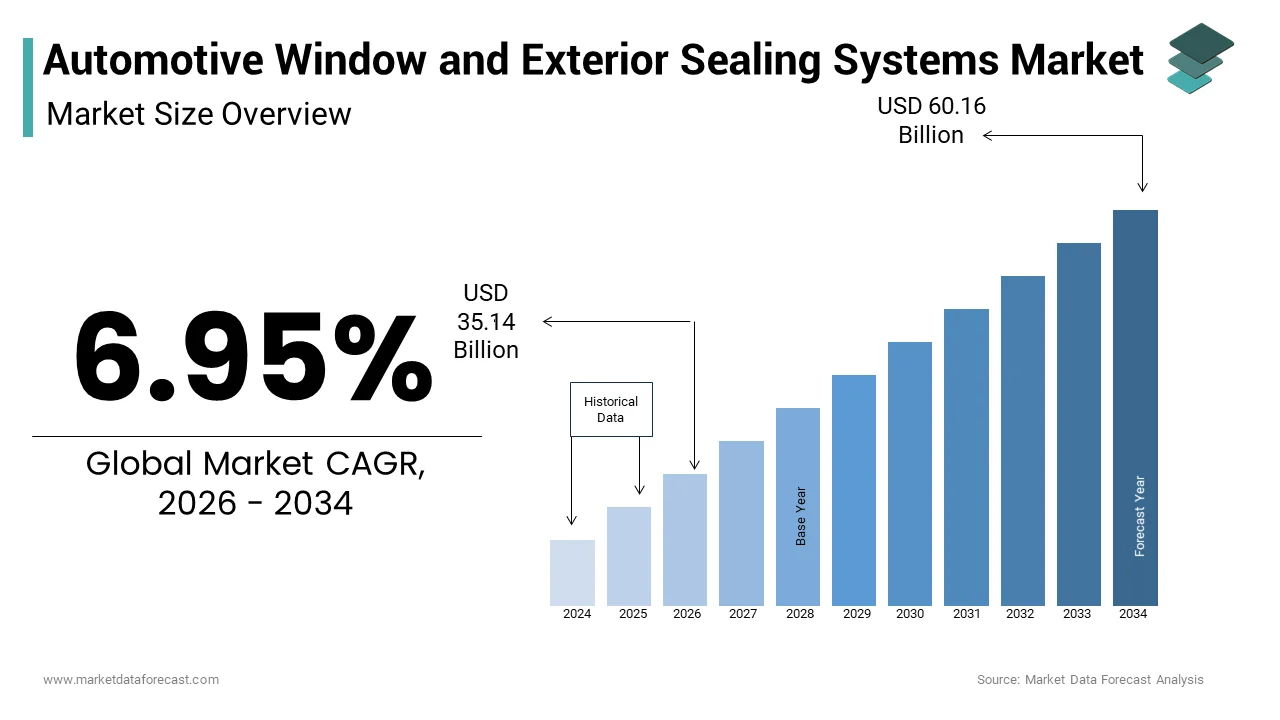
The global automotive window and exterior sealing systems market size was valued at USD 32.86 billion in 2025 and it is anticipated to reach a valuation of USD 35.14 billion in 2026, and USD 60.16 billion by 2034, growing at a CAGR of 6.95%, from 2026 to 2034.
MARKET OVERVIEW
Automotive window and exterior sealing systems are specialised rubber or plastic parts that seal gaps around a vehicle's body to keep out water, wind, dust, and noise. These systems include door seals window guides trunk gaskets and sunroof perimeters which are critical for preventing water ingress reducing wind noise and enhancing passenger comfort. As per the International Organization of Motor Vehicle Manufacturers, global vehicle production reached approximately 93.5 million units in 2023, sustaining a strong baseline demand for glass run channels, door seals, and specialized exterior sealing architectures. According to the National Highway Traffic Safety Administration, federal safety standards require hybrid and electric light-duty vehicles to emit pedestrian warning sounds at low speeds up to 30 kilometres per hour, driving original equipment manufacturers to enhance exterior body sealing to block external noise transmission while keeping the cabin quiet. Each passenger vehicle typically requires between 15 to 20 meters of sealing profiles depending on the body style and feature set. As per the European Automobile Manufacturers Association, the average age of the passenger car fleet in the European Union has risen to 12.3 years, accelerating aftermarket replacement rates for degraded EPDM rubber door seals and weatherstripping. Advanced materials such as thermoplastic vulcanizates and silicone blends are increasingly replacing traditional EPDM rubber to meet weight reduction targets. The integration of smart sensors within sealing strips for blind spot detection further adds value to these traditionally passive components. Regulatory bodies like the Environmental Protection Agency emphasise the role of tight sealing in improving aerodynamic efficiency, which directly impacts fuel economy and electric vehicle range.
MARKET DRIVERS
Rising Consumer Demand for Enhanced Acoustic Comfort and NVH Reduction
The escalating consumer expectation for quiet cabin environments is a primary driver for the Automotive Window and Exterior Sealing Systems Market. Manufacturers are striving to minimise noise, vibration, and harshness. According to J.D. Power, excessive wind noise is frequently cited as a top design-related issue in initial quality surveys, representing a key metrics benchmark of 7.6 problems per 100 vehicles (PP100) that forces automotive original equipment manufacturers to re-engineer door and window seal fitments. Modern sealing systems utilise complex multi-chamber designs and foam-filled cores that can reduce exterior noise penetration by up to 4 decibels, significantly enhancing perceived vehicle quality. The Society of Automotive Engineers notes that aerodynamic wind noise scales exponentially and becomes the dominant in-cabin acoustic source once cruising speeds surpass 80 kilometres per hour, rendering window seals and A-pillar transitions critical for vehicle sound isolation. Luxury vehicle segments now incorporate active noise cancellation technologies that work in tandem with high-precision sealing to create near-silent cabins. As per research, automotive tier-one manufacturers fabricate custom EPDM extruded sealing profiles to maximize vehicle aerodynamics, mitigating flow separation and reducing structural drag along the cabin periphery. The rise of electric vehicles, which lack engine noise to mask road and wind sounds, further amplifies the need for exceptional sealing performance. Consumers are willing to pay a premium for vehicles that offer a serene driving experience, driving OEMs to specify higher-grade materials such as thermoplastic elastomers. This shift toward premiumization in mid-segment vehicles expands the total addressable market for advanced sealing systems. The correlation between low noise levels and brand perception ensures that sealing quality remains a key differentiator in competitive automotive markets.
Stringent Regulatory Standards for Weatherproofing and Safety Compliance
Government regulations mandate safety and durability standards for the automotive industry, which propels the global automotive window and exterior sealing systems market. These requirements compel manufacturers to adopt high-performance exterior sealing systems that ensure long-term reliability and occupant protection. The Federal Motor Vehicle Safety Standards mandate strict requirements under FMVSS No. 305a to prevent electrical short circuits or loss of isolation from water ingress during standing water immersion and vehicle washing procedures, prompting suppliers to optimize seal design around high-voltage batteries and underbody enclosures. According to the Insurance Institute for Highway Safety, the deployment of side curtain airbags is critical for occupant protection, reducing fatalities by more than 45 percent during severe side-impact collisions. Failure in sealing systems can lead to electrical short circuits and corrosion compromising vehicle safety and longevity. The European Union utilizes harmonized international standard frameworks like IEC 60529 to mandate strict water ingress protection levels, certifying vehicle component enclosures through static water immersion and pressurized spray compliance testing. As per Trelleborg Sealing Solutions, automotive suppliers distribute performance elastomer compounds designed to maintain chemical stability and functional elasticity within a temperature window of minus 40 degrees Celsius to 120 degrees Celsius. These extreme operational requirements drive the adoption of advanced materials like silicone and fluoropolymers that offer superior thermal stability. Regulatory pressure to reduce vehicle weight also pushes manufacturers to integrate lightweight sealing solutions that do not compromise on performance. The standardization of crash test protocols globally ensures that sealing systems must contribute to the overall stiffness of the body structure. Non compliance with these standards results in costly recalls and reputational damage incentivizing OEMs to partner with leading sealing specialists. This regulatory framework creates a consistent demand for high-quality certified sealing products across all major automotive markets.
MARKET RESTRAINTS
Volatility in Raw Material Prices and Supply Chain Disruptions
Fluctuations in the cost of key raw materials such as ethylene propylene diene monomer rubber and thermoplastic elastomers are a major hindrance to the Automotive Window and Exterior Sealing Systems Market. This affects profit margins and pricing stability. According to the International Rubber Study Group, world natural rubber consumption decreased by 1.4% in 2023 to 14.054 million tonnes, though ongoing supply disruptions in Southeast Asia sustained underlying price volatility across international shipping networks. The volatility forces sealing manufacturers to frequently adjust pricing models, which can strain relationships with original equipment manufacturers who operate on fixed cost contracts. The American Chemistry Council reports that petroleum-based synthetic rubber prices fluctuate based on shifts in energy feedstock and crude oil markets, creating pricing volatility for industrial procurement agreements. Supply chain disruptions caused by geopolitical tensions and logistics bottlenecks have led to lead time extensions of several weeks for specialized sealing compounds. As per sources, automotive suppliers optimize operational capacity via digital solutions that lower planned downtime costs by 15% to 30%, provided that localized material catalog and equipment data stay synchronized. Small and medium sized sealing manufacturers struggle to absorb these cost increases unlike larger players who benefit from economies of scale. The reliance on single-source suppliers for certain additives and processing aids exacerbates the risk of production delays. Manufacturers must invest in alternative material formulations, which require extensive validation and testing, adding to development costs. These financial pressures limit the ability of companies to invest in research and development for next generation sealing technologies. The uncertainty in raw material availability also hinders the planning of large-scale production runs for new vehicle launches.
High Tooling Costs and Complexity of Customised Designs
Substantial tooling and development costs arise from needing customized sealing profiles for every vehicle model, and ultimately hamper the expansion of the automotive window and exterior sealing systems market. These high upfront expenses ultimately limit flexibility for manufacturers and act as a barrier to entry. However, according to the Society of Plastics Engineers, profile extrusion tooling costs remain low compared to injection molding, typically ranging in the hundreds to low thousands of dollars, making extrusion highly favorable for variable production volumes. Each new vehicle platform requires unique sealing designs to match specific body contours and glass thicknesses, preventing the use of standardized off the shelf solutions. The International Journal of Automotive Technology details engineering frameworks for optimizing automotive sealing system parameters to control noise and vibration levels within the passenger cabin. Also, the lengthy process ties up capital and engineering resources, limiting the ability of suppliers to respond quickly to changing market demands. Original equipment manufacturers often demand last minute design changes which require expensive tool modifications and revalidation. As per studies, automotive consumer shifting behaviors show rising demand for affordable electric and hybrid vehicles, pressing equipment manufacturers to restructure global sourcing frameworks. Small volume vehicle programs struggle to justify the high upfront investment in custom tooling, leading to limited supplier interest. The need for tight tolerances in the sub-millimetre range requires advanced manufacturing equipment and skilled labour, further increasing operational costs. These financial and technical barriers consolidate the market among a few large players who can amortize tooling costs over high volume production runs. New entrants find it difficult to compete without significant capital investment in specialized manufacturing capabilities.
MARKET OPPORTUNITIES
Integration of Smart Sensors and Active Sealing Technologies
The emergence of smart vehicles offers a significant opportunity for the Automotive Window and Exterior Sealing Systems Market. This growth is driven by integrating sensors and active adjustment mechanisms directly into sealing profiles. According to sources, the global micro-electromechanical systems device landscape is projected to reach a substantial level by 2030, maintaining a steady growth rate that expands hardware deployment inside advanced automotive sensing nodes. Sealing systems can now house capacitive sensors for blind spot detection and rain sensors for automatic wiper activation, eliminating the need for separate external components. This integration reduces assembly complexity and improves vehicle aesthetics by creating cleaner exterior lines. As per MDPI, smart material configurations utilize active control sealing assemblies driven by integrated piezoelectric ceramics to dynamically adapt to shifting structural loads and internal pressure variations. Such adaptive technologies can improve fuel efficiency by minimising drag during highway cruising. Electric vehicle manufacturers are particularly interested in these smart sealing solutions as they contribute to extended battery range and enhanced user experience. The ability to monitor seal health and predict maintenance needs through connected vehicle data opens new revenue streams for service providers. Partnerships between sealing manufacturers and technology firms are accelerating the development of these intelligent components. Early adopters of smart sealing technologies gain a competitive advantage in the premium vehicle segment where innovation is highly valued. This technological convergence transforms passive rubber parts into active electronic systems commanding higher value and margins.
Expansion of Electric Vehicle Production and Lightweighting Initiatives
The rapid growth of the electric vehicle sector unlocks potential for the Automotive Window and Exterior Sealing Systems Market. Manufacturers are prioritising weight reduction to maximise battery range. According to the International Energy Agency, global electric car sales neared 14 million units in 2023, accounting for 18% of all passenger car sales worldwide and accelerating the industry-wide transition toward specialised, low-density thermal insulation and body-sealing compounds. Traditional rubber seals are being replaced by thermoplastic elastomers and hollow profile designs that offer notable weight savings without compromising performance. As per research, automotive design specifications adhere to Aluminum Association metrics to enforce uniform structural thickness tolerances, ensuring that every kilogram of vehicle weight reduction translates directly into an extended driving range and lower energy consumption. Electric vehicles also require enhanced sealing to protect sensitive high-voltage batteries and electronics from moisture and dust ingress, necessitating higher precision manufacturing standards. According to EVANNEX, direct glazing techniques bond vehicle glass panels directly to the body frame with high-performance urethane adhesives, structurally reinforcing the roof and A-pillar framework while mitigating cabin wind drag. The trend toward panoramic glass roofs in electric vehicles increases the length and complexity of perimeter sealing required for large surface areas. Manufacturers are developing recyclable sealing materials to align with the sustainability goals of electric vehicle brands. This shift toward eco-friendly and lightweight materials opens new avenues for innovation and differentiation. Suppliers who can offer integrated lightweight sealing solutions are well positioned to secure long-term contracts with leading electric vehicle manufacturers.
MARKET CHALLENGES
Material Recycling and End of Life Vehicle Regulations
Strict environmental regulations regarding vehicle recyclability and waste management are a serious impediment to the Automotive Window and Exterior Sealing Systems Market. This challenge arises because traditional multi-material seals are exceptionally difficult to process. As per the European Parliament, provisional circularity regulations dictate that type-approved vehicles must be constructed to ensure they are reusable or recyclable to a minimum of 85% by mass and reusable or recoverable to a minimum of 95% by mass. Conventional seals often combine rubber metal clips and plastic carriers which are bonded together making material recovery complex and costly. According to the Plastics Industry Association, industrial manufacturers utilize standard commercial and fine tolerance matrices to manage the production accuracy and structural alignment of thermoplastic parts. Developing mono-material sealing solutions that maintain performance while being fully recyclable requires significant research and development investment. As per Michelin, the validation of an industrial demonstrator at the Bassens production site establishes a functional process for synthesizing bio-based butadiene from bioethanol to reduce the carbon footprint of structural elastomers. Automakers are increasingly demanding that suppliers provide detailed material passports for recycling purposes, adding administrative burden. The lack of standardised recycling infrastructure for automotive rubber limits the economic viability of closed-loop systems. Manufacturers must balance the need for durable high performance materials with the requirement for easy disassembly and recycling. Failure to comply with upcoming circular economy regulations could result in penalties and loss of market access. This transition requires a fundamental shift in material science and product design philosophy.
Increasing Complexity of Vehicle Body Structures and Assembly Processes
The evolving design of modern vehicles with frameless windows flush surfaces and complex curvature is a technical challenge for sealing system integration and assembly efficiency, which constrains the expansion of the Automotive window and exterior sealing systems market. According to the Center for Automotive Research, original equipment manufacturers adopt an extensive multi-material approach incorporating high-strength steels, aluminum, and polymer composites to lower overall vehicle mass. Frameless window designs require seals that provide both weatherproofing and structural support, which demands higher precision in manufacturing and fitment. Automated installation robots require highly consistent seal dimensions and stiffness to ensure proper placement without damage. As per sources, the increasing consumer adoption of premium panoramic sunroofs and integrated modular roofs accelerates the deployment of specialized sealing tracks by major automotive manufacturers. The trend toward tighter body gaps for aesthetic purposes leaves less tolerance for seal variation, increasing the risk of leaks and wind noise. Suppliers must invest in advanced quality control systems such as laser scanning to ensure dimensional accuracy. The need for seamless integration with other exterior components like mirrors and trim adds another layer of complexity. These technical challenges require close collaboration between designers, engineers, and suppliers early in the development process. Failure to address these assembly complexities can lead to production delays and quality issues.
REPORT COVERAGE
| REPORT METRIC | DETAILS |
| Market Size Available | 2025 to 2034 |
| Base Year | 2025 |
| Forecast Period | 2026 to 2034 |
| CAGR | 6.95% |
| Segments Covered | By Vehicle Type, Component, and Region. |
| Various Analyses Covered | Global, Regional and Country Level Analysis, Segment-Level Analysis, DROC, PESTLE Analysis, Porter’s Five Forces Analysis, Competitive Landscape, Analyst Overview of Investment Opportunities |
| Regions Covered | North America, Europe, APAC, Latin America, Middle East & Africa |
| Market Leaders Profiled | Hutchinson Sealing Systems, Magna International Inc., Copper Standard Automotive Inc., Minth Group Ltd, Rehau Group, and Others. |
SEGMENTAL ANALYSIS
By Vehicle Insights
Passenger Cars
The passenger cars segment maintained dominance in the Automotive Window and Exterior Sealing Systems Market and accounted for a substantial share in 2025. This dominance of the segment was driven by its high production volumes, increasing consumer expectations for cabin comfort and stringent regulatory requirements for noise reduction. The sheer scale of global passenger car manufacturing drives consistent demand for window and exterior sealing systems, as each unit requires extensive sealing profiles for doors, windows and sunroofs. According to the International Organization of Motor Vehicle Manufacturers, over 67 million passenger cars were produced globally in 2023, representing the largest output segment across the motor vehicle manufacturing sector. This massive production base ensures a steady stream of original equipment orders for sealing manufacturers who supply components for every vehicle assembly line. As per the European Automobile Manufacturers Association, the average age of passenger cars operating across the European Union has expanded to 12.7 years, increasing the overall volume of structural wear and maintenance touchpoints. With over 1.4 billion passenger cars in operation worldwide according to global fleet indexes from Simi Valley CDJR, the continuous operation of aging automotive assets sustains a massive baseline demand for replacement window seals, glass run channels, and weatherstripping kits. Consumers are increasingly proactive in maintaining vehicle aesthetics and comfort, leading to higher uptake of premium sealing products during service intervals. The modular design of modern passenger cars allows for easier replacement of individual sealing strips compared to integrated commercial vehicle structures. This combination of high initial installation volume and recurring replacement demand solidifies the dominance of the passenger car segment. Manufacturers benefit from economies of scale in producing standardized sealing profiles for popular models while customizing solutions for luxury variants. The continuous launch of new models with updated designs further stimulates demand for fresh tooling and specialized sealing configurations.
Rising consumer expectations for quiet cabins and premium features in passenger cars drive the adoption of advanced acoustic sealing technologies that reduce wind and road noise. According to J.D. Power, new-vehicle quality surveys evaluate design-related defects across major cabin systems, identifying interior noise and slow-charging infrastructure as persistent triggers for owner-reported complaints. Modern passenger cars utilise multi-lip seals and foam-filled profiles that can attenuate exterior noise, enhancing the perceived quality of the vehicle. The Society of Automotive Engineers notes that aerodynamic noise becomes the primary source of irritation at highway speeds, making high-precision window seals essential for customer satisfaction. Luxury segments are increasingly incorporating frameless windows and panoramic roofs, which require complex sealing architectures to prevent leaks while maintaining sleek aesthetics. As per Continental AG, tier-one manufacturing facilities supply custom EPDM profile extrusions to maximize door and window sound isolation while maintaining low visual tolerance lines across the exterior sheet metal. The rise of electric passenger cars, which lack engine noise to mask external sounds, further amplifies the need for exceptional sealing performance. Automakers are responding by specifying softer thermoplastic elastomers that provide better contact pressure and vibration damping. This trend toward premiumization extends to mid-range vehicles as brands seek to differentiate themselves in a crowded market. The direct correlation between sealing quality and brand perception ensures that passenger car manufacturers prioritise high-performance sealing systems in their design processes.
Light Duty Vehicles
The Light duty vehicles segment is estimated to register the fastest CAGR of 6.8% from 2026 to 2034 due to shifting consumer preferences toward versatile utility vehicles and increased off road usage. This segment includes SUVs and pickups. The global shift in consumer preference from sedans to sport utility vehicles and pickup trucks is driving rapid growth in the light duty vehicle sealing market due to the larger surface areas and complex body structures of these vehicles. According to a study, the rapid expansion of the utility segment drove sports utility vehicles to account for more than 40% of all global light vehicle sales in 2023. These vehicles typically feature larger windows, sunroofs, and tailgates, which require more extensive and robust sealing systems compared to smaller cars. As per the National Highway Traffic Safety Administration, occupant fatality rates per 100,000 registered vehicles dropped by 7 per cent for light trucks, including utility vehicles and pickups, from 2022 to 2023. The increased use of glass surfaces in modern SUVs to enhance visibility and aesthetic appeal further increases the linear meters of sealing required per vehicle. According to the U.S. Environmental Protection Agency, light trucks and utility configurations have captured more than 80% of the domestic automotive market share, altering structural manufacturing and parts stamping requirements for original equipment suppliers. Consumers view these vehicles as lifestyle enablers leading to higher willingness to pay for premium features like panoramic roofs and power liftgates which rely on precise sealing for proper function. The versatility of light-duty vehicles for both urban commuting and recreational use drives demand for sealing systems that perform well across diverse conditions. This segment growth outpaces traditional passenger cars as automakers expand their SUV and truck portfolios to meet market demand.
Light duty vehicles are increasingly used for outdoor recreational activities and work purposes exposing them to harsh environmental conditions that demand high performance exterior sealing systems. According to the Outdoor Industry Association, the domestic outdoor recreation participant base expanded by 4.1 percent in 2023 to reach an all-time record high of 175.8 million participants. The usage pattern accelerates wear and tear on door and window seals, requiring materials that offer superior resistance to UV radiation, ozone, and temperature extremes. The Rubber Manufacturers Association details a structural shifting pattern toward thermoplastic vulcanizates (TPVs) in body sealing systems, generating a weight savings of up to 15% to 20% over traditional vulcanized rubber while sustaining broad thermal stability up to 120 degrees Celsius. Off-road driving generates significant vibration and flexing of the vehicle body, which can compromise standard sealing interfaces, necessitating reinforced designs with higher compression set resistance. As per research, rising consumer outdoor involvement directly expands the domestic all-terrain vehicle market as off-roading and trail riding demand drives component manufacturing through 2030. The trend toward adventurous lifestyles drives demand for vehicles that can withstand elemental exposure without leaking or developing wind noise. Manufacturers are responding by developing seals with integrated dust barriers and enhanced drainage channels to handle muddy and wet conditions. This functional requirement distinguishes light duty vehicle sealing from standard passenger car applications and drives innovation in durable material formulations.
By Component Insights
Glass Run Channel Seals
The glass run channel seals segment led the Automotive Window and Exterior Sealing Systems Market and captured a significant share in 2025. This leading position of the segment was attributed to its critical role in guiding window movement preventing rattles and ensuring watertight closure in all vehicle types. Glass run channel seals are indispensable for the smooth operation of power windows and the prevention of wind noise making them a high volume component in every vehicle. According to the Society of Automotive Engineers, automotive manufacturers utilize standardized material pair friction tests to mitigate annoying cabin buzz, squeak, and rattle noises that typically trigger costly dealer diagnostic repairs and customer warranty claims. These seals provide the necessary friction and alignment for glass panels to move vertically without binding or tilting, which is crucial for user satisfaction. The National Highway Traffic Safety Administration mandates strict structural occupant protection guidelines under FMVSS No. 214, evaluating lateral door intrusion velocities and biological impact forces using advanced anthropomorphic test devices in dynamic side-impact crash simulations. Each vehicle typically contains four glass run channels, one for each side window, resulting in high unit volume demand proportional to vehicle production. As per Cooper Standard, material engineers blend specialized thermoplastic vulcanizate (TPV) formulations to manufacture high-performance glass run channels that match custom original equipment flexibility and performance metrics. The complexity of curved side windows in modern designs requires precision extruded profiles that maintain consistent contact pressure along the entire glass edge. Failure in these components can lead to water leakage into door panels, causing electrical failures and corrosion. The mandatory nature of these components for basic vehicle functionality ensures steady demand regardless of vehicle trim level. Manufacturers continuously innovate to reduce the thickness of these seals to allow for thinner door designs and improved aerodynamics.
The widespread application of glass run channel seals across all vehicle segments from compact cars to heavy duty trucks ensures their market dominance through standardized high volume production. According to Simi Valley CDJR, global vehicular scaling has expanded the total active worldwide fleet past 1.4 billion vehicles, driving baseline parts procurement across broad replacement tier segments. This ubiquity allows sealing manufacturers to achieve significant economies of scale by producing common profile shapes for multiple platforms. The American Chemistry Council notes that advanced engineering thermoplastic polyester elastomers (TPE-E) help minimise warranty claims across high-stress industrial and transport components due to their exceptional thermal stability and mechanical resilience. The durability requirements for these components are well defined by industry standards. The aftermarket for glass run channels is also robust, as worn channels are a common cause of window streaking and noise in older vehicles. Service centres frequently replace these components during door module repairs, creating a consistent secondary revenue stream. The technical maturity of run channel manufacturing allows for high automation rates, reducing labor costs and ensuring consistent quality. This combination of universal application and manufacturing efficiency cements the leading position of glass run channel seals in the market.
Roof Ditch Moulding Seals
The roof ditch moulding seals segment is anticipated to witness the fastest CAGR of 7.2% during the forecast period owing to the increasing popularity of panoramic sunroofs and flush roof designs in modern vehicles. Moreover, the growing consumer preference for panoramic sunroofs and large glass roof areas is driving rapid demand for specialised roof ditch moulding seals that provide weatherproofing for expansive opening mechanisms. According to Webasto, automotive original equipment manufacturers integrate high-resolution transparent ambient lighting systems into panoramic roof assemblies to offer up to 18,000 color configurations for consumer personalization. These large glass panels require continuous perimeter sealing along the roof ditch to prevent water ingress while allowing for smooth sliding or tilting operations. The Society of Plastics Engineers coordinates technical symposiums tracking the deployment of low-density rigid and elastomeric thermoplastic polyolefins (TPOs) to reduce structural vehicle weight across modern clean-energy light truck frames. Modern designs often integrate multiple sealing lips to handle rain runoff from the large glass surface effectively. The weight of large glass panels exerts significant pressure on sealing interfaces, requiring materials with high compression set resistance to maintain long-term integrity. Automakers are moving toward frameless panoramic designs which rely entirely on the roof ditch seal for structural support and weather protection. This architectural shift increases the technical complexity and value of the sealing system. The aesthetic desire for seamless glass roofs eliminates traditional metal frames, placing greater responsibility on the rubber seal to define the visual boundary. This trend toward larger transparent surfaces in vehicle roofs fuels the rapid expansion of the roof ditch molding segment.
Modern roof ditch moulding seals are evolving to include integrated drainage channels and aerodynamic profiles that enhance vehicle performance and reliability, driving technological growth in this segment. According to studies, autonomous driving arrays combine lidar sensor packages and high-definition cameras directly into a low-profile roof module, incorporating active thermal management and spray cleaning channels to safeguard automated vision paths. Advanced roof ditch seals now feature engineered grooves that direct rainwater away from the opening mechanism and toward designated drain holes, reducing the risk of clogging and overflow. The Center for Automotive Research outlines that major structural weight reduction goals are constrained by joining limitations and production expenses, with aggressive vehicle mass targets requiring an expanded shift to high-strength magnesium and composite profiles. Flush-mounted roof designs require seals that sit perfectly level with the body panel, creating a smooth airflow path over the vehicle. These sophisticated designs require precise manufacturing tolerances and advanced simulation tools to ensure performance. The integration of sensors into roof ditch seals for rain detection and automatic closing functions adds further value and complexity. Manufacturers are investing in co-extrusion technologies to combine hard structural supports with soft sealing lips in a single profile. This multifunctional approach reduces assembly steps and improves reliability. The continuous innovation in roof sealing technology to meet aesthetic and performance goals drives the fast growth of this component segment.
REGIONAL ANALYSIS
North America Market Analysis
North America was the top performer in the automotive window and exterior sealing systems market and held the largest share in 2025. The region’s dominance in the global market was propelled by high demand for light-duty trucks and SUVs, which require robust and extensive sealing solutions. The region benefits from a mature automotive industry with strict safety and quality standards that drive the adoption of premium sealing technologies. According to the Alliance for Automotive Innovation, light trucks, including SUVs, CUVs, pickup trucks, and vans, accounted for 80% of all automotive sales in the United States in 2023, accelerating structural parts supply for long-lasting exterior cab weathering systems. The National Highway Traffic Safety Administration implements comprehensive safety frameworks under FMVSS No. 305a to minimize systemic short-circuiting hazards from localized water intrusion during vehicle washing or standing water operations. The presence of major OEMs such as General Motors, Ford, and Stellantis ensures a steady volume of original equipment orders. The region also has a strong aftermarket sector due to the large number of older vehicles on the road requiring seal replacements. As per the Specialty Equipment Market Association, the highly specialized performance parts and accessories niche market has scaled past 52 billion USD, while the broader aggregate domestic auto care aftermarket exceeds 400 billion dollars. The trend toward electric vehicles in the region further stimulates demand for lightweight and aerodynamic sealing solutions to maximize battery range. Government incentives for domestic manufacturing under the Inflation Reduction Act encourage local production of sealing systems. The focus on consumer comfort and noise reduction in the premium segment drives innovation in acoustic sealing technologies. This combination of high vehicle utilisation, strict regulations, and technological advancement sustains the region's strong market position.
Europe Market Analysis
Europe was positioned second in the automotive window and exterior sealing systems market and occupied a significant share in 2025. This position of the European market was supported by stringent environmental directives and a strong focus on vehicle recyclability and sustainability. The region is home to leading luxury automakers who prioritize acoustic comfort and premium aesthetics driving demand for advanced sealing solutions. According to the European Automobile Manufacturers Association, the European passenger vehicle market achieved double-digit delivery expansions across major core regional states throughout 2023, driving higher sub-component volume contracts for localised tier-one suppliers. As per the European Parliament, circular automotive framework mandates push for a minimum vehicle weight recoverability threshold of 95% by mass, requiring manufacturers to adapt material configurations for simpler component separation. The German Association of the Automotive Industry coordinates manufacturing strategies to fulfil unified industrial noise attenuation guidelines, directing development toward structural insulation modifications to minimise cabin audio disturbances. The presence of major sealing manufacturers like Cooper Standard and Henniges Automotive in the region fosters innovation and close collaboration with OEMs. The shift toward electric vehicles in Europe is accelerating the adoption of lightweight sealing materials to improve energy efficiency. The region also leads in the adoption of smart sealing technologies integrated with sensor systems for autonomous driving applications. Strong intellectual property protections encourage continuous research and development in material science. This regulatory and technological leadership positions Europe as a hub for high-value sealing innovations.
Asia Pacific Market Analysis
Asia Pacific is the fastest growing region in the Automotive Window and Exterior Sealing Systems Market, fueled by rapid industrialization increasing vehicle ownership and the expansion of local manufacturing capabilities. China, India, and Japan are the primary drivers of growth, with governments implementing policies to boost domestic automotive production. According to the China Association of Automobile Manufacturers, China's automobile production hit an all-time high of 30.16 million units and wholesale deliveries topped 30.09 million units in 2023, solidifying its position as the world's largest automotive market and a major consumer of glass run channels and body weatherstripping. The Ministry of Heavy Industries states that aggregate domestic vehicle manufacturing expanded by nearly 33 percent over the ten-year fiscal horizon ending in 2025, supported by the implementation of Advanced Automotive Technology production-linked incentive frameworks. The rising middle class in emerging economies is increasing demand for vehicles with premium features such as sunroofs and power windows which require advanced sealing solutions. Local manufacturers are increasingly adopting global quality standards to compete in international markets, driving demand for high-performance sealing materials. As per the Japan Automobile Manufacturers Association, domestic vehicle distribution dynamics shifted toward alternative powertrains, pushing plug-in hybrid and traditional hybrid vehicle registrations above 1.8 million units in the domestic market. The region benefits from lower labor costs and established supply chains for raw materials like synthetic rubber. Government initiatives to improve infrastructure and reduce traffic congestion are stimulating vehicle sales. The presence of major global sealing suppliers setting up production facilities in the region ensures technology transfer and quality consistency. This dynamic growth environment positions Asia Pacific as the central engine for future market expansion.
Latin America Market Analysis
Latin America is a developing region in the automotive window and exterior sealing systems market. The region experiences economic volatility alongside a steady demand for affordable and durable vehicles. Brazil and Mexico are the primary hubs for automotive manufacturing in the region, supplying both domestic and export markets. According to the Brazilian National Association of Vehicle Manufacturers (Anfavea), automotive manufacturing plants in Brazil produced 2.324 million finished units in 2023, steering component procurement strategies toward localized engine platforms and regional light commercial fleets. The Mexican Association of the Automotive Industry (AMIA) indicates that regional manufacturing output achieved its most productive post-pandemic cycle, exporting more than 3.3 million light vehicles to international markets. Economic challenges such as inflation and currency fluctuation can impact consumer purchasing power, leading to a preference for cost-effective sealing solutions. However, the need for durable seals that can withstand tropical climates and rough road conditions remains a priority for local consumers. The region is seeing gradual adoption of newer vehicle models with improved features, including sunroofs and better acoustic insulation. As per the Inter-American Development Bank, nearshoring industrial relocations and supply chain re-alignments generated a record automotive export valuation of nearly 173 billion USD across manufacturing hubs. Local manufacturers are partnering with global suppliers to improve technology and quality. The aftermarket sector is significant due to the age of the vehicle fleet and harsh operating conditions. Despite economic hurdles, the strategic importance of the region as a manufacturing base for global OEMs sustains market activity.
Middle East & Africa Market Analysis
The Middle East and Africa region is anticipated to expand in the Automotive Window and Exterior Sealing Systems Market between 2026 and 2034, owing to extreme climatic conditions and increasing infrastructure development. Countries in the Gulf Cooperation Council such as Saudi Arabia and the United Arab Emirates have high per capita vehicle ownership rates with a preference for luxury SUVs and trucks. According to the Saudi Zakat, Tax and Customs Authority, vehicle import volumes into the Kingdom experienced sharp year-over-year gains to hit 93,199 finished passenger units via maritime and land customs channels. The extreme heat and sandstorms in the region place severe stress on exterior seals, necessitating materials with high UV resistance and dust-proofing capabilities. The African continent is experiencing gradual growth in vehicle sales, particularly in South Africa and Nigeria, driven by urbanization and economic development. As per naamsa, South African new vehicle retail sales inched up by just 0.4 percent in 2023 to hit 531,787 units, reflecting severe downward commercial pressures caused by high interest rates and falling disposable incomes. The lack of local manufacturing capacity in most African countries means that sealing systems are primarily imported as part of complete vehicles or aftermarket kits. Governments in the region are investing in road infrastructure, which stimulates vehicle usage and subsequent demand for maintenance parts. The tourism sector in North Africa also contributes to demand for rental vehicles which require regular maintenance including seal replacement. While the market size is smaller compared to other regions, the specific technical requirements for heat and dust resistance create opportunities for specialized sealing solutions.
COMPETITIVE LANDSCAPE
The competition in the Automotive Window and Exterior Sealing Systems Market is characterized by a mix of global giants and specialized regional players who compete on technology quality and cost efficiency. Established companies leverage their extensive experience and broad product portfolios to secure long term contracts with major original equipment manufacturers. Innovation in material science is a key differentiator as firms strive to develop lighter more durable and environmentally friendly sealing solutions. The market sees intense rivalry in the premium segment where acoustic performance and aesthetic integration are critical for brand differentiation. Price pressure remains significant in the mass market segment prompting manufacturers to optimize production processes and supply chains. Regional players often compete by offering customized solutions and faster response times to local automakers. The entry of new technologies such as smart seals with integrated sensors is reshaping the competitive landscape by adding electronic functionality to traditional rubber components. Collaborations between sealing suppliers and technology firms are becoming common to address these advancements. Regulatory compliance regarding recyclability and emissions drives continuous improvement in product design. Companies that can balance cost effectiveness with high performance and sustainability are best positioned to succeed in this dynamic market environment.
KEY MARKET PLAYERS
These are the market players that are dominating the window and exterior waterproofing systems.
- Hutchinson Sealing Systems
- Magna International Inc.
- Henniges Automotive
- Copper Standard Automotive Inc.
- Toyoda Gosei Co Ltd
- Minth Group Ltd
- Rehau Group
Top Players In The Market
- Cooper Standard Holdings Inc is a global leader in sealing systems providing comprehensive solutions for weather protection and noise reduction across all vehicle segments. The company leverages its extensive expertise in thermoplastic elastomers to deliver lightweight and durable sealing profiles that meet stringent automotive standards. Recently Cooper Standard expanded its manufacturing capabilities in Asia Pacific to support the growing demand for electric vehicles and premium passenger cars. The firm actively collaborates with original equipment manufacturers to co develop innovative sealing architectures that enhance aerodynamic efficiency and acoustic comfort. By investing in advanced extrusion technologies and automated quality control systems the company ensures consistent product performance and reliability. Its focus on sustainability drives the development of recyclable materials aligning with global environmental regulations. These strategic initiatives strengthen its position as a preferred partner for major automakers seeking high value sealing solutions.
- Henniges Automotive specializes in advanced sealing technologies offering integrated solutions that combine functionality with aesthetic appeal for modern vehicle designs. The company is renowned for its expertise in complex roof ditch molding and glass run channel seals that support panoramic sunroofs and frameless windows. Henniges recently invested in research and development to create smart sealing systems embedded with sensors for autonomous driving applications. This innovation allows for real time monitoring of seal integrity and environmental conditions enhancing vehicle safety and performance. The firm has strengthened its global footprint by expanding production facilities in Europe and North America to serve key automotive hubs. Its commitment to lightweight materials helps automakers achieve fuel efficiency targets without compromising on durability. Henniges continues to drive market growth through continuous innovation and close partnerships with leading car manufacturers.
- Toyoda Gosei Co Ltd is a prominent player in the automotive sealing industry known for its high quality rubber and resin based products that ensure superior weatherproofing and comfort. The company supplies a wide range of exterior sealing systems including door seals trunk gaskets and window channels to major global automakers. Toyoda Gosei recently launched new eco friendly sealing materials derived from bio based sources to support the industry shift toward sustainability. The firm has enhanced its engineering capabilities to design complex sealing profiles for electric vehicles which require precise fitment and noise isolation. By focusing on cost effective manufacturing processes and rigorous quality assurance Toyoda Gosei maintains strong relationships with its clients. Its proactive approach to material innovation and regional expansion solidifies its reputation as a reliable and forward thinking supplier in the competitive automotive market.
Top Strategies Used By Key Market Participants
Key players in the Automotive Window and Exterior Sealing Systems Market primarily focus on product innovation to develop lightweight and sustainable sealing solutions that meet evolving regulatory standards. Companies invest heavily in research and development to create advanced materials such as thermoplastic elastomers and bio based rubbers that offer superior performance and recyclability. Strategic partnerships with original equipment manufacturers enable collaborative design processes that integrate sealing systems early in the vehicle development cycle. Expansion into emerging markets particularly in Asia Pacific allows firms to capitalize on growing vehicle production and rising consumer demand. Automation of manufacturing processes enhances production efficiency and ensures consistent quality while reducing labor costs. Diversification into smart sealing technologies with embedded sensors provides new revenue streams and adds value to traditional components. These strategies collectively help companies maintain competitiveness and adapt to the rapid changes in the automotive industry.
MARKET SEGMENTATION
This research report on the global automotive window and exterior sealing systems market is segmented and sub-segmented.
By Vehicle Type
- Passenger Car
- Light Duty Vehicles
- Medium and Heavy-Duty Vehicles
By Component
- Glass Run Channel Seals
- Roof Ditch Molding Seals
- Exterior Sealing’s
- Front Windshield Seal
- Rear Windshield Seal
- Hood Seals
- Trunk Seals
By Region
- North America
- Europe
- Asia Pacific
- Latin America
- Middle East & Africa