- Product Description Description
- Table of Contents TOC
- List of Table & Figure LOT
- Get Free Sample PDF Sample PDF
Market Size, 2025
$142 BnMarket Estimate, 2026
$156 BnMarket Forecast, 2034
$345 BnCAGR, 2026–2034
10.36%Global Banana Market Summary
The global banana market was valued at USD 142.09 billion in 2025 and is projected to grow to USD 156.81 billion in 2026 and further reach USD 345.04 billion by 2034, expanding at a CAGR of 10.36% during the forecast period. Bananas remain one of the world’s most consumed fruits, driven by their affordability, nutritional value, and widespread availability across regions.
Key Market Trends
- Rising demand for bananas as a staple fruit due to their high nutritional content.
- Expansion of supermarket and retail chains is improving global banana accessibility.
- Growth of sustainable and organic banana farming practices.
- Increasing global trade and export opportunities from major producing countries.
Segmental Insights
- Based on Distribution Channel, the offline distribution segment dominated the banana market by capturing a significant share in 2025.
- Based on Type, the conventional banana segment held the largest share of the market in 2025.
- Based on Form Factor, the fresh bananas segment led the banana market with a significant share in 2025.
Regional Insights
- North America held the leading share of the global banana market with 39.7% in 2025.
- Europe continues to show robust growth supported by increasing imports and demand for sustainable bananas.
- Asia-Pacific is expected to expand rapidly due to high population consumption and rising export capacity.
- Latin America remains the largest production hub, supplying a major share of global banana exports.
Competitive Landscape
Key players operating in the banana market include 7 Eleven Inc., Agro America, Agrofruit Holding Corp., Aldi Stores Ltd., Auchan Retail Portugal SA, Axfood AB, Chiquita Brands International Sarl, Co-operative Group Ltd., Coliman, Dole plc, Federation of Migros Cooperatives, Fresh Del Monte Produce Inc., Fyffes Ltd., J Sainsbury plc, Koninklijke Ahold Delhaize NV, Lidl US LLC, Reybanpac, The Daiei Inc., and Waitrose & Partners. These companies focus on enhancing supply chains, expanding distribution networks, and adopting sustainable farming practices to meet global demand.
Global Banana Market Size
The global banana market size was valued at USD 142.09 billion in 2025 and is expected to reach USD 345.04 billion by 2034 from USD 156.81 billion in 2026. The market is projected to grow at a CAGR of 10.36%.
Banana is primarily focusing on dessert and cooking varieties, with Cavendish dominating commercial production. Also, bananas are a staple food and a significant source of calories and nutrients for millions of people in tropical regions, which is why they play a key dietary role in sub-Saharan Africa and Southeast Asia. According to the study, global banana production was around 125 million metric tons in 2022, cultivated across more than 130 countries. India leads in production volume, contributing approximately 30 million metric tons annually, while Uganda records the highest per capita consumption at over 200 kilograms per person per year. Bananas are grown in humid tropical climates between latitudes 30°N and 30°S, where consistent rainfall and temperatures support year-round cultivation.
MARKET DRIVERS
Rising Urbanization and Changing Dietary Preferences in Emerging Economies
The urbanization in developing nations has caused a shift toward convenient, ready-to-eat fruits, which is driving the growth of the banana market. Bananas are emerging as a preferred choice due to their portability, affordability, and nutritional profile. In countries like Nigeria and Indonesia, rapid urban population growth has intensified demand for perishable goods that align with fast-paced lifestyles. Bananas, rich in potassium, vitamin B6, and dietary fiber, are increasingly integrated into breakfast routines and snack regimens among health-conscious urban populations. Moreover, informal street vendors and modern retail chains alike stock bananas due to their shelf stability and low spoilage rate compared to other fruits.
Expansion of Export Infrastructure in Key Producing Nations
The enhanced cold chain logistics and port modernization in major banana-exporting countries are amplifying the growth of the banana market. Ecuador, the world’s largest banana exporter, shipped over 6.5 million metric tons in 2023, a figure sustained by strategic investments in refrigerated transport and phytosanitary compliance systems. Also, the Philippines has expanded its maritime cold storage capacity at key ports like Davao and Tagum, enabling faster shipment to Northeast Asian markets. These infrastructural advancements reduce post-harvest losses, which historically affected a portion of tropical fruit volumes, and ensure compliance with stringent import standards in the European Union and North America.
MARKET RESTRAINTS
Vulnerability to Fusarium Wilt Tropical Race 4 (TR4)
Fusarium wilt, which is caused by the soil-borne fungus Fusarium oxysporum f. sp. cubense Tropical Race 4 (TR4), is restricting the growth of the banana market. This is particularly the Cavendish variety, which accounts for a portion of exported bananas. Once established in soil, TR4 persists for decades, rendering farmland unusable for banana cultivation. According to the study, TR4 has been confirmed in more than 20 countries across Asia, Africa, Latin America, and the Middle East, including major producers like Colombia and Peru. The disease has already caused annual losses in China’s Guangdong and Yunnan provinces, as reported by the Chinese Academy of Tropical Agricultural Sciences. Given the genetic uniformity of commercial bananas, resistance development is slow, and replanting with alternative varieties faces market resistance due to taste and shelf-life differences.
Labor Shortages and Rising Production Costs in Plantation Agriculture
The banana cultivation is highly labor-intensive is restricting the growth of the banana market. It requires manual planting, de-leafing, bunch covering, harvesting, and packing. However, rural-to-urban migration and aging farming populations are depleting the agricultural workforce in key producing regions. Simultaneously, labor costs have risen due to improved wage regulations and unionization efforts. Like, in Ecuador, minimum agricultural wages increased, as per study. These rising costs, coupled with shortages, compel producers to reduce plantation sizes or delay expansion. In the Dominican Republic, labor scarcity led to the abandonment of hectares of banana farmland, as per research, directly constraining supply capacity and export potential.
MARKET OPPORTUNITIES
Development and Commercialization of Disease-Resistant Banana Varieties
Scientific advancements in biotechnology and conventional breeding are paving the way for TR4-resistant banana cultivars, providing an opportunity for the banana market. In Uganda, a number of banana hybrid varieties (including NARITA/NAROBAN) have been developed for resistance to pests and diseases like Black Sigatoka and the banana weevil. Such innovations could safeguard millions of hectares of vulnerable farmland and stabilize supply chains, particularly in Southeast Asia and Latin America.
Growth of Value-Added Banana-Based Products in Health and Wellness Sectors
The rising demand for natural, plant-based ingredients in functional foods and dietary supplements is providing an opportunity for the banana market. Banana flour, which is made from green bananas, is gaining traction as a gluten-free, resistant starch-rich alternative in baking and infant nutrition. According to the research, the global business for gluten-free products significantly surpassed, with banana flour capturing an increasing share due to its prebiotic properties. In Peru, smallholder cooperatives have expanded banana flour production, supplying both domestic and export markets, as per the study. Apart from these, banana fiber extracted from pseudostems is being utilized in eco-friendly textiles and biodegradable packaging, with pilot projects in India processing tons of agricultural waste annually, according to the study. These diversifications enhance farmgate incomes and reduce post-harvest waste, which affects a portion of total production in tropical regions.
MARKET CHALLENGES
Climate Variability and Its Impact on Yield Stability
The high sensitivity towards climatic deviations is challenging the growth of the banana market. Prolonged droughts and erratic rainfall patterns associated with climate change are disrupting growing cycles in major producing regions. In 2023, El Niño-induced drought reduced banana yields in parts of Central America, with Honduras reporting a decline in export volumes compared to the previous year, as per the research. Conversely, excessive rainfall in India’s Tamil Nadu state led to waterlogging and increased incidence of Panama disease, destroying over 8,000 hectares of plantations in 2022, according to the Tamil Nadu Agricultural University. Rising temperatures also accelerate pest proliferation. For instance, banana weevil infestations in East Africa have increased over the past decade due to warmer conditions, as per the research.
Land Use Competition and Deforestation
Deforestation and rising demand for other land uses, including urban development, palm oil plantations, and conservation areas, is challenging the growth of the banana market. In Indonesia, hectares of forest were converted to agricultural land, with banana farming contributing to this expansion, as per the research. This encroachment not only diminishes biodiversity but also attracts scrutiny from international buyers committed to zero-deforestation supply chains. In response, producers in Cameroon and Papua New Guinea face increasing insistence to certify their farms under sustainability standards like Rainforest Alliance, a process that can take up to five years and incur significant costs, as per the study.
REPORT COVERAGE
| REPORT METRIC | DETAILS |
| Market Size Available | 2025 to 2034 |
| Base Year | 2025 |
| Forecast Period | 2026 to 2034 |
| CAGR | 10.36% |
| Segments Covered | By Distribution Channel, Type, Form Factor, and Region |
| Various Analyses Covered | Global, Regional, & Country Level Analysis; Segment-Level Analysis; DROC; PESTLE Analysis; Porter’s Five Forces Analysis; Competitive Landscape; Analyst Overview of Investment Opportunities |
| Regions Covered | North America, Europe, APAC, Latin America, Middle East & Africa |
| Market Leaders Profiled | 7 Eleven Inc., Agro America, Agrofruit Holding Corp., Aldi Stores Ltd., Auchan Retail Portugal SA, Axfood AB, Chiquita Brands International Sarl, Co-operative Group Ltd., Coliman, Dole plc, Federation of Migros Cooperatives, Fresh Del Monte Produce Inc., Fyffes Ltd., J Sainsbury plc, Koninklijke Ahold Delhaize NV, Lidl US LLC, Reybanpac, and others |
SEGMENTAL ANALYSIS
By Distribution Channel Insights
The offline distribution segment dominated the banana market by capturing a significant share in 2025, with the perishable nature of fresh bananas and the entrenched infrastructure of traditional retail and wet markets in both producing and consuming regions. In sub-Saharan Africa and South Asia, over 80% of bananas are sold through informal roadside vendors, local markets, and small-scale grocers, according to the International Institute of Tropical Agriculture. These channels require minimal cold storage and enable rapid turnover which aligns with the short shelf life of the fruit. Apart from these, in Latin American countries like Ecuador and Costa Rica, direct farm-to-wholesale market linkages bypass formal retail. This reduces costs and ensures faster distribution. The World Bank notes that informal markets absorb a portion of domestic banana production in low-income tropical nations, where digital penetration and last-mile logistics remain underdeveloped, further entrenching offline systems as the primary conduit for banana trade.
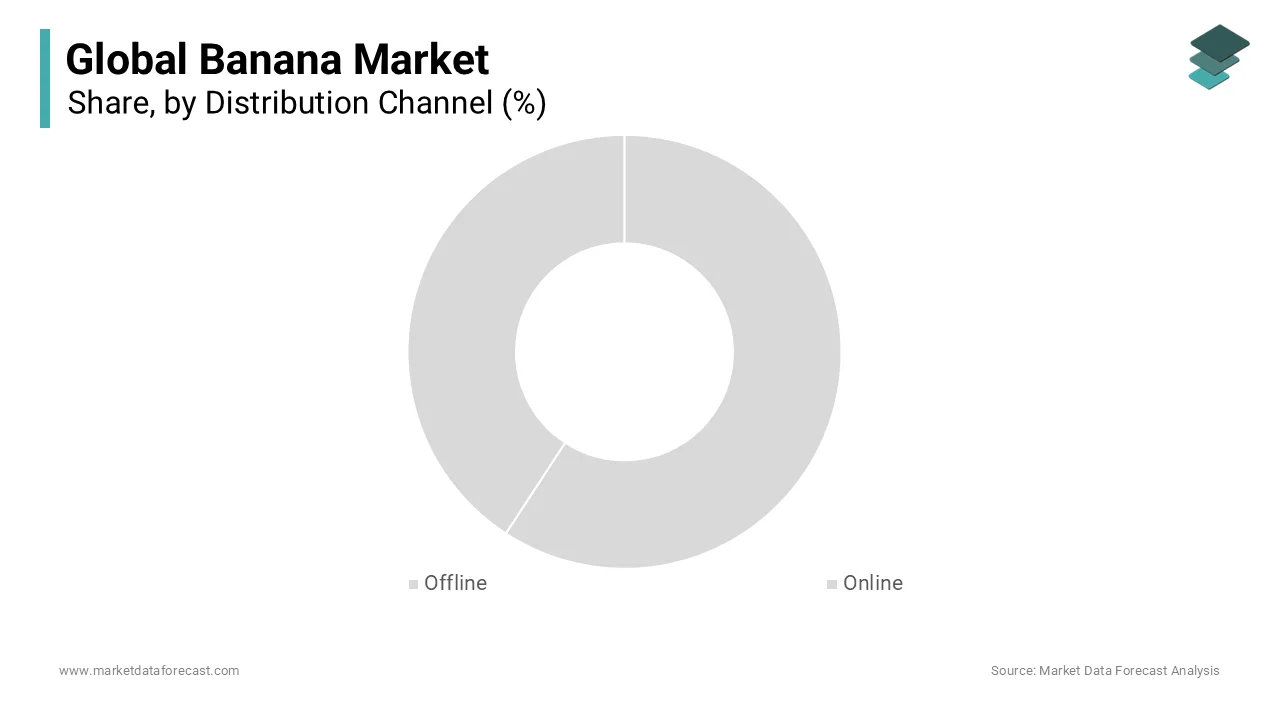
The online distribution segment is estimated to register the fastest CAGR of 14.3% over the forecast period owing to the proliferation of e-grocery platforms and same-day delivery services in urban centers across high-income economies. In the United States, online fruit and vegetable sales doubled during the post-pandemic period, with Amazon Fresh and Walmart+ accounting for a portion of digital fresh produce transactions, according to the study. In China, platforms have integrated cold chain logistics with AI-driven demand forecasting, reducing spoilage rates for online banana deliveries, as per the study. Furthermore, younger, tech-savvy consumers in Europe are increasingly purchasing bundled fruit hampers online, with Germany recording a year-on-year increase in banana orders via digital retailers, as per the study. The integration of blockchain traceability and subscription models is further enhancing consumer trust and convenience by accelerating the shift toward digital banana commerce.
By Type Insights
The conventional banana segment dominated the banana market by capturing a significant share in 2025. The growth of the conventional banana segment is driven by its scalability, cost-efficiency, and compatibility with large-scale export agriculture. Major exporters such as Ecuador, the Philippines, and Costa Rica rely on conventional farming systems that utilize synthetic fertilizers and integrated pest management to achieve high yields. These systems are optimized for Cavendish bananas, which constitute 97% of international trade volume due to their uniform ripening and transport resilience. Moreover, conventional plantations benefit from established certification protocols like GlobalG.A.P., enabling access to stringent markets in the European Union and North America. The United Nations Conference on Trade and Development notes that a portion of certified banana farms in Latin America operate under conventional practices with sustainability add-ons, allowing producers to meet export demands without the yield penalties often associated with organic conversion.
The organic banana segment is estimated to register the fastest CAGR of 11.8% over the forecast period, owing to the rising consumer demand for pesticide-free, sustainably grown produce in North America and Western Europe. In the United States, organic banana sales surged, accounting for a portion of total banana retail value, according to the study. The European Union imported significant metric tons of organic bananas, an increase from 2018, driven by policy incentives and retailer commitments to sustainable sourcing, according to the study. "Producers in the Dominican Republic and Peru have responded by converting hectares to more sustainable cultivation by receiving technical assistance for their efforts. Apart from these, organic bananas command premiums over conventional ones, as per the International Trade Centre, incentivizing smallholder participation.
By Form Factor Insights
The fresh bananas segment led the banana market by capturing a significant share in 2025, with the fruit’s role as a staple food and ready-to-eat snack in both tropical and temperate regions. In East Africa, where bananas are a dietary cornerstone, a portion of production is consumed fresh. The global fresh banana trade is also bolstered by efficient maritime cold chains, which maintain optimal temperatures between 13°C and 14°C during transit. This minimizes spoilage. According to research, millions of metric tons of bananas were shipped fresh in 2023, primarily from Ecuador, the Philippines, and Guatemala, emphasizing the logistical maturity and consumer preference that sustain this segment’s dominance.
The processed banana segment is predicted to witness the highest CAGR of 9.6% during the forecast period due to innovation in banana-based food products and the rising demand for natural, plant-based ingredients. Banana chips, flour, and puree are increasingly incorporated into gluten-free snacks, infant foods, and functional beverages. In India, the processed banana industry utilizes significant metric tons of surplus and damaged fruit, reducing post-harvest losses, according to the study. The Philippines has established many small-scale drying facilities to produce banana chips for export, generating notable millions in overseas sales, as per a study. Apart from these, banana pulp is being used in bioethanol production and biodegradable packaging, with pilot projects in Brazil converting agricultural waste into value-added materials.
REGIONAL ANALYSIS
North America Banana Market Insights
North America held the leading share of 39.7% of the global market in 2025 and the growth of North America in the worldwide market is likely to be driven by the affordability, nutritional awareness, and integration into school lunch programs. The United States is a high-volume and high-value market for bananas, importing millions of metric tons in 2023, according to the study. As the largest single-country importer globally, the U.S. relies on Ecuador, Costa Rica, and Colombia for a portion of its banana supply. Bananas are the top-selling fruit in American supermarkets. Major distributors like Chiquita, Dole, and Del Monte maintain long-term contracts with Latin American plantations, ensuring supply stability. However, rising labor costs, transportation volatility, and consumer demand for transparency are pushing retailers to adopt blockchain-based traceability systems. Walmart and Kroger have already piloted digital labeling that tracks bananas from farm to shelf, enhancing food safety and brand trust.
Latin America Banana Market Insights
Latin America was the top performer in the global banana market with 63.1% of the share in 2025, with the region’s equatorial climate, fertile volcanic soils, and decades of investment in agro-export infrastructure. As the world’s largest producing and exporting region, countries like Ecuador, Guatemala, and Costa Rica dominate international supply chains, with Ecuador shipping millions of metric tons in 2023, as reported by the Ecuadorian Ministry of Agriculture. Bananas remain an important foreign exchange earner, generating notable revenue in export revenue for Central America in 2022, according to the research. The proximity to North American markets reduces shipping times and spoilage, while bilateral trade agreements like CAFTA-DR ensure preferential access. However, reliance on a single cultivar, Cavendish, and exposure to TR4 pose systemic risks. This prompts regional governments to invest in diversification and phytosanitary research through institutions like the Honduran Foundation for Agricultural Research.
Asia Pacific Banana Market Insights
Asia Pacific was ranked second in the banana market, owing to being both a major producer and the largest consumer region. India and China lead in output, with India producing millions of metric tons domestically, primarily for internal consumption, according to the Indian Ministry of Agriculture. Unlike Latin America, most bananas in Asia are consumed locally, with a minimal export orientation; only a limited share of India’s production enters international markets. The region’s significance lies in its dietary dependence on bananas, particularly in countries like Indonesia and the Philippines, where bananas serve as a staple carbohydrate source. According to the study, the Philippine Department of Agriculture reports that a large number of smallholder farmers depend on banana cultivation for their livelihoods.
Europe Banana Market Insights
Europe is driven by its status as the world’s largest banana importer. The region absorbs a portion of global banana exports, as per the study. Its domestic production is low due to climatic constraints and the demand is met almost entirely through imports from Latin America, the Caribbean, and West Africa. France, Germany, and the United Kingdom collectively account for a portion of EU banana imports, driven by consistent consumer demand for fresh fruit. In 2025, the average annual per capita banana consumption in the EU was closer to 10.5 kg, according to the research. Retailers like Tesco and Carrefour have implemented sustainability sourcing policies by favoring Fair Trade and organic certifications. According to the research, a portion of bananas sold in major supermarkets now carry ethical labels.
Middle East & Africa Banana Market Insights
Middle East & Africa are likely to grow in the global banana market with Sub-Saharan Africa being a major producer yet a net importer in certain regions. However, intra-African trade remains underdeveloped due to poor transport infrastructure and phytosanitary barriers. Domestic consumption dominates, with bananas forming a portion of daily caloric intake in parts of East Africa. In contrast, Gulf Cooperation Council countries like Saudi Arabia and the UAE import nearly all their bananas, sourcing primarily from India, Jordan, and Egypt. The Gulf region imported significant million metric tons, as per the study, driven by expatriate populations and luxury retail demand. Cold chain expansion and regional trade agreements under the African Continental Free Trade Area may unlock future integration and reduce import dependency.
KEY MARKET PLAYERS AND COMPETITIVE LANDSCAPE
7 Eleven Inc., Agro America, Agrofruit Holding Corp., Aldi Stores Ltd., Auchan Retail Portugal SA, Axfood AB, Chiquita Brands International Sarl, Co-operative Group Ltd., Coliman, Dole plc, Federation of Migros Cooperatives, Fresh Del Monte Produce Inc., Fyffes Ltd., J Sainsbury plc, Koninklijke Ahold Delhaize NV, Lidl US LLC, Reybanpac, The Daiei Inc., and Waitrose & Partners are the key players in the banana market.
The banana market is characterized by intense yet concentrated competition, dominated by multinational agribusinesses and regional cooperatives. Also, local producers in Asia, Africa, and Latin America maintain strong domestic influence as few global players control significant portions of the export trade. Competitive dynamics are shaped by logistical efficiency, compliance with international standards, and responsiveness to sustainability demands. PBanana sensitivity in mass retail channels contrasts with premium positioning in organic and ethically sourced segments. Innovation in cold chain management and digital traceability has become a differentiator among top firms. Apart from these, the threat of crop diseases and climate volatility compels companies to invest in resilient supply networks. Market position is increasingly determined by the growing consumer awareness, brand reputation and environmental stewardship.
TOP PLAYERS IN THE MARKET
Chiquita Brands International
Chiquita Brands International operates extensively across the Asia Pacific region, strengthening its presence through strategic partnerships with local growers in the Philippines and Indonesia. The company has invested in sustainable farming initiatives, including water conservation systems and integrated pest management, to align with regional environmental standards. It actively participates in industry forums such as the Asia-Pacific Banana Producers Network to influence best practices. These efforts reflect Chiquita’s focus on quality assurance and consumer trust in high-income Asian markets.
Dole Food Company
Dole Food Company maintains a robust footprint in the Asia Pacific through large-scale sourcing operations in the Philippines, one of the world’s top banana exporters. Dole collaborates with thousands of smallholder farmers under its sustainability program, promoting fair labor practices and eco-friendly cultivation techniques. In 2022, the company upgraded its packing facilities in Mindanao to reduce post-harvest losses and improve export efficiency. Dole has also introduced organic banana lines in response to rising demand in South Korea and Australia. It partnered with e-commerce platforms like Lazada and Alibaba Fresh to distribute premium fruit bundles directly to urban consumers. This strengthens market visibility.
Fyffes Limited
Fyffes Limited, a subsidiary of Sumitomo Corporation, has intensified its engagement in the Asia Pacific by expanding import operations into Japan, Hong Kong, and Taiwan. Known for its stringent quality controls, Fyffes sources bananas from certified farms in Cambodia and Vietnam, where it has helped establish GlobalG.A.P.-compliant production units. The company has strengthened its reputation for reliability by aligning with regional food safety regulations and investing in cold logistics. Its participation in trade expos such as the Asia Fruit Logistica further amplifies its visibility among regional buyers and distributors.
TOP STRATEGIES USED BY THE KEY MARKET PLAYERS
Key players in the banana market are deploying vertical integration, sustainability certification, digital traceability, strategic alliances, and product diversification to consolidate their positions. Companies are acquiring upstream assets such as plantations and packing facilities to control quality and reduce supply chain disruptions. Sustainability initiatives, including Fair Trade and Rainforest Alliance certifications, are being leveraged to meet regulatory demands in premium markets. Digital tools like blockchain-enabled tracking systems enhance transparency and consumer confidence. Firms are also forming joint ventures with local cooperatives to secure supply and improve smallholder productivity.
MARKET SEGMENTATION
This research report on the global banana market has been segmented and sub-segmented based on distribution channel, type, form factor, and region.
By Distribution Channel
- Offline
- Online
By Type
- Inorganic/conventional
- Organic
By Form Factor
- Fresh bananas
- Processed bananas
By Region
- North America
- Europe
- Asia-Pacific
- Latin America
- Middle East and Africa