- Product Description Description
- Table of Contents TOC
- List of Table & Figure LOT
- Get Free Sample PDF Sample PDF
Market Size, 2025
$394 MnMarket Estimate, 2026
$419.61 MnMarket Forecast, 2034
$694.45 MnCAGR, 2026–2034
6.5%Global Barcode Decoders Market Size
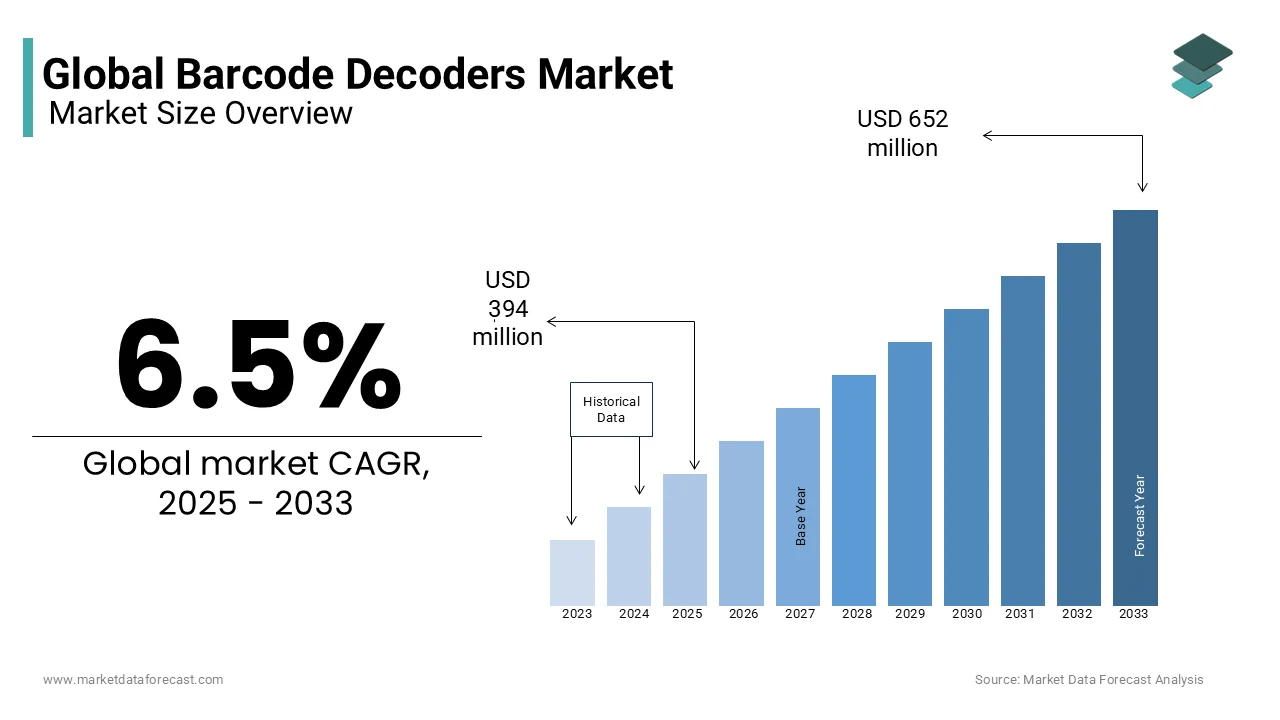
The global barcode decoders market was worth USD 394 million in 2025. The global market is expected to reach USD 419.61 million in 2026 and USD 694.45 million by 2034, growing at a CAGR of 6.5% during the forecast period (2026 to 2034).
Barcode decoders are hardware devices that translate barcode data into a digital representation. They examine the bars and spaces in a barcode, evaluate whether the data is from a legitimate barcode, and then select the appropriate barcode symbology. An ASCII text file with check digits at the beginning and end of the barcode is sent to a host computer, usually a PC. Text-formatting options in some barcode decoders allow you to delete leading digits from a string, add a character to the beginning, or convert numbers to letters. Programming can be done on the barcode decoder or on the host computer using software.
Power, programmability, interface, special keys, termination characters, and decode rate are all features of barcode decoders. The majority of decoding devices are powered by the computer, although battery-powered barcode decoders are not. Some models include a setup menu and DIP switches for programmability. The type of connector for keyboard or wedge barcode decoders may differ. Wireless barcode decoders are also available. The interface is normally a keyboard or USB, although wireless barcode decoders are also available. Some decoding applications require support for special keys and termination characters. A barcode decoder's decode rate is a measurement of its speed. Barcode decoders support a variety of barcode symbologies. These symbologies are essentially alphabets in which varied bar and space widths are used to generate letters and, eventually, messages.
MARKET DRIVERS
Emergence of Digital Technologies for Scanning and Interpreting Inventory of Data
The growing demand for barcode decoders in the retail and wholesale, logistics and warehousing, industrial manufacturing, healthcare, and other applications sectors around the globe, which is one of the major factors propelling the global market growth.
Due to the emergence of digital technologies for scanning and interpreting inventory of data, primarily in the retail and warehousing sectors, the barcode scanner market is expected to grow significantly. Due to its cutting-edge features and technological advantages, the barcode scanner is becoming more popular in the retail and warehousing industries. Furthermore, the introduction of barcode technology is expected to make inventory tracking and supply easier for retail and warehousing businesses. Another important element driving the growth of the barcode scanner market is advancements in barcode technology and its continuous improvement.
Proliferation of the Retail Sector because of Rising Sales
During the forecast period, the barcode scanner market is expected to grow significantly due to the proliferation of the retail sector because of rising sales. The increase in the number of shopping malls and supermarkets in developing nations because of economic growth is fuelling the barcode scanner industry indirectly. Barcode scanners are in high demand due to high volume sales in the retail industry that must be handled electronically. A barcode scanner is a critical component for scanning and interpreting data recorded in barcodes.
MARKET RESTRAINTS
High Cost of Barcode Technology
A barcode reader must be acquired to use barcode technology, which is rather costly. If it's a 2D barcode scanner, the costs are even higher. This expense cannot be justified, especially for small firms. A further analysis is required to ensure that the investment in a barcode scanner is worthwhile. Physical damage to barcode readers is a common occurrence. It is subjected to wear and tear in the same way that other equipment is. If it is damaged, it may result in additional repair charges. Only a limited number of data can be scanned by barcode readers. Those details are limited to the product and its manufacturers. There are no details about the date of manufacturing or the expiration date. Cybercriminals may have created harmful barcodes. Hackers could simply obtain access to the operating system because the USB that connects the scanner to the PC works as a secondary keyboard. These factors make customers hesitant before purchasing a barcode decoder and limit global barcode decoder market growth.
REPORT COVERAGE
| REPORT METRIC | DETAILS |
| Market Size Available | 2025 to 2034 |
| Base Year | 2025 |
| Forecast Period | 2026 to 2034 |
| CAGR | 6.5% |
| Segments Covered | By Type, Application and Region |
|
Various Analyses Covered | Global, Regional & Country Level Analysis, Segment-Level Analysis, DROC, PESTLE Analysis, Porter’s Five Forces Analysis, Competitive Landscape, Analyst Overview of Investment Opportunities |
| Regions Covered | North America, Europe, APAC, Latin America, Middle East & Africa |
| Market Leaders Profiled | Datalogic, Symbol Technologies (Zebra), Honeywell, Cognex, SICK, Newland NCR, Denso Wave, Code, Microscan, Opticon Sensors, MINDEO, Zebex, CipherLAB, Bluebird, Argox (SATO), SUNLUX IOT, and others. |
SEGMENTAL ANALYSIS
By Type Insights
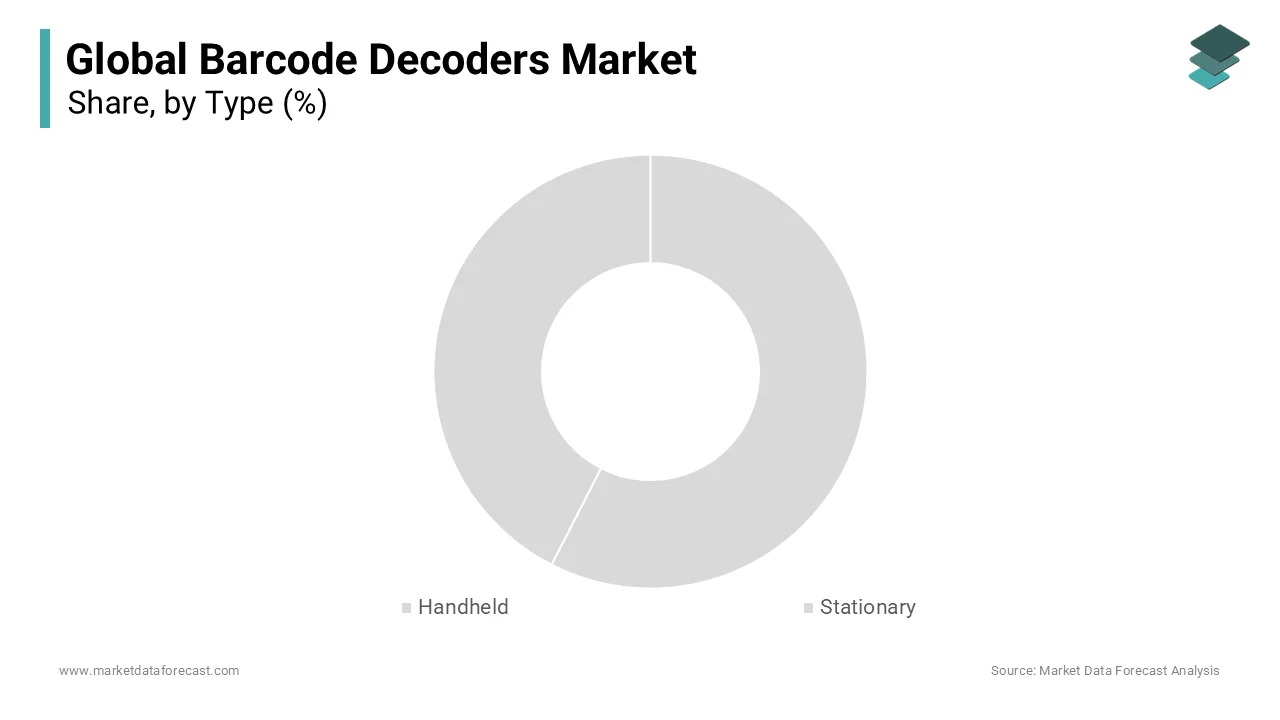
With the biggest market share, the Handheld Barcode Scanner category is predicted to develop significantly and dominate the global market over the forecast period.
By Application Insights
In the global market, the retail and wholesale segment had the biggest share of the global market in 2023 and is expected to develop at a rapid pace over the forecast period. The Segment focuses on each application's current position and potential for substantial application value, market share, and growth valuation.
REGIONAL ANALYSIS
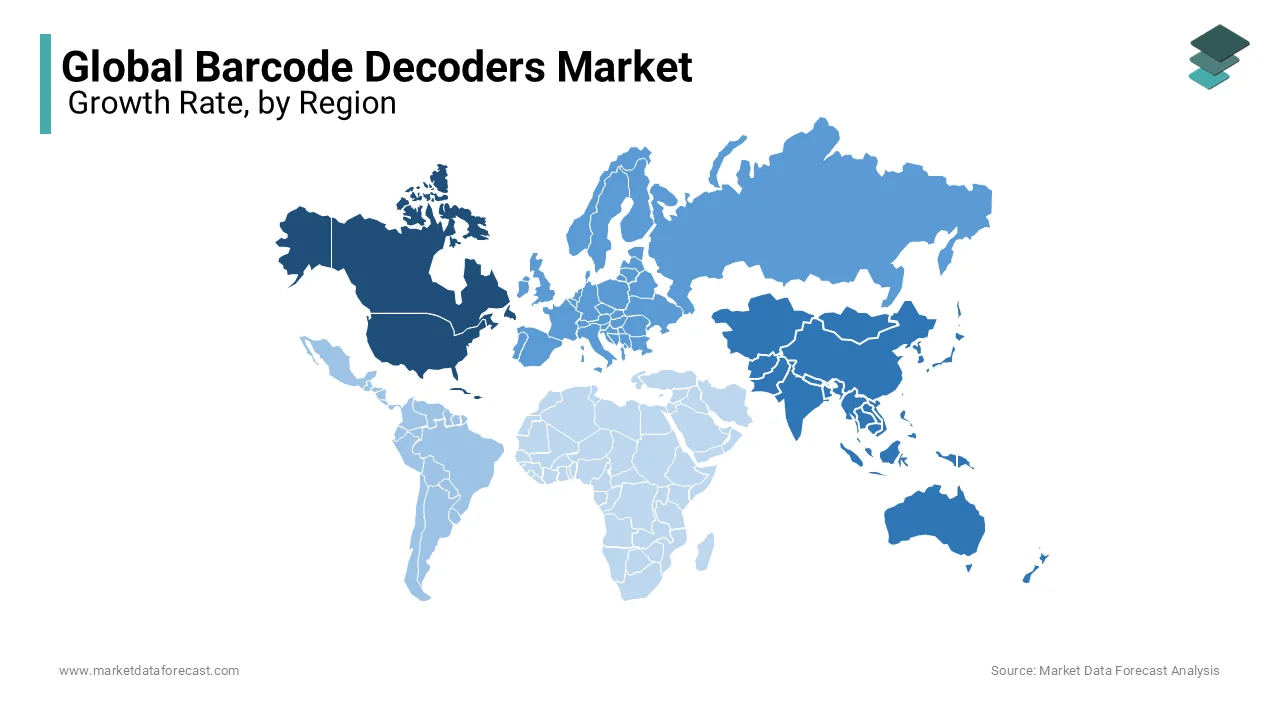
Based on the region, North America is likely to be the top region among them, owing to the widespread use of cutting-edge technologies in the public distribution system. Over the forecast period, the barcode scanner market in the Asia Pacific is expected to rise at a significant rate. The barcode scanner market is indirectly fuelled by a large increase in the number of e-tailers in the region due to the appeal of online shopping for convenience and selection. E-tailers may maintain track of inventory using barcode technology, which allows them to keep track of it as it moves out. Asia Pacific is a notable region in the barcode scanner market due to the presence of numerous key companies in China, India, Japan, and South Korea.
KEY PLAYERS IN THE MARKET
Datalogic, Symbol Technologies (Zebra), Honeywell, Cognex, SICK, Newland NCR, Denso Wave, Code, Microscan, Opticon Sensors, MINDEO, Zebex, CipherLAB, Bluebird, Argox (SATO) and SUNLUX IOT are some of the major companies in the global barcode decoders market.
RECENT HAPPENINGS IN THE MARKET
-
Kemtek sought for new and unique technologies that push the boundaries of what was previously thought to be feasible in the realm of bar coding. In this mission, Kemtek discovered the ideal partner in Datalogic, a bar coding and auto ID OEM developer with experience in a wide range of industries, including retail, point of sale, warehousing, logistics, automotive, and more.
-
Yodel chosen ProGlove, a supplier of wearable barcode scanners, to improve visibility, scan control, and productivity across 50 locations in the United Kingdom.
MARKET SEGMENTATION
This research report on the global barcode decoders market has been segmented and sub-segmented based on type, application and region.
By Type
-
Handheld
-
Stationary
By Application
-
Retail and Wholesale
-
Logistics and Warehousing
-
Industrial Manufacturing
-
Healthcare
-
Others
By Region
-
North America
-
Europe
-
Asia Pacific
-
Latin America
-
Middle East & Africa