- Product Description Description
- Table of Contents TOC
- List of Table & Figure LOT
- Get Free Sample PDF Sample PDF
Global Biorefinery Applications Market Size
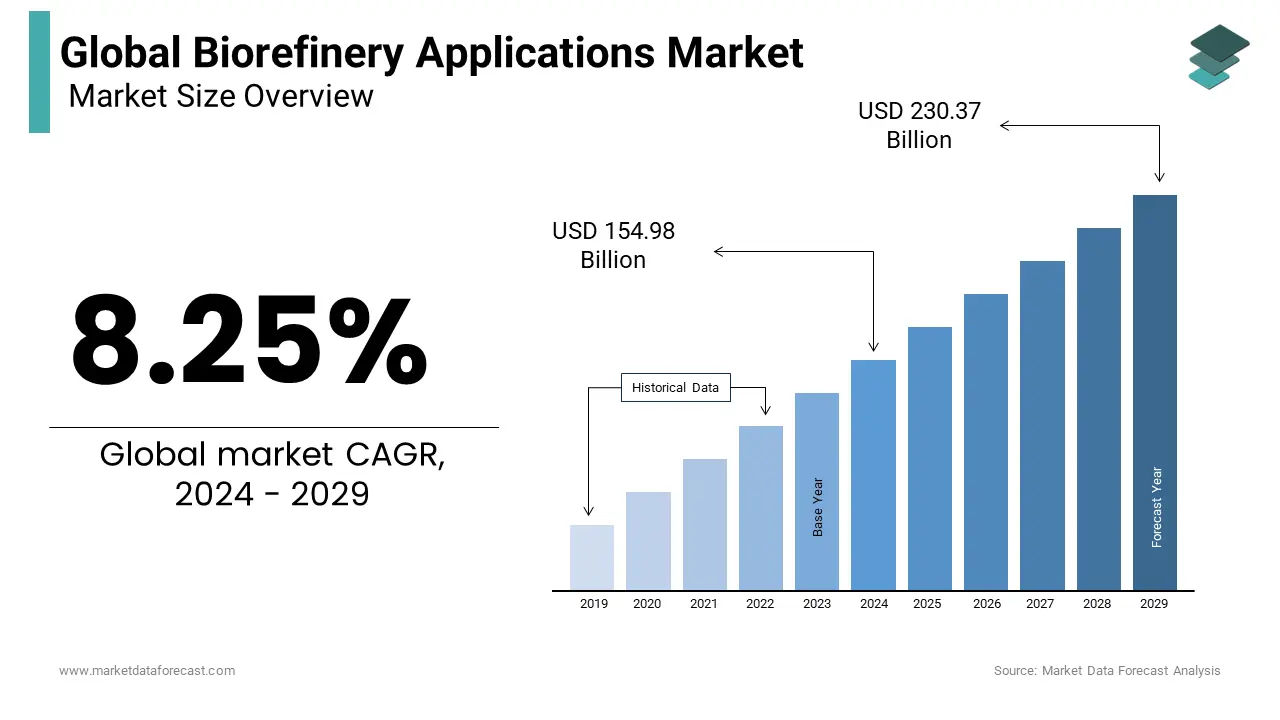
The global biorefinery applications market size is expected to grow at a CAGR of 8.25% during the forecast period. The market was valued at USD 155 billion in 2024 and is expected to reach USD 316.37 billion by 2033 from USD 167.69 billion in 2025.
MARKET DRIVERS
The growing importance of sustainable resource management is a driving factor in Biorefinery Applications Market.
Sustainable resource management is a significant driver in the Biorefinery Applications Market because nowadays, people are becoming more aware of the limited availability of fossil fuels, and there is a greater focus on using resources wisely. So, Biorefineries play an important role by converting renewable resources like leftover crop materials and wood waste into useful products like biofuels and bioplastics. As a result, it reduces our reliance on finite fossil fuels, helps protect the environment, and also aligns with our goal of using resources efficiently and responsibly.
Diversifying energy sources surges the Biorefinery Applications Market growth. Energy security is a key driver of the Biorefinery Applications Market. These applications help us produce biofuels such as ethanol and biodiesel from renewable sources like plants and wood. So, we are less dependent on other countries for our energy needs, making our energy supply more secure and reliable. As a result, biorefinery applications play a vital role in ensuring our energy security and reducing the risks associated with relying too heavily on imported fuels, and it drives the Biorefinery Applications Market in these market place.
MARKET RESTRAINTS
The Biorefinery Applications Market faces significant restraints due to its high initial cost.
This substantial upfront cost can be a restraining factor for smaller companies or regions with limited financial resources. So, these financial barriers can slow down the development of biorefineries, limiting their market growth and potential contributions to sustainable resource management and energy security.
MARKET OPPORTUNITIES
Expanding Agricultural Residue Utilization Provides Growth Opportunities in Biorefinery Applications Market. The Biorefinery Applications Market offers a significant opportunity to utilize a broader range of agricultural residues, such as corn stover, wheat straw, and rice husks, which were previously underutilized. The increased utilization of these feedstocks can enhance the economic viability of biorefineries and also reduce agricultural waste. As a result, this market trend aligns with sustainability goals and creates growth opportunities in the biorefinery applications market.
REPORT COVERAGE
| REPORT METRIC | DETAILS |
| Market Size Available | 2024 to 2033 |
| Base Year | 2024 |
| Forecast Period | 2025 to 2033 |
| Segments Covered | By Feedstock, Product, End-User, and Region. |
| Various Analyses Covered | Global, Regional, & Country Level Analysis; Segment-Level Analysis, Drivers, Restraints, Opportunities, Challenges, PESTLE Analysis, Porter’s Five Forces Analysis, Competitive Landscape, Analyst Overview of Investment Opportunities |
| Regions Covered | North America, Europe, Asia Pacific, Latin America, Middle East, and Africa |
| Key Market Players | Archer Daniels Midland Company, Neste Corporation, DuPont de Nemours, Inc., Novozymes A/S, Abengoa Bioenergy, Valero Energy Corporation, Pacific Ethanol, Inc., POET LLC, Covestro AG, Amyris, Inc., Green Plains Inc., Wilmar International Limited, REG Life Sciences, LLC, Raizen Energia S.A., Borregaard ASA, DSM Nutritional Products AG, TotalEnergies, Abitep GmbH, and Others. |
SEGMENTAL ANALYSIS
By Feedstock Insights
Agricultural residues dominate the Biorefinery Applications Market due to their abundant availability from crop production, cost-effectiveness, and sustainability. These residues, such as those from corn, wheat, rice, and sugarcane, offer versatile feedstock sources that align with environmentally friendly practices to drive the biorefinery applications market demand.
By Product Insights
The biofuels segment dominates the Biorefinery Applications Market due to their pivotal role in transitioning to cleaner energy sources. These fuels serve as direct replacements for fossil fuels, reducing greenhouse gas emissions. Their market maturity and established production systems further solidify their dominance in biorefinery applications.
By End-User Insights
The "Chemicals" end-user type dominates the Biorefinery Applications Market due to the versatility of bio-based chemicals and their wide-ranging applications in industries such as pharmaceuticals, cosmetics, and agriculture. These environmentally-friendly alternatives to petrochemicals align with sustainability goals, fostering a higher demand for bio-based chemicals.
REGIONAL ANALYSIS
North American region held the largest share of the global market in 2024.
The growth of the North American region in the worldwide market is majorly due to strong government support for renewable energy and a growing focus on sustainability. The presence of key market players and research institutions further drives innovation and growth in the biorefinery applications market.
Europe holds a significant share next to North America, driven by strict environmental regulations, a mature economy, and a growing emphasis on green technologies. European countries actively promote biorefinery initiatives, contributing to market dominance.
Asia-Pacific biorefinery applications market growth rate is leveraging due to rapid industrialization, population growth, and increased awareness of environmental concerns. Rising investments in biorefinery infrastructure and the abundance of biomass resources further boost the region's market presence.
The Middle East and Africa biorefinery applications market size is witnessing growing interest in biorefinery applications as they seek to diversify their economies and reduce dependence on fossil fuels. The region's vast biomass resources and the need for sustainable solutions drive market growth.
Latin America, although smaller in comparison, is steadily increasing its focus on biorefinery applications. The region's agriculture and forestry sectors provide ample feedstock, and governments are promoting bio-based products, contributing to market expansion.
KEY MARKET PLAYERS
Companies playing a prominent role in the global biorefinery applications market include Archer Daniels Midland Company, Neste Corporation, DuPont de Nemours, Inc., Novozymes A/S, Abengoa Bioenergy, Valero Energy Corporation, Pacific Ethanol, Inc., POET LLC, Covestro AG, Amyris, Inc., Green Plains Inc., Wilmar International Limited, REG Life Sciences, LLC, Raizen Energia S.A., Borregaard ASA, DSM Nutritional Products AG, TotalEnergies, Abitep GmbH, and Others.
RECENT MARKET HAPPENINGS
- In 2021, NatureWorks focused on producing bio-based plastics and biodegradable materials. These innovations aimed to reduce plastic waste and promote more sustainable packaging solutions.
- In 2021, DuPont continued to expand the commercial production of advanced biofuels, particularly cellulosic ethanol. These efforts aimed to reduce reliance on traditional fossil fuels and lower greenhouse gas emissions.
- In 2021, Corbion diversified its product portfolios beyond biofuels and biochemicals. They explored new markets, including bio-based cosmetics, pharmaceuticals, and personal care products.
- In 2020, Enerkem focused on converting municipal solid waste (MSW) and other waste streams into biofuels and chemicals. This approach aimed to address waste management challenges while producing renewable products.
MARKET SEGMENTATION
This global biorefinery applications market research report has been segmented and sub-segmented based on feedstock product, end user and region.
By Feedstock
- Agricultural Residues
- Woody Biomass
- Algae
- Energy Crops
- Other
By Product
Biofuels
- Ethanol
- Biodiesel
Biochemicals
- Enzymes
- Bioplastics
Biopower
- Electricity
- Heat
By End-User
- Biofuels
- Electricity
- Energy products
- Material products
- Foodstuff
- Chemicals
- Fertilizer
- Polymers
- Others
By Region
- North America
- Europe
- Asia Pacific
- Latin America
- Middle East & Africa