- Product Description Description
- Table of Contents TOC
- List of Table & Figure LOT
- Get Free Sample PDF Sample PDF
Market Size, 2025
$2.20 BnMarket Estimate, 2026
$2.72 BnMarket Forecast, 2034
$15.01 BnCAGR, 2026–2034
23.78%Executive Summary: Global Blockchain in Telecom Market
- Market Scope: Comprehensive global blockchain in telecom market analysis covering provider categories, application sectors, enterprise tiers, regional leadership frameworks, and 5G network slicing trust infrastructure trends.
- Market Valuation: Valued at USD 2.20 billion (2025), estimated at USD 2.72 billion (2026), and projected to reach USD 15.01 billion by 2034, registering an exceptional CAGR of 23.78% (2026–2034).
- Primary Growth Drivers: Escalating identity fraud losses exceeding USD 6.8 billion annually, inefficient cross-border settlement cycles, 5G network slicing automation, self-sovereign identity frameworks, and EU Digital Identity Wallet mandates.
Key Market Segment Metrics (2026–2034)
| Category | Leading Segment (Base Position) | Fastest-Growing Segment |
|---|---|---|
| By Provider Type | Infrastructure Providers (held the largest share in 2025 across telecom blockchain frameworks) | Middleware Providers (projected to grow at the fastest CAGR of 25.2%) |
| By Application | Identity Management (dominated applications due to fraud mitigation and compliance ROI) | Connectivity Provisioning (anticipated to expand at the fastest CAGR of 28.8% driven by 5G slicing) |
| By Enterprise Size | Large-Scale Enterprises (accounted for the largest market share in 2025) | Small and Medium-Sized Enterprises (SMEs forecast to grow at the fastest CAGR of 30.9% via managed services) |
| By Region / Country | North America (leads the global market with a 35.5% share in 2025) | Asia-Pacific (expected to witness accelerated growth driven by state-directed infrastructure in China and open consortiums in Japan) |
Major Market Players & Market Structure
Market Structure: Highly competitive global telecommunications and enterprise blockchain landscape where major cloud and infrastructure leaders focus on automated network slicing modules, equipment provenance platforms, and data-localized privacy computation.
Key Companies: AWS, Guardtime, IBM, Microsoft, SAP, Bitfury, Ericsson, Nokia, Huawei, Oracle, TBCASoft, and ShoCard.
Global Blockchain in Telecom Market Size
The global blockchain in telecom market was valued at USD 2.20 billion in 2025. The global market size is estimated at USD 2.72 billion in 2026 and USD 15.01 billion by 2034, growing at a CAGR of 23.78% from 2026 to 2034.
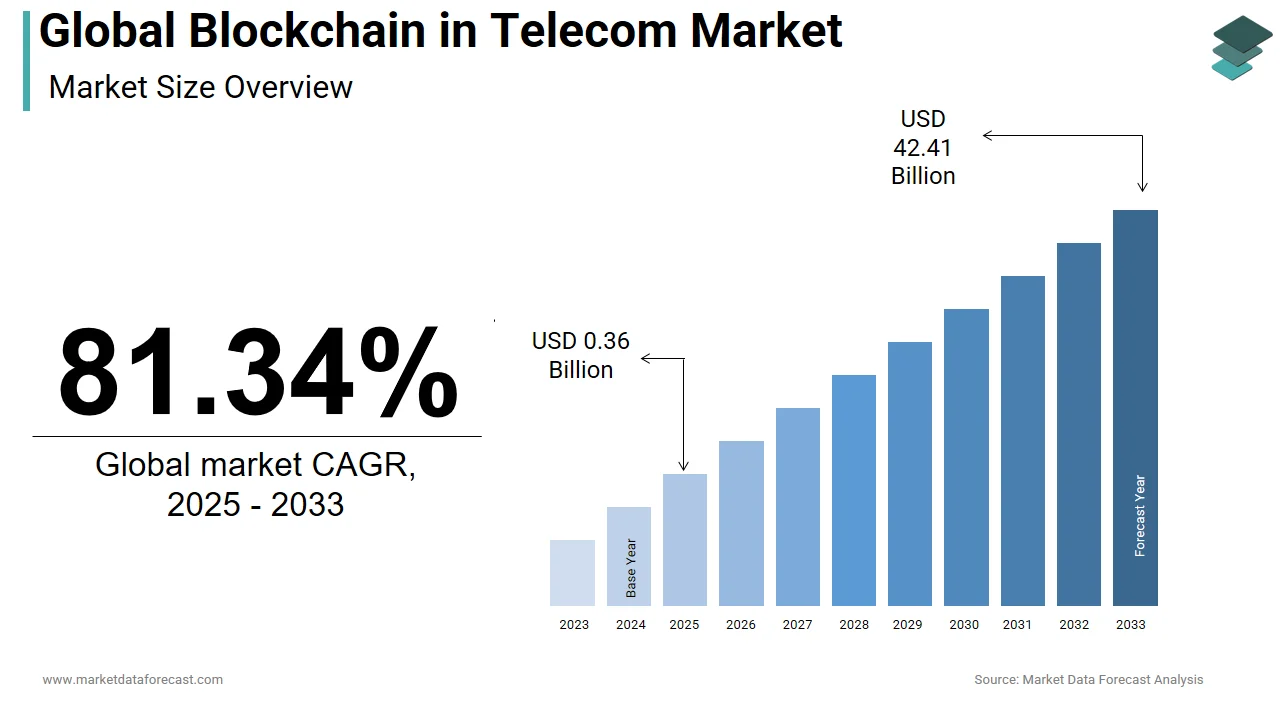
Blockchain in telecom refers to the integration of distributed ledger technology within telecommunications infrastructure to enhance security, transparency, and operational efficiency across network management and service delivery. This technological convergence addresses systemic vulnerabilities, including identity fraud, roaming disputes, and supply chain opacity that cost the industry billions annually. According to the GSMA, mobile network operators lost approximately 38 billion dollars to fraud in 2023, representing 2.1% of total industry revenue and creating urgent demand for immutable verification systems. According to the International Telecommunication Union, over 45 national regulatory authorities have initiated blockchain pilot programs for spectrum management and digital identity since 2022, reflecting growing institutional recognition of distributed ledger utility beyond cryptocurrency applications. As per the World Economic Forum, 67% of telecom executives surveyed in 2024 identified blockchain as critical infrastructure for enabling secure 5G network slicing and IoT device authentication at scale. Unlike traditional centralized databases vulnerable to single points of failure, blockchain provides tamper-resistant record-keeping, enabling trustless collaboration between competing operators sharing network resources. According to BICS industry benchmarks, this capability proves particularly valuable for cross-border settlements where reconciliation delays average 45 days. Consequently, blockchain functions as a foundational trust layer for next-generation telecommunications ecosystems requiring automated verification and decentralized coordination among multiple stakeholders operating in low-trust environments.
MARKET DRIVERS
Identity Verification Crisis Demands Decentralized Authentication Solutions
Telecommunications networks face escalating identity fraud as synthetic identities and SIM swap attacks exploit centralized database vulnerabilities, which are undermining subscriber trust and regulatory compliance and are driving the global blockchain in telecom market growth. Account takeover fraud targeting mobile carriers increased 78% in 2023, with losses exceeding 6.8 billion dollars globally as criminals leverage compromised personal data to hijack phone numbers for two-factor authentication bypass. Traditional KYC processes require subscribers to repeatedly submit sensitive documents to each service provider, creating redundant attack surfaces and friction during onboarding that drives customer abandonment rates above 25%. Blockchain-based self-sovereign identity frameworks enable users to control verified credentials without exposing underlying personal data to multiple vendors, reducing breach exposure while streamlining compliance. According to Deutsche Telekom and Orange, the European Self-Sovereign Identity Framework piloted in 2024 demonstrated a 90% reduction in identity verification time and a 65% decrease in fraud incidents across participating networks. Regulatory pressures, including the EU Digital Identity Wallet mandate effective 2026, compel operators to adopt interoperable identity standards compatible with government-issued digital credentials. This convergence of security imperatives and regulatory requirements creates structural demand for blockchain identity infrastructure as operators transition from custodial data models toward user-centric verification architectures that reduce liability while improving customer experience.
Cross-Border Settlement Inefficiencies Drive Distributed Ledger Adoption
International roaming and intercarrier settlements suffer from opaque reconciliation processes, which is causing significant working capital tie-up and dispute resolution costs across global telecommunications networks and further aiding the blockchain in telecom market growth expansion. According to BICS, the average settlement cycle for international voice and data roaming exceeds 45 days, with dispute rates reaching 12% of total transaction volume due to mismatched records between originating and terminating operators. These inefficiencies trap an estimated 18 billion dollars in working capital industry-wide, representing opportunity cost that could fund network modernization or shareholder returns. Smart contract-enabled blockchain platforms automate usage verification and payment execution upon predefined conditions, eliminating manual reconciliation and reducing settlement times to under 24 hours. Vodafone and Telefónica's joint blockchain roaming pilot completed in Q3 2024 processed over 2 million transactions with zero disputes and 98% faster settlement compared to legacy clearinghouse methods. The GSMA Open Gateway initiative incorporates blockchain settlement standards, enabling API monetization across operator boundaries with real-time revenue sharing previously impossible through batch processing systems. As 5G enables new wholesale business models, including network slicing resale and edge computing marketplace transactions, automated settlement becomes a prerequisite for scalable B2B commerce requiring trustless coordination among multiple parties without established bilateral relationships.
MARKET RESTRAINTS
Legacy Infrastructure Integration Complexity Limits Deployment Velocity
Telecommunications operators manage decades-old billing and operations support systems architected before distributed ledger technology existed, which is a major impediment to the blockchain in the telecom market. According to the TM Forum, 72% of tier-one operators still run core billing on mainframe systems averaging 25 years in age, with proprietary data formats incompatible with modern blockchain protocols without extensive middleware development. Migration projects typically require 18 to 36 months and budgets exceeding 50 million dollars, with success rates below 40% due to unforeseen dependencies and testing complexities inherent in monolithic architectures. Real-time blockchain transaction processing conflicts with batch-oriented legacy systems designed for overnight processing cycles, creating synchronization challenges that compromise data consistency across hybrid environments. A consortium of European operators attempting a shared blockchain KYC platform abandoned the initiative in 2024 after spending 28 million euros over three years due to insurmountable integration issues with member legacy stacks. Vendor lock-in from incumbent system providers further complicates matters, as proprietary APIs lack standardized interfaces for external ledger connectivity, forcing custom development that increases maintenance burden and vendor dependency. Until operators complete multiyear digital transformation journeys replacing legacy cores with cloud-native architectures, blockchain deployment will remain confined to greenfield use cases rather than achieving enterprise-scale integration necessary for transformative impact.
Regulatory Uncertainty Regarding Data Privacy Compliance Creates Legal Risk
Blockchain's immutable data storage characteristics fundamentally conflict with privacy regulations mandating data deletion rights, which is further impeding global market growth. According to the European Data Protection Board, GDPR Article 17 right to erasure applies to personal data stored on distributed ledgers, yet technical immutability prevents actual deletion, forcing operators to choose between regulatory compliance and blockchain integrity. France's CNIL issued guidance in 2024 stating that storing personal data directly on public blockchains violates GDPR principles regardless of encryption or hashing techniques applied, limiting permissible architectures to permissioned private ledgers with centralized governance that undermines decentralization benefits. California Consumer Privacy Act amendments effective January 2024 expanded deletion obligations to derived data, including blockchain transaction metadata, broadening compliance scope beyond obvious personal identifiers. A broad industry survey found that 68% of telecom legal departments have blocked blockchain projects involving any personal data processing due to unresolved regulatory ambiguity, preferring wait-and-see approaches despite operational benefits. Cross-border data transfer restrictions compound challenges, as blockchain nodes distributed across jurisdictions may violate data localization requirements in countries like China, Russia, and India mandating domestic storage. Until regulators provide clear safe harbor provisions or technical standards emerge reconciling immutability with privacy rights, legal uncertainty will persistently restrain blockchain adoption in customer-facing telecom applications where personal data handling is unavoidable.
MARKET OPPORTUNITIES
Network Slicing Monetization Requires Automated Trust Infrastructure
Fifth-generation network slicing creates unprecedented opportunities for the global blockchain in telecom market. According to industry reports from 2024, enterprise network slice deployments are projected to reach 15 million by 2028, generating 35 billion dollars in annual revenue requiring automated provisioning and guaranteed performance verification that traditional manual processes cannot support at scale. Each slice represents a distinct contractual commitment with specific latency, bandwidth, and reliability parameters, necessitating tamper-proof monitoring and billing records acceptable to both operator and enterprise customer without third-party arbitration. Nokia and T-Mobile successfully demonstrated a blockchain-mediated slice marketplace in Q1 2025, enabling enterprises to purchase temporary high-bandwidth slices for events, with smart contracts automatically adjusting pricing based on real-time utilization metrics and verifying SLA compliance through oracle-fed network telemetry. The GSMA Operator Platform Group has published blockchain-based slice trading specifications enabling cross-operator slice resale, creating secondary market liquidity previously impossible due to trust deficits between competing carriers. Edge computing integration amplifies opportunity as distributed compute resources require microsecond-level coordination and micropayment settlement for resource sharing among multiple tenants. This convergence of 5G capabilities and blockchain automation unlocks new revenue streams from programmable network infrastructure, transforming connectivity from a commodity service into a customizable digital product with verifiable quality guarantees.
Supply Chain Transparency Addresses Counterfeit Equipment Risks
Telecommunications infrastructure faces growing counterfeit component threats, which is compromising network security and reliability while exposing operators to regulatory penalties and reputational damage from compromised equipment and offering further possibilities for the blockchain in the telecom market. According to the OECD, counterfeit electronics trade reached 465 billion dollars in 2023, with telecom equipment representing 18% of seized goods as sophisticated fakes evade traditional inspection methods and enter legitimate supply chains through authorized distributors. The US Federal Communications Commission banned Huawei and ZTE equipment citing national security concerns, yet verification of authentic components from approved vendors remains challenging given complex multi-tier supplier networks spanning dozens of countries. Blockchain provenance tracking enables end-to-end component traceability from semiconductor fabrication through final installation, with immutable records accessible to regulators and customers demonstrating compliance with sourcing restrictions. AT&T and Cisco launched a joint blockchain supply chain initiative in late 2024 covering 5G radio equipment with QR code-linked ledger entries verifying authenticity, test results, and custody transfers across 14 manufacturing and logistics partners. According to the UK National Cyber Security Centre, blockchain provenance standards were endorsed in 2025 as recommended practice for critical infrastructure procurement, creating a regulatory pull factor accelerating adoption. As geopolitical tensions fragment global supply chains and reshoring initiatives create new vendor ecosystems, transparent provenance verification becomes a competitive differentiator, enabling operators to demonstrate security posture to enterprise customers and regulators demanding assurance against compromised hardware infiltration.
MARKET CHALLENGES
Scalability Limitations Conflict with Telecom Transaction Volumes
Telecommunications networks generate transaction volumes orders of magnitude exceeding current blockchain throughput capabilities, which is creating fundamental architectural mismatches that prevent direct application of distributed ledger technology to core operational processes and challenging the global blockchain in telecom market. According to the Cisco Annual Internet Report, global mobile networks processed 1.2 zettabytes of data in 2024, with signaling transactions exceeding 500 billion daily across all operators, representing a load that even high-performance blockchains processing 65,000 transactions per second cannot handle without radical redesign. Bitcoin and Ethereum mainnets achieve only 7 and 30 transactions per second, respectively, while enterprise permissioned ledgers like Hyperledger Fabric peak around 3,500 transactions per second in optimal configurations, which remains insufficient for real-time call detail recording or IoT sensor ingestion. Layer 2 scaling solutions introduce complexity and security tradeoffs that telecom operators find unacceptable for mission-critical systems requiring deterministic finality rather than probabilistic confirmation. Vodafone's attempted blockchain-based real-time rating system failed in a 2024 pilot after discovering that 400-millisecond transaction latency exceeded the maximum tolerable threshold for prepaid balance updates, causing customer experience degradation. Sharding and parallel processing architectures remain experimental with no production deployments at telecom scale, creating a chicken-and-egg problem where operators await proven scalability before investing, yet vendors need operator deployments to validate designs. Until blockchain achieves million-transaction-per-second throughput with sub-100-millisecond latency, adoption will remain restricted to low-volume back-office functions rather than transforming core network operations.
Energy Consumption Concerns Conflict With Sustainability Commitments
Proof-of-work consensus mechanisms underlying many blockchain implementations consume electricity at scales incompatible with telecommunications industry net-zero commitments, which is further challenging global market growth. According to the Cambridge Centre for Alternative Finance, global blockchain mining consumed 173 terawatt-hours in 2024, equivalent to Poland's national electricity consumption, with a carbon footprint exceeding 85 million metric tons of CO2 annually, contradicting the GSMA industry commitment to achieve net-zero emissions by 2050. Even energy-efficient proof-of-stake alternatives require continuous validator node operation consuming 2 to 5 kilowatts per node, translating to significant aggregate consumption when deployed across thousands of network locations for geo-redundancy. Telefónica suspended a blockchain pilot in Spain during 2024 after a sustainability audit revealed projected annual consumption of 2.4 gigawatt-hours would increase the divisional carbon footprint by 8%, violating internal environmental KPIs tied to executive compensation. Regulatory pressures intensify as the EU Corporate Sustainability Reporting Directive, effective 2025, mandates detailed energy disclosure for digital infrastructure investments, subjecting blockchain projects to scrutiny previously reserved for physical assets. Renewable energy sourcing partially mitigates concerns, yet grid availability and intermittency issues limit reliable green power access in many regions where telecom operates. Operators must balance innovation ambitions against measurable environmental impact, creating tension between technological experimentation and publicly stated climate responsibilities that investors and customers increasingly demand accountability for.
REPORT COVERAGE
| REPORT METRIC | DETAILS |
| Market Size Available | 2025 to 2034 |
| Base Year | 2025 |
| Forecast Period | 2026 to 2034 |
| Segments Covered | By Provider, Application, Organization Size, and Region. |
| Various Analyses Covered | Global, Regional, and Country-Level Analysis, Segment-Level Analysis, Drivers, Restraints, Opportunities, Challenges; PESTLE Analysis; Porter’s Five Forces Analysis, Competitive Landscape, Analyst Overview of Investment Opportunities |
| Countries Covered | North America, Europe, APAC, Latin America, Middle East & Africa |
| Market Leaders Profiled | AWS, Guardtime, IBM, Microsoft, SAP, Bitfury, Cegeka, Clear, Reply, Ericsson, ShoCard, Abra, Auxesis Group, Blockchain Foundry, BlockCypher, Blocko, Blockpoint, Blockstream, Nokia, Chain, Filament, Huawei, Oracle, RecordsKeeper, Sofocle, SpinSys, TBCASoft, and Others. |
SEGMENTAL ANALYSIS
By Provider Insights
The infrastructure providers segment led the market by commanding the largest share of the global market in 2025 because distributed ledger functionality must be embedded directly into core network elements to achieve operational relevance beyond experimental pilots. According to GSMA Intelligence data from 2024, 78% of tier-one mobile network operators prioritize infrastructure-level blockchain integration over application-layer solutions when allocating transformation budgets, reflecting recognition that foundational capabilities determine long-term strategic value. Companies including Ericsson and Nokia have integrated blockchain modules directly into 5G core network functions, enabling native support for slice lifecycle management and automated roaming settlements without external middleware dependencies that introduce latency and complexity. The TeleManagement Forum's Open Digital Architecture framework adopted by 65 operators worldwide specifies blockchain as a recommended infrastructure component for trust and data integrity layers, creating standardized demand across vendor ecosystems. Infrastructure providers benefit from existing vendor relationships and multiyear contracts that create natural expansion pathways for blockchain capabilities bundled with network modernization projects. Industry analysis found that infrastructure-embedded blockchain deployments achieve 3 times higher adoption rates than standalone applications due to reduced integration friction and aligned upgrade cycles. This structural advantage ensures infrastructure providers capture disproportionate value as operators recognize that blockchain utility depends fundamentally on deep network integration rather than superficial application overlays that cannot access real-time telemetry or enforce service level agreements at the protocol level.
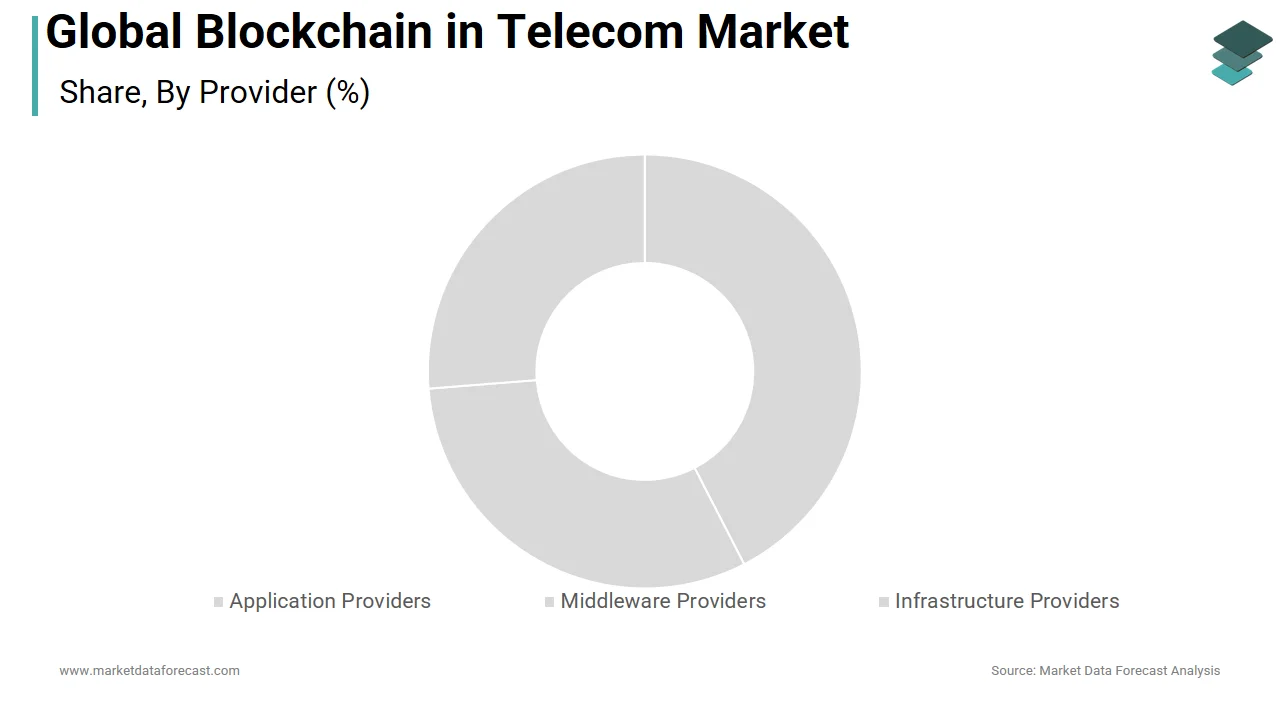
However, the middleware providers segment is expected to register a CAGR of 25.2% over the forecast period in the global market as heterogeneous blockchain deployments across the telecom ecosystem require translation layers enabling cross-platform communication and data consistency. According to industry IT spending guides from 2024, middleware and integration services represent the fastest-growing subsegment, accounting for 32% of total blockchain telecom expenditure as operators deploy multiple ledger technologies for different use cases requiring orchestration. Enterprise Ethereum Alliance membership grew 45% in 2024, with telecom companies comprising the largest industry vertical, reflecting an urgent need for interoperability standards connecting private permissioned ledgers with public networks and legacy systems. Hyperledger Fabric and Corda deployments in telecom increased 68% year over year, yet these platforms use incompatible data models necessitating middleware abstraction layers for unified operations. R3 and ConsenSys have launched telecom-specific middleware products, achieving 150 enterprise deployments in 2024 by providing prebuilt connectors for OSS/BSS systems and network APIs, reducing custom development time by 70%. As regulatory requirements mandate cross-operator data sharing for fraud prevention and number portability, middleware becomes essential infrastructure enabling compliant information exchange without forcing standardization on underlying ledger choices. This interoperability imperative creates sustained demand drivers independent of individual blockchain platform success, ensuring middleware growth continues regardless of which specific distributed ledger technology ultimately dominates particular use cases.
By Application Insights
The identity management segment dominated the market by capturing the major share of the global market in 2025 because they address the most acute financial pain point facing operators with a measurable return on investment justifying immediate deployment. According to the GSMA Mobile Identity Fraud Report 2024, SIM swap and account takeover fraud cost the global telecom industry 9.2 billion dollars annually, with incidents increasing 34% year over year as criminals exploit centralized authentication vulnerabilities. Blockchain-based decentralized identity solutions reduce fraud losses by 65% to 80% according to pilot results from a Telefónica and Deutsche Telekom joint venture launched in Q2 2024, processing 15 million verifications with zero successful impersonation attacks. The economic case proves compelling, with typical payback periods under 14 months for mid-tier operators making identity management the easiest blockchain use case to secure executive sponsorship and budget approval. Regulatory tailwinds strengthen the business case as the EU Digital Identity Wallet regulation, effective 2026, mandates interoperable identity infrastructure, creating compliance-driven demand independent of fraud economics. National identity programs in India, Brazil, and Nigeria have integrated telecom verification with government blockchain identity systems covering a combined population of 1.8 billion people, creating massive-scale deployments anchored in public sector mandates. This convergence of immediate financial returns and regulatory compulsion ensures identity management maintains application leadership as operators prioritize investments delivering quantifiable loss prevention over speculative future value propositions.
However, the connectivity provisioning segment is expected to showcase a CAGR of 28.8% over the forecast period in the global market. The growth of the connectivity provisioning segment in the global market is likely to be driven by 5G network slicing commercialization requiring automated trust mechanisms for dynamic resource allocation across multi-tenant environments. According to industry mobility reports from late 2024, enterprise network slice deployments will reach 18 million by 2028, generating 42 billion dollars in annual service revenue dependent on smart contract-mediated provisioning and SLA enforcement impossible through manual processes. Each network slice represents a distinct contractual commitment with guaranteed performance parameters requiring tamper-proof monitoring records acceptable to both operator and enterprise customer without third-party arbitration overhead. Nokia and T-Mobile demonstrated a blockchain-mediated slice marketplace in Q1 2025, enabling enterprises to purchase temporary high-bandwidth slices with automated pricing adjustments based on real-time utilization and verified SLA compliance through oracle-fed telemetry. The GSMA Operator Platform Group published blockchain slice trading specifications in 2024, enabling cross-operator resale, creating secondary market liquidity previously impossible due to trust deficits between competing carriers. Edge computing integration amplifies demand as distributed compute resources require microsecond coordination and micropayment settlement for resource sharing among multiple tenants operating in low-trust environments. This convergence of 5G capabilities and blockchain automation unlocks new revenue streams, transforming connectivity from a commodity service into a programmable digital product with verifiable quality guarantees sustaining growth rates exceeding the mature identity management segment.
By Organization Size Insights
The large-scale enterprises segment accounted for the largest share of the global market in 2025 because meaningful distributed ledger deployments require minimum investment thresholds exceeding small and medium enterprise financial capacities. According to global blockchain surveys from 2024, average enterprise blockchain production deployment costs 4.2 million dollars, including infrastructure, integration, and ongoing maintenance, creating a natural selection bias toward organizations with annual IT budgets exceeding 500 million dollars, typical of tier-one telecom operators and multinational corporations. The top 20 global telecom operators account for 73% of total blockchain in telecom spending, reflecting a concentration of resources necessary for multi-stakeholder consortium participation and custom protocol development. Large enterprises possess negotiating leverage to influence vendor roadmaps and standards bodies, ensuring blockchain solutions address their specific operational requirements rather than generic SMB needs. AT&T, Verizon, and Deutsche Telekom collectively invested 850 million dollars in blockchain initiatives during 2024, according to SEC filings, demonstrating a scale of commitment impossible for smaller players. Economies of scale in blockchain operations become significant as transaction volumes increase, reducing per-unit costs and improving ROI justification for continued investment. This capital intensity creates structural market concentration where large enterprises not only lead current adoption but also shape future technology evolution through purchasing power and standards participation, ensuring their dominance persists as blockchain matures from experimental to mainstream infrastructure.
On the other side, the small and medium enterprises segment is estimated to register a CAGR of 30.9% over the forecast period as managed service providers eliminate infrastructure complexity and capital requirements previously excluding smaller organizations. According to industry market guides from 2024, managed blockchain offerings from major cloud providers grew 89% year over year, with telecom SMEs comprising the fastest-adopting vertical as they seek competitive parity with larger rivals without dedicated blockchain engineering teams. These services reduce deployment costs by 75% compared to self-managed infrastructure, enabling SMEs to launch production blockchain applications with initial investments under 100,000 dollars versus multi-million-dollar traditional deployments. Regional telecom operators in Southeast Asia and Latin America have adopted managed blockchain for wholesale settlement and partner onboarding, achieving 60-day implementation timelines versus 18-month custom development cycles typical of enterprise projects. Pay-as-you-go pricing models align costs with actual usage, eliminating upfront capital commitments that strain SME balance sheets and enabling experimentation without long-term lock-in risk. As cloud providers expand telecom-specific blockchain templates and prebuilt integrations with common OSS/BSS platforms, technical expertise requirements decrease further, accelerating SME adoption curves. This service-enabled democratization creates a new market segment previously economically unviable, sustaining growth rates exceeding the saturated large enterprise segment where most obvious use cases are already deployed.
REGIONAL ANALYSIS
North America Blockchain in Telecom Market Analysis
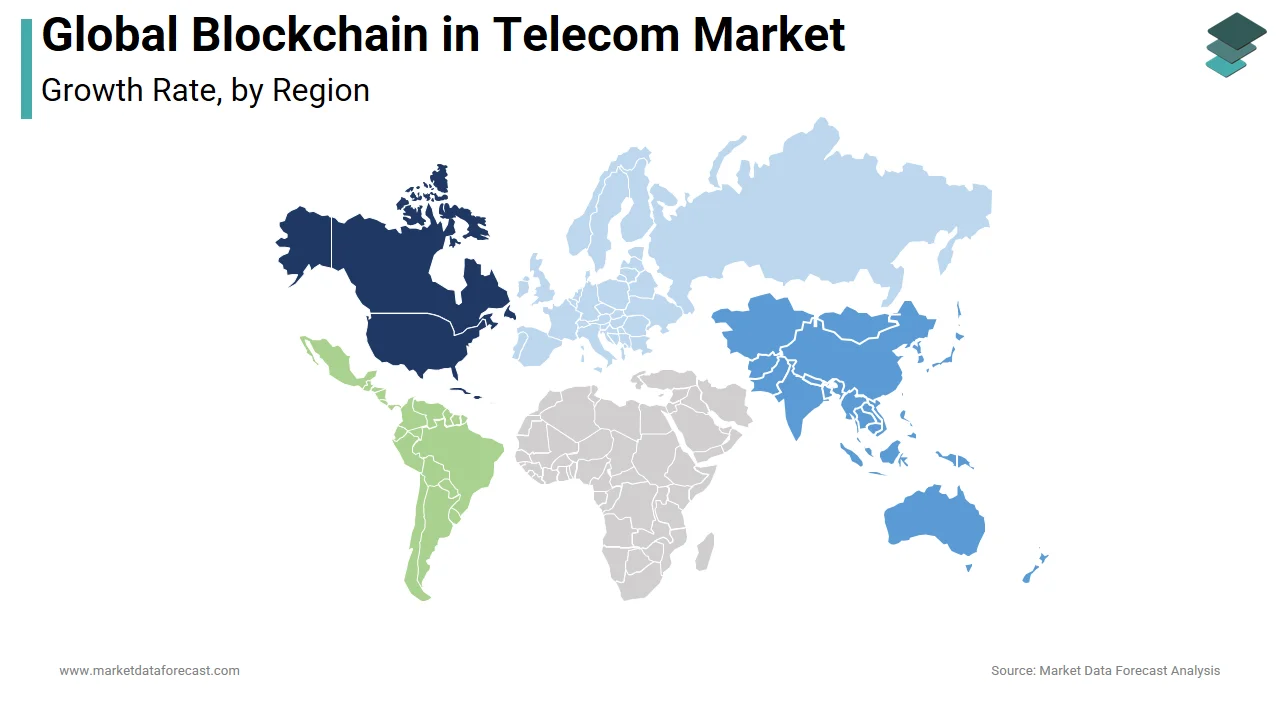
North America dominated the market by capturing 35.5% of the global market share in 2025 and is likely to maintain robust expansion over the next few years. The dominance of North America in the global market is primarily driven by the United States leadership in private 5G deployments and progressive regulatory frameworks enabling experimental distributed ledger applications. According to the Federal Communications Commission, 45 blockchain-related telecom innovation projects received regulatory sandbox approvals in 2024, facilitating real-world testing of spectrum sharing, IoT authentication, and wholesale settlement use cases without full compliance burdens. Major US operators including AT&T and Verizon invested a combined 620 million dollars in blockchain initiatives during 2024, focusing on enterprise private network slice management and supply chain provenance for critical infrastructure, according to SEC filings. The National Telecommunications and Information Administration allocated 1.5 billion dollars from the Infrastructure Investment and Jobs Act specifically for next-generation network security, including blockchain-based integrity verification, creating a federal funding pull factor absent in other regions. Canada contributes through public sector digital identity integration, with Telus and Bell networks enabling blockchain-anchored credential verification for 38 million citizens according to Treasury Board Secretariat reports. However, fragmented state-level privacy regulations create compliance complexity, slowing interstate blockchain deployments compared to the federally harmonized European framework. Despite this fragmentation, US technological leadership and capital availability sustain North American primacy as an innovation origin point with a global diffusion lag of 18 to 24 months for successful domestic deployments.
Europe Blockchain in Telecom Market Analysis
Europe is poised for steady, regulation-driven transformation in the coming years and is characterized by regulation-first adoption patterns differing fundamentally from commercially driven approaches dominating other regions. According to the European Commission Digital Europe Programme, 2.1 billion euros allocated for 2024 to 2027 specifically targets blockchain infrastructure for digital identity and trusted data sharing, creating a supranational funding mechanism transcending individual member-state budgets. The EU Digital Identity Wallet regulation mandating cross-border interoperability by 2026 has triggered coordinated blockchain deployments across Deutsche Telekom, Orange, Telefónica, and TIM covering a combined subscriber base of 450 million, according to GSMA Europe disclosures. The European Self-Sovereign Identity Framework pilot processed 12 million verifications in 2024 with zero GDPR violations, demonstrating a regulatory-compliant blockchain architecture achievable through permissioned designs and selective disclosure techniques. Nordic countries lead per capita blockchain telecom spending, with Sweden and Finland allocating 85 euros per citizen annually for digital infrastructure modernization according to Eurostat data, reflecting a social welfare model prioritization of universal digital access. However, stringent data protection enforcement creates headwinds, as France's CNIL and Ireland's DPC have blocked several blockchain projects citing unresolved right-to-erasure conflicts, delaying market maturation compared to more permissive jurisdictions. This tension between harmonization ambitions and national privacy interpretations produces uneven adoption patterns distinguishing European market dynamics from a more uniformly driven North American counterpart.
Asia Pacific Blockchain in Telecom Market Analysis
Asia Pacific is expected to accelerate dramatically over the next few years and is exhibiting extreme heterogeneity between China's state-directed deployment and Japan's open consortium approach. According to the China Ministry of Industry and Information Technology, the national blockchain infrastructure network BSN processed 4.8 billion telecom-related transactions in 2024, supporting state-mandated real-name verification and 5G slice orchestration across China Mobile, China Telecom, and China Unicom networks covering 1.6 billion subscribers. Japan maintains the most developed open blockchain ecosystem in the region, with NTT DOCOMO, KDDI, and SoftBank participating in a Hyperledger-based roaming settlement consortium processing 850 million transactions annually according to Japan Blockchain Association reports, reflecting Western-compatible governance and international vendor integration. India emerges as the fastest-growing major market, with Aadhaar-linked mobile verification reaching 8.3 billion authentications in 2024 using blockchain-anchored auditing.
COMPETITIVE LANDSCAPE
Competition in the blockchain in telecom market intensifies as traditional network equipment manufacturers face pressure from specialized blockchain vendors and cloud providers seeking entry into the telecommunications infrastructure domain. Incumbent advantage stems from existing vendor relationships and deep network integration, yet newcomers disrupt through superior developer experience and open source ecosystems, attracting innovation talent away from proprietary platforms. Competitive differentiation increasingly centers on regulatory compliance and interoperability standards rather than raw technical performance as operators prioritize risk mitigation over cutting-edge features in mission-critical environments. Vendor consolidation accelerates through strategic acquisitions as larger players absorb specialized blockchain startups to fill capability gaps and eliminate emerging competitive threats before they achieve scale. Geographic fragmentation creates distinct competitive arenas with Western vendors dominating North America and Europe while Chinese suppliers lead in Asia Pacific and emerging markets, reflecting geopolitical alignments rather than pure technological merit. Success ultimately requires balancing infrastructure depth with ecosystem openness in an environment where no single vendor can deliver a complete blockchain telecom solution independently, making partnership strategies as important as product capabilities for sustaining long-term market position amid evolving industry standards and regulatory frameworks reshaping competitive dynamics globally.
KEY MARKET PLAYERS
The leading companies operating in the global blockchain in telecom market include:
- AWS
- Guardtime
- IBM
- Microsoft
- SAP
- Bitfury
- Cegeka
- Clear
- Reply
- Ericsson
- ShoCard
- Abra
- Auxesis Group
- Blockchain Foundry
- BlockCypher
- Blocko
- Blockpoint
- Blockstream
- Nokia
- Chain
- Filament
- Huawei
- Oracle
- RecordsKeeper
- Sofocle
- SpinSys
- TBCASoft
TOP PLAYERS IN THE MARKET
- Ericsson integrates blockchain capabilities directly into 5G core network infrastructure, enabling native support for slice lifecycle management and automated roaming settlements without external dependencies. The company strengthened its position by launching the Blockchain Enabled Network Slicing module in early 2025, featuring smart contract-mediated SLA verification and real-time settlement for enterprise customers. This innovation addresses trust deficits in multi-tenant environments while reducing manual reconciliation overhead. Ericsson continues collaborating with the GSMA Open Gateway initiative to standardize cross-operator blockchain interfaces, ensuring interoperability across vendor ecosystems. Their deep network integration approach differentiates them from application layer providers by embedding distributed ledger functionality at the protocol level, where it can access real-time telemetry and enforce service guarantees deterministically. This infrastructure-centric strategy positions Ericsson as a foundational enabler rather than an optional overlay, capturing value through core network modernization cycles that operators cannot defer indefinitely.
- Nokia contributes significantly to blockchain in telecom through integrated security and provenance solutions addressing supply chain integrity and device authentication challenges facing global operators. The company recently introduced a Blockchain-Based Equipment Provenance platform in late 2024, enabling end-to-end component traceability from manufacturing through deployment with immutable audit trails accessible to regulators and customers. Nokia strengthens market position by bundling blockchain security features with 5G base station firmware updates, leveraging existing vendor relationships to distribute trust infrastructure without additional procurement friction. Their collaboration with Mobile World Capital Barcelona on decentralized identity pilots demonstrates commitment to open standards rather than proprietary lock-in strategies. Nokia’s focus on hardware-anchored trust complements software-only approaches by providing tamper-resistant root of confidence that pure-play blockchain vendors cannot replicate. This physical-digital convergence creates defensible competitive advantages as operators recognize that meaningful blockchain utility requires integration with underlying network equipment rather than abstract ledger layers operating independently from infrastructure realities.
- Huawei advances blockchain in telecom through comprehensive integration across network infrastructure, cloud platforms, and terminal devices, creating a unified trust ecosystem despite geopolitical challenges limiting Western market access. The company reinforced market standing by releasing the TrustChain 3.0 platform in January 2025, featuring enhanced throughput and privacy-preserving computation enabling compliant blockchain deployments in jurisdictions with strict data localization requirements. Huawei’s blockchain solutions serve over 180 million subscribers across Asia Pacific, the Middle East, and Africa, demonstrating scale achievable through state-supported digital transformation initiatives and Belt and Road infrastructure projects. Their vertical integration spanning chipsets to applications enables optimized performance unattainable by vendors controlling only partial stack. Strategic partnerships with national operators in emerging markets create captive deployment bases insulated from Western vendor competition while generating transaction volumes validating technology at scale. Despite exclusion from North American and some European markets, Huawei maintains significant global influence through alternative ecosystem development serving regions where cost efficiency and government alignment outweigh geopolitical concerns driving procurement decisions in favor of integrated Chinese technology stacks.
TOP STRATEGIES USED BY KEY MARKET PARTICIPANTS
Key players pursue deep infrastructure integration, embedding blockchain within core network elements rather than offering standalone applications requiring separate procurement and integration efforts. Companies increasingly participate in industry consortia including GSMA and TM Forum to establish interoperability standards preventing fragmentation and ensuring cross-vendor compatibility essential for multi-party use cases. Vendors bundle blockchain capabilities with planned network modernization investments, aligning distributed ledger adoption with existing capital expenditure cycles to reduce budget approval friction. Strategic focus shifts toward regulatory compliance features, including GDPR compatible data handling and national identity integration, creating mandatory demand independent of commercial ROI calculations. Market leaders invest in managed service models, lowering entry barriers for smaller operators lacking dedicated blockchain engineering teams, expanding the addressable market beyond tier one enterprises. Partnerships with cloud providers enable hybrid deployments combining on-premises security with cloud scalability, addressing diverse operator requirements while avoiding pure-play blockchain vendor risks associated with technology obsolescence and financial instability in the rapidly evolving distributed ledger landscape.
MARKET SEGMENTATION
The global blockchain in telecom market research report is segmented and sub-segmented based on the provider, application, organization size, and region.
By Provider
- Application Providers
- Middleware Providers
- Infrastructure Providers
By Application
- OSS/BSS Processes
- Identity Management
- Connectivity Provisioning
- Payments
- Smart contracts
By Organization Size
- SMEs
- Large-scale enterprises
By Region
- North America
- Europe
- Asia Pacific
- Latin America
- Middle East & Africa