Global Carbon Nanotube Market Size, Share, Trends, & Growth Forecast Report Segmented By Product (Multi-Walled Carbon Nanotubes (MWCNT) and Single-Walled Carbon Nanotubes (SWCNT)), Application, and Region (Latin America, North America, Asia Pacific, Europe, Middle East and Africa), Industry Analysis from 2026 to 2034
Market Size, 2025
$10.08 BnMarket Estimate, 2026
$11.45 BnMarket Forecast, 2034
$31.71 BnCAGR, 2026–2034
13.58%Global Carbon Nanotube Market Report Summary
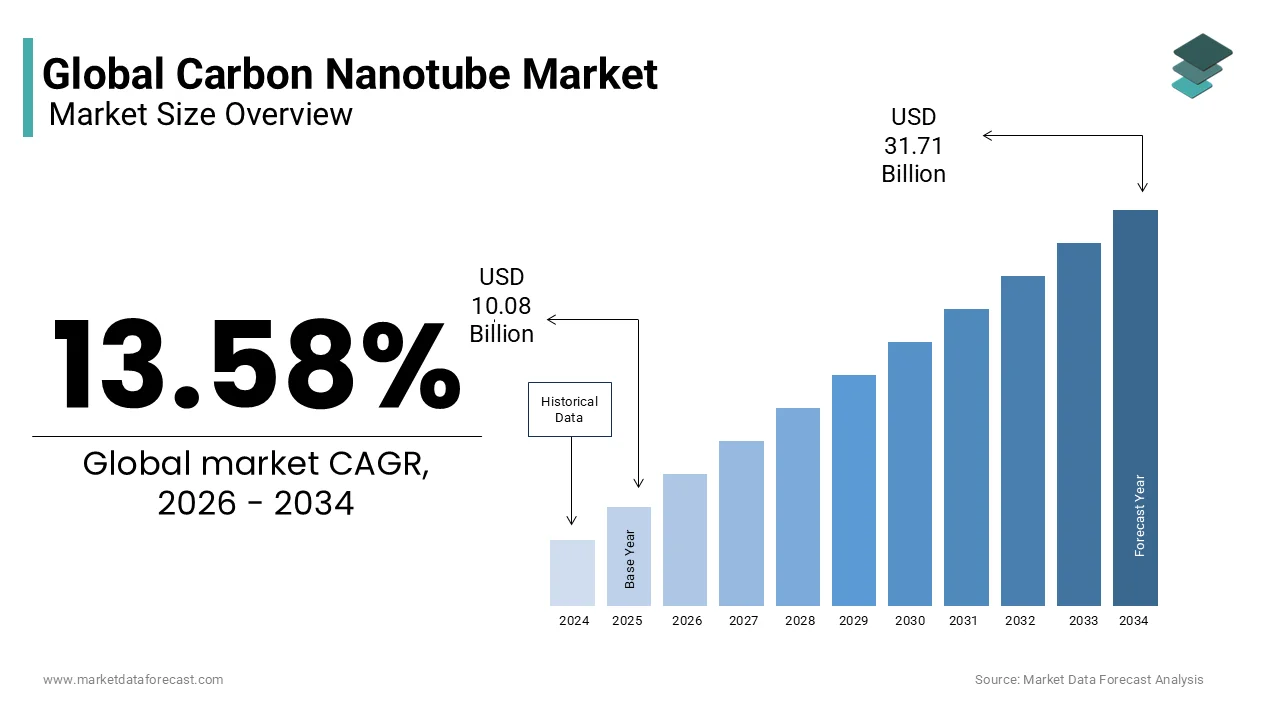
The global carbon nanotube (CNT) market was valued at USD 10.08 billion in 2025, is estimated to reach USD 11.45 billion in 2026, and is projected to reach USD 31.71 billion by 2034, growing at a CAGR of 13.58% during the forecast period from 2026 to 2034. The growth of the global carbon nanotube market is driven by increasing demand for lightweight and high-strength materials, expanding applications in electronics, energy storage, automotive, aerospace, and advanced composites, and continuous advancements in nanotechnology. Rising adoption of carbon nanotubes in lithium-ion batteries, conductive plastics, and high-performance materials is further supporting market growth. Additionally, increasing investments in research and development and growing commercialization of nanomaterials are accelerating market expansion worldwide.
Key Market Trends
-
Rising demand for lightweight, high-strength, and electrically conductive materials is driving the adoption of carbon nanotubes across multiple industries.
-
Increasing use of carbon nanotubes in lithium-ion batteries and electric vehicles is supporting market growth.
-
Growing applications in electronics, aerospace, automotive, and advanced composite materials are expanding market opportunities.
-
Advancements in nanotechnology and scalable manufacturing processes are improving product performance and commercial viability.
-
Increasing investments in research and development are accelerating innovation in carbon nanotube-based materials and applications.
Segmental Insights
-
Based on product, the multi-walled carbon nanotube (MWCNT) segment dominated the global carbon nanotube market in 2025. The segment's leadership is attributed to its cost-effectiveness, superior mechanical strength, excellent electrical conductivity, and widespread use in composites, batteries, coatings, and industrial applications.
-
Based on application, the plastics & composites segment held the largest share of the global carbon nanotube market by accounting for 43.5% of total demand in 2025. The segment's dominance is driven by increasing demand for lightweight, durable, and conductive composite materials across the automotive, aerospace, construction, and electronics industries.
Regional Insights
-
The global carbon nanotube market is witnessing rapid growth due to increasing industrial adoption of advanced materials, expanding nanotechnology applications, and rising investments in high-performance manufacturing.
-
Asia Pacific dominated the global carbon nanotube market by accounting for 41.4% of the global market share in 2025. The region's leadership is supported by strong electronics manufacturing, rapid growth in electric vehicle production, expanding battery manufacturing capacity, and significant investments in nanotechnology research across China, Japan, South Korea, and India.
-
North America remains a significant market due to increasing investments in aerospace, defense, advanced materials, and next-generation battery technologies.
Competitive Landscape
The global carbon nanotube market is highly competitive, with manufacturers focusing on capacity expansion, product innovation, and advanced nanotechnology solutions to strengthen their market positions. Companies are investing in research and development, strategic collaborations, and scalable production technologies to meet the growing demand from battery, electronics, automotive, aerospace, and industrial applications. Key players operating in the global carbon nanotube market include Arkema SA (France), Nanocyl SA (Belgium), Carbon Solutions, Inc. (U.S.), Resonac Holdings Corporation (Japan), Klean Commodities (Canada), Cabot Corporation (U.S.), OCSiAl (Luxembourg), NoPo Nanotechnologies (India), Jiangsu Cnano Technology Co., Ltd. (China), and LG Chem (South Korea).
Global Carbon Nanotube Market Size
The global carbon nanotube market size was valued at USD 10.08 billion in 2025 and is expected to reach USD 31.71 billion by 2034 from USD 11.45 billion in 2026. The market is projected to grow at a CAGR of 13.58%.
Carbon nanotube (CNT) are cylindrical nanostructures composed of carbon atoms arranged in a hexagonal lattice, exhibiting extraordinary mechanical, electrical, and thermal properties. These materials, classified as single-walled (SWCNT) or multi-walled (MWCNT), are integrated into polymers, metals, and composites to enhance conductivity, strength, and heat dissipation across advanced industries. Carbon nanotubes are reported to have tensile strength up to 100 times greater than steel at roughly one-sixth the weight, making them attractive for lightweight structural reinforcement. Certain SWCNTs have demonstrated electron mobility exceeding 100,000 cm²/V·s in studies, surpassing silicon and suggesting potential for next-generation electronics. Additionally, NASA has investigated CNT-reinforced composites for aerospace applications, and they have been evaluated for use in demanding environments such as space missions. These intrinsic performance advantages underpin their growing role in high-tech sectors where conventional materials reach functional limits.
MARKET DRIVERS
Their integration into lithium-ion batteries to enhance energy density, charge rates, and cycle life, is a primary driver of demand for carbon nanotubes. CNTs are used as conductive additives in cathodes and anodes, replacing traditional carbon black due to their superior electrical percolation at lower loading levels. According to the International Energy Agency, global lithium-ion battery production reached around 1.3 TWh in 2023, driven by electric vehicles and grid storage. CNTs are increasingly being explored as conductive additives in advanced battery designs, though adoption levels vary. As per suggestion by a research, CNT-enhanced anodes may improve energy capacity and charging performance compared to conventional materials. Automakers, including Tesla, are exploring CNTs to improve conductivity in advanced battery cells. With automakers targeting 500+ mile ranges and fast-charging capabilities, CNTs have become indispensable in next-generation energy storage systems.
The use of carbon nanotubes in polymer composites for aerospace, automotive, and industrial applications requiring lightweight, high-strength materials, is another pivotal demand driver. When dispersed into thermoplastics or thermosets, CNTs significantly improve mechanical performance, thermal stability, and electromagnetic shielding. In addition, modern aircraft such as the Airbus A350 incorporate advanced composites, and CNT-reinforced materials are being investigated to further reduce structural weight. CNT-enhanced polyamide composites have demonstrated improved thermal stability and impact resistance in testing, supporting applications in demanding automotive environments. Apart from these, as per the research at leading aerospace institutes, CNT-infused epoxy resins can improve fatigue resistance in rotor blade applications. As industries prioritize fuel efficiency, durability, and emissions reduction, the adoption of CNT composites is expanding beyond niche applications into mainstream engineering solutions.
MARKET RESTRAINTS
The persistent challenge of achieving uniform dispersion and interfacial bonding within host matrices, which directly affects performance consistency and commercial scalability, is one major restraint in the carbon nanotube market. Agglomeration of CNTs during compounding reduces their effectiveness and can create defects in final products. Also, poor dispersion during polymer processing can cause significant performance losses, with studies suggesting that much of the theoretical advantage of CNTs is not realized at industrial scale. In addition, variations in CNT distribution have been shown to reduce conductivity in thin films, with small inconsistencies leading to notable performance declines. Furthermore, certain dispersion methods, including surfactant-based mixing, may introduce impurities that affect CNT composite performance. These technical barriers increase R&D costs and require specialized equipment, limiting adoption in cost-sensitive industries and hindering the transition from laboratory-scale success to mass-market viability.
The high production cost and energy intensity associated with synthesizing high-purity carbon nanotubes, particularly single-walled variants, is another significant restraint. In addition, SWCNT production costs remain far higher than conventional carbon additives such as carbon black, restricting CNT use to high-value applications. Chemical vapor deposition (CVD), the most common synthesis method, is energy intensive, adding to lifecycle costs and emissions. Besides, purification steps to remove catalysts and impurities can significantly lower CNT yields, reducing process efficiency. These economic and environmental inefficiencies deter widespread adoption, particularly in emerging markets where cost sensitivity is paramount. Until scalable, low-energy synthesis methods are commercialized, cost will remain a critical barrier to broader market penetration.
MARKET OPPORTUNITIES
The development of carbon nanotube-based flexible and printed electronics, enabling next-generation wearable devices, foldable displays, and smart sensors, is a transformative opportunity. CNTs offer exceptional conductivity, mechanical flexibility, and solution-processability, making them ideal for inkjet-printed circuits and transparent conductive films. Also, CNT-based conductive inks are increasingly applied in wearable health monitors, providing stretchable, durable circuitry. Moreover, the University of Texas at Austin’s Flexible Electronics Consortium confirms that CNT transistors can operate at frequencies exceeding 10 GHz on plastic substrates, rivaling silicon in performance while enabling rollable electronics. Apart from these, CNT touch sensors are being developed for foldable smartphones due to their superior crack resistance, with adoption expected to grow as flexible electronics advance. As consumer electronics evolve toward flexible and conformal designs, CNTs are emerging as a foundational material for the future of human-machine interfaces.
The application of carbon nanotubes in water purification and desalination membranes, where their nanoscale pores and hydrophobic surfaces enable highly efficient filtration, is another emerging opportunity. Also, CNT membranes facilitate rapid water transport while rejecting contaminants, salts, and pathogens. According to the United Nations Water, over 2 billion people globally lack access to safely managed drinking water, driving demand for advanced filtration technologies. Similarly, as per the Massachusetts Institute of Technology, CNT-based membranes can significantly outperform conventional RO membranes in terms of water flux and energy efficiency. Additionally, CNT membranes can achieve high levels of salt rejection in brackish water desalination. With governments investing in sustainable water infrastructure, CNT membranes represent a high-impact application where nanotechnology can address critical global challenges in public health and resource scarcity.
MARKET CHALLENGES
The lack of standardized characterization and quality control protocols across producers, leading to variability in diameter, chirality, and defect density, is a critical challenge in the carbon nanotube market. These parameters directly influence electrical and mechanical performance, yet consistent measurement remains difficult. Also, few commercial CNT batches undergo full spectroscopic and microscopic validation as outlined in ISO technical specifications, leading to quality inconsistencies. As per the National Institute of Standards and Technology, minor variations in chirality can shift a CNT from metallic to semiconducting behavior, rendering it unsuitable for electronic applications. Furthermore, the European Chemicals Agency notes that inconsistent labeling and purity claims complicate procurement for end-users. This absence of harmonized benchmarks undermines trust, increases qualification timelines, and impedes large-scale adoption, particularly in regulated industries such as aerospace and medical devices where material traceability is mandatory.
Toxicity and long-term environmental impact remain persistent challenges, particularly concerning inhalation exposure during manufacturing and end-of-life disposal. While CNTs offer exceptional performance, their fibrous morphology has raised concerns about pulmonary effects similar to asbestos. As per the World Health Organization, certain long, rigid MWCNTs have been classified as "possibly carcinogenic to humans" (Group 2B) based on animal studies showing mesothelioma development. The U.S. National Institute for Occupational Safety and Health recommends exposure limits of 1 µg/m³ for CNTs as a time-weighted average, reflecting their potential hazard. Additionally, as per the U.S. the Environmental Protection Agency highlights that concerns about CNT persistence in aquatic environments and potential ecological impacts, though long-term degradation timelines remain under investigation. These health and environmental uncertainties necessitate rigorous handling protocols, lifecycle assessments, and regulatory scrutiny, slowing commercialization in consumer-facing applications and increasing liability risks for manufacturers despite their technical promise.
REPORT COVERAGE
| REPORT METRIC | DETAILS |
| Market Size Available | 2025 to 2034 |
| Base Year | 2025 |
| Forecast Period | 2026 to 2034 |
| CAGR | 13.58 % |
| Segments Covered | By Product, Application, and Region |
| Various Analyses Covered | Global, Regional, & Country Level Analysis; Segment-Level Analysis; DROC; PESTLE Analysis; Porter’s Five Forces Analysis; Competitive Landscape; Analyst Overview of Investment Opportunities |
| Regions Covered | North America, Europe, APAC, Latin America, Middle East & Africa |
| Market Leaders Profiled | Arkema SA (France), Nanocyl SA (Belgium), Carbon Solutions, Inc. (U.S.), Resonac Holdings Corporation (Japan), Klean Commodities (Canada), Cabot Corporation (U.S.), OCSiAl (Luxembourg), NoPo Nanotechnologies (India), Jiangsu Cnano Technology Co., Ltd. (China), and others. |
SEGMENTAL ANALYSIS
By Product Insights
The multi-walled carbon nanotube (MWCNT) segment dominated the global carbon nanotube market by capturing a substantial share of total volume in 2025. This dominance is primarily driven by its cost-effectiveness, scalable production, and broad applicability across industrial sectors. MWCNTs are widely used as conductive additives in polymers, rubber, and battery electrodes due to their relatively lower manufacturing cost and ease of integration compared to single-walled variants. Like, CNTs are common conductive additives in batteries at low weight percentages. Global CNT production is in the 5k ton range, China leading (over 50%). Additionally, CNT-reinforced polypropylene is used in automotive fuel lines and housings, underscoring their critical role in functional material enhancement at scale.
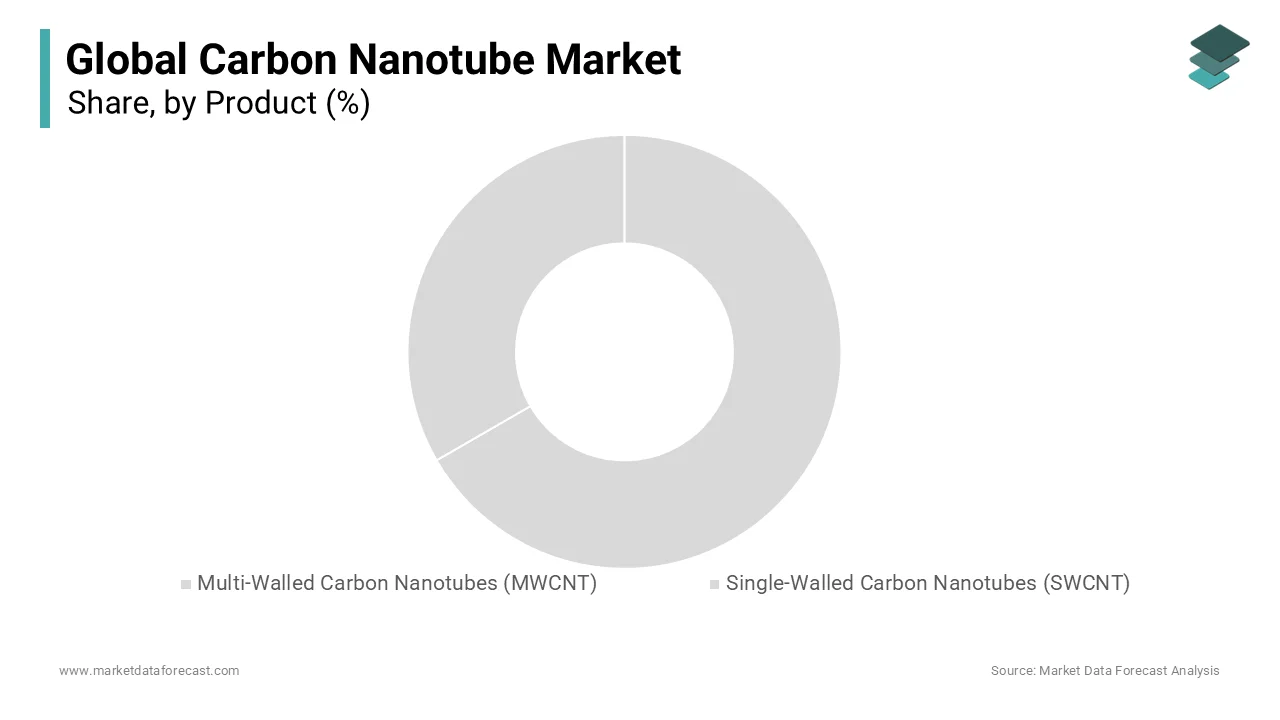
The single-walled carbon nanotube (SWCNT) segment is the fastest-growing product category and is projected to expand at a CAGR of 18.4% from 2026 to 2034. This rapid growth is fueled by their superior electrical and optical properties, making them indispensable in next-generation electronics, photovoltaics, and quantum devices. Moreover, SWCNTs exhibit exceptional carrier mobility and can be either metallic or semiconducting depending on chirality, enabling their use in transistors, flexible sensors, and transparent conductive films. The Institute of Electrical and Electronics Engineers reports that SWCNT-based thin-film transistors have achieved electron mobility exceeding 100 cm²/V·s in prototype flexible displays, outperforming amorphous silicon. Also, the Massachusetts Institute of Technology’s Microsystems Technology Laboratories confirms that SWCNTs are being integrated into neuromorphic computing chips due to their low power consumption and high switching efficiency. Additionally, CNTs are under active development in EU pilot projects for printable electronics. As demand for advanced electronics intensifies, SWCNTs are transitioning from research labs to high-value commercial applications.
By Application Insights
The plastics & composites segment was the prominent application in the carbon nanotube market by accounting for 43.5% of total demand in 2025. This position is driven by the integration of CNTs into engineering polymers to enhance mechanical strength, thermal stability, and electrical conductivity. Industries such as automotive, aerospace, and consumer electronics rely on CNT-reinforced composites for lightweight, durable components. Some vehicles produced annually in North America use CNT-enhanced polymer parts for under-hood applications, reducing weight and improving fuel efficiency. In addition, CNT-infused epoxy composites are used in a portion of non-structural aircraft components, including ducting and interior panels, due to their flame retardancy and electromagnetic shielding. Apart from these, CNTs enable electrostatic dissipation in fuel system components, preventing ignition risks. These performance and safety advantages ensure continued dominance in high-performance material systems.
The energy application segment is the fastest-growing and is anticipated to grow at a CAGR of 16.7% from 2026 to 2034. This surge is driven by the critical role of carbon nanotubes in advancing battery technology and renewable energy systems. CNTs are used as conductive additives in lithium-ion, lithium-sulfur, and solid-state batteries to improve electron transport, reduce internal resistance, and extend cycle life. As per the International Energy Agency, the global EV fleet surpassed 40 million vehicles in 2023, CNT use per EV is in tens to hundreds of grams, depending on cell chemistry. Also, CNT-enhanced silicon anodes can increase energy density by up to 30% while mitigating volume expansion issues. In solar cells, SWCNTs are being used in perovskite photovoltaics to improve hole transport layers. With governments investing heavily in energy storage and grid modernization, CNTs are becoming essential enablers of high-performance, next-generation energy solutions.
REGIONAL ANALYSIS
Asia Pacific Carbon Nanotube Market Analysis
Asia Pacific held the largest share of the global carbon nanotube market by accounting for 41.4% in 2025. As the world’s manufacturing and technological innovation hub, the region leads in both production and consumption of carbon nanotubes. China is the dominant producer, with state-backed enterprises producing large metric tons of MWCNTs annually. Japan’s electronics sector utilizes SWCNTs in flexible displays and sensors, with hundreds of patents filed in 2023 related to CNT-based semiconductors. South Korea’s battery manufacturers, including LG Energy Solution and Samsung SDI, with over 900 GWh of battery capacity manufactured in 2023. India is emerging as a downstream processing center, with startups developing CNT-enhanced composites for automotive and defense applications. The region’s integrated supply chains, government support for nanotechnology, and rapid industrialization solidify its leadership in the global CNT ecosystem.
North America Carbon Nanotube Market Analysis
North America remains a leader in high-value CNT applications and R&D. The United States is the primary contributor, with strong demand from aerospace, defense, and advanced electronics sectors. NASA has tested CNT composites in satellites and thermal systems. The U.S. funds several active CNT research programs, including wearable sensors and lightweight armor, through the Defense Advanced Research Projects Agency (DARPA). Additionally, as per the Semiconductor Research Corporation, CNT-based transistors are being developed at MIT and Stanford for post-silicon computing. The presence of leading producers like OCSiAl and Nanocomp Technologies ensures domestic supply for critical applications. With robust intellectual property frameworks and federal funding, North America continues to pioneer cutting-edge CNT innovations in strategic sectors.
Europe Carbon Nanotube Market Analysis
Europe holds a notable market share, and is a center for sustainable and regulated CNT deployment. Germany, the UK, and France lead in automotive and industrial applications, where CNTs are used in conductive polymers for fuel systems and anti-static components. CNTs are a material option used to meet electrostatic discharge (ESD) standards for fuel lines. The European Commission’s Horizon Europe program has allocated substantial amount to CNT research in energy storage and smart materials. With strong environmental regulations and a focus on functional safety, Europe emphasizes responsible innovation and high-performance integration across critical industries.
Latin America Carbon Nanotube Market Analysis
Latin America accounts for a notable share of the global market, with Brazil leading regional demand due to its growing industrial and technological base. The Brazilian Ministry of Science, Technology, and Innovation supports nanomaterial research through the National Nanotechnology Program, funding CNT applications in energy storage and water filtration. The country’s automotive sector, producing over 2 million vehicles annually, is beginning to adopt CNT-enhanced polymers for lightweighting. Additionally, Argentina’s Y-TEC research center has developed CNT-based electrodes for lithium-ion batteries using domestic lithium resources. However, limited local production and reliance on imported nanomaterials constrain growth. Like, only a small percentage of industrial R&D in the region focuses on advanced materials, compared to that in Asia. Despite these challenges, rising investments in clean energy and smart manufacturing are gradually increasing CNT adoption, particularly in pilot-scale battery and composite projects.
Middle East and Africa Carbon Nanotube Market Analysis
The Middle East and Africa collectively represent small share of the market, with growth concentrated in Gulf Cooperation Council (GCC) nations and South Africa. Saudi Arabia is investing heavily in advanced materials through its King Abdulaziz City for Science and Technology (KACST), which has launched a national nanotechnology initiative focusing on CNT-based desalination membranes and energy storage. The UAE’s Advanced Materials Research Center in Abu Dhabi is developing CNT-reinforced composites for aerospace and defense applications. South Africa’s Council for Scientific and Industrial Research (CSIR) has initiated pilot projects using CNTs in mine safety sensors and battery prototypes. However, the region lacks large-scale production infrastructure, relying on imports for raw CNTs. The African Union’s Science, Technology, and Innovation Strategy for Africa 2025–2034 includes nanomaterials as a priority, signaling long-term potential. With increasing government support and regional collaboration, the Middle East and Africa are laying the groundwork for future CNT integration in high-impact sectors.
COMPETITIVE LANDSCAPE
The competition in the carbon nanotube market is characterized by a dual dynamic: a few global producers dominate volume supply, while specialized firms compete in high-value, application-specific niches. Multinational companies leverage large-scale production and deep industry partnerships to secure positions in batteries and composites. Regional players and research-driven firms are gaining traction by offering customized grades for electronics, healthcare, and clean energy. The market is increasingly segmented by product type, with MWCNTs dominating industrial applications and SWCNTs emerging in advanced electronics. Intellectual property, dispersion expertise, and regulatory compliance are key battlegrounds. Geopolitical factors, raw material access, and environmental scrutiny are shaping supply chain strategies. As demand accelerates in energy and next-generation technologies, the competitive landscape is evolving from material supply to performance-enabling partnerships across the innovation chain.
KEY MARKET PLAYERS
Some of the key players in the Carbon Nanotubes (CNT) Market are
- Arkema SA (France)
- Nanocyl SA (Belgium)
- Carbon Solutions, Inc. (U.S.)
- Resonac Holdings Corporation (Japan)
- Klean Commodities (Canada)
- Cabot Corporation (U.S.)
- OCSiAl (Luxembourg)
- NoPo Nanotechnologies (India)
- Jiangsu Cnano Technology Co., Ltd. (China)
- LG Chem (South Korea)
TOP PLAYERS IN THE MARKET
- OCSiAl is a global leader in single-walled carbon nanotube (SWCNT) production and a key innovator in the Asia Pacific market, where it has expanded its technical and commercial footprint through strategic partnerships. The company supplies its TUBALL brand of SWCNTs to battery manufacturers, polymer compounders, and electronics firms across China, South Korea, and Japan. It has collaborated with LG Chem and SK Innovation to enhance the energy density and fast-charging capabilities of EV batteries. Additionally, OCSiAl launched a co-development program with Japanese polymer processors to create anti-static films for semiconductor packaging. By combining scalable production with application engineering, the company is accelerating the adoption of SWCNTs in high-performance industrial and energy applications across the region.
- Showa Denko K.K. (Resonac Holdings) plays a pivotal role in the Asia Pacific carbon nanotube market through its high-purity multi-walled carbon nanotubes (MWCNTs) used in automotive and electronics applications. The Japanese firm supplies its VGCF (Vapor Grown Carbon Fiber) to major battery and polymer manufacturers in Japan, China, and Taiwan, where it is integrated into conductive pastes and lightweight composites. The company has also partnered with Toyota to develop CNT-reinforced resins for under-hood components that withstand extreme thermal and mechanical stress. Its R&D center in Kawasaki focuses on improving dispersion technologies and surface functionalization to broaden application scope. With deep integration into Japan’s industrial ecosystem and a strong focus on quality and reliability, Showa Denko remains a trusted supplier in mission-critical sectors.
- Nanoshel LLC has emerged as a significant contributor to the Asia Pacific carbon nanotube market by providing customized CNT solutions for research institutions, startups, and mid-tier manufacturers. While not a mass producer, Nanoshel has strengthened its regional presence by supplying specialty-grade MWCNTs and SWCNTs for applications in energy storage, sensors, and water filtration. It has also supplied functionalized CNTs to South Korean startups working on flexible biosensors and wearable electronics. Through its agile supply model and technical consultation services, Nanoshel enables rapid prototyping and niche innovation across academic and industrial labs. By focusing on application-specific formulations and regional partnerships, the company is carving a distinct position in the evolving nanomaterial ecosystem of Asia Pacific.
TOP STRATEGIES USED BY THE KEY MARKET PLAYERS
Key players in the carbon nanotube market are deploying a combination of technological differentiation, vertical integration, application-specific co-development, regional technical support expansion, and sustainability-focused innovation to solidify their competitive standing. Companies are investing in scalable, low-defect synthesis methods to improve yield and consistency. Strategic collaborations with battery, electronics, and automotive OEMs enable tailored material design and faster commercialization. Expansion of local technical centers enhances customer onboarding and dispersion optimization. Firms are also advancing functionalization techniques to improve compatibility with polymers and electrolytes. Intellectual property protection, regulatory compliance, and lifecycle assessment are becoming central to market entry, particularly in Europe and North America. As the industry matures, the ability to deliver not just material but integrated solutions—combining nanotubes with processing guidelines and performance validation—is emerging as the key differentiator.
RECENT HAPPENINGS IN THE MARKET
- In January 2023, OCSiAl launched a technical support center in Shanghai to assist battery and polymer manufacturers in Asia with the integration of its TUBALL™ single-walled carbon nanotubes, improving dispersion efficiency and accelerating product development timelines.
- In June 2023, Showa Denko increased production capacity at its Oita facility in Japan to meet rising demand from electric vehicle battery makers, ensuring stable supply of high-purity multi-walled carbon nanotubes for conductive additives in lithium-ion cells.
MARKET SEGMENTATION
This research report on the global carbon nanotube market has been segmented and sub-segmented based on product, application, and region.
By Product
- Multi-Walled Carbon Nanotubes (MWCNT)
- Single-Walled Carbon Nanotubes (SWCNT)
By Application
- Plastics & Composites
- Electrical & Electronics
- TIMs
- Others
- Energy
- Others
By Region
- North America
- Europe
- Asia-Pacific
- Latin America
- Middle East and Africa
Frequently Asked Questions
1. What is the Carbon Nanotube Market?
The carbon nanotube market involves the production and application of CNTs in electronics, energy, automotive, aerospace, and healthcare.
2. What drives growth in the Carbon Nanotube Market?
Rising demand for lightweight materials, conductive additives, and nanotechnology innovations are key growth drivers
3. What types of products are common in the Carbon Nanotube Market?
Single-walled carbon nanotubes (SWCNTs) and multi-walled carbon nanotubes (MWCNTs) are the primary product types.
4. Which industries are major end-users in the Carbon Nanotube Market?
Electronics, energy storage, aerospace, automotive, and medical devices are the main end-use industries.
5. Which region dominates the Carbon Nanotube Market?
Asia-Pacific leads due to high production in China, Japan, and South Korea, followed by North America and Europe.
6. Who are the leading players in the Carbon Nanotube Market?
Key players include LG Chem, Showa Denko, Nanocyl, Arkema, Cabot Corporation, and Toray Industries.
7. What challenges face the Carbon Nanotube Market?
Challenges include high production costs, environmental concerns, and health and safety regulations.
8. What consumer trends shape the Carbon Nanotube Market?
Trends include adoption in electric vehicles, advanced medical devices, and smart electronics.
Related Reports
Access the study in MULTIPLE FORMATS
Purchase options starting from
$ 2500
Didn’t find what you’re looking for?
TALK TO OUR ANALYST TEAM
Need something within your budget?
NO WORRIES! WE GOT YOU COVERED!
Call us on: +1 888 702 9696 (U.S Toll Free)
Write to us: sales@marketdataforecast.com