- Product Description Description
- Table of Contents TOC
- List of Table & Figure LOT
- Get Free Sample PDF Sample PDF
Market Size, 2025
$1.28 BnMarket Estimate, 2026
$1.47 BnMarket Forecast, 2034
$14.41 BnCAGR, 2026–2034
14.41%Executive Summary: Europe Carbon Nanotubes Market
- Market Scope: Comprehensive European carbon nanotubes industry analysis covering product types (MWCNTs, SWCNTs), application sectors, end-use industries (polymers, electrical & electronics), regional leadership frameworks, strategic corporate developments, and competitive landscapes.
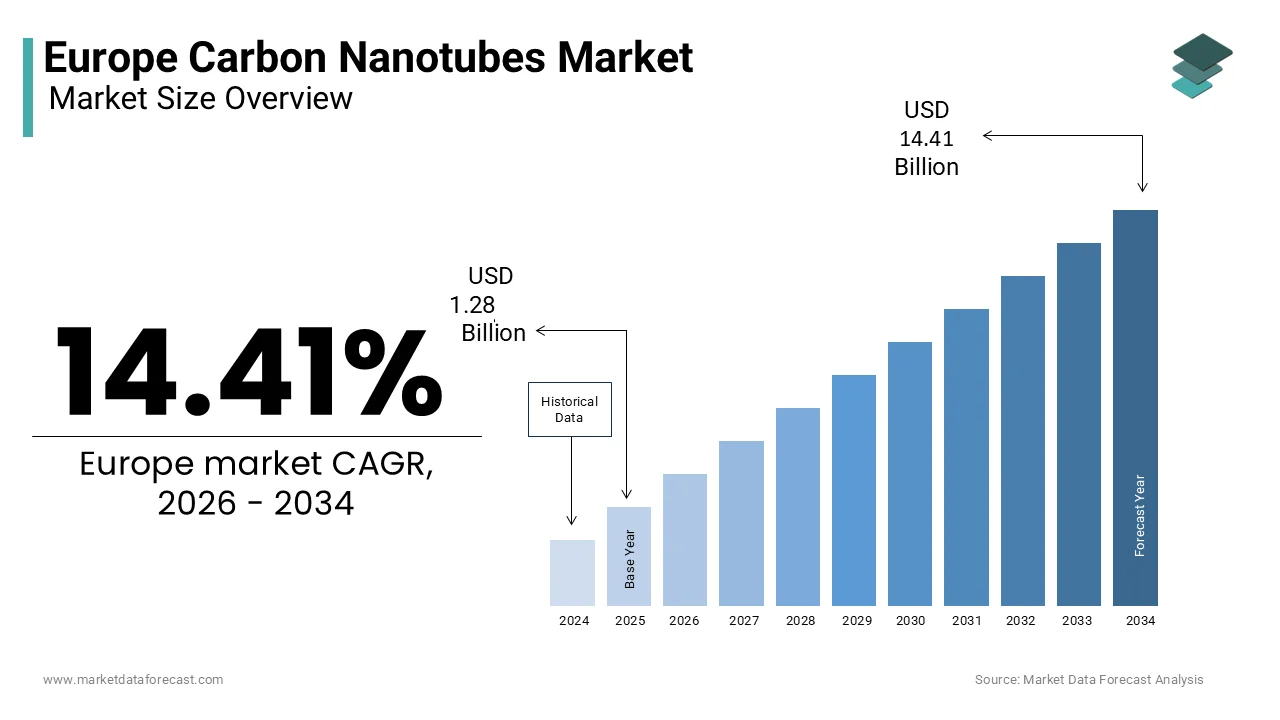
- Market Valuation: Valued at USD 1.28 billion (2025), estimated at USD 1.47 billion (2026), and projected to reach USD 14.41 billion by 2034, registering a robust CAGR of 14.41% (2026–2034).
- Primary Growth Drivers: Lightweight composites demand in aerospace/automotive, lithium-ion/solid-state battery conductive additives, European Green Deal mandates, and semiconductor sovereignty initiatives. Restraints include REACH regulatory classification, high purification costs, and catalyst supply chain vulnerabilities.
Key Market Segment Metrics (2026–2034)
| Category | Leading Segment / Region (Position) | Fastest-Growing Segment |
|---|---|---|
| By Product Type & Application | Multi-Walled Carbon Nanotubes (MWCNTs held majority share in 2025 via production cost advantages) | Single-Walled Carbon Nanotubes (SWCNTs witnessing fastest CAGR of 28.6% via transparent films/quantum devices) |
| By End-Use Industry | Polymers segment (led the market capturing 42.5% share in 2025 as engineering plastic additives) | Electrical and Electronics segment (exhibiting a notable CAGR of 31.2% from 2025 to 2033) |
| By Region / Country | Germany (led regional market with 29.4% share in 2025) & France (second-largest at 18.3% share) | European advanced technology and battery manufacturing clusters (supported by EU consortia like BATTERY 2030) |
Major Market Players & Market Structure
Market Structure: Highly specialized European nanomaterials ecosystem driven by production capacity expansions (such as Arkema expanding its Lacq facility in France), strategic R&D consortia participation (BASF in BATTERY 2030), and regional single-wall nanotube leadership (OCSiAl operations in Luxembourg).
Key Companies: Arkema S.A., Cabot Corporation, Showa Denko K.K., LG Chem Ltd., OCSiAl Group, Toray Industries, Inc., Nanocyl S.A., CNano Technology Ltd., Kuraray Co., Ltd., Mitsui & Co., Ltd., Sumitomo Corporation, Birla Carbon, Hyperion Catalysis International, Inc., Thomas Swan & Co. Ltd., Hanwha Chemical Corporation, Cheap Tubes Inc., Carbon Solutions, Inc., CNT Co., Ltd., Applied Nanotech Holdings, Inc., and Raymor Industries Inc.
Europe Carbon Nanotubes Market Size
The Europe carbon nanotubes market was valued at USD 1.28 billion in 2025, is estimated to reach USD 1.47 billion in 2026, and is projected to reach USD 14.41 billion by 2034, growing at a CAGR of 14.41% from 2026 to 2034.
Carbon nanotubes are cylindrical nanostructures composed of rolled graphene sheets exhibiting exceptional electrical conductivity, tensile strength, and thermal stability. In Europe, their application spans advanced composites, energy storage systems, and semiconductor devices where performance thresholds exceed conventional material capabilities. The region’s emphasis on high-value engineered materials aligns with strategic priorities under the European Commission’s Key Enabling Technologies framework, which identifies nanomaterials as critical to industrial competitiveness. As per sources, companies involved in the European carbon nanotube market are now required to declare their activities to regulatory bodies. Production is increasingly shifting toward multi-walled variants due to scalable synthesis and lower health risk profiles compared to single-walled counterparts. According to research, the industry has adopted standardized procedures for assessing the purity of nanomaterials and the stability of their dispersions. This ensures greater consistency and reliability for customers. This institutional scaffolding, combined with concentrated R&D clusters in regions, positions Europe as a precision-oriented rather than volume-driven market for carbon nanotubes.
MARKET DRIVERS
Demand for Lightweight High-Strength Composites in Aerospace and Automotive Sectors
The aerospace and automotive industries in the region are accelerating the adoption of carbon nanotube reinforced polymers to meet stringent fuel efficiency and emissions targets, which in turn propels the growth of the European carbon nanotube market. Carbon nanotubes enhance epoxy and thermoplastic matrices by improving interlaminar shear strength and reducing weight without compromising crashworthiness. The European Aviation Safety Agency has also updated material certification guidelines to include nano-reinforced composites, accelerating qualification timelines. This regulatory and engineering convergence creates sustained demand for high-purity carbon nanotubes with consistent aspect ratios tailored for matrix dispersion.
Expansion of Next Generation Energy Storage Systems
The region’s push toward electrification and grid resilience has intensified demand for this form of carbon in lithium-ion and solid-state batteries, where they serve as conductive additives that replace traditional carbon black, and thereby boost the expansion of the European carbon nanotubes market. As per sources, across Europe, a significant shift is underway in energy storage infrastructure, characterized by the widespread development of large-scale battery production facilities, commonly referred to as gigafactories. The rapid expansion of this manufacturing base emphasizes a strong continental commitment to bolstering domestic battery supply chains and meeting the growing demand for energy storage solutions. Moreover, these materials are instrumental in developing high-performance electric vehicle batteries capable of achieving very rapid charging times, significantly improving the practicality and user experience of electric mobility. Furthermore, a notable development in this field is the emergence of advanced sodium-ion battery prototypes that incorporate multi-walled nanotubes. These prototypes demonstrate impressive energy density and exceptional longevity, retaining substantial capacity even after numerous charge and discharge cycles, suggesting a viable and durable alternative to traditional lithium-ion chemistries. The regulatory impetus, combined with material innovation, is driving battery cell manufacturers to secure long-term nanotube supply agreements with European producers.
MARKET RESTRAINTS
Stringent Regulatory Classification Under REACH and CLP Frameworks
It faces significant regulatory headwinds due to its classification as a substance of very high concern under the Registration, Evaluation, Authorisation and Restriction of Chemicals framework, which restricts the growth of the European carbon nanotubes market. As per sources, certain types of long, rigid, multi-walled nanotubes have been officially classified within the same hazard category as asbestos by a major European regulatory agency. Compliance requires comprehensive safety data sheets, workplace exposure monitoring, and engineering controls that increase operational costs. Furthermore, updated safety guidelines and regulations now require specific hazard labeling and packaging for commercial products if they contain more than a minimal threshold of these classified nanotubes. These constraints delay product development cycles and deter small and medium enterprises from entering the market due to compliance burdens that outweigh perceived performance benefits in non-critical applications.
High Production Costs and Limited Scalability of High Purity Grades
Their commercial deployment in the region is constrained by the high cost and technical complexity of producing consistent high-purity grades required for electronics and medical applications. This constrains the expansion of the European carbon nanotubes market. Chemical vapor deposition, the dominant synthesis method, yields material with residual metal catalysts, such as Ir, on cobalt or nickel that must be removed through aggressive acid washing or thermal annealing processes, which degrade nanotube structure and increase production costs. As per research, the purification step alone accounts for up to a share of total manufacturing expenses for single-walled variants. Multi-ton scale production remains elusive as batch-to-batch variability in diameter length and defect density impedes standardization. Emerging Asian producers, with their subsidized scale, will continue to have a cost and consistency advantage over European manufacturers until continuous flow synthesis and in-line quality control technologies become more advanced.
MARKET OPPORTUNITIES
Integration into European Semiconductor and Flexible Electronics Roadmaps
Renewed focus on sovereign semiconductor capability introduces a strategic opening for carbon nanotube integration in next-generation logic and sensor devices, which is setting new opportunities for the European carbon nanotube market. Beyond traditional silicon technology, the European semiconductor industry is being revitalized through investments and the adoption of advanced materials like carbon nanotubes. Carbon nanotubes are particularly promising for next-generation, high-performance electronics, offering superior properties for creating smaller and faster components. In advanced semiconductor applications, carbon nanotubes are proving to be a viable alternative to silicon, especially as transistors continue to shrink. These applications do not require ultra-high purity but benefit from Europe’s strength in precision deposition and metrology. Embedding nanotubes in high-value and low-volume electronics will enable Europe to move beyond commodity applications and use its engineering ecosystem to drive innovation.
Development of Sustainable Nanomanufacturing Under Circular Economy Principles
Europe is developing novel closed-loop production processes for carbon nanotubes in alignment with the EU's Circular Economy policies, which creates fresh prospects for the expansion of the European carbon nanotube market. This requires greater resource efficiency in advanced material supply chains. Researchers at the University of Bologna have developed a plasma-based synthesis method using waste plastics as the sole carbon feedstock to create valuable materials. Similarly, a German startup is focusing on an innovative solution for sustainable material recovery by pioneering a sophisticated method to reclaim valuable carbon nanotubes from used lithium-ion batteries. The European Institute of Innovation and Technology (EIT) is assisting in the development of innovative production processes for nanotubes by supporting pilot lines that incorporate sustainability assessment metrics directly into their design. These initiatives not only lower environmental impact but also create cost advantages through feedstock substitution and waste valorization. European end users, increasingly focused on sustainability due to the CSRD making corporate reporting mandatory, favor suppliers who can demonstrate certified circular credentials, giving local producers an advantage over competitors dependent on imports.
MARKET CHALLENGES
Lack of Standardized Metrology and Quality Assurance Protocols
Inconsistent characterization methods hinder reproducibility and cross-supplier validation, despite advances in synthesis, which obstructs the growth of the European carbon nanotubes market. As per the European Metrology Network for Advanced Materials, there is no universally accepted reference material for measuring key parameters such as defect density, specific surface area, or electrical percolation threshold in polymer matrices. This leads to significant performance variance even among materials labeled as identical grades. The absence of ISO or CEN standards for dispersion stability in solvents further complicates formulation development, particularly in coatings and inks. The technical guidelines published by the Joint Research Centre in 2023 are non-binding, which has led to fragmented adoption across member states. European manufacturers face significant delays in safety-critical sectors, such as aerospace and medical devices, without harmonized metrology due to extended qualification periods and reduced design confidence where material traceability is a requirement.
Supply Chain Vulnerability Due to Concentrated Raw Material Sourcing
Upstream supply risks, specifically the import of metal catalysts and high-purity carbon precursors, expose it to potential vulnerabilities, which slow down the expansion of the European carbon nanotubes market. Geopolitical instability and export restrictions in these regions create procurement volatility. The EU Critical Raw Materials Act identifies nickel and cobalt as strategic, but does not yet include provisions for nanomaterial-specific recycling infrastructure. This dependency undermines the resilience of European nanotube producers and contradicts the bloc’s goal of strategic autonomy in advanced materials, particularly as global trade in critical inputs becomes increasingly fragmented.
REPORT COVERAGE
| REPORT METRIC | DETAILS |
| Market Size Available | 2025 to 2034 |
| Base Year | 2025 |
| Forecast Period | 2026 to 2034 |
| Segments Covered | By Product, Application, and Region. |
| Various Analyses Covered | Global, Regional, and Country-Level Analysis, Segment-Level Analysis, Drivers, Restraints, Opportunities, Challenges; PESTLE Analysis; Porter’s Five Forces Analysis, Competitive Landscape, Analyst Overview of Investment Opportunities |
| Countries Covered | UK, France, Spain, Germany, Italy, Russia, Sweden, Denmark, Switzerland, Netherlands, Turkey, Czech Republic, Rest of Europe |
| Market Leaders Profiled | Arkema S.A., Cabot Corporation, Showa Denko K.K., LG Chem Ltd., OCSiAl Group, Toray Industries, Inc., Nanocyl S.A., CNano Technology Ltd., Kuraray Co., Ltd., Mitsui & Co., Ltd., Sumitomo Corporation, Birla Carbon, Hyperion Catalysis International, Inc., Thomas Swan & Co. Ltd., Hanwha Chemical Corporation, Cheap Tubes Inc., Carbon Solutions, Inc., CNT Co., Ltd., Applied Nanotech Holdings, Inc., Raymor Industries Inc. |
SEGMENTAL ANALYSIS
By Product Insights
In 2025, the Multi-Walled Carbon Nanotubes (MWCNTs) segment held the majority share of the European carbon nanotubes market. The prominence of the MWCNTs segment is attributed to their lower production cost, higher yield, and compatibility with large-scale industrial processes. MWCNTs exhibit sufficient electrical conductivity and mechanical reinforcement for use in automotive composites, battery electrodes, and conductive plastics without requiring atomic-level precision. Some companies utilize MWCNTs in thermoplastic compounds for fuel system components meeting the ISO standard for static dissipation in vehicles. Furthermore, the European Chemicals Agency classifies many MWCNT variants as lower risk under REACH due to shorter lengths and bundled morphology, reducing regulatory friction. This combination of affordability, performance, adequacy, and regulatory acceptance cements MWCNTs as the backbone of Europe’s near-term nanotube adoption.
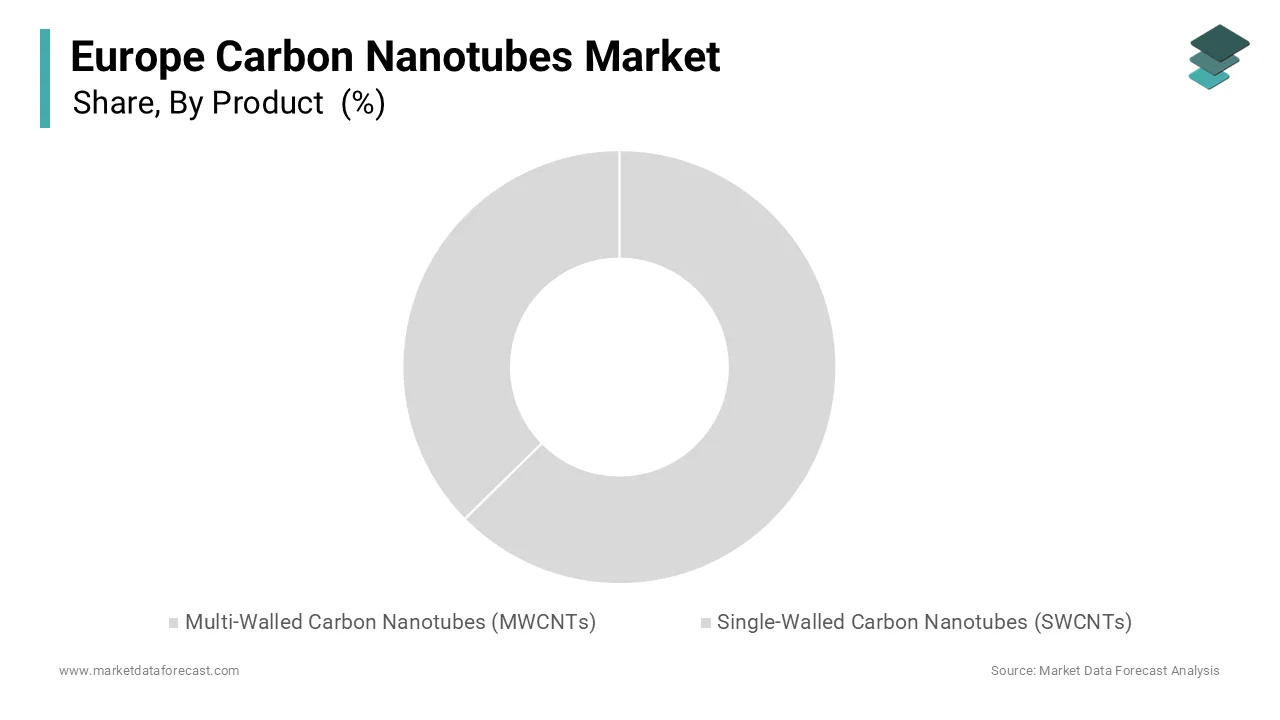
The single-walled carbon Nanotubes segment is on the rise and is expected to be the fastest-growing segment in the market by witnessing a CAGR of 28.6% over the forecast period, owing to breakthroughs in transparent conductive films and quantum device integration. Recent advances in selective chirality sorting by companies. Apart from these, the EU’s Graphene Flagship spin-off initiative has redirected funding toward hybrid graphene SWCNT platforms for neuromorphic computing. These high-value applications command premium pricing and align with Europe’s strategy to lead in deep tech rather than compete on volume, driving accelerated R&D investment and pilot line deployment across France, Germany, and the Netherlands.
By Application Insights
The polymers segment led the European carbon nanotubes market by capturing a 42.5% share in 2025. The growth of the polymers segment is propelled by the widespread use of carbon nanotubes as multifunctional additives in engineering plastics for automotive, aerospace, and industrial equipment. MWCNTs at loadings as low as 0.50 5 weight percent increase tensile strength and reduce surface resistivity to below 10⁶ ohms, enabling electrostatic paint adhesion without metal primers. Companies supply nanotube-compounded grades to Tier 1 suppliers for fuel rails, sensor housings, gaskets, and brake system components. This alignment with the circular economy and functional performance ensures polymers remain the largest application channel.
The Electrical and Electronics segment is expected to exhibit a noteworthy CAGR of 31.2% from 2025 to 2033 and is driven by demand for miniaturized high-performance components in sensors, interconnect, and flexible circuits. Carbon nanotubes enable electrical conductivity at ultra-low percolation thresholds, typically 0.01 to 0.1 weight percent in epoxy underfills, vital for advanced packaging in 3D chip stacking. The European Chips Act’s emphasis on heterogeneous integration has prioritized such materials for next-generation systems in package designs. Apart from these, printed electronics manufacturers use SWCNT inks for RFID tags with read ranges exceeding 10 meters on plastic substrates. The rise of edge AI devices requiring low-power neuromorphic sensors further accelerates adoption. These niche yet high-margin applications benefit from Europe’s strong semiconductor ecosystem and public funding for beyond CMOS technologies.
COUNTRY LEVEL ANALYSIS
Germany Carbon Nanotubes Market Analysis
Germany was the top performer in the European carbon nanotubes market by accounting for a 29.4% share in 2025 because of its world-leading chemical and automotive sectors. The country hosts several nanomaterial producers, including OCSiAl’s European distribution hub and Nanocyl’s legacy manufacturing facilities. Germany maintains a leading position in the integration of carbon nanotubes within advanced materials, driven by a cohesive strategy spanning public research support and industrial application. Industry leaders have leveraged this research to develop practical applications. Standardization efforts further solidify Germany's dominance in this field.
France Carbon Nanotubes Market Analysis
France was the second-largest country in the European carbon nanotubes market and occupied an 18.3% share in 2025, with its concentration on high-precision electronic and aerospace uses. French governmental organizations are pioneering advanced uses for carbon nanotubes. In the private sector, French chemical manufacturer Arkema provides its conductive Graphistrength multi-walled carbon nanotube product line to major aerospace and defense firms Thales and Safran. France’s emphasis on sovereign high-tech capabilities ensures sustained demand for emium-grade carbon nanotubes despite limited volume scale.
Netherlands Carbon Nanotubes Market Analysis
The Netherlands continues to be a major player in the European carbon nanotubes market by leveraging its world-class nanofabrication infrastructure and materials science talent. ASML’s need for contamination-free conductive components in EUV lithography machines has driven the adoption of ultra-pure MWCNTs in vacuum-compatible polymer housings. The Dutch Ministry of Economic Affairs supports the NANONED initiative, which links universities like Delft with companies to develop nanotube interconnects for automotive radar chips. Importantly, the Port of Rotterdam facilitates the import of high-purity nanotube precursors, while stringent Dutch occupational safety laws have led to automated handling systems that minimize worker exposure, setting de facto safety benchmarks for Europe. This ecosystem of precision manufacturing research and logistics cements the Netherlands as a center of excellence.
Italy Carbon Nanotubes Market Analysis
Italy expanded gradually in the European carbon nanotubes market due to its dense network of polymer compounders and premium automotive manufacturers. In the Emilia Romagna industrial district, numerous small and medium enterprises play a key role in the high-performance automotive supply chain. These materials meet stringent performance requirements, including effective static dissipation, superior heat resistance, and a high-quality surface gloss. The integration of multi-walled carbon nanotubes (MWCNTs) has become a significant trend in high-end automotive interiors. A considerable proportion of the advanced polymers used in these vehicles now incorporates MWCNTs. Italy’s National Institute of Metrological Research has developed Raman spectroscopy protocols to verify nanotube dispersion quality in recycled polymers supporting circular economy compliance. This fusion of artisanal manufacturing with advanced material science sustains Italy’s niche leadership.
Switzerland Carbon Nanotubes Market Analysis
Switzerland is predicted to grow in the European carbon nanotubes market from 2025 to 2033 due to ultra-high value applications in medical devices and microsystems. The country’s stringent medical device regulations under Swissmedic favor nanotubes for their biocompatibility when properly functionalized. Switzerland is at the forefront of nanotech-enabled medical device innovation, focusing on high-precision, low-volume production. Advanced research includes the development of highly sensitive, integrated strain sensors for real-time monitoring within orthopedic implants. Furthermore, the country's research institutions are pioneering scalable manufacturing techniques for transient medical electronics. This includes the development of innovative roll-to-roll processes to print nanotube electrodes on novel biodegradable substrates. This approach exemplifies a national economic model centered on high innovation and premium value addition, positioning the country as a leader in specialized nanotechnology applications. Switzerland’s lack of REACH constraints (as a non-EU member) allows faster prototyping, but its adoption of EU CLP standards ensures seamless export compatibility.
COMPETITIVE LANDSCAPE
The European carbon nanotubes market is characterized by a mix of global material giants, regional chemicaspecialiststs, and agile nanotechnology startups competing on technical expertise rather than price. Incumbents like BASF and Arkema leverage their polymer compounding infrastructure and established customer relationships to embed nanotubes into existing product lines. Meanwhile, pure play nanomaterial firms such as OCSiAl differentiate through purity consistency and application engineering support. Competition is highly fragmented across end-use sectors, with no single player dominating all applications. Regulatory compliance, particularly under REAC, H acts as both a barrier and a competitive filter, er favoring companies with robust safety data and traceability systems. Innovation is driven through public-private partnerships funded by Horizon Europe and national innovation agencies, fostering collaboration over confrontation. The absence of price-based competition allows participants to focus on value-added solutions tailored to Europe’s high-performance and sustainability-oriented industrial landscape.
KEY MARKET PLAYERS
Some of the companies that are playing a dominating role in the global europe carbon nanotubes market include
- Arkema S.A.
- Cabot Corporation
- Showa Denko K.K.
- LG Chem Ltd.
- OCSiAl Group
- Toray Industries, Inc.
- Nanocyl S.A.
- CNano Technology Ltd.
- Kuraray Co., Ltd.
- Mitsui & Co., Ltd.
- Sumitomo Corporation
- Birla Carbon
- Hyperion Catalysis International, Inc.
- Thomas Swan & Co. Ltd.
- Hanwha Chemical Corporation
- Cheap Tubes Inc.
- Carbon Solutions, Inc.
- CNT Co., Ltd.
- Applied Nanotech Holdings, Inc.
- Raymor Industries Inc.
TOP LEADING PLAYERS IN THE MARKET
- OCSiAl is a global leader in single-wall carbon nanotube production with significant operations in Luxembourg and distribution hubs across Germany and France. The company supplies its TUBALL brand nanotubes to battery manufacturers, automotive suppliers, and electronics firms throughout Europe. It has pioneered scalable plasma synthesis technology, enabling industrial tonnage output with consistent chirality. Recently, OCSiAl partnered with a major European lithium-ion cell producer to integrate TUBALL into silicon anode formulations, enhancing cycle life. The company also launched a REACH-compliant dispersion platform for thermoplastics, allowing easier adoption by compounders. Its investment in application development centers in Lyon and Stuttgart demonstrates a commitment to engineering solutions aligned with European regulatory and performance standards.
- Arkema is a French specialty chemicals company offering multi-walled carbon nanotubes under its Graphistrength product line, tailored for polymers and coatings. The company leverages its deep integration with European automotive and aerospace supply chains to deliver functional masterbatches that meet stringent flammability and conductivity requirements. Arkema recently expanded its nanotube production capacity at its Lacq facility in France to support growing demand from battery and electronics customers. It collaborates with CEA and Airbus on nano-reinforced composite projects under the French Future Investments Program. The company also emphasizes sustainable manufacturing, certifying its nanotubes under the EcoVadis framework to meet corporate procurement criteria across the EU.
- BASF integrates carbon nanotubes into its advanced material portfolio, serving customers in automotive energy and industrial sectors across Europe. The company develops custom-compounded grades using MWCNTs to enhance the mechanical, thermal, and electrical properties of engineering plastics. BASF recently introduced a new line of conductive polyamides for electric vehicle battery components that reduce weight while ensuring electromagnetic shielding. It works closely with automotive OEMs through its Coatings and Performance Materials divisions to qualify nanotube solutions under OEM-specific material standards. BASF also participates in EU-funded consortia such as BATTERY 2030 to advance nanotube applications in next-generation solid-state batteries, reinforcing its role as an innovation enabler rather than just a material supplier.
TOP STRATEGIES USED BY THE KEY MARKET PARTICIPANTS
Key players in the European carbon nanotubes market are forming technical partnerships with end users to co-develop application-specific formulations that meet industry performance and regulatory standards. They are investing in regional application laboratories to accelerate customer qualification and reduce time to market. Companies are securing REACH and ISO certifications to ensure compliance and build trust among industrial buyers. They are expanding production capacity through brownfield upgrades rather than greenfield projects to minimize environmental impact and permitting delays. Additionally, they are focusing on sustainable sourcing and recyclability to align with the EU Circular Economy Action Plan and enhance brand differentiation in a quality-driven market.
MARKET SEGMENTATION
This research report on the europe carbon nanotubes market is segmented and sub-segmented into the following categories.
By Product
- Multi-Walled Carbon Nanotubes (MWCNTs)
- Single-Walled Carbon Nanotubes (SWCNTs)
By Application
- Polymers
- Electrical & Electronics
- Others
By Country
- Germany
- France
- Netherlands
- Italy
- Switzerland
- Rest of Europe